
Bactrian Camel
The Bactrian camel offers remarkable hardiness and exceptional feed efficiency, thriving on diverse forage and requiring minimal intervention in challenging environments. Its superior cold tolerance and drought resistance make it an ideal choice for arid and cold climates, simplifying management where other livestock struggle. Originating from Central Asia, these two-humped ungulates are well-adapted to extreme conditions, demonstrating good heat tolerance as well. Their ability to subsist on browse and grasses that other animals find unpalatable sets them apart, making them a unique and resilient livestock option for farmers seeking robust and adaptable animals.
Regenerative Quick Profile
Best Suited For
Climates: Arid, semi-arid, temperate, and continental climates with distinct seasons and cold winters.
Scale: Best for medium to large operations (50+ animals)
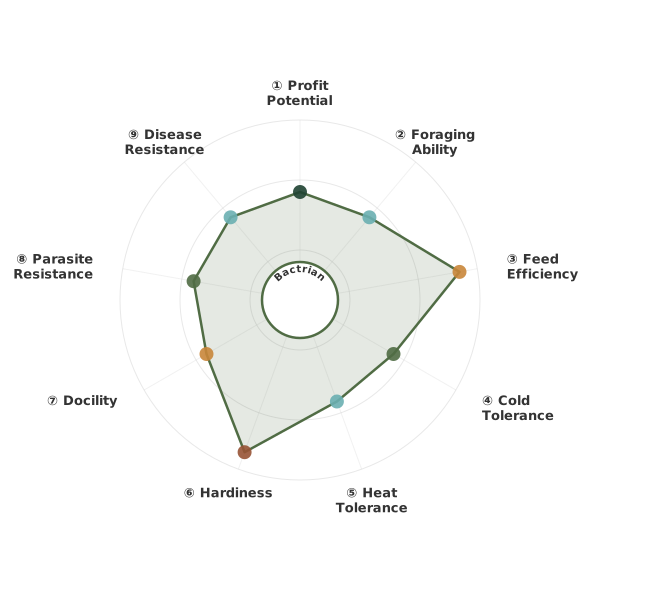
How These Traits Are Calculated
Trait dimensions are ordered clockwise starting from the top of the chart (12 o'clock position):
1. Profit Potential
Assesses Bactrian camel breeds' ability to generate income for the farm.
WHAT: This trait evaluates the economic viability of a Bactrian camel breed, considering factors like meat, fiber, milk production, and their market demand. Breeds may differ significantly in their inherent productivity for these commodities.
WHY: For regenerative farmers, maximizing profit potential ensures the long-term sustainability of their operation, allowing for reinvestment in ecosystem health and land stewardship. Higher profit potential supports a more resilient and thriving farm business.
HOW: Exceptional breeds might yield over 500 liters of milk annually or produce fiber consistently fetching premium prices, while Limited breeds may have lower yields or less desirable product markets. Typical breeds fall within the average range for these economic indicators.
2. Foraging Ability
Measures how effectively Bactrian camels find and utilize diverse plant matter.
WHAT: This trait assesses a Bactrian camel's skill and drive in seeking out and consuming a wide variety of vegetation, including tough, fibrous, and thorny plants common in arid and semi-arid environments. Breeds will vary in their willingness to explore, their ability to digest varied forage, and their preference for specific plant types.
WHY: For regenerative farmers, excellent foraging ability means camels can thrive on pasture and rangeland with less supplemental feed, reducing costs and reliance on external inputs. This trait is crucial for camels contributing to landscape health by grazing selectively and managing invasive species.
HOW: Exceptional breeds will readily consume a broad spectrum of plants, including drought-resistant shrubs and grasses, often requiring less than 20% supplemental feed. Typical breeds will efficiently graze common pasture plants but may need more supplemental feed (20-40%) in challenging conditions. Limited breeds are pickier eaters and may require over 40% supplemental feed, struggling with diverse or sparse vegetation.
3. Feed Efficiency
Measures how well Bactrian camels convert feed into usable energy and weight.
WHAT: Feed efficiency in Bactrian camels refers to their ability to gain weight or produce output (like milk or fiber) relative to the amount of forage and supplementary feed they consume. This trait can vary significantly between different Bactrian camel breeds due to genetic predispositions for metabolism and digestive capabilities.
WHY: For regenerative farmers, high feed efficiency means lower feed costs and reduced reliance on external inputs, aligning with ecological principles. Efficient camels can thrive on less, making them ideal for grazing systems and minimizing their environmental footprint while maximizing productivity.
HOW: Exceptional Bactrian camels will maintain or gain weight on minimal pasture, requiring less than 1.5% of their body weight in dry matter daily. Typical breeds will require 1.5-2.5% of body weight, while limited breeds may struggle to maintain condition even with higher feed intake.
4. Cold Tolerance
Measures how well Bactrian camels withstand extreme cold and snow.
WHAT: This trait assesses the Bactrian camel's ability to thrive in frigid environments, including its capacity to regulate body temperature, maintain energy levels, and remain active during prolonged cold spells and heavy snowfall. Different breeds may exhibit variations in fur density, fat reserves, and metabolic adaptations that influence their cold resilience.
WHY: For regenerative farmers operating in colder climates, superior cold tolerance means reduced need for supplemental heating and shelter, lower feed requirements during winter, and sustained productivity. This trait directly impacts animal welfare and the economic viability of a Bactrian camel herd in challenging winter conditions.
HOW: Exceptional cold tolerance indicates the ability to comfortably endure temperatures below -20°C (-4°F) with minimal impact on health or productivity. Typical tolerance allows for good performance in temperatures down to -10°C (14°F). Limited tolerance suggests the need for significant protection and supplemental feeding below 0°C (32°F).
5. Heat Tolerance
Measures Bactrian camels' ability to withstand high ambient temperatures and humidity.
WHAT: This trait assesses a Bactrian camel's physiological and behavioral adaptations to heat, including their ability to maintain core body temperature, conserve water, and remain productive under hot conditions. Different bloodlines or regional ecotypes within Bactrian camels may have varying degrees of inherent heat tolerance due to their ancestral environments.
WHY: For regenerative farmers, high heat tolerance is crucial for ensuring animal welfare, reducing stress-related health issues, and maintaining productivity (e.g., milk, fiber, transport) in arid or semi-arid climates. It minimizes the need for intensive cooling interventions, aligning with sustainable practices.
HOW: Exceptional breeds can comfortably perform physical tasks and maintain production at ambient temperatures exceeding 40°C (104°F) with minimal water intake. Typical breeds can tolerate prolonged periods above 35°C (95°F) but may show reduced activity. Limited breeds struggle above 30°C (86°F) and require shade and ample water to avoid significant stress and production loss.
6. Hardiness
Measures the Bactrian camel's ability to thrive in harsh environments.
WHAT: Hardiness assesses the Bactrian camel's resilience to extreme temperatures, drought, and poor-quality forage. Breeds will vary in their inherent ability to withstand water scarcity, extreme heat (above 40°C), and extreme cold (below -30°C) with minimal supplemental care.
WHY: For regenerative farmers, hardy Bactrian camels require less intensive management and can utilize marginal lands, reducing reliance on external inputs. This trait is crucial for sustainable grazing systems, especially in arid and semi-arid regions where water and feed can be scarce.
HOW: Exceptional hardiness means the camel can thrive with less than 5 liters of water daily and minimal shade in extreme heat. Typical hardiness allows for survival with moderate water and shade provisions. Limited hardiness requires significant supplemental feeding and watering, especially during challenging weather conditions.
7. Docility
Measures the camel's temperament and ease of handling.
WHAT: Docility assesses how calm, cooperative, and receptive a Bactrian camel is to human interaction and management. This trait varies, with some breeds naturally more skittish or independent than others.
WHY: For regenerative farmers, docile camels are crucial for efficient grazing management, easier training for work or transport, and safer interactions for handlers and other animals. A calm animal reduces stress on the farm ecosystem.
HOW: Exceptional breeds consistently exhibit minimal flight response and readily accept touch and guidance, often requiring less than 5% of handlers to use force. Typical breeds require moderate handling and may show occasional resistance. Limited breeds are often flighty, difficult to approach, or actively resist handling, potentially requiring over 20% of handlers to use significant restraint.
8. Parasite Resistance
Measures Bactrian camels' innate ability to withstand internal and external parasites.
WHAT: This trait assesses the natural resilience of Bactrian camels to various internal and external parasites, such as lungworms, gastrointestinal nematodes, and ectoparasites like mites and ticks. Resistance can vary significantly between different Bactrian camel populations, influenced by genetics, environment, and historical management practices.
WHY: For regenerative farmers, high parasite resistance reduces the need for chemical treatments, promoting ecosystem health and animal welfare. It leads to healthier animals, lower input costs, and a more sustainable, self-sufficient herd, crucial for maintaining soil health and biodiversity.
HOW: Exceptional breeds demonstrate very low parasite loads even under challenging conditions, requiring minimal or no deworming (e.g., <5% fecal egg counts). Typical breeds may require occasional preventative treatments during high-risk periods. Limited breeds often show high parasite loads and a greater susceptibility to parasitic diseases, necessitating frequent interventions.
9. Disease Resistance
Measures Bactrian camels' natural ability to fight off common illnesses.
WHAT: This trait assesses the inherent ability of Bactrian camel breeds to withstand and recover from common diseases and parasites. Variations exist due to genetic predispositions, historical selection pressures, and adaptation to specific environments.
WHY: High disease resistance reduces veterinary costs, minimizes animal losses, and ensures consistent productivity in a regenerative system. It allows camels to thrive with fewer external interventions, aligning with ecological principles.
HOW: Exceptional breeds demonstrate very low mortality rates (<2%) from common diseases and require minimal treatment. Typical breeds have moderate resistance with occasional minor health issues. Limited breeds are more susceptible, experiencing higher illness rates and requiring more frequent veterinary care.
Regenerative Advantages
- Drought Tolerance: Bactrian camels survive 10-14 days without water, tolerate 25-40% body weight loss (vs 15% fatal in non-desert mammals), and thrive in arid regions with <10 inches annual rainfall.
- Hardiness: Bactrian camels survive extreme temperature ranges (-40°C to +40°C), require minimal veterinary care, and maintain productivity in harsh conditions that challenge all other livestock.
- Feed Efficiency: Camels extract maximum nutrition from poor-quality forage, require 50-70% less feed than cattle per unit body weight, and thrive on vegetation other livestock reject.
- Pack Capacity: Bactrian camels carry 220-300 kg loads for 40-50 km daily through mountain terrain, with two-hump fat storage providing multi-day endurance unmatched by other pack animals.
- Fiber Production: Bactrian camels produce 5-7 kg of premium fiber annually (comparable to alpaca quality), commanding $30-60/kg for dehaired fiber in specialty markets.
Know the Debate
- Camel suitability debated for hot vs. cold arid climates.
- Heat efficiency is key differentiator for arid regions.
- Breed selection and management adapt camels to extremes.
Value Streams
Experience Level
Some livestock experience recommended (better for larger operations)
3
Know the Debate
Bactrian camels are renowned for their hardiness in extreme environments, but their optimal application depends on specific climatic conditions. In...
Know the Debate
Bactrian camels are renowned for their hardiness in extreme environments, but their optimal application depends on specific climatic conditions. In...
Bactrian camels are renowned for their hardiness in extreme environments, but their optimal application depends on specific climatic conditions. In regions with extreme cold and adequate forage, their thick coats and efficient metabolism provide a distinct advantage. However, when considering very hot, arid deserts, their adaptability compared to other livestock, including dromedary camels, becomes a point of discussion. Factors such as water conservation strategies, heat shedding capabilities, and the type of forage available play a critical role in determining their productivity and success.
Are Bactrian camels better suited for hot or cold arid climates?
Suited for both Cold and Hot Arid Climates
Bactrian camels possess unique adaptations for survival in extreme environments, including efficient water conservation and the ability to thrive on diverse, scarce forage. Their thick coats are advantageous in cold deserts, while their physiological mechanisms also support resilience in hot arid conditions.
Sources behind this view
Sources behind this view
 Videos & Podcasts
-
Camels possess specialized adaptations for arid survival, including water preservation strategies, unique oval red blood cells preventing dehydration clotting, and physical features like closable nostrils and protective elbow calluses.
 Research
-
Goat as the ideal climate-resilient animal model in tropical environment: revisiting advantages over other livestock species. (opens in new window)
This study found: Goats are highlighted as the best livestock choice for dealing with climate change, especially in hot regions, compared to cattle and sheep. They are tough animals that can handle heat, drought, and scarce food and water better than other farm animals. Goats are also good at adapting their behavior and have physical traits that help them survive tough conditions. They are easier for small farmers to raise because they need less investment, fewer special facilities, and less labor, while still providing good returns. Their ability to digest poor-quality feed and conserve water makes them very efficient. This makes goats a key animal for ensuring food security as the climate changes.
-
Interaction Between Camel Farming and Environment (opens in new window)
This study found: Camels are well-suited to desert life, which means they generally have a small environmental impact when farmed traditionally in dry areas. Their populations are growing, but they contribute very little to greenhouse gas emissions. However, if camel farming becomes more intensive to meet rising demand, this could change their impact on the environment. Intensification might also lead to a loss of camel diversity, which could have unforeseen consequences for how camel farming systems interact with their ecosystems.
More suited for Cold Arid; Hot Arid performance debated
While excelling in cold deserts, Bactrian camels' thick coat might be a disadvantage in extreme heat. Some practitioners suggest other breeds or dromedary camels may be more productive in intense heat, highlighting the need for careful selection and management to mitigate heat stress.
Sources behind this view
Sources behind this view
Videos & Podcasts
-
Bison phenotypes differ by climate: larger body mass for cold (Alberta) vs. better heat shedding for heat (Texas). Adaptation to warmer climates is a generational process.
-
The 'sweet spot' for animal traits is a moving target, heavily influenced by environmental variations like rainfall and forage availability. Optimal animal types shift based on conditions, requiring continuous adaptation and adjustment to current circumstances.
Research
-
Physiological, Immune Response, Antioxidant Capacity and Lipid Metabolism Changes in Grazing Sheep during the Cold Season (opens in new window)
This study found: Research in Inner Mongolia, China, looked at how Mongolian sheep cope with cold weather. During winter, these sheep showed boosted energy processing (both sugars and fats) and increased heat production to stay warm. Their immune systems also became more active, producing more signaling molecules to fight off potential illness. However, their ability to protect cells from damage decreased in the cold. Overall, these changes help Mongolian sheep survive and thrive in cold, high-altitude pastures.
Making Sense of the Differences
Bactrian camels are highly adaptable to diverse arid conditions, excelling in both cold and hot desert environments due to their water efficiency and ability to forage on tough vegetation. While their thick coats are a clear advantage in cold deserts, their performance in extreme heat is debated, with some suggesting that breed selection, management strategies, and hydration become even more critical in hotter climates. The optimal outcome likely depends on specific genetic traits, local forage availability, and how well their physiology is managed against heat stress, making them a viable but context-specific choice for arid regions.