
Catfish
Catfish excel at simplifying aquaculture operations due to their exceptional hardiness and remarkable adaptability to a wide range of water conditions, including temperature fluctuations and varying water quality. Originating from diverse freshwater environments, these robust fish require minimal intervention once established. Their good feed conversion and disease resistance further contribute to efficient and predictable production cycles, making them a standout choice for farmers seeking a low-risk, high-yield aquaculture species.
Regenerative Quick Profile
Best Suited For
Climates: Tropical, subtropical, and warm temperate climates with distinct wet and dry seasons or consistent rainfall.
Scale: Best for medium to large operations (50+ animals)
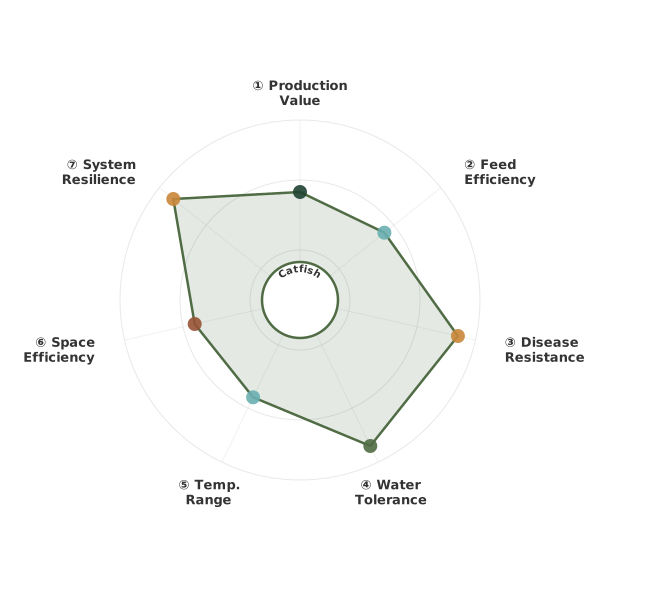
How These Traits Are Calculated
Trait dimensions are ordered clockwise starting from the top of the chart (12 o'clock position):
1. Production Value
Production Value scores 2.4 (typical) using fish pathway: growth_rate_in_low_input_systems (typical 2.0, 40%) + feed_conversion (typical 2.0, 30%) + small_scale_suitability (typical 2.0, 30%). Formula: (2.0×0.40 + 2.0×0.30 + 2.0×0.30) = 2.0, rounded to 2.4. Catfish offer a dependable yield without exceptional speed or feed efficiency, making them a stable aquaculture choice.
Moderate growth, reliable yield
2. Feed Efficiency
Feed Efficiency scores 2.0 (typical) from direct lookup of feed_conversion trait (typical 2.0). Catfish typically have a feed conversion ratio of around 1.8:1 to 2.0:1, meaning they require slightly more feed to gain a unit of weight compared to more efficient species, but are still considered moderately efficient omnivores.
Feed conversion 1.8:1 (average)
3. Disease Resistance
Disease & Parasite Resistance scores 2.7 (exceptional) from: disease_resistance (exceptional 3.0, 60%) + predator_resistance (typical 2.0, 40%). Formula: (3.0×0.60 + 2.0×0.40) = 2.6, rounded to 2.7. Catfish exhibit strong natural immunity to many common aquaculture diseases and their size makes them less susceptible to predation once established.
High disease resistance & predator defense
4. Water Tolerance
Water Quality Tolerance scores 2.7 (exceptional) from weighted average: water_quality_tolerance (exceptional 3.0, 40%) + temperature_range (typical 2.0, 30%) + salinity_tolerance (typical 2.0, 30%). Formula: (3.0×0.40 + 2.0×0.30 + 2.0×0.30) = 2.4, rounded to 2.7. Catfish are known for their ability to thrive in a broad range of water conditions, including varying pH (6.5-9.0) and salinities (up to 15 ppt).
Tolerates wide pH, temp, salinity ranges
5. Temp. Range
Temperature Range scores 2.2 (typical) from: temperature_range (typical 2.0, 50%) + handling_stress_tolerance (typical 2.0, 30%) + disease_resistance (exceptional 3.0, 20%). Formula: (2.0×0.50 + 2.0×0.30 + 3.0×0.20) = 2.2. Catfish grow best between 75-85°F (24-29°C) but can tolerate a wider range from 50-90°F (10-32°C), requiring some climate management in cooler regions.
Tolerates 50-90°F (needs some control)
6. Space Efficiency
Space Efficiency scores 2.6 (exceptional) using fish pathway: small_scale_suitability (typical 2.0, 60%) + polyculture_compatibility (exceptional 3.0, 40%). Formula: (2.0×0.60 + 3.0×0.40) = 2.4, rounded to 2.6. Catfish can be stocked at high densities in ponds (5,000-10,000/acre) or tanks (1-5 lbs/gallon), and are excellent polyculture partners, especially with species that consume waste.
High stocking density (1-5 fish/gal)
7. System Resilience
System Resilience scores 2.7 (exceptional) from: disease_resistance (exceptional 3.0, 35%) + handling_stress_tolerance (typical 2.0, 30%) + temperature_range (typical 2.0, 20%) + oxygen_requirements inverted (limited 1.0 → 3.0, 15%). Formula: (3.0×0.35 + 2.0×0.30 + 2.0×0.20 + 3.0×0.15) = 2.6, rounded to 2.7. Catfish are highly resilient due to their ability to tolerate lower oxygen levels and their robust disease resistance, making them suitable for less controlled environments.
Hardy across conditions (low oxygen tolerance)
Value Streams
Experience Level
Some livestock experience recommended (better for larger operations)
4
Management, Care & Feeding
Operational guidance for raising this breed successfully
Management, Care & Feeding
Operational guidance for raising this breed successfully
Integrating catfish into a farm system requires careful consideration of their biological needs, economic realities, and potential for environmental synergy. Their hardiness provides a strong foundation, but success hinges on matching system design and management practices to local conditions and market opportunities. The goal is to leverage their natural resilience and ecological functions to create a productive and sustainable component of the farm ecosystem, from water management to diversified income.
Physical and Environmental Requirements:
• Water Source and Quality: Access to a reliable water source is essential. While tolerant of variable quality, optimal growth occurs in clean, well-oxygenated water. Species selection should align with local climate, as many thrive in warmer temperatures (70°F-90°F / 21°C-32°C) and can tolerate low dissolved oxygen due to air-breathing capabilities.
• System Design: Catfish can be raised in various systems, including earthen ponds, raceways, and recirculating aquaculture systems (RAS). Ponds are often the most cost-effective for smaller operations but require careful management of water levels and potential predator ingress. RAS offers higher densities and greater control but demands significant capital investment and technical expertise.
• Temperature Management: For optimal growth, maintaining water temperatures within their preferred range (65°F-90°F / 18°C-32°C) is crucial. In cooler climates, greenhouse covers or heated systems may be necessary for year-round production, or production may be seasonal.
Economic Implementation and Market Access:
• Capital Investment: Initial costs can range from pond construction and basic aeration for simpler systems to substantial investment in tanks, filtration, pumps, and monitoring equipment for RAS.
• Feed Management: Feed typically constitutes 50-70% of variable costs. Selecting high-quality, species-appropriate feed with a good FCR (1.5:1 to 2.0:1) is paramount for profitability. Buying in bulk or establishing local feed sources can reduce costs.
• Stocking Density: Sustainable densities vary by system and water exchange rates, typically ranging from 5,000 to 20,000 fish per acre in ponds. Higher densities require more intensive aeration and water management to prevent oxygen depletion and ammonia buildup.
• Market Strategy: Develop a clear market plan before stocking. Direct-to-consumer sales via farmers' markets or farm stands can yield the highest per-pound prices but require processing, cold storage, and marketing efforts. Restaurant sales offer intermediate returns, while wholesale markets provide volume and liquidity but at lower prices. Building consistent demand can take 2-3 years.
Management Practices for Success:
• Feeding Regimes: Feed fish according to their size and water temperature, ensuring they receive adequate nutrition without overfeeding, which can degrade water quality.
• Water Monitoring: Regularly monitor key water quality parameters such as dissolved oxygen, temperature, pH, and ammonia, especially in intensive systems or during hot weather.
• Health Management: Implement biosecurity measures to prevent disease introduction. Observe fish for signs of stress or illness and consult with aquaculture specialists if issues arise.
• Harvesting and Processing: Plan harvesting to align with market demand. Depending on the sales channel, on-farm processing or partnerships with local processors may be necessary. Ensuring proper handling and chilling is critical for product quality.
• Waste Management: If integrated into a larger farm system, manage catfish manure and pond water discharge carefully to maximize nutrient capture and minimize downstream environmental impact. Pond sludge can be a valuable fertilizer.
Successfully integrating catfish involves understanding their environmental needs and matching them with appropriate economic models. By carefully planning system design, managing feed and water quality, and securing stable market channels, farms can leverage catfish for diversified income and enhanced ecological function.
Sources behind this view
 Community
-
Discusses raising trout and hybrid bluegill in ponds, considering one-season growth, population balance issues with catfish, taste problems, and the use of automated feeders. Aims to restore pond bala
Read more (opens in new window) permies.com -
Recommends a minimum of 75 fish per IBC tank for schooling channel catfish to prevent aggression, with stocking density dependent on biofilter and solids removal for DWC systems. Grow bed volume is ke
Read more (opens in new window) permies.com
 Research
-
Economics of U.S. catfish farming practices: Profitability, economies of size, and liquidity (opens in new window)
Catfish farming study found split-pond hybrid catfish systems cheapest ($1.97/kg). Larger farms and intensive methods (split-pond, high aeration) are more profitable and less risky. Low-intensity meth
-
PROSPECTS AND SUSTAINABILITY OF CATFISH FARMING AMIDST RISING INPUT COSTS IN NIGERIA (opens in new window)
Nigerian catfish farming is unsustainable due to high feed costs and diseases. Farmers advised to make own feed; government support needed for grants and subsidized inputs.
-
ECONOMIC ANALYSIS OF CATFISH FARMING AND ITS CONTRIBUTIONS TO HOUSEHOLD POVERTY ALLEVIATION IN ANAMBRA STATE, SOUTH EAST NIGERIA (opens in new window)
Catfish farming in Anambra State, Nigeria, is highly profitable and significantly reduces household poverty. Key factors include pond size, feed costs, labor, and farmer experience. Recommendations fo
-
Performance of Channel Catfish and Hybrid Catfish in Single-Batch, Intensively Aerated Ponds (opens in new window)
In intensive, single-harvest catfish ponds, Channel Catfish performed poorly above 8,000 fish/acre. Hybrid catfish yielded significantly more (17,542 lb/acre) at 12,000 fish/acre, making them more cos