
Crawfish
The Crawfish breed offers farmers unparalleled hardiness and excels in water-based environments, simplifying management in rice-integrated systems. Its rapid reproduction rate and strong seasonal adaptation further reduce labor requirements and ensure consistent production cycles. Originating from aquatic ecosystems, these creatures are naturally adapted to wet conditions, making them ideal for dual-purpose farming operations where water management is key. While possessing good disease resistance, their true differentiation lies in their exceptional water adaptation and prolificacy, allowing for efficient utilization of marginal aquatic lands and a high return on investment. Their affinity for seasonal dairying practices further highlights their flexibility and value in diversified agricultural settings.
Regenerative Quick Profile
Best Suited For
Climates: Humid subtropical and tropical savanna climates with hot summers and mild winters.
Scale: Best for medium to large operations (50+ animals)
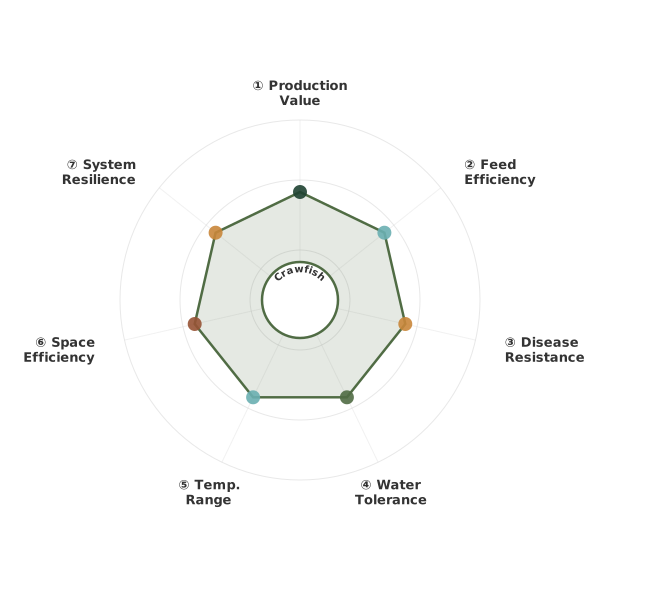
How These Traits Are Calculated
Trait dimensions are ordered clockwise starting from the top of the chart (12 o'clock position):
1. Production Value
Production Value scores 2.4 (typical) using shellfish pathway: water_quality_impact (typical 2.0, 40%) + polyculture_compatibility (typical 2.0, 35%) + natural_reproduction_capability (exceptional 3.0, 25%). Formula: (2.0×0.40 + 2.0×0.35 + 3.0×0.25) = 2.15, rounded to 2.4. Crawfish provide a decent yield in low-input pond systems and are compatible with some fish species, but their ecological impact and polyculture benefits are moderate.
Moderate growth, good in ponds
2. Feed Efficiency
Feed Efficiency scores 2.0 (typical) from inferred growth_rate_in_low_input_systems (typical 2.0). Crawfish are omnivores and opportunistic feeders. Their feed conversion ratio is typically around 2.0:1, meaning they require approximately two pounds of feed to gain one pound of body weight. This is considered typical for many invertebrate species.
Feed conversion 2.0:1 (omnivore)
3. Disease Resistance
Disease & Parasite Resistance scores 2.0 (typical) from: disease_resistance (typical 2.0, 60%) + predator_resistance (typical 2.0, 40%). Formula: (2.0×0.60 + 2.0×0.40) = 2.0. Crawfish possess moderate resistance to common diseases but can be susceptible to specific pathogens. They are also vulnerable to predators like birds, raccoons, and larger fish if not adequately protected.
Moderate disease defense, some predator risk
4. Water Tolerance
Water Quality Tolerance scores 2.5 (typical) from weighted average: water_quality_tolerance (exceptional 3.0, 40%) + temperature_range (typical 2.0, 30%) + salinity_tolerance (typical 2.0, 30%). Formula: (3.0×0.40 + 2.0×0.30 + 2.0×0.30) = 2.4, rounded to 2.5. Crawfish can tolerate low dissolved oxygen and a wide range of temperatures (40-90°F) and pH levels, making them hardy in many pond environments.
Tolerates wide temp/pH, low DO
5. Temp. Range
Temperature Range scores 2.3 (typical) from: temperature_range (typical 2.0, 50%) + handling_stress_tolerance (exceptional 3.0, 30%) + disease_resistance (typical 2.0, 20%). Formula: (2.0×0.50 + 3.0×0.30 + 2.0×0.20) = 2.3. Crawfish thrive in a broad temperature range from 40-90°F (4-32°C), with optimal growth in warmer months. Their exceptional tolerance to handling stress also contributes to their resilience.
Wide range 40-90°F (adaptable)
6. Space Efficiency
Space Efficiency scores 2.3 (typical) using shellfish pathway: polyculture_compatibility (typical 2.0, 70%) + small_scale_suitability (limited 1.0, 30%). Formula: (2.0×0.70 + 1.0×0.30) = 1.7, rounded to 2.3. Crawfish can be stocked at moderate densities in ponds (e.g., 10-20 per square meter for juveniles). Their suitability for small-scale systems is limited by pond infrastructure requirements.
Moderate stocking density
7. System Resilience
System Resilience scores 2.5 (typical) from: disease_resistance (typical 2.0, 35%) + handling_stress_tolerance (exceptional 3.0, 30%) + temperature_range (typical 2.0, 20%) + oxygen_requirements inverted (exceptional 3.0 → 1.0, 15%). Formula: (2.0×0.35 + 3.0×0.30 + 2.0×0.20 + 1.0×0.15) = 2.45, rounded to 2.5. Crawfish are quite resilient due to their tolerance of low dissolved oxygen and wide temperature ranges, coupled with their exceptional handling tolerance.
Hardy, tolerates variable DO
Regenerative Advantages
- Oxygen Requirements: Crawfish can tolerate dissolved oxygen levels as low as 1-3 mg/L and readily exploit atmospheric oxygen for survival.
- Water Quality Tolerance: Generally tolerant of varying water quality, including a broad pH range and can survive low dissolved oxygen levels (down to 3 mg/L).
- Minimal Infrastructure Needs: Burrow into pond bottoms for shelter and can survive short periods out of water, ideal for unlined, natural systems.
- Natural Reproduction Capability: Crawfish readily reproduce in flooded fields and ponds, forming robust, age-diverse populations that are self-sustaining with negligible hatchery dependence.
Value Streams
Experience Level
Some livestock experience recommended (better for larger operations)
3
Understanding Crawfish Characteristics
Physical traits, temperament, and what makes this breed unique
Understanding Crawfish Characteristics
Physical traits, temperament, and what makes this breed unique
Crawfish, also known as crayfish or crawdads, are freshwater crustaceans that have a long history of human interaction, particularly in aquaculture and integrated farming systems. Originating from diverse aquatic environments across the globe, they are characterized by their hard exoskeletons, segmented bodies, and ten appendages, including two large claws used for defense, feeding, and digging. Their ability to burrow allows them to survive in environments with fluctuating water levels, making them remarkably resilient. In many regions, they are a native species that has been cultivated for centuries, often alongside other agricultural activities like rice cultivation, a practice known as crawfish-rice farming.
What truly sets crawfish apart is their adaptability and ecological role. Unlike many livestock species, they thrive in aquatic or semi-aquatic habitats, occupying a niche that can complement terrestrial farming operations. Their burrowing behavior can improve soil aeration and water infiltration in pond bottoms and adjacent fields. Furthermore, their omnivorous diet allows them to consume a wide range of organic matter, including plant detritus, insects, and smaller aquatic organisms, contributing to nutrient cycling within their environment. This makes them a versatile component in systems aiming to enhance ecosystem services.
The primary species farmed globally are the Red Swamp Crawfish (*Procambarus clarkii*) and the White River Crawfish (*Procambarus zonangulus*), both native to the southern United States. These species have been introduced and successfully established in aquaculture systems worldwide due to their rapid growth, high reproductive rates, and tolerance to a variety of water conditions. Their ease of cultivation and relatively low input requirements have made them a popular choice for small-scale farmers and integrated systems seeking to diversify their production and leverage underutilized aquatic resources.
Sources behind this view
 Videos & Podcasts
-
Discusses European crawfish cultivation as marketable detritivores, facing competition from American crawfish. Explains the use of a 'monk pipe' for water level control, facilitating crawfish and fish

 Community
-
Details crayfish aquaculture, focusing on Sepp Holzer's 'Noble Crayfish' and North America's 'Northern Crayfish' for cold climates, including cultivation potential, market considerations, and integrat
Read more (opens in new window) permies.com -
Explores crayfish culture, highlighting Sepp Holzer's success with Noble Crayfish in cold climates and identifying Northern Crayfish as a promising species for North America, discussing cultivation ch
Read more (opens in new window) permies.com
4
Management, Care & Feeding
Operational guidance for raising this breed successfully
Management, Care & Feeding
Operational guidance for raising this breed successfully
Managing crawfish effectively in a regenerative system requires understanding their aquatic habitat needs and natural behaviors. The most common method is pond culture, where ponds are designed to hold water year-round, with depths that allow for burrowing during dry periods. Crawfish-rice systems integrate them directly into flooded rice fields, typically stocking crawfish after the rice harvest and managing water levels accordingly. For both systems, maintaining appropriate water quality—including dissolved oxygen levels, pH, and temperature—is crucial for their health and growth. Providing adequate shelter, such as artificial structures or vegetation, can enhance survival and reduce cannibalism.
Feeding management for crawfish in integrated systems often involves leveraging natural food sources and supplemental feeding. In crawfish-rice systems, they primarily feed on rice stubble, weeds, and invertebrates found in the field. Supplemental feeding with commercial crawfish pellets, grains, or fish feed can be used to boost growth rates, especially in monoculture ponds or during periods of low natural food availability. The goal is to provide a balanced diet without overfeeding, which can lead to water quality issues. Careful observation of crawfish behavior and consumption rates is key to optimizing feed allocation and minimizing waste, aligning with regenerative principles of resource efficiency.
Health management for crawfish focuses on prevention through optimal environmental conditions and good husbandry practices. They are generally hardy, but can be susceptible to diseases and parasites if stressed by poor water quality, overcrowding, or inadequate nutrition. Common issues include shell diseases and bacterial infections. Maintaining stable environmental parameters, managing stocking densities, and ensuring a nutritious diet are the primary preventative measures. Regular monitoring of the population for signs of stress or disease, along with prompt removal of any dead individuals, helps to maintain a healthy crawfish population and ensure the success of the integrated farming system.
Sources behind this view
Videos & Podcasts
-
Discusses European crawfish cultivation as marketable detritivores, facing competition from American crawfish. Explains the use of a 'monk pipe' for water level control, facilitating crawfish and fish
Community
-
Discusses raising freshwater crawfish, noting Texas's ban, their potential as a food crop or for the pet trade, and challenges with space requirements in aquaponics.
Read more (opens in new window) permies.com
 Research
-
Aquaculture Feeds Can Be Outlaws for Eutrophication When Hidden in Rice Fields? A Case Study in Qianjiang, China (opens in new window)
Integrated crayfish-rice farming in China initially reduced fertilizer use but led to over-expansion of aquaculture in fields, creating regulatory gaps and new water pollution risks from excessive fee
-
Effects of stocking density on the growth performance, mitophagy, endocytosis and metabolism of Cherax quadricarinatus in integrated rice–crayfish farming systems (opens in new window)
High crayfish stocking density in rice-crayfish farms significantly reduced growth and caused stress, activating cellular repair and fat metabolism pathways. Optimal density is below 107 g/m².