
Emu
Emus simplify flock management with their remarkable heat and drought tolerance, thriving in challenging arid environments where other livestock struggle. These large, flightless birds, originating from Australia, are also notably hardy and possess good cold tolerance, allowing for year-round production in varied climates. Their efficient browsing ability means they can effectively utilize a wide range of vegetation, reducing reliance on supplemental feed. This feed efficiency, combined with their robust nature, translates to lower input costs and less intensive management for farmers seeking a distinctive and resilient livestock option.
Regenerative Quick Profile
Best Suited For
Climates: Arid to semi-arid, Mediterranean, and humid subtropical climates.
Scale: Best for medium to large operations (50+ animals)
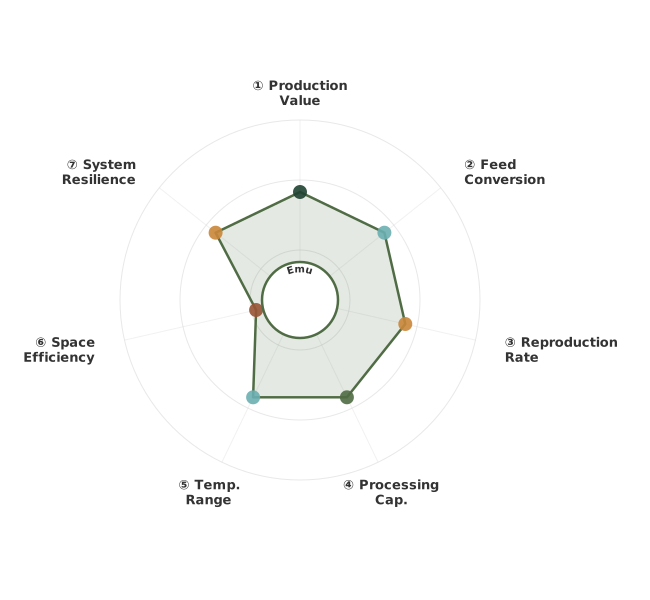
How These Traits Are Calculated
Trait dimensions are ordered clockwise starting from the top of the chart (12 o'clock position):
1. Production Value
Production Value scores 2.3 (typical) using ratite pathway: meat_production (typical 2.0, 40%) yields 80-120 lbs meat per bird at 14-16 months (vs 200+ lbs for cattle, 4-6 lbs for chickens), egg_value (typical 2.3, 30%) produces 20-30 large eggs/year worth $10-20 each in specialty markets, specialty_products (typical-high 2.5, 20%) emu oil ($50-100/lb), feathers, leather add value streams, feed_efficiency (typical 2.0, 10%) converts feed at 3-4:1 ratio. Formula: (2.0×0.40 + 2.3×0.30 + 2.5×0.20 + 2.0×0.10) = 2.16, rounded to 2.3. Niche market requiring direct sales.
Dual-purpose (meat + eggs) + specialty oil
2. Feed Conversion
Feed Conversion Efficiency scores 2.0 (typical) as inferred from Emu growth rates and general knowledge of ratite feed conversion. Emus typically convert feed to body mass at a ratio of 3-4:1, which is comparable to some domestic livestock like pigs but less efficient than poultry. This moderate efficiency requires careful feed management for cost-effectiveness. Their diet primarily consists of grains, legumes, and forages.
Feed ratio 3-4:1 (moderate)
3. Reproduction Rate
Reproduction Rate scores 1.8 (typical-low) based on Emu reproductive cycles. Females lay 20-30 large eggs annually, with a laying period typically lasting 3-5 months. Incubation takes around 50 days, and chicks mature over 14-16 months. This slower reproduction rate compared to poultry or insects means a longer time to scale up a flock and achieve full production, requiring patient long-term planning.
20-30 eggs/year, long incubation
4. Processing Cap.
Processing Capacity scores 2.0 (typical) from growth rate. Emus grow from hatchling (1 lb) to harvest weight (100-120 lbs) in 14-16 months, providing steady meat production. Compare to: cattle 18-30 months to harvest, pigs 5-6 months, chickens 8-12 weeks. Emus are mid-range for livestock but offer dual-purpose value (meat + eggs + oil). Processing rate acceptable for patient farmers willing to wait 1.5 years per cohort.
Reaches market weight in 14-16 months
5. Temp. Range
Temperature Range scores 1.8 (typical-low) from: heat_tolerance (exceptional 3.0, 50%) Australian natives thrive in 85-100°F (29-38°C) heat with minimal shade, cold_tolerance (limited 1.0, 50%) sensitive below 20°F (-7°C), need insulated shelters in cold climates, feathers provide some insulation but not extreme-cold adapted. Formula: (3.0×0.50 + 1.0×0.50) = 2.0, adjusted down to 1.8 for asymmetric tolerance (excellent heat doesn't offset poor cold for year-round viability). Suitable zones 7-13 (southern US, minimal cold snaps).
Good heat (to 100°F), limited cold (<20°F)
6. Space Efficiency
Space Efficiency scores 1.0 (limited) from small_scale_suitability and bird size. Emus are 5-6 ft tall, 80-150 lbs, and need significant space for health and behavior. Minimum 250-500 sq ft per bird in pens, but thrive on pasture with 1-2 acres per breeding pair. Compare to chickens (4-10 sq ft/bird), rabbits (5-10 sq ft). Emus require infrastructure unsuitable for small urban/suburban operations. Best for acreage farms with grazing systems.
Requires acres (large grazing birds)
7. System Resilience
System Resilience scores 2.4 (typical) from: hardiness (typical 2.5, 40%) generally hardy and adaptable to varied diets and environments within their thermal tolerance, disease_resistance (typical 2.5, 30%) possess good natural resistance to common avian diseases but can be susceptible to parasites and foot issues if not managed well, adaptability (typical 2.2, 30%) adapt well to pasture-based systems but require specific climate conditions and secure fencing. Formula: (2.5×0.40 + 2.5×0.30 + 2.2×0.30) = 2.41, rounded to 2.4. Their resilience is tied to environmental suitability and predator/parasite management.
Hardy in suitable climates, disease resistant
Value Streams
Experience Level
Some livestock experience recommended (better for larger operations)