
Khaki Campbell Ducks
Also known as: khaki campbells, campbell ducks, khaki ducks, egg ducks
For farmers seeking a highly productive and adaptable waterfowl, the Khaki Campbell duck excels at prolific egg-laying and thrives on diverse forage, making them an excellent choice for pastured poultry operations. Originating from England, these ducks are renowned for their exceptional foraging ability, significantly reducing feed costs and contributing to natural pest control by consuming insects and weeds. Their good disease resistance and cold hardiness simplify management in various climates, while their docility makes them easy to handle. While they do have a moderate water dependency for health and hygiene, their overall low-maintenance nature and outstanding egg output position them as a distinct advantage for farmers prioritizing efficiency and natural resource utilization.
Regenerative Quick Profile
Best Suited For
Climates: Humid subtropical to temperate oceanic, and semi-arid climates
Scale: Suitable for small to medium operations (10-50 animals)
How These Traits Are Calculated
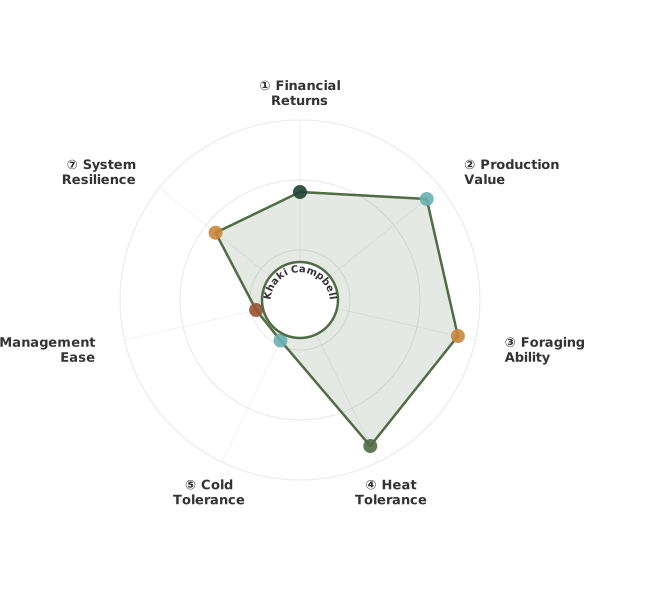
Trait dimensions are ordered clockwise starting from the top of the chart (12 o'clock position):
1. Financial Returns
Annual income per bird from eggs, meat, or specialty products
WHAT: Evaluates profit potential for specialty poultry (turkeys, ducks, geese, guinea fowl) combining meat yield, egg production (where applicable), growth timelines, and market premiums for specialty products.
WHY: Specialty poultry targets premium markets—heritage turkeys at $6-8/lb versus $1.50 commodity, duck eggs at $8-12/dozen versus $3-5 chicken eggs. Understanding enterprise-specific returns helps match birds to market opportunities, with successful operations generating 2-4× returns of conventional poultry.
HOW: Calculated from production data (market weight, timelines, egg yield) combined with efficiency traits and premium market access. Exceptional (≥2.6): strong output + premium markets + efficient growth. Typical (1.8-2.5): moderate production and markets. Limited (<1.8): low output or limited market access.
2. Production Value
Meat yield, egg production, and specialty product quality
WHAT: Measures output quality and quantity combining meat characteristics (size, flavor, texture prized by consumers), egg production (for laying breeds), and specialty products (foie gras, down feathers) that command premiums.
WHY: Production value determines market positioning. Heritage turkeys with superior flavor justify $6-8/lb premiums, duck eggs with rich yolks attract baking customers at $1+ per egg, quality down commands $20-40/lb. High production value enables profitable small-scale operations where commodity birds require large volume to achieve viability.
HOW: Composite assessment of documented production characteristics and market quality. Exceptional (≥2.6): superior product quality + strong output + specialty attributes. Typical (1.8-2.5): good standard production. Limited (<1.8): commodity quality, minimal specialty value.
3. Foraging Ability
Feed cost reduction through natural foraging behavior
WHAT: Measures effectiveness at obtaining nutrition through foraging—consuming insects, seeds, greens, and other natural foods—reducing purchased feed requirements 20-50% in pasture-based systems.
WHY: Aggressive foragers reduce feed costs while providing pest control (insects, ticks, slugs) and weed management services. Turkeys consuming 30-40% of calories from forage save $15-30 per bird over growing season, making the difference between profitable and marginal operations.
HOW: Rated from documented foraging behavior and feed reduction potential. Exceptional (≥2.6): excellent foragers, 40-50% feed reduction, active pest control. Typical (1.8-2.5): moderate foraging, 20-30% reduction. Limited (<1.8): minimal foraging, requires full feeding.
4. Heat Tolerance
Performance in hot weather above 85°F (29°C)
WHAT: Evaluates adaptation to sustained heat above 85°F (29°C), measuring heat stress resistance, growth/production maintenance, and survival during summer peaks. Critical for southern operations and summer meat production.
WHY: Heat stress reduces feed intake 20-40%, slows growth, and increases mortality—particularly problematic for turkeys naturally susceptible to heat. Heat-adapted breeds maintain production schedules where others require expensive cooling or suffer significant losses during summer.
HOW: Rated from database trait 'heat_tolerance' based on documented characteristics. Exceptional (≥2.6): maintains production in 95°F+ (35°C+), low mortality. Typical (1.8-2.5): manageable with shade and water. Limited (<1.8): high heat sensitivity, struggles above 85°F.
5. Cold Tolerance
Performance in cold weather below 20°F (-7°C)
WHAT: Evaluates adaptation to sustained cold below 20°F (-7°C), measuring feather insulation, cold-weather foraging activity, and winter production/growth maintenance. Important for year-round outdoor systems in northern climates.
WHY: Cold-sensitive birds require heated housing ($50-200 monthly winter costs), reduce activity limiting foraging value, and experience higher mortality. Cold-hardy breeds remain active outdoors year-round, maintain winter egg production (ducks/geese), and thrive with basic shelter.
HOW: Rated from database trait 'cold_tolerance' based on breed characteristics. Exceptional (≥2.6): excellent insulation, active in <0°F (-18°C), maintains winter production. Typical (1.8-2.5): moderate hardiness. Limited (<1.8): requires heated shelter, limited winter activity.
6. Management Ease
Handling temperament and care requirements
WHAT: Measures daily management simplicity combining temperament (calm vs flighty/aggressive), health needs, natural breeding ability (versus artificial insemination required), and routine handling cooperation.
WHY: Difficult birds increase labor 2-3× and create safety concerns. Aggressive turkeys or geese require protective equipment during handling, flighty birds complicate catching for processing, breeds requiring AI add complexity. Calm birds with good health enable confident management by beginners.
HOW: Weighted assessment: temperament (50%), health needs (30%), breeding ease (20%). Exceptional (≥2.6): calm and manageable, robust health, natural breeding. Typical (1.8-2.5): manageable with experience. Limited (<1.8): aggressive or nervous, high health needs, or breeding complications.
7. Flock Resilience
Disease resistance and survival under typical stresses
WHAT: Evaluates flock robustness across disease resistance (particularly respiratory issues and common poultry diseases), parasite tolerance, predator awareness, and general hardiness determining survival through typical challenges.
WHY: Resilient breeds maintain productivity through challenges causing 20-50% losses in susceptible birds—surviving disease pressure, evading predators through awareness, resisting parasites. This determines whether flocks thrive with basic care or require intensive interventions and predator-proof housing.
HOW: Composite assessment of documented health and survival characteristics. Exceptional (≥2.6): strong disease resistance + predator-savvy + hardy. Typical (1.8-2.5): standard resilience with routine care. Limited (<1.8): health-sensitive or vulnerable, requires intensive management and protection.
Regenerative Advantages
- Heat Tolerance: Khaki Campbells demonstrate remarkable resilience to heat, likely due to efficient thermoregulation. They maintain excellent egg production even in hot weather, provided water is accessible.
- Foraging Ability: Khaki Campbell ducks exhibit a pronounced and highly effective natural foraging drive, readily consuming a wide spectrum of vegetation and invertebrates. Their diet naturally extends to insects, grubs, seeds, succulent weeds, and aquatic plants, demonstrating a broad capacity to utilize diverse and often low-quality biomass. This inherent ability to thrive on varied, unimproved landscapes with minimal supplementary feed aligns perfectly with the 'exceptional' benchmark for foraging on diverse/marginal vegetation.
- Egg Production: Khaki Campbells are exceptional layers, consistently producing over 200 eggs annually and often reaching 250-300+. Their reliability and good egg quality set a benchmark for high output.
- Water Dependency: Khaki Campbells are adept at utilizing natural water sources and precipitation for hydration. They are less reliant on constant supplemental watering than many other breeds.
- Egg Size Consistency: Renowned for very consistent egg production and size, often exceeding 90% within a tight size range. Ideal for commercial egg markets.
Value Streams
- Egg production
- Insect and pest control
- Scratch tillage and compost distribution
Experience Level
Suitable for first-time livestock owners
3
Understanding Khaki Campbell Ducks Characteristics
Physical traits, temperament, and what makes this breed unique
Understanding Khaki Campbell Ducks Characteristics
Physical traits, temperament, and what makes this breed unique
The Khaki Campbell duck stands out as a premier egg-layer, renowned for its prolificacy and distinctive khaki coloration. Developed in Britain during the early 20th century by Adele Campbell and later refined by Reginald Campbell, this breed was meticulously created by crossing Rouen and Indian Runner ducks, with later additions of Welsh Harlequins. The goal was to produce a bird that combined the foraging ability and egg-laying prowess of the Indian Runner with the hardiness and calmer temperament of the Rouen. Their unique appearance, a blend of buff and brown, provides excellent camouflage in pasture settings, making them less susceptible to aerial predators. Unlike many other domestic duck breeds that are primarily raised for meat or ornamental purposes, the Khaki Campbell's defining trait is its exceptional and consistent egg production, often rivaling or even surpassing that of many chicken breeds.
Sources behind this view
 Videos & Podcasts
-
Park Carrig raises Khaki Campbell, Dark Campbell, and rare Welsh Harlequin ducks for their egg-laying and slug-slaying abilities. They are the UK's only organic duck breeders, focusing on genetics for
 Community
-
Investigates if six-month-old Khaki Campbell ducks, who are nesting daily, can successfully incubate their own eggs if left undisturbed, and how to manage this process, considering their potential to
Read more (opens in new window) permies.com -
Muscovy ducks are recommended over chickens for quiet egg and meat production, offering benefits like less garden damage, better predator defense, and safer manure, but require more space and frequent
Read more (opens in new window) permies.com
4
Management, Care & Feeding
Operational guidance for raising this breed successfully
Management, Care & Feeding
Operational guidance for raising this breed successfully
Managing Khaki Campbell ducks effectively in a regenerative system focuses on providing access to pasture and water while ensuring adequate protection. They require access to a clean water source large enough for them to submerge their heads and clean their nostrils, though a full pond isn't strictly necessary; large tubs or troughs suffice. While they are hardy and tolerate various weather conditions, a basic shelter from extreme elements like heavy rain, snow, and intense sun is beneficial to ensure comfort and continued laying. Their diet should be primarily foraged, supplemented with a quality waterfowl or game bird feed, especially during peak laying periods. Ensure the feed is formulated for their life stage (e.g., grower, layer) and has appropriate niacin levels to prevent leg and bone issues common in waterfowl. Regularly moving their grazing area or using portable electric netting allows for rotational grazing, maximizing their impact on pest control and pasture health while preventing overgrazing and concentrating their valuable manure.
Sources behind this view
Community
-
Experienced Khaki Campbell duck owner recommends planting grass in trays for foraging, supplementing with greens and fruits, and securing a pen against predators, noting ducks' effectiveness against s
Read more (opens in new window) permies.com -
Newly acquired Khaki Campbell duck hens are exhibiting extreme fear, refusing to leave their indoor housing or eat unless the feeder is inside. This is compounded by cold weather and a tragic drowning
Read more (opens in new window) permies.com
 Research
-
PRESENT STATUS OF FREE-RANGE DUCK FARMING SYSTEM OF TULSIPUR DANG, NEPAL (opens in new window)
Nepal study: Free-range ducks often raised with chickens, fed corn. Traditional methods lack proper housing, vaccines, and supplements, leading to 15% annual mortality.