
Mealworms
Mealworms excel at efficient feed conversion, rapid reproduction, and processing organic waste, making them an incredibly space-efficient livestock option. Originating from various terrestrial environments, these insects require minimal intervention and thrive on a diverse range of organic byproducts. Their ability to rapidly convert waste streams into valuable protein offers a unique solution for sustainability and resource management. Mealworms demonstrate good temperature tolerance, further simplifying their integration into various farming operations. For farmers seeking a low-input, high-output protein source, mealworms present a distinct and compelling livestock choice.
Regenerative Quick Profile
Best Suited For
Climates: Temperate to tropical climates with moderate to high humidity. Tolerant of seasonal temperature variations.
Scale: Excellent for small homesteads (1-10 animals)
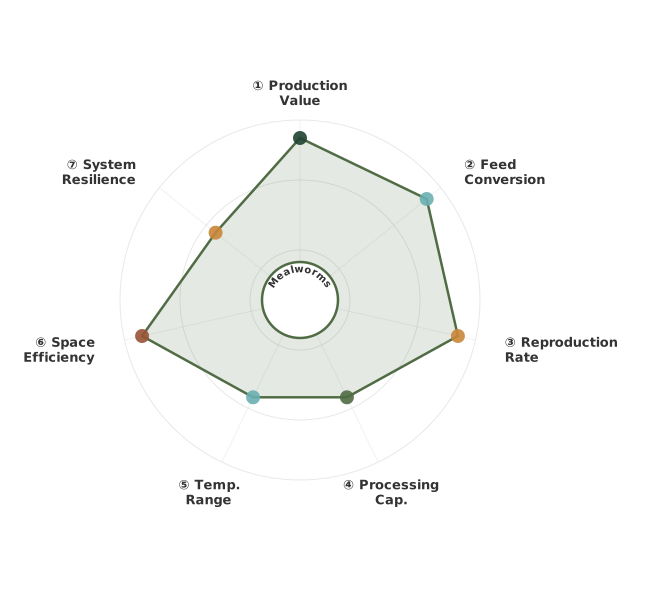
How These Traits Are Calculated
Trait dimensions are ordered clockwise starting from the top of the chart (12 o'clock position):
1. Production Value
Production Value scores 2.9 (exceptional) using waste processor pathway: feed_conversion (exceptional 3.0, 40%) mealworms convert a variety of organic wastes into biomass with high efficiency (1.5:1 to 2:1 ratio), reproduction_rate (exceptional 2.8, 30%) beetles lay 200-300 eggs, with a 4-6 week generation time allowing for scaling, protein_yield (exceptional 2.9, 30%) larvae are 40-50% protein by dry weight, making them valuable feed. Formula: (3.0×0.40 + 2.8×0.30 + 2.9×0.30) = 2.91, rounded to 2.9. Mealworms are effective at processing food scraps and spent grains into a nutrient-dense product.
Rapid waste conversion + high protein
2. Feed Conversion
Feed Conversion Efficiency scores 2.8 (exceptional) from breed characteristics. Mealworms exhibit an impressive feed conversion ratio, typically converting 1.5 to 2 kg of feed into 1 kg of larval biomass. This efficiency is comparable to or better than many conventional livestock, especially when considering the waste streams they can utilize. Their ability to efficiently transform organic matter into protein makes them attractive for circular economy applications.
Converts waste at 1.5:1 to 2:1 ratio (excellent)
3. Reproduction Rate
Reproduction Rate scores 2.8 (exceptional) from species biology. Female mealworm beetles lay 200-300 eggs, and under optimal conditions, the lifecycle from egg to adult beetle can be completed in 4-6 weeks. This relatively rapid generation time allows for significant population growth and scaling of production within a few months, making them a viable option for consistent output of larvae.
200-300 eggs/female, 4-6 week generation
4. Processing Cap.
Processing Capacity scores 2.5 (typical) based on their voracious appetite and ability to consume large volumes of organic matter relative to their size. While not as rapid as Black Soldier Fly larvae, mealworms can process substantial amounts of food scraps, grains, and spent brewery products. Their ability to convert these materials into nutrient-rich biomass is a key component of their processing capacity for waste valorization.
Processes significant waste volume
5. Temp. Range
Temperature Range scores 2.5 (typical) inferred from species requirements. Mealworms thrive in temperatures between 70-85°F (21-29°C). Temperatures outside this range can slow development significantly or lead to mortality. While not as sensitive as some insects, consistent temperature control is crucial for optimal growth rates and reproduction, requiring some environmental management in less stable climates.
Optimal 70-85°F (needs stable temps)
6. Space Efficiency
Space Efficiency scores 3.0 (exceptional) from small_scale_suitability. Mealworms are ideal for contained systems like plastic bins or trays and can be stacked vertically. They can be raised at high densities (hundreds to thousands per square foot depending on life stage), requiring minimal horizontal space. This makes them highly suitable for urban farming, small homesteads, and facilities with limited footprint.
Minimal space (bin systems, high density)
7. System Resilience
System Resilience scores 2.3 (typical) from: hardiness (typical 2.5, 40%) mealworms are relatively robust and can tolerate a variety of organic substrates, disease_resistance (typical 2.0, 30%) generally resistant to major diseases but can be affected by mites or fungal infections if conditions are not managed, adaptability (typical 2.4, 30%) adapt well to different waste streams but require stable temperature and moderate humidity. Formula: (2.5×0.40 + 2.0×0.30 + 2.4×0.30) = 2.32, rounded to 2.3. They are manageable in controlled environments but require attention to detail.
Hardy but sensitive to moisture/pests
Regenerative Advantages
- Small Scale Suitability: Minimal space requirements in stacked bins for rearing. Handling is simple, and infrastructure needs are very low, ideal for small-scale protein production.
Value Streams
Experience Level
Consult local experts for handling requirements
3
Understanding Mealworms Characteristics
Physical traits, temperament, and what makes this breed unique
Understanding Mealworms Characteristics
Physical traits, temperament, and what makes this breed unique
Mealworms, the larval stage of the darkling beetle (*Tenebrio molitor*), are unique not as a traditional livestock breed, but as a highly efficient insect bio-converter. Their primary role in agriculture is as a feed source and a decomposer, transforming organic waste into valuable biomass. Originating from a natural detritivore lifecycle, they have been cultivated for centuries, initially as a food source for humans and pets, and increasingly recognized for their potential in waste management and sustainable feed production. Their physical characteristics – a soft, segmented body, a creamy white to brown coloration, and a voracious appetite – are optimized for rapid growth and nutrient accumulation, making them distinct from conventional livestock.
What truly sets mealworms apart is their ability to thrive on a wide range of organic substrates that would otherwise be considered waste. Unlike larger livestock that require specific forage or feed crops, mealworms can consume food scraps, agricultural by-products, and even certain types of processed materials. This adaptability allows for their integration into closed-loop systems where waste streams are valorized. Their lifecycle, from egg to adult beetle, is relatively short, typically completed within a few months under optimal conditions, enabling rapid scaling of production compared to the lengthy gestation and growth periods of traditional animals.
Furthermore, the nutritional profile of mealworms is highly desirable, particularly for feed applications. They are rich in protein, essential fatty acids, and minerals, offering a comparable or even superior nutritional value to traditional feed ingredients like fishmeal or soybean meal, but with a significantly smaller environmental footprint. This combination of waste-conversion efficiency, rapid life cycle, and high nutritional output makes them a distinct and valuable component for reimagining agricultural resource flows.
Sources behind this view
 Videos & Podcasts
-
Acenta's organic mealworm farm in Switzerland demonstrates sustainable insect farming. Mealworms require minimal feed, utilize food waste, and are rich in protein and nutrients. Products include insec
-
Life cycle assessments show mealworm protein has a dramatically lower carbon footprint (0.2 kg CO2/kg larvae) than chicken or beef, making it a highly sustainable and digestible meat replacement with
 Community
-
Mealworms (larval darkling beetles) can consume Styrofoam due to their gut bacteria, demonstrating a potential recycling application. This was observed in a UC Davis project where mealworms ate a Styr
Read more (opens in new window) ucanr.edu -
Farming mealworms and flesh-eating beetles is suggested for fertilizer production and as feeder insects, utilizing waste products to enhance nutrient cycling.
Read more (opens in new window) permies.com
 Research
-
Polyethylene, polystyrene and lignocellulose wastes as mealworm (Tenebrio molitor L.) diets and their impact on the breeding condition, biometric parameters, metabolism, and digestive microbiome. (opens in new window)
Mealworms grew best on recycled polyethylene plastic, with some ability to break down polystyrene, showing potential for bioconverting plastic waste and adapting their gut microbes.
4
Management, Care & Feeding
Operational guidance for raising this breed successfully
Management, Care & Feeding
Operational guidance for raising this breed successfully
Managing mealworms effectively centers on providing a suitable environment and a consistent food source. The core husbandry involves creating controlled habitats, typically shallow bins or trays filled with a substrate, which is the mealworm's food source. This substrate can be a mix of grains, bran, or other approved organic matter, and it serves as both food and bedding. Temperature and humidity control are crucial; mealworms thrive in a warm, relatively dry environment, generally between 70-85°F (21-29°C), with moderate humidity. Ventilation is also important to prevent the buildup of ammonia and maintain air quality, which is vital for both the mealworms' health and the quality of the final product.
Feeding and substrate management are intertwined. Mealworms are fed their substrate, which should be replenished regularly as they consume it. It's essential to avoid over-wetting the substrate, as excessive moisture can lead to mold growth and disease. Supplementation with fresh materials like vegetable scraps can provide necessary moisture and nutrients, but these should be added in moderation and monitored to prevent spoilage. The larvae will burrow into the substrate, consuming it and growing. When they reach maturity, they pupate and then emerge as adult darkling beetles, which lay eggs to start the cycle anew. Regular harvesting of mature larvae is done by sifting the substrate.
Health considerations for mealworms are primarily related to environmental control and substrate quality. Overcrowding, poor ventilation, excessive moisture, and contaminated feed can lead to stress, disease outbreaks (often fungal or bacterial), and increased mortality. Mites can also be a pest. Proactive management involves maintaining optimal temperature, humidity, and airflow, using clean and appropriate substrate materials, and regularly removing waste and dead mealworms. While they don't require vaccination or complex veterinary care, diligent observation of the colony's behavior and physical condition is key to preventing and addressing potential issues before they impact the entire population.
Sources behind this view
Videos & Podcasts
-
Acenta's organic mealworm farm in Switzerland demonstrates sustainable insect farming. Mealworms require minimal feed, utilize food waste, and are rich in protein and nutrients. Products include insec
-
Life cycle assessments show mealworm protein has a dramatically lower carbon footprint (0.2 kg CO2/kg larvae) than chicken or beef, making it a highly sustainable and digestible meat replacement with
Community
-
Shares practical mealworm farming tips for feeding chickens/ducks, including storage, feeding carrots/potatoes, sifting dross, and a query about human consumption safety and white worms.
Read more (opens in new window) permies.com -
Discusses simplified mealworm breeding techniques, focusing on sieving for separation and addressing temperature challenges with heating pads and insulated containers, while assessing economic viabili
Read more (opens in new window) permies.com -
Experiment details small-scale mealworm rearing using wheat bran (high yield, gluten risk), oats/cornmeal (gluten-free, low yield). Processed mealworms made protein-enriched pasta and crackers with a
Read more (opens in new window) smallfarms.cornell.edu
Research
-
Polyethylene, polystyrene and lignocellulose wastes as mealworm (Tenebrio molitor L.) diets and their impact on the breeding condition, biometric parameters, metabolism, and digestive microbiome. (opens in new window)
Mealworms grew best on recycled polyethylene plastic, with some ability to break down polystyrene, showing potential for bioconverting plastic waste and adapting their gut microbes.