
Minnesota Hygienic Bees
Also known as: minnesota hygienic stock, hygienic bees, smr bees
The Minnesota Hygienic bee breed simplifies management with its exceptional hygienic behavior and robust disease resistance, significantly reducing labor and potential losses. Originating from selective breeding in Minnesota, these bees exhibit good gentleness, making them easy to handle, and demonstrate strong overwintering capabilities, heat tolerance, and impressive foraging ability across diverse flora. This combination leads to reliable honey production and excellent adaptation to a wide range of climates, setting them apart for farmers seeking a resilient and productive bee stock with inherent disease defense mechanisms.
Regenerative Quick Profile
Best Suited For
Climates: Humid continental and subarctic climates, characterized by cold winters and warm summers.
Scale: Suitable for small to medium operations (10-50 animals)
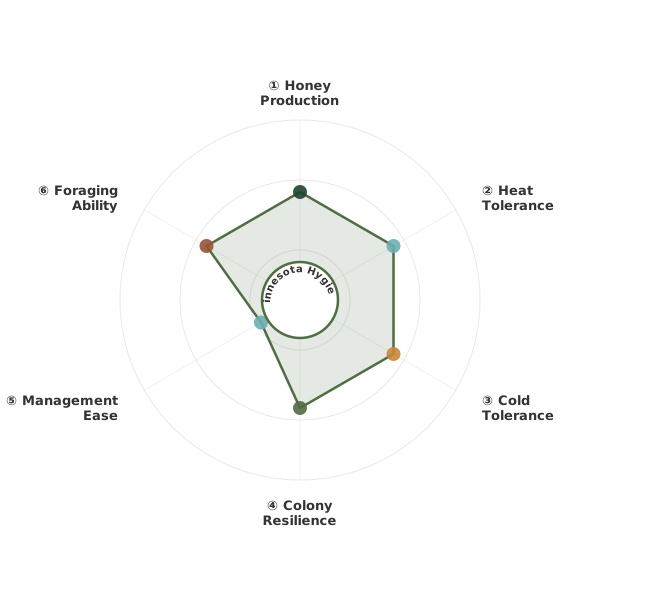
How These Traits Are Calculated
Trait dimensions are ordered clockwise starting from the top of the chart (12 o'clock position):
1. Honey Production
Annual honey yield per hive in pounds
WHAT: Measures annual honey production per hive, typically ranging 30-100 lbs in temperate climates. High producers generate 70-100+ lbs annually while lower producers yield 30-50 lbs, directly affecting revenue from honey sales.
WHY: Honey revenue determines whether beekeeping is a profitable side enterprise or requires large colony counts to achieve viability. At $8-12 per pound, high-producing hives generate $560-1,200 annually versus $240-600 for low producers, making the difference between 10 hives providing income or requiring 30+ hives.
HOW: Rated from documented production levels and breed characteristics. Exceptional (≥2.6): 80-100+ lbs annually, consistent high yields. Typical (1.8-2.5): 50-80 lbs, standard production. Limited (<1.8): <50 lbs, primarily consumed by colony for winter survival.
2. Heat Tolerance
Colony survival and productivity in hot weather above 85°F (29°C)
WHAT: Evaluates colony adaptation to sustained heat above 85°F (29°C), measuring temperature regulation behaviors (fanning, water collection), brood survival, and honey production maintenance during hot periods.
WHY: Heat stress halts foraging, causes brood mortality, and requires intensive cooling (water collection, fanning) that redirects energy from honey production. Heat-adapted breeds maintain productivity in southern climates where others struggle, preventing 2-4 month production gaps during summer peaks.
HOW: Rated from database trait 'heat_tolerance' based on documented characteristics. Exceptional (≥2.6): tropical origins, efficient cooling, maintains production in 95°F+ (35°C+). Typical (1.8-2.5): moderate tolerance, manageable with shade and water access. Limited (<1.8): struggles above 85°F, reduced foraging and brood survival.
3. Cold Tolerance
Overwinter survival in cold climates below 20°F (-7°C)
WHAT: Evaluates colony survival through sustained cold below 20°F (-7°C), measuring cluster efficiency, winter honey consumption, brood-rearing timing, and spring buildup speed. Critical for northern beekeeping viability.
WHY: Cold-sensitive bees consume 50-80 lbs honey for winter survival, start brood-rearing late, and suffer high winter losses (40-60%). Cold-hardy breeds overwinter on 40-60 lbs, resume brood-rearing earlier, and maintain losses below 20%, making northern beekeeping economically viable.
HOW: Rated from database trait 'cold_tolerance' based on documented overwinter performance. Exceptional (≥2.6): proven success in <0°F (-18°C), efficient clustering, low winter stores needed. Typical (1.8-2.5): moderate hardiness, standard overwintering. Limited (<1.8): high losses, requires extensive feeding or indoor wintering.
4. Hive Stability
Disease resistance and survival under typical stresses
WHAT: Evaluates colony robustness across disease resistance (foulbrood, nosema, viruses), pest tolerance (varroa mites, small hive beetles), hygienic behavior (removing diseased brood), and general stress adaptation.
WHY: Resilient colonies maintain productivity through challenges causing 30-50% losses in susceptible bees—surviving varroa pressure, resisting diseases, adapting to forage gaps. This determines whether beekeeping requires intensive treatments (monthly medications) or colonies thrive with minimal interventions.
HOW: Composite assessment of documented health characteristics. Exceptional (≥2.6): strong hygienic behavior + disease/mite resistant + thrives with minimal treatment. Typical (1.8-2.5): standard resilience, routine management sufficient. Limited (<1.8): susceptible, requires intensive treatment regimes.
5. Management Ease
Colony temperament and handling complexity
WHAT: Measures handling simplicity combining temperament (calm vs defensive), swarming tendency (frequent vs controlled), comb-building behavior (straight vs wandering), and routine inspection cooperation.
WHY: Defensive bees require full protective gear, limit inspection frequency, and create liability concerns near homes or public spaces. Frequent swarmers lose half the workforce annually, reducing productivity. Calm bees enable confident inspections in light protection, making beekeeping accessible and pleasant.
HOW: Weighted assessment: temperament (50%), swarming tendency (30%), comb behavior (20%). Exceptional (≥2.6): gentle and calm, low swarming, straight comb. Typical (1.8-2.5): manageable with standard practices. Limited (<1.8): defensive requiring full suits, frequent swarmers, or challenging comb behavior.
6. Foraging Ability
Nectar and pollen collection efficiency across seasons
WHAT: Measures foraging effectiveness combining flight range, early/late season activity (when few others are foraging), poor weather tolerance (flying in cool or cloudy conditions), and diverse floral source utilization.
WHY: Aggressive foragers extend the honey production season 2-4 weeks at each end, collect more per flight, and maintain productivity during brief nectar flows. This produces 20-40% more honey annually than less vigorous foragers from the same floral resources.
HOW: Rated from documented foraging characteristics and behavior. Exceptional (≥2.6): extended season activity + poor weather tolerance + diverse sources + vigorous foragers. Typical (1.8-2.5): standard foraging behavior. Limited (<1.8): restricted season, fair-weather only, selective about sources.
Regenerative Advantages
- Defensiveness: Demonstrate minimal guard behavior with <5 guards at the entrance and virtually no following beyond 10 feet.
- Mite Resistance: Exceptional hygienic behavior enables rapid detection and removal of mite-infested brood, significantly reducing mite loads.
- Robbing Behavior: Bred for hygienic behavior, their focus on colony health often suppresses aggressive robbing, keeping it well below the <5% significant threshold.
- Hygienic Behavior: Superior hygienic behavior allows rapid detection and removal of diseased brood, minimizing the need for external interventions.
- Swarming Tendency: Genetically selected for hygiene, resulting in <10% swarming annually with proactive management.
Value Streams
- Honey production
- Crop pollination (increases yields 20-40%)
- Biodiversity and ecosystem health indicator
Experience Level
Beekeeping requires specialized knowledge
6
Production Capabilities & Market Economics
Business case evaluation and production metrics
Production Capabilities & Market Economics
Business case evaluation and production metrics
Honey Production Economics
| Category | Value |
|---|---|
| Honey Yield/Hive/Year | 60-100 lbs |
| Equipment Cost/Hive | 200-300 |
| Treatment Cost/Year | 0 |
| Feed Cost/Year | 5-15 |
| Price Premium/lb | +20% to +40% |
| Net Income/Hive/Year | 200-400 |
Management Economics & Labor
| Category | Value |
|---|---|
| Queen Replacement | 1-2 |
| Winter Loss Rate | 10-20 |
| Nuc Value | 180-250 |
| Labor Hours/Year | 3-5 |
| Swarm Tendency | low |
| Minimum Protective Gear | Veil and gloves |
Queen Replacement: How often queens need replacing to maintain productivity and genetics. Hybrids (Buckfast) may need annual requeening to maintain traits, while pure races can go 2-4 years. Cost: $25-45 per mated queen.
Winter Loss Rate: Expected percentage of hives that die over winter in well-managed operations. Varies by climate and race. Cold-hardy races (Carniolan, Russian, German) have lower losses in northern climates. National average is 30-40%; regenerative beekeepers targeting 15-25%.
Swarm Tendency: How often colonies swarm without intervention. Low = minimal management, High = frequent splits needed to prevent swarming. Swarming is natural reproduction but reduces honey yield and requires proactive management.
Minimum Protective Gear: Minimum equipment needed for safe hive work based on breed temperament. Gentle races (Italian, Carniolan) allow work with just veil or even no gear for experienced beekeepers. Defensive races (German) require full suit, gloves, and smoker. Beekeepers can always choose to wear more protective gear for extra caution. Impacts urban/suburban suitability and visitor safety.
Value-Added Products & Services
| Category | Value |
|---|---|
| Propolis/Year | N/A oz |
| Beeswax/Year | 5-10 lbs 2-4 kg |
| Pollen Potential | Moderate, varies with forage availability |
| Pollination Value | N/A |
| Orchard Readiness | Strong, known for rapid colony growth |
Orchard Readiness: Ability to build up strong populations by early spring (March-April) for orchard pollination. Italian and Buckfast excel with rapid spring buildup. Carniolan moderate. German and Russian slower. Critical for pollination service income.
Sources behind this view
 Community
-
Beekeeping offers multiple income streams beyond honey: premium mono-floral and cut-comb honey, highly sought-after pollen (£10+/lb), valuable bee bread (£10-£20/100g), and beeswax for ingots (£6.50/l
Read more (opens in new window) permies.com