
Muscovy Ducks
The Muscovy duck simplifies management by thriving on diverse forage and excelling at pest control, requiring minimal intervention for a healthy flock. Originating from South America, these large, striking ducks possess good disease resistance and cold hardiness, making them adaptable to various climates. Their excellent foraging ability means they can significantly reduce feed costs and contribute to natural insect management around the farm. Furthermore, Muscovy ducks are known for their quiet nature and good mothering skills, making them a desirable dual-purpose breed for farmers prioritizing both meat and eggs in a low-input pastured poultry system.
Regenerative Quick Profile
Best Suited For
Climates: Humid subtropical to temperate oceanic, with some tolerance for semi-arid warm climates
Scale: Best for medium to large operations (50+ animals)
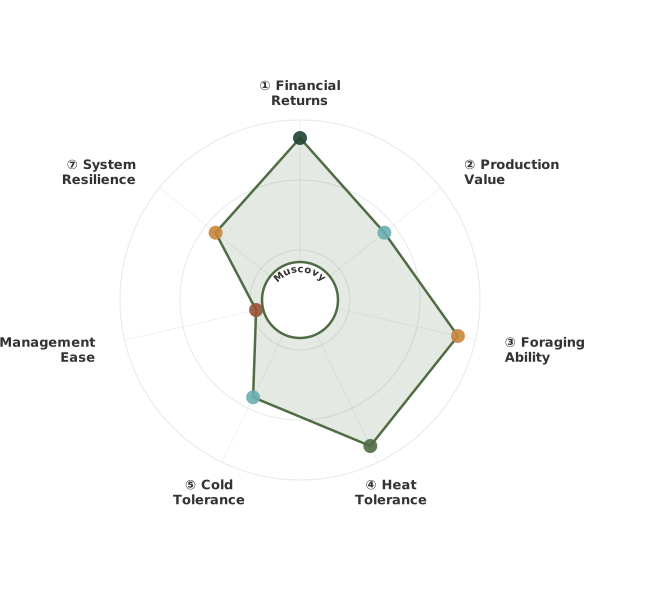
How These Traits Are Calculated
Trait dimensions are ordered clockwise starting from the top of the chart (12 o'clock position):
1. Financial Returns
Annual income per bird from eggs, meat, or specialty products
WHAT: Evaluates profit potential for specialty poultry (turkeys, ducks, geese, guinea fowl) combining meat yield, egg production (where applicable), growth timelines, and market premiums for specialty products.
WHY: Specialty poultry targets premium markets—heritage turkeys at $6-8/lb versus $1.50 commodity, duck eggs at $8-12/dozen versus $3-5 chicken eggs. Understanding enterprise-specific returns helps match birds to market opportunities, with successful operations generating 2-4× returns of conventional poultry.
HOW: Calculated from production data (market weight, timelines, egg yield) combined with efficiency traits and premium market access. Exceptional (≥2.6): strong output + premium markets + efficient growth. Typical (1.8-2.5): moderate production and markets. Limited (<1.8): low output or limited market access.
2. Production Value
Meat yield, egg production, and specialty product quality
WHAT: Measures output quality and quantity combining meat characteristics (size, flavor, texture prized by consumers), egg production (for laying breeds), and specialty products (foie gras, down feathers) that command premiums.
WHY: Production value determines market positioning. Heritage turkeys with superior flavor justify $6-8/lb premiums, duck eggs with rich yolks attract baking customers at $1+ per egg, quality down commands $20-40/lb. High production value enables profitable small-scale operations where commodity birds require large volume to achieve viability.
HOW: Composite assessment of documented production characteristics and market quality. Exceptional (≥2.6): superior product quality + strong output + specialty attributes. Typical (1.8-2.5): good standard production. Limited (<1.8): commodity quality, minimal specialty value.
3. Foraging Ability
Feed cost reduction through natural foraging behavior
WHAT: Measures effectiveness at obtaining nutrition through foraging—consuming insects, seeds, greens, and other natural foods—reducing purchased feed requirements 20-50% in pasture-based systems.
WHY: Aggressive foragers reduce feed costs while providing pest control (insects, ticks, slugs) and weed management services. Turkeys consuming 30-40% of calories from forage save $15-30 per bird over growing season, making the difference between profitable and marginal operations.
HOW: Rated from documented foraging behavior and feed reduction potential. Exceptional (≥2.6): excellent foragers, 40-50% feed reduction, active pest control. Typical (1.8-2.5): moderate foraging, 20-30% reduction. Limited (<1.8): minimal foraging, requires full feeding.
4. Heat Tolerance
Performance in hot weather above 85°F (29°C)
WHAT: Evaluates adaptation to sustained heat above 85°F (29°C), measuring heat stress resistance, growth/production maintenance, and survival during summer peaks. Critical for southern operations and summer meat production.
WHY: Heat stress reduces feed intake 20-40%, slows growth, and increases mortality—particularly problematic for turkeys naturally susceptible to heat. Heat-adapted breeds maintain production schedules where others require expensive cooling or suffer significant losses during summer.
HOW: Rated from database trait 'heat_tolerance' based on documented characteristics. Exceptional (≥2.6): maintains production in 95°F+ (35°C+), low mortality. Typical (1.8-2.5): manageable with shade and water. Limited (<1.8): high heat sensitivity, struggles above 85°F.
5. Cold Tolerance
Performance in cold weather below 20°F (-7°C)
WHAT: Evaluates adaptation to sustained cold below 20°F (-7°C), measuring feather insulation, cold-weather foraging activity, and winter production/growth maintenance. Important for year-round outdoor systems in northern climates.
WHY: Cold-sensitive birds require heated housing ($50-200 monthly winter costs), reduce activity limiting foraging value, and experience higher mortality. Cold-hardy breeds remain active outdoors year-round, maintain winter egg production (ducks/geese), and thrive with basic shelter.
HOW: Rated from database trait 'cold_tolerance' based on breed characteristics. Exceptional (≥2.6): excellent insulation, active in <0°F (-18°C), maintains winter production. Typical (1.8-2.5): moderate hardiness. Limited (<1.8): requires heated shelter, limited winter activity.
6. Management Ease
Handling temperament and care requirements
WHAT: Measures daily management simplicity combining temperament (calm vs flighty/aggressive), health needs, natural breeding ability (versus artificial insemination required), and routine handling cooperation.
WHY: Difficult birds increase labor 2-3× and create safety concerns. Aggressive turkeys or geese require protective equipment during handling, flighty birds complicate catching for processing, breeds requiring AI add complexity. Calm birds with good health enable confident management by beginners.
HOW: Weighted assessment: temperament (50%), health needs (30%), breeding ease (20%). Exceptional (≥2.6): calm and manageable, robust health, natural breeding. Typical (1.8-2.5): manageable with experience. Limited (<1.8): aggressive or nervous, high health needs, or breeding complications.
7. Flock Resilience
Disease resistance and survival under typical stresses
WHAT: Evaluates flock robustness across disease resistance (particularly respiratory issues and common poultry diseases), parasite tolerance, predator awareness, and general hardiness determining survival through typical challenges.
WHY: Resilient breeds maintain productivity through challenges causing 20-50% losses in susceptible birds—surviving disease pressure, evading predators through awareness, resisting parasites. This determines whether flocks thrive with basic care or require intensive interventions and predator-proof housing.
HOW: Composite assessment of documented health and survival characteristics. Exceptional (≥2.6): strong disease resistance + predator-savvy + hardy. Typical (1.8-2.5): standard resilience with routine care. Limited (<1.8): health-sensitive or vulnerable, requires intensive management and protection.
Regenerative Advantages
- Heat Tolerance: Of tropical origin, Muscovys are exceptionally heat-adapted, efficiently cooling through panting and water use to maintain activity.
- Foraging Ability: Muscovy ducks exhibit exceptional foraging ability by readily consuming a wide array of non-grass vegetation, including insects, weeds, seeds, aquatic plants, and small vertebrates. Their inherent scavenging nature allows them to thrive on unimproved pastures, marginal lands, and even scrubby environments, extracting significant nutrition without extensive supplemental feed. This broad dietary flexibility and eagerness to utilize diverse, often low-quality, forage sources allows them to efficiently manage pests and forage for sustenance in a wide range of ecological conditions.
- Noise Level: These ducks are notably quiet, with vocalizations rarely exceeding 50 dB and minimal alarm calling.
- Cold Hardiness: Their dense feathering and robust physique offer remarkable resilience to cold, making them exceptional in frigid conditions without supplemental heat.
- Water Dependency: Adapted to marshy climates, Muscovys are naturally hardy and can forage for water sources, reducing their reliance on supplemental water.
Value Streams
- Meat & Egg production
- Insect and pest control
- Scratch tillage and compost distribution
Experience Level
Some livestock experience recommended (requires confident handling, better for larger operations)
3
Understanding Muscovy Ducks Characteristics
Physical traits, temperament, and what makes this breed unique
Understanding Muscovy Ducks Characteristics
Physical traits, temperament, and what makes this breed unique
Muscovy ducks, scientifically known as *Cairina moschata*, are a unique waterfowl species native to the tropical regions of Mexico and Central and South America. Unlike most domestic ducks, they are not descended from the Mallard but rather from the wild Muscovy duck. A distinctive feature is the presence of caruncles, fleshy red growths, around their eyes and face, which are more pronounced in males. Males are significantly larger than females, often weighing twice as much, and possess a characteristic "hissing" vocalization, lacking the typical "quack." This size difference and unique appearance set them apart from other domesticated duck breeds, making them easily identifiable.
Historically, Muscovy ducks were domesticated by indigenous peoples in South America long before European contact. They were valued for their meat, eggs, and their ability to control pests. Their adaptability to various climates and their relatively docile nature allowed them to spread and become a popular choice for smallholders and homesteaders. Their unique genetic lineage and self-sufficiency made them a resilient livestock option, thriving even in less managed environments.
What truly distinguishes Muscovy ducks is their remarkable foraging ability and their tendency to roost in elevated places, such as on tree branches or specialized roosting structures, rather than exclusively on the ground. They are also known for their relatively quiet nature compared to other ducks, making them a good choice for farms with neighbors. Their strong maternal instincts and ability to go broody further add to their appeal for those looking for a self-sustaining waterfowl flock.
Sources behind this view
 Videos & Podcasts
-
Details plans for raising Muscovy ducks for meat, focusing on pasture foraging, feed conversion rates, and planned feed trials. Also covers mushroom inoculation techniques using various spawn types fo

 Community
-
Muscovy ducks are good mothers with strong broodiness, grazing-dependent, and prefer roosting high. They require water for head-dunking, can be managed for meat, and their droppings/water can fertiliz
Read more (opens in new window) permies.com -
Muscovy ducks are suitable for urban/backyard pest control (slugs) and meat production, converting grass/bugs to protein. They are good mothers but not prolific layers, and require adequate space to p
Read more (opens in new window) permies.com
 Research
-
The Impact of Different Environments on Productive Performance, Welfare, and the Health of Muscovy Ducks during the Summer Season (opens in new window)
Muscovy ducks with pond access grew better and had healthier bones, though slightly less breast meat, compared to those on deep litter alone in a Czech summer study.
4
Management, Care & Feeding
Operational guidance for raising this breed successfully
Management, Care & Feeding
Operational guidance for raising this breed successfully
Managing Muscovy ducks effectively involves providing them with access to pasture or foraging areas, along with clean water for drinking and bathing. While they are excellent foragers, they benefit from supplemental feed, especially during laying season or in winter. A balanced waterfowl feed or a good quality layer ration will support their health and productivity. Ensure they have access to shade during hot weather and protection from predators, which can be a significant concern for ground-nesting birds. Providing roosting bars, even low ones, can encourage their natural inclination to perch off the ground, keeping them cleaner and safer.
Feeding and grazing management for Muscovy ducks should leverage their natural foraging instincts. Allow them ample time on pasture, in orchards, or in areas where insect and weed control is desired. Rotational grazing is ideal, moving them to fresh areas regularly to prevent overgrazing and allow vegetation to recover. Their water needs are crucial; a pond, large trough, or even a kiddie pool will suffice for bathing and drinking. While they can sustain themselves on forage and insects to a degree, supplementing with grains and a protein source will ensure optimal growth and egg production, especially for breeding stock or laying females.
Health management for Muscovy ducks is generally straightforward due to their hardiness. They are less susceptible to common poultry diseases than some other breeds, partly due to their robust immune systems and their ability to forage for beneficial plants. However, maintaining clean water sources is paramount to preventing waterborne illnesses. Regular observation for any signs of injury or illness, such as lameness or lethargy, is important. Parasite control is often managed naturally through their foraging habits and by moving them to clean pastures, but monitoring for external parasites like mites and lice and treating as necessary is good practice. Ensuring they have adequate protection from extreme weather and predators will significantly reduce stress and health issues.
Sources behind this view
Videos & Podcasts
-
Details plans for raising Muscovy ducks for meat, focusing on pasture foraging, feed conversion rates, and planned feed trials. Also covers mushroom inoculation techniques using various spawn types fo
Community
-
Provides detailed guidance on Muscovy duck hatching, emphasizing long incubation, the need for water, caution against wiping eggs, and the benefits of males for meat and mosquito control.
Read more (opens in new window) permies.com -
A case study details raising Muscovy ducks, noting their resilience, high-quality eggs from forage, and need for supplemental feed and predator protection, with pros including self-sufficiency and con
Read more (opens in new window) permies.com -
A SARE-funded project tested integrating ducks into shiitake mushroom agroforestry, finding heritage breeds best for meat, establishing a 'slug-free moat' for pest control, and shifting focus from cos
Read more (opens in new window) smallfarms.cornell.edu
Research
-
The Impact of Different Environments on Productive Performance, Welfare, and the Health of Muscovy Ducks during the Summer Season (opens in new window)
Muscovy ducks with pond access grew better and had healthier bones, though slightly less breast meat, compared to those on deep litter alone in a Czech summer study.