
Navajo-Churro Sheep
Also known as: navajo churro, churro sheep
Navajo-Churro sheep simplify management with their exceptional lambing ease, remarkable cold hardiness, and superior foraging ability, thriving on diverse pastures with minimal intervention. This ancient breed, descended from sheep brought by Spanish colonists, is also renowned for its excellent mothering instincts, ensuring healthy lamb survival. Beyond their hardiness, Navajo-Churros offer good meat quality and desirable wool, making them a true dual-purpose animal. Their inherent parasite resistance further reduces labor and veterinary costs. These traits make them particularly well-suited for rotational grazing and silvopasture systems, where their natural grazing prowess can be fully utilized.
Regenerative Quick Profile
Best Suited For
Climates: Semi-arid to humid subtropical and temperate continental
Terrain: Excels on rolling to steep terrain
Scale: Excellent for small homesteads (1-10 animals)
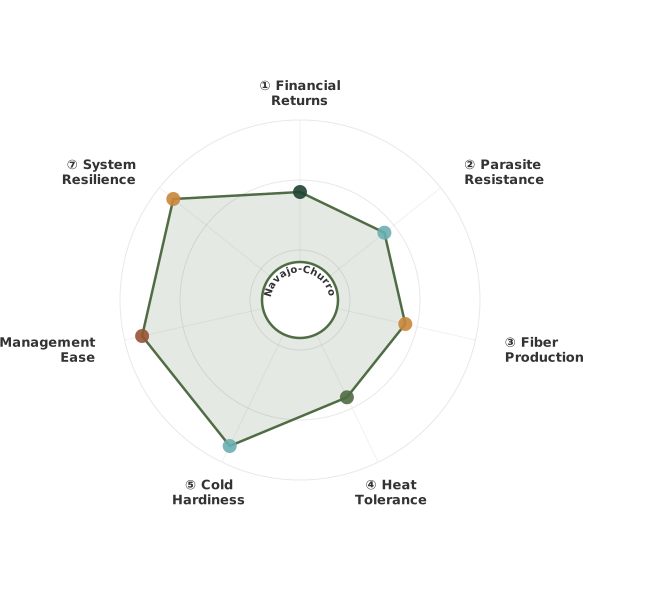
How These Traits Are Calculated
Trait dimensions are ordered clockwise starting from the top of the chart (12 o'clock position):
1. Financial Returns
Annual income per ewe from lamb sales and wool
WHAT: Evaluates annual profit potential combining lamb production (twins, growth rates), wool value, and input costs. Dual-purpose breeds excelling in both meat and wool provide diversified income streams more resilient to market fluctuations.
WHY: Sheep economics depend on lambing percentages and fleece value. Breeds consistently producing twins with good growth plus quality fleece generate $200-400 annual returns per ewe, while single-lamb low-wool breeds struggle to cover costs at small scales.
HOW: Calculated from production data (lambing rate, lamb growth, fleece weight, wool quality) combined with input costs and efficiency traits. Exceptional (≥2.6): high lambing percentage + valuable wool + low costs. Typical (1.8-2.5): moderate production. Limited (<1.8): low output or high costs.
2. Parasite Resistance
Natural resistance to internal parasites (worms)
WHAT: Measures genetic resistance to gastrointestinal parasites (primarily barber pole worm and other internal worms), evaluated through fecal egg counts, documented resistance breeding programs, and performance in parasite-prone regions.
WHY: Internal parasites are the #1 health challenge in sheep, causing 30-50% of flock deaths and requiring frequent deworming that breeds resistance. Breeds with natural parasite resistance reduce deworming 60-80%, lower mortality, and maintain productivity in warm humid climates where parasites thrive year-round.
HOW: Rated from database trait 'parasite_resistance' based on genetic selection and documented performance. Exceptional (≥2.6): tested resistance lines, low fecal egg counts, thrives in parasite-heavy regions. Typical (1.8-2.5): moderate resistance, standard deworming sufficient. Limited (<1.8): highly susceptible, requires intensive parasite management.
3. Wool Production
Annual fleece weight and wool quality value
WHAT: Evaluates wool production combining fleece weight (total pounds annually) and wool quality (fineness, crimp, luster, cleanliness) that determines market value. Measures both quantity and quality of fiber output.
WHY: Wool provides significant income diversification—quality fleeces fetch $50-200 annually versus $10-30 for low-grade wool. In meat-focused operations, wool that covers shearing costs is sufficient, but fiber-focused flocks need high-quality production to be viable.
HOW: Weighted formula: wool quality characteristics (60%), fleece weight (40%). Exceptional (≥2.6): premium quality (fine, lustrous, clean) + heavy fleeces 10-15 lbs. Typical (1.8-2.5): standard wool, moderate weight. Limited (<1.8): coarse or light fleeces with minimal market value.
4. Heat Tolerance
Performance in hot weather above 85°F (29°C)
WHAT: Evaluates adaptation to sustained heat above 85°F (29°C), measuring coat characteristics (hair vs wool, shedding ability), heat stress resistance, and documented performance in hot climates.
WHY: Heat stress reduces feed intake, lowers reproduction rates, and increases mortality, especially in wool breeds where heavy fleeces trap heat. Hair sheep and shedding breeds thrive in southern climates where wool breeds struggle without intensive cooling or frequent shearing.
HOW: Rated from database trait 'heat_tolerance' based on breed type and adaptation. Exceptional (≥2.6): hair breeds or natural shedders, proven in 95°F+ (35°C+), minimal cooling needed. Typical (1.8-2.5): moderate tolerance with shade and water. Limited (<1.8): heavy fleece, struggles above 85°F.
5. Cold Hardiness
Performance in cold weather below 20°F (-7°C)
WHAT: Evaluates adaptation to sustained cold below 20°F (-7°C), measuring wool insulation, body size, metabolic efficiency, and documented winter performance. Particularly important for wool breeds in northern climates.
WHY: Cold stress increases feed requirements for maintenance, complicates winter lambing, and can cause mortality in newborns. Cold-hardy breeds with dense wool coats thrive outdoors year-round, minimizing barn infrastructure and winter feed costs.
HOW: Rated from database trait 'cold_hardiness' based on documented characteristics. Exceptional (≥2.6): dense fleece, northern origins, thrives in <0°F (-18°C) with basic shelter. Typical (1.8-2.5): moderate hardiness. Limited (<1.8): requires heated shelter or struggles with winter lambing.
6. Management Ease
Handling temperament and maternal care quality
WHAT: Measures daily management simplicity combining temperament, lambing ease (unassisted births), and mothering ability (bonding, milk production, lamb survival). Easy breeds require minimal intervention during critical lambing period.
WHY: Difficult sheep increase labor 3-4× through lambing interventions, bottle-feeding rejected lambs, and handling challenges. Breeds with easy lambing and strong mothers enable one-person operations where complicated breeds require round-the-clock monitoring during lambing season.
HOW: Weighted formula: lambing ease (50%), mothering ability (50%). Exceptional (≥2.6): unassisted lambing, excellent mothers, high lamb survival. Typical (1.8-2.5): occasional assistance, good maternal instincts. Limited (<1.8): frequent interventions, weak mothers, high rejection rates.
7. Flock Resilience
Health and survival under stress conditions
WHAT: Evaluates flock robustness across multiple dimensions: drought tolerance (forage scarcity adaptation), fescue toxicity resistance (endophyte tolerance), browsing ability (dietary flexibility), and terrain adaptation (sure-footedness on hills or rough ground).
WHY: Resilient breeds maintain productivity through challenges that devastate others—surviving drought years on sparse forage, thriving on fescue pastures toxic to others, utilizing brushy terrain, navigating steep hillsides. This determines whether flocks require intensive management or thrive with minimal inputs.
HOW: Weighted formula: drought tolerance (40%), fescue tolerance (25%), browsing ability (20%), terrain adaptation (15%). Exceptional (≥2.6): thrives through drought + fescue-tolerant + browsers + sure-footed. Typical (1.8-2.5): moderate resilience. Limited (<1.8): sensitive to stress, requires controlled conditions.
Regenerative Advantages
- Drought Tolerance: Developed by the Navajo people in arid lands, this ancient breed is exceptionally drought-tolerant, efficiently using dry forage and requiring minimal water.
- Foraging Ability: Navajo-Churro sheep demonstrate exceptional foraging, thriving on the diverse, marginal vegetation characteristic of their ancestral arid and mountainous environments. Their ability to subsist on sparse forages, including brush and weeds, with minimal supplementation highlights their genetic adaptation to unimproved rangelands. This broad utilization of varied and less palatable plant matter signifies a true landrace proficiency in foraging.
- Mothering Ability: With strong maternal instincts and good milk production, Navajo-Churro ewes consistently raise lambs, including multiples, with minimal human intervention.
- Lambing Ease: Navajo-Churro sheep are renowned for their exceptional lambing ease and robust maternal instincts, ensuring high lamb survival rates in extensive grazing scenarios.
- Terrain Steep: With ancestral grazing across rugged high-desert landscapes, Navajo-Churro sheep exhibit superior balance and sure-footedness on steep and uneven terrain.
Know the Debate
- Heritage breed excels in low-input, pasture-based systems.
- Parity with commercial breeds debated for market competitiveness.
- Hardiness and parasite resistance reduce veterinary costs.
- Dual-purpose potential for meat and niche wool markets.
Value Streams
- Nutrient cycling and soil building
- Pasture management
Experience Level
Consult local experts for handling requirements
4
Know the Debate
Navajo-Churro sheep offer a unique proposition for regenerative systems, valued for their hardiness, adaptability, and heritage qualities. However,...
Know the Debate
Navajo-Churro sheep offer a unique proposition for regenerative systems, valued for their hardiness, adaptability, and heritage qualities. However,...
Navajo-Churro sheep offer a unique proposition for regenerative systems, valued for their hardiness, adaptability, and heritage qualities. However, their economic viability in commercial markets compared to specialized breeds is a point of discussion. While ideal for low-input, pasture-based operations emphasizing resilience, their slower growth and distinct wool qualities present different considerations for farmers targeting high-volume meat production or conventional wool markets. Success hinges on aligning breed strengths with specific market demands and management intensity.
Are Navajo-Churro sheep economically competitive in modern agricultural markets?
Niche Market Viability (Resilient & Low-Input)
Practitioners and heritage breed advocates highlight Navajo-Churros' exceptional hardiness, parasite resistance, and lambing ease. They thrive in low-input, pasture-based systems, requiring minimal intervention and specialized infrastructure, making them cost-effective for regenerative operations focused on whole-systems benefits and niche fiber markets.
Sources behind this view
Sources behind this view
 Videos & Podcasts
-
Recommends Saint Croix sheep for parasite resistance and low-input winter grazing on diverse forage, contrasting with management-intensive Dorpers. Highlights the importance of guard dogs and culling for resilience, not deworming, especially in higher rainfall environments.
 From the Web
-
Arriola Sunshine Farm in Dolores, Colorado, uses Holistic Management and planned rotational grazing with Navajo-Churro sheep to restore land productivity. Key practices include 3-7 day grazing periods with 35-60 day recovery, maximizing animal impact for fertility, and intensive monitoring. This has doubled forage production, increased soil organic matter by nearly 200%, and improved profitability.
-
Guide to selecting sheep breeds based on market, climate, and preference, categorizing breeds and emphasizing healthy animal selection and record-keeping to avoid issues from sale barns.
Commercial Market Challenges (Slower Growth & Lower Yield)
Academic and extension sources suggest that for commercial wool and meat production, breeds like Suffolk, Texel, or Dorper offer higher wool yields and faster growth to market weight. These breeds are often favored for their rapid development and established market demand, potentially leading to quicker profitability compared to heritage breeds.
Sources behind this view
Sources behind this view
Videos & Podcasts
-
Compares Suffolk and Texel rams as terminal sires, discussing their impact on carcass merit, growth rate, and maternal traits. Analysis includes a case study of a ram's performance and the goal of complementing existing Texel genetics.

 Research
-
Retrospective Study of Production and Commercialization of Sheep Wool from Mexico (opens in new window)
This study found: A review of sheep wool production in Mexico from 1980 to 2019 shows that the country produces less wool than it needs, requiring imports. The study emphasizes how local sheep breeds, like the 'Chiapas sheep,' are vital for preserving traditional crafts. To boost the wool industry, the research suggests considering sheep breeds that are good for both wool and meat production. This approach could help meet national demand and support local economies.
From the Web
-
Coffey Ranch implemented electric poly wire fencing to contain hair sheep (Katahdin and Dorper ewes), chosen for their hardiness, parasite resistance, and low maintenance. These sheep utilize available forage, including weeds, reducing feed and chemical costs and offering quick profitability potential.
Making Sense of the Differences
The economic competitiveness of Navajo-Churro sheep hinges on the target market and management approach. While their hardiness and low-input needs make them highly cost-effective in regenerative, niche fiber, or extensive grazing operations, commercial meat or high-volume wool production may favor breeds with faster growth rates and higher yields. Farmers should assess their local markets, labor availability, and long-term goals to determine if the unique strengths of the Navajo-Churro align with their economic objectives.
5
Management, Care & Feeding
Operational guidance for raising this breed successfully
Management, Care & Feeding
Operational guidance for raising this breed successfully
Managing Navajo-Churro sheep effectively in a regenerative system requires an understanding of their unique needs and strengths. Their hardy nature means they generally require less intensive management than some other breeds, thriving on well-managed pastures with access to clean water and basic shelter. Rotational grazing is highly recommended to maximize pasture utilization, promote plant diversity, and prevent overgrazing, which aligns with their natural grazing habits. Supplementation should be minimal and based on forage quality, with a focus on providing essential minerals, especially for pregnant or lactating ewes. Health management should be proactive, emphasizing good pasture hygiene, regular observation for any signs of illness or parasites, and utilizing natural remedies or minimal interventions when possible. Their distinctive fleece also requires specific handling; shearing should be done carefully to preserve the quality of both the outer and inner coats, catering to the needs of artisans and weavers.
Sources behind this view
 Community
-
Suggests Navajo Churro and Icelandic sheep for the southeast, highlighting hardiness and wool quality. Recommends integrating goats, livestock guardian dogs (with training tips), chickens, and donkeys
Read more (opens in new window) permies.com
From the Web
-
Arriola Sunshine Farm in Dolores, Colorado, uses Holistic Management and planned rotational grazing with Navajo-Churro sheep to restore land productivity. Key practices include 3-7 day grazing periods