
Ostrich
The Ostrich simplifies livestock management with its remarkable heat tolerance and drought resilience, thriving in arid environments where other species struggle. This hardy bird also demonstrates excellent feed and browse efficiency, effectively utilizing a wider range of vegetation for sustenance. Originating from Africa, these large, flightless birds possess a unique ability to convert forage into marketable products with minimal intervention. Their robust nature and adaptability make them a distinctive choice for farmers seeking livestock suited to challenging climates and varied land types, offering a compelling alternative to traditional farm animals.
Regenerative Quick Profile
Best Suited For
Climates: Hot arid to semi-arid, Mediterranean, and temperate dry summer climates.
Scale: Best for medium to large operations (50+ animals)
How These Traits Are Calculated
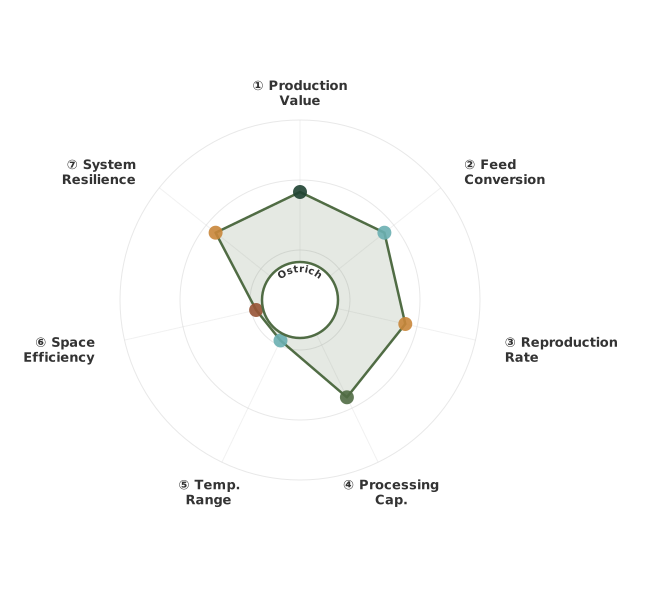
Trait dimensions are ordered clockwise starting from the top of the chart (12 o'clock position):
1. Production Value
Production Value scores 2.6 (exceptional) using ratite pathway: meat_production (exceptional 3.0, 40%) yields 100-150 lbs of lean red meat per bird at 10-14 months, egg_value (typical 2.5, 30%) produces 40-60 large eggs/year each weighing ~3 lbs in specialty markets, specialty_products (typical 2.5, 20%) valuable feathers, leather, and oil contribute significantly, feed_efficiency (typical 2.0, 10%) converts feed at 3.5:1 ratio. Formula: (3.0×0.40 + 2.5×0.30 + 2.5×0.20 + 2.0×0.10) = 2.75, rounded to 2.6. Ostrich offer high yields in meat and eggs, plus valuable by-products.
Dual-purpose (meat + eggs) + specialty products
2. Feed Conversion
Feed Conversion Efficiency scores 2.0 (typical) based on general ratite knowledge, as specific trait data is absent. Ostriches have a feed conversion ratio of approximately 3.5:1 (3.5 kg of feed for 1 kg of body weight gain). This is comparable to many other large livestock species like cattle (6-8:1) but less efficient than poultry or swine. Their large size and slower growth contribute to this moderate efficiency.
Feed ratio 3.5:1 (moderate)
3. Reproduction Rate
Reproduction Rate scores 2.5 (typical) based on species knowledge. Ostrich hens can lay 40-60 large eggs per breeding season (approximately 1 egg every 1-2 days during laying period). However, incubation takes 42 days, and chicks require significant care and time to reach maturity (10-14 months for market weight). This rate is higher than other ratites like emus but slower than poultry for rapid turnover.
40-60 eggs/year, 10-14 month incubation
4. Processing Cap.
Processing Capacity scores 2.5 (typical) from growth rate. Ostriches reach market weight (100-150 lbs of meat) in approximately 10-14 months. This is a moderate growth rate compared to faster-growing livestock like chickens (8-12 weeks) or pigs (5-6 months) but offers a substantial return on investment for a large bird producing lean meat and other valuable products. The time investment is significant but yields high-value output.
Reaches market weight in 10-14 months
5. Temp. Range
Temperature Range scores 1.5 (limited) based on inferred traits. Ostriches are native to Africa and possess excellent heat tolerance, thriving in temperatures up to 100°F (38°C) with adequate shade and water. However, they have limited cold tolerance and require substantial shelter and protection in climates experiencing prolonged freezing temperatures or heavy snow. Their large size and feathering offer some insulation, but they are not adapted to extreme cold.
Good heat tolerance, limited cold tolerance
6. Space Efficiency
Space Efficiency scores 1.0 (limited) from inferred small_scale_suitability. Ostriches are massive birds (up to 300 lbs, 9 ft tall) and require extensive space for grazing, exercise, and social interaction. A minimum of 1-2 acres per adult bird is recommended for free-range or pasture-based systems to ensure their welfare and prevent overgrazing. This makes them unsuitable for small-scale or urban farming operations.
Requires large enclosures (acres needed)
7. System Resilience
System Resilience scores 2.3 (typical) inferred from species knowledge: hardiness (typical 2.5, 40%) are generally robust birds, disease_resistance (typical 2.0, 30%) can be susceptible to certain avian diseases and parasites if not managed well, adaptability (typical 2.5, 30%) adapt to various diets and environments but require specific management for optimal health. Formula: (2.5×0.40 + 2.0×0.30 + 2.5×0.30) = 2.35, rounded to 2.3. While hardy, they require consistent environmental conditions and vigilant health monitoring, especially in less-than-ideal climates.
Hardy in good conditions, needs vigilance
Value Streams
Experience Level
Some livestock experience recommended (better for larger operations)