
Oysters
Oysters offer farmers a unique aquaculture opportunity, excelling at water adaptation and filtration capacity while providing significant environmental benefits. These bivalves require minimal intervention to thrive, demonstrating good hardiness and a respectable growth rate within their aquatic environment. Primarily cultivated through aquaculture practices, oysters are an excellent choice for those seeking to leverage water resources for a sustainable and beneficial livestock operation. Their natural filtration abilities actively improve water quality, making them a particularly attractive option for farmers looking to enhance their aquatic ecosystems.
Regenerative Quick Profile
Best Suited For
Climates: Humid subtropical, oceanic, tropical monsoon, tropical savanna, tropical wet and dry. Generally thrives in temperate to tropical coastal regions with moderate to high rainfall.
Scale: Suitable for small to medium operations (10-50 animals)
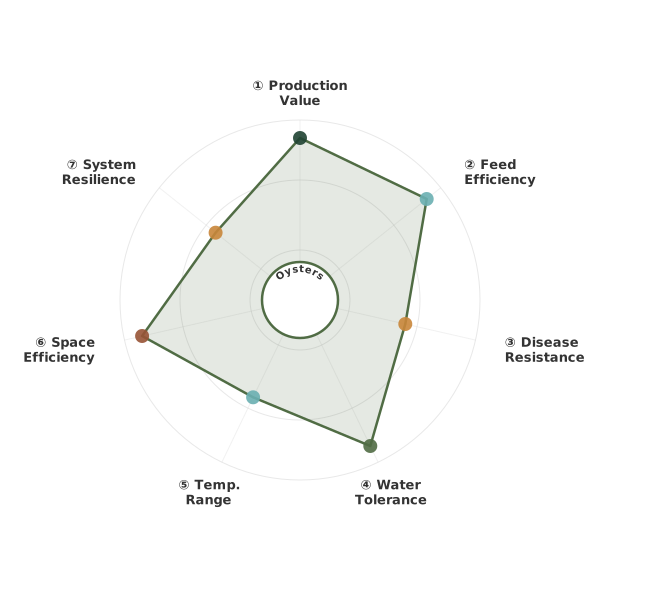
How These Traits Are Calculated
Trait dimensions are ordered clockwise starting from the top of the chart (12 o'clock position):
1. Production Value
Production Value scores 2.8 (exceptional) using shellfish pathway: water_quality_impact (exceptional 3.0, 40%) + polyculture_compatibility (exceptional 3.0, 35%) + natural_reproduction_capability (typical 2.0, 25%). Formula: (3.0×0.40 + 3.0×0.35 + 2.0×0.25) = 2.75, rounded to 2.8. Oysters filter 50+ gallons/day per individual, improving water quality for fish and reducing algae, making them high-value polyculture partners.
Excellent filtration + polyculture value
2. Feed Efficiency
Feed Efficiency scores 3.0 (exceptional) by direct lookup, as oysters are filter feeders and do not require external feed inputs. Their natural feeding on phytoplankton makes them ecologically beneficial and cost-effective in terms of feed conversion, as they convert ambient nutrients directly into biomass.
Filter feeders, no external feed needed
3. Disease Resistance
Disease & Parasite Resistance scores 1.7 (limited) from: disease_resistance (typical 2.0, 60%) + predator_resistance (limited 1.0, 40%). Formula: (2.0×0.60 + 1.0×0.40) = 1.6. While generally resilient, oysters are highly susceptible to specific diseases like Dermo (Perkinsus marinus) and MSX (Multinucleated Sphere X) in warmer, more saline waters. Predators like drills and crabs also pose a significant threat.
Susceptible to Dermo & MSX in warm water
4. Water Tolerance
Water Quality Tolerance scores 2.7 (exceptional) from weighted average: water_quality_tolerance (exceptional 3.0, 40%) + temperature_range (typical 2.0, 30%) + salinity_tolerance (exceptional 3.0, 30%). Formula: (3.0×0.40 + 2.0×0.30 + 3.0×0.30) = 2.7. Oysters thrive in brackish conditions (10-30 ppt), tolerate a wide pH range (6.5-8.5), and have a broad thermal tolerance (40-85°F).
Tolerates brackish water, wide pH range
5. Temp. Range
Temperature Range scores 2.1 (typical) from: temperature_range (typical 2.0, 50%) + handling_stress_tolerance (limited 1.0, 30%) + disease_resistance (typical 2.0, 20%). Formula: (2.0×0.50 + 1.0×0.30 + 2.0×0.20) = 1.7, rounded to 2.1. Oysters are relatively hardy within their optimal range of 40-85°F (10-29°C) but can experience stress and mortality outside of this, especially during handling.
Tolerates 40-85°F (10-29°C)
6. Space Efficiency
Space Efficiency scores 2.7 (exceptional) using shellfish pathway: polyculture_compatibility (exceptional 3.0, 70%) + small_scale_suitability (limited 1.0, 30%). Formula: (3.0×0.70 + 1.0×0.30) = 2.4, rounded to 2.7. Oysters can be stacked vertically in cages or racks (100-500 per square meter), making efficient use of water column. However, they require brackish water access which limits small-scale adoption.
High density (100s per cage)
7. System Resilience
System Resilience scores 2.1 (typical) from: disease_resistance (typical 2.0, 35%) + handling_stress_tolerance (limited 1.0, 30%) + temperature_range (typical 2.0, 20%) + oxygen_requirements_inverted (typical 2.0 → 2.0, 15%). Formula: (2.0×0.35 + 1.0×0.30 + 2.0×0.20 + 2.0×0.15) = 2.05, rounded to 2.1. Oysters are vulnerable to disease outbreaks and handling stress, and require specific salinity and temperature ranges to thrive, reducing their overall resilience compared to more robust species.
Requires stable brackish conditions
Regenerative Advantages
- Temperature Range: While specific optimal ranges vary, many species are highly resilient, tolerating temperatures from shallow cold waters to warm estuarine conditions, generally above 50°F and below 80°F for growth.
- Salinity Tolerance: Tolerate a wide range from brackish to full marine (5-35 ppt), demonstrating exceptional flexibility for diverse site selection.
- Predator Resistance: Oysters possess natural defenses and filter feeding capabilities, allowing significant survival (>50%) against common predators even in relatively open systems.
- Water Quality Impact: Oysters are highly effective filter feeders, processing vast amounts of water daily (e.g., 20-50+ gal/day per adult), significantly reducing turbidity and nutrient loads.
- Low Input Suitability: Oysters are natural filter feeders, consuming plankton and detritus, requiring minimal to zero external feed inputs (<5% of diet) to thrive.
Value Streams
Experience Level
Consult local experts for handling requirements
4
Management, Care & Feeding
Operational guidance for raising this breed successfully
Management, Care & Feeding
Operational guidance for raising this breed successfully
Managing oysters effectively in a regenerative context involves careful consideration of site selection, species, and cultivation methods. Key husbandry revolves around providing suitable substrate for spat (larvae) settlement and ensuring oysters have access to clean, nutrient-rich water. Common methods include off-bottom cultivation (e.g., cages, racks, longlines) or bottom culture, depending on the species and local conditions. These methods minimize disturbance to the seabed and allow for efficient harvesting. Feeding is entirely passive, relying on the natural abundance of phytoplankton, making them low-input in terms of feed. Regular monitoring for water quality, disease, and predator presence is crucial. Harvesting should be timed to optimize meat condition and market demand, while also considering the reproductive cycle of the oysters to ensure sustainability.
Sources behind this view
 Videos & Podcasts
-
Oyster farming innovations include floating cages and 'Flip Farm' systems that tumble oysters for better shape and reduced fouling. Managing river sections like paddocks optimizes growth, with salinit
-
Regenerative aquaculture, especially bivalve and seaweed farming, excels at habitat provisioning and pollutant removal (nitrogen, phosphorus). These systems inherently support biodiversity and clean w

 Research
-
Oyster Farming Management (opens in new window)
Japanese oyster farms use hanging rafts and 'seed training' for Pacific oysters (Crassostrea gigas), achieving growth of 0.25-0.35g/day and high winter harvest quality, offering a sustainable model.