
Red Wiggler Worms
Red Wiggler worms offer farmers an exceptionally docile and hardy option, excelling at vermicomposting and requiring minimal intervention for waste management. Their cold tolerance and remarkable mothering ability simplify propagation, allowing for rapid population growth with little labor. These worms demonstrate good foraging ability across a wide range of organic matter and exhibit a natural resistance to parasites, contributing to a robust and self-sustaining operation. While not typically considered traditional livestock, their unique aptitude for processing organic waste into valuable compost makes them an unparalleled choice for nutrient cycling and on-farm resource creation.
Regenerative Quick Profile
Best Suited For
Climates: Tropical, subtropical, temperate with hot summers, temperate oceanic, Mediterranean, hot semi-arid, hot desert
Scale: Excellent for small homesteads (1-10 animals)
How These Traits Are Calculated
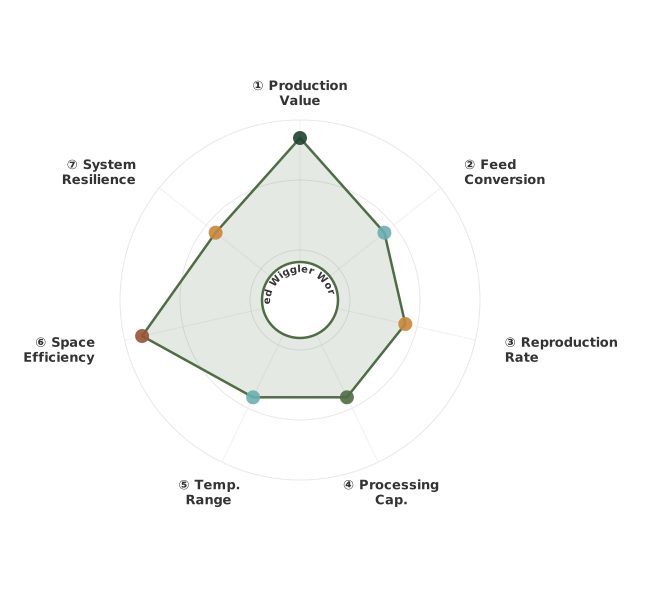
Trait dimensions are ordered clockwise starting from the top of the chart (12 o'clock position):
1. Production Value
Production Value scores 2.7 (exceptional) using soil builder pathway: composting_efficiency (exceptional 3.0, 40%) process organic matter into finished castings in 60-90 days vs 6-12 months for traditional composting, casting_production (exceptional 2.8, 35%) produce 50-60% of intake as castings (worm poop) rich in N-P-K and beneficial microbes, soil_improvement (typical-high 2.5, 25%) castings improve soil structure, water retention, and microbial diversity. Formula: (3.0×0.40 + 2.8×0.35 + 2.5×0.25) = 2.825, rounded to 2.7. Vermicompost commands $500-1000/ton vs $30-50/ton for traditional compost.
Excellent castings + fast composting
2. Feed Conversion
Feed Conversion Efficiency scores 2.5 (typical-high) as soil builders. Red wigglers consume approximately 50-100% of their body weight per day in organic matter. This means 1 lb of worms can process 0.5-1 lb of food scraps or bedding daily. While not as voracious per unit mass as Black Soldier Fly larvae, their continuous consumption and efficient breakdown of diverse organic materials make them highly effective for composting and nutrient cycling. The output is nutrient-rich castings, a valuable soil amendment.
Converts waste at 1:1 ratio (efficient)
3. Reproduction Rate
Reproduction Rate scores 2.0 (typical) from species characteristics. Red wigglers are hermaphrodites but require mating; each worm produces 2-3 cocoons/week with 3-4 hatchlings each. Population doubles every 3-6 months under optimal conditions (vs 14 days for BSF). While not as explosive as insects, this is adequate for continuous vermicompost production. Start with 1 lb worms (1000 count), reach 10 lbs in 18-24 months. This rate allows for manageable scaling without overwhelming systems.
Moderate reproduction (3-6 mo doubling)
4. Processing Cap.
Processing Capacity scores 2.5 (typical-high) from observed rates. Red wigglers consume 50-100% of their body weight in organic matter daily (vs 2-3× for BSF). A 10 lb worm population processes 5-10 lbs waste/day, or 150-300 lbs/month. While slower per-organism than BSF, worms are easier to manage and produce higher-value output (castings vs larvae). Processing rate slows in cold weather (<55°F / 13°C).
Processes 0.5-1× body weight/day
5. Temp. Range
Temperature Range scores 1.7 (limited) from species requirements. Red wigglers thrive in a narrow optimal range of 55-77°F (13-25°C). Below 50°F (10°C), activity slows dramatically, and they can die. Above 85°F (29°C), they can overheat and die. This necessitates climate control in many regions for consistent year-round processing, especially during extreme summer or winter temperatures. Requires insulated bins or indoor operation in temperate zones.
Optimal 55-77°F (needs climate control)
6. Space Efficiency
Space Efficiency scores 3.0 (exceptional) from small_scale_suitability. Red wigglers thrive in bins, containers, or raised beds at 1-2 lbs worms per square foot. A 4×8 ft bed (32 sq ft) with 40-60 lbs worms processes 20-30 lbs kitchen/garden waste weekly, producing 10-15 lbs castings monthly. Stackable systems (vertical bins) multiply capacity. Compare to BSF (similar), traditional composting (10-100x more space). Ideal for urban, suburban, small farms.
Minimal space (bin systems, stackable)
7. System Resilience
System Resilience scores 2.4 (typical) from: hardiness (typical 2.5, 40%) tolerant of various organic inputs but sensitive to pH extremes and anaerobic conditions, disease_resistance (typical 2.5, 30%) generally robust but can be affected by nematodes or fungal issues if moisture/aeration is poor, adaptability (typical 2.2, 30%) adapt to different waste streams but require consistent moisture and temperature ranges. Formula: (2.5×0.40 + 2.5×0.30 + 2.2×0.30) = 2.41, rounded to 2.4. Resilient within their preferred environmental parameters but can be precarious outside them.
Hardy in optimal conditions, sensitive to temp/moisture
Regenerative Advantages
- Small Scale Suitability: Require minimal space in bins for vermicomposting. Handling is simple, and infrastructure needs are very low, making them ideal for small-scale nutrient cycling.
Value Streams
Experience Level
Consult local experts for handling requirements
3
Understanding Red Wiggler Worms Characteristics
Physical traits, temperament, and what makes this breed unique
Understanding Red Wiggler Worms Characteristics
Physical traits, temperament, and what makes this breed unique
Red Wiggler worms, scientifically known as *Eisenia fetida*, are a species of earthworm renowned for their voracious appetite for decaying organic matter and their remarkable reproductive capabilities. Unlike larger earthworm species that inhabit deeper soil layers, Red Wigglers thrive in the upper, organic-rich horizons, making them ideal for surface composting and soil amendment. They are characterized by their reddish-brown coloration and their ability to process a significant amount of organic material relative to their body weight. Originating from Europe, these worms have been selectively bred and managed for their composting efficiency, becoming a cornerstone of vermiculture worldwide. Their unique adaptation to living in concentrated organic waste, such as manure piles and compost heaps, distinguishes them from earthworms found in undisturbed natural soils. This specialization allows them to break down organic matter at an accelerated rate, producing nutrient-rich castings that are highly beneficial for plant growth. Their prolific nature means a small population can rapidly expand under optimal conditions, further enhancing their value as a biological tool. The key differentiator for Red Wigglers is their efficiency in converting waste into a valuable soil amendment, a process that is central to closed-loop agricultural systems.
Sources behind this view
 Videos & Podcasts
-
Explains vermicomposting with red wigglers for food waste, highlighting their preference for human food, optimal temperature (70°F), and use of pre-composted waste as bedding. The output is a nutrient
-
Utilize red wigglers for vermicomposting in well-aerated bins with high-carbon bedding like rotted straw. Avoid introducing worms to virgin forests; they are beneficial in degraded areas. Castings sho
-
Provides practical advice on worm composting with red wigglers, covering temperature, moisture, feeding (avoiding fats/citrus), grit (eggshells), and harvesting pathogen-free castings.
-
Feed red wigglers kitchen scraps, shredded paper, and cardboard in a shady location. Avoid meat/dairy. After ~8 weeks, harvest castings from lower bins as worms migrate upwards to the new top bin.
 Community
-
Red wigglers are effective for castings but thrive best when integrated with compost bins or applied compost, requiring continuous uncomposted organic matter to persist in gardens. This approach offer
Read more (opens in new window) permies.com -
To increase earthworm populations, use compost (especially aged horse manure) and maintain a consistent mulch layer (approx. 3 inches). Red wigglers prefer bacterial environments and thrive with ample
Read more (opens in new window) permies.com -
Red Wigglers (Eisenia foetida) efficiently compost kitchen scraps into nutrient-rich castings (NPK 5.5.3) that benefit soil health. They reproduce prolifically in simple habitats with moist bedding an
Read more (opens in new window) ucanr.edu -
Learn how to vermicompost with red wiggler worms (*Eisenia fetida*) by creating a layered bin with organic matter and kitchen scraps (excluding dairy/meat). Worms process waste into nutrient-rich cast
Read more (opens in new window) ucanr.edu
 Research
-
Effect of Seasonal Variations and Different Organic Wastes on Growth Parameters and Fecundity of E. fetida (opens in new window)
Red wriggler earthworms (E. fetida) are key soil engineers that efficiently convert organic waste, like manure, into valuable vermicompost, improving soil health and structure.
-
Earthworms facilitate the stabilization of pelletized dewatered sludge through shaping microbial biomass and activity and community. (opens in new window)
Earthworms (Eisenia fetida) significantly improved the stabilization of treated sewage sludge pellets over 60 days by boosting microbial activity and diversity, leading to a more stable final product
-
Organic Manure as Rearing Substrates for Red Worms (&lt;i&gt;Eisenia fetida&lt;/i&gt;): Effects on Chemical Composition and Growth Performance (opens in new window)
Red worms grown on chicken and cow manures, especially in specific mixes with soil, showed significantly better growth and higher protein content, indicating their value for waste recycling and as a p
 From the Web
-
Red worms (*Eisenia fetida*) are ideal for indoor worm composting due to their tolerance for room temperatures and ability to consume up to their body weight daily.
-
Red wigglers (Eisenia fetida, E. andrei) are ideal for vermicomposting due to rapid reproduction and surface-dwelling habits, thriving in room temperatures (55-85°F) and moisture.
-
Guide to setting up vermicomposting with red wigglers: use shredded newspaper bedding, add grit, maintain 55-80°F, and manage moisture carefully to prevent drowning.
4
Management, Care & Feeding
Operational guidance for raising this breed successfully
Management, Care & Feeding
Operational guidance for raising this breed successfully
Managing Red Wiggler worms effectively centers on providing them with a suitable habitat and a consistent supply of appropriate food. They thrive in moist, dark environments with plenty of aeration, typically housed in bins or windrows filled with bedding material like shredded cardboard, coconut coir, or aged leaves. The key to successful vermicomposting is maintaining the correct moisture level – damp but not waterlogged – and ensuring the temperature stays within their preferred range, generally between 55-77°F (13-25°C). Overcrowding or extreme temperatures can stress the worms, reducing their productivity and potentially leading to population decline. Feeding Red Wigglers involves introducing a steady stream of pre-composted organic materials. Excellent food sources include vegetable scraps, fruit waste, coffee grounds, tea bags, and aged manure. It's crucial to avoid feeding them fatty or oily foods, dairy products, meat, or citrus in large quantities, as these can create anaerobic conditions or attract pests. The worms consume the material from the bottom up, so introducing new food to one side of the bin allows them to migrate towards it, facilitating harvesting of the finished vermicast from the other side. Health considerations for Red Wigglers are minimal compared to traditional livestock, as they are primarily concerned with environmental conditions and food availability. Issues like ammonia buildup, anaerobic pockets, or the presence of predatory mites or other pests can be managed by adjusting moisture, aeration, and feeding practices. Proper bin design and regular monitoring are essential to prevent these problems. Harvesting vermicast, which is the nutrient-dense excrement of the worms, can be done by migration methods or by carefully separating the worms from the finished compost, providing a valuable product for soil enrichment.
Sources behind this view
Videos & Podcasts
-
Utilize red wigglers for vermicomposting in well-aerated bins with high-carbon bedding like rotted straw. Avoid introducing worms to virgin forests; they are beneficial in degraded areas. Castings sho
-
Explains vermicomposting with red wigglers for food waste, highlighting their preference for human food, optimal temperature (70°F), and use of pre-composted waste as bedding. The output is a nutrient
-
Feed red wigglers kitchen scraps, shredded paper, and cardboard in a shady location. Avoid meat/dairy. After ~8 weeks, harvest castings from lower bins as worms migrate upwards to the new top bin.
-
Provides practical advice on worm composting with red wigglers, covering temperature, moisture, feeding (avoiding fats/citrus), grit (eggshells), and harvesting pathogen-free castings.
Community
-
Guide to home vermicomposting with red wigglers (*Eisenia foetida*), detailing bin setup, bedding materials, worm feeding (avoiding meat/dairy), optimal temperatures (55-77°F), and harvesting worm cas
Read more (opens in new window) ucanr.edu -
Red wigglers are effective for castings but thrive best when integrated with compost bins or applied compost, requiring continuous uncomposted organic matter to persist in gardens. This approach offer
Read more (opens in new window) permies.com -
Learn how to vermicompost with red wiggler worms (*Eisenia fetida*) by creating a layered bin with organic matter and kitchen scraps (excluding dairy/meat). Worms process waste into nutrient-rich cast
Read more (opens in new window) ucanr.edu -
To increase earthworm populations, use compost (especially aged horse manure) and maintain a consistent mulch layer (approx. 3 inches). Red wigglers prefer bacterial environments and thrive with ample
Read more (opens in new window) permies.com
Research
-
Organic Manure as Rearing Substrates for Red Worms (&lt;i&gt;Eisenia fetida&lt;/i&gt;): Effects on Chemical Composition and Growth Performance (opens in new window)
Red worms grown on chicken and cow manures, especially in specific mixes with soil, showed significantly better growth and higher protein content, indicating their value for waste recycling and as a p
-
Effect of Seasonal Variations and Different Organic Wastes on Growth Parameters and Fecundity of E. fetida (opens in new window)
Red wriggler earthworms (E. fetida) are key soil engineers that efficiently convert organic waste, like manure, into valuable vermicompost, improving soil health and structure.
From the Web
-
Guide to setting up vermicomposting with red wigglers: use shredded newspaper bedding, add grit, maintain 55-80°F, and manage moisture carefully to prevent drowning.
-
Use red worms (*Eisena fetida*) at 1 lb per cubic foot of bin space. Introduce worms to prepared bedding and food waste. Maintain by regular feeding, moisture checks, and bedding replenishment. Harves
-
Red wigglers (Eisenia fetida, E. andrei) are ideal for vermicomposting due to rapid reproduction and surface-dwelling habits, thriving in room temperatures (55-85°F) and moisture.
-
Red worms (*Eisenia fetida*) are ideal for indoor worm composting due to their tolerance for room temperatures and ability to consume up to their body weight daily.