
Tilapia
Tilapia simplifies aquaculture operations with its remarkable hardiness and efficient feed conversion, thriving across a wide range of water conditions and boasting a rapid reproduction rate. Originating from Africa and Asia, these fish are renowned for their adaptability, making them an excellent choice for farmers seeking robust livestock. While not as disease-resistant as some species, their overall resilience and ability to reproduce prolifically mean that successful breeding programs require minimal intervention. Tilapia's strong performance in aquaculture settings, coupled with their tolerance for varying temperatures, distinguishes them as a highly accessible and productive species for commercial fish farming.
Regenerative Quick Profile
Best Suited For
Climates: Tropical and subtropical climates with warm temperatures year-round. Tolerant of a wide range of warm temperate climates.
Scale: Suitable for small to medium operations (10-50 animals)
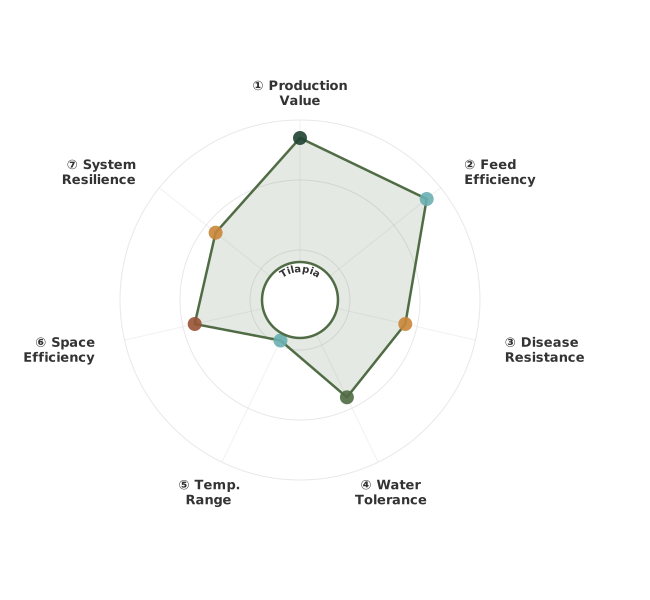
How These Traits Are Calculated
Trait dimensions are ordered clockwise starting from the top of the chart (12 o'clock position):
1. Production Value
Production Value scores 2.7 (exceptional) using fish pathway: growth_rate_in_low_input_systems (limited 1.0, 40% weight) + feed_conversion (exceptional 3.0, 30% weight) + small_scale_suitability as market proxy (typical 2.0, 30% weight). Formula: (1.0×0.40 + 3.0×0.30 + 2.0×0.30) = 1.9. Tilapia's rapid growth (200-300g in 6 months) and excellent feed conversion (1.5:1 ratio) make them commercially viable at any scale. However, the limited growth_rate_in_low_input_systems pulls the score down from potential maximum.
Fast growth + efficient feed conversion
2. Feed Efficiency
Feed Efficiency scores 3.0 (exceptional) from direct lookup of feed_conversion trait (exceptional 3.0). Tilapia exhibit outstanding feed-to-weight ratios of 1.5:1 under optimal conditions, meaning 1.5 pounds of feed produces 1 pound of fish. Their omnivorous diet allows utilization of diverse feed sources including algae, aquatic plants, and commercial pellets, reducing input costs by 30-40% compared to carnivorous fish.
Feed conversion 1.5:1 (excellent)
3. Disease Resistance
Disease & Parasite Resistance scores 2.0 (typical) from: disease_resistance (typical 2.0, 60% weight) + predator_resistance (typical 2.0, 40% weight). Formula: (2.0×0.60 + 2.0×0.40) = 2.0. Tilapia have natural robustness against common fish pathogens in well-managed systems but are vulnerable to birds, otters, and larger fish in open ponds (20-50% losses without protection).
Good disease resistance, moderate predation risk
4. Water Tolerance
Water Quality Tolerance scores 2.3 (typical) from weighted average: water_quality_tolerance (typical 2.0, 40% weight) + temperature_range (limited 1.0, 30% weight) + salinity_tolerance (typical 2.0, 30% weight). Formula: (2.0×0.40 + 1.0×0.30 + 2.0×0.30) = 1.9. Tilapia prefer pH 6.0-8.0 and can tolerate slightly brackish water (0-15 ppt) but have a narrow thermal range which impacts overall water quality resilience.
Tolerates pH 6.0-8.0, moderate salinity
5. Temp. Range
Temperature Range scores 1.5 (limited) from: temperature_range (limited 1.0, 50% weight) + handling_stress_tolerance (typical 2.0, 30% weight) + disease_resistance (typical 2.0, 20% weight). Formula: (1.0×0.50 + 2.0×0.30 + 2.0×0.20) = 1.5. Tilapia require consistent 70-85°F (21-29°C) water temperatures; below 60°F causes stress and cessation of feeding, above 95°F causes mortality. Temperate climates need heated systems 6-8 months/year.
Narrow range 70-85°F (needs heating)
6. Space Efficiency
Space Efficiency scores 2.2 (typical) using fish pathway: small_scale_suitability (typical 2.0, 60% weight) + polyculture_compatibility (typical 2.0, 40% weight). Formula: (2.0×0.60 + 2.0×0.40) = 2.0. Tilapia can be stocked at 1-3 fish per gallon in recirculating systems or 5,000-10,000/acre in ponds. They work well in polyculture with catfish or vegetables (aquaponics), but compatibility is not exceptional.
Moderate stocking density (1-3 fish/gal)
7. System Resilience
System Resilience scores 2.2 (typical) from: disease_resistance (typical 2.0, 35% weight) + handling_stress_tolerance (typical 2.0, 30% weight) + temperature_range (limited 1.0, 20% weight) + oxygen_requirements inverted (limited 1.0 → 3.0, 15% weight). Formula: (2.0×0.35 + 2.0×0.30 + 1.0×0.20 + 3.0×0.15) = 2.15, rounded to 2.2. While hardy in managed systems, tilapia require consistent DO >5 mg/L and temperature control, making them moderately resilient but not exceptional.
Stable environment needed (oxygen + temp control)
Value Streams
Experience Level
Consult local experts for handling requirements
4
Management, Care & Feeding
Operational guidance for raising this breed successfully
Management, Care & Feeding
Operational guidance for raising this breed successfully
Managing tilapia effectively in a regenerative system centers on optimizing their environment and diet. For pond-based systems, stocking densities should be carefully managed to prevent overgrazing of natural food sources and maintain water quality. Aeration can be crucial during warmer months or at higher densities to ensure adequate dissolved oxygen. Feeding should be strategic; while tilapia are omnivores, supplemental feeding with high-quality, preferably locally sourced or by-product feeds, can maximize growth rates. In integrated systems, carefully managed effluent from livestock or crop production can provide a nutrient base, but it's essential to monitor water parameters to avoid detrimental levels of ammonia or pathogens. Regular monitoring of fish health, including visual checks for parasites or diseases, is vital. Disease prevention through good water quality, optimal stocking densities, and appropriate nutrition is far more effective and aligns better with regenerative practices than treatment. Quarantine for new stock is also a sound practice to prevent introducing diseases into established systems.
Sources behind this view
 Community
-
Tilapia are ideal for aquaponics due to disease resistance, tolerance to poor water/temperature conditions, rapid growth, and omnivorous diet. They thrive on pellets, vegetables (lettuce, peas), fruit
Read more (opens in new window) permies.com -
Proposes diverse sustainable fish feed (duckweed, azolla, worms, BSF larvae) for tilapia/prawns in zone 7-8 aquaponics, utilizing geothermal/compost heat and greenhouses. Blue Tilapia's cold tolerance
Read more (opens in new window) permies.com -
Aquaponic systems require specific fish (tilapia, trout, catfish, carp), holding tanks, grow beds, pumps, air bubblers, and heaters. Daily monitoring of pH and dissolved oxygen is crucial. Systems use
Read more (opens in new window) smallfarms.cornell.edu
 Research
-
Intensifying aquaculture production through new approachesto manipulating natural food. (opens in new window)
New methods for using natural pond food can boost aquaculture yields, especially for plant-eating fish. Enhancing algae growth and using techniques like IMTA and activated suspension can significantly
-
Biofloc based farming of Nile tilapia (Oreochromis niloticus) in tanks under different stocking densities (opens in new window)
Biofloc tilapia farming in Bangladesh found 150 fish/m³ yielded highest profit by balancing total harvest weight and individual fish size, outperforming lower and higher stocking densities.