
Toulouse Geese
Also known as: toulouse, toulouse goose, gray toulouse, dewlap geese
The Toulouse goose breed simplifies management for farmers through its remarkable hardiness and exceptional foraging ability, thriving on diverse pastures with minimal supplemental feed. Originating from the Toulouse region of France, these large, docile geese are renowned for their cold tolerance, making them an excellent choice for cooler climates and reducing winter feeding costs. Toulouse geese also exhibit good guardian instincts, offering protection for other livestock, and possess a dual-purpose quality, providing both meat and eggs. Their efficient grass conversion makes them a valuable asset for pastured poultry operations and seasonal dairying, requiring less intensive management compared to other breeds.
Regenerative Quick Profile
Best Suited For
Climates: Temperate to humid continental climates with moderate to high precipitation
Scale: Suitable for small to medium operations (10-50 animals)
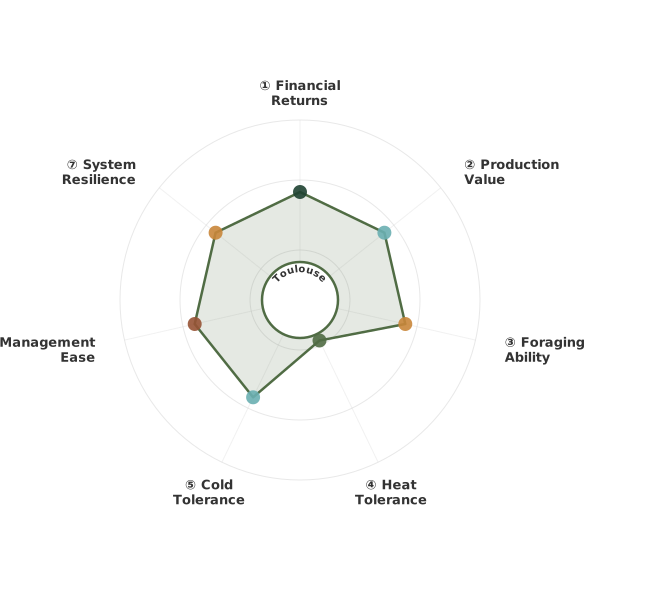
How These Traits Are Calculated
Trait dimensions are ordered clockwise starting from the top of the chart (12 o'clock position):
1. Financial Returns
Annual income per bird from eggs, meat, or specialty products
WHAT: Evaluates profit potential for specialty poultry (turkeys, ducks, geese, guinea fowl) combining meat yield, egg production (where applicable), growth timelines, and market premiums for specialty products.
WHY: Specialty poultry targets premium markets—heritage turkeys at $6-8/lb versus $1.50 commodity, duck eggs at $8-12/dozen versus $3-5 chicken eggs. Understanding enterprise-specific returns helps match birds to market opportunities, with successful operations generating 2-4× returns of conventional poultry.
HOW: Calculated from production data (market weight, timelines, egg yield) combined with efficiency traits and premium market access. Exceptional (≥2.6): strong output + premium markets + efficient growth. Typical (1.8-2.5): moderate production and markets. Limited (<1.8): low output or limited market access.
2. Production Value
Meat yield, egg production, and specialty product quality
WHAT: Measures output quality and quantity combining meat characteristics (size, flavor, texture prized by consumers), egg production (for laying breeds), and specialty products (foie gras, down feathers) that command premiums.
WHY: Production value determines market positioning. Heritage turkeys with superior flavor justify $6-8/lb premiums, duck eggs with rich yolks attract baking customers at $1+ per egg, quality down commands $20-40/lb. High production value enables profitable small-scale operations where commodity birds require large volume to achieve viability.
HOW: Composite assessment of documented production characteristics and market quality. Exceptional (≥2.6): superior product quality + strong output + specialty attributes. Typical (1.8-2.5): good standard production. Limited (<1.8): commodity quality, minimal specialty value.
3. Foraging Ability
Feed cost reduction through natural foraging behavior
WHAT: Measures effectiveness at obtaining nutrition through foraging—consuming insects, seeds, greens, and other natural foods—reducing purchased feed requirements 20-50% in pasture-based systems.
WHY: Aggressive foragers reduce feed costs while providing pest control (insects, ticks, slugs) and weed management services. Turkeys consuming 30-40% of calories from forage save $15-30 per bird over growing season, making the difference between profitable and marginal operations.
HOW: Rated from documented foraging behavior and feed reduction potential. Exceptional (≥2.6): excellent foragers, 40-50% feed reduction, active pest control. Typical (1.8-2.5): moderate foraging, 20-30% reduction. Limited (<1.8): minimal foraging, requires full feeding.
4. Heat Tolerance
Performance in hot weather above 85°F (29°C)
WHAT: Evaluates adaptation to sustained heat above 85°F (29°C), measuring heat stress resistance, growth/production maintenance, and survival during summer peaks. Critical for southern operations and summer meat production.
WHY: Heat stress reduces feed intake 20-40%, slows growth, and increases mortality—particularly problematic for turkeys naturally susceptible to heat. Heat-adapted breeds maintain production schedules where others require expensive cooling or suffer significant losses during summer.
HOW: Rated from database trait 'heat_tolerance' based on documented characteristics. Exceptional (≥2.6): maintains production in 95°F+ (35°C+), low mortality. Typical (1.8-2.5): manageable with shade and water. Limited (<1.8): high heat sensitivity, struggles above 85°F.
5. Cold Tolerance
Performance in cold weather below 20°F (-7°C)
WHAT: Evaluates adaptation to sustained cold below 20°F (-7°C), measuring feather insulation, cold-weather foraging activity, and winter production/growth maintenance. Important for year-round outdoor systems in northern climates.
WHY: Cold-sensitive birds require heated housing ($50-200 monthly winter costs), reduce activity limiting foraging value, and experience higher mortality. Cold-hardy breeds remain active outdoors year-round, maintain winter egg production (ducks/geese), and thrive with basic shelter.
HOW: Rated from database trait 'cold_tolerance' based on breed characteristics. Exceptional (≥2.6): excellent insulation, active in <0°F (-18°C), maintains winter production. Typical (1.8-2.5): moderate hardiness. Limited (<1.8): requires heated shelter, limited winter activity.
6. Management Ease
Handling temperament and care requirements
WHAT: Measures daily management simplicity combining temperament (calm vs flighty/aggressive), health needs, natural breeding ability (versus artificial insemination required), and routine handling cooperation.
WHY: Difficult birds increase labor 2-3× and create safety concerns. Aggressive turkeys or geese require protective equipment during handling, flighty birds complicate catching for processing, breeds requiring AI add complexity. Calm birds with good health enable confident management by beginners.
HOW: Weighted assessment: temperament (50%), health needs (30%), breeding ease (20%). Exceptional (≥2.6): calm and manageable, robust health, natural breeding. Typical (1.8-2.5): manageable with experience. Limited (<1.8): aggressive or nervous, high health needs, or breeding complications.
7. Flock Resilience
Disease resistance and survival under typical stresses
WHAT: Evaluates flock robustness across disease resistance (particularly respiratory issues and common poultry diseases), parasite tolerance, predator awareness, and general hardiness determining survival through typical challenges.
WHY: Resilient breeds maintain productivity through challenges causing 20-50% losses in susceptible birds—surviving disease pressure, evading predators through awareness, resisting parasites. This determines whether flocks thrive with basic care or require intensive interventions and predator-proof housing.
HOW: Composite assessment of documented health and survival characteristics. Exceptional (≥2.6): strong disease resistance + predator-savvy + hardy. Typical (1.8-2.5): standard resilience with routine care. Limited (<1.8): health-sensitive or vulnerable, requires intensive management and protection.
Regenerative Advantages
- Hardiness: Traditional Toulouse lines demonstrate robust foraging capabilities and thrive in varied conditions with few health issues. This exceptional hardiness suits low-input farming systems.
- Guardian Ability: The imposing size and territorial drive of old-fashioned Toulouse lines, coupled with vigilance, make them exceptional deterrents against predators. They effectively confront a wide range of threats.
- Fence Requirements: Toulouse geese are very heavy and have minimal flight capability. A 4ft fence is more than adequate for containment.
- Grass Conversion Efficiency: Managed Toulouse Geese show excellent grass conversion, maintaining condition and producing quality meat with minimal supplements. Their robust digestive system supports this efficiency.
Value Streams
- Meat & Egg production
- Insect and pest control
- Scratch tillage and compost distribution
Experience Level
Suitable for first-time livestock owners
4
Management, Care & Feeding
Operational guidance for raising this breed successfully
Management, Care & Feeding
Operational guidance for raising this breed successfully
Managing Toulouse Geese effectively in a regenerative system centers on providing ample space and access to quality pasture. While they are excellent foragers, a balanced diet is still important, especially for breeding stock or during periods of rapid growth. Supplementing their pasture diet with a high-quality waterfowl feed, particularly in winter or when foraging is limited, ensures optimal health and productivity. Access to clean, fresh water is crucial, not only for drinking but also for hygiene and thermoregulation; a large pond, trough, or pool is highly recommended. Protection from predators is also a key consideration, as their size does not make them immune to attacks from foxes, raccoons, or birds of prey. A secure night-time shelter or electric fencing can provide necessary security. Breeding pairs typically consist of one gander to 3-5 geese. Incubation periods are around 28-35 days, and goslings are relatively hardy but benefit from dry, warm conditions and protection from extreme weather. Regular observation for signs of illness, such as lethargy or changes in droppings, is important, though Toulouse Geese are generally robust and disease-resistant when managed well.
Sources behind this view
 Community
-
Geese can be rotationally grazed after sheep to manage shorter grasses, control snails/slugs (reducing parasite needs), and fertilize pastures. They require fresh grass or grain in winter, not just ha
Read more (opens in new window) permies.com -
Geese and chickens have different needs; geese excel on pasture. Soaking feed increases chicken intake and reduces waste. Local university extension services offer valuable data on nutrition and stock
Read more (opens in new window) permies.com