
American Rabbit
The American Rabbit breed simplifies livestock management through its exceptional docility, cold tolerance, and superb mothering ability, requiring minimal intervention during kidding and raising young. Originating in the United States, these rabbits are known for their hardy nature and remarkable adaptability to grazing, thriving on diverse forages and demonstrating good foraging skills for efficient finishing on grass. Distinctively, their inherent robustness and resistance to parasites make them a low-input choice for farmers, particularly those interested in rotational or mob grazing systems and silvopasture, where their ability to efficiently utilize pasture resources truly shines.
Regenerative Quick Profile
Best Suited For
Climates: Humid subtropical to continental temperate climates
Scale: Excellent for small homesteads (1-10 animals)
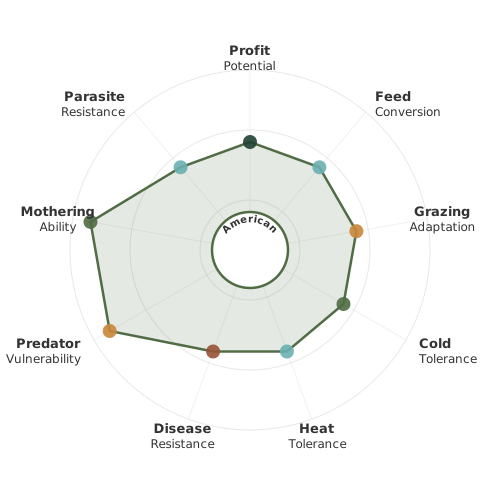
How These Traits Are Calculated
Trait dimensions are ordered clockwise starting from the top of the chart (12 o'clock position):
1. Financial Returns
Monthly income per doe from meat sales and breeding
WHAT: Evaluates profit potential combining litter size, growth rates, meat yield, and input costs. Productive does raising 8-12 kits per litter with fast growth (8-10 lbs in 10-12 weeks) generate strong monthly returns.
WHY: Rabbit profitability depends on litter frequency and kit survival. Does producing 30-50 kits annually with good survival rates generate $600-1,200 annual revenue versus $200-400 for lower producers, determining whether rabbit enterprises provide meaningful income or remain hobbies.
HOW: Calculated from production data (litter size, frequency, growth rates) combined with feed efficiency and mothering ability. Exceptional (≥2.6): large litters + fast growth + high survival. Typical (1.8-2.5): moderate production. Limited (<1.8): small litters, slow growth, or high mortality eroding returns.
2. Breeding Performance
Litter size, frequency, and kit survival rates
WHAT: Measures reproductive success combining litter size (kits born), breeding frequency (litters per year), conception rates, and kit survival to weaning. High performers consistently produce large, healthy litters.
WHY: Reproductive performance determines production capacity. Does averaging 8-10 kits per litter at 4-5 litters annually with 85%+ survival produce 30-45 market kits yearly versus 15-25 for lower performers—doubling output from same feeding and housing investment.
HOW: Composite assessment of documented breeding characteristics. Exceptional (≥2.6): 8-10+ kits per litter, 4-5+ litters yearly, high survival. Typical (1.8-2.5): 6-8 kits, 3-4 litters. Limited (<1.8): small litters, low frequency, or poor survival rates.
3. Feed Efficiency
Growth rate and meat yield per pound of feed consumed
WHAT: Measures how effectively rabbits convert feed into meat, evaluating feed-to-gain ratio (typically 3.5-4.5:1), growth rate to market weight (10-12 weeks), and meat dress-out percentage (actual meat from live weight).
WHY: Feed represents 60-75% of rabbit production costs. Breeds converting 3.5:1 versus 4.5:1 save $3-5 per fryer, adding $90-150 annually per doe's production. Efficient breeds reach market weight 2-3 weeks faster, accelerating cash flow and reducing cage occupancy time.
HOW: Rated from documented feed conversion, growth rates, and meat yield. Exceptional (≥2.6): 3.5:1 or better conversion, fast growth, high dress-out. Typical (1.8-2.5): 3.5-4.5:1 conversion. Limited (<1.8): >4.5:1 or slow growth extending feeding period.
4. Heat Tolerance
Performance in hot weather above 85°F (29°C)
WHAT: Evaluates adaptation to sustained heat above 85°F (29°C), measuring heat stress resistance, reproductive performance in heat (fertility and litter size often drop 30-50%), and survival during summer peaks.
WHY: Heat stress halts breeding, reduces feed intake, and increases mortality. Heat-adapted breeds maintain reproduction through summer where others experience 2-4 month breeding gaps, creating production holes that reduce annual output 20-40% in hot climates.
HOW: Rated from database trait 'heat_tolerance' based on documented characteristics. Exceptional (≥2.6): tropical adaptations, maintains breeding in 95°F+ (35°C+). Typical (1.8-2.5): moderate tolerance with cooling measures. Limited (<1.8): breeding stops above 85°F, high mortality risk without cooling systems.
5. Cold Tolerance
Performance in cold weather below 20°F (-7°C)
WHAT: Evaluates adaptation to sustained cold below 20°F (-7°C), measuring coat insulation, metabolic adaptation, and winter breeding success. Critical for year-round production in northern climates.
WHY: Cold-sensitive rabbits require heated buildings ($50-150 monthly winter costs), cease breeding in winter, and experience higher kit mortality. Cold-hardy breeds maintain year-round breeding in unheated hutches with basic wind protection, enabling consistent production through harsh winters.
HOW: Rated from database trait 'cold_tolerance' based on breed characteristics. Exceptional (≥2.6): thick fur, proven winter breeding in <0°F (-18°C), minimal shelter needed. Typical (1.8-2.5): moderate hardiness. Limited (<1.8): requires heated shelter for winter breeding, high kit mortality in cold.
6. Management Ease
Handling temperament and mothering quality
WHAT: Measures daily management simplicity combining temperament (calm vs nervous), mothering ability (nest-building, nursing, kit survival), handling cooperation, and health needs.
WHY: Difficult rabbits increase labor 2-3× through nervous behavior complicating handling, poor mothers requiring hand-rearing rejected kits, and health complications. Calm does with strong maternal instincts enable efficient colony management where problem breeds create constant interventions.
HOW: Weighted assessment: temperament (40%), mothering ability (40%), handling cooperation (20%). Exceptional (≥2.6): calm and docile, excellent mothers, easy handling. Typical (1.8-2.5): manageable with experience. Limited (<1.8): nervous or aggressive, poor mothers, frequent kit losses.
7. Colony Resilience
Disease resistance and survival under typical stresses
WHAT: Evaluates colony robustness across disease resistance (pasteurellosis, coccidiosis, respiratory infections), genetic vigor, stress adaptation, and overall hardiness determining survival through typical challenges.
WHY: Resilient breeds reduce veterinary costs, maintain productivity through disease challenges that cause 20-40% losses in susceptible lines, and thrive across diverse environments. This determines whether colonies require constant medical interventions or remain productive with basic preventive care.
HOW: Composite assessment of documented health characteristics and hardiness. Exceptional (≥2.6): strong disease resistance + genetic vigor + thrives with minimal intervention. Typical (1.8-2.5): standard resilience with routine care. Limited (<1.8): health-sensitive, requires intensive management.
Regenerative Advantages
- Mothering Ability: Selected for meat production, this breed consistently exhibits strong maternal instincts, ensuring excellent litter survival and robust milk production.
- Docility: Historically bred for meat and fur, American Rabbits possess a calm disposition, making them easy to handle and well-suited for farm environments.
- Predator Vulnerability: Lacking specialized defenses, this domestic breed relies entirely on human security, placing it in the highest vulnerability category.
- Small Scale Suitability: Small size (8-10 lbs) and exceptional docility allow for compact housing. Minimal infrastructure needs and easy handling suit solo management perfectly.
Value Streams
- Meat production
Experience Level
Suitable for first-time livestock owners
4
Management, Care & Feeding
Operational guidance for raising this breed successfully
Management, Care & Feeding
Operational guidance for raising this breed successfully
Managing American Rabbits effectively in a regenerative system centers on providing ample space, appropriate nutrition, and protection from predators. Whether housed in hutches, pens, or mobile tractors, ensuring adequate ventilation and protection from extreme weather is crucial. For pasture-based systems, mobile tractors allow rabbits to graze on grasses and forbs, supplementing their diet and depositing manure directly onto the land. This requires daily or frequent moving of the tractors to prevent overgrazing and allow pasture recovery. Supplementing with a high-quality pelleted feed, especially for pregnant or nursing does and growing kits, ensures they receive balanced nutrition, though the emphasis should be on pasture forage whenever possible.
Feeding strategies should leverage their natural foraging instincts. While a commercial pelleted feed provides a consistent nutritional base, incorporating fresh greens, vegetables, and even small amounts of hay can diversify their diet and improve gut health. For rabbits on pasture, the goal is to allow them to consume a significant portion of their diet from managed grazing, reducing the need for purchased feed. Water must always be readily available, and care should be taken to keep water sources clean. The manure produced should be collected and composted or directly applied to fields, ideally after a composting period to kill any weed seeds or pathogens, thus completing the nutrient cycle.
Health management for American Rabbits focuses on prevention through good husbandry. Regular observation for signs of illness, such as lethargy, changes in appetite, or respiratory issues, is key. Keeping housing clean and dry helps prevent common ailments like flystrike and respiratory infections. Parasite control, both internal and external, should be addressed proactively, with treatments chosen carefully to align with organic or regenerative principles where possible. Due to their robust nature, American Rabbits are generally hardy, but attention to diet, stress reduction, and predator protection are paramount for maintaining a healthy, productive herd within a regenerative framework.
Sources behind this view
 Community
-
Raising rabbits in colony settings requires robust predator protection (electric fence, buried fencing, guard dogs) and ample hiding places. Experienced raisers recommend sheds with deep straw bedding
Read more (opens in new window) permies.com -
Manages rabbit parasites through rotation (60+ days) and culling, not worming. Uses California x New Zealand rabbits, feeding hay and root crops in winter, and references century-old grazing hutch tec
Read more (opens in new window) permies.com
 Research
-
One Health Approach to Rabbit Farming: Balancing Act between Environmental Impact, Farmers Livelihood, and Animal Welfare (opens in new window)
Rabbit farming can be a sustainable meat production model by balancing environmental impact, farmer income, and animal welfare, due to their efficiency and lower resource needs.
-
Precision Feeding Systems in Animal Husbandry: Guiding Rabbit Farming from Concept to Implementation (opens in new window)
Smart feeding systems using sensors and AI can boost rabbit farming efficiency and sustainability. This review guides implementation, highlighting benefits like better feed use and animal welfare, whi
 From the Web
-
Offers comprehensive advice on raising rabbits for meat, covering housing, feeding, reproduction, pasturing, health management (especially coccidiosis), and processing, emphasizing their suitability f