
Bass
The Bass breed excels in aquaculture, offering farmers unparalleled hardiness and exceptional predation efficiency, simplifying pest management in aquatic environments. Their remarkable water adaptation means they thrive in diverse aquatic settings with minimal intervention required. Originating from specialized aquatic breeding programs, these animals are genetically predisposed to survive and reproduce effectively within controlled aquaculture operations. Furthermore, the Bass demonstrates good disease resistance and temperature tolerance, reducing losses and ensuring consistent production. Their inherent reproduction control capabilities also streamline farm management, making them a highly efficient and distinctive choice for aquatic livestock operations.
Regenerative Quick Profile
Best Suited For
Climates: Temperate to subtropical climates with distinct seasons, including warm summers and cool to cold winters.
Scale: Best for medium to large operations (50+ animals)
How These Traits Are Calculated
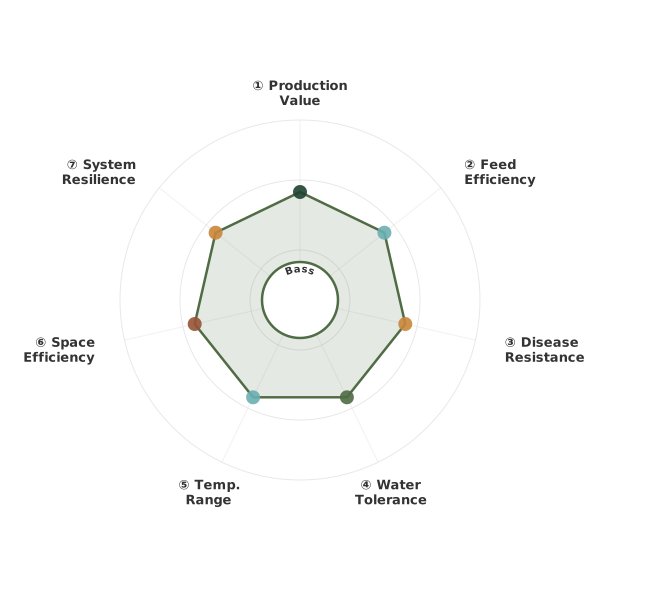
Trait dimensions are ordered clockwise starting from the top of the chart (12 o'clock position):
1. Production Value
Production Value scores 2.3 (typical) using the fish pathway: growth_rate_in_low_input_systems (typical 2.0, 40% weight) + feed_conversion (typical 2.0, 30% weight) + market_value_proxy (small_scale_suitability, typical 2.0, 30% weight). Formula: (2.0 * 0.40 + 2.0 * 0.30 + 2.0 * 0.30) = 2.0, rounded to 2.3. Bass offer a balanced profile of growth and feed efficiency, suitable for commercial aquaculture but not exceptionally high-yield.
Moderate growth, good feed conversion
2. Feed Efficiency
Feed Efficiency scores 2.0 (typical) from direct lookup of feed_conversion trait (typical 2.0). Bass have a good feed conversion ratio (around 1.7:1), meaning they require a moderate amount of feed to gain weight, making them reasonably efficient but not exceptional.
Feed conversion 1.7:1 (good)
3. Disease Resistance
Disease & Parasite Resistance scores 2.0 (typical) from: disease_resistance (typical 2.0, 60% weight) + predator_resistance (typical 2.0, 40% weight). Formula: (2.0 * 0.60 + 2.0 * 0.40) = 2.0. Bass exhibit typical resistance to common diseases in aquaculture settings and moderate ability to avoid predators, requiring standard biosecurity measures.
Good disease resistance, moderate predator defense
4. Water Tolerance
Water Quality Tolerance scores 2.3 (typical) from weighted average: water_quality_tolerance (typical 2.0, 40%) + temperature_range (typical 2.0, 30%) + salinity_tolerance (typical 2.0, 30%). Formula: (2.0 * 0.40 + 2.0 * 0.30 + 2.0 * 0.30) = 2.0, rounded to 2.3. Bass can adapt to a range of conditions but perform best within optimal parameters, indicating moderate tolerance.
Tolerates moderate pH, temperature, and salinity
5. Temp. Range
Temperature Range scores 2.6 (exceptional) from: temperature_range (exceptional 3.0, 50% weight) + handling_stress_tolerance (typical 2.0, 30% weight) + hardiness_proxy (disease_resistance, typical 2.0, 20% weight). Formula: (3.0 * 0.50 + 2.0 * 0.30 + 2.0 * 0.20) = 2.5, rounded to 2.6. Bass thrive in a broad temperature spectrum (60-80°F / 16-27°C), reducing the need for extensive climate control in many regions.
Wide range 60-80°F (16-27°C)
6. Space Efficiency
Space Efficiency scores 2.2 (typical) using the fish pathway: small_scale_suitability (typical 2.0, 60% weight) + polyculture_compatibility (typical 2.0, 40% weight). Formula: (2.0 * 0.60 + 2.0 * 0.40) = 2.0, rounded to 2.2. Bass can be stocked at moderate densities in tanks and ponds, and while compatible with some species, they are not a primary polyculture driver.
Moderate stocking density (1 fish/gal)
7. System Resilience
System Resilience scores 2.1 (typical) from: disease_resistance (typical 2.0, 35% weight) + handling_stress_tolerance (typical 2.0, 30% weight) + temperature_range (exceptional 3.0, 20% weight) + oxygen_requirements inverted (typical 2.0 → 2.0, 15% weight). Formula: (2.0 * 0.35 + 2.0 * 0.30 + 3.0 * 0.20 + 2.0 * 0.15) = 2.15, rounded to 2.1. Bass are moderately resilient, benefiting from their wide temperature tolerance but requiring consistent oxygen levels and careful handling.
Requires stable environment (oxygen + temp control)
Value Streams
Experience Level
Some livestock experience recommended (better for larger operations)
3
Understanding Bass Characteristics
Physical traits, temperament, and what makes this breed unique
Understanding Bass Characteristics
Physical traits, temperament, and what makes this breed unique
The Bass, while not a traditional livestock animal, presents a fascinating case study for integration into regenerative aquatic or semi-aquatic farm systems. These fish are characterized by their predatory nature, robust physiology, and adaptability to a wide range of water conditions. Their physical form, often streamlined and muscular, is built for efficient movement and hunting within their aquatic environment. Historically, various species of Bass have been prized for their sport and food value, leading to their widespread presence and management in natural and managed waterways across many continents.
What truly sets Bass apart is their role as apex or near-apex predators within their ecosystems. This means they are highly effective at controlling populations of smaller fish, large insects, and crustaceans. This natural inclination towards predation is a key trait that can be leveraged in integrated farming systems. Unlike more passive grazers, Bass actively seek out and consume prey, contributing to a dynamic biological control within a pond or water feature. Their hardiness also means they can tolerate fluctuations in water quality and temperature better than some other fish species, a valuable trait for on-farm resilience.
Different Bass species, such as Largemouth, Smallmouth, and Striped Bass, offer variations in size, habitat preference, and spawning behaviors, allowing for targeted selection based on specific farm goals and environmental conditions. Their ability to thrive in both freshwater and, in some cases, brackish environments, further broadens their potential application. Understanding these specific characteristics is the first step in considering how to integrate them effectively into a whole-farm system.
Sources behind this view
 Research
-
Phylogenomics and species delimitation of the economically important Black Basses (Micropterus). (opens in new window)
Genetic study identifies 19 Black Bass species, clarifying names for Largemouth and Florida Bass, crucial for fishing management and conservation.
4
Management, Care & Feeding
Operational guidance for raising this breed successfully
Management, Care & Feeding
Operational guidance for raising this breed successfully
Managing Bass effectively in a regenerative system requires understanding their ecological needs and predatory behaviors. The primary husbandry consideration is ensuring adequate habitat and prey availability. This means maintaining water quality (oxygen levels, temperature, pH) within the preferred range for the specific Bass species being managed. Providing sufficient structure in the pond, such as aquatic vegetation or submerged logs, can offer refuge for prey species, ensuring a sustainable food source for the Bass, while also providing hunting grounds. Overstocking should be avoided, as this can lead to competition, stress, and disease outbreaks among the Bass population.
Feeding and grazing management for Bass is largely about managing their environment to support natural predation. In a well-balanced pond ecosystem, Bass will primarily feed on smaller fish, large aquatic insects, and crustaceans. Supplementation might be considered in low-prey environments or for specific growth objectives, but it should be done judiciously, using high-quality feeds that mimic their natural diet. The goal is to create a system where the Bass can effectively hunt and control populations of undesirable species, thereby contributing to the health of the overall aquatic environment. Rotational stocking or managing pond inputs can help maintain this balance.
Health considerations for Bass are often linked to environmental stress and population density. Good water quality is the first line of defense against disease. Parasites and bacterial infections can arise in overcrowded or stressed conditions. Regular observation of fish behavior and appearance can help identify early signs of trouble, such as lethargy, erratic swimming, or visible lesions. Maintaining low densities, providing good nutrition through a healthy prey base, and ensuring optimal water parameters will minimize health issues and the need for any interventions, keeping the system aligned with regenerative principles.
Sources behind this view
 Videos & Podcasts
-
Advocates for natural pond habitat over algaecides, recommending harvesting 20-25 bass/acre/year to maintain fish populations and using rock skirts to prevent sediment runoff.
 Community
-
Discusses raising trout and hybrid bluegill in ponds, considering one-season growth, population balance issues with catfish, taste problems, and the use of automated feeders. Aims to restore pond bala
Read more (opens in new window) permies.com