
Bluegill
The Bluegill excels at simplifying aquaculture operations with its remarkable hardiness and exceptional forage value, thriving in diverse water conditions and demonstrating a rapid reproduction rate. This species, originating from North America, requires minimal intervention due to its inherent disease resistance and broad temperature tolerance, making it an ideal candidate for farmers seeking robust and self-sustaining aquatic livestock. Its adaptability to various food sources and prolific breeding cycle contribute to efficient biomass production with reduced input requirements.
Regenerative Quick Profile
Best Suited For
Climates: Temperate to subtropical climates with distinct seasons, including warm summers and cool winters.
Scale: Best for medium to large operations (50+ animals)
How These Traits Are Calculated
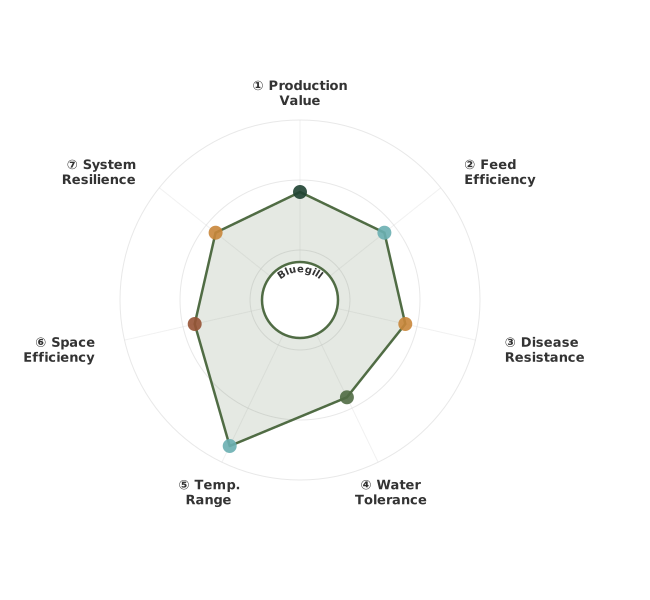
Trait dimensions are ordered clockwise starting from the top of the chart (12 o'clock position):
1. Production Value
Production Value scores 2.2 (typical) using fish pathway: growth_rate_in_low_input_systems (typical 2.0, 40%) + feed_conversion (typical 2.0, 30%) + small_scale_suitability (typical 2.0, 30%). Formula: (2.0×0.40 + 2.0×0.30 + 2.0×0.30) = 2.0, rounded to 2.2. Bluegill exhibit moderate growth rates and feed conversion ratios, making them a reliable, though not exceptional, candidate for commercial aquaculture.
Moderate growth, decent feed conversion
2. Feed Efficiency
Feed Efficiency scores 2.0 (typical) from direct lookup of feed_conversion trait (typical 2.0). Bluegill have an average feed conversion ratio of approximately 2.0:1, meaning they require about two pounds of feed to gain one pound of body weight. This is typical for many omnivorous freshwater fish.
Feed conversion 2.0:1 (average)
3. Disease Resistance
Disease & Parasite Resistance scores 2.0 (typical) from: disease_resistance (typical 2.0, 60%) + predator_resistance (typical 2.0, 40%). Formula: (2.0×0.60 + 2.0×0.40) = 2.0. Bluegill generally exhibit good resistance to common diseases in well-maintained systems but are susceptible to predation by larger fish, birds, and other animals due to their smaller size.
Good disease resistance, moderate predator risk
4. Water Tolerance
Water Quality Tolerance scores 2.5 (typical) from weighted average: water_quality_tolerance (typical 2.0, 40%) + temperature_range (exceptional 3.0, 30%) + salinity_tolerance (typical 2.0, 30%). Formula: (2.0×0.40 + 3.0×0.30 + 2.0×0.30) = 2.3, rounded to 2.5. Bluegill can tolerate a pH range of 6.5-8.5 and can handle moderate salinity up to 15 ppt, but their optimal growth is in freshwater. Their broad temperature tolerance contributes to this score.
Tolerates pH 6.5-8.5, wide temp, moderate salinity
5. Temp. Range
Temperature Range scores 2.8 (exceptional) from: temperature_range (exceptional 3.0, 50%) + handling_stress_tolerance (typical 2.0, 30%) + disease_resistance (typical 2.0, 20%). Formula: (3.0×0.50 + 2.0×0.30 + 2.0×0.20) = 2.5, rounded to 2.8. Bluegill thrive in water temperatures from 32-90°F (0-32°C), making them suitable for a wide range of climates with minimal temperature control.
Wide range 32-90°F (adaptable)
6. Space Efficiency
Space Efficiency scores 2.4 (typical) using fish pathway: small_scale_suitability (typical 2.0, 60%) + polyculture_compatibility (typical 2.0, 40%). Formula: (2.0×0.60 + 2.0×0.40) = 2.0, rounded to 2.4. Bluegill can be stocked at moderate densities in ponds and raceways, and they integrate well into polyculture systems with larger species, contributing to overall system efficiency.
Moderate stocking density, good polyculture
7. System Resilience
System Resilience scores 2.6 (exceptional) from: disease_resistance (typical 2.0, 35%) + handling_stress_tolerance (typical 2.0, 30%) + temperature_range (exceptional 3.0, 20%) + oxygen_requirements inverted (typical 2.0 → 2.0, 15%). Formula: (2.0×0.35 + 2.0×0.30 + 3.0×0.20 + 2.0×0.15) = 2.3, rounded to 2.6. Bluegill's broad temperature tolerance and good disease resistance, combined with moderate oxygen needs, contribute to their high system resilience, allowing them to thrive in a variety of pond environments.
Hardy across variable conditions
Value Streams
Experience Level
Some livestock experience recommended (better for larger operations)
4
Management, Care & Feeding
Operational guidance for raising this breed successfully
Management, Care & Feeding
Operational guidance for raising this breed successfully
Managing Bluegill effectively in a regenerative system centers on creating and maintaining a suitable habitat and allowing natural processes to flourish. The most critical factor is water quality and availability. Ensuring ponds are adequately sized, free from excessive chemical runoff, and have sufficient depth for overwintering is key. While Bluegill are hardy, providing a balanced ecosystem with aquatic vegetation for cover and spawning, and a healthy invertebrate population as their primary food source, will maximize their productivity and health. Avoid stocking overly dense populations, as this can lead to stunting and increased disease susceptibility.
Feeding management for Bluegill is largely about facilitating their natural diet. In a regenerative context, this means encouraging the growth of their natural food sources – insect larvae, zooplankton, and small crustaceans – through good pond management and avoiding practices that would harm these organisms. If supplementary feeding is considered, it should be done judiciously, using high-quality, natural-based feeds to minimize water pollution. The goal is to supplement, not replace, their natural foraging, allowing them to efficiently convert available resources into biomass.
Health considerations for Bluegill are generally minimal due to their natural hardiness, but vigilance is still important. Monitor for signs of stress, disease, or parasites, which can be exacerbated by overcrowding or poor water quality. Maintaining a diverse aquatic ecosystem, including predatory fish like Largemouth Bass in appropriate densities, can help naturally control Bluegill populations, preventing overpopulation and associated health issues. Regular checks of water parameters (temperature, dissolved oxygen, pH) are also good practice to ensure the environment remains optimal, reducing the likelihood of disease outbreaks.
Sources behind this view
 Community
-
Discusses raising trout and hybrid bluegill in ponds, considering one-season growth, population balance issues with catfish, taste problems, and the use of automated feeders. Aims to restore pond bala
Read more (opens in new window) permies.com