
Holland Chicken
The Holland chicken excels at foraging and demonstrates remarkable docility, simplifying flock management and reducing labor needs for farmers. This hardy breed, originating from the Netherlands, is also good at cold hardiness and disease resistance, requiring minimal intervention. Hollands are well-suited for multi-species grazing operations, efficiently converting diverse forage into eggs and meat, making them a valuable dual-purpose choice for a variety of farm settings. Their robust nature and excellent foraging skills distinguish them from breeds that require more specialized feed and environmental controls.
Regenerative Quick Profile
Best Suited For
Climates: Humid subtropical to humid continental climates, tolerating moderate winters and warm to hot summers.
Scale: Excellent for small homesteads (1-10 animals)
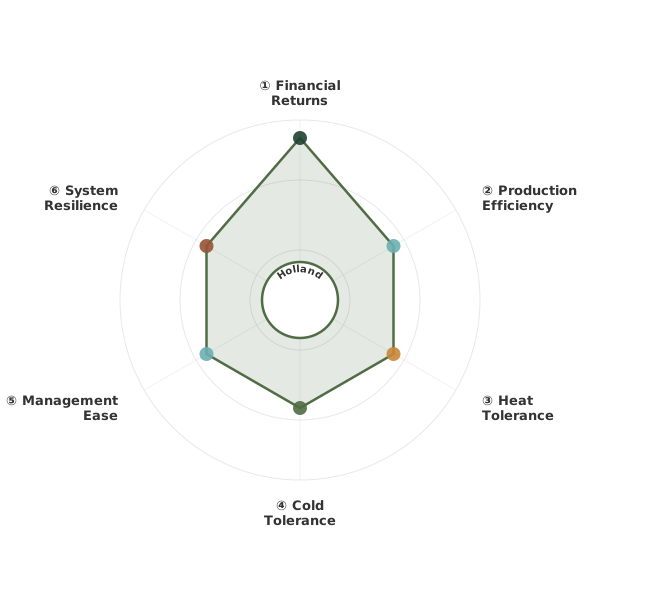
How These Traits Are Calculated
Trait dimensions are ordered clockwise starting from the top of the chart (12 o'clock position):
1. Financial Returns
Monthly income per bird from eggs, meat, or dual-purpose value
WHAT: Evaluates monthly profit potential combining egg production, meat yield, dual-purpose value, and input costs. Breeds with high output, efficient feed conversion, and minimal health costs generate stronger returns per bird.
WHY: Flock profitability depends on daily output relative to feed costs. Breeds laying 250+ eggs annually or reaching 6-8 lbs in 12-16 weeks provide income streams that cover feed plus profit, while lower producers require larger flocks or alternative revenue.
HOW: Calculated from production data (eggs per year or meat timeline) combined with feed efficiency and health characteristics. Exceptional (≥2.6): high output + low inputs + minimal health issues. Typical (1.8-2.5): moderate production or standard costs. Limited (<1.8): low output or high inputs eroding margins.
2. Production Efficiency
Output relative to feed consumed and space required
WHAT: Measures how effectively chickens convert feed and space into saleable products (eggs or meat), combining foraging ability, production levels, and resource needs into an efficiency score.
WHY: Efficient breeds reduce daily feed costs 20-40% while maximizing output, enabling profitability even when feed prices spike. Space-efficient breeds allow higher stocking density without stress, expanding flock size within existing infrastructure.
HOW: Weighted formula: foraging ability reduces feed costs (40%), egg or meat production measures output (30%), feed-to-output ratio (30%). Exceptional (≥2.6): excellent foragers + high production + low feed needs. Typical (1.8-2.5): moderate efficiency. Limited (<1.8): high inputs for output level.
3. Heat Tolerance
Egg production and health in hot weather above 85°F (29°C)
WHAT: Evaluates breed performance during sustained heat above 85°F (29°C), measuring production maintenance, heat stress resistance, and cooling behavior adaptations.
WHY: Heat stress drops egg production 15-40% and increases mortality. Heat-adapted breeds maintain laying through summer peaks where others stop production completely, avoiding 2-3 month income gaps in hot climates.
HOW: Rated from database trait 'heat_tolerance' based on breed characteristics. Exceptional (≥2.6): Mediterranean origins, large combs for cooling, maintains production in 95°F+ (35°C+). Typical (1.8-2.5): moderate tolerance with shade. Limited (<1.8): production drops significantly above 85°F, requires cooling systems.
4. Cold Tolerance
Egg production and health in cold weather below 20°F (-7°C)
WHAT: Evaluates breed performance during sustained cold below 20°F (-7°C), measuring production maintenance, frostbite resistance (especially combs and wattles), and winter hardiness.
WHY: Cold stress halts laying in non-adapted breeds, causes frostbite requiring amputations, and increases feed needs 30-50%. Cold-hardy breeds continue production through winter, maintaining year-round income where others require heated coops or accept seasonal gaps.
HOW: Rated from database trait 'cold_tolerance' based on breed characteristics. Exceptional (≥2.6): small combs, dense feathering, proven winter laying in <0°F (-18°C). Typical (1.8-2.5): moderate hardiness, basic shelter sufficient. Limited (<1.8): large combs prone to frostbite, production stops without heat.
5. Management Ease
Handling temperament and care complexity
WHAT: Measures daily management simplicity combining temperament docility, disease resistance, and behavioral predictability. Easy breeds require minimal interventions while difficult breeds demand constant attention.
WHY: Management complexity determines whether chickens are a pleasant side enterprise or a daily burden. Calm, healthy breeds allow 10-15 minute daily checks, while flighty or sickly birds require 45-60 minutes daily for catching, treating, and monitoring.
HOW: Evaluated from temperament, health needs, and typical care requirements. Exceptional (≥2.6): calm and friendly, excellent health, self-sufficient with basic care. Typical (1.8-2.5): manageable with standard practices. Limited (<1.8): nervous or aggressive, frequent health interventions needed.
6. Flock Resilience
Health and productivity under typical stresses
WHAT: Evaluates flock robustness across disease resistance, parasite tolerance, general hardiness, and stress adaptation. Measures ability to maintain production and survive challenges that devastate more fragile breeds.
WHY: Resilient flocks reduce veterinary costs, survive disease outbreaks that wipe out neighbors' chickens, and maintain production through weather extremes. This determines whether your flock thrives independently or requires constant medical interventions.
HOW: Composite assessment of documented health characteristics, survival rates, and stress tolerance. Exceptional (≥2.6): exceptional disease resistance + thrives through challenges + minimal losses. Typical (1.8-2.5): standard resilience with routine care. Limited (<1.8): health-sensitive, requires intensive management.
Regenerative Advantages
- Foraging Ability: The Holland chicken's heritage and actively inquisitive nature allow it to excel in seeking out a wide variety of food sources on diverse and unimproved pastures. They demonstrate a significant ability to subsist on forbs, weeds, insects, and other non-grass vegetation, requiring minimal supplemental feed. This broad-spectrum utilization of available resources, including roughage and less palatable plant matter, indicates they thrive on marginal forage and scrubland, aligning with the 'exceptional' standard for this trait.
- Small Scale Suitability: Requires minimal space (4-10 sq ft per bird indoors, 10-15 sq ft outdoor run). Their typical docility and manageable size are well-suited for small farms.
Value Streams
- Meat & Egg production
- Insect and pest control
- Scratch tillage and compost distribution
Experience Level
Suitable for first-time livestock owners
6
Production Capabilities & Market Economics
Business case evaluation and production metrics
Production Capabilities & Market Economics
Business case evaluation and production metrics
Meat Production Economics
| Category | Value |
|---|---|
| Dressed Weight/Bird | 4-5.5 lbs 1.8-2.5 kg |
| Months to Finish | 4-5 |
| Batches/Year | 3-4 |
| Price Premium | +10% to +25% |
| Input Cost/Bird | $20-30 |
Months to Finish: Time from hatch to processing weight. Commercial meat breeds (Cornish Cross) finish in 8-10 weeks, while heritage breeds take 14-20+ weeks. Slower growth produces better flavor and texture.
Batches/Year: Number of production cycles annually. Pastured meat chickens are typically raised in 2-4 batches per year (8-12 weeks per batch). This allows pasture recovery between batches and spreads production throughout the season.
Price Premium: Premium above conventional chicken prices ($0-6/lb range). Pastured poultry typically commands $4-8/lb vs. $1-3/lb for conventional. Direct sales, organic certification, and heritage breeds command highest premiums. Premium only applies when farm qualifies through certification (organic, Animal Welfare Approved, Certified Humane) or direct marketing establishes pastured practices. Without certification or direct sales channels, premium falls to $0.
Input Cost/Bird: Includes chicks, feed, bedding, processing. Excludes labor, land, and infrastructure. Pastured systems have lower feed costs (due to foraging 10-20% of diet) but higher processing and chick costs than confinement operations.
Egg Production Economics
| Category | Value |
|---|---|
| Eggs/Hen/Year | 150-200 |
| Egg Size | Large |
| Laying Period | 2-3 |
| Price Premium/Dozen | $0 to $3.00 |
| Input Cost/Hen | $15-$25 |
Eggs/Hen/Year: Annual egg production for pastured hens. Production peaks in first 2 years then declines. Heritage breeds typically lay 150-250 eggs/year, while modern hybrids can lay 280-320 eggs/year in pasture systems (less than confinement due to foraging time and weather exposure).
Egg Size: Industry classifications (Small, Medium, Large, Extra Large, Jumbo). Breed determines typical size. Younger hens lay smaller eggs; size increases with age.
Laying Period: How long hens remain economically productive. Most breeds lay well for 2-4 years, with declining production after that. Heritage breeds often lay longer than hybrids.
Price Premium/Dozen: Premium above conventional egg prices ($0-6/dozen range). Pastured eggs typically sell for $5-10/dozen vs. $2-4/dozen for conventional. Direct sales, organic certification, and specialty breeds (e.g., blue eggs) command highest premiums. Premium only applies when farm qualifies through certification (organic, Certified Humane, free-range verified) or direct marketing establishes pastured practices. Without certification or direct sales channels, premium falls to $0.
Input Cost/Hen: Annual cost including feed, bedding, supplements, health care. Pastured layers forage 15-30% of their diet, reducing feed costs compared to confinement. Excludes infrastructure, land, and labor.
Sources behind this view
 Videos & Podcasts
-
Evaluates pastured poultry: Pros include low startup cost, fast ROI, and ease of management. Cons are high labor, seasonality, need for scale (400-500 birds/batch), high price, and butchering challeng

-
Detailed financial analysis of pastured poultry shows economies of scale are crucial for profitability, targeting $50/hour labor and 2x money factor. Specific costs, pricing ($4.99/lb whole chicken),
![Thumbnail for Earn $10000 an Acre Raising Pastured Poultry [PROFIT not GROSS]](/static/thumbnails/Ej-qyb6GrOA.jpg)
-
A homestead egg cost analysis shows organic feed and other inputs cost $3.20/dozen, excluding labor. Including labor at $20/hour raises the cost to $7.45/dozen. Seasonality and alternative feed source

-
On a Swedish farm, pastured broilers are raised for quick sale, and eggs from mobile hen houses are sold via a three-month subscription to ensure cash flow and customer loyalty, leveraging their high

 Community
-
Taste and quality are key drivers for pastured eggs and meats, often valued more than certifications. Superior products, like forest-ranged eggs, command premium prices, with perceived value influenci
Read more (opens in new window) permies.com