
Silkworms
Silkworms offer farmers a unique opportunity to excel in high-value silk production, leveraging their exceptional mulberry conversion efficiency and rich traditional heritage. These insects simplify management by requiring minimal intervention once established, thriving on a readily available diet. Originating from ancient China, their primary value lies not in physical traits but in the unparalleled quality of silk they produce, making them a distinctive choice for niche agricultural markets. While their reproduction rate is good, it's the consistent, premium silk output that truly sets silkworms apart from other livestock, presenting a specialized and rewarding venture.
Regenerative Quick Profile
Best Suited For
Climates: Humid subtropical, Oceanic, Tropical monsoon, Tropical savanna
Scale: Excellent for small homesteads (1-10 animals)
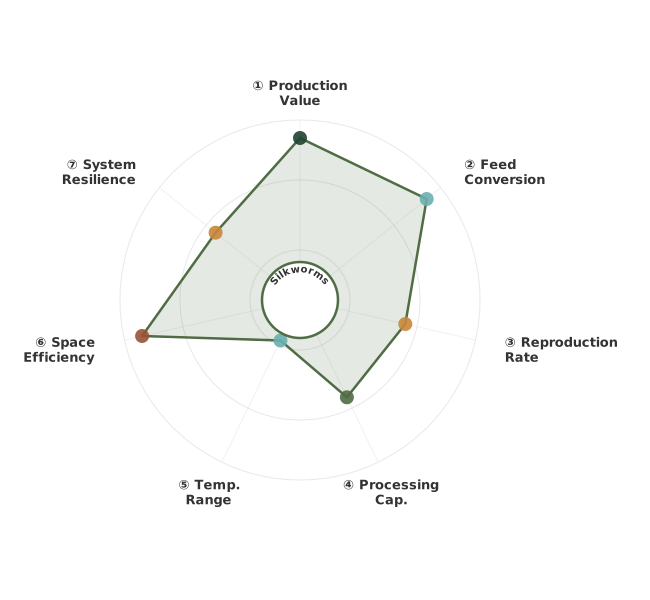
How These Traits Are Calculated
Trait dimensions are ordered clockwise starting from the top of the chart (12 o'clock position):
1. Production Value
Production Value scores 2.7 (exceptional) using soil builder pathway: composting_efficiency (exceptional 3.0, 40%) silkworms convert mulberry leaves into frass rapidly, typically within 2-3 weeks of feeding, casting_production (exceptional 2.8, 35%) produce large volumes of nutrient-rich frass (worm poop equivalent) that is excellent for soil amendment, soil_improvement (typical 2.0, 25%) frass is high in nitrogen and minerals, directly benefiting soil fertility and plant growth. Formula: (3.0×0.40 + 2.8×0.35 + 2.0×0.25) = 2.78, rounded to 2.7. Silkworm frass is a valuable, high-nitrogen fertilizer.
Excellent castings + fast composting
2. Feed Conversion
Feed Conversion Efficiency scores 3.0 (exceptional). Silkworms are highly efficient converters of leafy biomass (primarily mulberry leaves) into their own biomass and frass. They convert approximately 4 kg of feed into 1 kg of silk and frass combined, a very favorable ratio compared to many livestock species. This high efficiency makes them ideal for turning agricultural byproducts into valuable soil amendments and protein sources.
Converts feed at 4:1 ratio (excellent)
3. Reproduction Rate
Reproduction Rate scores 2.0 (typical). Silkworm moths lay 300-500 eggs, but the life cycle from egg to adult moth to egg again takes approximately 25-30 days depending on temperature and humidity. While prolific egg layers, the longer generation time compared to insects like BSF means population scaling is not as rapid. This rate is sufficient for consistent production of frass and silk over time.
Moderate reproduction, 25-30 day cycle
4. Processing Cap.
Processing Capacity scores 2.5 (typical-high). Silkworms consume large quantities of mulberry leaves daily, often equivalent to their own body weight during peak feeding stages. This voracious appetite leads to significant conversion of leafy biomass into frass. While not processing waste like BSF, their capacity to break down plant matter into high-quality fertilizer is substantial and consistent throughout their larval stages.
Processes own body weight in leaves daily
5. Temp. Range
Temperature Range scores 1.5 (limited). Silkworms have a very specific optimal temperature range, typically between 70-85°F (21-29°C). Deviations outside this range can significantly impact their growth, development, and survival. Maintaining precise temperature and humidity is crucial for successful silk production and frass generation, requiring climate-controlled environments. This makes them less resilient to fluctuating natural conditions.
Narrow optimal range (70-85°F, needs control)
6. Space Efficiency
Space Efficiency scores 3.0 (exceptional). Silkworms can be raised in stacked trays or bins at very high densities. A relatively small area can house a significant number of silkworms, allowing for intensive farming. Their growth and processing occur within contained environments, making them highly suitable for integrated farming systems, even in smaller spaces or urban settings. Compare to ratites, they require minimal land.
Minimal space (bin/tray systems, high density)
7. System Resilience
System Resilience scores 1.8 (typical). Silkworms have moderate hardiness (2.0, 40%) but are susceptible to diseases like pebrine and flacherie, requiring strict hygiene. Disease resistance is typical (2.0, 30%), as outbreaks can be devastating. Adaptability is limited (1.5, 30%) as they are highly dependent on specific feed (mulberry leaves) and precise environmental conditions (temperature, humidity). Formula: (2.0×0.40 + 2.0×0.30 + 1.5×0.30) = 1.85, rounded to 1.8. Strict management is needed.
Sensitive to disease & environmental fluctuations
Regenerative Advantages
- Small Scale Suitability: Require minimal space in controlled indoor environments (bins or trays). Management is simple, focusing on feeding and temperature control, ideal for solo operators.
Value Streams
Experience Level
Consult local experts for handling requirements
3
Understanding Silkworms Characteristics
Physical traits, temperament, and what makes this breed unique
Understanding Silkworms Characteristics
Physical traits, temperament, and what makes this breed unique
Silkworms (Bombyx mori) are not a traditional livestock breed but a domesticated insect species, unique for their extraordinary capacity to produce silk. Unlike most farm animals, their primary output is a fiber, not meat or milk. This species has been cultivated for over 5,000 years, originating in ancient China, where the secret of silk production was closely guarded for centuries. Their entire life cycle is dependent on human intervention, specifically feeding on mulberry leaves. This makes them distinct from any grazing animal – their 'pasture' is carefully managed mulberry foliage. The silkworm's defining characteristic is its transformation from a larva that consumes vast amounts of mulberry leaves into a pupa encased in a cocoon of raw silk.
What sets silkworms apart is their singular focus on silk production and their long history of co-evolution with humans. They are entirely dependent on cultivation and have lost the ability to fly or fend for themselves. Their genetic makeup has been optimized over millennia for silk yield, cocoon size, and ease of handling. This contrasts sharply with grazing livestock breeds, which have evolved for foraging efficiency, resilience in diverse environments, and various output products like meat, wool, or dairy. The silkworm's life cycle, from egg to moth, is relatively short, typically spanning 4-6 weeks for the larval stage, allowing for multiple production cycles within a year under optimal conditions.
The silkworm's uniqueness lies in its biological role as a producer of a highly valuable natural fiber using a readily available plant resource. This biological process is not about converting forage into animal products but about the insect's own metabolic output. The cocoon is spun from a single, continuous filament of fibroin protein, coated in sericin, which is then processed into silk yarn. This remarkable biological engineering is what makes the silkworm a subject of agricultural interest, even outside the conventional definition of livestock.
Sources behind this view
 Community
-
Discusses potential for silkworm cultivation as a cottage industry, exploring different species (Bombyx mori, wild silkmoths) and their food plants, with a historical anecdote from Vermont illustratin
Read more (opens in new window) permies.com -
Silkworm rearing (sericulture) holds potential as a cottage industry, with possibilities for silk reeling and selling eggs. Exploring diverse species and historical practices, like those in Vermont, r
Read more (opens in new window) permies.com -
An open house at UC Davis Bohart Museum featured silkworm moth (*Bombyx mori*) husbandry, detailing their life cycle, silk production (1000-3000 ft per cocoon), and diet of mulberry leaves, with a cra
Read more (opens in new window) ucanr.edu
 Research
-
Effects of Habitual Dietary Change on the Gut Microbiota and Health of Silkworms (opens in new window)
Switching silkworms from artificial feed to mulberry leaves boosted gut microbial diversity and improved growth, immunity, and silk production, highlighting diet-microbe links.
-
Comparative shotgun metagenomic data of the silkworm Bombyx mori gut microbiome. (opens in new window)
Advanced DNA sequencing revealed the gut bacteria of silkworms, identifying common species like Enterobacter and Acinetobacter, and providing a genetic blueprint for future research.
4
Management, Care & Feeding
Operational guidance for raising this breed successfully
Management, Care & Feeding
Operational guidance for raising this breed successfully
Managing silkworms primarily involves controlled environments and careful feeding. The larval stage, or silkworm itself, requires a clean, temperature-controlled (ideally 20-28°C) and humid (70-80%) rearing space, often called a 'sericulture house' or dedicated trays. They are fed exclusively fresh, pesticide-free mulberry leaves, with the quantity increasing significantly as they grow. Feeding is typically done multiple times a day, and the rearing trays must be cleaned regularly to prevent disease. The larvae molt several times, and during these periods, they require undisturbed conditions. Once the larvae mature and begin to spin their cocoons, they are moved to spinning frames or beds where they can complete their silk production.
The feeding management is critical. Farmers must ensure a consistent supply of high-quality mulberry leaves. This often means dedicated mulberry cultivation, managed for optimal leaf production. The leaves should be clean, free from contaminants, and ideally harvested just before feeding. Different silkworm breeds might have slight preferences or requirements for leaf age and type. Once cocoons are complete, they are typically harvested before the moth emerges. Some cocoons are left to allow the breeding cycle to continue, while the majority are processed for silk. The pupae within the harvested cocoons are usually killed by heat (drying or steaming) to prevent the moth from breaking the silk filament when it emerges, thus preserving the integrity of the silk.
Health management in silkworms focuses on preventing disease outbreaks, which can be devastating in a confined population. Strict hygiene is paramount: clean rearing trays, sanitized equipment, and good air circulation are essential. Common diseases include bacterial infections (like flacherie) and viral infections (like nuclear polyhedrosis virus). Avoiding stress on the larvae, such as overcrowding or sudden temperature/humidity fluctuations, also plays a role in their health and silk quality. Farmers need to be vigilant for any signs of disease – lethargy, discoloration, or unusual behavior – and remove affected individuals immediately. Sourcing disease-free eggs (disease-tested layings) from reputable suppliers is the first step in a healthy silkworm operation.
Sources behind this view
Community
-
Provides practical advice on housing, feeding (frequent mulberry leaves), and cleaning for newly hatched silkworms, stressing ample space, gentle handling with brushes/chopsticks, and managing their f
Read more (opens in new window) permies.com -
Initiating silkworm (Bombyx mori) rearing requires maintaining temperatures above 20°C, providing humidity with a damp sponge, and offering fresh mulberry leaves upon hatching, which can occur within
Read more (opens in new window) permies.com -
An open house at UC Davis Bohart Museum featured silkworm moth (*Bombyx mori*) husbandry, detailing their life cycle, silk production (1000-3000 ft per cocoon), and diet of mulberry leaves, with a cra
Read more (opens in new window) ucanr.edu
Research
-
Effects of Habitual Dietary Change on the Gut Microbiota and Health of Silkworms (opens in new window)
Switching silkworms from artificial feed to mulberry leaves boosted gut microbial diversity and improved growth, immunity, and silk production, highlighting diet-microbe links.