
Gamba Grass
Available data highlights its potential in regenerative agriculture, primarily as a forage and soil-building component. Studies indicate its use in fallow rotations following legume crops significantly enhances soil fertility, demonstrably increasing nitrogen (33%), carbon (51.72%), and crucial minerals like potassium (98.68%) and calcium (353%). This perennial grass fallow also improves soil organic matter accessibility for microbes. As a forage, Andropogon gayanus, when mixed with other grasses, has supported improved milk yields in livestock, suggesting its role in grazing systems. Supplementation trials indicate its value in animal nutrition, potentially contributing to live-weight gains. While intercropping with sorghum showed mixed results, with potential yield decreases in some associations, the primary regenerative benefits observed are soil enrichment and potential carbon sequestration. Further research would be beneficial to fully understand its integration into diverse regenerative practices like rotational grazing or no-till systems. While coverage in our knowledge base is limited, the above represents documented uses in regenerative systems.
For a full botanical description see: Wikipedia(opens in new window) (external link)
Regenerative Quick Profile
All recommendations assume integrated, regenerative practices—not conventional inputs.
Climate & Soil Fit
Climate: Tropical Rainforest, Tropical Monsoon, Tropical Savanna, Hot Semi-Arid (Steppe), Humid Subtropical, Oceanic (Maritime Temperate), Hot-Summer Mediterranean, Warm-Summer Mediterranean, Monsoon-Influenced Humid Subtropical, Subtropical Highland
Zones: USDA 8-11, Australian Zones 3-14, EU Mediterranean, Subtropical
Optimal Soil: Sandy Soil
System Role & Functions
Primary: Cover Crop System
Secondary: Forage Integration, Soil Remediation
Key Benefits: Low maintenance, Weed Suppression, Root System Depth
Management Level
Experience: Beginner-Friendly
Maintenance: Very low maintenance - Once established, this robust perennial requires minimal intervention, relying on its inherent drought tolerance and efficient nutrient cycling to thrive in low-input systems.
Value Streams
- Cover crop (soil investment)
- Soil building and erosion control
- Livestock forage value
Know the Debate
- Exceptional biomass production supports soil fertility and carbon sequestration.
- Can improve livestock forage quality and carrying capacity.
- Highly productive but can be invasive in non-native environments.
- Requires careful management to prevent uncontrolled spread.
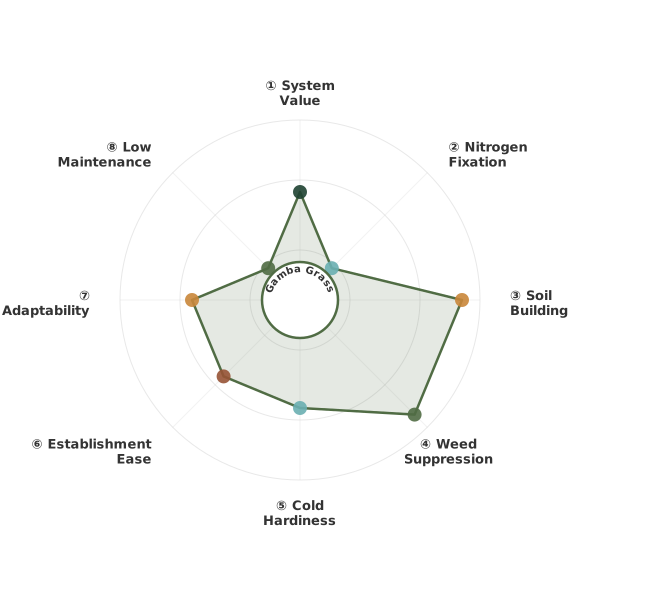
How These Traits Are Calculated
Trait dimensions are ordered clockwise starting from the top of the chart (12 o'clock position):
1. System Value
Ecosystem service stacking across nitrogen, carbon, water, biodiversity
WHAT: Synthesizes the compounding value of multiple ecosystem services delivered simultaneously—nitrogen fixation, soil organic matter building, pollinator support, erosion control, and water infiltration improvement. This is the total regenerative impact beyond single-function metrics.
WHY: The highest-value cover crops deliver 3-5 significant ecosystem services at once. A legume that fixes nitrogen, builds biomass, supports pollinators, and improves water infiltration provides $150-300/acre in combined benefits versus $30-60 for single-function covers. This service stacking is the core principle of regenerative agriculture.
HOW: Scored via LLM synthesis of economics data, timeline benefits, and trait combinations. Exceptional (3.0): 4-5 major services stacked with strong economic value ratios. Typical (2.0): 2-3 moderate services. Limited (1.0): Single-function covers with minimal service stacking. Considers seed cost relative to benefit value.
2. Nitrogen Fixation
Biological nitrogen production via legume root nodule bacteria
WHAT: Measures the ability to convert atmospheric nitrogen (N₂) into plant-available ammonia through symbiotic bacteria in root nodules. Legumes form partnerships with rhizobium bacteria that fix 60-150 lbs N/acre/year, reducing or eliminating synthetic fertilizer needs for following crops.
WHY: Nitrogen is the most expensive fertilizer input in crop production ($0.50-1.00/lb). Cover crops with exceptional nitrogen fixation can provide $60-150/acre worth of fertility while building soil organic matter. This biological process also reduces groundwater contamination from nitrogen runoff and lowers farm carbon footprint.
HOW: Ratings based on annual nitrogen fixation capacity and reliability across soil conditions. Exceptional (3.0): Legumes like hairy vetch, crimson clover, and field peas fixing >100 lbs N/acre/year. Typical (2.0): Moderate fixers like red clover at 60-100 lbs N/acre/year. Limited (1.0): Non-legumes (grasses, brassicas) with zero fixation capacity.
3. Soil Building
Weighted: biomass production (60%) + root system depth (40%)
WHAT: Combines above-ground biomass production with root depth to measure total soil organic matter contribution. Biomass provides surface organic matter, while deep roots deposit carbon at depth and break up compaction layers.
WHY: Soil organic matter is the foundation of regenerative agriculture, improving water retention, nutrient cycling, and biological activity. Each 1% increase in soil organic matter holds an additional 20,000 gallons of water per acre and represents $500-1,000 in fertility value. Deep roots access subsoil nutrients and create channels for water infiltration.
HOW: Weighted formula prioritizes biomass production (60% weight) for immediate organic matter contribution, with root depth (40% weight) for long-term soil structure. Exceptional (3.0): High-biomass crops with deep roots like cereal rye (8+ tons biomass, 5+ ft roots). Typical (2.0): Moderate on both factors. Limited (1.0): Low biomass or shallow roots.
4. Weed Suppression
Physical competition through rapid establishment and dense growth
WHAT: Measures the ability to outcompete weeds through rapid germination, aggressive early growth, and dense canopy formation. Physical smothering and light competition reduce weed pressure without herbicides.
WHY: Weed management is a major labor and cost burden for farmers. Cover crops that effectively suppress weeds reduce herbicide costs ($20-60/acre), decrease cultivation passes (fuel + labor), and provide clean seedbeds for cash crops. This is especially valuable in organic systems where herbicide options are limited.
HOW: Ratings based on germination speed, tillering density, and canopy closure timing. Exceptional (3.0): Fast-establishing, dense-tillering crops like cereal rye, oilseed radish that close canopy within 3-4 weeks. Typical (2.0): Moderate establishment and coverage. Limited (1.0): Slow-establishing or sparse crops that allow weed competition.
5. Cold Hardiness
Winter survival for fall planting and spring green manure value
WHAT: Measures tolerance to freezing temperatures and ability to survive winter conditions. Winter-hardy cover crops can be fall-planted, overwinter as living mulch, and provide early spring growth before cash crop planting.
WHY: Fall-planted winter-hardy covers extend the growing season into unused months, capturing solar energy and preventing erosion during wet periods. Spring green manure from overwintered covers provides early nitrogen and biomass. This timing flexibility is critical in cold climates with short growing seasons.
HOW: Ratings based on minimum survival temperature and winter active growth. Exceptional (3.0): Winter-hardy crops like cereal rye, hairy vetch, crimson clover surviving to -20°F with active growth in spring. Typical (2.0): Moderate cold tolerance. Limited (1.0): Warm-season crops like buckwheat, cowpea killed by first frost.
6. Establishment Ease
Germination speed, soil requirement flexibility, planting window breadth
WHAT: Measures how easily the cover crop establishes from seed, including germination speed, tolerance for variable soil conditions, and flexibility in planting timing. Easy establishment means reliable stands without intensive management.
WHY: Difficult-to-establish covers increase risk of stand failure, wasted seed costs, and reduced benefits. Easy establishment crops tolerate late planting, poor seedbed preparation, and variable moisture—critical when cover cropping windows are narrow between cash crops. Reliable establishment ensures consistent soil building and weed suppression benefits.
HOW: Ratings based on days to emergence, soil condition sensitivity, and planting window breadth. Exceptional (3.0): Fast germinators like buckwheat (3-5 days) and cereal rye (5-7 days) with wide planting windows. Typical (2.0): Moderate establishment requirements. Limited (1.0): Slow or finicky establishers requiring precise conditions.
7. Adaptability
Weighted: climate tolerance (60%) + multi-benefit versatility (40%)
WHAT: Combines climate adaptability (temperature and rainfall range) with multi-benefit versatility (diverse ecosystem services) to measure overall system flexibility. High adaptability means the cover works across farm regions and provides multiple functions.
WHY: Farmers need cover crops that work reliably across diverse fields and provide stacked benefits. Climate-adaptable covers reduce risk in variable weather, while multi-benefit crops deliver nitrogen fixation + pollinator support + forage value simultaneously. This versatility maximizes return on cover crop investment.
HOW: Weighted formula prioritizes climate tolerance (60% weight) for geographic reliability, with multi-benefit value (40% weight) for functional stacking. Exceptional (3.0): Wide climate range + multiple significant benefits. Typical (2.0): Moderate on both factors. Limited (1.0): Narrow climate range or single-function crops.
8. Low Maintenance
Inverted from maintenance intensity—low inputs mean high scores
WHAT: Measures minimal input requirements for successful cover cropping. Low-maintenance covers require no irrigation, minimal fertility, easy termination, and tolerate variable management timing.
WHY: Cover crops compete for resources with cash crops in tight rotations. Low-maintenance covers fit easily into existing systems without adding labor, equipment, or input costs. Easy termination is especially critical—covers that are difficult to kill can become weeds and delay cash crop planting.
HOW: Inverted score from maintenance intensity trait (4.0 minus raw score). Exceptional (3.0): Self-sufficient crops like cereal rye, field peas requiring no irrigation or fertility, easily terminated by mowing or winter-kill. Typical (2.0): Moderate input needs. Limited (1.0): High-maintenance crops needing irrigation, heavy fertility, or difficult termination (herbicides, multiple tillage passes).
Ratings are based on documented performance in regenerative systems, not conventional high-input scenarios. All traits assume integrated management practices focused on soil health and ecosystem services.
5
Management & Care Requirements
Integration guidance, maintenance needs, and care practices
Management & Care Requirements
Integration guidance, maintenance needs, and care practices
How to Integrate This Plant
Gamba grass (Andropogon Gayanus) can be integrated into regenerative systems primarily as a cover crop and for forage. Its role as a perennial grass makes it valuable for erosion control and improving soil health over time. In Burkina Faso, it demonstrated significant increases in soil nitrogen, carbon, and nutrient availability when used in fallow rotations after a legume crop. This suggests its utility in building soil organic matter and fertility, supporting crop production in subsequent cycles. It can also be part of intercropping systems, though care must be taken to manage its competitive nature, as seen in trials where it decreased sorghum yield. Its perennial nature means it provides consistent ground cover and contributes to soil structure stabilization from its first year. Over time, its root system enhances soil aggregation and water infiltration. While not providing shade or windbreaks like trees, its dense growth offers surface protection. It can be grazed, contributing to livestock feed, and its biomass can be incorporated into the soil to further boost organic matter.
Integration Practices & Management
The provided knowledge base offers limited insight into the specific methods regenerative farmers use to integrate *Andropogon gayanus* (gamba grass). While Source indicates its use in a fallow rotation following a legume crop in Burkina Faso, it primarily focuses on the positive impacts on soil physico-chemical properties such as increased soil nitrogen, carbon, and various mineral nutrients. Source further elaborates on the soil benefits, noting that *Andropogon gayanus* fallow contributes to accessible organic matter pools. Source discusses its role in livestock feed, detailing how supplementation alongside *Andropogon gayanus* and *Panicum maximum* affected milk yield and live-weight changes in cattle. However, details on establishment, specific grazing management strategies like mob or rotational grazing, timing of grazing and rest periods, or termination methods are not present in these mentions. Similarly, information regarding its integration with cash crops, fertility requirements, competition management, or succession planning within the context of regenerative agriculture practices is absent from this limited knowledge base.
Management Profile
Maintenance Intensity: Ideally Suited - Once established, this robust perennial requires minimal intervention, relying on its inherent drought tolerance and efficient nutrient cycling to thrive in low-input systems.
Sources behind this view
 Research
-
Short Term Impact of Andropogon gayanus Kunth. on Soil Fertility and Legume Crop Rotation in West Central Region of Koudougou, Burkina Faso (opens in new window)
This study found: Rotating legume crops with gamba grass cover in Burkina Faso significantly improved soil fertility, boosting organic matter, nitrogen, and key nutrients over three years. Soil conservation is crucial
8
Know the Debate
Andropogon gayanus (Gamba grass) is a highly productive perennial grass with significant potential for soil improvement and forage. Its use spans t...
Know the Debate
Andropogon gayanus (Gamba grass) is a highly productive perennial grass with significant potential for soil improvement and forage. Its use spans t...
Andropogon gayanus (Gamba grass) is a highly productive perennial grass with significant potential for soil improvement and forage. Its use spans tropical and subtropical farming systems, from cattle ranching in the Brazilian Cerrado to pasture renovation in Australian dry tropics. While its deep roots and biomass production enhance soil fertility, carbon sequestration, and erosion control, its aggressive growth necessitates careful management. Successful integration depends on climate, soil conditions, and diligent containment to prevent invasiveness, particularly in regions like Australia and parts of South America where it is classified as a weed. Establishing and managing Gamba grass requires specific seeding rates, planting depths, and fertility strategies, often prioritizing biological inputs over synthetics.
Is Gamba grass a valuable forage or an invasive threat?
Valuable Forage (Soil Fertility & Biomass)
Andropogon gayanus is highly productive, yielding significant biomass and enriching soil fertility by increasing organic matter and essential minerals. When intercropped with legumes, it offers improved nutritional value for livestock and contributes to soil carbon sequestration.
Sources behind this view
Sources behind this view
Research
-
Short Term Impact of Andropogon gayanus Kunth. on Soil Fertility and Legume Crop Rotation in West Central Region of Koudougou, Burkina Faso (opens in new window)
This study found: In Burkina Faso, a three-year study looked at how rotating legume crops with a short period of gamba grass (Andropogon gayanus) cover improved degraded farmland. The gamba grass cover significantly boosted soil organic matter, nitrogen, and several key nutrients like phosphorus, potassium, magnesium, and calcium. While the legume crops slightly increased nitrate levels, the overall effect of the gamba grass rotation was a substantial improvement in soil fertility. The study also found that even small slopes (1.35%) led to poorer soil quality, emphasizing the need for soil conservation practices. This rotation system is recommended as a sustainable way for small farmers to manage and improve their land.
-
Goat performance on pure Andropogon gayanus pastures or associated with legumes. (opens in new window)
This study found: This study compared how well goats performed grazing on a single type of grass (*Andropogon gayanus*) versus pastures where that grass was mixed with legumes (*Stylosanthes* or *Calopogonium*). The grass-legume mixtures produced more total forage and had better nutritional value (higher protein, lower fiber) than the grass-only pasture. Goats spent more time grazing the grass-only pasture but spent more time chewing their cud (ruminating) on the mixture with *Stylosanthes*. Goats ate more overall on the mixed pastures, indicating they were more palatable and digestible. The legumes themselves had distinct carbon signatures. Overall, mixing legumes with grass improved pasture quality and goat intake.
-
The leaf micromorphology and anatomy of gamba grass, Andropogon gayanus Kunth (Poaceae: Panicoideae) (opens in new window)
This study found: Context Andropogon gayanus, commonly known as gamba grass, is one of the declared weeds of national significance in Australia. Past studies have focused on gross morphology of root structures, biogeochemical behaviour, and ecology, but there has been limited work on comparative descriptions of leaf micromorphology and anatomy. Aims We investigated and described its leaf micromorphology and anatomy to understand weed biology and ecophysiology. Methods Optical and scanning electron microscope examination of the adaxial and abaxial leaf surfaces of A. gayanus was carried out. We identified and generated a list of morphological characters that were used to compare several dried herbarium specimens of A. gayanus. Key results The leaf characters were consistent across all specimens examined, with minor differences in leaf pubescence, indicating this could be a plastic trait. Conclusions Andropogon gayanus leaves are well adapted to wet and dry tropical conditions. Plasticity in leaf surface pubescence possibly enhances its adaptability, increasing its success as a weed in Australian ecosystems. The success of A. gayanus in Australia could be because the environment compares favourably with the native environment of the species in Africa, where it has adapted to extremes of wet and dry conditions over a large geographical range. Implications Plant morphological and taxonomic studies of A. gayanus focused on describing characters of spikelets and caryopses are recommended to understand how reproductive structures aid in its successful proliferation.
Invasive Threat (Ecological Harm)
In regions like Australia and Brazil, Gamba grass is recognized as a nationally declared weed and an invasive threat, drastically altering native savanna understories and potentially outcompeting native vegetation.
Sources behind this view
Sources behind this view
Research
-
The leaf micromorphology and anatomy of gamba grass, Andropogon gayanus Kunth (Poaceae: Panicoideae) (opens in new window)
This study found: Context Andropogon gayanus, commonly known as gamba grass, is one of the declared weeds of national significance in Australia. Past studies have focused on gross morphology of root structures, biogeochemical behaviour, and ecology, but there has been limited work on comparative descriptions of leaf micromorphology and anatomy. Aims We investigated and described its leaf micromorphology and anatomy to understand weed biology and ecophysiology. Methods Optical and scanning electron microscope examination of the adaxial and abaxial leaf surfaces of A. gayanus was carried out. We identified and generated a list of morphological characters that were used to compare several dried herbarium specimens of A. gayanus. Key results The leaf characters were consistent across all specimens examined, with minor differences in leaf pubescence, indicating this could be a plastic trait. Conclusions Andropogon gayanus leaves are well adapted to wet and dry tropical conditions. Plasticity in leaf surface pubescence possibly enhances its adaptability, increasing its success as a weed in Australian ecosystems. The success of A. gayanus in Australia could be because the environment compares favourably with the native environment of the species in Africa, where it has adapted to extremes of wet and dry conditions over a large geographical range. Implications Plant morphological and taxonomic studies of A. gayanus focused on describing characters of spikelets and caryopses are recommended to understand how reproductive structures aid in its successful proliferation.
-
Efeito do fogo anual na mortalidade e no banco de sementes de Andropogon gayanus Kunth. no Parque Nacional de Brasília/DF (opens in new window)
This study found: Andropogon gayanus foi introduzido no território brasileiro para a formação de pastagens e espalhou-se por grandes extensões de ecossistemas naturais sendo consideradas atualmente ameaça a diversidade em Unidades de Conservação. Por apresentar excelente rebrota pós-fogo é considerado uma espécie resistente. Este trabalho teve como objetivo avaliar os efeitos de queimadas anuais, na mortalidade e no banco de sementes do solo desta espécie invasora. As queimadas foram realizadas em setembro de 2009, 2010 e 2011 em uma área de cerrado ralo invadida por Andropogon gayanus no Parque Nacional de Brasília. A capacidade de rebrota de 50 indivíduos da espécie invasora foi acompanhada bimestralmente após cada queimada e até a véspera da próxima queimada. O efeito do fogo no banco de sementes do solo foi estimado por comparação do banco de sementes germináveis antes e imediatamente após cada queimada. A mortalidade de indivíduos adultos estabelecidos na área variou de 8% a 10% estando restrita a indivíduos com diâmetro basal menor do que 16cm. A densidade de sementes germinadas no banco do solo foi de 325, 375 e 400 sementes/m2 antes das queimadas de 2009, 2010 e 2011, respectivamente, com redução de 71%, 82% e 79% após estas queimadas. Embora as queimadas, tenham reduzido significativamente o número de sementes germináveis o banco de sementes da espécie invasora, a baixa mortalidade de indivíduos, inclusive indivíduos de pequeno diâmetro basal (menor que 16cm), indica que a espécie é resistente ao fogo e que com a rápida recuperação da parte aérea haverá reposição do banco de sementes na próxima estação reprodutiva sem interrupção do processo de invasão.
-
Invasive <i>Andropogon gayanus</i> (gamba grass) is an ecosystem transformer of nitrogen relations in Australian savanna (opens in new window)
This study found: Invasion by the African grass Andropogon gayanus is drastically altering the understory structure of oligotrophic savannas in tropical Australia. We compared nitrogen (N) relations and phenology of A. gayanus and native grasses to examine the impact of invasion on N cycling and to determine possible reasons for invasiveness of A. gayanus. Andropogon gayanus produced up to 10 and four times more shoot phytomass and root biomass, with up to seven and 2.5 times greater shoot and root N pools than native grass understory. These pronounced differences in phytomass and N pools between A. gayanus and native grasses were associated with an altered N cycle. Most growth occurs in the wet season when, compared with native grasses, dominance of A. gayanus was associated with significantly lower total soil N pools, lower nitrification rates, up to three times lower soil nitrate availability, and up to three times higher soil ammonium availability. Uptake kinetics for different N sources were studied with excised roots of three grass species ex situ. Excised roots of A. gayanus had an over six times higher uptake rate of ammonium than roots of native grasses, while native grass Eriachne triseta had a three times higher uptake rate of nitrate than A. gayanus. We hypothesize that A. gayanus stimulates ammonification but inhibits nitrification, as was shown to occur in its native range in Africa, and that this modification of the soil N cycle is linked to the species' preference for ammonium as an N source. This mechanism could result in altered soil N relations and could enhance the competitive superiority and persistence of A. gayanus in Australian savannas.
Making Sense of the Differences
The key conflict with Gamba grass lies in its dual nature: an exceptionally productive forage and soil improver versus a highly invasive species. Its success in regenerative agriculture hinges on strict containment. In its native or ecologically similar environments, or where it's managed within fire-breaks and grazing rotations, it offers significant benefits. However, in regions where it outcompetes native flora and alters fire dynamics, its cultivation can lead to ecological damage. Successful integration requires assessing local invasive potential, choosing appropriate climates (like arid rangelands or specific tropical zones with controlled grazing), and implementing rigorous management to prevent uncontrolled spread.
9
Learn More
Why farmers use this plant and additional resources
Learn More
Why farmers use this plant and additional resources
Why Regenerative Farmers Use This Plant
Andropogon gayanus, commonly known as Gamba grass or Giant beard grass, is a highly productive perennial grass that offers significant regenerative benefits when integrated into livestock systems, forages, and cropping systems. It is renowned for its exceptional biomass production, capable of yielding 4-20 tons of dry matter per acre (9-44 metric tons/ha) annually under optimal conditions. This substantial biomass is crucial for building soil organic matter, with decomposition rates contributing to soil carbon sequestration over 3-5 year rotations. While not a nitrogen fixer, its extensive root system, reaching depths of 6-12 feet (1.8-3.6 meters), effectively scavenges nutrients from deeper soil profiles, making them available to subsequent crops or livestock. This nutrient cycling capacity can reduce the reliance on synthetic fertilizers by an estimated 20-30% for following cash crops.
Integrating Gamba grass into pasture systems provides high-quality forage for grazing animals, supporting carrying capacities of 0.5-3 Animal Units per acre (0.2-1.2 AU/ha) depending on soil fertility, rainfall, and management. Its dense growth habit also offers excellent erosion control, stabilizing soils on slopes and preventing nutrient runoff. In silvopasture systems, it can be managed as an understory component, providing forage while supporting tree growth. Its ability to outcompete many annual weeds once established also contributes to weed suppression, reducing the need for mechanical or chemical weed control in pasture renovation.
The ecological contributions of Gamba grass extend to supporting biodiversity and improving soil health indicators. Its dense root system enhances soil aggregation and porosity, leading to improved water infiltration rates, which can improve by 15-25% over time. This improved soil structure and water-holding capacity are vital for resilience in variable rainfall environments, reducing runoff and nutrient leaching. The plant also provides habitat and food sources for various beneficial insects and pollinators, contributing to a more balanced farm ecosystem. By building soil organic matter, Gamba grass fosters a healthier soil microbiome, which is essential for nutrient cycling and disease suppression in the wider agricultural landscape.
Farmers in regions like Queensland, Australia, have utilized Gamba grass to improve carrying capacity on low-fertility soils, transforming degraded pastures into productive grazing land. In tropical Africa, it serves as a vital forage component in livestock systems, providing a reliable feed source during dry seasons. In parts of South America, it is used for soil conservation on cattle ranches, effectively preventing erosion on rolling terrain. In the Brazilian Cerrado, it is widely used in pasture renovation and silvopasture systems, providing year-round forage and contributing to soil health under large-scale cattle operations. In the southern United States, it can be grown in USDA Zones 8-11, often as a forage for livestock, requiring careful management to prevent invasiveness in some areas. In parts of India, it is used for erosion control on slopes and as a valuable fodder for livestock, especially during drier months.
Sources behind this view
Research
-
Short Term Impact of Andropogon gayanus Kunth. on Soil Fertility and Legume Crop Rotation in West Central Region of Koudougou, Burkina Faso (opens in new window)
This study found: Rotating legume crops with gamba grass cover in Burkina Faso significantly improved soil fertility, boosting organic matter, nitrogen, and key nutrients over three years. Soil conservation is crucial