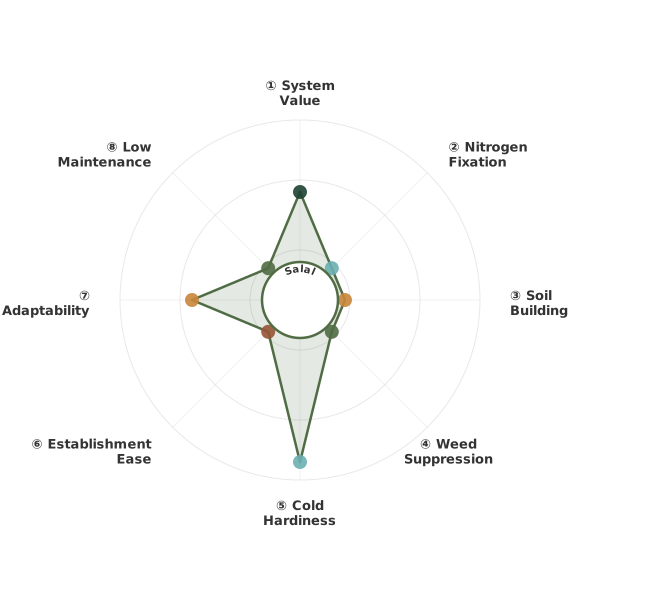
Gaultheria shallon, or Salal, shows potential for regenerative agriculture, though our current knowledge base provides limited insights into its specific applications. Primarily, it's considered for its role as a groundcover and potential forage component within polyculture systems. Its dense growth habit suggests benefits for soil building, potentially suppressing weeds and contributing to organic matter. While not explicitly identified as a nitrogen fixer in our data, its evergreen nature could offer year-round soil protection and carbon sequestration. Integration in agroforestry or silvopasture systems is a logical consideration, providing understory diversity and habitat. Direct farmer experiences within our knowledge base regarding its use in rotational grazing or no-till systems are not detailed, highlighting a need for further observation and reporting on its practical integration and efficacy in regenerative landscapes.

Regenerative Quick Profile

All recommendations assume integrated, regenerative practices—not conventional inputs.

Climate & Soil Fit

Climate: Tropical Rainforest, Tropical Monsoon, Tropical Savanna, Hot Semi-Arid (Steppe), Cold Semi-Arid (Steppe), Humid Subtropical, Oceanic (Maritime Temperate), Hot-Summer Mediterranean, Warm-Summer Mediterranean, Monsoon-Influenced Humid Subtropical, Subtropical Highland, Hot-Summer Continental, Warm-Summer Continental, Subarctic, Monsoon-Influenced Hot-Summer Continental

Zones: USDA 5-9, Australian Zones 3-6

Optimal Soil: Acidic Soil

System Role & Functions

Primary: Cover Crop System

Secondary: Forage Integration, Pollinator Support

Key Benefits: Low maintenance, Cold Hardiness

Management Level

Experience: Advanced

Maintenance: Very low maintenance - This shade-tolerant evergreen shrub thrives in acidic soils with minimal intervention, spreading well and requiring very little management once integrated into the landscape.

Value Streams

  • Cover crop (soil investment)
  • Soil building and erosion control
  • Livestock forage value
  • Pollinator habitat and support
1

Climate Suitability Assessment

Will this plant thrive in your climate?

IDEALLY SUITED

Köppen Zone: Cfa (Humid Subtropical), Cfb (Oceanic (Maritime Temperate))
USDA Zone: 6a, 7a, 8a, 9a
EU Climate Region: atlantic

Salal performs exceptionally well in climates characterized by mild winters and cool, moist summers, with annual rainfall typically exceeding 30 inches (75 cm). These conditions are met in Köppen Cfb zones, USDA zones 7a-8b, and the EU Atlantic climate region. In these areas, Salal establishes readily, exhibits vigorous growth, and reliably persists as a perennial cover crop. The consistent moisture and moderate temperatures prevent heat stress and winter kill, allowing for optimal performance in supporting regenerative agriculture functions like groundcover and pollinator habitat. Minimal management is required beyond ensuring adequate initial establishment, with its dense growth habit effectively suppressing weeds and improving soil structure. Its suitability in these zones makes it a valuable component for enhancing biodiversity and ecological resilience within agricultural landscapes.

ADEQUATE

Köppen Zone: Af (Tropical Rainforest), Am (Tropical Monsoon), Aw (Tropical Savanna), Csa (Hot-Summer Mediterranean), Csb (Warm-Summer Mediterranean), Cwa (Monsoon-Influenced Humid Subtropical), Cwb (Subtropical Highland), Dfa (Hot-Summer Continental), Dfb (Warm-Summer Continental)
USDA Zone: 5a, 5b, 10a, 11a, 12a
Australian Zone: temperate

Salal demonstrates adequate performance in climates with moderate temperatures and sufficient, though not always consistent, moisture. This includes Köppen Cfc zones, USDA zones 5b-6b and 9a-9b, and Australian temperate regions. In these areas, Salal can establish and grow, but may require supplemental irrigation during drier summer periods or protection from occasional frost. While it can provide groundcover and support pollinators, its productivity and stand persistence might be somewhat reduced compared to ideal zones. Careful site selection, potentially incorporating partial shade and ensuring good soil moisture retention, will be key to maximizing its benefits. These zones represent a balance where Salal is viable but may necessitate slightly more attentive management to overcome climatic limitations.

NOT RECOMMENDED

Köppen Zone: ET (Tundra), BSh (Hot Semi-Arid (Steppe)), BSk (Cold Semi-Arid (Steppe)), BWh (Hot Desert), BWk (Cold Desert), Dfc (Subarctic), Dwa (Monsoon-Influenced Hot-Summer Continental)
USDA Zone: 2a, 3a, 3b, 4a

Salal is not recommended for climates with extreme winter cold (Köppen Dfb, Dfc; USDA 1a-5a) or hot, dry summers (Köppen Csa, Csb; USDA 10a-10b). In cold regions, severe winter temperatures lead to widespread winter kill, preventing perennial establishment and reliable productivity. The short growing seasons further hinder its ability to establish before winter. In hot, dry regions, intense summer heat and drought stress cause significant plant decline, poor establishment, and high mortality rates, necessitating extensive and uneconomical irrigation. These conditions make Salal impractical and unreliable for cover cropping, forage integration, or pollinator support in these zones, with alternative plants better suited to the specific climatic challenges offering more dependable results and economic viability.

Note: Zones listed above represent climates where this plant can produce reliably with reasonable management. Climate zones not mentioned would require intensive climate modification (greenhouses, extensive infrastructure) and are not economically viable for regenerative agriculture purposes.

2

Soil Suitability Assessment

Which soil types work best for this plant?

IDEALLY SUITED

Acidic Soil

This plant thrives in these soil types without requiring amendments or remediation. Natural soil conditions support optimal growth and productivity.

ADEQUATE

Clay Soil, Loam Soil, Rich Soil, Rocky Soil, Sandy Soil

This plant performs acceptably in these soil types with moderate, manageable remediation such as pH adjustment, compost addition, or drainage improvement. The required amendments are practical and cost-effective for regenerative agriculture.

NOT RECOMMENDED

Alkaline Soil, Desert Soil, Saline Soil, Wet Soil

Growing this plant in these soil types would require impractical remediation such as complete soil replacement, extensive amendments, or cost-prohibitive infrastructure. These conditions are not economically viable for regenerative agriculture.

Note: Soil suitability assessments focus on remediation requirements. "Ideally Suited" means the plant generally thrives without the need for substantial amendments, "Adequate" means manageable remediation (lime, compost, mulch), and "Not Recommended" means impractical soil changes would be required. Climate factors like rainfall and temperature also influence success.

3

Seasonal Considerations

Planting timing, growth duration, and harvest windows

Gaultheria shallon, or salal, offers a robust evergreen option for regenerative systems across a range of climates. For spring planting, aim for after the last expected frost, allowing its evergreen foliage to establish before summer heat. In fall, plant several weeks before the first expected frost to ensure good root development and overwinter survival in zones Dfb and Dfc. While not typically a summer cover crop, it can be incorporated into longer rotations, especially in cooler Cfb and Cfc climates, where it can provide year-round ground cover.

Salal generally takes several weeks to establish a solid root system. In colder climates (Dfb, Dfc), it’s a reliable winter cover, entering dormancy but retaining its foliage. Termination should occur several weeks before planting your main cash crop to allow for decomposition and soil preparation. Its peak biomass is typically achieved after its first full year of growth, making it ideal for longer-term soil building strategies. Consider frost-seeding in early spring in suitable climates, broadcasting seeds onto a prepared seedbed as the soil begins to warm.

4

System Role & Multi-Benefit Value

Functional roles, integration strategies, and stacked benefits

Functional Role

Total System Value

Salal offers substantial system value beyond its direct use, primarily as an understory component in diverse perennial systems. Its dense, evergreen foliage provides excellent erosion control and helps retain soil moisture, reducing the need for irrigation and improving water infiltration. As a pollinator plant, it supports beneficial insect populations throughout its blooming period, contributing to the broader ecosystem services of the farm. In food forests or silvopastures, salal occupies the understory niche, outcompeting less desirable weeds and adding a layer of biodiversity. While direct harvest value is limited to its berries for niche markets or personal consumption, its role in enhancing soil health, supporting pollinators, and providing habitat for wildlife significantly increases the farm's ecological resilience. This risk diversification is achieved through its contribution to soil stability, pest control through pollinator support, and general ecological health, making the farm less vulnerable to single-point failures.

Integration Characteristics

Multi-Benefit Value: Adequate - Provides edible berries and habitat for wildlife, with its dense growth aiding erosion control and contributing to soil organic matter, thus offering niche benefits for system integration.

5

Management & Care Requirements

Integration guidance, maintenance needs, and care practices

How to Integrate This Plant

Salal (Gaultheria shallon) can be integrated into regenerative systems primarily as a groundcover and understory component, offering erosion control and habitat. Its role as a pollinator support species is significant, providing early to mid-season nectar. In silvopasture or food forest systems, salal can occupy the understory layer, suppressing weeds and retaining soil moisture. It is compatible with practices like alley cropping, where it could be planted in the alley margins, and food forests, serving as a shade-tolerant groundcover. While not a nitrogen fixer, its dense growth habit aids in soil stabilization and organic matter accumulation. Salal starts providing significant groundcover and pollinator benefits within its first 2-3 years, with mature stands offering robust erosion control and habitat value by year 5. Its multi-benefit stacking includes soil health improvement, pollinator resource provision, and wildlife habitat creation, contributing to overall farm biodiversity and resilience.

Integration Practices & Management

Information regarding the specific integration methods of Gaultheria shallon (salal) by regenerative farmers is limited within the provided knowledge base. The available sources do not detail establishment techniques such as seeding rates, timing, companion planting, or specific tillage practices (no-till vs. minimal tillage) for salal. Similarly, the knowledge base offers no insights into how regenerative farmers integrate salal with grazing systems, including mob grazing, rotational grazing, or the timing and duration of grazing and rest periods. Termination strategies, whether through natural winterkill, grazing down, crimping, mowing, or herbicide use, are also not discussed. Furthermore, management considerations like fertility needs, competition management, or succession planning for salal are absent from the text. The knowledge base also does not provide information on how salal is integrated with cash crops through relay cropping, intercropping, or rotation sequences, nor does it include practical farmer experiences or insights on its use in regenerative agriculture.

Management Profile

Maintenance Intensity: Ideally Suited - This shade-tolerant evergreen shrub thrives in acidic soils with minimal intervention, spreading well and requiring very little management once integrated into the landscape.

6

Economics & Value Streams

Direct harvest, system benefits, ecosystem services, and risk diversification

Comprehensive economic analysis including direct harvest value, system enhancement contributions, ecosystem services, value timeline, and risk diversification strategies.

Cover Crop Investment

Metric Value
Seed Cost N/A N/A
Termination Cost 15-40 37-99
Biomass Production 1-3 2-7
N Fixation Value N/A N/A
Weed Control Savings 10-50 25-124

Cover crops are soil investments, not cash crops. Economics measured in soil health gains, input reduction, and subsequent crop performance. Values show direct costs and estimated benefits.

System Enhancement Value

Beyond cost recovery: soil building, nitrogen, biomass, and weed suppression

Soil Building & Weed Suppression

Salal's integration into a cover crop system offers significant secondary benefits beyond its primary function. As a forage integration component, its evergreen foliage provides valuable browse for livestock, particularly during winter months when other forage options may be scarce. This extends the grazing season and reduces reliance on external feed inputs. Furthermore, Salal is recognized for its role in pollinator support. While specific nectar and pollen production data are not detailed in the provided excerpts, its flowering period likely contributes to the diverse floral resources available to native and managed pollinators throughout the season. The dense growth habit of Salal also contributes to soil health by acting as a ground cover, suppressing weeds, and potentially improving soil structure and moisture retention. Its tolerance for both sunny and shady conditions (as noted in) makes it adaptable to various microclimates within an integrated farm system, further enhancing its utility.

Ecosystem Service Contributions

Environmental contributions: carbon, pollinators, wildlife, and water

  • Carbon Sequestration: As a woody shrub with evergreen foliage, Salal has good potential for carbon sequestration through biomass accumulation in its stems, leaves, and root system. Its perennial nature allows for continuous carbon storage over many years.
  • Pollinator Support: High. Salal is noted as a plant that supports pollinators. Its evergreen nature may also provide habitat and forage opportunities over a longer period.
  • Wildlife Habitat: Salal berries are a food source for wildlife, and its dense foliage can offer nesting and shelter opportunities for birds and small mammals.
  • Water Quality: Not applicable

Value Timeline: Soil Building Process

When you'll see results: immediate soil benefits, compounding over seasons

Years 1-2

Establishment of ground cover, weed suppression, and initial pollinator support. Potential for early forage integration if planted strategically for livestock access.

Years 3-5

Increased biomass contributing to soil health and carbon sequestration. More established forage availability. Enhanced pollinator support through mature plant structure and continued berry production.

Years 10-20

Significant contributions to soil health and carbon sequestration. Mature Salal stands offer substantial evergreen cover for wildlife and potentially extended foraging periods for livestock. Berry production at peak levels.

20+ Years

Long-term maintenance of ecosystem services including carbon storage, pollinator support, and wildlife habitat. Potential for Salal to become a dominant groundcover in certain zones, providing stable ecological functions.

Farm Risk Reduction

How this reduces farm risk: lower input costs and better soil resilience

  • Multiple Revenue Streams: Direct harvest of berries for fresh consumption, jams, preserves, or value-added products. Forage for livestock, reducing feed costs. Potential for cut foliage ('lemon leaf') sales to florists ().
  • Temporal Income Spread: Value is spread across multiple seasons: evergreen forage and habitat year-round, berry harvest in late summer/fall, and ongoing ecosystem services like carbon sequestration and pollinator support.
  • Market Risk Hedge: Reduces reliance on single crops by providing multiple revenue and service streams. Forage integration hedges against fluctuating feed prices. Berry diversification offers an alternative market, and cut foliage sales provide another niche revenue. Its resilience as a cover crop can also mitigate risks associated with soil erosion and weed pressure.
7

Regenerative Suitability Details

Comprehensive trait ratings for system integration assessment

Comparative ratings for this plant across key regenerative agriculture traits.

Trait Suitability Explanation
Cold Hardiness Ideally Suited Salal is an extremely hardy evergreen shrub, thriving in Zone 4, offering dense, reliable ground cover and excellent winter protection within a regenerative system.
Weed Suppression Not Recommended This shade-tolerant shrub's slow growth and woody structure contribute to ground cover, but it does not form a dense, competitive canopy for significant weed suppression within an integrated system.
Nitrogen Fixation Not Recommended As a non-legume shrub, Salal does not fix nitrogen but provides valuable ground cover and habitat, particularly in acidic soils, contributing to the overall soil ecosystem.
Root System Depth Not Recommended Salal possesses a shallow, rhizomatous root system, generally under 2 feet, which effectively forms dense ground cover and aids in soil surface stability.
Biomass Production Not Recommended Salal is a woody shrub with slow growth and low biomass, adapted to forest understories, making its direct contribution to agricultural soil organic matter minimal but valuable for its niche role.
Establishment Ease Not Recommended Salal exhibits very slow germination and establishment, requiring acidic, moist conditions; it competes poorly initially but, once established, contributes to long-term ecosystem function.
Multi Benefit Value Adequate Provides edible berries and habitat for wildlife, with its dense growth aiding erosion control and contributing to soil organic matter, thus offering niche benefits for system integration.
Climate Adaptability Adequate Salal thrives in cool, moist, acidic conditions (zones 5-9), tolerates shade, and demonstrates good moisture retention once established, fitting well into specific microclimates.
Maintenance Intensity Ideally Suited This shade-tolerant evergreen shrub thrives in acidic soils with minimal intervention, spreading well and requiring very little management once integrated into the landscape.

Comparative System: Ratings compare plants within their economic category (e.g., cover crop nitrogen fixation compared to other cover crops, not to all plants). Individual farm conditions and management practices significantly influence actual performance.

8

Learn More

Why farmers use this plant and additional resources

Why Regenerative Farmers Use This Plant

Gaultheria shallon, commonly known as Salal, is a valuable evergreen shrub for regenerative agriculture systems, particularly in cooler, moist, and temperate regions. While not a nitrogen fixer, its dense, low-growing habit and extensive root system make it an exceptional choice for erosion control and soil stabilization on slopes and disturbed areas. Its ability to thrive in acidic, low-fertility soils means it can reclaim and improve marginal lands. Salal contributes significantly to soil organic matter through its persistent foliage and root turnover, creating a stable carbon sink and providing a protective mulch layer that suppresses weed growth and retains soil moisture. Over a 3-5 year period, continuous presence can lead to a measurable increase in soil aggregation and water-holding capacity.

Integrating Salal into agricultural landscapes offers multiple system benefits beyond soil health. Its dense growth habit provides excellent habitat and forage for beneficial insects, pollinators, and small wildlife, contributing to on-farm biodiversity. Its evergreen nature ensures year-round ground cover, protecting soil from wind and water erosion even during winter months. Salal can be used as a living mulch in perennial cropping systems, such as orchards or berry patches, suppressing weeds and retaining soil moisture. In silvopasture systems, its shade tolerance allows it to grow under trees, providing ground cover and forage for livestock in areas where other plants may struggle. As a component of hedgerows or windbreaks, it offers habitat and can buffer cash crops.

The quantitative ecosystem benefits of Salal are substantial. Its deep, fibrous root system can penetrate soil to depths of 1-3 feet (0.3-0.9 meters), improving soil aeration and water infiltration. This enhanced infiltration reduces surface runoff by an estimated 20-40%, a critical factor in preventing nutrient leaching and water pollution. The dense ground cover provided by Salal contributes to soil organic matter accumulation at a rate of approximately 0.5-1.5 tons per acre per year, depending on density and decomposition rates. For every 1,000 square feet (93 sq m) of established Salal, it can help retain an estimated 50-100 gallons (190-380 liters) more water in the soil profile during rainfall events compared to bare ground. Its dense foliage offers shelter and nesting sites for a variety of beneficial arthropods, potentially increasing populations of natural pest predators by 15-25% in adjacent fields. While specific pollinator visit data for Salal is limited, its flowering period and abundant nectar can support local bee populations and other insect pollinators, indirectly benefiting nearby cash crops.

Salal has demonstrated success in various regional agricultural contexts. In the Pacific Northwest of the United States and Canada, it is naturally occurring and often managed in forest-garden systems, around berry farms, and as an understory plant in conifer forests and on logged areas to prevent erosion and rebuild soil structure. In parts of the United Kingdom and Ireland, it is integrated into woodland edges, hedgerows, and habitat restoration projects to provide habitat and soil stabilization. In Australia, it is best suited to cooler, high-rainfall zones such as Tasmania or the higher elevations of Victoria and New South Wales, where it can be used for erosion control on slopes and as a ground cover in established vineyards or orchards. In New Zealand, where it is an introduced species, it has been used in erosion control projects and as a ground cover in horticultural settings, particularly in cooler, wetter regions. Its adaptability to shady conditions makes it suitable for understory planting in orchards and vineyards.

9

How to Integrate This Plant

Practical guidance for regenerative systems

Establishing Gaultheria shallon can be achieved through various methods, with vegetative propagation often yielding the quickest and most consistent results. Cuttings taken from mature plants in late spring or early summer and rooted under mist typically establish within 60-90 days. For larger-scale plantings, nursery-grown seedlings, rooted cuttings, or bare-root transplants are commonly used.

Planting and Spacing: Optimal planting depth for seedlings and transplants is usually the same as their depth in the nursery container or the original soil level, typically 4-8 inches (10-20 cm) below the soil surface, ensuring the root ball is fully covered. Spacing can vary widely depending on the desired outcome:

  • Individual plants for dense groundcover: 3-6 feet (0.9-1.8 meters) apart, allowing them to spread and form a dense mat over 2-3 years.
  • Mass plantings for rapid erosion control: Closer spacing may be used.

Planting Times: Planting is best undertaken in early spring or fall when temperatures are moderate and moisture is readily available.

  • Northern Hemisphere: Typically March to May or September to October.
  • Southern Hemisphere: Typically April to June or September to November.

This allows establishment before extreme temperatures or winter dormancy.

Seeding: While possible, direct seeding is a slower and less reliable method for establishing dense ground cover quickly. For direct seeding in situ, rates can range from 0.5 to 1 lb/acre (0.56 to 1.12 kg/ha) for fine seeds, planted at a shallow depth of 0.125 to 0.25 inches (0.3 to 0.6 cm). Seeds may require stratification (a period of cold, moist treatment) for germination, which can take 90-120 days.

Establishment and Management: Once established, Salal requires minimal management, aligning with regenerative principles.

  • Soil Preference: Prefers acidic soils (pH 4.5-6.0) and consistent moisture, thriving in partial to full shade but tolerating some sun if adequate water is available.
  • Watering: Supplemental watering is most critical during the first 1-2 years after establishment, with approximately 1 inch (2.5 cm) of water per week during dry periods. Established plants are generally drought-tolerant but benefit from consistent moisture.
  • Fertility: Fertility management should prioritize organic approaches. Incorporating compost or aged bark into the planting area at establishment is beneficial. Established plants are generally hardy and require little to no fertilization, thriving in low-nutrient environments.
  • Growth Timeline: Salal typically reaches a mature height of 3-6 feet (0.9-1.8 meters) within 3-5 years, depending on growing conditions, and forms a dense, spreading ground cover within 2-3 years.

Pest and Disease Management: Pest and disease issues are uncommon. Good air circulation and avoiding waterlogged conditions can prevent fungal problems. Maintaining plant health through proper site selection and adequate moisture is key to prevention; biological controls are usually sufficient, with chemical interventions rarely needed.

Termination and Residue Management: As a perennial groundcover, termination is generally not a concern as it is typically used as a permanent or semi-permanent ground cover. If management is needed to control its spread or prepare an area for a different use, mechanical methods like cutting or digging are effective. In situations where Salal might be used in a more temporary role, it would be managed through mowing or cutting, with the resulting biomass left in place to decompose and contribute to soil organic matter. Mowing can be done in late spring or early summer, allowing regrowth and ensuring year-round cover. Grazing, if applicable, should be managed to prevent overconsumption. The resulting biomass from pruning or mowing will decompose over several months, contributing to soil organic matter and providing a nutrient release that benefits the surrounding ecosystem. Seed management is not a concern as Salal is propagated vegetatively. Relay or intercropping is not typically applicable as Salal is a slow-growing shrub.

View Full Document (Printable single-page version)