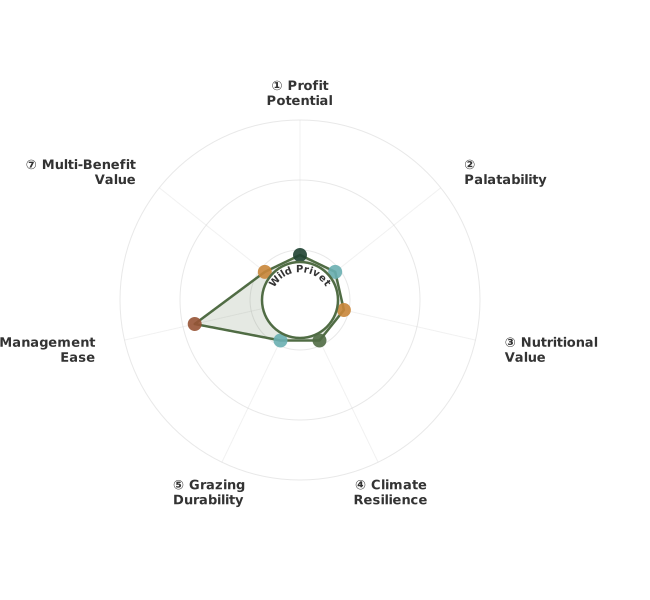
With only five mentions. However, where discussed, it appears to be valued as a component in polyculture systems and potentially as a source of forage. Regenerative benefits suggested by its inclusion in these systems include support for pollinators, contributing to biodiversity, and potential soil building through organic matter contribution. While specific integration with practices like rotational grazing or no-till is not detailed in the provided excerpts, its use in polycultures implies compatibility with multi-layered agroforestry or integrated crop-livestock systems. Farmer experiences or practical insights regarding its efficacy, challenges, or specific management within regenerative contexts are not sufficiently detailed in the available knowledge base to draw firm conclusions. Further research and observation within regenerative farming systems would be beneficial to fully understand its role and impact. While coverage in our knowledge base is limited, the above represents documented uses in regenerative systems.

Regenerative Quick Profile

All recommendations assume integrated, regenerative practices—not conventional inputs.

Climate & Soil Fit

Climate: Tropical Savanna, Hot Semi-Arid (Steppe), Cold Semi-Arid (Steppe), Humid Subtropical, Oceanic (Maritime Temperate), Hot-Summer Mediterranean, Warm-Summer Mediterranean, Monsoon-Influenced Humid Subtropical, Subtropical Highland, Hot-Summer Continental, Warm-Summer Continental, Subarctic, Monsoon-Influenced Hot-Summer Continental

Zones: USDA 4-8, Australian Zones 3-5

Optimal Soil: Loam Soil

System Role & Functions

Primary: Pollinator Support

Secondary: Forage Integration, Cover Crop System

Management Level

Experience: Beginner-Friendly

Maintenance: Moderate maintenance - This hardy shrub integrates well into diverse systems, benefiting from occasional pruning to manage structure and promote vigor, fostering a resilient landscape.

Value Streams

  • Forage production
  • Livestock forage value
1

Climate Suitability Assessment

Will this plant thrive in your climate?

IDEALLY SUITED

Köppen Zone: Cfa (Humid Subtropical), Cfb (Oceanic (Maritime Temperate)), Cwa (Monsoon-Influenced Humid Subtropical), Dfa (Hot-Summer Continental), Dfb (Warm-Summer Continental)
USDA Zone: 6a, 7a, 8a, 9a
Australian Zone: temperate
EU Climate Region: atlantic

Wild Privet thrives in climates with mild summers and moderate winters, characterized by 150-200 frost-free days and average summer temperatures between 65-75°F (18-24°C). These conditions are met in Köppen Cfb zones and regional zones such as USDA 7a-8b, Australian temperate, and EU Atlantic. Consistent rainfall (30-50 inches/75-125 cm annually) supports vigorous growth and abundant flowering, crucial for its primary function of pollinator support. Establishment is highly successful with minimal management required, and the plant reliably produces flowers and fruits year after year. Its adaptability to various soil types, provided they are well-drained, further contributes to its success in these regions. The extended growing season ensures maximum bloom duration, providing a consistent nectar and pollen source for a wide array of beneficial insects.

ADEQUATE

Köppen Zone: Aw (Tropical Savanna), BSh (Hot Semi-Arid (Steppe)), BSk (Cold Semi-Arid (Steppe)), Csa (Hot-Summer Mediterranean), Csb (Warm-Summer Mediterranean), Cwb (Subtropical Highland)
USDA Zone: 5a, 5b, 10a, 11a, 12a
Australian Zone: subtropical
EU Climate Region: continental

Wild Privet can perform adequately in climates with a wider range of temperature and precipitation patterns, including Köppen Cfa and Dfb zones, and regional zones like USDA 5b-6b, 9a-9b, Australian subtropical, and EU continental. These zones typically have 120-180 frost-free days and summer temperatures that can occasionally exceed optimal ranges (above 80°F/27°C) or experience more pronounced winter cold. While the plant will survive and provide some pollinator support, flowering intensity and duration may be reduced due to heat stress or shorter growing seasons. Supplemental irrigation might be necessary during dry periods, and winter hardiness can be a concern in the colder end of these zones, potentially impacting perennial establishment and reliability. Forage integration might be less consistent due to variable growth rates.

NOT RECOMMENDED

Köppen Zone: Af (Tropical Rainforest), Am (Tropical Monsoon), ET (Tundra), BWh (Hot Desert), BWk (Cold Desert), Dfc (Subarctic), Dwa (Monsoon-Influenced Hot-Summer Continental)
USDA Zone: 2a, 3a, 3b, 4a

Wild Privet is not recommended for climates with extreme temperature fluctuations or prolonged periods outside its optimal range, specifically Köppen Dfa zones and regional zones such as USDA 3a-5a, 10a-10b, and parts of the EU continental region. In cold zones (USDA 3a-5a), extreme winter temperatures (-15°F/-26°C and below) lead to significant winter kill, making perennial survival highly unreliable and limiting its effectiveness for pollinator support. In hot zones (USDA 10a-10b, Köppen Dfa), prolonged summer heat (above 85°F/29°C) causes severe stress, reducing flowering, fruit set, and overall plant health, thus diminishing its value for pollinator support and forage integration. Establishment success is low (<60%) due to these challenging conditions, requiring intensive management and frequent replanting, making it economically impractical. Alternative plants better adapted to these specific extreme conditions are strongly advised.

Better alternatives for these "not recommended" zones: Serviceberry (Amelanchier spp.) (More cold-hardy and heat-tolerant native options for cooler and warmer marginal zones.), Elderberry (Sambucus spp.) (Adaptable to a wider range of conditions and provides abundant flowers for pollinators.), Lantana (Highly heat and drought tolerant, excellent for attracting pollinators in hot climates.), Hairy Vetch (Cold-hardy annual legume for nitrogen fixation and some pollinator value in cold zones.)

Note: Zones listed above represent climates where this plant can produce reliably with reasonable management. Climate zones not mentioned would require intensive climate modification (greenhouses, extensive infrastructure) and are not economically viable for regenerative agriculture purposes.

2

Soil Suitability Assessment

Which soil types work best for this plant?

IDEALLY SUITED

Loam Soil

This plant thrives in these soil types without requiring amendments or remediation. Natural soil conditions support optimal growth and productivity.

ADEQUATE

Acidic Soil, Alkaline Soil, Clay Soil, Desert Soil, Rich Soil, Rocky Soil, Sandy Soil

This plant performs acceptably in these soil types with moderate, manageable remediation such as pH adjustment, compost addition, or drainage improvement. The required amendments are practical and cost-effective for regenerative agriculture.

NOT RECOMMENDED

Saline Soil, Wet Soil

Growing this plant in these soil types would require impractical remediation such as complete soil replacement, extensive amendments, or cost-prohibitive infrastructure. These conditions are not economically viable for regenerative agriculture.

Note: Soil suitability assessments focus on remediation requirements. "Ideally Suited" means the plant generally thrives without the need for substantial amendments, "Adequate" means manageable remediation (lime, compost, mulch), and "Not Recommended" means impractical soil changes would be required. Climate factors like rainfall and temperature also influence success.

3

Seasonal Considerations

Planting timing, growth duration, and harvest windows

Wild privet offers a resilient option for regenerative grazing systems. For establishment, aim for early spring planting once the soil is workable and after the last expected frost, allowing approximately 6-8 weeks for initial root development before any grazing pressure. Fall planting is also an option in milder climates, giving the plants time to establish a strong root system before winter dormancy.

First grazing readiness typically occurs 8-10 weeks after seeding, once plants have reached sufficient maturity. Implement rotational grazing with rest periods of 3-5 weeks between rotations to allow for robust regrowth. Depending on your specific climate and management, you can expect 2-3 significant growth cycles per season.

Peak production for wild privet will be observed during the warmer, longer days of mid-summer. While it is semi-evergreen in milder zones, expect some degree of dormancy in colder Dfa and Dfb climates during winter. Its good frost tolerance allows for potential late-fall grazing before the first expected frost, provided sufficient leaf mass remains. Regrowth patterns are strong, especially with adequate moisture and nutrients, making it a dependable component of a diversified forage base.

4

System Role & Multi-Benefit Value

Functional roles, integration strategies, and stacked benefits

Functional Role

Total System Value

Wild privet offers significant system value primarily through its role in supporting pollinator populations. By providing abundant nectar and pollen, it enhances the populations of bees, butterflies, and other beneficial insects crucial for farm-level pollination services and natural pest suppression. This direct contribution to ecosystem services is its main benefit. While it doesn't offer direct harvest value in the traditional sense (like fruit or timber), its contribution to a resilient farm ecosystem is substantial. It acts as a habitat provider and can contribute to biodiversity. Integrated into hedgerows or field margins, it can offer some minor soil stabilization. Its value is in its ability to enhance the overall health and functioning of the farm's ecological processes, reducing reliance on external inputs and increasing the farm's capacity to self-regulate pest populations and pollination.

Integration Characteristics

Multi-Benefit Value: Not Recommended - While providing some habitat and berries for wildlife, its potential invasiveness necessitates careful consideration within a diverse ecological planting aiming for broad regenerative benefits.

5

Management & Care Requirements

Integration guidance, maintenance needs, and care practices

How to Integrate This Plant

Wild privet, a non-tree plant, excels as a pollinator support species within regenerative systems. Its primary role is to provide nectar and pollen resources for a wide range of beneficial insects, enhancing biodiversity and natural pest control. It can be integrated into hedgerows, field margins, and as understory planting in silvopasture or food forest systems, particularly where early season blooms are beneficial. Compatible practices include hedgerow establishment and border plantings. While not a primary erosion control or nitrogen-fixing species, its dense growth can offer some soil stabilization. It begins providing pollinator support in Year 1, with significant bloom density and attractiveness to insects increasing by Year 3-5. The multi-benefit stacking comes from its contribution to a healthy agroecosystem, supporting beneficial insect populations which in turn can aid crop pollination and pest management, and providing habitat for other wildlife.

Integration Practices & Management

Knowledge base coverage regarding the integration of Ligustrum vulgare in regenerative agriculture systems is limited, preventing a detailed explanation of specific establishment, grazing, termination, and management practices. The provided sources do not offer insights into seeding rates, optimal timing, or its use in no-till versus minimal tillage scenarios. Similarly, information on how Ligustrum vulgare interacts with grazing animals, such as mob or rotational grazing, including timing and rest periods, is absent. Termination strategies, whether through natural winterkill, grazing, crimping, mowing, or herbicide use, are not detailed. Management considerations, including fertility requirements, competition control, and succession planning within regenerative systems, are also not discussed. Furthermore, its integration with cash crops through relay cropping, intercropping, or rotation sequences is not elaborated upon. Consequently, practical farmer experiences and specific insights from the knowledge base on the 'how' of integrating Ligustrum vulgare into regenerative agriculture are not available.

Management Profile

Maintenance Intensity: Adequate - This hardy shrub integrates well into diverse systems, benefiting from occasional pruning to manage structure and promote vigor, fostering a resilient landscape.

6

Economics & Value Streams

Direct harvest, system benefits, ecosystem services, and risk diversification

Comprehensive economic analysis including direct harvest value, system enhancement contributions, ecosystem services, value timeline, and risk diversification strategies.

Economics in Regenerative Systems

Metric Value
Seed Cost N/A (cutting/seedling) N/A (cutting/seedling)
Establishment Cost $200-400/acre $494-988/ha
Forage Yield 1-3 tons/acre/year 1-3 tons/ha/year
Annual Management Cost $50-100/acre $123-247/ha
Value/Sale Price $60-120/ton $60-120/tonne
Net Annual Return* $-440 to $110/acre/year

Values represent typical ranges for regenerative agriculture contexts. Actual results vary by region, management, and market conditions. Costs exclude land and labor.

* Net Annual Return = (Yield × Market Price) − (Amortized Establishment Cost + Annual Maintenance). This return is realized only at/after first harvest; early years have costs but no revenue. Range shows worst case to best case scenarios.

System Enhancement Value

Beyond harvest: pollination services for your crops and ecosystem

Pollination Service Provision

Wild privet's primary documented system contribution is pollinator support, acting as an alternative host plant for certain specialist insects, particularly ash hawkmoths, during periods of native host decline (Horne,). While this initially appears to be a conservation-focused benefit, supporting insect populations is crucial for broader ecosystem health and agricultural productivity through pollination services for crops. Additionally, the knowledge base mentions its potential integration into cover crop systems and as a forage integration component, though specifics are lacking. Its dense growth may also offer some degree of wildlife habitat and potential for erosion control along field edges. The challenge of root suckering, as noted for invasive Ligustrum species, might also imply a capacity for rapid ground cover establishment, which could be leveraged for soil stabilization in certain contexts, though management of its spread would be critical.

Erosion Control (if applicable)

Variable, depends on density and establishment. Generally, windbreaks can protect 3-5 acres per tree row and lead to 5-15% crop yield improvement in protected areas.

While wild privet (Ligustrum vulgare) is not explicitly mentioned as a windbreak species in the provided knowledge base excerpts, its dense growth habit and shrub form suggest potential for wind protection when established in hedgerows or shelterbelts. In integrated farm systems, such plantings can reduce wind speed across agricultural fields, mitigating soil erosion from wind and decreasing evapotranspiration rates from crops and livestock. This can lead to improved soil moisture retention, reduced wind damage to crops, and a more comfortable environment for livestock, potentially decreasing heat stress in warmer months and cold stress in cooler months. The establishment of windbreaks also contributes to landscape heterogeneity, creating microclimates that can favor beneficial insects and other wildlife.

Ecosystem Service Contributions

Environmental contributions: carbon, pollinators, wildlife, and water

  • Carbon Sequestration: As a woody shrub, wild privet has the potential for carbon sequestration through biomass accumulation in stems, branches, and roots. Its growth rate and density will influence the rate of sequestration.
  • Pollinator Support: High. Wild privet is noted as a potential alternative host plant for ash-specialist hawkmoth species facing native host decline, indicating direct support for specific insect populations (Horne,).
  • Wildlife Habitat: Offers potential habitat and forage for some insects. Its dense growth may provide some cover for small wildlife, though specific benefits like mast or nesting sites are not detailed.
  • Water Quality: Not applicable

Value Timeline: Bloom & Establishment

When you'll see results: annuals bloom year 1, perennials mature 2-3 years

Years 1-2

Initial establishment of ground cover and potential for early pollinator support as flowering begins. Some minor windbreak effect may start to develop.

Years 3-5

Increased pollinator support as plant matures and flowers more prolifically. Developing windbreak and erosion control benefits. Potential for integration into forage systems if managed appropriately.

Years 10-20

Established windbreak and erosion control functions. Significant pollinator support. Potential for increased biodiversity within the farm system due to habitat provision.

20+ Years

Mature ecosystem services including robust pollinator support, significant windbreak and erosion control, and contributing to overall farm biodiversity and resilience.

Farm Risk Reduction

How pollinator support reduces crop failure risk

  • Multiple Revenue Streams: Pollinator support (indirectly through crop yield enhancement), potential forage integration, erosion control services, biodiversity enhancement.
  • Temporal Income Spread: Ongoing ecosystem services (pollinator support, windbreak) provide continuous value, while potential forage integration offers periodic benefits. The value is largely service-based rather than direct harvest.
  • Market Risk Hedge: Reduces reliance on single commodity markets by enhancing the productivity of other farm enterprises (e.g., crops requiring pollination) and by providing on-farm ecological services that reduce input costs (e.g., less erosion, potentially less need for artificial windbreaks).
7

Regenerative Suitability Details

Comprehensive trait ratings for system integration assessment

Comparative ratings for this plant across key regenerative agriculture traits.

Trait Suitability Explanation
Palatability Not Recommended Common privet's inherent compounds deter livestock, making it a plant that animals naturally avoid, thereby supporting pasture integrity.
Protein Content Not Recommended As a woody shrub, common privet offers minimal protein and is not considered a forage crop, highlighting the need for diverse planting strategies to meet livestock nutritional needs.
Drought Tolerance Not Recommended Common privet exhibits limited resilience to dry periods; healthy growth and system integration are supported by effective water management and moisture retention strategies.
Grazing Tolerance Not Recommended This woody shrub has poor tolerance to grazing pressure, as its vulnerable meristems are easily damaged by continuous browsing, emphasizing its role beyond direct livestock forage.
Establishment Ease Adequate Common privet establishes moderately well from seed or cuttings, thriving in diverse soil conditions with minimal need for external inputs, contributing to ground cover and biodiversity.
Multi Benefit Value Not Recommended While providing some habitat and berries for wildlife, its potential invasiveness necessitates careful consideration within a diverse ecological planting aiming for broad regenerative benefits.
Climate Adaptability Adequate Common privet adapts to a range of climates (zones 4-8) but requires attention to water management to mitigate potential invasiveness and ensure it integrates harmoniously within the local ecosystem.
Maintenance Intensity Adequate This hardy shrub integrates well into diverse systems, benefiting from occasional pruning to manage structure and promote vigor, fostering a resilient landscape.
Seasonal Availability Not Recommended Common privet, a year-round shrub, offers limited direct forage value due to its palatability and low nutritional content for livestock, reinforcing its role in habitat and landscape structure.

Comparative System: Ratings compare plants within their economic category (e.g., cover crop nitrogen fixation compared to other cover crops, not to all plants). Individual farm conditions and management practices significantly influence actual performance.

8

Learn More

Why farmers use this plant and additional resources

Why Regenerative Farmers Use This Plant

Ligustrum vulgare, commonly known as common privet, offers significant regenerative value when integrated into livestock systems, primarily as a robust and adaptable hedgerow or windbreak species that can also provide browse. While not a primary forage crop, its dense growth habit and resilience contribute to improved livestock management by providing crucial shelter and contributing to overall farm biodiversity.

In silvopasture systems, it can support animal well-being by offering shade and protection from harsh weather, potentially reducing stress and improving weight gain. It can contribute to extending the grazing season by providing browse during periods when grasses are less productive. While specific carrying capacity metrics are not directly attributable to the plant as a sole forage source, its browse can supplement diets, particularly for goats and sheep, who are selective browsers. In a mixed-species grazing scenario, it can contribute to animal well-being by offering dietary variety. For instance, in a silvopasture system with cattle and sheep, the sheep may preferentially browse the privet, allowing cattle to utilize the pasture grasses more effectively. In rotational grazing systems, it can support a carrying capacity of approximately 0.5-1 Animal Unit (AU) per acre when combined with high-quality pastures, providing essential roughage and browse. Its crude protein content can range from 6-15% in young growth, declining with maturity.

Beyond direct livestock benefits, Ligustrum vulgare contributes to ecosystem health through its extensive root system, which can reach depths of 6-10 feet (1.8-3 meters), aiding in soil stabilization and reducing erosion on slopes or in areas prone to wind damage. This deep rooting also enhances water infiltration and can help scavenge nutrients from deeper soil profiles, making them available to shallower-rooted forages or crops. While not a nitrogen fixer, its biomass contributes to soil organic matter when managed appropriately, such as through periodic pruning and incorporation into the soil or through animal deposition in grazed areas. Its dense flowering in late spring and summer provides a valuable nectar and pollen source for a wide array of pollinators, including bees and butterflies, supporting their populations crucial for crop pollination across the farm. The woody structure of established hedges can support a higher diversity of insect life compared to open fields, potentially increasing populations of predatory insects that help manage pasture pests.

The presence of dense privet hedgerows can also create microhabitats that support beneficial insect populations, including pollinators and natural predators of common agricultural pests. This biodiversity enhancement contributes to a more resilient farm ecosystem. As a windbreak, it can reduce wind erosion, protect more sensitive crops or pastures from desiccation, and create microclimates that reduce heat stress on livestock. The plant's ability to establish readily and form thickets can also play a role in weed suppression, outcompeting less desirable species and reducing the need for mechanical or chemical weed control. Its integration into hedgerows can also serve as a buffer zone, separating different pasture paddocks and facilitating rotational grazing management. Furthermore, its ability to establish and thrive in less fertile conditions makes it an excellent choice for marginal lands, turning unproductive areas into functional components of the farm landscape. Its role in wind reduction can also decrease soil moisture evaporation, leading to more efficient water use across the pasture. The dense foliage can contribute to carbon sequestration within the landscape, with mature hedgerows acting as significant carbon sinks over time.

Ligustrum vulgare has demonstrated utility and success in various regional farming contexts. In the United Kingdom, it is a staple for traditional hedgerows bordering pastures and arable fields, providing shelter for sheep and cattle, acting as a buffer against wind erosion, and contributing to landscape connectivity and biodiversity. In parts of the United States, particularly in the Midwest and Northeast, it is employed in silvopasture designs to protect livestock from winter winds and summer sun, thereby improving weight gain and milk production potential by reducing energy expenditure on thermoregulation. In the Midwestern United States, it can be planted in windbreaks for corn and soybean fields, offering protection to emerging seedlings and reducing wind erosion. In Australia, its drought tolerance makes it a valuable component for windbreaks in dryland farming and grazing operations, safeguarding soil and livestock from harsh conditions. Australian land managers in cooler temperate zones have also employed it for shelterbelts on livestock properties, mitigating the impact of strong winds on grazing animals and soil. In Brazil, it can be used in certain agroforestry systems to provide shade and browse in areas with less intensive grazing. Brazilian farmers might consider it in silvopasture designs for cattle, particularly in regions with distinct dry seasons where browse can offer supplemental nutrition. In South Africa's Western Cape, it can be integrated into vineyards or orchards as a component of agroforestry systems, providing habitat and supplemental browse for goats.

9

How to Integrate This Plant

Practical guidance for regenerative systems

Establishing Ligustrum vulgare can be achieved through several methods, with vegetative propagation and seeding being common. For hedgerow or windbreak plantings, bare-root or containerized seedlings are common. Spacing for a dense hedge is usually 1-2 feet (0.3-0.6 meters) apart, with plants set at a depth of 6-8 inches (15-20 cm) to ensure good root contact. For hedgerow or windbreak plantings, spacing between plants is typically 12-24 inches (30-60 cm). If planting from seed, which is less common for immediate impact, rates can vary widely but are generally around 1-5 lbs/acre (1.1-5.6 kg/ha), with a planting depth of 0.25-0.5 inches (0.6-1.3 cm). For seeding, rates typically range from 5 to 15 lbs/acre (5.6 to 16.8 kg/ha), depending on seed viability and desired stand density.

Optimal planting times are in early spring or fall to allow for establishment before extreme temperatures. For Northern Hemisphere regions, spring planting (March-April) is ideal, while in the Southern Hemisphere, autumn planting (March-April) or early spring (September-October) is recommended to allow roots to establish before extreme temperatures. For seeding, optimal planting times are in early spring (March-April in the Northern Hemisphere) or late autumn (September-October in the Southern Hemisphere) when soil moisture is adequate for germination.

Management of Ligustrum vulgare in regenerative systems prioritizes its role within a larger ecological framework. Water requirements are moderate; providing 1 inch (2.5 cm) of rainfall or irrigation per week during the initial establishment phase is crucial, especially during the first year. Once established, it is quite drought-tolerant. Fertility needs are generally low, especially when integrated into systems with existing manure or compost applications. Its ability to scavenge nutrients makes it less reliant on synthetic inputs. Biological means are preferred for fertility management; incorporating compost or allowing for natural decomposition of pruned material will provide adequate nutrients.

Growth is typically vigorous, reaching a mature height of 10-15 feet (3-4.5 meters) within 5-10 years, though it can be managed through pruning. Pruning is essential for maintaining its form and density as a hedge or windbreak. Regular trimming, typically once or twice a year after flowering, encourages bushier growth and prevents the plant from becoming leggy. Pest and disease management should focus on cultural practices and encouraging biodiversity; healthy plants in well-managed systems are less susceptible to significant issues. Integrated pest management strategies, including encouraging beneficial insects and ensuring good air circulation through pruning, are preferred over chemical interventions.

For livestock integration, Ligustrum vulgare is best managed as part of a silvopasture or hedgerow system. It is not intended for direct grazing by livestock as a primary forage source, as its palatability is generally considered moderate to low for cattle and it can cause mild digestive upset if ingested in large quantities. Instead, it is managed to provide shade, wind protection, and habitat. Grazing animals should be managed to prevent them from browsing the hedges excessively, which can be achieved through appropriate fencing or by integrating it into areas where livestock are rotated and have access to preferred forage. In rotational grazing systems, it can be incorporated into paddocks to provide browse during periods of low grass growth, such as late summer or early winter. Stockpiling its growth is not a primary strategy for forage, but its woody biomass contributes to landscape structure year-round, offering consistent shelter. Managed grazing should allow for rest periods of 45-60 days, especially during the active growing season, to ensure regrowth and maintain plant health.

View Full Document (Printable single-page version)