
Stiff Ryegrass
Annual ryegrass (*Lolium rigidum*) shows potential as a cover crop and forage in regenerative systems, though its nitrogen-fixing capabilities are not highlighted in the provided excerpts. Research indicates that defoliation intensity significantly impacts its root growth and carbon exudation, affecting soil microbial communities. While not explicitly detailed, this suggests that careful management, such as optimizing grazing or mowing, is crucial for maximizing its soil-building benefits. The plant's root development and sugar concentrations are sensitive to management, influencing dissolved and microbial carbon in the soil. Deeper soil layers also show differential responses to defoliation. Limited knowledge base coverage means specific integration with practices like rotational grazing or no-till, and direct farmer experiences are not extensively detailed, requiring further investigation into its role in polycultures or agroforestry systems. Its primary regenerative contribution appears linked to managing soil carbon dynamics through root activity and decomposition, contingent on appropriate management strategies.
For a full botanical description see: Wikipedia(opens in new window) (external link)
Regenerative Quick Profile
All recommendations assume integrated, regenerative practices—not conventional inputs.
Climate & Soil Fit
Climate: Tropical Rainforest, Tropical Monsoon, Tropical Savanna, Hot Semi-Arid (Steppe), Cold Semi-Arid (Steppe), Hot Desert, Cold Desert, Humid Subtropical, Oceanic (Maritime Temperate), Hot-Summer Mediterranean, Warm-Summer Mediterranean, Monsoon-Influenced Humid Subtropical, Subtropical Highland, Hot-Summer Continental, Warm-Summer Continental, Subarctic, Monsoon-Influenced Hot-Summer Continental, Tundra
Zones: USDA 7-10, Australian Zones 3-11
Optimal Soil: Loam Soil
System Role & Functions
Primary: Cover Crop System
Secondary: Forage Integration, Soil Remediation
Key Benefits: Easy establishment
Management Level
Experience: Beginner-Friendly
Maintenance: Moderate maintenance - This fast-growing, adaptable species integrates well into a system with built-in fertility management through compost and mulch, and optimized water management for consistent productivity.
Value Streams
- Forage production
- Soil building and erosion control
- Livestock forage value
Know the Debate
- Forage yields vary widely; plan for 4-8 tons/acre under ideal conditions.
- Seeding rates: 30-100 lbs/acre; timing depends on climate and goals.
- Management challenges include vigorous growth and allelopathy.
- High nutritional value for livestock, 14-18% protein.
- Excellent for erosion control and weed suppression.
- Adaptable to various climates and systems.
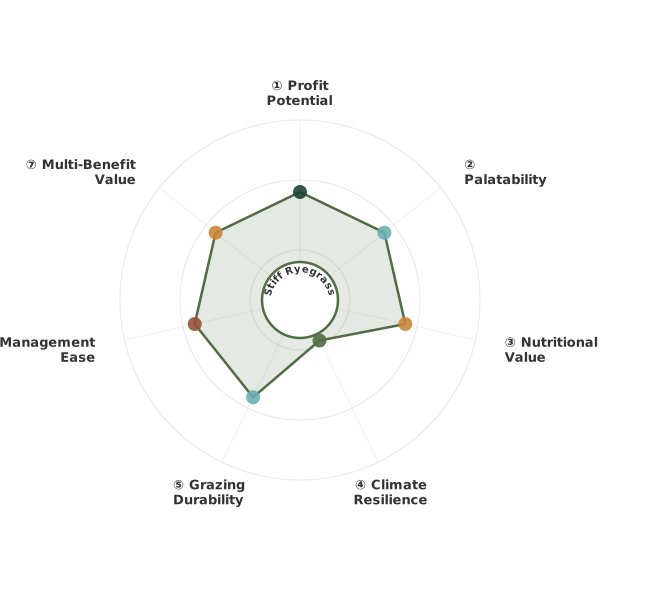
How These Traits Are Calculated
Trait dimensions are ordered clockwise starting from the top of the chart (12 o'clock position):
1. Profit Potential
Economic returns from hay sales, grazing value, and system contributions
WHAT: Synthesizes direct revenue potential (hay sales or grazing service value) with system contributions (nitrogen fixation, reduced supplement needs) into net economic value. Captures both cash income and cost savings.
WHY: Forage profitability comes from two sources—direct sales (hay, haylage) or indirect value (grazing services supporting livestock production). High-value forages provide $300-600/acre in combined revenue and savings versus $100-200/acre for lower-value options. This determines whether forage enterprises are viable versus purchasing feed.
HOW: Scored via LLM synthesis of economics data (hay yields, prices, grazing value), timeline considerations (establishment costs, productive lifespan), and system value (nitrogen contributions, supplement replacement). Exceptional (3.0): High yields with premium pricing or exceptional grazing value plus nitrogen fixation. Typical (2.0): Moderate returns. Limited (1.0): Low yields, commodity pricing, or minimal system contributions.
2. Palatability
Livestock preference and voluntary consumption rates
WHAT: Measures how eagerly livestock consume the forage—preference ranking when choices are available. Highly palatable forages are grazed first and completely; limited palatability means animals avoid unless no alternatives exist.
WHY: Palatability directly determines voluntary intake, which drives animal performance. High-palatability forages support faster weight gain and higher milk production because animals eat more. Low-palatability forages reduce performance and waste productive potential—animals selectively graze preferred species and leave unpalatable plants ungrazed.
HOW: Ratings based on the palatability trait documenting livestock selection preference. Exceptional (3.0): Preferentially selected, high sugar content, tender growth eagerly consumed (orchardgrass, white clover, ryegrass). Typical (2.0): Readily consumed when available. Limited (1.0): Avoided unless no other options (coarse stems, bitter compounds, low digestibility).
3. Nutritional Value
Protein content and forage quality for livestock growth and production
WHAT: Measures protein content as the primary indicator of forage nutritional quality. High-protein forages (>18%) support rapid growth and high milk production; low-protein forages (<12%) require supplementation for production animals.
WHY: Protein is the most expensive supplement in livestock diets ($0.40-0.60/lb). Forages with exceptional protein content eliminate or reduce supplement costs while supporting maximum animal performance. High-quality forage can save $200-400/cow/year in purchased feed versus low-protein options.
HOW: Ratings based on the protein_content trait. Exceptional (3.0): High protein (>18%) supporting rapid weight gain or high milk production (alfalfa, clovers, young grasses). Typical (2.0): Moderate protein (12-18%) for maintenance and moderate production (mature grasses). Limited (1.0): Low protein (<12%) requiring supplementation for production animals (mature warm-season grasses, low-fertility forages).
4. Climate Resilience
Weighted: drought tolerance (60%) + climate adaptability (40%)
WHAT: Combines drought tolerance (primary climate stressor for forages) with overall climate adaptability (temperature range, geographic flexibility). Resilient forages survive extended dry periods and diverse weather patterns.
WHY: Drought is the most common forage crisis—dry years can cut production 50-80% and force costly hay purchases or herd reductions. Drought-tolerant forages maintain productivity through dry spells, reducing feed costs and providing grazing when less-resilient options fail. Geographic adaptability allows forage systems to work across farm regions.
HOW: Weighted formula prioritizes drought tolerance (60% weight) as primary stressor, with climate adaptability (40% weight) for temperature and general flexibility. Exceptional (3.0): Survives extended drought (6+ weeks) with minimal production loss and works across diverse climates. Typical (2.0): Moderate drought and climate tolerance. Limited (1.0): Drought-sensitive or narrow climate requirements.
5. Grazing Durability
Weighted: trampling tolerance (70%) + seasonal availability (30%)
WHAT: Combines grazing tolerance (resistance to trampling and frequent defoliation) with seasonal availability (timing and duration of productive growth). Durable forages handle intensive rotational grazing and provide consistent seasonal production.
WHY: Grazing tolerance determines management system viability. Tolerant forages allow intensive rotational grazing or mob grazing for maximum animal performance and pasture health. Intolerant forages are hay-only or require long rest periods. Seasonal availability indicates production timing—year-round, seasonal gaps, or narrow windows.
HOW: Weighted formula prioritizes grazing tolerance (70% weight) for management system determination, with seasonal availability (30% weight) for production timing. Exceptional (3.0): Handles intensive rotational grazing with consistent seasonal production. Typical (2.0): Moderate tolerance and availability. Limited (1.0): Hay-only species or narrow seasonal production windows.
6. Management Ease
Weighted: establishment ease (50%) + low maintenance needs (50%)
WHAT: Combines establishment difficulty (germination, stand establishment) with ongoing maintenance requirements (fertility, weed control, renovation needs). Easy forages establish reliably and persist without intensive management.
WHY: Pasture establishment is expensive ($150-400/acre) and risky. Easy-to-establish forages reduce stand failure risk and provide quicker returns. Low-maintenance forages reduce annual input costs and labor, improving long-term profitability of grazing systems.
HOW: Weighted formula balances establishment ease (50% weight) for startup success and inverted maintenance intensity (50% weight) for ongoing care. Exceptional (3.0): Fast germination, reliable stand establishment, minimal fertility/weed management needs (white clover, orchardgrass). Typical (2.0): Moderate establishment and care requirements. Limited (1.0): Difficult establishment or intensive maintenance (heavy fertility, frequent renovation, weed competition).
7. Multi-Benefit Value
Ecosystem services beyond forage—nitrogen fixation, pollinator support, wildlife habitat
WHAT: Measures ecosystem services provided beyond livestock nutrition. Multi-benefit forages contribute nitrogen fixation (legumes), pollinator support (flowering species), wildlife habitat, soil building, erosion control, and biodiversity support.
WHY: Forage systems can either extract from farm ecosystems or contribute to them. Nitrogen-fixing legumes (clovers, alfalfa) provide $80-150/acre/year worth of fertility for companion grasses and following crops. Flowering forages support pollinators critical for fruit/vegetable crops. These service-stacking forages deliver total system value beyond livestock production.
HOW: Ratings based on the multi_benefit_value trait documenting service diversity. Exceptional (3.0): Multiple significant benefits (legumes fixing 80-150 lbs N/acre/year + pollinator support + wildlife forage). Typical (2.0): Some ecosystem contributions. Limited (1.0): Single-purpose forage with minimal ecosystem services beyond grazing value.
Ratings are based on documented performance in regenerative systems, not conventional high-input scenarios. All traits assume integrated management practices focused on soil health and ecosystem services.
5
Management & Care Requirements
Integration guidance, maintenance needs, and care practices
Management & Care Requirements
Integration guidance, maintenance needs, and care practices
How to Integrate This Plant
Stiff ryegrass (Lolium rigidum) is a valuable annual cover crop for regenerative systems, primarily functioning as a biomass producer and soil protector. It excels in erosion control, suppressing weeds, and building soil organic matter. Its primary role is to cover bare soil, protecting it from wind and water erosion, especially during fallow periods or between cash crop cycles. It can be integrated into no-till or reduced-till systems, undersown with slower-growing perennials, or used as a multi-species cover crop mix. The plant's rapid establishment and high biomass production mean it starts providing benefits like soil cover and organic matter contribution from its first growing season. In the medium term (years 3-5), its consistent use will enhance soil structure and water infiltration. Long-term benefits (years 10+) include significant improvements in soil health, nutrient cycling, and resilience to drought and extreme weather. It contributes to system value by improving soil health, suppressing weeds, and providing habitat for beneficial insects.
Integration Practices & Management
While the provided knowledge base extensively discusses the biological impacts of Lolium rigidum, particularly its responses to defoliation and its influence on soil microbial communities, it offers limited direct insight into specific regenerative agriculture integration strategies employed by farmers. The sources primarily focus on experimental observations of Lolium rigidum's behavior under controlled conditions rather than detailing practical establishment, grazing, or termination methods used in regenerative systems. For instance, one source details a pot experiment investigating Lolium rigidum's root growth and microbial responses to defoliation, but does not elaborate on how this plant is practically integrated into field-scale regenerative farming operations. Therefore, based solely on the provided text, a comprehensive explanation of how regenerative farmers integrate Lolium rigidum, covering establishment, grazing, termination, management, and cash crop integration, cannot be fully detailed. The knowledge base highlights Lolium rigidum's sensitivity to defoliation and its role in soil carbon dynamics, suggesting potential benefits in cover cropping or pasture systems, but lacks specific farmer methodologies or practical application details.
Management Profile
Maintenance Intensity: Adequate - This fast-growing, adaptable species integrates well into a system with built-in fertility management through compost and mulch, and optimized water management for consistent productivity.
Sources behind this view
 Videos & Podcasts
-
Integrating livestock (especially ruminants) with cover crops in cash grain systems significantly enhances soil health, nutrient cycling, and weed control. It creates economic opportunities, improves

8
Know the Debate
Annual ryegrass is a versatile cover crop and forage option, but its success hinges on matching its needs to your context. In regions with adequate...
Know the Debate
Annual ryegrass is a versatile cover crop and forage option, but its success hinges on matching its needs to your context. In regions with adequate...
Annual ryegrass is a versatile cover crop and forage option, but its success hinges on matching its needs to your context. In regions with adequate rainfall and fertile soils, it offers high yields and excellent grazing potential, supporting significant livestock carrying capacities. However, its management can be challenging, especially in drier climates or when aiming for subsequent cash crops, due to its vigorous growth, allelopathic properties, and variable winter kill. Entry costs are generally low, relying on existing equipment for planting and management, though specific termination strategies may require additional resources. While it establishes quickly, achieving its full benefits requires attention to seeding rates, timing, and proactive termination to avoid unintended consequences.
How much forage yield can annual ryegrass produce?
High yield and nutritional potential
Academic research suggests substantial biomass (4-8 tons/acre) and high nutritional content (14-18% protein) under optimal conditions, supporting high livestock carrying capacities of 2.5-4.0 AU/acre.
Sources behind this view
Sources behind this view
Videos & Podcasts
-
Cover crops are categorized as cool-season/warm-season, grasses/broadleaves (legumes/brassicas). Selection factors include growth cycle, water use, and plant architecture for optimal sunlight capture. Specific species examples are given, with legumes providing significant nitrogen. Proper legume inoculation is crucial, requiring careful storage and handling of inoculants.
 Research
-
Evaluating Cover Crops for Benefits, Costs and Performance within Cropping System Niches (opens in new window)
This study found: This review looks at the pros and cons of using cover crops in farming systems, drawing on literature and Michigan farmer experiences. Cover crops can help control pests, improve soil and water, make nutrients cycle better, and boost the yield of your main crops. However, they also come with costs like extra expenses, potentially lower income if they interfere with other crops, slower soil warming, and uncertainty about when nitrogen will become available. The benefits tend to be greater in irrigated fields. The review highlights the best cover crops for different seasons and regions in the US (USDA Zones 5-8). For warm summer growing periods, C4 grasses are top performers, producing a lot of biomass. For winter cover, cereal rye is a strong choice across all zones. Mixtures of legumes (like clover or vetch) with cereal grains (like wheat or rye) can create large amounts of diverse organic matter. Legumes are good at fixing nitrogen from the air and can also support beneficial insects. Plants from the Brassica family (like radishes) can help suppress soil pests and diseases. Legume cover crops are the most dependable way to increase the yield of your main crops compared to leaving fields bare. If soil pests are a big problem, brassicas are a good option. If building soil organic matter quickly is the goal, cereal cover crops are best. Combining different types of cover crops, like legumes with cereals or brassicas with cereals, shows promise for various situations.
 From the Web
-
Annual ryegrass is a versatile cool-season cover crop that prevents erosion, improves soil structure, suppresses weeds, and scavenges nutrients. It establishes quickly, even in poor soils, and can be used as a living mulch or emergency forage. Seeding rates range from 10-30 lb./A with specific timing based on hardiness zones.
Yield variability and contextual dependence
Field practitioners and some academic accounts emphasize that actual yields and nutritional value are highly variable, depending heavily on climate, soil type, and specific management practices, implying that optimal results are not always guaranteed.
Sources behind this view
Sources behind this view
Videos & Podcasts
-
Recommends cover crop species and mixes (cereal rye, oats, radish, clover, rape, vetch, Austrian peas) based on planting dates (Sept 1-Oct 15 for early mixes, late Oct for ryegrass, any time for cereal rye) and goals like erosion control, compaction removal, and nutrient capture, while managing potential issues like vole habitat.

Research
-
Impact of climate change stressors—temperature, CO<sub>2</sub>, and UV‐B—on early growth and development of different cover crop species (opens in new window)
This study found: This study tested how five different cover crop species (cereal rye, triticale, winter wheat, crimson clover, and mustard) might grow under future climate conditions: warmer temperatures, higher CO2 levels, and increased UV-B light. In a controlled environment, higher CO2 generally helped all cover crops grow better. However, increased UV-B light harmed them. The best conditions for growth were a combination of warmer fall temperatures and higher CO2. Mustard plants grew the most under these combined conditions, while rye and triticale were least affected by the changes. This research helps predict which cover crops might be more resilient in a changing climate.
From the Web
-
Strategies for extending the grazing season include using annual forages like ryegrass, oats, and brassicas, and stockpiling forages. Drought management involves adjusting stocking rates and rotations, with a caution on plant toxicity in stressed forages.
Making Sense of the Differences
Annual ryegrass yield and nutritional quality are highly dependent on environmental and management factors. In humid temperate zones with adequate moisture and fertility, it can achieve high productivity and support significant livestock. However, in drier or colder climates, or with less precise management, yields and nutritional value can be considerably lower. Farmers should assess their local rainfall, soil conditions, and commitment to optimal grazing or termination strategies to set realistic expectations for forage production.
What are the ideal seeding rates and timing for annual ryegrass?
Specific rates and timing for different zones and methods
Academic and institute sources provide specific guidance: drilled seeding rates of 10-30 lbs/acre, broadcast 20-30 lbs/acre for cover crops and 50-100 lbs/acre for forage. Timing is zone-dependent, with fall seeding in Zone 6+ and midsummer-early fall in Zone 5 and colder for overwintering.
Sources behind this view
Sources behind this view
Videos & Podcasts
-
Recommends cover crop species and mixes (cereal rye, oats, radish, clover, rape, vetch, Austrian peas) based on planting dates (Sept 1-Oct 15 for early mixes, late Oct for ryegrass, any time for cereal rye) and goals like erosion control, compaction removal, and nutrient capture, while managing potential issues like vole habitat.
From the Web
-
Annual ryegrass is a versatile cool-season cover crop that prevents erosion, improves soil structure, suppresses weeds, and scavenges nutrients. It establishes quickly, tolerates various soil conditions, and can be used as emergency forage. Seeding rates range from 10-30 lb./A, with specific timing recommendations for different climate zones and overseeding practices.
-
Annual ryegrass is a versatile cover crop for erosion control, soil structure, weed suppression, and nutrient scavenging. Recommended seeding rates are 20-30 lb/A broadcast or 10-20 lb/A drilled. Optimal seeding times vary by hardiness zone, with fall seeding in Zone 6+ and midsummer-to-early fall in Zone 5 and colder. It can be mixed with legumes and small grains.
Adaptable seeding rates and flexible timing
Field practitioners offer broader ranges (30-50 lbs/acre drilled, 50-100 lbs/acre broadcast) and emphasize flexibility in timing (late August-early October in NH, late Feb-mid-April in SH) based on regional climate and crop goals, prioritizing rapid germination and soil contact.
Sources behind this view
Sources behind this view
Videos & Podcasts
-
Recommends cover crop species and mixes (cereal rye, oats, radish, clover, rape, vetch, Austrian peas) based on planting dates (Sept 1-Oct 15 for early mixes, late Oct for ryegrass, any time for cereal rye) and goals like erosion control, compaction removal, and nutrient capture, while managing potential issues like vole habitat.
-
Cover crops are categorized as cool-season/warm-season, grasses/broadleaves (legumes/brassicas). Selection factors include growth cycle, water use, and plant architecture for optimal sunlight capture. Specific species examples are given, with legumes providing significant nitrogen. Proper legume inoculation is crucial, requiring careful storage and handling of inoculants.
Making Sense of the Differences
While specific seeding rates vary slightly between drilled and broadcast methods, both academic and field sources agree on general ranges. Timing is the more variable factor, heavily influenced by regional climate and the intended use of the ryegrass. Colder climates necessitate earlier fall planting to ensure establishment before winter, while milder zones offer more flexibility. Farmers must consider their local hardiness zone, desired outcome (grazing vs. cover crop), and ensure optimal soil conditions for rapid germination.
When is annual ryegrass considered difficult to manage?
Challenges with termination and persistence
Field practitioners and some academic sources categorize annual ryegrass as medium-to-high difficulty due to its vigorous growth and allelopathic potential, which can suppress cash crops. It may not winter-kill reliably in milder climates, requiring specific termination methods.
Sources behind this view
Sources behind this view
Videos & Podcasts
-
Cover crops are classified by management difficulty: easy (oats, radish, peas, buckwheat), medium (brassicas, cereal rye, sorghum sedan, clovers), and high (annual ryegrass, wheat). Easy options often die naturally, while others may require herbicides or specific residue management. Brassicas offer weed control and soil benefits.
-
Recommends cover crop species and mixes (cereal rye, oats, radish, clover, rape, vetch, Austrian peas) based on planting dates (Sept 1-Oct 15 for early mixes, late Oct for ryegrass, any time for cereal rye) and goals like erosion control, compaction removal, and nutrient capture, while managing potential issues like vole habitat.
Research
-
Cool-season cover crop effects on forage productivity and short-term soil health in a semi-arid environment (opens in new window)
This study found: A two-year study in Reno, Nevada, tested different cool-season cover crop mixes and single species under irrigation in a dry climate. The goal was to see how they affected feed production for livestock and short-term soil health. While most cover crops produced significantly more above-ground biomass than winter lentils, none of the cover crop systems consistently improved soil nitrogen or organic carbon levels compared to leaving the field fallow over the short term. However, forage kale provided the highest relative feed value (a measure of forage quality), and the fallow system had higher soil potassium levels. The study suggests that while cover crops can boost feed production, their immediate impact on soil health in this specific semi-arid, irrigated environment was minimal, but there's potential for integration.
Easier management with focus on termination timing
While acknowledging potential challenges, some sources highlight that with proper management and timely termination, ryegrass can be effectively integrated. Its allelopathic properties can be leveraged for weed control if managed correctly.
Sources behind this view
Sources behind this view
Videos & Podcasts
-
Rye is a hardy, late-planting cover crop with strong allelopathy for weed control, especially for small-seeded weeds. Southern varieties like Elbon and Aroostock are good for biomass and winter hardiness. Spring triticale is also discussed for its cold tolerance and flexible planting windows.
Research
-
Evaluating Cover Crops for Benefits, Costs and Performance within Cropping System Niches (opens in new window)
This study found: This review looks at the pros and cons of using cover crops in farming systems, drawing on literature and Michigan farmer experiences. Cover crops can help control pests, improve soil and water, make nutrients cycle better, and boost the yield of your main crops. However, they also come with costs like extra expenses, potentially lower income if they interfere with other crops, slower soil warming, and uncertainty about when nitrogen will become available. The benefits tend to be greater in irrigated fields. The review highlights the best cover crops for different seasons and regions in the US (USDA Zones 5-8). For warm summer growing periods, C4 grasses are top performers, producing a lot of biomass. For winter cover, cereal rye is a strong choice across all zones. Mixtures of legumes (like clover or vetch) with cereal grains (like wheat or rye) can create large amounts of diverse organic matter. Legumes are good at fixing nitrogen from the air and can also support beneficial insects. Plants from the Brassica family (like radishes) can help suppress soil pests and diseases. Legume cover crops are the most dependable way to increase the yield of your main crops compared to leaving fields bare. If soil pests are a big problem, brassicas are a good option. If building soil organic matter quickly is the goal, cereal cover crops are best. Combining different types of cover crops, like legumes with cereals or brassicas with cereals, shows promise for various situations.
Making Sense of the Differences
Annual ryegrass's vigorous growth and allelopathic nature can make it challenging if not managed proactively. While many sources categorize it as higher difficulty compared to simpler cover crops, this primarily relates to the need for deliberate termination strategies, particularly in the absence of a hard winter kill. Farmers must be prepared for timely termination, using methods like roller-crimping or herbicides, to prevent suppression of subsequent cash crops. In milder climates, ensuring it winter-kills or is effectively terminated is paramount.