
Cassava
Cassava (Manihot esculenta) is integrated into regenerative agriculture systems primarily as a component in polycultures and intercropping systems. Studies show its use alongside crops like cacao, pigeon pea, and sweet potato, indicating its role as a potential food crop within diverse agroforestry and intercropping designs. While not explicitly identified as a cover crop or nitrogen fixer in these excerpts, its cultivation within organic systems demonstrates a focus on improving soil health and crop vitality compared to conventional methods. Research highlights cassava's ability to influence its rhizosphere, with its cyanide production triggering beneficial microbial community shifts in neighboring plants like peanuts, enhancing nutrient availability. Furthermore, studies on organic matter application, including compost and crop residues, show its positive impact on cassava yield and soil organic carbon sequestration in various soil types, underscoring its potential contribution to soil building and carbon sequestration when managed regeneratively.
For a full botanical description see: Plants For A Future(opens in new window) (external link)
Regenerative Quick Profile
All recommendations assume integrated, regenerative practices—not conventional inputs.
Climate & Soil Fit
Climate: Tropical Rainforest, Tropical Monsoon, Tropical Savanna, Hot Semi-Arid (Steppe), Cold Semi-Arid (Steppe), Hot Desert, Cold Desert, Humid Subtropical, Oceanic (Maritime Temperate), Hot-Summer Mediterranean, Warm-Summer Mediterranean, Monsoon-Influenced Humid Subtropical, Subtropical Highland, Hot-Summer Continental, Warm-Summer Continental, Subarctic, Monsoon-Influenced Hot-Summer Continental
Zones: USDA 9-11, Australian Zones 11-14, EU Mediterranean, Subtropical
Optimal Soil: Loam Soil
System Role & Functions
Primary: Cash Crop With Services
Secondary: Cover Crop System, Soil Remediation
Management Level
Experience: Advanced
Maintenance: High maintenance - Optimal cassava growth hinges on well-drained soils and extended warm periods, with attention needed to prevent root issues and manage potential pathogen pressures through integrated practices.
Value Streams
- Vegetable/specialty crop harvest
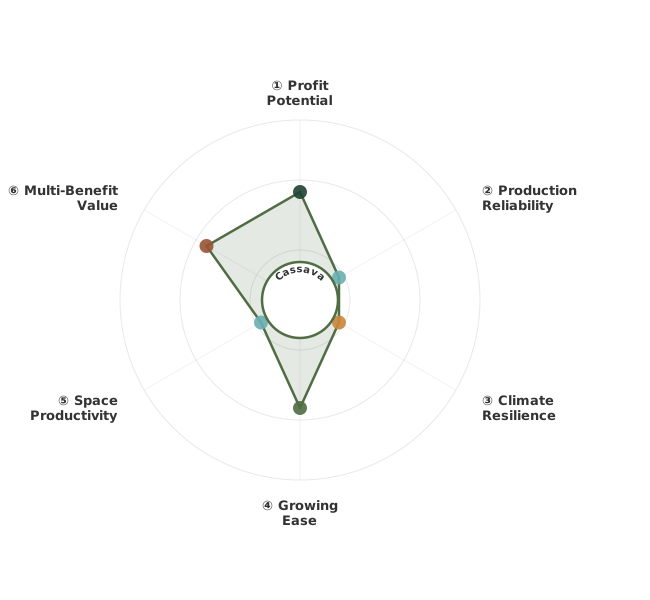
How These Traits Are Calculated
Trait dimensions are ordered clockwise starting from the top of the chart (12 o'clock position):
1. Profit Potential
Net returns per acre from yield, pricing, input costs, and labor efficiency
WHAT: Synthesizes gross revenue potential, input costs, labor requirements, and storage/marketing advantages into net profitability per acre. Captures the complete economic picture from planting to sale.
WHY: Not all vegetables are equally profitable. High-value crops with efficient production can return $10,000-30,000/acre versus $2,000-5,000/acre for lower-value options. Profit potential guides crop selection for maximum return on limited land and determines viable scale for farm businesses.
HOW: Scored via LLM synthesis of economics data (yields, prices, costs), storage advantages (season extension, value-added potential), and labor intensity. Exceptional (3.0): High yields × premium prices with moderate inputs and good storage (garlic, high-value salad greens). Typical (2.0): Moderate returns (tomatoes, squash). Limited (1.0): Low yields, commodity pricing, or intensive labor requirements (low-value greens).
2. Production Reliability
Weighted: yield consistency (60%) + disease/pest resistance (40%)
WHAT: Combines yield reliability (harvest consistency year-to-year) with disease and pest resistance to measure predictable production. Reliable vegetables deliver consistent harvests without catastrophic failures from pests or weather.
WHY: Market commitments and CSA subscriptions require dependable production. Unreliable crops that fail in bad years or require intensive pest management create cash flow gaps and customer dissatisfaction. Reliable producers allow confident planning and reduce input costs from emergency pest interventions.
HOW: Weighted formula prioritizes yield reliability (60% weight) for overall consistency, with disease/pest resistance (40% weight) to prevent total failures. Exceptional (3.0): Consistent yields across variable seasons with strong natural pest resistance. Typical (2.0): Generally reliable with some pest/weather sensitivity. Limited (1.0): Highly variable yields or severe pest vulnerability requiring intensive management.
3. Climate Resilience
Temperature and rainfall tolerance across diverse growing conditions
WHAT: Measures the breadth of climatic conditions where the vegetable produces successfully—temperature extremes, humidity ranges, and rainfall variability. Climate-resilient crops work across diverse regions and weather patterns.
WHY: Climate variability is increasing—unexpected heat waves, cold snaps, or drought periods can wipe out entire vegetable harvests. Resilient crops provide insurance against weather uncertainty and allow geographic expansion for market growth. This is especially critical for direct-market farmers who can't easily substitute crops mid-season.
HOW: Ratings based on the climate_adaptability trait documenting temperature tolerance and geographic range. Exceptional (3.0): Grows successfully in diverse climates (cold to hot, humid to dry) with wide hardiness zone range. Typical (2.0): Moderate climate flexibility. Limited (1.0): Narrow climate requirements (tropical-only, cool-season-only, humidity-sensitive).
4. Growing Ease
Weighted: establishment ease (50%) + low maintenance requirements (50%)
WHAT: Combines establishment difficulty (germination, transplanting) with ongoing maintenance needs (watering, fertilizing, pest management) to measure total labor requirements. Easy crops grow reliably with minimal intervention.
WHY: Labor is the primary cost for small-scale vegetable production. Easy-care crops allow farmers to manage more production area with the same labor, improving profitability. Difficult crops requiring constant attention, precise timing, or specialized skills reduce overall farm productivity and increase risk.
HOW: Weighted formula balances establishment ease (50% weight) for reliable startup and inverted maintenance intensity (50% weight) for ongoing care. Exceptional (3.0): Direct-seeded or easy transplants with minimal water/fertility/pest needs. Typical (2.0): Moderate care requirements. Limited (1.0): Difficult establishment or intensive ongoing management (daily watering, heavy feeding, constant pest monitoring).
5. Space Productivity
Weighted: yield per square foot (60%) + season extension potential (40%)
WHAT: Combines spatial productivity (yield per square foot) with temporal productivity (extended harvest windows from succession planting or season extension). Maximizes production from limited growing area.
WHY: Land is the primary constraint for vegetable farmers—especially those near urban markets. Space-efficient crops delivering high yields in small areas improve per-acre profitability dramatically. Season extension (spring tunnels, fall protection) adds bonus production windows when competing supply is limited and prices are higher.
HOW: Weighted formula prioritizes space efficiency (60% weight) for core yield per area, with season extension potential (40% weight) for bonus production opportunities. Exceptional (3.0): High yields per square foot (10,000+ lbs/acre equivalents) with season extension options. Typical (2.0): Moderate yields and extension potential. Limited (1.0): Low yields or crops unsuitable for season extension.
6. Multi-Benefit Value
Ecosystem services beyond harvest—pollinator support, nitrogen fixing, pest habitat
WHAT: Measures ecosystem services provided beyond harvestable yield. Multi-benefit vegetables contribute to farm ecology through nitrogen fixation (legumes), pollinator support (flowering crops), beneficial insect habitat, soil building, or erosion control.
WHY: Cash crops can either extract from farm ecosystems or contribute to them. Vegetables with strong multi-benefit value build soil fertility, support pollinators needed for fruit/vine crops, and create habitat for pest predators—reducing external input needs. Nitrogen-fixing vegetables (beans, peas) provide $40-80/acre worth of fertility for following crops.
HOW: Ratings based on the multi_benefit_value trait documenting service contributions. Exceptional (3.0): Significant ecosystem services (nitrogen fixation, heavy pollinator support, soil building, pest habitat). Typical (2.0): Some ecosystem contributions. Limited (1.0): Single-purpose cash crops with minimal farm ecology benefits.
Ratings are based on documented performance in regenerative systems, not conventional high-input scenarios. All traits assume integrated management practices focused on soil health and ecosystem services.
4
System Role & Multi-Benefit Value
Functional roles, integration strategies, and stacked benefits
System Role & Multi-Benefit Value
Functional roles, integration strategies, and stacked benefits
Functional Role
Total System Value
Cassava offers a compelling multi-benefit profile within regenerative agriculture systems. Its direct harvest value as a staple food and source of starch is significant. Beyond this, it acts as a cash crop with ecological services, contributing substantial biomass that can be utilized as mulch, enhancing soil organic matter and moisture retention. Studies like excerpt highlight its role in soil organic carbon sequestration, especially when managed with organic matter additions. In intercropping systems, as demonstrated in excerpt with peanuts, cassava can influence rhizosphere microbial communities, leading to improved nutrient availability for companion crops. Organic cassava farming, as evaluated in excerpt, shows strong potential for high soil quality and crop health indicators. This stacking of benefits—direct harvest, soil health improvement, biomass generation, and contribution to complex agroecosystems—enhances farm resilience by diversifying income streams and strengthening ecological functions, reducing reliance on external inputs and mitigating risks associated with monoculture.
Integration Characteristics
Multi-Benefit Value: Adequate - Edible tubers are a primary benefit, complemented by its drought tolerance and contribution to soil structure; integrating it can support a more resilient farm ecosystem.
Sources behind this view
 Research
-
Promoting Cassava as an Industrial Crop in Ghana: Effects on Soil Fertility and Farming System Sustainability (opens in new window)
Ghanaian research shows cassava, in crop rotation, can maintain soil fertility, supporting sustainable industrial production and poverty reduction.
5
Management & Care Requirements
Integration guidance, maintenance needs, and care practices
Management & Care Requirements
Integration guidance, maintenance needs, and care practices
How to Integrate This Plant
Cassava (Manihot esculenta) is a versatile root crop that can be integrated into regenerative systems primarily as a cash crop providing significant biomass and soil-improving services. Its primary function as a cash crop with services means it can be grown in conjunction with other practices. Compatible practices include alley cropping and intercropping systems, as seen in excerpt where it was intercropped with sweet potato. Cassava can also be part of food forests or other polyculture systems, contributing to ground cover and potential soil carbon sequestration, as investigated in excerpt. While not providing nitrogen fixation or direct shade like trees, its rapid growth and substantial root system contribute to soil health and erosion control. Its value begins in Year 1 with harvest and soil cover, with increasing contributions to soil organic matter in subsequent years. The multi-benefit stacking comes from its harvest value, biomass for mulch or animal feed, soil structure improvement, and its role in complex intercropping systems that enhance nutrient cycling and microbial activity, as noted in excerpt.
Integration Practices & Management
Cassava (Manihot esculenta) integration into regenerative agriculture systems is primarily demonstrated through intercropping and soil management practices. Studies highlight its use in intercropping systems, such as with peanut, where its cyanide production influences rhizosphere microbial communities, enhancing nutrient availability for companion crops. Field trials have also explored intercropping cassava with sweet potato, investigating various planting times and densities relative to cassava establishment. Long-term experiments examine the impact of organic matter applications, including cassava residue and compost, on soil organic carbon sequestration and cassava yield in different soil types. While the provided sources detail intercropping and organic matter integration, they do not cover establishment methods like seeding rates, specific timing, no-till vs. minimal tillage, integration with grazing systems, or termination strategies. Management considerations like fertility needs and competition management are implicitly addressed through the study of organic matter and intercropping, but not explicitly detailed. The knowledge base focuses on the plant's role within established cropping systems and its impact on soil health and companion crops, rather than a farmer's step-by-step integration process including grazing or termination.
Management Profile
Maintenance Intensity: Not Recommended - Optimal cassava growth hinges on well-drained soils and extended warm periods, with attention needed to prevent root issues and manage potential pathogen pressures through integrated practices.
Sources behind this view
Research
-
Promoting Cassava as an Industrial Crop in Ghana: Effects on Soil Fertility and Farming System Sustainability (opens in new window)
Ghanaian research shows cassava, in crop rotation, can maintain soil fertility, supporting sustainable industrial production and poverty reduction.
6
Economics & Value Streams
Direct harvest, system benefits, ecosystem services, and risk diversification
Economics & Value Streams
Direct harvest, system benefits, ecosystem services, and risk diversification
Comprehensive economic analysis including direct harvest value, system enhancement contributions, ecosystem services, value timeline, and risk diversification strategies.
Vegetable & Specialty Economics
| Metric | Value |
|---|---|
| Seed/Transplant Cost | 150-300 $/acre 370-741 $/ha |
| Expected Yield | 8000-15000 lbs/acre 8966-16812 kg/ha |
| Market Price | 0.40-0.80 $/lb 0-1 $/kg |
| Harvest/Handling Cost | 800-1600 $/acre 1976-3953 $/ha |
| Marketing/Distribution Cost | 400-800 $/acre 988-1976 $/ha |
| Net Annual Return* | $500-$10650/acre/year |
Economics highly variable by market channel (direct vs wholesale), scale, and management. Direct marketing commands premiums but requires labor. Values shown for mid-scale market garden operations.
* Net Annual Return = (Yield × Market Price) − (Amortized Establishment Cost + Annual Maintenance). This return is realized only at/after first harvest; early years have costs but no revenue. Range shows worst case to best case scenarios.
System Enhancement Value
Beyond harvest: ecosystem services from regenerative cash crop practices
Ecological Service Contributions
Cassava offers significant soil remediation and improvement capabilities. Its ability to grow on marginal lands and tolerate various soil conditions () makes it valuable for rehabilitating degraded soils. The research highlights its role in intercropping systems where it influences rhizosphere microbial communities, leading to enhanced nutrient availability and plant fitness in neighboring crops, such as peanuts, through root ethylene signaling (). Furthermore, cassava residue management, including incorporation of harvest residues (), contributes to soil organic matter (SOM) accumulation, especially in sandy soils, which positively impacts soil structure, water retention, and nutrient cycling. This SOM enhancement is crucial for long-term soil health and fertility. By improving soil structure and potentially increasing water infiltration, cassava can also contribute to better water management within the farm system. Its use in diverse planting arrangements (,) indicates its adaptability for creating complex, multi-strata agroecosystems that can improve overall farm resilience.
Erosion Control (if applicable)
Variable, dependent on planting density and integration with other windbreak species. Potential for significant yield improvement in protected areas (5-15%) and reduced soil loss.
While cassava is not a nitrogen-fixing plant, its role as a cover crop and its potential for soil remediation (,) contribute indirectly to soil health, which is foundational for windbreak effectiveness. In integrated systems, cassava can be strategically planted to buffer wind and reduce soil erosion, particularly in conjunction with other species. Its biomass, when managed as residue (), can further stabilize soil. Although not explicitly mentioned as a windbreak species in the provided excerpts, its growth habit and use in intercropping systems (,) suggest its capacity to form dense ground cover. This density can help dissipate wind energy at the soil surface, protecting more sensitive crops or young trees from wind damage. The economic benefit of such protection can be significant, preventing yield losses due to lodging, desiccation, and physical damage. In sandy soils, where cassava yield is positively influenced by organic matter (), planting practices that enhance soil structure and moisture retention, often aided by cover cropping, further bolster its erosion control potential.
Ecosystem Service Contributions
Environmental contributions: carbon, pollinators, wildlife, and water
- Carbon Sequestration: Cassava contributes to carbon sequestration primarily through the accumulation of soil organic carbon when its residues are managed appropriately, as demonstrated in sandy soils with organic matter application (). While not a woody perennial with extensive long-term carbon storage, its biomass production and incorporation into the soil can enhance SOC levels over time.
- Pollinator Support: Low. While cassava does flower, it is not typically recognized as a significant attractant for pollinators compared to many other agricultural or wild species. Its primary value in integrated systems lies in its other functional roles.
- Wildlife Habitat: Low to Medium. Cassava can provide some ground cover and potentially forage for certain wildlife, especially during its growth cycle. However, it is not a primary source of mast or significant nesting habitat for most wildlife species. Its main contribution to wildlife would be through supporting a healthier overall farm ecosystem that can indirectly benefit wildlife.
- Water Quality: Not applicable
Value Timeline: Production & Services
When you'll see results: varies by crop (annual harvest vs. perennial establishment)
Years 1-2
Initial soil stabilization and ground cover for erosion control, influence on rhizosphere microbial communities in intercropped systems, and early biomass for potential chop-and-drop or residue incorporation.
Years 3-5
Established ground cover contributing to soil health and potential for early harvest revenue. Continued soil remediation and organic matter building, with increasing benefits to neighboring plants and soil structure.
Years 10-20
Mature contribution to soil organic carbon sequestration, especially in sandy soils with consistent residue management. Established functionality as a component in diverse agroforestry or intercropping systems, providing ongoing soil health benefits and risk diversification.
20+ Years
Long-term enhancement of soil fertility and structure, contributing to a more resilient and productive farm system. Continued role in integrated cropping systems, supporting biodiversity and overall ecosystem function.
Farm Risk Reduction
How this reduces farm risk: backup income, weather protection, market hedges
- Multiple Revenue Streams: Primary cash crop revenue, potential for food security (root crop), soil amendment services (organic matter, microbial enhancement), erosion control, and contribution to overall farm resilience.
- Temporal Income Spread: Annual harvest of tubers, with ongoing soil health and ecosystem service benefits that accrue over multiple years and contribute to long-term farm productivity.
- Market Risk Hedge: Cassava's drought tolerance and ability to grow on marginal lands provide a buffer against adverse weather conditions. Its role in intercropping diversifies the farm's output, reducing reliance on a single crop. Furthermore, its contribution to soil health can reduce the need for external inputs, hedging against fluctuating fertilizer and pesticide prices.
Sources behind this view
Research
-
Promoting Cassava as an Industrial Crop in Ghana: Effects on Soil Fertility and Farming System Sustainability (opens in new window)
Ghanaian research shows cassava, in crop rotation, can maintain soil fertility, supporting sustainable industrial production and poverty reduction.
8
Learn More
Why farmers use this plant and additional resources
Learn More
Why farmers use this plant and additional resources
Why Regenerative Farmers Use This Plant
Cassava (Manihot esculenta) presents a compelling opportunity for regenerative farmers seeking high-value, resilient cash crops, particularly in tropical and subtropical regions. Its rapid growth and adaptability make it a strong contender for generating significant revenue per acre, with harvest timelines typically ranging from 8 to 18 months depending on variety and growing conditions. This extended harvest window allows for strategic market access, catering to direct-to-consumer sales, CSA shares, and specialty wholesale markets that value its unique culinary applications and versatility as a food staple and industrial ingredient. Its ability to produce substantial edible roots, often yielding 10,000-40,000 lbs/acre (11,200-44,800 kg/ha) of fresh roots, positions it as a potent economic engine in tropical and subtropical regenerative systems. The crop's adaptability to marginal soils also presents an opportunity for farmers in areas less suited to other staple crops.
Beyond its direct economic benefits, cassava plays a crucial role in enhancing farm ecosystem health. As a deep-rooted crop, its extensive root system, which can reach depths of 3-6 feet (0.9-1.8 meters) or 1-2 feet (30-60 cm) depending on soil conditions, excels at scavenging nutrients from lower soil profiles, effectively cycling them back to the surface and improving overall soil fertility. Its robust root system helps to break up soil compaction, improving aeration and water infiltration, which are critical for long-term soil health and resilience. The substantial above-ground biomass produced by cassava can be returned to the soil as organic matter, contributing to carbon sequestration and improving soil fertility over time. While not a nitrogen fixer, its efficient nutrient scavenging, particularly for potassium, can help balance soil nutrient profiles.
The ecological contributions of cassava extend to its role in building soil structure and supporting biodiversity. Its extensive root network binds soil particles, significantly reducing erosion risk, especially in areas prone to heavy rainfall. The dense canopy it forms during its growth cycle also helps to suppress weed competition, thereby reducing the need for external inputs and labor. While not a primary pollinator attractant, its presence in diverse cropping systems can contribute to a more stable habitat for beneficial insects and soil microbes. Post-harvest residue management, such as leaving root remnants and foliage to decompose in situ or incorporating them back into the soil, further enriches the soil with organic carbon and nutrients, fostering a more vibrant and self-sustaining agricultural ecosystem.
Cassava has demonstrated remarkable success and diverse regional adaptations. In the humid tropics of Southeast Asia, it is a staple crop, often grown in rotation with rice or maize, providing a vital food security and income source for smallholder farmers. In parts of Brazil, it is cultivated in agroforestry systems alongside coffee and cacao, offering shade tolerance and contributing to the economic diversification of these plantations. In Africa, particularly West Africa (e.g., Nigeria, Ghana), cassava is a cornerstone of many farming systems, providing both food and income, and is increasingly being integrated into more diversified and resilient agricultural landscapes to combat food insecurity and environmental degradation. In the Caribbean, it is a traditional crop, often grown in small plots and integrated into mixed farming systems. In India, it is a significant crop in rainfed areas, grown in rotation with pulses and oilseeds, contributing to the resilience of smallholder farming systems. In Australia's tropical north, it is cultivated for both domestic consumption and industrial uses, often on sandy soils where its drought tolerance is a significant advantage.
Sources behind this view
Research
-
Promoting Cassava as an Industrial Crop in Ghana: Effects on Soil Fertility and Farming System Sustainability (opens in new window)
Ghanaian research shows cassava, in crop rotation, can maintain soil fertility, supporting sustainable industrial production and poverty reduction.
-
Biofertilizer Impacts: Cassava (Manihot Esculenta Crantz) Cultivation Crop Yield and Regenerative Agriculture (opens in new window)
Biofertilizers are key for sustainable cassava cultivation and regenerative agriculture, improving yields, soil health, and nutrient use through beneficial microbes, while potentially reducing harmful