While Pennisetum purpureum (Napier grass) has limited mentions in our knowledge base, available data suggests its utility in regenerative systems, particularly as a trap plant in Push-Pull pest management strategies. In this integrated pest management approach, Napier grass attracts pests away from cereal crops, acting as a 'pull' plant. Studies also indicate its potential for soil building. Research on biochar amendment in Napier grass cultivation showed significant shifts in soil microbial communities, enhancing carbon turnover and denitrification, suggesting benefits for soil health and nutrient cycling. Furthermore, its root decomposition rate is noted in studies evaluating perennial grasses, indicating its contribution to soil organic matter. While not explicitly detailed as a cover crop or nitrogen fixer in these excerpts, its role as a biomass producer in cropping systems, as seen in bioenergy studies, implies potential for carbon sequestration. Further research is needed to fully explore its multifaceted applications in regenerative agriculture.

Regenerative Quick Profile

All recommendations assume integrated, regenerative practices—not conventional inputs.

Climate & Soil Fit

Climate: Tropical Rainforest, Tropical Monsoon, Tropical Savanna, Hot Semi-Arid (Steppe), Cold Semi-Arid (Steppe), Hot Desert, Humid Subtropical, Oceanic (Maritime Temperate), Hot-Summer Mediterranean, Warm-Summer Mediterranean, Monsoon-Influenced Humid Subtropical, Subtropical Highland, Hot-Summer Continental, Warm-Summer Continental, Monsoon-Influenced Hot-Summer Continental

Zones: USDA 9-11, Australian Zones 11-14, EU Mediterranean, Subtropical

Optimal Soil: Loam Soil

System Role & Functions

Primary: Forage Integration

Secondary: Cover Crop System, Cash Crop With Services

Key Benefits: Weed Suppression, Root System Depth, Biomass Production

Management Level

Experience: Beginner-Friendly

Maintenance: Moderate maintenance - As a high-yielding perennial, optimal Napiergrass production is supported by practices that enhance soil fertility and moisture retention, with harvesting integrated into the overall system's organic matter cycling.

Value Streams

  • Diversifies farm income
  • Enhances biodiversity
1

Climate Suitability Assessment

Will this plant thrive in your climate?

IDEALLY SUITED

Köppen Zone: Af (Tropical Rainforest), Am (Tropical Monsoon), Aw (Tropical Savanna), Cfa (Humid Subtropical), Cwa (Monsoon-Influenced Humid Subtropical)
USDA Zone: 7a, 8a, 9a, 10a, 11a, 12a
Australian Zone: tropical, subtropical

Napier grass excels in tropical and subtropical climates characterized by high temperatures (averaging 25-30°C or 77-86°F) and abundant rainfall (exceeding 1000 mm annually), conditions met in Köppen zones Aw, Am, and Cfa, and Australian zones subtropical and tropical, and USDA zones 8b through 13a. These environments provide long, frost-free growing seasons (270-365 days) allowing for continuous, vigorous growth and multiple harvests per year, yielding 30-60 tons/acre (70-140 tons/ha) of high-quality forage. Its ability to tolerate short dry spells and resprout with the return of moisture makes it resilient. Minimal management is required beyond harvesting and nutrient replenishment, making it highly productive and economically viable for forage integration, cover cropping, and as a cash crop with ecosystem services. Establishment is rapid and reliable, with perennial stands persisting for many years under optimal conditions.

ADEQUATE

Köppen Zone: BSh (Hot Semi-Arid (Steppe)), Cfb (Oceanic (Maritime Temperate)), Csa (Hot-Summer Mediterranean), Csb (Warm-Summer Mediterranean), Cwb (Subtropical Highland)
USDA Zone: 6a
Australian Zone: grassland, temperate
EU Climate Region: atlantic, mediterranean

Napier grass can be grown adequately in climates with moderate temperatures and rainfall, including Köppen Cwa, and Australian zones grassland and temperate, and EU regions atlantic and mediterranean, as well as USDA zones 7a and 7b. These zones typically offer growing seasons of 180-270 frost-free days with temperatures suitable during the warmer months. However, limitations such as cooler summers, distinct dry seasons, or occasional frost may reduce its perennial performance and overall yield (15-30 tons/acre or 35-70 tons/ha). Supplemental irrigation is often necessary during dry periods, particularly in Mediterranean and grassland climates, to maintain productivity and ensure stand persistence. While not as consistently productive as in ideal tropical zones, it remains a viable option for forage integration with appropriate management and site selection.

NOT RECOMMENDED

Köppen Zone: ET (Tundra), BSk (Cold Semi-Arid (Steppe)), BWh (Hot Desert), BWk (Cold Desert), Dfa (Hot-Summer Continental), Dfb (Warm-Summer Continental), Dfc (Subarctic), Dwa (Monsoon-Influenced Hot-Summer Continental)
USDA Zone: 2a, 3a, 3b, 4a, 5a, 5b
Australian Zone: arid

Napier grass is not recommended for arid and desert climates (Köppen BSh, BWh; Australian arid) and potentially very cold regions due to its high water requirements and sensitivity to extreme temperatures. In hot arid zones, low and erratic rainfall (<600 mm annually) and high evaporation rates prevent sustained growth without extensive and costly irrigation, making establishment and productivity economically unviable. Yields would be minimal, and perennial stands unlikely. In extreme desert conditions, survival is impossible without significant water input. While it might technically survive in some marginal temperate or cold zones as an annual, its perennial potential is severely compromised by winter kill and short growing seasons. For these challenging environments, alternative, more drought-tolerant grasses and legumes are significantly better suited for forage and soil health benefits.

Better alternatives for these "not recommended" zones: Buffel Grass (Cenchrus ciliaris) (highly drought-tolerant perennial grass adapted to arid and semi-arid conditions), Sorghum-Sudangrass hybrids (annual forage with good drought tolerance and high biomass production), Leucaena leucocephala (drought-tolerant legume tree that can provide forage and nitrogen fixation), Saltbush (Atriplex spp.) (drought and salt tolerant shrubs providing forage)

Note: Zones listed above represent climates where this plant can produce reliably with reasonable management. Climate zones not mentioned would require intensive climate modification (greenhouses, extensive infrastructure) and are not economically viable for regenerative agriculture purposes.

2

Soil Suitability Assessment

Which soil types work best for this plant?

IDEALLY SUITED

Loam Soil

This plant thrives in these soil types without requiring amendments or remediation. Natural soil conditions support optimal growth and productivity.

ADEQUATE

Acidic Soil, Alkaline Soil, Clay Soil, Rich Soil, Rocky Soil, Sandy Soil

This plant performs acceptably in these soil types with moderate, manageable remediation such as pH adjustment, compost addition, or drainage improvement. The required amendments are practical and cost-effective for regenerative agriculture.

NOT RECOMMENDED

Desert Soil, Saline Soil, Wet Soil

Growing this plant in these soil types would require impractical remediation such as complete soil replacement, extensive amendments, or cost-prohibitive infrastructure. These conditions are not economically viable for regenerative agriculture.

Note: Soil suitability assessments focus on remediation requirements. "Ideally Suited" means the plant generally thrives without the need for substantial amendments, "Adequate" means manageable remediation (lime, compost, mulch), and "Not Recommended" means impractical soil changes would be required. Climate factors like rainfall and temperature also influence success.

3

Seasonal Considerations

Planting timing, growth duration, and harvest windows

Pennisetum purpureum thrives in warmer conditions and is best utilized as a dedicated summer or overwintering cover, depending on your climate. For spring planting, wait until well after the last expected frost and soils have warmed to at least 60°F (15°C). This allows for rapid establishment, typically within 3-5 weeks, leading to significant biomass accumulation throughout the summer.

If aiming for a fall termination to prepare for a spring cash crop, plant Pennisetum purpureum in early to mid-summer. This provides ample time for it to reach maturity and build substantial organic matter before the first expected frost. In warmer climates (Aw, As, Am), this grass can provide excellent winter cover, surviving dormancy and resuming growth in the spring. Termination before planting your subsequent cash crop is crucial; a light frost can weaken it, while mechanical methods or herbicides can be employed for more rapid breakdown, ideally done several weeks before cash crop seeding. In cooler Cwa and Cfa zones, it will likely be winter-killed, serving as a valuable winter cover that decomposes over winter, ready for spring incorporation. Frost-seeding is not recommended due to its warm-season nature.

4

System Role & Multi-Benefit Value

Functional roles, integration strategies, and stacked benefits

Functional Role

Total System Value

Napier grass offers substantial whole-farm resilience through a combination of direct harvest value and significant system enhancements. As a high-yielding forage, its primary direct harvest value lies in feeding livestock, reducing reliance on external feed sources. System enhancement comes from its potential role as a trap plant in push-pull pest management, reducing pest pressure on companion crops like cereals (Excerpt 1). Its vigorous root system contributes to soil health, with decomposition adding organic matter and potentially improving soil structure and water retention (Excerpts 2, 3, 4). While not a primary nitrogen fixer, its biomass contributes to nutrient cycling. Ecosystem services include some carbon sequestration in biomass and soil, and support for soil microbial communities (Excerpt 2). Risk diversification is achieved by diversifying farm outputs and enhancing on-farm fertility and pest control.

Integration Characteristics

Multi-Benefit Value: Adequate - This high biomass producer offers significant benefits for forage and erosion control, effectively binding soil; however, its potential invasiveness requires careful management within the system.

5

Management & Care Requirements

Integration guidance, maintenance needs, and care practices

How to Integrate This Plant

Napier grass (Pennisetum purpureum) is a valuable non-tree species for regenerative systems, primarily functioning as a forage crop for integration, particularly in tropical and subtropical regions. Its roles include providing high-quality biomass for livestock, acting as a potential trap plant in push-pull pest management strategies (Excerpt 1), and contributing to soil health through its root system's decomposition (Excerpt 3). Compatible practices include silvopasture, where it can be grazed alongside livestock, and potentially as a component in biomass production systems. Year 1: Napier grass establishes and begins providing forage. Year 3-5: It reaches full production potential, offering significant biomass for grazing or fodder. Year 10+: Continued biomass production and potential soil organic matter contribution. The multi-benefit stacking includes direct forage value, pest management support, and soil organic matter enhancement through root decomposition, contributing to overall farm resilience.

Integration Practices & Management

The provided knowledge base offers limited direct insight into the specific regenerative agriculture practices for integrating Pennisetum purpureum. While sources mention its use as a trap plant in Push-Pull systems and its inclusion in decomposition studies, detailed methods for establishment, grazing integration, or termination are not elaborated upon within these texts. Source implies its use as a trap plant, suggesting it's part of a larger cropping system, but does not specify the establishment technique. Similarly, the decomposition study focuses on root breakdown rates rather than agricultural management. Source discusses biochar amendment impacts on soil microbes in a Napier grass cultivation, indicating its potential in soil health improvement, but again, does not detail the practical integration methods used by farmers. Therefore, based on these mentions, specific farmer experiences regarding establishment, grazing, termination, fertility, competition, succession, or cash crop integration are not available in this knowledge base.

Management Profile

Maintenance Intensity: Adequate - As a high-yielding perennial, optimal Napiergrass production is supported by practices that enhance soil fertility and moisture retention, with harvesting integrated into the overall system's organic matter cycling.

6

Economics & Value Streams

Direct harvest, system benefits, ecosystem services, and risk diversification

Comprehensive economic analysis including direct harvest value, system enhancement contributions, ecosystem services, value timeline, and risk diversification strategies.

Cover Crop Investment

Metric Value
Seed Cost $20-50/acre $49-124/ha
Termination Cost 25-75 62-185
Biomass Production 10-30 22-67
N Fixation Value 0-0 0-0
Weed Control Savings 15-40 37-99

Cover crops are soil investments, not cash crops. Economics measured in soil health gains, input reduction, and subsequent crop performance. Values show direct costs and estimated benefits.

System Enhancement Value

Beyond harvest: livestock nutrition, soil building, and pasture improvement

Livestock Nutrition & Soil Building

Napier grass offers substantial benefits beyond its primary function as forage. As highlighted in the Push-Pull strategy, it serves as an effective 'pull' plant, attracting stemborer moths away from cereal crops. This IPM function significantly contributes to reducing pest pressure and the need for chemical interventions, thereby enhancing the overall sustainability and economic viability of cropping systems. Furthermore, the root exudates and decomposition of Napier grass contribute to soil health. Studies indicate that biochar amendment, which can be used with Napier grass systems, enhances nutrient cycling and carbon sequestration. The rapid decomposition of its roots, as noted in decomposition studies, means that organic matter is efficiently returned to the soil, improving soil structure and fertility over time. This contributes to a more resilient and productive soil ecosystem, reducing reliance on external inputs and sequestering carbon.

Erosion Control

Variable, dependent on stand density and width. Can contribute to reduced soil erosion and potential minor yield improvements in adjacent crops.

While Napier grass (Pennisetum purpureum) is not typically considered a primary windbreak species in the same vein as trees, its dense, tall growth habit can offer significant benefits in certain integrated systems. When planted as border crops or intercropped, it can act as a physical barrier, reducing wind velocity across fields. This is particularly relevant for cereal-based systems as described in the knowledge base, where Napier grass can help protect crops from wind damage and reduce soil erosion. The physical presence of dense stands can also create microclimates that are more favorable for adjacent crops, potentially leading to improved growth and yield by minimizing stress from wind. The effectiveness as a windbreak would be dependent on the density and height of the Napier grass stand, and its strategic placement within the farm landscape.

Ecosystem Service Contributions

Environmental contributions: carbon, pollinators, wildlife, and water

  • Carbon Sequestration: Napier grass is a fast-growing perennial grass with significant biomass production, indicating a high potential for carbon sequestration in both above-ground and below-ground biomass, as well as in the soil through root decomposition and organic matter accumulation, especially when managed with practices like biochar amendment.
  • Pollinator Support: Low. While it provides biomass, it is not primarily known for its floral resources that attract a wide range of pollinators. Its role would be more as habitat than a direct food source.
  • Wildlife Habitat: Medium. Dense stands can provide cover and nesting habitat for small mammals and ground-nesting birds. Its biomass can also serve as browse for certain wildlife species, though its primary value is in managed systems.
  • Water Quality: Not applicable

Value Timeline: Forage Establishment & Production

When you'll see results: annuals year 1, perennial establishment 1-2, peak 3-10

Years 1-2

Initial establishment of dense stands for pest management (Push-Pull strategy). Early contributions to soil organic matter through root turnover. Potential for some windbreak effect and erosion control.

Years 3-5

Established forage production for livestock. Full pest deterrence and trap effects in integrated systems. Significant contribution to soil organic matter and nutrient cycling from ongoing biomass decomposition.

Years 10-20

Mature, highly productive forage source. Sustained and enhanced soil fertility and structure due to long-term organic matter accumulation. Potential for significant carbon sequestration benefits.

20+ Years

Continued high productivity as a perennial. Potential for increased resilience to environmental stresses. Long-term soil health improvements and carbon storage benefits.

Farm Risk Reduction

How this reduces farm risk: feed cost reduction and livestock performance

  • Multiple Revenue Streams: Forage for livestock, pest management services for crops (reducing losses and input costs), potential cash crop if marketed, soil health improvement (reducing long-term input costs and increasing resilience).
  • Temporal Income Spread: Ongoing forage production throughout its growing season, continuous pest management services, and gradual but consistent improvement in soil health and carbon sequestration over many years.
  • Market Risk Hedge: Diversifies farm revenue beyond single crops by providing a valuable livestock feed. Its role in pest management reduces reliance on external chemical inputs, mitigating price volatility and availability risks. Its contribution to soil health enhances farm resilience against drought and degraded land conditions.
7

Regenerative Suitability Details

Comprehensive trait ratings for system integration assessment

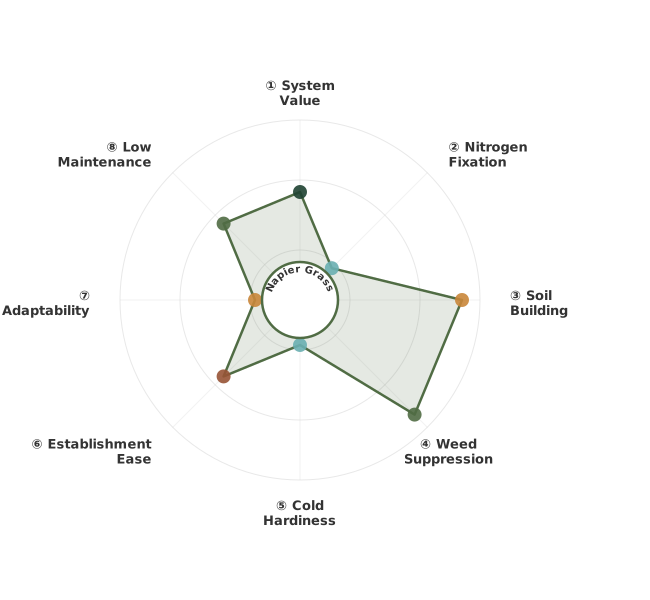
Comparative ratings for this plant across key regenerative agriculture traits.

Trait Suitability Explanation
Cold Hardiness Not Recommended As a tropical grass, Napiergrass thrives in warmer climates (Zone 9+) and is sensitive to frost, functioning as a summer annual in cooler regions where it offers no winter ground cover.
Weed Suppression Ideally Suited Napiergrass's rapid and dense growth creates a thick canopy that effectively outcompetes and smothers most weeds, contributing significantly to soil health through substantial organic matter deposition.
Nitrogen Fixation Not Recommended While a prolific biomass producer, Napiergrass is not a legume and therefore does not fix atmospheric nitrogen, relying on existing soil nutrients for its vigorous growth.
Root System Depth Ideally Suited Its exceptionally deep and extensive fibrous root system, often exceeding 4 feet, actively improves soil structure, breaks compaction, and enhances water infiltration.
Biomass Production Ideally Suited Napiergrass is a tropical grass renowned for its exceptionally high biomass yields, making it an excellent source of organic matter for warm climates.
Establishment Ease Adequate Readily establishes from cuttings or seed in warm climates, its vigorous growth is best supported by healthy soil and consistent moisture for optimal initial development.
Multi Benefit Value Adequate This high biomass producer offers significant benefits for forage and erosion control, effectively binding soil; however, its potential invasiveness requires careful management within the system.
Climate Adaptability Not Recommended Napiergrass thrives in tropical to subtropical zones (9-11) and is highly sensitive to cold, requiring ample heat and moisture, thus limiting its suitability to warmer agricultural landscapes.
Maintenance Intensity Adequate As a high-yielding perennial, optimal Napiergrass production is supported by practices that enhance soil fertility and moisture retention, with harvesting integrated into the overall system's organic matter cycling.

Comparative System: Ratings compare plants within their economic category (e.g., cover crop nitrogen fixation compared to other cover crops, not to all plants). Individual farm conditions and management practices significantly influence actual performance.

Sources behind this view

Research
8

Learn More

Why farmers use this plant and additional resources

Why Regenerative Farmers Use This Plant

Pennisetum purpureum is a highly productive perennial grass that offers significant regenerative benefits when integrated into farming systems. Its primary value lies in its exceptional biomass production, capable of yielding 20-40 tons of dry matter per acre (45-90 metric tons/ha) annually under optimal conditions. This substantial vegetative growth effectively sequesters atmospheric carbon, contributing to soil organic matter buildup over time. While not a legume, Pennisetum purpureum excels at scavenging nutrients from deeper soil profiles, making them available to subsequent crops or livestock through its rapid decomposition. Its dense and extensive root system, reaching depths of 4-12 feet (1.2-3.6 meters), is crucial for soil stabilization, preventing erosion on slopes and improving water infiltration by creating macropores.

When integrated into farming systems, Pennisetum purpureum serves multiple roles beyond direct soil building. As a high-quality forage, it supports livestock production, with carrying capacities typically ranging from 2-4 Animal Units per acre (0.8-1.6 AU/ha) depending on fertility and management. This allows for intensive rotational grazing systems that enhance soil health through manure deposition and hoof action. Its dense growth habit provides excellent ground cover and weed suppression, outcompeting many annual and perennial weeds after establishment, thereby reducing the need for mechanical or chemical weed control. In silvopasture or alley cropping systems, it can be used as a productive understory component, providing forage for livestock or biomass for mulch while allowing for the cultivation of other crops or the grazing of animals between rows or trees. Its rapid regrowth after grazing or cutting makes it ideal for continuous feed availability.

The ecosystem services provided by Pennisetum purpureum are considerable. The decomposition of its abundant residue enriches the soil with organic carbon, contributing to soil organic matter levels over time. Its deep root system enhances soil aeration and water holding capacity, leading to improved infiltration rates and reduced runoff, particularly in areas prone to heavy rainfall or drought. While not a direct pollinator attractant, its dense foliage can provide habitat for beneficial insects and arthropods, contributing to overall farm biodiversity. The rapid decomposition of its substantial biomass releases nutrients back into the soil, reducing the reliance on synthetic fertilizers; for instance, the decomposition of 20 tons of biomass can release an estimated 100-150 lbs of nitrogen (112-168 kg/ha) and significant amounts of phosphorus and potassium over a 6-12 month period.

Farmers in various regions have successfully leveraged Pennisetum purpureum. In Brazilian coffee and sugarcane plantations, it is often planted in the inter-rows as a cover crop and biomass producer, providing mulch, helping to suppress weeds, and improving soil structure and water infiltration on slopes. In parts of Southeast Asia, it is a staple forage for livestock, integrated into smallholder farming systems for both animal feed and soil improvement, often forming the backbone of smallholder dairy systems for cut-and-carry operations. In Australian tropical, subtropical, and semi-arid regions, it is utilized in grazing systems to improve pasture productivity and soil health in cattle operations, particularly on marginal lands where other forages struggle to establish. In parts of Africa, it is cultivated for both forage and as a source of biomass for bioenergy or soil improvement. In the Corn Belt of the United States, it can be grown in warmer southern regions as a summer forage crop. In the UK, while less common due to cooler temperatures, it can be grown in the warmest, most sheltered areas.

9

How to Integrate This Plant

Practical guidance for regenerative systems

Establishing Pennisetum purpureum typically involves vegetative propagation through stem cuttings or root divisions, ensuring genetic uniformity and rapid establishment. Seed can also be used, though it may result in more variability. For vegetative propagation, stem cuttings, approximately 12-18 inches (30-45 cm) in length, are planted horizontally into prepared soil at a depth of 2-4 inches (5-10 cm), ensuring nodes are in contact with moist soil. Root divisions can also be planted directly. A common guideline for planting stem cuttings is to use 5,000-10,000 cuttings per acre (12,350-24,700 cuttings/ha). Spacing can vary widely depending on management goals, from 2-3 feet (0.6-0.9 meters) for dense forage stands to wider spacings for integration into silvopasture systems. Rows are typically planted 3-6 feet (0.9-1.8 meters) apart, allowing for ample growth and management access. Planting is best done at the beginning of the rainy season, typically March-May in the Northern Hemisphere and September-November in the Southern Hemisphere, when temperatures are consistently above 20°C (68°F) and adequate moisture is available for establishment. Establishment is rapid, with significant growth visible within 30-60 days under warm, moist conditions.

Once established, Pennisetum purpureum requires consistent moisture, ideally 1-2 inches (2.5-5 cm) of rainfall or irrigation per week, especially during its active growth phase. Established stands can tolerate short dry spells. Fertility management should prioritize biological approaches; incorporating compost, animal manures, or utilizing the residue from rotational grazing are excellent strategies to build soil health and provide nutrients. While Pennisetum purpureum is a heavy feeder, its nutrient requirements can be significantly met through these regenerative practices, potentially reducing the need for synthetic NPK inputs by 40-60% over time. Growth is rapid in warm conditions, reaching harvestable height of 5-12 feet (1.5-3.6 meters) within 60-90 days of active growth. Pest and disease management should focus on maintaining plant health through balanced fertility, adequate water management, timely harvesting or grazing to prevent over-maturity, and by utilizing resistant varieties where available. Biological control agents and cultural practices are preferred over chemical interventions.

For cover cropping and soil building, or when used as a biomass generator, termination and residue management are key. Pennisetum purpureum is a perennial and does not typically winterkill in its preferred climate zones. Where winterkill is insufficient, management focuses on harvesting (grazing or mowing) to control height and maintain quality. If removal from a field is desired before planting a subsequent crop, it can be achieved through repeated mowing and grazing over an extended period, or by using mechanical means such as plowing. Mowing or chopping the stand to a height of 4-6 inches (10-15 cm) is an effective method. Roller-crimping is generally less effective on the thick stems of mature Pennisetum purpureum. If chemical termination is considered, it should be a last resort during a transition phase. Termination should ideally occur 2-3 weeks before planting the subsequent cash crop to allow for decomposition. The substantial residue breaks down over 60-120 days, releasing nutrients gradually. Seed management is generally not a concern as it is primarily propagated vegetatively, preventing unwanted reseeding. Relay or intercropping is generally not applicable due to its aggressive growth habit.

View Full Document (Printable single-page version)