
Moso Bamboo
Phyllostachys edulis, or Moso bamboo, is explored in regenerative agriculture primarily for its potential in soil improvement and carbon sequestration. Studies indicate its use in managed forests, where degradation impacts microbial carbon use efficiency, suggesting a role in soil health dynamics. Its integration with practices like biochar and organic mulching (including bamboo leaves) is being investigated to enhance soil conditions, as shown in trials involving rice husks, stalks, and biochar. While not explicitly detailed as a cover crop or nitrogen fixer in these excerpts, its biomass and root systems likely contribute to soil building. Research on Moso bamboo plantations highlights the interaction with soil amendments like nitrogen and biochar, influencing microbial limitations and respiration. Farmer experience insights are limited within this knowledge base, but the focus on soil oxygen, pH, and greenhouse gas emissions under different management strategies suggests a growing interest in optimizing its ecological benefits within agroforestry or silvopasture systems, particularly for carbon uptake and emission mitigation.
For a full botanical description see: Plants For A Future(opens in new window) (external link)
Regenerative Quick Profile
All recommendations assume integrated, regenerative practices—not conventional inputs.
Climate & Soil Fit
Climate: Tropical Rainforest, Tropical Monsoon, Tropical Savanna, Hot Semi-Arid (Steppe), Cold Semi-Arid (Steppe), Humid Subtropical, Oceanic (Maritime Temperate), Hot-Summer Mediterranean, Warm-Summer Mediterranean, Monsoon-Influenced Humid Subtropical, Subtropical Highland, Hot-Summer Continental, Warm-Summer Continental, Subarctic, Monsoon-Influenced Hot-Summer Continental
Zones: USDA 7-9, Australian Zones 3-11
Optimal Soil: Loam Soil
System Role & Functions
Primary: Cash Crop With Services
Secondary: Soil Remediation, Specialty
Key Benefits: Cold Hardiness, Weed Suppression, Root System Depth
Management Level
Experience: Beginner-Friendly
Maintenance: Moderate maintenance - This vigorous perennial contributes to system integration through its rapid growth; managing its spread and incorporating biomass enhances its regenerative contributions and harvest potential.
Value Streams
- Cash crop production
Know the Debate
- Use in managed systems for soil, carbon, erosion
- Biomass yields high; management for scale varies
- Aggressive spread requires containment; invasiveness risk
- Climate and soil conditions influence suitability
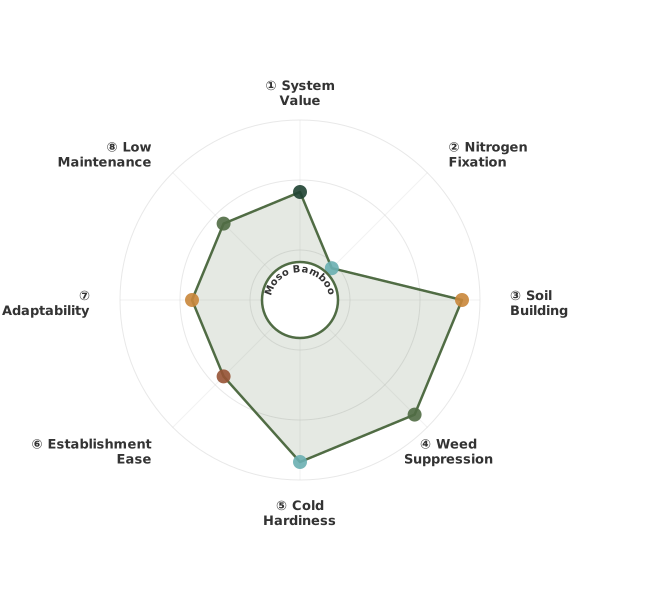
How These Traits Are Calculated
Trait dimensions are ordered clockwise starting from the top of the chart (12 o'clock position):
1. System Value
Ecosystem service stacking across nitrogen, carbon, water, biodiversity
WHAT: Synthesizes the compounding value of multiple ecosystem services delivered simultaneously—nitrogen fixation, soil organic matter building, pollinator support, erosion control, and water infiltration improvement. This is the total regenerative impact beyond single-function metrics.
WHY: The highest-value cover crops deliver 3-5 significant ecosystem services at once. A legume that fixes nitrogen, builds biomass, supports pollinators, and improves water infiltration provides $150-300/acre in combined benefits versus $30-60 for single-function covers. This service stacking is the core principle of regenerative agriculture.
HOW: Scored via LLM synthesis of economics data, timeline benefits, and trait combinations. Exceptional (3.0): 4-5 major services stacked with strong economic value ratios. Typical (2.0): 2-3 moderate services. Limited (1.0): Single-function covers with minimal service stacking. Considers seed cost relative to benefit value.
2. Nitrogen Fixation
Biological nitrogen production via legume root nodule bacteria
WHAT: Measures the ability to convert atmospheric nitrogen (N₂) into plant-available ammonia through symbiotic bacteria in root nodules. Legumes form partnerships with rhizobium bacteria that fix 60-150 lbs N/acre/year, reducing or eliminating synthetic fertilizer needs for following crops.
WHY: Nitrogen is the most expensive fertilizer input in crop production ($0.50-1.00/lb). Cover crops with exceptional nitrogen fixation can provide $60-150/acre worth of fertility while building soil organic matter. This biological process also reduces groundwater contamination from nitrogen runoff and lowers farm carbon footprint.
HOW: Ratings based on annual nitrogen fixation capacity and reliability across soil conditions. Exceptional (3.0): Legumes like hairy vetch, crimson clover, and field peas fixing >100 lbs N/acre/year. Typical (2.0): Moderate fixers like red clover at 60-100 lbs N/acre/year. Limited (1.0): Non-legumes (grasses, brassicas) with zero fixation capacity.
3. Soil Building
Weighted: biomass production (60%) + root system depth (40%)
WHAT: Combines above-ground biomass production with root depth to measure total soil organic matter contribution. Biomass provides surface organic matter, while deep roots deposit carbon at depth and break up compaction layers.
WHY: Soil organic matter is the foundation of regenerative agriculture, improving water retention, nutrient cycling, and biological activity. Each 1% increase in soil organic matter holds an additional 20,000 gallons of water per acre and represents $500-1,000 in fertility value. Deep roots access subsoil nutrients and create channels for water infiltration.
HOW: Weighted formula prioritizes biomass production (60% weight) for immediate organic matter contribution, with root depth (40% weight) for long-term soil structure. Exceptional (3.0): High-biomass crops with deep roots like cereal rye (8+ tons biomass, 5+ ft roots). Typical (2.0): Moderate on both factors. Limited (1.0): Low biomass or shallow roots.
4. Weed Suppression
Physical competition through rapid establishment and dense growth
WHAT: Measures the ability to outcompete weeds through rapid germination, aggressive early growth, and dense canopy formation. Physical smothering and light competition reduce weed pressure without herbicides.
WHY: Weed management is a major labor and cost burden for farmers. Cover crops that effectively suppress weeds reduce herbicide costs ($20-60/acre), decrease cultivation passes (fuel + labor), and provide clean seedbeds for cash crops. This is especially valuable in organic systems where herbicide options are limited.
HOW: Ratings based on germination speed, tillering density, and canopy closure timing. Exceptional (3.0): Fast-establishing, dense-tillering crops like cereal rye, oilseed radish that close canopy within 3-4 weeks. Typical (2.0): Moderate establishment and coverage. Limited (1.0): Slow-establishing or sparse crops that allow weed competition.
5. Cold Hardiness
Winter survival for fall planting and spring green manure value
WHAT: Measures tolerance to freezing temperatures and ability to survive winter conditions. Winter-hardy cover crops can be fall-planted, overwinter as living mulch, and provide early spring growth before cash crop planting.
WHY: Fall-planted winter-hardy covers extend the growing season into unused months, capturing solar energy and preventing erosion during wet periods. Spring green manure from overwintered covers provides early nitrogen and biomass. This timing flexibility is critical in cold climates with short growing seasons.
HOW: Ratings based on minimum survival temperature and winter active growth. Exceptional (3.0): Winter-hardy crops like cereal rye, hairy vetch, crimson clover surviving to -20°F with active growth in spring. Typical (2.0): Moderate cold tolerance. Limited (1.0): Warm-season crops like buckwheat, cowpea killed by first frost.
6. Establishment Ease
Germination speed, soil requirement flexibility, planting window breadth
WHAT: Measures how easily the cover crop establishes from seed, including germination speed, tolerance for variable soil conditions, and flexibility in planting timing. Easy establishment means reliable stands without intensive management.
WHY: Difficult-to-establish covers increase risk of stand failure, wasted seed costs, and reduced benefits. Easy establishment crops tolerate late planting, poor seedbed preparation, and variable moisture—critical when cover cropping windows are narrow between cash crops. Reliable establishment ensures consistent soil building and weed suppression benefits.
HOW: Ratings based on days to emergence, soil condition sensitivity, and planting window breadth. Exceptional (3.0): Fast germinators like buckwheat (3-5 days) and cereal rye (5-7 days) with wide planting windows. Typical (2.0): Moderate establishment requirements. Limited (1.0): Slow or finicky establishers requiring precise conditions.
7. Adaptability
Weighted: climate tolerance (60%) + multi-benefit versatility (40%)
WHAT: Combines climate adaptability (temperature and rainfall range) with multi-benefit versatility (diverse ecosystem services) to measure overall system flexibility. High adaptability means the cover works across farm regions and provides multiple functions.
WHY: Farmers need cover crops that work reliably across diverse fields and provide stacked benefits. Climate-adaptable covers reduce risk in variable weather, while multi-benefit crops deliver nitrogen fixation + pollinator support + forage value simultaneously. This versatility maximizes return on cover crop investment.
HOW: Weighted formula prioritizes climate tolerance (60% weight) for geographic reliability, with multi-benefit value (40% weight) for functional stacking. Exceptional (3.0): Wide climate range + multiple significant benefits. Typical (2.0): Moderate on both factors. Limited (1.0): Narrow climate range or single-function crops.
8. Low Maintenance
Inverted from maintenance intensity—low inputs mean high scores
WHAT: Measures minimal input requirements for successful cover cropping. Low-maintenance covers require no irrigation, minimal fertility, easy termination, and tolerate variable management timing.
WHY: Cover crops compete for resources with cash crops in tight rotations. Low-maintenance covers fit easily into existing systems without adding labor, equipment, or input costs. Easy termination is especially critical—covers that are difficult to kill can become weeds and delay cash crop planting.
HOW: Inverted score from maintenance intensity trait (4.0 minus raw score). Exceptional (3.0): Self-sufficient crops like cereal rye, field peas requiring no irrigation or fertility, easily terminated by mowing or winter-kill. Typical (2.0): Moderate input needs. Limited (1.0): High-maintenance crops needing irrigation, heavy fertility, or difficult termination (herbicides, multiple tillage passes).
Ratings are based on documented performance in regenerative systems, not conventional high-input scenarios. All traits assume integrated management practices focused on soil health and ecosystem services.
5
Management & Care Requirements
Integration guidance, maintenance needs, and care practices
Management & Care Requirements
Integration guidance, maintenance needs, and care practices
How to Integrate This Plant
Moso bamboo, a non-tree species functioning as a cash crop with services, can be integrated into regenerative systems primarily for its biomass production and soil-enhancing properties. Its dense growth can offer windbreak and erosion control benefits. While not explicitly mentioned in the provided excerpts, its perennial nature suggests potential for alley cropping or integration into silvopasture systems where its shade and biomass can be managed. Practices like mulching with bamboo leaves or using biochar derived from bamboo, as seen in excerpt, are directly applicable. The timeline to contribution is relatively quick, with initial biomass available for harvest in Year 1-2, and significant soil conditioning benefits (like improved microbial activity, as noted in excerpt) developing by Year 3-5. Beyond direct harvest, Moso bamboo contributes to system resilience by improving soil health, potentially sequestering carbon, and offering a diversified income stream.
Integration Practices & Management
The studies investigate microbial carbon use efficiency under bamboo forest degradation, the effects of nitrogen and biochar on soil resources in bamboo plantations, and the impact of mulching and aeration on bamboo cultivation. These highlight the plant's role in soil health, nutrient cycling, and the potential for its byproducts (like bamboo leaves for mulching) to be utilized. However, the sources do not offer specific insights into establishment methods, integration with grazing, termination strategies, or extensive integration with cash crops as typically practiced in regenerative agriculture. Therefore, based on the knowledge base, practical farmer experiences regarding the establishment and comprehensive integration of Phyllostachys edulis into regenerative systems, including its use in rotations, cover cropping, or as a component in grazing management, cannot be detailed. While coverage in our knowledge base is limited, the above represents documented uses in regenerative systems.
Management Profile
Maintenance Intensity: Adequate - This vigorous perennial contributes to system integration through its rapid growth; managing its spread and incorporating biomass enhances its regenerative contributions and harvest potential.
Sources behind this view
 Research
-
Responses of Soil Organic Carbon Sequestration Potential and Bacterial Community Structure in Moso Bamboo Plantations to Different Management Strategies in Subtropical China (opens in new window)
This study found: Less disturbance in Moso bamboo forests in China improved soil organic carbon and beneficial soil bacteria. Intensive management had negative effects.
-
Responses of soil nutrients and microbial communities to intercropping medicinal plants in moso bamboo plantations in subtropical China. (opens in new window)
This study found: Intercropping medicinal herbs with moso bamboo in China increased soil organic matter and nitrogen but lowered pH and potassium. Soil bacterial diversity and certain groups increased. Management strat
-
Changes in Soil Organic Carbon Fractions and Fungal Communities, Subsequent to Different Management Practices in Moso Bamboo Plantations (opens in new window)
This study found: Intensive management of Moso bamboo plantations significantly reduced soil organic carbon and altered fungal communities, suggesting less interference benefits soil health and carbon sequestration.
8
Know the Debate
Moso bamboo (Phyllostachys edulis) offers significant regenerative potential for soil building, carbon sequestration, and erosion control, particul...
Know the Debate
Moso bamboo (Phyllostachys edulis) offers significant regenerative potential for soil building, carbon sequestration, and erosion control, particul...
Moso bamboo (Phyllostachys edulis) offers significant regenerative potential for soil building, carbon sequestration, and erosion control, particularly in managed systems. However, its success and environmental impact are heavily influenced by scale and regional conditions. While capable of producing substantial biomass, implementing it at commercial scales demands careful consideration of labor, infrastructure, and ongoing containment strategies to prevent invasiveness. Its suitability varies considerably with climate, soil type, and intended application, from erosion control on slopes to biomass production in temperate zones.
How does scale impact Moso bamboo's management and profitability?
Optimal for small-scale (1-5 acres)
Moso bamboo can be managed effectively on smaller plots for soil stabilization, windbreaks, or household biomass needs. Intensive management for containment and pruning is feasible, contributing to local soil health and carbon sequestration.
Sources behind this view
Sources behind this view
 Videos & Podcasts
-
Use only clumping bamboo species for regenerative systems; they provide winter fodder, stabilize slopes, and act as windbreaks. Running bamboo requires deep rhizome barriers and regular pruning, and should be kept away from water and property lines.

Research
-
Pretty (and) invasive: The potential global distribution of <i>Tithonia diversifolia</i> under current and future climates (opens in new window)
This study found: AbstractMexican sunflower [Tithonia diversifolia (Hemsl.) A. Gray] is an invasive plant, native to the New World, and an exemplary conflict species. It has been planted widely for its ornamental and soil fertility enhancement qualities and has become a notorious environmental weed in introduced habitats. Here we use a bioclimatic niche model (CLIMEX) to estimate the potential global distribution of this invasive plant under historical climatic conditions. We apply a future climate scenario to the model to assess the sensitivity of the modeled potential geographic range to expected climate changes to 2050. Under current climatic conditions, there is potential for substantial range expansion into southern Europe with moderate climate suitability, and in southern China with highly suitable climates. Under the near-term future climate scenario, there is potential for poleward range expansion in the order of 200 to 500 km. In the tropics, climatic conditions are likely to become less favorable due to the increasing frequency of supra-optimal temperatures. In areas experiencing Mediterranean or warm temperate climates, the suitability for T. diversifolia appears set to increase as temperatures warm. There are vast areas in North America, Europe, and Asia (particularly China and India) that can support ephemeral populations of T. diversifolia. One means of enjoying the aesthetic benefits of T. diversifolia in gardens while avoiding the unwanted environmental impacts where it invades is to prevent its spread into areas climatically suitable for establishment and only allow it to be propagated in areas where it cannot persist naturally.
Challenging for commercial scale (>100 acres)
Large-scale operations face significant labor and infrastructure costs for containment and harvest. While biomass yields are high, challenges in managing aggressive spread may limit profitability and make continuous management intensive.
Sources behind this view
Sources behind this view
Videos & Podcasts
-
Use only clumping bamboo species for regenerative systems; they provide winter fodder, stabilize slopes, and act as windbreaks. Running bamboo requires deep rhizome barriers and regular pruning, and should be kept away from water and property lines.
Research
-
The influence of the landscape structure of small river floodplains on the mineralization of organic matter in drained organogenic soils (opens in new window)
This study found: A study on drained peat soils in river floodplains examined how different land uses affect soil organic matter breakdown, greenhouse gas release, and nutrient pollution. Researchers found that while drainage systems kept soils moist, the way the land was used made a big difference. Plant residue from flax broke down faster under annual crops compared to trees, especially in wet years. Annual crops also led to more nitrogen washing into groundwater, while tree plantations (like willow) retained more nitrogen but released more potassium and phosphorus. Miscanthus grass was the most productive energy crop, yielding 33-40 tons of dry matter per year, outperforming willow plantations which took two years to reach similar yields. Willow and Miscanthus plantations also helped retain more nutrients in the soil compared to annual crops.
Making Sense of the Differences
The scale of Moso bamboo implementation critically determines its management feasibility and profitability. For smaller acreages, intensive containment and pruning are manageable, making it suitable for localized soil improvement and biomass harvesting. However, cost-effective management of its aggressive spread and high biomass at commercial scales presents significant labor and infrastructure challenges, potentially limiting its widespread adoption for bulk biomass production unless specific innovations in large-scale containment or harvesting are applied.
What are the primary risks and requirements for establishing Moso bamboo regeneratively?
Requires precise management to prevent invasiveness
Moso bamboo's aggressive rhizomes can become invasive, necessitating careful containment with rhizome barriers or regular pruning, especially in suitable climates and soil types, to prevent ecological disruption.
Sources behind this view
Sources behind this view
Videos & Podcasts
-
Use only clumping bamboo species for regenerative systems; they provide winter fodder, stabilize slopes, and act as windbreaks. Running bamboo requires deep rhizome barriers and regular pruning, and should be kept away from water and property lines.
Research
-
Pretty (and) invasive: The potential global distribution of <i>Tithonia diversifolia</i> under current and future climates (opens in new window)
This study found: AbstractMexican sunflower [Tithonia diversifolia (Hemsl.) A. Gray] is an invasive plant, native to the New World, and an exemplary conflict species. It has been planted widely for its ornamental and soil fertility enhancement qualities and has become a notorious environmental weed in introduced habitats. Here we use a bioclimatic niche model (CLIMEX) to estimate the potential global distribution of this invasive plant under historical climatic conditions. We apply a future climate scenario to the model to assess the sensitivity of the modeled potential geographic range to expected climate changes to 2050. Under current climatic conditions, there is potential for substantial range expansion into southern Europe with moderate climate suitability, and in southern China with highly suitable climates. Under the near-term future climate scenario, there is potential for poleward range expansion in the order of 200 to 500 km. In the tropics, climatic conditions are likely to become less favorable due to the increasing frequency of supra-optimal temperatures. In areas experiencing Mediterranean or warm temperate climates, the suitability for T. diversifolia appears set to increase as temperatures warm. There are vast areas in North America, Europe, and Asia (particularly China and India) that can support ephemeral populations of T. diversifolia. One means of enjoying the aesthetic benefits of T. diversifolia in gardens while avoiding the unwanted environmental impacts where it invades is to prevent its spread into areas climatically suitable for establishment and only allow it to be propagated in areas where it cannot persist naturally.
-
Possibly Invasive New Bioenergy Crop Silphium perfoliatum: Growth and Reproduction Are Promoted in Moist Soil (opens in new window)
This study found: A study in Germany looked at how soil wetness affects the growth of cup plant (Silphium perfoliatum), a new bioenergy crop. They found that cup plant grows best and produces the most flowers and seeds in moist soil. In the second year, plants in moist conditions reached about 10 feet tall, weighed 3.3 pounds dry, and had around 350 flower heads each. Growth was significantly less in wetter or drier soils. This suggests that moist natural areas could be vulnerable to invasion by cup plant. Farmers should choose cultivation sites carefully, keeping them away from sensitive ecosystems, and monitor for any spread.
Establishment success depends on climate and soil conditions
Optimal growth, including high biomass production and soil benefits, is achieved in suitable climates with ample moisture and fertile soil. Cold tolerance varies by species and region, requiring selection of hardier varieties or protection in colder zones.
Sources behind this view
Sources behind this view
Research
-
The influence of the landscape structure of small river floodplains on the mineralization of organic matter in drained organogenic soils (opens in new window)
This study found: A study on drained peat soils in river floodplains examined how different land uses affect soil organic matter breakdown, greenhouse gas release, and nutrient pollution. Researchers found that while drainage systems kept soils moist, the way the land was used made a big difference. Plant residue from flax broke down faster under annual crops compared to trees, especially in wet years. Annual crops also led to more nitrogen washing into groundwater, while tree plantations (like willow) retained more nitrogen but released more potassium and phosphorus. Miscanthus grass was the most productive energy crop, yielding 33-40 tons of dry matter per year, outperforming willow plantations which took two years to reach similar yields. Willow and Miscanthus plantations also helped retain more nutrients in the soil compared to annual crops.
-
Assessment of Drought Tolerance of Miscanthus Genotypes through Dry-Down Treatment and Fixed-Soil-Moisture-Content Techniques (opens in new window)
This study found: Researchers tested 29 types of Miscanthus, a grass used for energy, to see how well they handle drought. They used two main methods: letting the soil dry out naturally in fields in Japan and the USA, and using an automatic watering system to keep soil moisture at a constant level in Japan. One specific type, Miscanthus sinensis PMS-285, showed good resilience to moderate drought. Miscanthus plants from the 'Yangtze-Qinling' region performed better in terms of photosynthesis, suggesting they could be a good source for drought-tolerant varieties. The study also found that Miscanthus with fewer sets of chromosomes (diploid) were more drought-tolerant than those with more sets (tetraploid). The field drying method was better for finding plants that can survive real-world dry spells.
-
Natural variation in <i>Miscanthus sinensis</i> seed germination under low temperatures (opens in new window)
This study found: Researchers studied 33 types of Miscanthus sinensis (a grass used for bioenergy) from different parts of Japan to see how well their seeds sprout in cool weather. They found that seeds from areas further north tended to sprout earlier than those from southern areas, especially in cooler temperatures. Interestingly, lighter seeds sprouted later, no matter where they came from. This information helps identify Miscanthus varieties that can reliably establish from seed in places with cold winters, making them a more dependable option for bioenergy production.
Making Sense of the Differences
Successful and regenerative integration of Moso bamboo hinges on understanding its establishment needs and potential invasiveness. While it thrives in humid, fertile conditions and contributes significantly to biomass and soil health, its aggressive rhizomes demand proactive containment strategies like barriers and pruning to prevent it from becoming ecologically disruptive. Cold tolerance varies, necessitating careful species selection or protection in cooler regions. Proper site selection based on soil moisture and climate is crucial to maximize its benefits while mitigating risks.
9
Learn More
Why farmers use this plant and additional resources
Learn More
Why farmers use this plant and additional resources
Why Regenerative Farmers Use This Plant
Phyllostachys edulis, commonly known as Moso bamboo, is a remarkable perennial grass that offers significant regenerative benefits in agricultural systems, particularly when managed for biomass production, soil improvement, and erosion control. While not a nitrogen-fixing legume, its rapid growth and extensive root system contribute substantially to soil organic matter accumulation and carbon sequestration. Mature stands are capable of sequestering significant amounts of carbon annually.
The dense canopy and deep, fibrous root structure are exceptionally effective at preventing soil erosion, stabilizing slopes, and improving water infiltration. The root system can extend 3-10 feet (0.9-3 meters) into the soil profile and laterally, acting as a powerful nutrient scavenger, drawing down excess nutrients from deeper soil profiles and preventing their leaching. Studies suggest infiltration rates can increase by 30-50% in areas with established bamboo. Over a 3-5 year rotation, the continuous addition of organic matter from leaf litter and culm decomposition can significantly increase soil organic matter content, potentially by 0.5-1.5% annually in suitable conditions, leading to enhanced nutrient cycling and a more resilient soil ecosystem.
Integrating Moso bamboo into agricultural landscapes provides diverse ecosystem services. As a perennial, it eliminates the need for annual tillage associated with annual cover crops, preserving soil structure and microbial communities. Its dense growth can act as a natural windbreak, protecting crops and livestock from harsh winds, thereby reducing soil desiccation and wind erosion. In silvopasture systems, managed bamboo can provide shade and shelter for livestock, and potentially a source of forage or bedding material. Its presence can also support biodiversity by offering habitat for various insects and birds, including natural enemies of common agricultural pests. The dense foliage and rapid growth make it an effective carbon sink, sequestering significant amounts of atmospheric carbon dioxide at rates comparable to or exceeding many tree species.
Moso bamboo can produce an impressive amount of above-ground biomass, estimated at 10-20 tons per acre (22-45 metric tons per hectare) annually in optimal conditions. This biomass, when managed appropriately, is a valuable source of organic matter for the soil, improving soil structure and water-holding capacity. Its extensive root system helps to break up soil compaction, improving drainage and aeration, which is particularly beneficial in heavy clay soils. Furthermore, the aesthetic appeal and biodiversity enhancement provided by bamboo groves can contribute to a more harmonious and productive farm ecosystem.
Regional adaptations and examples:
- Southeastern United States: Successfully integrated into agroforestry systems and as a biomass source; planted on slopes to prevent erosion and provide biomass.
- Europe (France, UK): Explored for erosion control on steeper terrains and as a sustainable fiber source; can be planted on slopes prone to erosion.
- Australia: Drought tolerance in certain varieties makes it suitable for drier temperate regions; potential for erosion control in semi-arid regions and as a biomass crop for bioenergy; trialed in conservation areas and on marginal lands for soil-remediating properties and carbon farming.
- South America (Brazil): Investigated for use in silvopasture and for land reclamation projects; explored in agroforestry systems to stabilize soils on coffee plantations and provide biomass for bioenergy; integrated into silvopasture systems, providing shade and fodder for livestock while improving soil structure in pastureland.
- Southeast Asia: Extensively used on steep slopes in mountainous regions for erosion control and as a sustainable source of timber and food.
- Pacific Northwest of the USA: Experimented with for biomass production and as a sustainable fencing material.
- Colder regions (parts of Europe or Canada): Selecting hardier Phyllostachys species or providing winter protection for young plants may be necessary, though Moso bamboo's cold tolerance is generally good down to USDA Zone 4.
Sources behind this view
Research
-
Introducing Native Tree Species Alter the Soil Organic Carbon, Nitrogen, Phosphorus, and Fine Roots in Moso Bamboo Plantations (opens in new window)
This study found: Mixing native trees like Chinese sassafras and golden larch with Moso bamboo significantly improved soil organic matter, nutrients, and microbial activity, enhancing overall soil health and nutrient c
-
Responses of soil nutrients and microbial communities to intercropping medicinal plants in moso bamboo plantations in subtropical China. (opens in new window)
This study found: Intercropping medicinal herbs with moso bamboo in China increased soil organic matter and nitrogen but lowered pH and potassium. Soil bacterial diversity and certain groups increased. Management strat
-
Responses of Soil Organic Carbon Sequestration Potential and Bacterial Community Structure in Moso Bamboo Plantations to Different Management Strategies in Subtropical China (opens in new window)
This study found: Less disturbance in Moso bamboo forests in China improved soil organic carbon and beneficial soil bacteria. Intensive management had negative effects.
-
Moso bamboo expansion into a broadleaved forest alters the dominant soil organic carbon source (opens in new window)
This study found: Moso bamboo expansion reduces soil organic carbon, primarily by decreasing plant-derived inputs, while increasing the relative contribution of microbial residues, potentially enhancing soil carbon sta