
Little Bluestem
Little bluestem (*Schizachyrium scoparium*) is primarily utilized as a forage component in regenerative grazing systems. It is often incorporated into native warm-season grass mixes for livestock pasture, as seen in examples from Virginia and Mississippi. Its resilience to drought makes it a valuable choice for farmers facing challenging conditions. Regenerative benefits include its role in rebuilding native prairie ecosystems, which can lead to increased wildlife habitat. Prescribed burns, particularly in mid- to late summer, have been shown to significantly improve the nutritional quality (crude protein and total digestible nutrients) of little bluestem during dormant periods, making it more valuable for winter grazing. Farmers integrate little bluestem into practices like rotational grazing, where its inclusion in a mix alongside other native grasses contributes to soil health and plant diversity under varying stocking densities. While specific farmer experiences with little bluestem establishment are mentioned, such as seeding in a native grass mix, the knowledge base emphasizes its integration into established grazing strategies rather than its standalone use as a cover crop or nitrogen fixer.
For a full botanical description see: Wikipedia(opens in new window) (external link)
Regenerative Quick Profile
All recommendations assume integrated, regenerative practices—not conventional inputs.
Climate & Soil Fit
Climate: Tropical Rainforest, Tropical Monsoon, Tropical Savanna, Hot Semi-Arid (Steppe), Cold Semi-Arid (Steppe), Hot Desert, Cold Desert, Humid Subtropical, Oceanic (Maritime Temperate), Hot-Summer Mediterranean, Warm-Summer Mediterranean, Monsoon-Influenced Humid Subtropical, Subtropical Highland, Hot-Summer Continental, Warm-Summer Continental, Subarctic, Monsoon-Influenced Hot-Summer Continental, Tundra
Zones: USDA 3-9, Australian Zones 3-11
Optimal Soil: Sandy Soil
System Role & Functions
Primary: Forage Integration
Secondary: Cover Crop System, Soil Remediation
Key Benefits: Climate adaptable, Drought tolerant, Low maintenance
Management Level
Experience: Beginner-Friendly
Maintenance: Very low maintenance - This resilient native prairie grass, adapted to naturally low fertility soils, requires minimal intervention after establishment due to its inherent drought tolerance and ecological integration.
Value Streams
- Forage production
Know the Debate
- Carbon sequestration potential varies by management and measurement.
- Full productivity takes 3-5 years; initial cover achieved sooner.
- Primary use is forage in summer grazing systems.
- Deep roots enhance soil structure and drought resilience.
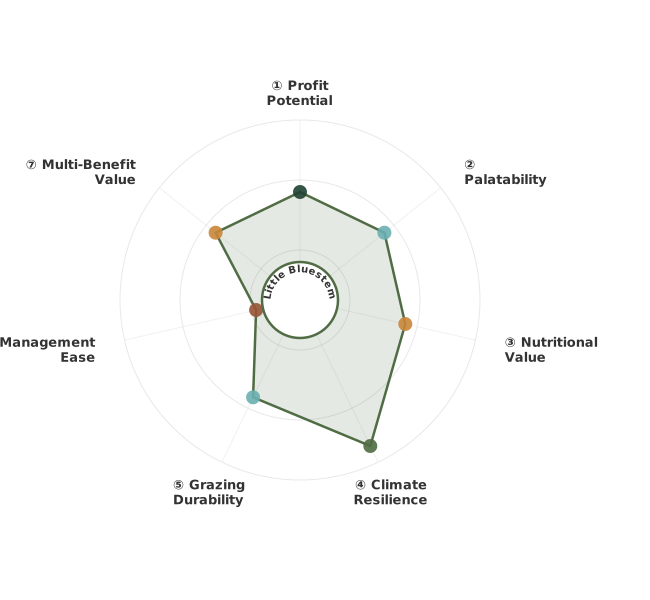
How These Traits Are Calculated
Trait dimensions are ordered clockwise starting from the top of the chart (12 o'clock position):
1. Profit Potential
Economic returns from hay sales, grazing value, and system contributions
WHAT: Synthesizes direct revenue potential (hay sales or grazing service value) with system contributions (nitrogen fixation, reduced supplement needs) into net economic value. Captures both cash income and cost savings.
WHY: Forage profitability comes from two sources—direct sales (hay, haylage) or indirect value (grazing services supporting livestock production). High-value forages provide $300-600/acre in combined revenue and savings versus $100-200/acre for lower-value options. This determines whether forage enterprises are viable versus purchasing feed.
HOW: Scored via LLM synthesis of economics data (hay yields, prices, grazing value), timeline considerations (establishment costs, productive lifespan), and system value (nitrogen contributions, supplement replacement). Exceptional (3.0): High yields with premium pricing or exceptional grazing value plus nitrogen fixation. Typical (2.0): Moderate returns. Limited (1.0): Low yields, commodity pricing, or minimal system contributions.
2. Palatability
Livestock preference and voluntary consumption rates
WHAT: Measures how eagerly livestock consume the forage—preference ranking when choices are available. Highly palatable forages are grazed first and completely; limited palatability means animals avoid unless no alternatives exist.
WHY: Palatability directly determines voluntary intake, which drives animal performance. High-palatability forages support faster weight gain and higher milk production because animals eat more. Low-palatability forages reduce performance and waste productive potential—animals selectively graze preferred species and leave unpalatable plants ungrazed.
HOW: Ratings based on the palatability trait documenting livestock selection preference. Exceptional (3.0): Preferentially selected, high sugar content, tender growth eagerly consumed (orchardgrass, white clover, ryegrass). Typical (2.0): Readily consumed when available. Limited (1.0): Avoided unless no other options (coarse stems, bitter compounds, low digestibility).
3. Nutritional Value
Protein content and forage quality for livestock growth and production
WHAT: Measures protein content as the primary indicator of forage nutritional quality. High-protein forages (>18%) support rapid growth and high milk production; low-protein forages (<12%) require supplementation for production animals.
WHY: Protein is the most expensive supplement in livestock diets ($0.40-0.60/lb). Forages with exceptional protein content eliminate or reduce supplement costs while supporting maximum animal performance. High-quality forage can save $200-400/cow/year in purchased feed versus low-protein options.
HOW: Ratings based on the protein_content trait. Exceptional (3.0): High protein (>18%) supporting rapid weight gain or high milk production (alfalfa, clovers, young grasses). Typical (2.0): Moderate protein (12-18%) for maintenance and moderate production (mature grasses). Limited (1.0): Low protein (<12%) requiring supplementation for production animals (mature warm-season grasses, low-fertility forages).
4. Climate Resilience
Weighted: drought tolerance (60%) + climate adaptability (40%)
WHAT: Combines drought tolerance (primary climate stressor for forages) with overall climate adaptability (temperature range, geographic flexibility). Resilient forages survive extended dry periods and diverse weather patterns.
WHY: Drought is the most common forage crisis—dry years can cut production 50-80% and force costly hay purchases or herd reductions. Drought-tolerant forages maintain productivity through dry spells, reducing feed costs and providing grazing when less-resilient options fail. Geographic adaptability allows forage systems to work across farm regions.
HOW: Weighted formula prioritizes drought tolerance (60% weight) as primary stressor, with climate adaptability (40% weight) for temperature and general flexibility. Exceptional (3.0): Survives extended drought (6+ weeks) with minimal production loss and works across diverse climates. Typical (2.0): Moderate drought and climate tolerance. Limited (1.0): Drought-sensitive or narrow climate requirements.
5. Grazing Durability
Weighted: trampling tolerance (70%) + seasonal availability (30%)
WHAT: Combines grazing tolerance (resistance to trampling and frequent defoliation) with seasonal availability (timing and duration of productive growth). Durable forages handle intensive rotational grazing and provide consistent seasonal production.
WHY: Grazing tolerance determines management system viability. Tolerant forages allow intensive rotational grazing or mob grazing for maximum animal performance and pasture health. Intolerant forages are hay-only or require long rest periods. Seasonal availability indicates production timing—year-round, seasonal gaps, or narrow windows.
HOW: Weighted formula prioritizes grazing tolerance (70% weight) for management system determination, with seasonal availability (30% weight) for production timing. Exceptional (3.0): Handles intensive rotational grazing with consistent seasonal production. Typical (2.0): Moderate tolerance and availability. Limited (1.0): Hay-only species or narrow seasonal production windows.
6. Management Ease
Weighted: establishment ease (50%) + low maintenance needs (50%)
WHAT: Combines establishment difficulty (germination, stand establishment) with ongoing maintenance requirements (fertility, weed control, renovation needs). Easy forages establish reliably and persist without intensive management.
WHY: Pasture establishment is expensive ($150-400/acre) and risky. Easy-to-establish forages reduce stand failure risk and provide quicker returns. Low-maintenance forages reduce annual input costs and labor, improving long-term profitability of grazing systems.
HOW: Weighted formula balances establishment ease (50% weight) for startup success and inverted maintenance intensity (50% weight) for ongoing care. Exceptional (3.0): Fast germination, reliable stand establishment, minimal fertility/weed management needs (white clover, orchardgrass). Typical (2.0): Moderate establishment and care requirements. Limited (1.0): Difficult establishment or intensive maintenance (heavy fertility, frequent renovation, weed competition).
7. Multi-Benefit Value
Ecosystem services beyond forage—nitrogen fixation, pollinator support, wildlife habitat
WHAT: Measures ecosystem services provided beyond livestock nutrition. Multi-benefit forages contribute nitrogen fixation (legumes), pollinator support (flowering species), wildlife habitat, soil building, erosion control, and biodiversity support.
WHY: Forage systems can either extract from farm ecosystems or contribute to them. Nitrogen-fixing legumes (clovers, alfalfa) provide $80-150/acre/year worth of fertility for companion grasses and following crops. Flowering forages support pollinators critical for fruit/vegetable crops. These service-stacking forages deliver total system value beyond livestock production.
HOW: Ratings based on the multi_benefit_value trait documenting service diversity. Exceptional (3.0): Multiple significant benefits (legumes fixing 80-150 lbs N/acre/year + pollinator support + wildlife forage). Typical (2.0): Some ecosystem contributions. Limited (1.0): Single-purpose forage with minimal ecosystem services beyond grazing value.
Ratings are based on documented performance in regenerative systems, not conventional high-input scenarios. All traits assume integrated management practices focused on soil health and ecosystem services.
5
Management & Care Requirements
Integration guidance, maintenance needs, and care practices
Management & Care Requirements
Integration guidance, maintenance needs, and care practices
How to Integrate This Plant
Little bluestem (Schizachyrium scoparium) is a valuable native warm-season grass that can be integrated into regenerative systems primarily as high-quality forage and for ecological uplift. Its roles include providing excellent forage for grazing livestock, improving soil health through its deep root system, and supporting wildlife. Compatible practices include mob grazing, where its resilience and nutritional quality can be leveraged through rotational or high-intensity grazing periods. It can also be part of native grass mixes for pasture renovation or ecological restoration projects. Establishment can be achieved through direct seeding, often on prepared land (Excerpts 1, 3). Value begins contributing in Year 1 with initial forage production, significantly increasing by Year 3-5 as the stand matures and root systems deepen, providing robust grazing and soil benefits. Long-term, it enhances soil structure, water infiltration, and provides habitat. Its multi-benefit stacking includes forage for livestock, significant carbon sequestration, pollinator support, and habitat for wildlife like bobwhite quail (Excerpt 5), contributing to a more resilient and diverse farm ecosystem.
Integration Practices & Management
Little bluestem (Schizachyrium scoparium) is integrated into regenerative systems primarily as a component of native warm-season grass mixes for grazing lands. Establishment often involves seeding in mixes with other native grasses like indiangrass and big bluestem, with specific rates mentioned for little bluestem ranging from 2 lbs/acre. While specific seeding depths and companion planting details are limited, one source notes seeding at a quarter-inch depth. Minimal tillage is implied in its establishment on former crop fields. Integration with grazing involves incorporating it into rotational systems, where it contributes to forage availability. The plant's resilience allows for grazing during both the growing and dormant seasons, with rest periods crucial for recovery and stockpiling regrowth. One case study noted that a medium-frequency rotation system, where little bluestem dominated, showed varied plant and microbial community compositions compared to continuous grazing. Termination strategies are not explicitly detailed for little bluestem itself, but general approaches for native grass mixes might include natural winterkill or management through grazing. Competition management is a consideration, as seen in the initial weed pressure during establishment. Specific fertility needs are not mentioned, but its native status suggests adaptation to local conditions. While its integration with cash crops is not detailed in these sources, its role in pasture and grazing systems is evident.
Management Profile
Maintenance Intensity: Ideally Suited - This resilient native prairie grass, adapted to naturally low fertility soils, requires minimal intervention after establishment due to its inherent drought tolerance and ecological integration.
Sources behind this view
 Videos & Podcasts
-
Improving soil health through practices like longer grazing rest periods and taller grazing encourages the natural emergence of diverse plant species, such as big bluestem, and increases mycorrhizal f

6
Economics & Value Streams
Direct harvest, system benefits, ecosystem services, and risk diversification
Economics & Value Streams
Direct harvest, system benefits, ecosystem services, and risk diversification
Comprehensive economic analysis including direct harvest value, system enhancement contributions, ecosystem services, value timeline, and risk diversification strategies.
Economics in Regenerative Systems
| Metric | Value |
|---|---|
| Seed Cost | $25-50/acre $61-123/ha |
| Establishment Cost | $200-350/acre $494-864/ha |
| Forage Yield | 2-4 tons/acre/year 2-4 tons/ha/year |
| Annual Management Cost | $50-100/acre $123-247/ha |
| Value/Sale Price | $70-130/ton $70-130/tonne |
| Net Annual Return* | $-310 to $270/acre/year |
Values represent typical ranges for regenerative agriculture contexts. Actual results vary by region, management, and market conditions. Costs exclude land and labor.
* Net Annual Return = (Yield × Market Price) − (Amortized Establishment Cost + Annual Maintenance). This return is realized only at/after first harvest; early years have costs but no revenue. Range shows worst case to best case scenarios.
System Enhancement Value
Beyond harvest: livestock nutrition, soil building, and pasture improvement
Livestock Nutrition & Soil Building
Little bluestem significantly contributes to soil health and remediation through its extensive and deep root system, which improves soil structure, aeration, and water infiltration. As a native warm-season grass, it provides valuable forage integration, as seen in Keith Tuck's experience and Tom Henslee's farm, offering substantial grazing days during summer months, thereby reducing reliance on hay feeding. Its role as a cover crop system helps suppress weeds, prevent nutrient runoff, and build soil organic matter. The resilience of native grasses like little bluestem, as highlighted in, makes them crucial for farm system robustness, enabling quick recovery after events like drought and wildfire. Furthermore, native grasses generally support a diverse insect and bird population, contributing to overall biodiversity and ecosystem services within the farm landscape.
Erosion Control
Variable, dependent on stand density and width. Can protect 3-5 acres per row with significant reduction in wind velocity and associated soil erosion.
While not explicitly mentioned as a windbreak, native grasses like little bluestem, due to their dense root systems and upright growth habit, can contribute to soil stabilization and reduce wind erosion. Establishing stands of little bluestem, particularly on sandy soils as referenced in, can create a vegetative barrier that slows wind speed at ground level. This protection is crucial for preventing topsoil loss, especially during dry periods or after disturbances. The dense root biomass helps bind soil particles, making them less susceptible to wind detachment. This windbreak effect indirectly benefits adjacent crops or pastures by reducing desiccating winds and improving microclimates. The resilience of these grasses, as noted in, to events like drought and wildfire further underscores their role in maintaining ground cover and protecting the soil from wind-driven erosion.
Ecosystem Service Contributions
Environmental contributions: carbon, pollinators, wildlife, and water
- Carbon Sequestration: Little bluestem, with its deep and extensive root system, is highly effective at sequestering atmospheric carbon into the soil. This perennial grass builds significant soil organic matter over time, contributing to long-term carbon storage.
- Pollinator Support: Medium. Little bluestem can provide habitat and forage for various native bees and other beneficial insects, particularly during its flowering and seed-head stages.
- Wildlife Habitat: High. Provides valuable nesting cover, forage for grazing animals (livestock and wildlife), and habitat for various ground-dwelling birds and small mammals.
- Water Quality: Not applicable
Value Timeline: Forage Establishment & Production
When you'll see results: annuals year 1, perennial establishment 1-2, peak 3-10
Years 1-2
Erosion control, initial soil structure improvement, early weed suppression, and the beginning of forage integration with limited grazing days.
Years 3-5
Established forage provision with significant grazing days during summer, substantial soil organic matter building, and improved water infiltration. Potential for early establishment of cover crop benefits.
Years 10-20
Mature, resilient stands providing consistent and high-quality summer forage, significant contributions to soil health and carbon sequestration, and robust habitat for wildlife.
20+ Years
Long-term soil health benefits, continuous ecosystem services including carbon storage and habitat provision, and a highly resilient component of the farm system with minimal input requirements.
Farm Risk Reduction
How this reduces farm risk: feed cost reduction and livestock performance
- Multiple Revenue Streams: Forage for livestock (grazing days), potential for seed production, soil health improvement leading to reduced input costs for other enterprises, and ecosystem services (carbon sequestration).
- Temporal Income Spread: Provides consistent summer forage, reducing the need for supplemental feed during peak heat and drought, while also contributing ongoing soil health and biodiversity benefits year-round.
- Market Risk Hedge: Reduces reliance on purchased feed (hay), offers drought tolerance compared to many conventional forages, and contributes to overall farm resilience, buffering against market volatility and environmental challenges.
Sources behind this view
 Research
-
Potential of Forages to Diversify Cropping Systems in the Northern Great Plains (opens in new window)
This study found: Forage crops in the Northern Great Plains can boost grain yields, improve soil health, and add nitrogen. They also offer environmental benefits like carbon storage but can impact soil moisture. Innova
8
Know the Debate
Little bluestem is a resilient native grass beneficial for regenerative grazing, particularly in warm-season pastures across USDA Zones 3-9. Its de...
Know the Debate
Little bluestem is a resilient native grass beneficial for regenerative grazing, particularly in warm-season pastures across USDA Zones 3-9. Its de...
Little bluestem is a resilient native grass beneficial for regenerative grazing, particularly in warm-season pastures across USDA Zones 3-9. Its deep roots enhance soil health and drought tolerance. While valuable for summer grazing, understanding establishment timelines and its role in carbon sequestration are key considerations. Performance can vary significantly based on regional climate, soil moisture, and management intensity. Costs are primarily associated with seeding and, in some cases, initial weed management or pasture renovation.
How much carbon does little bluestem sequester annually?
Modest gains (academic estimates)
Academic research often reports more conservative carbon sequestration rates for native grasses like little bluestem. These estimates vary due to measurement depth, methodology, and study duration, typically focusing on soil carbon changes over specific trial periods.
Sources behind this view
Sources behind this view
Research
-
Evaluating Performance of
<i>Bouteloua gracilis</i>
Cultivars After Drought: The Role of the Soil Microbiome (opens in new window)
This study found: A greenhouse study looked at two types of blue grama grass (Bouteloua gracilis), a native prairie grass, to see how they performed when planted with soil that had either experienced drought or not. The soil was collected from northeastern Colorado. The study found that both types of blue grama grew similarly and produced the same amount of plant material, regardless of whether the soil had a history of drought or not. The soil's microbial communities also didn't change much between the two grass types. This suggests that for these specific blue grama varieties, the past drought history of the soil doesn't seem to impact their growth or how they affect the soil microbes.
Significant gains (field observations)
Farmers and practitioners report substantial carbon sequestration from native grasses like little bluestem through deep root systems and improved soil health under managed grazing. These observations are often longer-term and consider the overall ecosystem impact, attributing gains to enhanced soil structure and reduced disturbance.
Sources behind this view
Sources behind this view
Videos & Podcasts
-
Recommends incorporating 25-35% warm-season grasses like big bluestem for summer grazing, which provides palatable forage and allows cool-season grasses like fescue to rest, while cautioning against over-reliance in winter.
-
Improving soil health through practices like longer grazing rest periods and taller grazing encourages the natural emergence of diverse plant species, such as big bluestem, and increases mycorrhizal fungi presence.
Making Sense of the Differences
Carbon sequestration estimates for little bluestem vary widely between academic research and field observations. Academic studies often provide conservative figures due to methodology and timescale, while practitioners report higher potential from integrated grazing systems. Actual sequestration likely depends on a combination of factors: soil type, regional climate (rainfall and temperature), grazing management (rest periods and intensity), and the time since establishment. Long-term, well-managed pastures on degraded soils may see more significant gains.
How long does it take to establish productive little bluestem pastures for grazing?
Establishment in 3-5 years for full productivity
Field reports suggest that while initial ground cover may appear within the first year, achieving full productivity for robust livestock grazing often requires 3 to 5 years of consistent management and favorable conditions.
Sources behind this view
Sources behind this view
Videos & Podcasts
-
Native C4 grasses (big bluestem, indiangrass, switchgrass) offer superior drought and heat tolerance due to deep roots and higher water use efficiency, improving soil health and extending grazing seasons. They are toxin-free, unlike fescue, and can produce higher yields and quality forage, though establishment requires careful management to control weeds and competition.
-
Big bluestem yield was half of last year, potentially due to dry conditions or 'lazy' root systems. Tilling is considered to stimulate seed production. Round-headed bush clover will also be harvested from the same field.

Establishment in 2-3 years with optimal conditions
Academic and extension knowledge suggests that with optimal conditions, including accurate seeding rates, sufficient moisture, and good weed control, productive stands can be achieved within 2-3 years. Early success depends on managing competition and ensuring good seed-to-soil contact.
Sources behind this view
Sources behind this view
Videos & Podcasts
-
Details the establishment of a native warm-season grass mix (big bluestem, indiangrass, little bluestem) in Blackstone, Virginia, using specific seeding rates, cover crops (cereal rye, barley), herbicides (glyphosate, Plateau, Duracore, Cimarron Plus), and timing (March 17th planting) for an 85% success rate in one year.
Research
-
Soil Quality and Region Influence Performance and Ranking of Switchgrass Genotypes (opens in new window)
This study found: This study looked at how different types of switchgrass (a grass used for bioenergy) performed in various locations across New Jersey, South Dakota, and Wisconsin. Researchers found that the region's climate and the soil's quality significantly affected which switchgrass varieties performed best and how they ranked. However, the amount of nitrogen fertilizer used had little effect on these differences. Varieties adapted to wetter, lowland areas were more sensitive to being grown in drier, upland environments. The findings suggest that if you're breeding switchgrass for marginal soils, your breeding sites should match those soil conditions. For lowland varieties, it's important to consider different climate zones and rainfall patterns. The study also recommends focusing on breeding switchgrass that can use nitrogen efficiently, scavenge it from the soil, and recycle it, rather than relying heavily on fertilizer.
Making Sense of the Differences
The timeline for establishing productive little bluestem pastures varies. While some field reports suggest 3-5 years for full productivity, academic and some field experiences indicate establishment within 2-3 years can be achieved with optimal conditions, including appropriate seeding, moisture, and weed control. Factors such as competition from existing grasses, drought, and grazing management during the establishment phase significantly influence how quickly the pasture reaches its full potential. Managing expectations and ensuring ideal conditions during the initial years are critical for timely establishment.