
Smooth Cordgrass
Spartina alterniflora, commonly known as smooth cordgrass, shows potential for carbon sequestration in coastal wetland restoration. Research indicates its biochar can significantly increase carbon accumulation, particularly in subtidal zones where anaerobic conditions may suppress microbial decomposition. While Spartina alterniflora can become invasive and requires management, studies are exploring its ecological role in coastal systems. Its plant tissues contain essential elements like carbon, nitrogen, phosphorus, and silicon, contributing to the ecological stoichiometry of salt marshes. The plant's impact on soil organic carbon has been studied in areas where it has been replaced by other species, suggesting its influence on soil carbon dynamics. Current knowledge base data does not extensively detail its direct use as a cover crop, forage, or in polyculture systems within typical regenerative farming. Further research is needed to understand its integration and benefits in broader regenerative agriculture practices beyond wetland carbon accumulation.
For a full botanical description see: Wikipedia(opens in new window) (external link)
Regenerative Quick Profile
All recommendations assume integrated, regenerative practices—not conventional inputs.
Climate & Soil Fit
Climate: Tropical Rainforest, Tropical Monsoon, Tropical Savanna, Hot Semi-Arid (Steppe), Humid Subtropical, Oceanic (Maritime Temperate), Hot-Summer Mediterranean, Warm-Summer Mediterranean, Monsoon-Influenced Humid Subtropical, Subtropical Highland, Hot-Summer Continental
Zones: USDA 4-10, Australian Zones 3-9
Optimal Soil: Clay Soil, Saline Soil, Wet Soil
System Role & Functions
Primary: Cash Crop With Services
Secondary: Soil Remediation, Specialty
Key Benefits: Climate adaptable, Easy establishment, Low maintenance
Management Level
Experience: Beginner-Friendly
Maintenance: Very low maintenance - This salt-tolerant marsh grass thrives in challenging coastal environments, naturally managing its needs without external water management or amendments, demonstrating high system integration.
Value Streams
- Cash crop production
Know the Debate
- Soil carbon impact debated: accumulation vs. variable results.
- Role varies: restoration tool vs. invasive species.
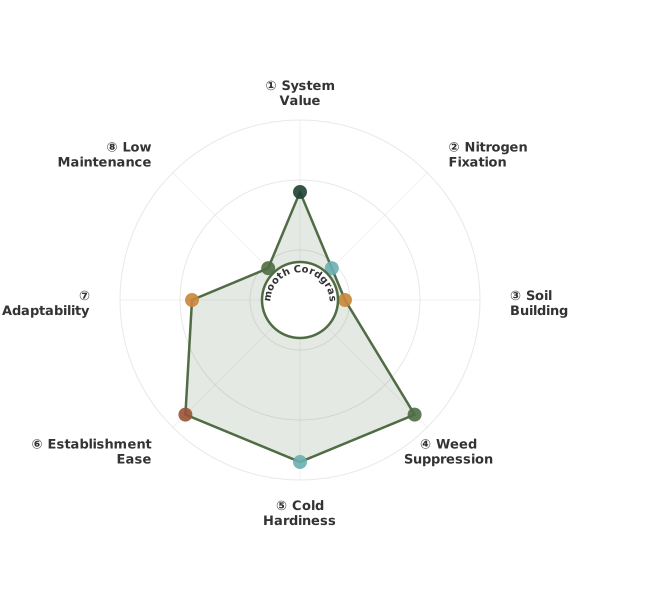
How These Traits Are Calculated
Trait dimensions are ordered clockwise starting from the top of the chart (12 o'clock position):
1. System Value
Ecosystem service stacking across nitrogen, carbon, water, biodiversity
WHAT: Synthesizes the compounding value of multiple ecosystem services delivered simultaneously—nitrogen fixation, soil organic matter building, pollinator support, erosion control, and water infiltration improvement. This is the total regenerative impact beyond single-function metrics.
WHY: The highest-value cover crops deliver 3-5 significant ecosystem services at once. A legume that fixes nitrogen, builds biomass, supports pollinators, and improves water infiltration provides $150-300/acre in combined benefits versus $30-60 for single-function covers. This service stacking is the core principle of regenerative agriculture.
HOW: Scored via LLM synthesis of economics data, timeline benefits, and trait combinations. Exceptional (3.0): 4-5 major services stacked with strong economic value ratios. Typical (2.0): 2-3 moderate services. Limited (1.0): Single-function covers with minimal service stacking. Considers seed cost relative to benefit value.
2. Nitrogen Fixation
Biological nitrogen production via legume root nodule bacteria
WHAT: Measures the ability to convert atmospheric nitrogen (N₂) into plant-available ammonia through symbiotic bacteria in root nodules. Legumes form partnerships with rhizobium bacteria that fix 60-150 lbs N/acre/year, reducing or eliminating synthetic fertilizer needs for following crops.
WHY: Nitrogen is the most expensive fertilizer input in crop production ($0.50-1.00/lb). Cover crops with exceptional nitrogen fixation can provide $60-150/acre worth of fertility while building soil organic matter. This biological process also reduces groundwater contamination from nitrogen runoff and lowers farm carbon footprint.
HOW: Ratings based on annual nitrogen fixation capacity and reliability across soil conditions. Exceptional (3.0): Legumes like hairy vetch, crimson clover, and field peas fixing >100 lbs N/acre/year. Typical (2.0): Moderate fixers like red clover at 60-100 lbs N/acre/year. Limited (1.0): Non-legumes (grasses, brassicas) with zero fixation capacity.
3. Soil Building
Weighted: biomass production (60%) + root system depth (40%)
WHAT: Combines above-ground biomass production with root depth to measure total soil organic matter contribution. Biomass provides surface organic matter, while deep roots deposit carbon at depth and break up compaction layers.
WHY: Soil organic matter is the foundation of regenerative agriculture, improving water retention, nutrient cycling, and biological activity. Each 1% increase in soil organic matter holds an additional 20,000 gallons of water per acre and represents $500-1,000 in fertility value. Deep roots access subsoil nutrients and create channels for water infiltration.
HOW: Weighted formula prioritizes biomass production (60% weight) for immediate organic matter contribution, with root depth (40% weight) for long-term soil structure. Exceptional (3.0): High-biomass crops with deep roots like cereal rye (8+ tons biomass, 5+ ft roots). Typical (2.0): Moderate on both factors. Limited (1.0): Low biomass or shallow roots.
4. Weed Suppression
Physical competition through rapid establishment and dense growth
WHAT: Measures the ability to outcompete weeds through rapid germination, aggressive early growth, and dense canopy formation. Physical smothering and light competition reduce weed pressure without herbicides.
WHY: Weed management is a major labor and cost burden for farmers. Cover crops that effectively suppress weeds reduce herbicide costs ($20-60/acre), decrease cultivation passes (fuel + labor), and provide clean seedbeds for cash crops. This is especially valuable in organic systems where herbicide options are limited.
HOW: Ratings based on germination speed, tillering density, and canopy closure timing. Exceptional (3.0): Fast-establishing, dense-tillering crops like cereal rye, oilseed radish that close canopy within 3-4 weeks. Typical (2.0): Moderate establishment and coverage. Limited (1.0): Slow-establishing or sparse crops that allow weed competition.
5. Cold Hardiness
Winter survival for fall planting and spring green manure value
WHAT: Measures tolerance to freezing temperatures and ability to survive winter conditions. Winter-hardy cover crops can be fall-planted, overwinter as living mulch, and provide early spring growth before cash crop planting.
WHY: Fall-planted winter-hardy covers extend the growing season into unused months, capturing solar energy and preventing erosion during wet periods. Spring green manure from overwintered covers provides early nitrogen and biomass. This timing flexibility is critical in cold climates with short growing seasons.
HOW: Ratings based on minimum survival temperature and winter active growth. Exceptional (3.0): Winter-hardy crops like cereal rye, hairy vetch, crimson clover surviving to -20°F with active growth in spring. Typical (2.0): Moderate cold tolerance. Limited (1.0): Warm-season crops like buckwheat, cowpea killed by first frost.
6. Establishment Ease
Germination speed, soil requirement flexibility, planting window breadth
WHAT: Measures how easily the cover crop establishes from seed, including germination speed, tolerance for variable soil conditions, and flexibility in planting timing. Easy establishment means reliable stands without intensive management.
WHY: Difficult-to-establish covers increase risk of stand failure, wasted seed costs, and reduced benefits. Easy establishment crops tolerate late planting, poor seedbed preparation, and variable moisture—critical when cover cropping windows are narrow between cash crops. Reliable establishment ensures consistent soil building and weed suppression benefits.
HOW: Ratings based on days to emergence, soil condition sensitivity, and planting window breadth. Exceptional (3.0): Fast germinators like buckwheat (3-5 days) and cereal rye (5-7 days) with wide planting windows. Typical (2.0): Moderate establishment requirements. Limited (1.0): Slow or finicky establishers requiring precise conditions.
7. Adaptability
Weighted: climate tolerance (60%) + multi-benefit versatility (40%)
WHAT: Combines climate adaptability (temperature and rainfall range) with multi-benefit versatility (diverse ecosystem services) to measure overall system flexibility. High adaptability means the cover works across farm regions and provides multiple functions.
WHY: Farmers need cover crops that work reliably across diverse fields and provide stacked benefits. Climate-adaptable covers reduce risk in variable weather, while multi-benefit crops deliver nitrogen fixation + pollinator support + forage value simultaneously. This versatility maximizes return on cover crop investment.
HOW: Weighted formula prioritizes climate tolerance (60% weight) for geographic reliability, with multi-benefit value (40% weight) for functional stacking. Exceptional (3.0): Wide climate range + multiple significant benefits. Typical (2.0): Moderate on both factors. Limited (1.0): Narrow climate range or single-function crops.
8. Low Maintenance
Inverted from maintenance intensity—low inputs mean high scores
WHAT: Measures minimal input requirements for successful cover cropping. Low-maintenance covers require no irrigation, minimal fertility, easy termination, and tolerate variable management timing.
WHY: Cover crops compete for resources with cash crops in tight rotations. Low-maintenance covers fit easily into existing systems without adding labor, equipment, or input costs. Easy termination is especially critical—covers that are difficult to kill can become weeds and delay cash crop planting.
HOW: Inverted score from maintenance intensity trait (4.0 minus raw score). Exceptional (3.0): Self-sufficient crops like cereal rye, field peas requiring no irrigation or fertility, easily terminated by mowing or winter-kill. Typical (2.0): Moderate input needs. Limited (1.0): High-maintenance crops needing irrigation, heavy fertility, or difficult termination (herbicides, multiple tillage passes).
Ratings are based on documented performance in regenerative systems, not conventional high-input scenarios. All traits assume integrated management practices focused on soil health and ecosystem services.
5
Management & Care Requirements
Integration guidance, maintenance needs, and care practices
Management & Care Requirements
Integration guidance, maintenance needs, and care practices
How to Integrate This Plant
Smooth cordgrass (Spartina Alterniflora) can be integrated into regenerative coastal systems primarily for its exceptional erosion control and carbon sequestration capabilities, particularly in intertidal and subtidal zones. It functions as a natural buffer against coastal erosion, stabilizing shorelines and preventing sediment loss, which is crucial for maintaining valuable agricultural land near the coast. Its dense root systems enhance soil organic carbon accumulation, as demonstrated by studies showing significant carbon sequestration in wetland soils (Excerpt 1). While not a direct food crop, its role in ecosystem health makes it a valuable component in a multi-benefit strategy. Compatible practices would include integrated coastal zone management and wetland restoration projects that aim to enhance ecosystem services. Its primary contribution is in the first few years, establishing robust root systems that immediately begin to protect shorelines and sequester carbon, with increasing benefits over time as biomass accumulates and soil health improves. The total system value lies in its ecological services, enhancing the resilience of adjacent agricultural lands by protecting them from erosion and sea-level rise, while contributing to carbon drawdown.
Integration Practices & Management
However, the literature does highlight its role in coastal wetland ecosystems and its potential for carbon accumulation. Spartina alterniflora biochar (SBC) has demonstrated efficacy in increasing carbon in subtidal zones, suggesting a use in soil amendment for carbon sequestration. One study focused on controlling invasive Spartina alterniflora using imazapyr, indicating a need for careful management in certain contexts, as the herbicide had long soil residual activity and affected microbial phyla. Another study examined the ecological stoichiometry of Spartina alterniflora alongside other marsh plants, analyzing its carbon, nitrogen, phosphorus, and silicon content. This suggests potential for nutrient cycling considerations when Spartina alterniflora is present or intentionally managed. Direct applications for regenerative agriculture practices such as seeding rates, grazing integration, termination strategies, or cash crop integration are not detailed in these specific excerpts. While coverage in our knowledge base is limited, the above represents documented uses in regenerative systems.
Management Profile
Maintenance Intensity: Ideally Suited - This salt-tolerant marsh grass thrives in challenging coastal environments, naturally managing its needs without external water management or amendments, demonstrating high system integration.
Sources behind this view
 Research
-
Effects of Spartina alterniflora Invasion on Soil Quality in Coastal Wetland of Beibu Gulf of South China. (opens in new window)
This study found: In South China wetlands, invasive Spartina alterniflora degraded soil in healthy native areas but improved soil in sparse/bare areas, increasing organic matter and microbial activity.
-
Interacting Effects of Plant Invasion, Climate, and Soils on Soil Organic Carbon Storage in Coastal Wetlands (opens in new window)
This study found: Invasive marsh grass (*Spartina alterniflora*) and temperature significantly impact coastal wetland soil carbon storage, interacting with soil salinity and texture. Deeper soil carbon storage increase
-
Effects of Spartina Alterniflora Invasion on Soil Organic Carbon Dynamics and Potential Sequestration Mechanisms in Coastal Wetlands, Eastern China (opens in new window)
This study found: Invasive marsh grass (Spartina alterniflora) in China's coastal wetlands doubled soil organic carbon in 8 years, driven by improved soil properties and enzyme activity, enhancing carbon storage.
-
<i>Spartina alterniflora</i> Invasion Alters Carbon Exchange and Soil Organic Carbon in Eastern Salt Marsh of China (opens in new window)
This study found: Invasive marsh grass (*Spartina alterniflora*) in China increased soil carbon storage and overall carbon uptake in coastal wetlands, potentially helping to mitigate climate change.
8
Know the Debate
Spartina alterniflora, or smooth cordgrass, presents a complex picture in regenerative agriculture, particularly for coastal and saline environment...
Know the Debate
Spartina alterniflora, or smooth cordgrass, presents a complex picture in regenerative agriculture, particularly for coastal and saline environment...
Spartina alterniflora, or smooth cordgrass, presents a complex picture in regenerative agriculture, particularly for coastal and saline environments. While its dense root systems and high biomass production are valuable for shoreline stabilization, erosion control, and building soil organic matter, its effectiveness and ecological impact can vary significantly by region. The presence of this species can lead to a notable increase in soil carbon accumulation in some contexts, but potential for invasive behavior in non-native areas adds a critical layer of consideration for its implementation.
How does Spartina Alterniflora affect soil carbon levels?
Potential carbon sink (wetlands)
Studies in Chinese wetlands suggest invasive Spartina alterniflora may increase soil carbon storage by improving soil structure and reducing decomposition rates, potentially aiding carbon sequestration in subtidal zones.
Sources behind this view
Sources behind this view
Research
-
Effects of Spartina alterniflora invasion on soil respiration in the Yangtze River estuary, China. (opens in new window)
This study found: In China's Yangtze River estuary, researchers studied how an invasive marsh grass, Spartina alterniflora, affected soil carbon. They found that while this invasive grass increased the amount of carbon dioxide released from the soil compared to native plants like common reed, it also produced significantly more plant growth and soil organic matter. The study suggests that the increased plant growth more than compensated for the extra carbon released from the soil, meaning these invaded areas might be storing more carbon overall, which could be important for managing climate change.
-
<i>Spartina alterniflora</i> Invasion Alters Carbon Exchange and Soil Organic Carbon in Eastern Salt Marsh of China (opens in new window)
This study found: Researchers in China studied how an invasive marsh grass, *Spartina alterniflora*, affects carbon cycling and soil carbon compared to native plants and bare mudflats. Over a year, they measured how much carbon the ecosystem took in and released. The invasive grass significantly boosted overall carbon uptake and release from the ecosystem, and increased the amount of carbon stored in the soil. While soil respiration (CO2 released from the soil) didn't change much, the invasive grass's growth patterns led to more carbon being stored underground, ultimately increasing soil organic carbon. This suggests the invasion could help store more carbon in these coastal areas, potentially mitigating climate change.
-
Habitat-specific responses of soil organic matter decomposition to Spartina alterniflora invasion along China's coast. (opens in new window)
This study found: This research examined how the invasive grass, smooth cordgrass (Spartina alterniflora), affects how quickly soil organic matter breaks down and how sensitive this breakdown is to temperature changes along China's coast. The study found that while soil organic matter generally breaks down slower in warmer areas, the presence of smooth cordgrass slowed this process even further. The impact of the grass on soil microbes and how they react to heat was strongest in middle-latitude saltmarshes. Warmer temperatures generally slowed down the breakdown, but the amount of dissolved carbon in the soil influenced how much this varied. Importantly, a greater variety of soil microbes seemed to make the breakdown less sensitive to temperature, which could help store more carbon in the soil. The invasive grass led to soil organic matter building up in saltmarshes but breaking down and being lost in mangrove areas. This suggests that the way soil microbes function and interact with climate and soil conditions is crucial for how soil carbon responds to invasive plants.
Variable carbon sequestration (complex impacts)
Research indicates that while Spartina alterniflora increases soil organic matter, its net effect on carbon sequestration is unclear and may be influenced by factors like soil salinity and decomposition rates, with some studies showing high variability in outcomes.
Sources behind this view
Sources behind this view
Research
-
Effects of Spartina alterniflora Invasion on Soil Quality in Coastal Wetland of Beibu Gulf of South China. (opens in new window)
This study found: In coastal wetlands of South China, the invasive plant Spartina alterniflora (cordgrass) had mixed effects on soil health depending on the existing vegetation. In areas with healthy native mangrove forests, the spread of Spartina led to a significant decrease in soil organic matter, phosphorus, and beneficial microbial activity. However, in areas with sparse native plants or bare ground, Spartina invasion actually improved soil quality by increasing organic matter, phosphorus, nitrogen, and the activity of soil enzymes. This suggests that while Spartina can degrade healthy native ecosystems, it can also help restore degraded or bare coastal lands. Management strategies should consider the existing native plant productivity.
-
Spartina alterniflora invasion alters soil microbial community composition and microbial respiration following invasion chronosequence in a coastal wetland of China. (opens in new window)
This study found: A study in a Chinese coastal wetland looked at how the invasive grass Spartina alterniflora changed soil microbes over 6 to 20 years compared to bare ground. The invasive grass significantly increased soil wetness, saltiness, and the amount of easily available carbon for microbes. It also boosted the total amount of soil microbes, including bacteria and fungi, and increased overall soil 'breathing' (microbial respiration). The most diverse and active microbial communities were found in soils invaded by the grass for about 10 years. This suggests that invasive Spartina alterniflora provides more food and alters soil conditions, leading to a larger and more active soil microbial population.
-
Interacting Effects of Plant Invasion, Climate, and Soils on Soil Organic Carbon Storage in Coastal Wetlands (opens in new window)
This study found: In coastal wetlands along the East China coast, researchers studied how invasive plants, climate, and soil conditions affect the amount of carbon stored in the soil. They found that the invasive marsh grass, *Spartina alterniflora*, directly increases soil carbon by producing more plant material. Temperature also plays a key role in how much carbon is stored, especially deeper in the soil. The study showed that the invasive grass, along with soil factors like saltiness, fine soil particles, and how compacted the soil is, work together to influence carbon storage. Over time, more of the stored carbon is found deeper in the soil rather than just in the top layer. This research emphasizes that managing invasive species and understanding climate impacts are crucial for maintaining carbon storage in these important coastal ecosystems.
Making Sense of the Differences
Spartina alterniflora's impact on soil carbon is debated, with wetland studies suggesting accumulation due to slower decomposition and biomass input, while broader agricultural contexts show variable results. The difference may stem from how 'carbon sequestration' is measured (total pool vs. net flux) and the specific environmental conditions, such as salinity levels and microbial activity influencing decomposition rates.
Is Spartina Alterniflora a beneficial native or an invasive threat?
Restoration asset (native range)
Studies indicate Spartina alterniflora exhibits high salt tolerance and can thrive in intertidal zones, suggesting its potential role in establishing resilient coastal plant communities and restoring degraded salt marshes.
Sources behind this view
Sources behind this view
 Videos & Podcasts
-
A pilot trial successfully demonstrated salt cooch propagation and replanting for salt marsh restoration. Key findings include no benefit from fertilizer, no difference in watering regimes, significant frost damage at infield sites, and higher success with dense planting and nursery-grown plants. The method achieved near 100% coverage within a year.
Research
-
From physiology to salt marsh management challenges with sea level rise: the case of native Spartina foliosa, invasive S. densiflora and their hybrid (opens in new window)
This study found: Researchers studied how three types of salt marsh grass in California respond to rising sea levels, which brings more salt and flooding. They found that the native grass, Spartina foliosa, can handle moderate salt but is sensitive to flooding. The invasive grass, Spartina densiflora, is very sensitive to salt, showing signs of stress like increased proline. The hybrid between the two grasses is highly tolerant to both salt and flooding, performing better than either parent in some conditions. By looking at a key plant enzyme (PEPC), scientists can predict how these plants will fare and help managers decide which species to protect, eradicate, or prioritize for removal in coastal areas facing climate change.
Ecological threat (introduced range)
In non-native regions like the Pacific Northwest, Spartina alterniflora is considered invasive, hybridizing with native Spartina species and leading to aggressive proliferation that displaces native flora and fauna, disrupting ecological balance.
Sources behind this view
Sources behind this view
Research
-
From physiology to salt marsh management challenges with sea level rise: the case of native Spartina foliosa, invasive S. densiflora and their hybrid (opens in new window)
This study found: Researchers studied how three types of salt marsh grass in California respond to rising sea levels, which brings more salt and flooding. They found that the native grass, Spartina foliosa, can handle moderate salt but is sensitive to flooding. The invasive grass, Spartina densiflora, is very sensitive to salt, showing signs of stress like increased proline. The hybrid between the two grasses is highly tolerant to both salt and flooding, performing better than either parent in some conditions. By looking at a key plant enzyme (PEPC), scientists can predict how these plants will fare and help managers decide which species to protect, eradicate, or prioritize for removal in coastal areas facing climate change.
-
Functional traits of macrobenthos substantially indicated habitat change from the invasive saltmarsh to introduced mangrove. (opens in new window)
This study found: A study in Southern China investigated how planting non-native mangrove trees (Sonneratia apetala) to replace an invasive grass (Spartina alterniflora) affected the small organisms living in the mud and sediment (macrobenthos). Researchers found that while the new mangroves helped remove the invasive grass, they created a different habitat compared to natural mangrove forests (Avicennia marina). The sediment composition changed, and the types of small organisms living there shifted. The introduced mangroves led to faster sediment buildup, altering how the macrobenthos used resources. The study concludes that using these introduced mangroves to replace invasive grasses is not a complete substitute for natural mangrove ecosystems in terms of supporting the diversity and function of macrobenthos. Careful planning is needed when managing coastal habitats.
Making Sense of the Differences
Spartina alterniflora's ecological impact varies by region: in its native range, it aids restoration and carbon sequestration by stabilizing shorelines. However, in introduced areas, it can outcompete native plants and hybridize, leading to invasive behavior that disrupts local ecosystems.
9
Learn More
Why farmers use this plant and additional resources
Learn More
Why farmers use this plant and additional resources
Why Regenerative Farmers Use This Plant
Spartina alterniflora is a foundational species for regenerative coastal agriculture and ecosystem restoration, offering unparalleled benefits for soil stabilization and ecosystem health. Its primary regenerative value lies in its exceptional ability to stabilize shorelines and build soil through sediment accretion. The dense, fibrous root system is exceptionally effective at binding sediments, preventing erosion in intertidal zones and along shorelines, and rebuilding marshland lost to sea-level rise or development. This natural engineering capability can significantly reduce infrastructure damage from wave action and storm surges, protecting valuable agricultural land adjacent to coastal areas from inundation and saltwater intrusion.
While not a nitrogen fixer, its vigorous growth and high biomass production contribute significantly to soil organic matter. Over time, the decomposition of its substantial above-ground and below-ground biomass enriches soil structure and fertility, creating a more resilient and productive agricultural landscape. Studies estimate that healthy marshes can sequester significant amounts of carbon, estimated at 10-20 tons of CO2 per acre per year, contributing to climate change mitigation. Furthermore, its vigorous growth produces substantial biomass, estimated at 5-15 tons of dry matter per acre annually, which decomposes to enrich the soil with organic matter and nutrients, creating a more resilient and fertile substrate. Its ability to thrive in brackish and saline conditions makes it ideal for marginal lands that are unsuitable for most conventional crops, turning unproductive areas into ecological assets.
Integrating Spartina alterniflora into coastal agricultural systems provides a robust natural buffer against the impacts of rising sea levels and increased storm intensity. It acts as a living buffer, protecting valuable farmland from storm surges and tidal erosion, thereby reducing the need for costly engineered sea defenses. Its presence can also help to filter pollutants and excess nutrients from runoff before they reach open water, improving water quality in adjacent waterways and preventing eutrophication of adjacent waterways. In areas transitioning from traditional agriculture to coastal restoration or aquaculture, Spartina alterniflora can be established as an initial step to improve soil health and create a more stable environment.
The ecosystem services provided by Spartina alterniflora are profound. Its root systems, which can extend 1-3 feet (0.3-1 meter) deep, are crucial for soil stabilization, preventing erosion by wave action and currents. The plant's high productivity ensures a continuous supply of organic material, which fuels the detrital food web essential for estuarine life. Studies have shown that healthy Spartina marshes can increase water infiltration rates by up to 50% compared to bare soil, reducing runoff and improving water quality. The plant also serves as a nursery ground for juvenile fish and invertebrates, supporting populations that are vital for both ecological balance and human livelihoods. Its dense stands provide critical habitat and food sources for a variety of commercially and ecologically important species, including shellfish and migratory birds, enhancing biodiversity and supporting local fisheries.
Sources behind this view
Research
-
Effects of Spartina alterniflora invasion on soil respiration in the Yangtze River estuary, China. (opens in new window)
This study found: Invasive marsh grass in China's Yangtze River estuary increased soil carbon storage despite higher soil CO2 release, suggesting it strengthens the wetland's carbon sink capacity.
-
Effects of Spartina alterniflora Invasion on Soil Quality in Coastal Wetland of Beibu Gulf of South China. (opens in new window)
This study found: In South China wetlands, invasive Spartina alterniflora degraded soil in healthy native areas but improved soil in sparse/bare areas, increasing organic matter and microbial activity.
-
Effects of Spartina alterniflora Invasion on Soil Organic Carbon Storage in the Beihai Coastal Wetlands of China (opens in new window)
This study found: Invasive marsh grass (<jats:italic>Spartina alterniflora</jats:italic>) in China's coastal wetlands significantly increased soil carbon storage by up to 90% over 26 years, influenced by soil propertie