
Managing Grazing Pressure
Managing grazing pressure means strategically controlling how long and how intensely livestock interact with pastures. It involves adjusting animal numbers, their duration on a given area, and the rest periods between grazings to align with plant growth cycles and soil health objectives. This practice ensures that pastures are not overgrazed, allowing plants to recover, build root systems, and sequester carbon, thereby enhancing soil health and ecosystem function.
Read More: Complete Description
Managing grazing pressure is a fundamental, context-dependent practice essential for regenerative agriculture. It goes beyond simply moving animals from one paddock to another; it is the deliberate manipulation of livestock density, time on-pasture, and rest periods to achieve specific ecological outcomes. At its core, it's about working with the natural growth dynamics of forages and the resilience of the soil ecosystem, rather than working against them. This practice is context-dependent because its regenerative application hinges entirely on how it's implemented and what ecological goals it serves. Extractive grazing, conversely, often involves continuous stocking at low densities, leading to selective overgrazing of preferred species, reduced plant diversity, soil compaction, and erosion.
When managed regeneratively, controlling grazing pressure directly supports multiple regenerative principles. It is instrumental in Integrat[ing] Livestock (Principle 5) as a tool for soil building. By carefully managing animal impact, land managers can judiciously deposit manure, stimulate plant growth through selective grazing (mimicking natural herbivory), and break up soil surface crusts. This prevents the negative impacts of overgrazing, such as excessive weed invasion and bare soil.
Crucially, regenerative grazing management heavily influences Maint[aining] Living Roots (Principle 4). When animals graze for short periods and then are moved, allowing adequate rest, perennial plants can regrow without depleting their root reserves. This continuous, or near-continuous, photosynthetic activity fuels soil biology, builds soil organic matter, and enhances nutrient cycling. Overgrazing, where animals are left too long on a pasture or return too soon, forces plants to regrow from root reserves, stunting root development and reducing overall plant health.
This practice also directly contributes to Keep[ing] Soil Covered (Principle 3). Well-managed grazing ensures that a sufficient amount of plant residue (litter) remains on the soil surface after grazing. This cover protects the soil from erosion by wind and water, moderates soil temperature and moisture fluctuations, and provides a habitat for soil microorganisms. Bare soil, a common consequence of overgrazing or extractive grazing, loses its protective cover, leading to rapid degradation.
While not directly related to tilling, judicious grazing management can indirectly support Minimiz[ing] Soil Disturbance (Principle 1). By preventing severe overgrazing and subsequent bare soil, regenerative grazing minimizes erosion, which is a form of soil disturbance. Furthermore, well-managed livestock can help incorporate organic matter into the soil surface in no-till systems, aiding in nutrient cycling without mechanical disruption.
Finally, managed grazing can significantly contribute to Maximiz[ing] Crop Diversity (Principle 2). By managing grazing intensity, land managers can favor certain desirable forage species, reduce the dominance of monocultures, and encourage the establishment of diverse plant communities. In silvopastoral systems, for example, livestock can be used to manage understory growth, promoting a healthy mix of grasses, forbs, and woody species. Over time, this leads to a more complex and resilient above-ground and below-ground ecosystem.
The transition to regenerative grazing pressure management involves a shift in mindset from simply feeding animals to managing an ecosystem. It requires understanding plant physiology, soil biology, and animal behavior. This transition may involve initial investments in fencing and water infrastructure to facilitate planned grazing systems such as rotational, mob, or adaptive multi-paddock grazing. The timeline for seeing significant soil health improvements can range from 1-3 years for visible changes in plant vigor and soil cover, to 5-10 years for more profound shifts in soil organic matter, water infiltration, and biodiversity, depending on the starting condition of the land and the consistency of management.
The core concept is to mimic natural grazing patterns where large herds move frequently across the landscape, grazing intensely for short periods, followed by long rest periods. This process stimulates plant growth, distributes manure evenly, and prevents the depletion of soil resources. The specific application varies widely across different climates and vegetation types, from the arid savannas of Africa managed by pastoralists, to the temperate grasslands of North America and Europe, to the tropical pastures of South America, and the mixed farming systems of Australia and Asia. Recognizing these regional differences is crucial for effective implementation.
Sources behind this view
Sources behind this view
 Videos & Podcasts
-
Regenerative grazing (adaptive multi-paddock) uses high-density, short-duration grazing with long recovery to stimulate soil health, increase biomass, and improve water infiltration, mimicking natural
-
Judy L's 'Grazing Management Principles' course covers grassland ecosystems, plant-soil-animal interactions, and practical methods like monitoring and planned grazing. It emphasizes universal principl
-
Seven grazing principles are detailed: maintain stocking below capacity, leave ample forage, allow full plant recovery, rest pastures, top graze, increase pasture numbers (30+), and use high stock den
-
Holistic management with cattle is key to improving soil health, water cycles, and carbon sequestration. Maximize animal impact (hooves, dung, urine) for diversity and plant growth, while breeding cat
 Community
-
Adopts a holistic grazing management approach emphasizing diverse perennial pastures, higher residuals (4"), and longer rest periods (avg. 45 days) to build soil health, increase organic matter (3.4%
Read more (opens in new window) smallfarms.cornell.edu -
Build healthy pasture soils by minimizing tillage, maintaining living roots and species diversity, and implementing proper grazing management. Livestock are essential for nutrient cycling and stimulat
Read more (opens in new window) smallfarms.cornell.edu -
Discusses regenerative grazing with cattle, sheep, and goats, emphasizing high-density impact and long recovery periods for soil health and ecosystem restoration in arid regions. Debates overgrazing,
Read more (opens in new window) permies.com -
Advocates for simpler regenerative methods based on Soil Foodweb and Holistic Management, emphasizing soil restructuring for water retention and reducing reliance on inputs like biochar. Promotes holi
Read more (opens in new window) permies.com
 Research
-
Managing Grazing to Restore Soil Health, Ecosystem Function, and Ecosystem Services (opens in new window)
This study found: Properly managed grazing animals can reverse environmental damage. Regenerative practices, like Adaptive Multi-Paddock (AMP) grazing, boost soil health, increase soil carbon, reduce erosion, and enhan
-
FORAGES AND PASTURES SYMPOSIUM: COVER CROPS IN LIVESTOCK PRODUCTION: WHOLE-SYSTEM APPROACH: Managing grazing to restore soil health and farm livelihoods1 (opens in new window)
This study found: Regenerative grazing management is key to sustainable, climate-resilient farms. It restores soil health, enhances ecosystem services like carbon capture and water infiltration, and improves farm profi
-
The Indigenous Roots of Regenerative Agriculture (opens in new window)
This study found: Modern regenerative agriculture practices are rooted in millennia of Indigenous land stewardship, offering profound knowledge and a crucial value system of respect and reciprocity for true transformat
-
Regenerative Agriculture: Restoring Ecosystems¢ Resilience and Productivity: A Review (opens in new window)
This study found: Regenerative agriculture builds soil health and ecosystem services through practices like no-till, cover crops, and diverse rotations. It increases soil organic matter, improves water infiltration, bo
 From the Web
-
Key principles for managing soil and forage include minimizing tillage, maintaining living roots, promoting species diversity, and practicing adaptive grazing. Specific grazing height recommendations
-
Six soil health principles (context, cover, minimize disturbance, diversity, living roots, integrate livestock) guide regenerative agriculture within four ecosystem processes (energy, water, nutrient
-
Adaptive grazing, emphasizing longer paddock rest periods, promotes pasture diversity and soil health. This leads to improved livestock nutrition, milk/meat quality, and extended grazing seasons, as d
-
A 10-step plan for regenerative grazing emphasizes adaptive management, goal setting, mapping, infrastructure assessment, and proper stocking rates. It advises starting small to gain experience before
Key Points
What It Is
- Strategic control of livestock impact on pasture
- Involves time on-pasture and rest periods
- Mimics natural herd movement patterns
- Essential for soil health and plant recovery
Why Do It
- Builds soil organic matter and structure
- Increases pasture biodiversity and resilience
- Enhances water infiltration and retention
- Supports Principle 5: Integrate Livestock
Know the Debate
- Regenerative grazing timelines vary significantly by climate and soil condition.
- Optimal stocking density depends on context, not a single prescribed number.
- Managers adapt grazing intensity to suit plant, soil, and animal needs.
- Early results visible in 1-3 years; deep soil change takes 5-10+ years.
Benefits - Financial
- Increases carrying capacity by 25-45% over 5-year establishment period.
- Reduces annual supplemental feed costs by 15-30% after year 3.
- Increases long-term land asset value by $600-1,200 per acre ($1,483–$2,965 per hectare).
Benefits - System
- Soil organic matter increase: 0.5-2.0% over decade
- Water infiltration improvement: 30-70%
- Erosion reduction: 70-90%
- Supports Principles 2, 3, 4, and 5
Risks - Financial
- Initial capital infrastructure investment ranges from $280-920 per acre ($692–$2,273 per hectare).
- Potential 10-20% reduction in stocking rates during 24-month transition.
- Management labor intensity increases annual operating costs by 15-30%.
Risks - System
- Overgrazing potential if management fails
- Risk of weed invasion without adequate rest
- Potential re-compaction if rest periods too short
- Requires adaptation to specific climate/soil
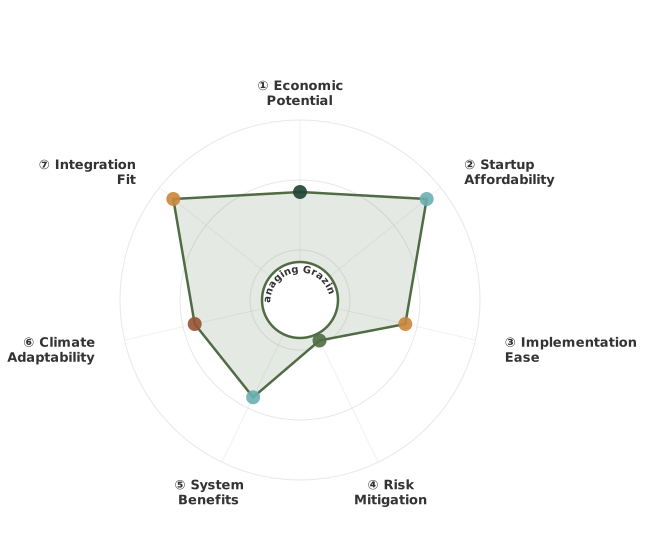
How These Traits Are Calculated
Trait dimensions are ordered clockwise starting from the top of the chart (12 o'clock position):
1. Economic Potential
Financial returns, annual value, and break-even timeline
WHAT: Evaluates financial viability by combining net annual value ($/ha from savings, income, and amortized harvests) with break-even timeline showing when practices pay for themselves.
WHY: Farmers need clear ROI understanding before committing resources. Fast payback (≤3 years) with strong returns (≥$300/ha) enables confident adoption, while long timelines (>10 years) restrict adoption to well-funded operations willing to wait for returns.
HOW: Calculated from net annual value in $/ha and break-even years. Exceptional (≥2.6): fast ROI ≤3 years + high value ≥$300/ha. Typical (1.8-2.5): moderate returns or longer timelines. Limited (<1.8): marginal economics or very long payback >10 years.
2. Startup Affordability
Initial investment costs and financial barrier to entry
WHAT: Measures financial barrier to entry through startup costs for equipment, infrastructure, consulting, and materials. Inverted scoring: lower costs = higher scores = more accessible adoption.
WHY: Affordability determines who can adopt. Low-cost practices (<$250/ha) enable widespread adoption across diverse scales, while high costs (>$2,500/ha) limit adoption to well-capitalized operations, creating barriers that slow regenerative transition.
HOW: Calculated from initial investment parsed from practice content. Inverted scoring: Exceptional (≥2.6): minimal investment <$250/ha. Typical (1.8-2.5): moderate costs $250-2,500/ha. Limited (<1.8): high barrier >$2,500/ha.
3. Implementation Ease
Learning curve and specialized knowledge required
WHAT: Measures how much learning, planning, and specialized knowledge a practice requires. Simpler practices with fewer steps score higher, while complex practices requiring extensive training or specialized resources score lower.
WHY: Complex practices create adoption barriers even when economically viable. Straightforward practices enable faster adoption and broader participation, while those requiring extensive training, timing precision, or specialized equipment limit who can succeed.
HOW: Evaluated by measuring documentation length and identifying complexity markers like location-specific requirements, seasonal timing windows, specialized skills, and dedicated equipment needs. Exceptional (≥2.6): straightforward practices with minimal prerequisites. Typical (1.8-2.5): moderate learning curve with some specialized needs. Limited (<1.8): steep learning curve requiring significant training or resources.
4. Risk Mitigation
Identified financial and ecological risk assessment
WHAT: Evaluates documented risks across financial (investment loss, market volatility) and ecological (crop failure, pest outbreaks) domains. Inverted scoring: fewer risks = higher scores.
WHY: Understanding risk exposure helps farmers make informed decisions. Low-risk practices allow confident implementation, while high-risk practices require careful planning and contingency resources. Risk transparency prevents costly failures.
HOW: Calculated from identified risks in practice content. Inverted scoring: Exceptional (≥2.6): ≤2 risks with manageable severity. Typical (1.8-2.5): 3-5 moderate risks. Limited (<1.8): 6+ risks or severe exposure.
5. System Benefits
How many ways the practice improves your land simultaneously
WHAT: Measures how many aspects of land health improve at once—carbon storage, soil quality, erosion control, water absorption, and biodiversity. Practices that improve multiple areas simultaneously create compounding benefits where each improvement reinforces the others.
WHY: The best practices solve multiple problems at once. For example, addressing erosion simultaneously builds carbon and improves water infiltration, creating a resilient system with positive feedback loops. Single-benefit approaches miss these compound transformation opportunities.
HOW: Evaluated across five key outcomes: carbon sequestration, soil organic matter increase, erosion reduction, water infiltration improvement, and biodiversity enhancement. Exceptional (≥2.6): high carbon storage (>8 t/ha/yr), improvements across 4-5 areas, transformative outcomes. Typical (1.8-2.5): moderate carbon (3-8 t/ha/yr), improvements across 2-3 areas. Limited (<1.8): modest impact (<3 t/ha/yr), single-area focus only.
6. Climate Adaptability
Geographic applicability across Köppen climate zones
WHAT: Evaluates geographic applicability by assessing how many Köppen climate zones successfully support a practice and what adaptation requirements are needed. Measures breadth of climates where farmers can implement with minimal to moderate modifications.
WHY: Universal practices working across diverse climates enable more farmers to adopt regenerative approaches. Practices limited to single climate types (only Mediterranean, only tropical) restrict adoption and slow global transition. Adaptability determines whether a practice serves niche regions or offers broad transformation.
HOW: LLM evaluation of regional success stories, Köppen zone coverage, and adaptation needs. Exceptional (≥2.6): 5+ zones or 4+ climate types, 3+ continents, minimal adaptation. Typical (1.8-2.5): 3-4 zones or 2-3 types, 2 continents, moderate adaptation. Limited (<1.8): 1-2 zones, single region, significant adaptation or highly specialized.
7. Integration Fit
How well this practice combines with others you're doing
WHAT: Measures how well a practice combines with other regenerative practices you might be doing. Some practices work as building blocks that make many other practices easier or more effective, while others work best on their own.
WHY: Practices that combine well with many others create more value on your farm. For example, cover cropping enables no-till, improves grazing, supports crop diversity, and helps water management—making all of them work better together. This helps you build a coherent system rather than juggling disconnected practices.
HOW: Evaluated by identifying which practices combine well and how strong those combinations are. 'Ideally Suited' means strong combinations where practices reinforce each other (practice A makes B easier, while B makes A more effective). 'Adequate' means complementary benefits that work well together. Exceptional (≥2.6): combines well with 6+ practices, serves as a building block. Typical (1.8-2.5): combines with 3-5 practices. Limited (<1.8): 1-2 practices or works best alone.
Going Deeper
1
WHY - The Benefits
Managing grazing pressure regeneratively is about orchestrating animal impact to foster a thriving ecosystem, not just produce animal products. The benefits are multifaceted, impacting soil health, economics, water cycles, carbon sequestration, and biodiversity. When...
Managing grazing pressure regeneratively is about orchestrating animal impact to foster a thriving ecosystem, not just produce animal products. The benefits are multifaceted, impacting soil health, economics, water cycles, carbon sequestration, and biodiversity. When implemented correctly, it transforms livestock from potential degraders into powerful tools for land regeneration.
WHY - The Benefits
Managing grazing pressure regeneratively is about orchestrating animal impact to foster a thriving ecosystem, not just produce animal products. The benefits are multifaceted, impacting soil health, economics, water cycles, carbon sequestration, and biodiversity. When...
Managing grazing pressure regeneratively is about orchestrating animal impact to foster a thriving ecosystem, not just produce animal products. The benefits are multifaceted, impacting soil health, economics, water cycles, carbon sequestration, and biodiversity. When implemented correctly, it transforms livestock from potential degraders into powerful tools for land regeneration.
Soil Health Benefits
The most profound impact of controlled grazing pressure is on soil health. Regenerative practices ensure plants are never grazed too short, allowing them to maintain adequate leaf area for photosynthesis and, critically, to maintain and regrow their root systems. This leads to increased Soil Organic Matter (SOM). Studies show well-managed perennial pastures can increase SOM by 0.5-2.0% over a decade, providing substantial benefits. Higher SOM improves soil structure, water-holding capacity, and nutrient availability.
Healthy root systems create Improved Soil Structure through their physical presence and the exudates they release, which feed soil microbes. This fosters the formation of stable soil aggregates, leading to better aeration and water infiltration. In degraded soils with low SOM and compaction, regenerative grazing can improve infiltration rates by 30-70% within 5-7 years, allowing rainfall to soak into the ground rather than running off as erosion.
Regenerative grazing directly combats erosion. By maintaining living plants and ground cover, it protects soil from the direct impact of rain and wind. Adequate rest periods allow plants to establish resilient swards. This protection can lead to a 70-90% reduction in erosion compared to overgrazed or bare land. The manure and urine deposited by livestock also act as natural fertilizers, improving soil fertility and reducing the need for external inputs.
The practice also revitalizes soil biology. A diverse and healthy plant community supports a rich and diverse soil microbial ecosystem. Earthworms, beneficial fungi (like mycorrhizae), and bacteria thrive in soils with continuous living roots, ample organic matter, and minimal disturbance (from compaction or bare patches). This biological activity is the engine of nutrient cycling and soil structure maintenance.
Economic Benefits
While often perceived as more labor-intensive or complex, managed grazing pressure can lead to significant economic advantages. One of the most immediate benefits is Increased Carrying Capacity. By improving pasture quality, species diversity, and resilience, properly managed lands can often support 20-50% more animal numbers over 5-7 years compared to their starting point, as reported by many farmers globally. This means more product (meat, milk, fiber) from the same land area.
Reduced Feed Input Costs are another major economic driver. Healthier pastures provide more nutritious forage, reducing the need for supplemental feeding, especially during the growing season. Over time, this can translate to 15-30% savings in feed costs by year 7. Improved animal health and weight gain are often direct consequences of better nutrition and reduced stress from heat or excessive standing to graze.
The Long-Term Land Value Appreciation can be substantial. Land that is actively regenerating its soil health, water cycles, and biodiversity becomes more productive, resilient, and valuable. This appreciation can be estimated at $500-2,000 per hectare (USD equivalent) over a decade, depending on the initial state and the rate of improvement.
Furthermore, regenerative grazing systems can provide Diversified Income Streams. For example, incorporating trees into pastures (silvopasture) introduces timber or nut revenues, while improved pasture health might support secondary enterprises like beekeeping or value-added processing of animal products.
Regenerative Systems Fit
Managed grazing pressure is a cornerstone of regenerative agriculture, directly supporting four of the five principles and indirectly influencing the fifth.
Principle 5 (Integrate Livestock): This practice is the embodiment of integrating livestock regeneratively. Instead of viewing animals as solely consumers, they are managed as key ecosystem engineers. Their grazing impact is a tool used to stimulate plant growth, cycle nutrients, and improve soil structure, all while producing valuable products.
Principle 4 (Maintain Living Roots): Adherence to rest periods after grazing is crucial for allowing plants to regrow and maintain their root systems. This continuous root activity fuels soil biology, sequesters carbon, and prevents the soil from becoming bare and vulnerable.
Principle 3 (Keep Soil Covered): Leaving adequate residual plant material after grazing ensures the soil surface is protected from the elements. This cover is vital for preventing erosion, conserving moisture, and supporting microbial life.
Principle 2 (Maximize Diversity): By managing grazing intensity, land managers can influence plant community composition. Strategic rest periods allow less competitive desirable species to recover and flourish, preventing monocultures and promoting a more biodiverse forage base. This diversity extends below ground, fostering a richer soil ecosystem.
Principle 1 (Minimize Soil Disturbance): While livestock hooves can cause compaction, regenerative grazing aims to minimize this by managing stocking density and duration, and critically, by ensuring adequate rest periods. This allows soil structure to recover and resist compaction. Preventing bare soil also halts wind and water erosion, a major form of disturbance on degraded landscapes.
Transitioning to regenerative grazing pressure management often involves a journey. For farms coming from continuous grazing, the initial stocking rates might need to be temporarily reduced by 10-20% to allow plants to recover and build root reserves. This ensures the land can handle higher densities later. Investments in fencing and water infrastructure are often necessary to implement planned grazing systems. The expected timeline for seeing significant improvements in pasture health and soil biology is typically 1-3 years, with more profound changes taking 5-10 years.
Water Cycle Benefits
Controlled grazing pressure enhances the entire water cycle. By improving soil structure and increasing SOM, soils become better able to absorb and retain water. This leads to Improved Water Infiltration, reducing surface runoff and erosion. In arid and semi-arid regions, this means more rainwater is captured for plant and animal use, and groundwater recharge is enhanced. In humid regions, it helps prevent waterlogging and nutrient leaching. Healthy forage cover also reduces evaporation from the soil surface, conserving soil moisture.
Carbon Sequestration
One of the significant co-benefits of healthy soil built through regenerative grazing is Carbon Sequestration. As plants photosynthesize, they pull carbon dioxide from the atmosphere. A significant portion of this carbon is transferred below ground through root exudates and decaying plant matter, building soil organic carbon. Well-managed perennial pastures can sequester 1-4 tonnes of carbon per hectare per year, contributing to climate change mitigation.
Biodiversity Benefits
Restored pastures with diverse plant communities and healthy soil become havens for biodiversity. This includes an increase in beneficial insects (pollinators, predators), birds, ground-dwelling wildlife, and, crucially, a boom in soil microbial diversity and abundance. This complex web of life supports a more resilient and productive ecosystem.
Sources behind this view
Videos & Podcasts
-
Regenerative grazing (adaptive multi-paddock) uses high-density, short-duration grazing with long recovery to stimulate soil health, increase biomass, and improve water infiltration, mimicking natural
-
Holistic management with cattle is key to improving soil health, water cycles, and carbon sequestration. Maximize animal impact (hooves, dung, urine) for diversity and plant growth, while breeding cat
-
Laura Payne details how managed grazing enhances soil health, water quality, and wildlife habitat, citing research on reduced erosion, improved stream health, and support for grassland birds. Key prin
-
Judy L's 'Grazing Management Principles' course covers grassland ecosystems, plant-soil-animal interactions, and practical methods like monitoring and planned grazing. It emphasizes universal principl
Community
-
Build healthy pasture soils by minimizing tillage, maintaining living roots and species diversity, and implementing proper grazing management. Livestock are essential for nutrient cycling and stimulat
Read more (opens in new window) smallfarms.cornell.edu -
Adopts a holistic grazing management approach emphasizing diverse perennial pastures, higher residuals (4"), and longer rest periods (avg. 45 days) to build soil health, increase organic matter (3.4%
Read more (opens in new window) smallfarms.cornell.edu -
Discusses regenerative grazing with cattle, sheep, and goats, emphasizing high-density impact and long recovery periods for soil health and ecosystem restoration in arid regions. Debates overgrazing,
Read more (opens in new window) permies.com -
Advocates for simpler regenerative methods based on Soil Foodweb and Holistic Management, emphasizing soil restructuring for water retention and reducing reliance on inputs like biochar. Promotes holi
Read more (opens in new window) permies.com
Research
-
Managing Grazing to Restore Soil Health, Ecosystem Function, and Ecosystem Services (opens in new window)
This study found: Properly managed grazing animals can reverse environmental damage. Regenerative practices, like Adaptive Multi-Paddock (AMP) grazing, boost soil health, increase soil carbon, reduce erosion, and enhan
-
FORAGES AND PASTURES SYMPOSIUM: COVER CROPS IN LIVESTOCK PRODUCTION: WHOLE-SYSTEM APPROACH: Managing grazing to restore soil health and farm livelihoods1 (opens in new window)
This study found: Regenerative grazing management is key to sustainable, climate-resilient farms. It restores soil health, enhances ecosystem services like carbon capture and water infiltration, and improves farm profi
-
Regenerative Livestock Farming as a Socioeconomic Model for Sustainable Agribusiness in Latin America (opens in new window)
This study found: Regenerative livestock farming in Latin America improved soil carbon, biodiversity, and water quality, while boosting farmer income and quality of life. Government support is key for wider adoption.
-
Regenerative Agriculture: Restoring Ecosystems¢ Resilience and Productivity: A Review (opens in new window)
This study found: Regenerative agriculture builds soil health and ecosystem services through practices like no-till, cover crops, and diverse rotations. It increases soil organic matter, improves water infiltration, bo
From the Web
-
Adaptive grazing, emphasizing longer paddock rest periods, promotes pasture diversity and soil health. This leads to improved livestock nutrition, milk/meat quality, and extended grazing seasons, as d
-
Key principles for managing soil and forage include minimizing tillage, maintaining living roots, promoting species diversity, and practicing adaptive grazing. Specific grazing height recommendations
-
Key regenerative agriculture methods include no-till farming, cover cropping, agroforestry, perennial crops, planned rotational grazing (Holistic Management), and compost application, all aimed at imp
-
Organic farming and rotational grazing are presented as solutions, enhancing soil health, sequestering carbon, and preventing erosion. Managed grazing boosts plant roots, improving soil fertility and
2
WHERE - Regional Considerations
The principles of managing grazing pressure are universal, but their application varies significantly with regional climate, topography, and vegetation types. Adapting strategies to local conditions is paramount for success.
The principles of managing grazing pressure are universal, but their application varies significantly with regional climate, topography, and vegetation types. Adapting strategies to local conditions is paramount for success.
WHERE - Regional Considerations
The principles of managing grazing pressure are universal, but their application varies significantly with regional climate, topography, and vegetation types. Adapting strategies to local conditions is paramount for success.
The principles of managing grazing pressure are universal, but their application varies significantly with regional climate, topography, and vegetation types. Adapting strategies to local conditions is paramount for success.
Click Here to Look up your Region if you don't already know it
Humid Temperate Regions
Representative Locations: Northeastern United States, most of Western Europe, northern China, Japan, southeastern Australia
Climate Context: Warm to hot summers and cool to cold winters, with moderate to high annual precipitation (75-150 cm or 30-60 inches) distributed relatively evenly throughout the year. USDA Zones 5-7, Köppen Cfb/Cfa.
Management Focus: In these regions, the primary challenge is often preventing overgrazing during the peak growing season and managing for adequate rest periods to prevent excessive weed growth and monoculture dominance. Maintaining year-round soil cover is crucial to prevent nutrient leaching during wet periods. Techniques like adaptive multi-paddock grazing, utilizing portable electric fencing to create numerous small paddocks for short grazing durations, are highly effective. The long growing seasons allow for substantial root development and organic matter accumulation, provided grazing is managed correctly. Animal performance can be high, but maintaining pasture quality requires vigilant monitoring and adjustment of stocking rates.
Mediterranean Regions
Representative Locations: California, the Mediterranean basin, central Chile, southwestern Australia, Western Cape, South Africa
Climate Context: Hot, dry summers and mild, wet winters. Annual precipitation is highly seasonal, ranging from 40-90 cm (15-35 inches). USDA Zones 8-10, Köppen Csa/Csb.
Management Focus: The critical factor here is managing grazing pressure during the short, intense wet growing season and planning for the long dry summer. Overgrazing during the wet season can severely damage perennial grasses and forbs, leading to soil degradation and increased erosion during the dry months. Strategies often involve utilizing rest periods during the dry summer to allow plants to recover and build root reserves, or strategic winter grazing to utilize growth and prevent damage from excessive wetness. Water availability is often a limiting factor, making efficient water harvesting and distribution through paddocks crucial. Drought-tolerant native species are favored. Livestock may need supplemental feeding during dry summer months.
Arid and Semi-Arid Regions
Representative Locations: Western USA, North Africa, Central Asia, the Sahel, Outback Australia
Climate Context: Low annual precipitation (<40 cm or 15 inches), high temperatures, short and often unpredictable growing seasons, with significant risk of drought. USDA Zones 7-9, Köppen BSh/BSk.
Management Focus: These fragile ecosystems demand extremely careful management to prevent desertification. The key is long rest periods, often multiple years, for perennial grasses and shrubs to recover from grazing impact. Stocking rates must be very conservative, and managers often need to supplement feed or move animals to different seasonal pastures. Adaptive multi-paddock grazing with very short grazing durations (hours to a few days) and extremely long rest periods (months to years) are essential. Water infrastructure is critical, as animals must be able to access water without overgrazing the surrounding area. Maintaining ground cover is paramount to prevent erosion and capture scarce rainfall. The focus is on plant survival and regeneration.
Cold Continental Regions
Representative Locations: Northern Great Plains (USA/Canada), Siberia, central Canada, northern Europe, parts of Argentina
Climate Context: Very short growing seasons, extreme summer heat, and severe winter cold (USDA Zones 3-5, Köppen Dfa/Dfb).
Management Focus: The challenge is maximizing grazing during the short, intense summer growth period. This often involves managed intensive grazing over a few months to stimulate growth while ensuring ample rest before winter. Winter management might involve grazing standing forage (deferred grazing) with minimal soil impact, or supplemental feeding. Animal performance can be highly seasonal. Planning for over-wintering and ensuring adequate plant residue to protect soil during harsh winters is critical. The risk of soil compaction from machinery on wet spring soils must also be managed proactively.
Subtropical Regions
Representative Locations: Southeastern USA, Southern China, Southern Brazil, Eastern Australia
Climate Context: Hot, humid summers and mild winters with generally ample rainfall. Köppen Cfa/Cwa.
Management Focus: Similar to humid temperate regions, the challenge is managing lush growth and preventing overgrazing. However, the longer growing season and higher humidity can increase disease pressure on forages and accelerate weed growth. Implementing rotational grazing with adequate rest periods is key to maintaining pasture quality and animal health. Strategies to improve drainage and reduce compaction may be necessary in areas with high rainfall and susceptible soil types. Heat stress management for livestock becomes a more significant consideration during hotter months.
Tropical Regions
Representative Locations: Central America, Southeast Asia, East Africa, Northern Australia, Northern South America
Climate Context: High temperatures year-round, with distinct wet and dry seasons or consistent high rainfall. Köppen Af/Am/Aw.
Management Focus: The critical factor is managing grazing pressure through the distinct wet and dry seasons. During wet seasons, intense growth necessitates quick pasture rotation to prevent senescence (aging and falling over of grass) and maintain nutritional value. Overgrazing during the dry season can be catastrophic for perennial pastures, leading to death and landscape degradation. Strategies often involve deferring grazing during the dry season on specific pastures to allow plants to recover, or utilizing drought-tolerant forages. Managing pasture species diversity to cope with varying rainfall and temperature is essential. Livestock often benefit from shade, making silvopasture an attractive option.
3
HOW - Implementation Process
Implementing managed grazing pressure for regenerative outcomes requires a systematic approach, moving from assessment to planning and execution. It's a journey of observation, adaptation, and continuous learning.
Implementing managed grazing pressure for regenerative outcomes requires a systematic approach, moving from assessment to planning and execution. It's a journey of observation, adaptation, and continuous learning.
HOW - Implementation Process
Implementing managed grazing pressure for regenerative outcomes requires a systematic approach, moving from assessment to planning and execution. It's a journey of observation, adaptation, and continuous learning.
Implementing managed grazing pressure for regenerative outcomes requires a systematic approach, moving from assessment to planning and execution. It's a journey of observation, adaptation, and continuous learning.
Prerequisites
- Understanding Goals: Clearly define what you want to achieve. Is it increased soil organic matter, improved water infiltration, enhanced biodiversity, higher animal performance, or a combination? This guides your management decisions.
- Land Assessment: Evaluate your current land condition. This includes:
- Soil Type & Health: Analyze soil organic matter, texture, structure, compaction, and pH. Look for signs of erosion, bare patches, and nutrient deficiencies.
- Vegetation: Identify dominant plant species (grasses, forbs, legumes, woody plants), their health, vigor, and presence of weeds. Understand the life cycles and palatability of key forage species.
- Water Resources: Map available watering points, their reliability, and capacity. Consider how water access influences animal distribution.
- Topography: Understand slope, aspect, and drainage patterns, as these affect plant growth, erosion risk, and animal movement.
- Animal Assessment: Know your livestock type, breed characteristics, nutritional needs, and current health status. Understand their grazing behavior.
- Resource Availability: Identify available labor, financial resources for infrastructure (fencing, water), and time commitment.
- Existing Management: Document current grazing practices, stocking rates, and their observed impacts on land health.
Phase 1: Planning the Grazing System
This phase involves designing the "how" based on your goals and assessment.
- Choose a Grazing Strategy: Select a planned grazing system that suits your context:
- Rotational Grazing: Animals move between paddocks, with each paddock receiving a rest period. Sub-types include:
- Static Rotational Grazing: Fixed number of paddocks managed cyclically.
- Adaptive Multi-Paddock (AMP) Grazing: Uses a large number of paddocks, allowing for very short grazing periods (hours to days) and very long rest periods (weeks to months). This is often considered the most regenerative.
- Strip Grazing: Portable electric fences create narrow strips, allowing fresh graze areas daily. Good for crop-like pastures.
- Mob Grazing: High-density short-duration grazing with a large mob of animals on a small area, followed by a long rest. This is intensive, promoting rapid soil stirring and manure distribution but requires careful management to avoid overgrazing.
- Browsing vs. Grazing: For woody areas or silvopasture, consider managing browsers (goats, sheep) to control woody encroachment or targeted grazing to manage specific plant species.
- Rotational Grazing: Animals move between paddocks, with each paddock receiving a rest period. Sub-types include:
- Paddock Design: Divide your land into paddocks based on your chosen strategy.
- Size: Paddock size should be determined by animal numbers and planned grazing duration. Shorter grazing periods require smaller paddocks.
- Water Access: Ensure each paddock has reliable access to water or a plan for moving water.
- Fencing: Plan for the type of fencing needed (permanent, temporary electric) to create these paddocks.
- Develop a Grazing Plan/Calendar: Sketch out your anticipated grazing sequence for the season. This is a living document; it will require adjustment based on actual plant growth and weather.
- Grazing Duration: How long will animals stay in each paddock? (Hours, days).
- Rest Period Length: How long will paddocks remain ungrazed? (Weeks, months, years). This is often the most critical variable for recovery.
- Stocking Density: How many animals per unit area during grazing? (High density for short periods is key in AMP/mob grazing).
- Infrastructure Planning: Identify and cost necessary infrastructure:
- Fencing: Permanent boundary fences, temporary internal electric fencing, corner posts, gate hardware.
- Water Systems: Troughs, tanks, pipelines, solar pumps, natural spring development, accessible water points within paddocks.
- Livestock Handling Equipment: Corrals, handling yards, loading ramps for efficient animal movement.
Phase 2: Infrastructure Development
This phase involves the practical implementation of your plan.
- Fencing Installation: Install permanent fences and establish a system for deploying temporary electric fencing to create paddocks. Consider polywire, step-in posts, energizers, and gate systems that are easy to move.
- Water System Development: Extend water reticulation to provide access in new paddocks. This might involve digging trenches for pipelines, installing troughs and float valves, or setting up portable tanks. Prioritize areas with highest grazing traffic or furthest from existing water.
- Access Roads/Trails: Where necessary, develop or maintain access paths for moving livestock and equipment without causing significant soil disturbance.
Phase 3: Implementation and Observation
This is the active management phase, requiring constant vigilance and adaptation.
- Move Animals According to Plan: Stick to your grazing plan as much as possible, moving animals to fresh paddocks to ensure short grazing durations and long rest periods.
- Observe and Monitor: This is the most critical part. Regularly assess:
- Plant Growth: Is forage growing back vigorously after rest? Are desired species thriving?
- Plant Recovery: Are plants regrowing from leaves/stems rather than root reserves? Is leaf area sufficient?
- Soil Conditions: Check for compaction, bare soil, evidence of erosion, and soil moisture. Digging soil pits can reveal root depth and structure.
- Livestock Performance: Monitor animal health, weight gain, and behavior.
- Water Availability: Ensure all animals have access to clean water.
- Adapt the Plan: Use your observations to adjust the grazing plan in real-time. If plants are recovering faster than anticipated, you might shorten rest periods slightly or increase stocking density. If recovery is slow, extend rest periods or reduce stocking rates. This adaptive approach is key to regenerative management.
- Record Keeping: Maintain detailed records of grazing dates, paddock rested, animal numbers, weather conditions, and observations. This data is invaluable for future planning and learning.
Transition Timeline & Phase-Out Strategy
For farms transitioning from continuous or poorly managed grazing, a phased approach is recommended:
- Years 1-2: Introducing Basic Rotation & Rest: Begin by dividing existing pastures into 4-6 larger paddocks and implementing a simple rotation with longer rest periods (e.g., 30-45 days). Focus on establishing a routine and becoming comfortable with moving animals. Observe plant recovery and soil condition changes.
- Years 3-5: Implementing AMP or Mob Grazing Principles: Gradually increase paddock numbers, reduce grazing duration, and extend rest periods. Invest in more fencing and water infrastructure. Focus on achieving full plant recovery between grazings. Monitor soil health metrics (SOM, infiltration) and animal performance.
- Years 5+: Refinement and Ecosystem Integration: Optimize grazing plans based on long-term monitoring data. Integrate other regenerative practices like cover cropping, silvopasture, or biochar. Aim for a dynamic grazing system that responds to seasonal variations and builds ecosystem resilience.
Phase-out considerations: The goal is not to "phase out" managed grazing but to refine it. The "phase-out" applies to extractive or damaging grazing practices. This means phasing out:
- Continuous stocking
- Overgrazing that leads to bare soil and erosion
- Excessive manure/urine concentration leading to plant killer patches
- Failure to provide adequate rest periods for plant recovery
- Use of heavy equipment on wet soils that cause compaction
These practices are phased out through the process of adopting and refining planned grazing systems. The timeline for this transition depends on the farm's starting point, resources, and commitment, but significant benefits can be observed within 3-5 years, with full regenerative potential realized over 7-10 years and beyond.
Sources behind this view
Videos & Podcasts
-
Seven grazing principles are detailed: maintain stocking below capacity, leave ample forage, allow full plant recovery, rest pastures, top graze, increase pasture numbers (30+), and use high stock den
-
Implement adaptive multi-paddock (AMP) grazing with short (1-3 day) grazing periods and long recovery (90-120+ days) to prevent overgrazing. Focus on plant recovery, soil health, and consistent livest

-
A 5-year case study in Mississippi transformed a degraded farm using adaptive grazing, bale grazing, and plant diversity. Soil organic matter, water infiltration, and forage species increased dramatic

-
Judy L's 'Grazing Management Principles' course covers grassland ecosystems, plant-soil-animal interactions, and practical methods like monitoring and planned grazing. It emphasizes universal principl
Community
-
Adopts a holistic grazing management approach emphasizing diverse perennial pastures, higher residuals (4"), and longer rest periods (avg. 45 days) to build soil health, increase organic matter (3.4%
Read more (opens in new window) smallfarms.cornell.edu -
Manage rotational grazing by setting recovery (15-40+ days, adapting to region/season) and grazing periods (2-3 days). Aim to 'take half, leave half' for livestock and soil microbes. High stocking den
Read more (opens in new window) smallfarms.cornell.edu -
Prescribed grazing is a controlled harvest of vegetation by animals to improve plant health, animal productivity, water quality, and soil conditions. Key components include resource inventory, balanci
Read more (pp. 1-2) (opens PDF, pp. 1-2) efotg.sc.egov.usda.gov -
Allan Savory explains holistic management prevents desertification by using livestock to mimic nature, replacing prescriptive grazing systems. Holistic Planned Grazing, with decisions guided by a holi
Read more (opens in new window) permies.com
Research
-
Managing Grazing to Restore Soil Health, Ecosystem Function, and Ecosystem Services (opens in new window)
This study found: Properly managed grazing animals can reverse environmental damage. Regenerative practices, like Adaptive Multi-Paddock (AMP) grazing, boost soil health, increase soil carbon, reduce erosion, and enhan
-
Impacts of holistic planned grazing with bison compared to continuous grazing with cattle in South Dakota shortgrass prairie (opens in new window)
This study found: Managed grazing with bison in South Dakota's shortgrass prairie significantly improved soil health, water infiltration, forage, and plant composition compared to continuous cattle grazing over a decad
-
The effect of Holistic Planned Grazing™ on African rangelands: a case study from Zimbabwe (opens in new window)
This study found: Holistic Planned Grazing™ in Zimbabwe improved rangeland health, soil, and vegetation with higher animal density. Temporary animal enclosures also boosted crop yields, suggesting HPG enhances ecosyste
-
Principles and guidelines for managing cattle grazing in the grazing lands of northern Australia: stocking rates, pasture resting, prescribed fire, paddock size and water points – a review (opens in new window)
This study found: Review of cattle grazing management in northern Australia: principles for stocking rates, pasture resting, prescribed fire, and fencing/water points to improve livestock production, economic returns,
From the Web
-
A 10-step plan for regenerative grazing emphasizes adaptive management, goal setting, mapping, infrastructure assessment, and proper stocking rates. It advises starting small to gain experience before
-
Grazing plans prioritize plant recovery to prevent overgrazing, mimicking bison herds. Key elements include goals, maps, infrastructure, forage data, stocking rates, and recovery periods, with plans a
-
This manual guides farmers through developing a grazing plan using a five-step process: goal setting, resource inventory, matching forage to animal needs, creating a schedule, and monitoring. It empha
-
This section details paddock setup, fencing, and water systems for rotational grazing. It provides seasonal adjustment guidelines for cool-season and warm-season grasses, emphasizing plant recovery pe
4
Know the Debate
Managing grazing pressure regeneratively shows remarkable results, but outcomes vary widely depending on where you are and how you start. In humid ...
Know the Debate
Managing grazing pressure regeneratively shows remarkable results, but outcomes vary widely depending on where you are and how you start. In humid ...
Managing grazing pressure regeneratively shows remarkable results, but outcomes vary widely depending on where you are and how you start. In humid regions with reliable rainfall and robust soils, plant and microbial responses can appear within 1-3 years. However, in semi-arid rangelands with degraded soils and shorter growing seasons, significant soil carbon accumulation might take five to ten years or longer, requiring immense patience and consistent management. Initial infrastructure costs for fencing and water can range from $500-2,700 per hectare, with higher costs for larger or more remote operations, and ongoing labor of 1-2 hours daily for paddock moves is typically required at any scale.
How long until regenerative grazing shows results?
Moderate gains in 2-5 years (Temperate/Humid)
Academic and continuous moderate grazing studies in temperate grasslands suggest noticeable soil health improvements and carbon gains within 2-5 years. This outcome is typical in regions with reliable rainfall and relatively healthy starting soils.
Sources behind this view
Sources behind this view
Research
-
A Global Meta‐Analysis of Grazing Impacts on Soil Health Indicators (opens in new window)
This study found: A large global study analyzing data from 64 different research sites found that how livestock graze significantly impacts soil health. Leaving land ungrazed generally resulted in better soil organic matter and nitrogen levels compared to continuous grazing. While both continuous and rotational grazing led to more soil compaction (higher bulk density) than no grazing, rotational grazing was less compacting than continuous grazing and showed similar soil organic carbon levels to ungrazed land. This suggests that managed grazing systems, like rotational grazing, can improve soil health and potentially help store carbon, offering benefits for climate change mitigation. The study also highlighted that local environmental conditions play a big role in how grazing affects soil.
-
Response of Grazing Land Soil Health to Management Strategies: A Summary Review (opens in new window)
This study found: This review looks at how different ways of managing pastures affect soil health, specifically how well water soaks in, how much carbon the soil stores, and how efficiently plants use nitrogen. Generally, good grazing practices like moderate, continuous grazing or planned rotational grazing with fewer animals per acre tend to improve these soil functions. Healthy, complete plant cover helps water penetrate the soil better, as does more soil carbon. Planting diverse, fast-growing forage species can boost carbon storage. However, overgrazing or incorrect fertilizer use can lead to carbon loss. Getting the right balance of manure and fertilizer, along with the correct number of animals, is key for plants to use nitrogen effectively. The best approach involves combining these practices based on the specific farm and climate to improve both soil health and overall farm productivity.
From the Web
-
Key principles for managing soil and forage include minimizing tillage, maintaining living roots, promoting species diversity, and practicing adaptive grazing. Specific grazing height recommendations are provided for different grass types to ensure plant recovery and soil health.
Significant improvement in 5-10+ years (Arid/Degraded)
Experienced regenerative graziers often report that substantial soil organic matter gains and visible ecosystem recovery in arid rangelands or heavily degraded soils take 5-10 years or more. This is due to slower plant growth and decomposition rates requiring longer rest periods.
Sources behind this view
Sources behind this view
Videos & Podcasts
-
Regenerative grazing (adaptive multi-paddock) uses high-density, short-duration grazing with long recovery to stimulate soil health, increase biomass, and improve water infiltration, mimicking natural systems.
-
Defines overgrazing and compaction, contrasting them with intensive rotational grazing that uses short, intense grazing periods followed by long recovery (now ~45 days) to build fertility, grow more grass, and increase diversity.
-
Seven grazing principles are detailed: maintain stocking below capacity, leave ample forage, allow full plant recovery, rest pastures, top graze, increase pasture numbers (30+), and use high stock density. Water infrastructure and monitoring soil health indicators (color, smell, organisms, Bricks values) are crucial for adaptive management.
Making Sense of the Differences
The timeline for regenerative grazing results depends on climate and starting soil condition. Humid, healthier soils show quicker plant and microbial responses (1-3 yrs). Arid, degraded lands need longer rest and slower processes for soil carbon build-up (5-10+ yrs). Farmers should plan for initial recovery and learning in the first few years before expecting profound soil changes.
What is the optimal stocking density and impact for regenerative grazing?
Moderate density grazing (2-5 animals/ha)
Academic research suggests moderate, continuous, or rotational grazing densities in temperate grasslands can optimize soil carbon storage by balancing plant growth and decay. This approach appears effective in regions with reliable rainfall and where maintaining consistent vegetative cover is key.
Sources behind this view
Sources behind this view
Research
-
Improved grazing management may increase soil carbon sequestration in temperate steppe (opens in new window)
This study found: This three-year study in a temperate grassland found that how you manage grazing livestock significantly impacts soil health and its ability to store carbon. Continuous moderate grazing led to the most root growth and decay, which built up the most soil carbon. While resting pastures at certain times (deferred grazing) stored less carbon, they resulted in more root mass, better plant diversity, and kept more nitrogen in the soil. Heavy, continuous grazing damaged plant growth, led to nitrogen loss, and reduced the carbon going into the soil. The research suggests that managing stocking rates to about 5 animals per hectare and aiming for around 40% of the grass to be eaten can maximize carbon storage. This shows that adjusting grazing practices can improve soil carbon sequestration in these grasslands.
-
Response of Grazing Land Soil Health to Management Strategies: A Summary Review (opens in new window)
This study found: This review looks at how different ways of managing pastures affect soil health, specifically how well water soaks in, how much carbon the soil stores, and how efficiently plants use nitrogen. Generally, good grazing practices like moderate, continuous grazing or planned rotational grazing with fewer animals per acre tend to improve these soil functions. Healthy, complete plant cover helps water penetrate the soil better, as does more soil carbon. Planting diverse, fast-growing forage species can boost carbon storage. However, overgrazing or incorrect fertilizer use can lead to carbon loss. Getting the right balance of manure and fertilizer, along with the correct number of animals, is key for plants to use nitrogen effectively. The best approach involves combining these practices based on the specific farm and climate to improve both soil health and overall farm productivity.
From the Web
-
Key principles for managing soil and forage include minimizing tillage, maintaining living roots, promoting species diversity, and practicing adaptive grazing. Specific grazing height recommendations are provided for different grass types to ensure plant recovery and soil health.
High density, short duration grazing (>200k lbs/acre)
Experienced regenerative graziers often advocate for very high stock densities for short periods to maximize hoof action, nutrient distribution, and soil stimulation, mimicking natural herd movements. This approach is frequently used in humid climates or where rapid plant recovery is possible.
Sources behind this view
Sources behind this view
Videos & Podcasts
-
Regenerative grazing (adaptive multi-paddock) uses high-density, short-duration grazing with long recovery to stimulate soil health, increase biomass, and improve water infiltration, mimicking natural systems.
-
Explains five regenerative grazing concepts: short graze periods and long rest periods to prevent overgrazing and the 'second bite'; animal impact (physical/biological); high stock density for even plant utilization and manure distribution; and soil armor. Mnemonic: GRASS.
-
Master grazing management by controlling graze period, rest period, stock density, and animal impact. Use fencing to manage these elements, maximizing plant utilization, improving manure distribution, and enhancing soil biology.
-
Key grazing concepts include short graze periods to prevent second bites, adequate rest for plant recovery, high stock density for manure distribution and plant utilization, and building soil armor. Animal impact, both physical and biological, is vital for grassland health and soil stimulation.
Making Sense of the Differences
Optimal stocking density depends on context: moderate densities may balance soil carbon and plant growth in many temperate systems. Very high densities promote hoof action and manure distribution, beneficial where rapid soil stimulation and intense nutrient cycling are goals, but require excellent plant recovery and careful rest management. Experienced managers adapt density based on forage growth, soil moisture, and desired plant response, not a single prescribed number.
5
HOW MUCH - Costs & Investment
Note: All costs are based on recent US economic data (2023-2025) and may vary substantially in other regions based on local labor rates, material costs, and regulatory requirements. International managers should research local pricing.
Note: All costs are based on recent US economic data (2023-2025) and may vary substantially in other regions based on local labor rates, material costs, and regulatory requirements. International managers should research local pricing.
HOW MUCH - Costs & Investment
Note: All costs are based on recent US economic data (2023-2025) and may vary substantially in other regions based on local labor rates, material costs, and regulatory requirements. International managers should research local pricing.
Note: All costs are based on recent US economic data (2023-2025) and may vary substantially in other regions based on local labor rates, material costs, and regulatory requirements. International managers should research local pricing.
Note: All costs provided are estimates based on 2024–2026 U.S. market conditions for agricultural fencing, water infrastructure, and labor. These figures represent comprehensive investment levels per acre and may vary substantially based on regional terrain, existing utility access, local labor rates (typically $30–$65 per hour for specialized fence installation), and whether the enterprise utilizes DIY installation or professional contractors.
Temporary Fencing Infrastructure
Temporary fencing serves as the primary tool for executing high-density, short-duration grazing. Costs are driven by the density of paddock subdivision required to meet specific soil health and forage recovery goals. For small farms (under 50 acres (20 ha)), the investment is $40 to $160 per acre ($99–$395/ha). This higher cost-per-acre is necessitated by the purchase of portable, high-tensile polywire reels, fiberglass tread-in posts, and solar-powered energizers, which inherently suffer from a lack of scale. Mid-size farms (50–500 acres (20–202 ha)) see costs decline to $30 to $120 per acre ($74–$297/ha), as economies of scale allow for the purchase of centralized high-output energizers that manage larger circuits. Large farms (over 500 acres (202 ha)) benefit significantly from bulk procurement of wire and materials, resulting in costs ranging from $20 to $100 per acre ($49–$247/ha). At this scale, the linear footage per acre drops as paddocks are designed with larger geometric layouts, reducing the total length of fencing required to manage each animal unit.
Permanent Division Fencing
While temporary fencing manages daily grazing, permanent interior perimeter fencing provides the structural backbone that allows for larger landscape-scale management. Small farms (under 50 acres (20 ha)) face higher costs of $200 to $600 per acre ($494–$1,483/ha) due to the intensive subdivision required to manage small, segmented zones. Mid-size farms (50–500 acres (20–202 ha)) typically use high-tensile, 4-strand electric layouts to create long-term corridors, resulting in costs from $160 to $480 per acre ($395–$1,186/ha). Large farms (over 500 acres (202 ha)) utilize bulk material pricing for posts, high-tensile wire, and heavy-duty tensioning systems, which reduces the per-acre cost to $120 to $400 per acre ($297–$988/ha). These systems are specifically designed to reduce long-term maintenance burdens, though they require a higher initial capital outlay compared to temporary systems.
Water Infrastructure
The reliability of water infrastructure defines the ceiling for grazing efficiency. Without water in every paddock, livestock will gravitate to fixed watering points, causing inconsistent grazing pressure. Small farms (under 50 acres (20 ha)) face costs of $80 to $320 per acre ($198–$791/ha), heavily weighted toward specialized quick-connect valves and high-flow portable troughs designed to move with the herd. Mid-size farms (50–500 acres (20–202 ha)) generally invest in permanent or semi-permanent poly-pipe mains with strategic risers that service multiple paddocks, costing $60 to $240 per acre ($148–$593/ha). Large farms (over 500 acres (202 ha)) focus their investment on solar-pump setups that draw from deep-well infrastructure or natural springs, lowering costs to $40 to $200 per acre ($99–$494/ha). This design minimizes dependence on electrical grid extensions, which is the single largest cost-driver in large-scale watering projects.
Most Spend: Most agricultural operations fall within the $280 to $920 per-acre range for total infrastructure deployment. This middle 60% covers the acquisition of a balanced system, including the necessary solar energizers, high-tensile permanent boundary wire, and a mobile, pressurized water delivery system.
Why the Range?: The primary drivers of cost variance are topography and existing utility access. Farms located on extremely steep, rocky, or heavily wooded terrain face significantly higher labor and hardware costs because fencing installation speed is reduced by as much as 40–50%. Conversely, farms with flat, accessible, and open pasture configurations can reduce installation costs by utilizing standardized, high-speed fence-laying equipment, directly lowering the overall capital burden.
Sources behind this view
Videos & Podcasts
-
Details the financial benefits of investing in fencing and water infrastructure for grazing, estimating costs ($175/acre) and returns (66% increase in carrying capacity). Discusses specific paddock de
-
Increase grazing frequency (e.g., twice daily) for better pasture utilization and animal performance. Invest heavily in water infrastructure and use temporary fencing in long, narrow paddocks to maxim
-
Improved grazing management boosts ranch economics through higher stocking rates, better cows-per-man ratios, extended grazing seasons, and reduced feeding costs. Strategic fencing and water developme
-
Details the practical implementation of intensive rotational grazing, including infrastructure (fencing, water points) and management strategies for large Australian properties. This approach signific
Community
-
Recommends permanent rotational pastures using high tensile fencing and cattle panels for goats and sheep, with advice on water lines, pallet-built shelters, and cost-effective handling systems.
Read more (opens in new window) permies.com -
Investigates financial benefits of rotational grazing, including extended grazing season and cattle weight gains, while detailing the use of portable electric fences and HDPE water hoses due to infras
Read more (opens in new window) ucanr.edu -
Implement rotational grazing with strong perimeter and interior fencing (high tensile electric recommended, focus on grounding) and reliable water systems, using resources like 'The Art and Science of
Read more (opens in new window) smallfarms.cornell.edu -
Grazing dairy heifers and cull cows reduces costs compared to confinement, with potential savings on feed, labor, and equipment. Producers can manage pastures themselves or use custom grazers, seeking
Read more (opens in new window) smallfarms.cornell.edu
Research
-
Increasing Intensity of Pasture Use with Dairy Cattle: An Economic Analysis (opens in new window)
This study found: Intensive grazing on Pennsylvania dairy farms was more profitable than hay/corn silage, returning $129/acre. High debt and poor cash flow motivated increased grazing intensity, which lowered feed cost
-
Pasture-Based Dairy Systems in Temperate Lowlands: Challenges and Opportunities for the Future (opens in new window)
This study found: Pasture-based dairy in temperate lowlands can improve efficiency and sustainability by using more legumes for nitrogen, extending grazing, and selecting robust cows. This reduces chemical inputs, lowe
-
Optimising intensive grazing: a comprehensive review of rotational grassland management, innovative grazing strategies and infrastructural requirements (opens in new window)
This study found: Intensive grazing requires good infrastructure. 24-36 hour pasture allocations reduce cow competition. Farm roadway quality and location are key for efficient movement, cow health, and labor efficienc
From the Web
-
Analyzes ROI for high stock density grazing, detailing infrastructure costs ($3,250 with grant), labor ($3600 estimate), and a 257% carrying capacity increase. Discusses scaling challenges and lists k
6
REWARDS AND RISKS - Economics & Risk Factors
Economic Scenarios
Economic Scenarios
REWARDS AND RISKS - Economics & Risk Factors
Economic Scenarios
Economic Scenarios
Managing grazing pressure is effectively a strategy to convert variable annual costs, such as hay and synthetic fertilizer, into long-term capital assets. Producers who successfully execute this strategy prioritize the biological recovery of the pasture, which pays dividends in reduced input dependency.
Economic Scenarios In a Best Case Scenario, the producer sees a net gain of $150 to $400 per acre ($371–$988/ha) annually by year three. This is achieved through a 45% increase in carrying capacity and a 30% reduction in supplemental hay and fertilization costs. Furthermore, long-term land asset value typically appreciates by $600 to $1,200 per acre ($1,483–$2,965/ha) due to documented improvements in soil organic matter and increased water-holding capacity.
In a Typical Case Scenario, the operation achieves a net gain of $50 to $150 per acre ($124–$371/ha) by year five. The farm realizes a 25% boost in stocking rate and a 15% decrease in annual feed expenses as extended grazing windows replace more expensive winter feeding practices. Amortizing infrastructure costs over seven years allows the operation to maintain a steady and reliable buffer against market-driven fluctuations in commodity feed prices.
In a Worst Case Scenario, the producer incurs a net loss of $100 to $300 per acre ($247–$741/ha). This typically results from overbuilding infrastructure relative to actual carrying capacity or failing to adjust stocking intensity to forage production rates. Without scientific rest periods, pastures degrade quickly, forcing the producer to purchase emergency hay. During peak winter cycles, emergency hay can cost $100 to $200 per head/month. If catastrophic management failure occurs, firms may be forced to destock during low-market cycle cycles, creating a significant loss of equity.
Transition Period Risks During the first 18 to 24 months, the transition to managed grazing often leads to a temporary productivity slump. As the ecosystem adjusts to new root system depths and soil biological life increases, above-ground biomass may temporarily decrease. Expect a 10-20% reduction in carrying capacity during this two-year window. Mitigation efforts include: 1. Staged Implementation: Transitioning only 30% of the land area annually to stabilize cash flow. 2. Strategic Destocking: Reducing herd size by 10% during the first two seasons to prevent overgrazing, which prioritizes the health of the soil over immediate animal performance. 3. Financial Cushioning: Retaining a line of credit equivalent to 15% of total annual feed costs to ensure liquidity during the establishment phase.
Market Factors and Risk Mitigation Profitability is explicitly linked to the farm’s ability to decouple from global commodity prices. Producers should allocate 5% of their annual operating budget for "contingency grazing," such as stored bale grazing or supplemental mineral blocks, to manage pastures during abnormally dry conditions. Forward-contracting for livestock is strongly advised, as it locks in pricing and shields the operation from the volatility inherent during the transition period.
Sources behind this view
Videos & Podcasts
-
This cluster details ultra-high stock density grazing (UHSDG) and 'total grazing' for cattle, emphasizing intensive management, long pasture recovery, and increased stocking rates. The speaker advocat
-
Laura Payne details how managed grazing enhances soil health, water quality, and wildlife habitat, citing research on reduced erosion, improved stream health, and support for grassland birds. Key prin
-
Adaptive grazing, emphasizing high stock density, flexibility, and frequent movement/rest, rapidly builds soil organic matter and microbial populations. A Mississippi case study showed dramatic improv

-
Holistic grazing, with high-density short grazing (2-3 days) and long rest periods (3-4 months), dramatically increases pasture diversity, eliminates pests like grasshoppers, and boosts livestock prod
Community
-
Adopts a holistic grazing management approach emphasizing diverse perennial pastures, higher residuals (4"), and longer rest periods (avg. 45 days) to build soil health, increase organic matter (3.4%
Read more (opens in new window) smallfarms.cornell.edu -
Manage rotational grazing by setting recovery (15-40+ days, adapting to region/season) and grazing periods (2-3 days). Aim to 'take half, leave half' for livestock and soil microbes. High stocking den
Read more (opens in new window) smallfarms.cornell.edu -
Discusses regenerative grazing with cattle, sheep, and goats, emphasizing high-density impact and long recovery periods for soil health and ecosystem restoration in arid regions. Debates overgrazing,
Read more (opens in new window) permies.com -
Allan Savory explains holistic management prevents desertification by using livestock to mimic nature, replacing prescriptive grazing systems. Holistic Planned Grazing, with decisions guided by a holi
Read more (opens in new window) permies.com
Research
-
Managing Grazing to Restore Soil Health, Ecosystem Function, and Ecosystem Services (opens in new window)
This study found: Properly managed grazing animals can reverse environmental damage. Regenerative practices, like Adaptive Multi-Paddock (AMP) grazing, boost soil health, increase soil carbon, reduce erosion, and enhan
-
Integrated crop and livestock systems increase both climate change adaptation and mitigation capacities. (opens in new window)
This study found: Combining crops with beef cattle grazing in Brazil boosted farm productivity and soil carbon over 18 years. Moderate grazing levels were best for resilience and climate change adaptation/mitigation.
-
A 100-Year Review: A century of change in temperate grazing dairy systems. (opens in new window)
This study found: Dairy grazing systems evolved over 100 years from random grazing to intensive, high-output systems driven by research, technology, and breeding. Managed grazing, better genetics, and supplementary fee
-
Regenerative Livestock Farming as a Socioeconomic Model for Sustainable Agribusiness in Latin America (opens in new window)
This study found: Regenerative livestock farming in Latin America improved soil carbon, biodiversity, and water quality, while boosting farmer income and quality of life. Government support is key for wider adoption.
From the Web
-
Dr. Allen Williams offers 10 tips for successful grazing: avoid early spring grazing, prepare for worst-case conditions, prevent overgrazing by managing plant exposure, utilize livestock for weed cont
-
Adaptive grazing, emphasizing longer paddock rest periods, promotes pasture diversity and soil health. This leads to improved livestock nutrition, milk/meat quality, and extended grazing seasons, as d
-
Key principles for managing soil and forage include minimizing tillage, maintaining living roots, promoting species diversity, and practicing adaptive grazing. Specific grazing height recommendations
-
This section details paddock setup, fencing, and water systems for rotational grazing. It provides seasonal adjustment guidelines for cool-season and warm-season grasses, emphasizing plant recovery pe
7
WHO - Labor & Expertise
Managing grazing pressure effectively requires a shift in focus from traditional animal husbandry to ecological management. While the core skills of animal handling remain, new competencies and a different mindset are essential.
Managing grazing pressure effectively requires a shift in focus from traditional animal husbandry to ecological management. While the core skills of animal handling remain, new competencies and a different mindset are essential.
WHO - Labor & Expertise
Managing grazing pressure effectively requires a shift in focus from traditional animal husbandry to ecological management. While the core skills of animal handling remain, new competencies and a different mindset are essential.
Managing grazing pressure effectively requires a shift in focus from traditional animal husbandry to ecological management. While the core skills of animal handling remain, new competencies and a different mindset are essential.
Skill Requirements
- Observation Skills: The ability to critically observe plant health, soil condition, animal behavior, and weather patterns is paramount. This involves understanding what "good" looks like for your specific environment and identifying early warning signs of stress or degradation.
- Planning and Adaptability: Creating grazing plans and calendars requires foresight and strategic thinking. However, the ability to adapt these plans based on real-time observations is equally critical. Regenerative grazing is not a rigid, one-size-fits-all formula but a dynamic process.
- Animal Handling: Efficient and low-stress movement of livestock is necessary for implementing short grazing periods and moving animals between paddocks. Familiarity with low-stress handling techniques is beneficial.
- Infrastructure Management: Understanding and maintaining fencing (especially electric fencing), water systems, and gates is crucial for the practical implementation of paddock systems.
- Basic Ecology & Botany: Understanding plant life cycles, growth responses to defoliation, key forage species, and the role of soil biology provides the foundation for informed decisions.
- Record Keeping: Developing a habit of consistent record-keeping (grazing dates, paddock rested, observation notes) is vital for learning, adaptation, and long-term trend analysis.
Labor Considerations
- Increased Daily Management: Compared to continuous grazing, planned grazing often requires more frequent animal movements and daily checks of fences and water. This can translate to 15-30% more time spent on direct animal and pasture management activities.
- Seasonal Focus: Labor demands can be higher during peak growing seasons when more frequent moves are needed, and during times of infrastructure setup or repair.
- "Planning Time" vs. "Doing Time": While daily "doing time" might increase, the overall time spent thinking about and planning grazing strategies can be more significant.
Expertise and Learning
- Formal Training: Workshops, courses, and certifications in planned grazing, holistic management, or adaptive multi-paddock grazing are highly beneficial. Organizations like the Savory Institute, Holistic Management International, and various extension services offer such training.
- Mentorship and Peer Learning: Connecting with experienced regenerative graziers can provide invaluable practical insights and troubleshooting support. Farmer-to-farmer learning is exceptionally effective.
- Local Context: Understanding your specific region's climate, plant communities, and soil types is vital. Generic advice needs to be adapted locally.
- On-Farm Trials: Implementing new strategies on a smaller scale initially allows for learning and adaptation with reduced risk.
International Labor Cost Context
- Regions with High Labor Costs: In North America and Western Europe, the increased time commitment may require hiring additional labor or investing in labor-saving infrastructure (e.g., automated water systems, robust permanent fencing). The economic justification for infrastructure is stronger.
- Regions with Lower Labor Costs: In parts of Africa, Asia, or South America, the increased time commitment may be more feasible for family labor. The focus might be on maximizing the use of existing infrastructure and labor for movement, with less emphasis on purely automated systems until scale or economics justify it. The cost of materials (fencing wire, pumps) can still be a significant barrier regardless of labor costs.
Sources behind this view
Videos & Podcasts
-
Laura Payne details how managed grazing enhances soil health, water quality, and wildlife habitat, citing research on reduced erosion, improved stream health, and support for grassland birds. Key prin
-
This cluster details ultra-high stock density grazing (UHSDG) and 'total grazing' for cattle, emphasizing intensive management, long pasture recovery, and increased stocking rates. The speaker advocat
-
Judy L's 'Grazing Management Principles' course covers grassland ecosystems, plant-soil-animal interactions, and practical methods like monitoring and planned grazing. It emphasizes universal principl
-
Holistic grazing, with high-density short grazing (2-3 days) and long rest periods (3-4 months), dramatically increases pasture diversity, eliminates pests like grasshoppers, and boosts livestock prod
Community
-
Adopts a holistic grazing management approach emphasizing diverse perennial pastures, higher residuals (4"), and longer rest periods (avg. 45 days) to build soil health, increase organic matter (3.4%
Read more (opens in new window) smallfarms.cornell.edu -
Manage rotational grazing by setting recovery (15-40+ days, adapting to region/season) and grazing periods (2-3 days). Aim to 'take half, leave half' for livestock and soil microbes. High stocking den
Read more (opens in new window) smallfarms.cornell.edu -
Allan Savory explains holistic management prevents desertification by using livestock to mimic nature, replacing prescriptive grazing systems. Holistic Planned Grazing, with decisions guided by a holi
Read more (opens in new window) permies.com -
Discusses regenerative grazing with cattle, sheep, and goats, emphasizing high-density impact and long recovery periods for soil health and ecosystem restoration in arid regions. Debates overgrazing,
Read more (opens in new window) permies.com
Research
-
Managing Grazing to Restore Soil Health, Ecosystem Function, and Ecosystem Services (opens in new window)
This study found: Properly managed grazing animals can reverse environmental damage. Regenerative practices, like Adaptive Multi-Paddock (AMP) grazing, boost soil health, increase soil carbon, reduce erosion, and enhan
-
A 100-Year Review: A century of change in temperate grazing dairy systems. (opens in new window)
This study found: Dairy grazing systems evolved over 100 years from random grazing to intensive, high-output systems driven by research, technology, and breeding. Managed grazing, better genetics, and supplementary fee
-
Regenerative Livestock Farming as a Socioeconomic Model for Sustainable Agribusiness in Latin America (opens in new window)
This study found: Regenerative livestock farming in Latin America improved soil carbon, biodiversity, and water quality, while boosting farmer income and quality of life. Government support is key for wider adoption.
-
Impacts of holistic planned grazing with bison compared to continuous grazing with cattle in South Dakota shortgrass prairie (opens in new window)
This study found: Managed grazing with bison in South Dakota's shortgrass prairie significantly improved soil health, water infiltration, forage, and plant composition compared to continuous cattle grazing over a decad
From the Web
-
Adaptive grazing, emphasizing longer paddock rest periods, promotes pasture diversity and soil health. This leads to improved livestock nutrition, milk/meat quality, and extended grazing seasons, as d
-
Key principles for managing soil and forage include minimizing tillage, maintaining living roots, promoting species diversity, and practicing adaptive grazing. Specific grazing height recommendations
-
A 10-step plan for regenerative grazing emphasizes adaptive management, goal setting, mapping, infrastructure assessment, and proper stocking rates. It advises starting small to gain experience before
-
This section details paddock setup, fencing, and water systems for rotational grazing. It provides seasonal adjustment guidelines for cool-season and warm-season grasses, emphasizing plant recovery pe
8
EQUIPMENT - Tools & Infrastructure
Successfully managing grazing pressure regeneratively often involves investing in infrastructure that facilitates animal movement, water access, and paddock management. The specific equipment depends on the scale of operation, chosen grazing system, and terrain.
Successfully managing grazing pressure regeneratively often involves investing in infrastructure that facilitates animal movement, water access, and paddock management. The specific equipment depends on the scale of operation, chosen grazing system, and terrain.
EQUIPMENT - Tools & Infrastructure
Successfully managing grazing pressure regeneratively often involves investing in infrastructure that facilitates animal movement, water access, and paddock management. The specific equipment depends on the scale of operation, chosen grazing system, and terrain.
Successfully managing grazing pressure regeneratively often involves investing in infrastructure that facilitates animal movement, water access, and paddock management. The specific equipment depends on the scale of operation, chosen grazing system, and terrain.
Fencing
-
Permanent Fencing: For primary paddock boundaries and areas requiring long-term division. Various materials are used:
- High-Tensile Wire: Durable, excellent conductivity for electric fencing.
- Barbed Wire: Traditional, but less effective for electrification and can injure animals.
- Woven Wire: Suitable for smaller livestock like sheep and goats, or for containing small predators.
- Posts: Steel T-posts, wooden posts, fiberglass posts.
-
Temporary Electric Fencing: The cornerstone for creating many small paddocks efficiently.
- Polywire/Polytapes/Polinets: Conductive strands for flexibility and visibility.
- Insulators: To attach wire to temporary posts and prevent grounding.
- Temporary Posts: Fiberglass or plastic step-in posts for quick deployment.
- Portable Electric Energizers: Battery-powered or solar-powered units for electrifying temporary fences.
- Gate Systems: Portable gate kits or simple wire loops for easy pasture access.
Water Systems
- Water Troughs & Tanks: Permanent concrete or poly tanks, portable plastic troughs. Size depends on animal numbers and watering frequency.
- Pipelines: Polyethylene or PVC pipes to transport water from source to paddocks.
-
Pumps:
- Centrifugal/Submersible Pumps: For wells or surface water, often powered by PTO, diesel, or electricity.
- Solar Pumps: Increasingly popular for remote locations where grid power is unavailable.
- Wind Pumps: Traditional and reliable in windy areas.
- Water-Powered Pumps (e.g., Ram Pumps): Use water flow to operate.
-
Hydrants & Valves: For easy connection of temporary water lines or filling troughs.
- Water Collection: Dams, ponds, rainwater harvesting tanks.
Animal Handling
- Portable Corrals/Panels: Easily assembled and disassembled for temporary containment, drafting, or weighing.
- Galleries/Chutes: For sorting, treating, or moving larger numbers of animals efficiently.
- Loading Ramps: For safely moving animals to and from transport.
Monitoring & Management Tools
- GPS Devices/Apps: For mapping paddocks, tracking animal location (if using electronic monitoring), and planning routes.
- Pasture Probes/Penetrometers: To assess soil compaction and health.
- Moisture Meters: To check soil moisture and inform grazing decisions.
- Drones: For aerial monitoring of pasture condition and animal distribution.
- Weather Monitoring Stations: To track rainfall, temperature, and wind, which influence plant growth and management decisions.
International Sourcing
- Many fencing and water system components are internationally manufactured and distributed. Local agricultural supply stores are the primary point of purchase.
- For specialized items like solar pumps or specific electric fencing components, online international suppliers or regional distributors may be necessary.
- Cost-effectiveness will vary greatly by region due to import duties, shipping costs, and local manufacturing. Prioritize durable, locally supported options where possible.
Sources behind this view
Videos & Podcasts
-
Increase grazing frequency (e.g., twice daily) for better pasture utilization and animal performance. Invest heavily in water infrastructure and use temporary fencing in long, narrow paddocks to maxim
-
This cluster details ultra-high stock density grazing (UHSDG) and 'total grazing' for cattle, emphasizing intensive management, long pasture recovery, and increased stocking rates. The speaker advocat
-
Key lessons for custom grazing: use a detailed grazing plan, rent equipment, invest in portable corrals and strong electric fence power. Cultivate relationships with customers, peers, family, and cons
-
Details the practical implementation of intensive rotational grazing, including infrastructure (fencing, water points) and management strategies for large Australian properties. This approach signific
Community
-
Practical rotational grazing advice for small acreage with goats, sheep, and chickens, emphasizing frequent moves, sacrificial paddocks, and specific forage types (fescue, rye, Bermuda) for Zone 8b. M
Read more (opens in new window) permies.com -
Adopts a holistic grazing management approach emphasizing diverse perennial pastures, higher residuals (4"), and longer rest periods (avg. 45 days) to build soil health, increase organic matter (3.4%
Read more (opens in new window) smallfarms.cornell.edu -
Details an integrated system of Managed Intensive Rotational Grazing and rotational cropping using holistic management. It emphasizes increasing forage availability, integrating livestock (cattle, chi
Read more (opens in new window) permies.com -
Manage rotational grazing by setting recovery (15-40+ days, adapting to region/season) and grazing periods (2-3 days). Aim to 'take half, leave half' for livestock and soil microbes. High stocking den
Read more (opens in new window) smallfarms.cornell.edu
Research
-
Review: Precision Livestock Farming technologies in pasture-based livestock systems. (opens in new window)
This study found: Smart farming tech (GPS, drones, virtual fencing) can improve livestock management on pasture for cattle, sheep, goats, pigs, and poultry, despite challenges like battery life and cost.
-
Precision Livestock Farming Applications (PLF) for Grazing Animals (opens in new window)
This study found: Precision Livestock Farming (PLF) uses sensors and software to monitor grazing animals, improving health and management. Adoption is limited by cost, tradition, and poor infrastructure, despite availa
-
Precision Tools for Forage Assessment and Nutritional Decision Support in Grazing-Ruminant Systems: A Narrative Review (opens in new window)
This study found: New precision tools can help manage grazing animal nutrition by assessing pasture quality, but face challenges in calibration, cost, and farm-level adoption for practical decision-making.
-
A 100-Year Review: A century of change in temperate grazing dairy systems. (opens in new window)
This study found: Dairy grazing systems evolved over 100 years from random grazing to intensive, high-output systems driven by research, technology, and breeding. Managed grazing, better genetics, and supplementary fee
9
COMPATIBLE PRACTICES - Integration Opportunities
Managing grazing pressure is rarely a standalone practice; its regenerative power is amplified when integrated with other land management strategies.
Managing grazing pressure is rarely a standalone practice; its regenerative power is amplified when integrated with other land management strategies.
COMPATIBLE PRACTICES - Integration Opportunities
Managing grazing pressure is rarely a standalone practice; its regenerative power is amplified when integrated with other land management strategies.
Managing grazing pressure is rarely a standalone practice; its regenerative power is amplified when integrated with other land management strategies.
- Rotational Grazing / Adaptive Multi-Paddock Grazing (⭐⭐⭐⭐⭐ Essential): This is the core methodology for implementing managed grazing pressure. The two are inseparable parts of the same system. Integration ensures adequate rests, controls animal impact, and promotes plant recovery.
- Cover Cropping (⭐⭐⭐⭐ High Synergy): In systems with annual cropping or long fallow periods, cover crops provide living roots and ground cover during dormant periods. Managed grazing can be used to graze cover crops, carefully controlled to benefit plant diversity and nutrient cycling without overgrazing.
- Silvopasture (⭐⭐⭐⭐ High Synergy): Integrating trees into pastures creates a multi-layered system where grazing pressure management is crucial. Livestock can be used to manage understory vegetation, clear invasive species, and distribute fertility, but their impact on young trees must be carefully controlled with fencing or strategic timing. Trees also provide shade, reducing livestock heat stress and potentially extending grazing into hotter periods.
- Holistic Planned Grazing (⭐⭐⭐⭐⭐ Essential): A specific framework for planning grazing that integrates animal and ecological goals, focusing on holistic decision-making and continuous monitoring.
- Keyline Design / Water Harvesting (⭐⭐⭐ Moderate Synergy): Implementing keyline plowing or other water harvesting earthworks can improve water distribution across pastures. Managed grazing can then ensure these improved water resources support more productive and resilient plant growth, preventing overgrazing in wetter areas.
- No-Till Farming (⭐⭐⭐⭐ High Synergy, for cropping interfaces): If land also incorporates cropping, preventing soil disturbance through no-till and using managed grazing on cover crops between cash crops can maintain soil health and build organic matter.
- Biochar and Compost Application (⭐⭐ Moderate Synergy): While not directly interacting with grazing, these soil amendments can accelerate soil health recovery, making pastures more resilient and potentially supporting higher stocking rates under managed grazing systems.
When integrated, these practices create a synergistic effect, enhancing soil health, biodiversity, and the overall resilience of the agricultural system. For farms transitioning toward regenerative systems, adopting managed grazing pressure as a foundational practice provides a strong starting point from which other practices can be layered over time.
Sources behind this view
Videos & Podcasts
-
Regenerative grazing (adaptive multi-paddock) uses high-density, short-duration grazing with long recovery to stimulate soil health, increase biomass, and improve water infiltration, mimicking natural
-
Laura Payne details how managed grazing enhances soil health, water quality, and wildlife habitat, citing research on reduced erosion, improved stream health, and support for grassland birds. Key prin
-
Holistic planned grazing (HPG), also called adaptive multi-paddock grazing, significantly improves soil carbon (3 tons/ha/yr more than continuous grazing), water infiltration, and ecological function
-
Holistic management with cattle is key to improving soil health, water cycles, and carbon sequestration. Maximize animal impact (hooves, dung, urine) for diversity and plant growth, while breeding cat
Community
-
Adopts a holistic grazing management approach emphasizing diverse perennial pastures, higher residuals (4"), and longer rest periods (avg. 45 days) to build soil health, increase organic matter (3.4%
Read more (opens in new window) smallfarms.cornell.edu -
Advocates for Soil Foodweb principles and Holistic Management, emphasizing land leasing and custom grazing/growing over labor-intensive methods. Focuses on soil restructuring for water availability an
Read more (opens in new window) permies.com -
Build healthy pasture soils by minimizing tillage, maintaining living roots and species diversity, and implementing proper grazing management. Livestock are essential for nutrient cycling and stimulat
Read more (opens in new window) smallfarms.cornell.edu -
Advocates for simpler regenerative methods based on Soil Foodweb and Holistic Management, emphasizing soil restructuring for water retention and reducing reliance on inputs like biochar. Promotes holi
Read more (opens in new window) permies.com
Research
-
Managing Grazing to Restore Soil Health, Ecosystem Function, and Ecosystem Services (opens in new window)
This study found: Properly managed grazing animals can reverse environmental damage. Regenerative practices, like Adaptive Multi-Paddock (AMP) grazing, boost soil health, increase soil carbon, reduce erosion, and enhan
-
FORAGES AND PASTURES SYMPOSIUM: COVER CROPS IN LIVESTOCK PRODUCTION: WHOLE-SYSTEM APPROACH: Managing grazing to restore soil health and farm livelihoods1 (opens in new window)
This study found: Regenerative grazing management is key to sustainable, climate-resilient farms. It restores soil health, enhances ecosystem services like carbon capture and water infiltration, and improves farm profi
-
The Indigenous Roots of Regenerative Agriculture (opens in new window)
This study found: Modern regenerative agriculture practices are rooted in millennia of Indigenous land stewardship, offering profound knowledge and a crucial value system of respect and reciprocity for true transformat
-
Impacts of holistic planned grazing with bison compared to continuous grazing with cattle in South Dakota shortgrass prairie (opens in new window)
This study found: Managed grazing with bison in South Dakota's shortgrass prairie significantly improved soil health, water infiltration, forage, and plant composition compared to continuous cattle grazing over a decad
From the Web
-
Key principles for managing soil and forage include minimizing tillage, maintaining living roots, promoting species diversity, and practicing adaptive grazing. Specific grazing height recommendations
-
Key regenerative agriculture methods include no-till farming, cover cropping, agroforestry, perennial crops, planned rotational grazing (Holistic Management), and compost application, all aimed at imp
-
Five steps to regenerative agriculture: Holistic Planned Grazing, no-till farming, planting diverse cover crops/interseeding, using compost/inoculants (with caution), and incorporating silvopasture/wo
-
Six soil health principles (context, cover, minimize disturbance, diversity, living roots, integrate livestock) guide regenerative agriculture within four ecosystem processes (energy, water, nutrient