
Ridge Tillage
Ridge tillage is a conservation tillage method where permanent ridges are formed for planting crops, with furrows between them left largely undisturbed. This concentrates most soil disturbance to the planting zone each season, preserving soil structure in the furrows. It aims to improve soil conditions for crop growth while reducing overall tillage compared to conventional methods.
Read More: Complete Description
Ridge tillage is a conservation tillage system that involves creating elevated planting beds, or ridges, on which crops are planted year after year. The furrows between these permanent ridges receive minimal disturbance, serving primarily as channels for water and residue management. Each season, tillage is concentrated in a narrow band (typically 15-30 cm or 6-12 inches wide) along the top of the existing ridge where the next crop's seedbed is prepared. This contrasts with conventional tillage, which typically involves plowing or disking the entire field annually.
The primary goal of ridge tillage is to create a favorable seedbed for crop establishment while minimizing soil disturbance and its associated negative impacts. By concentrating tillage in a small zone, it preserves soil structure, organic matter, and biological activity in the furrows and on the undisturbed sides of the ridges. This system can lead to improved soil aggregation, enhanced water infiltration, reduced erosion, and better soil aeration compared to moldboard plowing or extensive secondary tillage.
From a regenerative agriculture perspective, ridge tillage is best classified as a transition practice. While it significantly reduces overall soil disturbance compared to conventional tillage, it still violates Principle 1 – Minimize Soil Disturbance – by disturbing the planting zone. However, it can serve as a crucial stepping stone for farms transitioning from intensive tillage systems to full no-till. By gradually reducing the amount of land tilled each year and concentrating what tillage remains, farmers can begin to rebuild soil health without the immediate disruption of a full no-till conversion, which might be infeasible due to severe compaction or weed pressure.
The practice of ridge tillage, popularized in parts of North America from the 1970s onwards, aims to balance crop production needs with soil conservation. Farmers form ridges using specialized equipment, often in the fall after harvest or in the spring before planting. These ridges can be rebuilt or maintained annually. Crop residue from the previous season is typically moved aside from the planting zone on the ridge, or incorporated into the narrower tilled strip, while the majority of the residue remains in the furrows to protect the soil surface.
The benefits of ridge tillage are most pronounced in areas prone to soil erosion by water or wind, or in fields with moderate compaction. The undisturbed furrows help to slow runoff, trap sediment, and maintain soil structure, while the drier, warmer soil on the ridges can be advantageous for early planting in cooler climates. Water can infiltrate into the furrows and slowly move towards the crop roots on the ridge, improving water use efficiency. The raised planting zones can also help prevent waterlogging in poorly drained soils.
However, ridge tillage is not a panacea. It still involves annual disturbance of the soil surface in the form of tilling the planting zone. This disturbance, even if localized, can disrupt soil aggregates, harm mycorrhizal fungi networks, and expose soil organic matter to decomposition. Over time, if not managed carefully, this narrow strip of annual tillage can lead to a "plow pan" at the depth of cultivation, and the furrows, while less disturbed, are not completely untouched by machinery if not managed carefully. The overall goal for many regenerative farmers is to eventually transition from ridge tillage to full no-till systems, thereby completely eliminating annual soil disturbance.
The effectiveness of ridge tillage depends heavily on the specific soil type, climate, crop rotation, and management practices employed. In regions with very high rainfall and steep slopes, ridge tillage can be highly beneficial for erosion control. In drier climates, the raised beds can warm faster, promoting earlier growth, but may also increase surface water evaporation if furrows are not managed to conserve moisture. For farms looking to reduce tillage without an immediate jump to no-till, ridge tillage offers a pragmatic intermediate step.
Regenerative farmers who employ ridge tillage often do so with a clear exit strategy in mind. They use it to manage weed pressure or break up moderate compaction, while simultaneously implementing practices like diverse cover cropping and reduced synthetic inputs to rebuild soil biology. The objective is to make the land resilient enough that annual tillage becomes unnecessary, allowing the farm to graduate to a fully regenerative no-till system that maximizes soil health benefits. This highlights ridge tillage's role as a tool for progressive improvement, not an end in itself within a regenerative framework.
Sources behind this view
Sources behind this view
 Community
-
Conservation tillage systems, including no-till, strip-till, ridge-till, and mulch-till, aim to reduce erosion and conserve resources by maintaining at least 30% crop residue cover after planting.
Read more (pp. 2-3) (opens PDF, pp. 2-3) extension.cropsciences.illinois.edu
 Research
-
The Quantification of the Ecosystem Services of Forming Ridges in No-Tillage Farming in the Purple Soil Region of China: A Meta-Analysis (opens in new window)
This study found: No-till farming with ridges in China's purple soil regions significantly cut erosion and runoff, boosted soil nutrients (e.g., 15% SOC), improved soil moisture, and increased crop yields by up to 63%
-
Conventional, Minimum/Reduced, and Zero Tillage: Implications for Soil and Water Conservation and Residue Management in Global and Indian Contexts (opens in new window)
This study found: Zero tillage, especially with Happy Seeders, improves soil structure, water retention, and yields by up to 17% while cutting costs and emissions. Success depends on local adaptation and integrated wee
-
Responses of Soil Respiration and Organic Carbon to Straw Mulching and Ridge Tillage in Maize Field of a Triple Cropping System in the Hilly Region of Southwest China (opens in new window)
This study found: In Southwest China, raised beds and straw mulch on corn fields reduced soil CO2 release and increased carbon storage, acting as a carbon sink. Straw mulch also improved soil temperature sensitivity an
-
Effect of Mechanized Ridge Tillage with Rice-Rape Rotation on Paddy Soil Structure (opens in new window)
This study found: Mechanized ridge tillage in rice-rapeseed rotations improved paddy soil structure by increasing aggregate stability and altering pore size distribution, with narrow ridges showing the best results.
 From the Web
-
Ridge planting and ridge-till systems are explained for row crops, focusing on erosion control and managing wet soils. Key practices include maintaining 3-5 inch high ridges, using band herbicides, an
-
Ridge tillage uses permanent elevated rows and specialized planters for weed control and soil management. Key features include adjustable disk hillers and sweeps for cultivation, rebuilding ridges to
-
The ridge planting system, detailed by University of Nebraska–Lincoln Extension, improves weed control and soil moisture by planting into cultivated ridges that move weed seeds out of the row. It offe
-
Ridge planting enhances weed control by moving seeds out of the row, improves soil temperature for faster emergence, and preserves soil moisture by reducing preplant tillage, making it beneficial for
Key Points
What It Is
- Permanent ridges for planting, undisturbed furrows
- Concentrates tillage to narrow planting zone
- Redesigned from conventional tillage practices
- Less disturbance than conventional tillage
Why Do It
- Reduces overall soil disturbance
- Improves soil structure and water infiltration
- Controls erosion on slopes and flat land
- Transitional step towards no-till systems
Know the Debate
- Soil benefits range from 3 years to over 5 years.
- Suitability varies by soil type: best on moderate, worst on extreme.
- Costs $8k-$160k+ for equipment, $100-$350/ha annually.
- Transition to no-till typically takes 3-7 years.
Benefits - Financial
- Annual operational savings of $31.26–$62.52 per acre ($77–$154 per hectare) for typical systems.
- Yield stability in drought provides $83.36–$156.30 per acre ($206–$386 per hectare) buffer.
- Early planting capacity generates potential market premiums of $0.16–$0.42 per bushel.
Benefits - System
- Soil structure improvement: 10-20% over decade
- Erosion reduction: 50-75% decrease
- Water infiltration: 15-30% increase
- Supports 3 regenerative principles (cover, roots, diversity)
Risks - Financial
- Initial equipment investment ranges from $10,420 to $260,500+ per system.
- Transition year yield drags potential losses of $41.68–$72.94 per acre ($103–$180 per hectare).
- Component wear increases annual maintenance costs by 10%–20% versus conventional.
Risks - System
- Violates no-disturbance principle; annual tillage
- Can create "ridge-furrow plow pan" over time
- Requires careful management to maintain ridge integrity
- Effectiveness compromised if residue not managed well
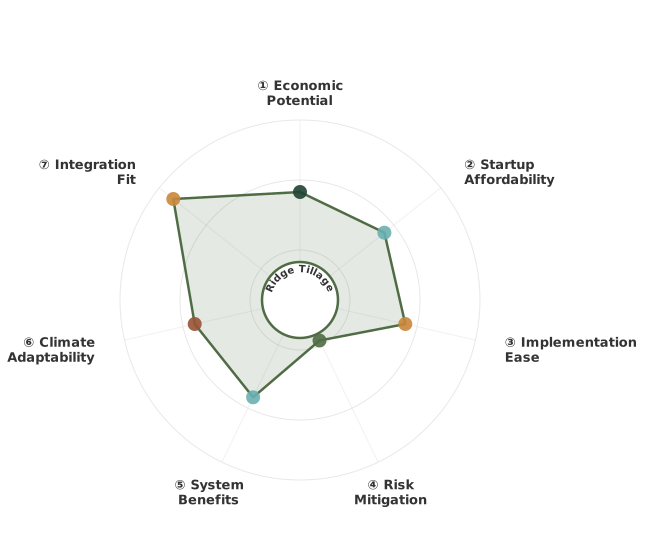
How These Traits Are Calculated
Trait dimensions are ordered clockwise starting from the top of the chart (12 o'clock position):
1. Economic Potential
Financial returns, annual value, and break-even timeline
WHAT: Evaluates financial viability by combining net annual value ($/ha from savings, income, and amortized harvests) with break-even timeline showing when practices pay for themselves.
WHY: Farmers need clear ROI understanding before committing resources. Fast payback (≤3 years) with strong returns (≥$300/ha) enables confident adoption, while long timelines (>10 years) restrict adoption to well-funded operations willing to wait for returns.
HOW: Calculated from net annual value in $/ha and break-even years. Exceptional (≥2.6): fast ROI ≤3 years + high value ≥$300/ha. Typical (1.8-2.5): moderate returns or longer timelines. Limited (<1.8): marginal economics or very long payback >10 years.
2. Startup Affordability
Initial investment costs and financial barrier to entry
WHAT: Measures financial barrier to entry through startup costs for equipment, infrastructure, consulting, and materials. Inverted scoring: lower costs = higher scores = more accessible adoption.
WHY: Affordability determines who can adopt. Low-cost practices (<$250/ha) enable widespread adoption across diverse scales, while high costs (>$2,500/ha) limit adoption to well-capitalized operations, creating barriers that slow regenerative transition.
HOW: Calculated from initial investment parsed from practice content. Inverted scoring: Exceptional (≥2.6): minimal investment <$250/ha. Typical (1.8-2.5): moderate costs $250-2,500/ha. Limited (<1.8): high barrier >$2,500/ha.
3. Implementation Ease
Learning curve and specialized knowledge required
WHAT: Measures how much learning, planning, and specialized knowledge a practice requires. Simpler practices with fewer steps score higher, while complex practices requiring extensive training or specialized resources score lower.
WHY: Complex practices create adoption barriers even when economically viable. Straightforward practices enable faster adoption and broader participation, while those requiring extensive training, timing precision, or specialized equipment limit who can succeed.
HOW: Evaluated by measuring documentation length and identifying complexity markers like location-specific requirements, seasonal timing windows, specialized skills, and dedicated equipment needs. Exceptional (≥2.6): straightforward practices with minimal prerequisites. Typical (1.8-2.5): moderate learning curve with some specialized needs. Limited (<1.8): steep learning curve requiring significant training or resources.
4. Risk Mitigation
Identified financial and ecological risk assessment
WHAT: Evaluates documented risks across financial (investment loss, market volatility) and ecological (crop failure, pest outbreaks) domains. Inverted scoring: fewer risks = higher scores.
WHY: Understanding risk exposure helps farmers make informed decisions. Low-risk practices allow confident implementation, while high-risk practices require careful planning and contingency resources. Risk transparency prevents costly failures.
HOW: Calculated from identified risks in practice content. Inverted scoring: Exceptional (≥2.6): ≤2 risks with manageable severity. Typical (1.8-2.5): 3-5 moderate risks. Limited (<1.8): 6+ risks or severe exposure.
5. System Benefits
How many ways the practice improves your land simultaneously
WHAT: Measures how many aspects of land health improve at once—carbon storage, soil quality, erosion control, water absorption, and biodiversity. Practices that improve multiple areas simultaneously create compounding benefits where each improvement reinforces the others.
WHY: The best practices solve multiple problems at once. For example, addressing erosion simultaneously builds carbon and improves water infiltration, creating a resilient system with positive feedback loops. Single-benefit approaches miss these compound transformation opportunities.
HOW: Evaluated across five key outcomes: carbon sequestration, soil organic matter increase, erosion reduction, water infiltration improvement, and biodiversity enhancement. Exceptional (≥2.6): high carbon storage (>8 t/ha/yr), improvements across 4-5 areas, transformative outcomes. Typical (1.8-2.5): moderate carbon (3-8 t/ha/yr), improvements across 2-3 areas. Limited (<1.8): modest impact (<3 t/ha/yr), single-area focus only.
6. Climate Adaptability
Geographic applicability across Köppen climate zones
WHAT: Evaluates geographic applicability by assessing how many Köppen climate zones successfully support a practice and what adaptation requirements are needed. Measures breadth of climates where farmers can implement with minimal to moderate modifications.
WHY: Universal practices working across diverse climates enable more farmers to adopt regenerative approaches. Practices limited to single climate types (only Mediterranean, only tropical) restrict adoption and slow global transition. Adaptability determines whether a practice serves niche regions or offers broad transformation.
HOW: LLM evaluation of regional success stories, Köppen zone coverage, and adaptation needs. Exceptional (≥2.6): 5+ zones or 4+ climate types, 3+ continents, minimal adaptation. Typical (1.8-2.5): 3-4 zones or 2-3 types, 2 continents, moderate adaptation. Limited (<1.8): 1-2 zones, single region, significant adaptation or highly specialized.
7. Integration Fit
How well this practice combines with others you're doing
WHAT: Measures how well a practice combines with other regenerative practices you might be doing. Some practices work as building blocks that make many other practices easier or more effective, while others work best on their own.
WHY: Practices that combine well with many others create more value on your farm. For example, cover cropping enables no-till, improves grazing, supports crop diversity, and helps water management—making all of them work better together. This helps you build a coherent system rather than juggling disconnected practices.
HOW: Evaluated by identifying which practices combine well and how strong those combinations are. 'Ideally Suited' means strong combinations where practices reinforce each other (practice A makes B easier, while B makes A more effective). 'Adequate' means complementary benefits that work well together. Exceptional (≥2.6): combines well with 6+ practices, serves as a building block. Typical (1.8-2.5): combines with 3-5 practices. Limited (<1.8): 1-2 practices or works best alone.
Going Deeper
1
WHY - The Benefits
Ridge tillage offers a range of benefits in soil health and economics, primarily by finding a middle ground between intensive conventional tillage and pure no-till systems. It provides immediate improvements in soil conservation and crop establishment conditions, serving...
Ridge tillage offers a range of benefits in soil health and economics, primarily by finding a middle ground between intensive conventional tillage and pure no-till systems. It provides immediate improvements in soil conservation and crop establishment conditions, serving...
WHY - The Benefits
Ridge tillage offers a range of benefits in soil health and economics, primarily by finding a middle ground between intensive conventional tillage and pure no-till systems. It provides immediate improvements in soil conservation and crop establishment conditions, serving...
Ridge tillage offers a range of benefits in soil health and economics, primarily by finding a middle ground between intensive conventional tillage and pure no-till systems. It provides immediate improvements in soil conservation and crop establishment conditions, serving...
Soil Health Benefits
Ridge tillage's main contribution to soil health is through reduced overall disturbance. By confining tillage to a narrow strip (15-30 cm or 6-12 inches wide) and leaving the furrows largely intact, it helps to preserve a relatively stable soil structure. This preserves macro- and micropore connections essential for water and air movement and supports soil biology.
Over time, this reduction in disturbance can lead to increased soil organic matter. The undisturbed areas in the furrows are less prone to rapid decomposition of organic matter exposed by tillage. This helps build soil carbon stocks and improves soil aggregation, leading to better soil tilth. Studies published in agricultural journals like Soil & Tillage Research have shown that ridge tillage can maintain or even increase soil organic matter levels in the top 5-10 cm (2-4 inches) compared to conventional plowing systems, especially when combined with residue management and cover cropping.
Water infiltration and retention are significantly enhanced. The undisturbed furrows act as natural channels that capture rainfall and snowmelt, reducing surface runoff and erosion. This allows more water to infiltrate the soil profile, making it available for crops during dry periods. The raised ridges warm up faster in the spring, facilitating earlier planting and potentially extending the growing season in cooler climates. This also means that water is less likely to be lost through surface evaporation from the tilled strip, as the majority of the soil surface remains covered by residue in the furrows. Research from North America and Europe indicates improved water retention by 10-20% in chronically tilled soils after several years of ridge tillage.
Erosion control is a major benefit of ridge tillage, particularly on sloping land. The permanent ridges, aligned with the contour, act as mini-terraces, intercepting downslope water flow and sediment. The residue left in the furrows further protects the soil surface from wind and water erosion. This has been quantified in studies showing 50-75% reduction in soil loss compared to conventional tillage. This reduction in erosion not only conserves topsoil but also prevents siltation of waterways, improving water quality.
Economic Benefits
The economic advantages of ridge tillage generally stem from reduced input costs and improved productivity over time. The most immediate financial benefit is the reduction in tillage operations. Rather than multiple passes with a plow, disk, and harrow across the entire field, ridge tillage typically involves one or two passes for ridge building and one pass for planting. This translates directly to savings in fuel, labor, and machinery wear and tear. Savings can range from $30-70 per hectare ($12-28 per acre) annually compared to conventional tillage.
Improved water management can lead to economic benefits by reducing the need for supplemental irrigation in water-limited environments. By capturing and holding more rainfall, ridge tillage systems can optimize water use efficiency, leading to cost savings on pumping and irrigation infrastructure. In regions with unpredictable rainfall or periodic droughts, this enhanced water availability can stabilize yields, reducing the risk of catastrophic crop losses.
Faster warming of the ridges can allow for earlier planting by 5-10 days in cooler climates. This can be a significant economic advantage, enabling farmers to access better market prices for early harvests or to plant crops that require a longer growing season. It also spreads out the workload, allowing farmers to begin fieldwork earlier in the spring.
While ridge tillage itself requires an initial investment in specialized equipment, the long-term savings in other inputs and the potential for yield stabilization and enhancement can offer a positive return on investment. Studies considering the entire system, including reduced erosion and improved soil health, suggest net economic gains can accrue over several years of implementation.
Regenerative Systems Fit
Ridge tillage is classified as a transition practice within regenerative agriculture, as it deliberately violates Principle 1 (Minimize Soil Disturbance) while aiming to enable other regenerative principles. It serves as a practical stepping stone for farms accustomed to conventional tillage, allowing them to gradually reduce disturbance and begin rebuilding soil health.
Principle 1 (Minimize Soil Disturbance): Ridge tillage directly addresses this by reducing the area and intensity of annual tillage compared to conventional systems. While the planting zone is disturbed annually, the furrows and ridge sides remain largely intact. This preserves some soil structure and biological activity for the majority of the soil surface. It is a compromise that acknowledges a complete jump to no-till may be too abrupt for some systems, and for some operations, it may represent a long-term, context-appropriate management strategy.
Principle 2 (Maximize Crop Diversity): Ridge tillage is compatible with crop diversity. It allows farmers to plant a wider range of crops, including those that benefit from warmer, drier seedbeds than might be available in a no-till system with heavy residue cover. This can include implementing 2-3 year rotations with diverse crops and cover crops, planted on the ridges. The diversity of root structures from these crops, even if only in the planting zone, contributes to soil health.
Principle 3 (Keep Soil Covered): Ridge tillage aids in keeping soil covered, particularly through residue management. By leaving significant amounts of crop residue in the furrows, the majority of the soil surface remains covered year-round, protecting against erosion and retaining moisture. When combined with cover crops planted on the ridges, soil coverage is maintained throughout the year.
Principle 4 (Maintain Living Roots): By enabling the planting of diverse crops and cover crops, ridge tillage supports the continuation of living roots in the soil for longer periods. While the annual tillage disturbs the immediate planting zone, the goal is to establish a rotation that maximizes the time living roots are present, feeding soil biology and maintaining soil structure.
Principle 5 (Integrate Livestock): Ridge tillage can be integrated with livestock operations, though direct grazing on the ridges requires careful management to avoid excessive compaction. However, livestock can graze cover crops grown on the ridges or in rotation, contributing to nutrient cycling and pasture improvement within the overall farm system.
Transition Pathway: Ridge tillage is instrumental in transitioning farms from conventional tillage to no-till. It offers a managed reduction in disturbance, allowing farmers to gain experience with reduced tillage systems, observe soil improvements, and adapt their equipment and management for future transitions. The typical timeline for phasing out ridge tillage and moving to full no-till is 3-7 years. During this period, farmers would focus on: 1. Increasing cover crop diversity: Introducing more species, especially those with strong root systems like daikon radish or forage turnips, to naturally break up remaining compaction in the planting zone. 2. Residue management: Developing systems to manage larger amounts of residue without interference from tillage, signaling readiness for no-till. 3. Weed seed bank reduction: Utilizing cover crop strategies to suppress perennial weeds, making a full no-till transition more manageable. 4. Equipment adaptation: Ensuring planters and drills can handle planting into undisturbed soil without requiring prior tilling of the ridge.
The ultimate goal is to reach a point where the soil has self-repaired enough—through biology, root action, and residue cover—that annual tillage in the planting zone is no longer necessary. Success looks like farmers confidently implementing profitable no-till crop rotations and managing weed pressure with integrated strategies rather than tillage.
Sources behind this view
 Videos & Podcasts
-
Farmers discuss no-till benefits (soil health, water retention, weed control) and challenges (labor intensity, initial cost). Strategies include tarping, mulching, cover cropping, and careful planning

-
Discusses weed management tactics in tillage and reduced tillage systems, emphasizing seed bank management, cover crop biomass for light suppression, delayed termination benefits, and adaptive use of
-
A Minnesota farmer details their successful transition to strip-tilling and no-till, highlighting significant improvements in soil health (organic matter, infiltration, earthworms), yield increases, p

Community
-
Conservation tillage systems, including no-till, strip-till, ridge-till, and mulch-till, aim to reduce erosion and conserve resources by maintaining at least 30% crop residue cover after planting.
Read more (pp. 2-3) (opens PDF, pp. 2-3) extension.cropsciences.illinois.edu
Research
-
The Quantification of the Ecosystem Services of Forming Ridges in No-Tillage Farming in the Purple Soil Region of China: A Meta-Analysis (opens in new window)
This study found: No-till farming with ridges in China's purple soil regions significantly cut erosion and runoff, boosted soil nutrients (e.g., 15% SOC), improved soil moisture, and increased crop yields by up to 63%
-
Conventional, Minimum/Reduced, and Zero Tillage: Implications for Soil and Water Conservation and Residue Management in Global and Indian Contexts (opens in new window)
This study found: Zero tillage, especially with Happy Seeders, improves soil structure, water retention, and yields by up to 17% while cutting costs and emissions. Success depends on local adaptation and integrated wee
-
Технології Strip-till і Verti-till у контексті мінімізації обробітку ґрунту (opens in new window)
This study found: Strip-till and Verti-till are soil conservation technologies that save fuel, conserve moisture, reduce erosion, and boost soil life. They are effective in dry regions, increasing yields for crops like
-
Conservation Tillage Practices and Their Role in Sustainable Farming Systems (opens in new window)
This study found: Review of conservation tillage (no-till, strip-till, etc.) shows benefits for soil health, water conservation, and reduced emissions, while also addressing crop yields and pest management challenges.
From the Web
-
Ridge planting and ridge-till systems are explained for row crops, focusing on erosion control and managing wet soils. Key practices include maintaining 3-5 inch high ridges, using band herbicides, an
-
Conservation tillage principles include reducing tillage to minimize soil compaction, using crop rotations with cover crops to maintain soil coverage, and managing equipment for site-specific needs. M
-
Ridge tillage uses permanent elevated rows and specialized planters for weed control and soil management. Key features include adjustable disk hillers and sweeps for cultivation, rebuilding ridges to
-
No-till and ridge-till soybean farming are discussed, emphasizing the importance of high humus levels and reduced toxic inputs to overcome potential issues like soil depletion and increased pests. Ben
2
WHERE - Regional Considerations
Ridge tillage is a widely applicable conservation practice, but its effectiveness and optimal implementation vary significantly based on regional climate and soil conditions. Its value is often highest in systems prone to water erosion or where early warming of the...
Ridge tillage is a widely applicable conservation practice, but its effectiveness and optimal implementation vary significantly based on regional climate and soil conditions. Its value is often highest in systems prone to water erosion or where early warming of the...
WHERE - Regional Considerations
Ridge tillage is a widely applicable conservation practice, but its effectiveness and optimal implementation vary significantly based on regional climate and soil conditions. Its value is often highest in systems prone to water erosion or where early warming of the...
Ridge tillage is a widely applicable conservation practice, but its effectiveness and optimal implementation vary significantly based on regional climate and soil conditions. Its value is often highest in systems prone to water erosion or where early warming of the...
Click Here to Look up your Region if you don't already know it
Humid Temperate Regions
Representative Locations: Midwestern United States, Northern Europe (e.g., Germany, France, UK), Eastern China, Japan, New Zealand. Climate Context: Consistently moist environments with distinct warm summers and cool/cold winters. Annual precipitation generally 75-150 cm (30-60 inches). Köppen Cfb, Cfa, Dfb, Dfa. USDA Zones 4-8. Suitability: High. These regions often experience moderate to heavy rainfall events, making erosion control a priority. Ridge tillage's ability to manage surface water and reduce runoff is highly beneficial. Faster ridge warming aids early planting of spring crops like corn and soybeans. Management of residue from high-yielding summer crops like corn is critical; leaving it in the furrows protects soil from intense rainfall.
Mediterranean Regions
Representative Locations: California (USA), Mediterranean Basin (Spain, Italy), Central Chile, Southwestern Australia, South Africa. Climate Context: Hot, dry summers and mild, wet winters. Precipitation is seasonal, often falling in short, intense bursts. Köppen Csa, Csb. USDA Zones 8-10. Suitability: Moderate to High. The seasonal rainfall patterns make water conservation crucial. Ridge tillage helps capture winter precipitation and reduce runoff, allowing more water to infiltrate the soil. The elevated ridges dry and warm faster, which can be advantageous for planting in the cooler, wetter parts of the season. However, managing residue to conserve moisture and prevent wind erosion in dry summers is vital.
Arid and Semi-Arid Regions
Representative Locations: Western USA (Great Plains, Intermountain West), North Africa, Central Asia, Interior Australia. Climate Context: Low and erratic rainfall (<40 cm or 15 inches annually), high evaporation rates, often extreme temperatures. Köppen BSh, BSk. USDA Zones 6-9. Suitability: Moderate. Ridge tillage can improve water infiltration and reduce wind erosion in these fragile environments. Water conservation in the furrows is a significant benefit. However, the amount of residue produced might be lower, making it harder to maintain fully covered furrows year-round. Careful selection of drought-tolerant crops and cover crops is essential. Reduced disturbance preserves soil moisture, which is paramount.
Cold Continental Regions
Representative Locations: Northern USA (e.g., Dakotas, Montana), Canada, Northern Europe (e.g., Scandinavia, Russia). Climate Context: Very short growing seasons, potentially hot summers, and severe winters. Annual precipitation can vary but often concentrated in summer. Köppen Dfa, Dfb, Dfc. USDA Zones 3-5. Suitability: High. Faster ridge warming is a key advantage, enabling earlier planting in short growing seasons. Reduced soil disturbance can help maintain soil temperature and protect young plants from frost. Managing heavy snowmelt and early spring thaw is critical; furrows help channel meltwater, reducing erosion. Adequate residue management is important to protect soil from freeze-thaw cycles during winter.
Subtropical Regions
Representative Locations: Southeastern USA, Southern China, parts of Brazil, Eastern Australia. Climate Context: Hot, humid summers and mild winters. High annual rainfall, often distributed throughout the year or with distinct wet seasons. Köppen Cfa, Cwa, Cfa. USDA Zones 9-11. Suitability: High. High rainfall and humidity make erosion control a priority. Ridge tillage helps manage excess surface water to prevent waterlogging while also reducing erosion. The raised planting zones offer better aeration and drainage, beneficial in soils prone to becoming saturated. Maintaining residue cover is important to protect against intense summer storms.
Tropical Regions
Representative Locations: Southeast Asia, Central America, East Africa, Northern South America, Northern Australia. Climate Context: High temperatures year-round with significant rainfall, either consistently high or with distinct wet and dry seasons. Köppen Af, Am, Aw. Suitability: Moderate to High. In areas with high annual rainfall, ridge tillage is excellent for managing surface water, preventing erosion, and avoiding waterlogged conditions. The raised beds provide better drainage. However, in regions with intense dry seasons, managing residue and conserving soil moisture becomes critical. The practice can be beneficial provided appropriate crops and cover crops are selected and residue is consistently managed.
3
HOW - Implementation Process
Implementing ridge tillage involves establishing permanent ridges and managing them to support crop growth while preserving soil health in the furrows. This process requires specific equipment and a shift in management philosophy from annual field-wide tillage.
Implementing ridge tillage involves establishing permanent ridges and managing them to support crop growth while preserving soil health in the furrows. This process requires specific equipment and a shift in management philosophy from annual field-wide tillage.
HOW - Implementation Process
Implementing ridge tillage involves establishing permanent ridges and managing them to support crop growth while preserving soil health in the furrows. This process requires specific equipment and a shift in management philosophy from annual field-wide tillage.
Implementing ridge tillage involves establishing permanent ridges and managing them to support crop growth while preserving soil health in the furrows. This process requires specific equipment and a shift in management philosophy from annual field-wide tillage.
Prerequisites
- Soil Assessment: Understand your soil type, drainage characteristics, and susceptibility to erosion. Mild to moderate compaction may be addressed by ridge formation, but severe compaction may require deeper intervention before ridge tillage. Lands prone to water erosion benefit most.
- Crop Selection: Choose crops that tolerate or benefit from slightly drier, warmer seedbeds than might be available in no-till systems. Crops with fibrous root systems that can access nutrients and moisture from both the ridge and furrow are ideal.
- Residue Management Plan: Determine how you will manage crop residue from the previous season. It needs to be moved partly from the planting zone on the ridge while being mostly retained in the furrows.
- Equipment Availability: Access to specialized ridge tillage equipment (ridge planters, cultivators, cover crop seeders) is essential. This can be purchased, leased, or accessed through custom hire services.
Phase 1: Establishing Permanent Ridges & Planting
Ridge Formation: This can be done in the fall after harvest or in late winter/early spring before planting. Specialized ridge tillage cultivators or plows are used to form raised beds (ridges) 15-30 cm (6-12 inches) high and 15-30 cm (6-12 inches) wide at the top. The primary goal is to create a well-drained, friable seedbed on top of the ridge.
Equipment: Ridge cultivators have specific sweeps or blades designed to move soil from the furrow onto the ridge. Some systems incorporate a "residue management" component that lifts and moves residue from the planting zone either onto the ridge sides or into the furrows. The goal is to clear the immediate planting strip on the ridge to allow for good seed-to-soil contact, while leaving most of the residue in the furrows for protection.
Planting: Specialized ridge till planters are then used. These planters have a row unit that straddles the ridge, preparing a narrow seedbed on top of the ridge and planting the seed. They often include attachments to manage residue, lightly till the planting zone, and ensure good seed placement. Planter coulters or small disks may open a narrow slit in the ridge to place the seed.
Cost: Purchase of specialized ridge till equipment can range from $5,000-25,000+ USD equivalent per unit depending on manufacturer and scale. Custom hire options may be available in some regions.
Phase 2: Managing Ridges and Furrows During the Growing Season
Weed Control: Weeds can be managed through mechanical cultivation specific to the ridge system. Cultivators designed for ridge tillage work the narrow tilled strip on the ridge, removing weeds without disturbing the furrows. This mechanical control of weeds is often a key reason farmers adopt ridge tillage, as it offers an alternative to broadcast tillage.
Nutrient and Water Management: Nutrients can be applied directly to the planting zone on the ridge, minimizing losses to the furrows. The raised ridges provide improved drainage, which can be crucial in wet years or poorly drained soils. The furrows facilitate water movement, preventing waterlogging.
Residue Management: At harvest, crop residue should be managed to leave sufficient material in the furrows to protect the soil. While some residue may be moved onto the ridge during planting, it's crucial that the furrows remain largely undisturbed and covered.
Phase 3: Post-Harvest and Overwinter Management
Cover Cropping: After harvest, cover crops can be planted on the ridges. This ensures continuous soil cover and living roots, contributing to soil health. Specialized planters can sow cover crops directly onto the ridges or into the wider tilled zone.
Ridge Rebuilding: In the fall or spring, the process of rebuilding or maintaining the ridges occurs. This involves using cultivators to move soil from the furrows back onto the ridges, reforming them for the next planting season. This annual "rebuilding" is the practice's primary disturbance activity.
Equipment: For fall ridge building and spring planting, a full suite of ridge tillage equipment is ideal: a high-clearance planter with ridge-following capabilities, a ridge runner cultivator for inter-row weeding, and a ridge builder or cultivator for reforming ridges annually.
Transition Timeline & Phase-Out Strategy (Moving to Full No-Till)
Ridge tillage is a transitional step, meaning the goal is to eventually move to fully regenerative no-till. This transition typically takes 3-7 years:
Years 1-2: Adoption and Observation:
- Implement ridge tillage on a portion of the farm where soil health is a concern or erosion is prevalent.
- Focus on managing residue effectively, ensuring furrows remain covered and undisturbed.
- Observe soil changes: improved infiltration, soil structure, and biology in the furrows.
- Continue to use cover crops, prioritizing species that build soil structure (e.g., daikon radish, ryegrass).
Years 3-4: Expanding and Intensifying Cover Cropping:
- Gradually increase the acreage under ridge tillage.
- Introduce more diverse cover crop mixes, including deep-rooted species that can help break down any emerging compaction in the tilled zone.
- Experiment with reduced tillage intensity on the ridges—perhaps less aggressive cultivation.
- Begin to notice that the furrows are becoming more resilient and biologically active.
Years 5-7: Graduating to No-Till:
- As soil health improves and residue management becomes more routine, begin planting into the undisturbed furrow zones or between ridges with a no-till drill.
- This requires a planter capable of cutting through residue and placing seed directly into undisturbed soil.
- Gradually eliminate the annual ridge-building operation. The original ridges may persist for a few years as no-till zones, eventually leveling out or becoming part of a more integrated soil structure if managed correctly with cover crops and reduced traffic.
- Success is achieved when no annual tillage is required for planting, and weed and residue management are handled with integrated strategies (cover crops, crop rotation, rotation grazing).
Sources behind this view
Community
-
Conservation tillage systems, including no-till, strip-till, ridge-till, and mulch-till, aim to reduce erosion and conserve resources by maintaining at least 30% crop residue cover after planting.
Read more (pp. 2-3) (opens PDF, pp. 2-3) extension.cropsciences.illinois.edu
Research
-
The Quantification of the Ecosystem Services of Forming Ridges in No-Tillage Farming in the Purple Soil Region of China: A Meta-Analysis (opens in new window)
This study found: No-till farming with ridges in China's purple soil regions significantly cut erosion and runoff, boosted soil nutrients (e.g., 15% SOC), improved soil moisture, and increased crop yields by up to 63%
-
Effect of Mechanized Ridge Tillage with Rice-Rape Rotation on Paddy Soil Structure (opens in new window)
This study found: Mechanized ridge tillage in rice-rapeseed rotations improved paddy soil structure by increasing aggregate stability and altering pore size distribution, with narrow ridges showing the best results.
-
Research on the Reshaping Device for Ridge-Till and No-Till Seeders (opens in new window)
This study found: Research on a soil-conditioning attachment for ridge-till and no-till planters, analyzing its design, parameters, and working resistance, with a 3D model for future development.
From the Web
-
Ridge tillage uses permanent elevated rows and specialized planters for weed control and soil management. Key features include adjustable disk hillers and sweeps for cultivation, rebuilding ridges to
-
Ridge planting and ridge-till systems are explained for row crops, focusing on erosion control and managing wet soils. Key practices include maintaining 3-5 inch high ridges, using band herbicides, an
-
The ridge planting system, detailed by University of Nebraska–Lincoln Extension, improves weed control and soil moisture by planting into cultivated ridges that move weed seeds out of the row. It offe
-
Ridge planting enhances weed control by moving seeds out of the row, improves soil temperature for faster emergence, and preserves soil moisture by reducing preplant tillage, making it beneficial for
4
Know the Debate
Ridge tillage's effectiveness, from soil improvements to costs, depends heavily on where and how you implement it. In humid temperate regions with ...
Know the Debate
Ridge tillage's effectiveness, from soil improvements to costs, depends heavily on where and how you implement it. In humid temperate regions with ...
Ridge tillage's effectiveness, from soil improvements to costs, depends heavily on where and how you implement it. In humid temperate regions with moderate soils, benefits like faster warming and erosion control appear within three years. However, in drier climates or on very sandy/clay soils, results can be slower, and specialized management or different transition pathways to no-till might be needed. Equipment costs range from $8,000 for used tools on smaller farms to over $160,000 for large-scale operations, with annual costs of $100-$350/ha for seed, fuel, and labor. Full transition to no-till often spans 3-7 years, guided by observed soil health improvements.
What timelines are expected for soil benefits?
Faster results (3 years)
Academic studies, particularly from Asia, often suggest noticeable improvements in soil structure and carbon sequestration within about three years of implementing ridge tillage. These findings are sometimes tied to specific soil types and climates where conservation tillage shows rapid positive effects.
Sources behind this view
Sources behind this view
Research
-
Effect of Mechanized Ridge Tillage with Rice-Rape Rotation on Paddy Soil Structure (opens in new window)
This study found: A field study in China compared different ways of tilling rice paddies, focusing on how they affect soil structure. They tested traditional plowing versus two types of mechanized 'ridge tillage' (creating raised beds) in a system that rotated rice with rapeseed. The study found that the mechanized ridge tillage methods improved soil structure. Specifically, they reduced large pore spaces in the soil while increasing smaller ones, and made soil clumps (aggregates) stronger and more stable. This means the soil is likely to be less prone to erosion and better at holding water and nutrients. The raised bed approach, especially with narrow ridges, showed the best results for soil structure.
-
The Quantification of the Ecosystem Services of Forming Ridges in No-Tillage Farming in the Purple Soil Region of China: A Meta-Analysis (opens in new window)
This study found: A comprehensive review of 21 studies in China's purple soil regions shows that using a no-till farming method that creates ridges and ditches significantly improves soil health and reduces erosion. This ridge-ditch system cut water runoff by nearly half and soil erosion by over two-thirds. It also boosted key soil nutrients like organic carbon (by 15%), total nitrogen (by 14%), and phosphorus (by 58%). Soil became less compacted on the ridges, and the soil held more water in the furrows. Crop yields, including corn, rapeseed, potatoes, and wheat, also saw substantial increases, with above-ground biomass up by 23% and below-ground biomass by 63%. This practice offers major benefits for the environment and farm productivity in these specific soil areas.
-
Effect of conservation tillage on crop yield and soil organic carbon in Northeast China: A meta‐analysis (opens in new window)
This study found: A review of studies in Northeast China found that conservation tillage methods, like no-till, ridge tillage, and subsoiling, can improve soil health and crop production. In colder areas (below 3°C average yearly temperature), ridge tillage and subsoiling tillage led to higher crop harvests compared to traditional plowing, while no-till slightly reduced yields. All conservation tillage methods, especially no-till, significantly increased soil organic matter. The review suggests using ridge tillage in colder climates and rotating subsoiling tillage with other methods to keep yields stable while building soil carbon.
Slower results (5-10 years)
Field practitioners commonly report that significant, lasting soil benefits like improved structure and consistent nutrient gains take longer, often 5-10 years. They emphasize that superficial early improvements require continuous, intensive management to become deeply established.
Sources behind this view
Sources behind this view
Videos & Podcasts
-
Transitioning from full tillage to no-till or strip-till in North Central Iowa reduces erosion and rebuilds soil organic matter, leading to spongier soil, better nutrient release, and increased land value. Modern equipment and drain tile are key enablers.

-
Achieving healthy soil involves continuous no-till to build structure and biology, managing soil air/water via drainage, balancing fertility with lime/gypsum, and applying manure with minimal tillage to support cover crops.

Making Sense of the Differences
The timeline for soil benefits under ridge tillage depends on factors like initial soil degradation, climate suitability, and management practices. Degraded soils in humid regions with consistent cover cropping may show improvements within 3 years, while drier climates or soils with less intensive management might take 5-10 years or more for structural changes to become significant. Continuous cover cropping and precise residue management are key for accelerating gains.
What soil types are best suited for ridge tillage?
Best for moderate/erodible soils
Academic and institute sources often highlight ridge tillage's benefits for improving soil structure and controlling erosion on various soil types, especially those prone to water runoff or moderate compaction like clay loams and purple soils. It's also noted for promoting warmer seedbeds in cooler climates.
Sources behind this view
Sources behind this view
Research
-
Effect of Mechanized Ridge Tillage with Rice-Rape Rotation on Paddy Soil Structure (opens in new window)
This study found: A field study in China compared different ways of tilling rice paddies, focusing on how they affect soil structure. They tested traditional plowing versus two types of mechanized 'ridge tillage' (creating raised beds) in a system that rotated rice with rapeseed. The study found that the mechanized ridge tillage methods improved soil structure. Specifically, they reduced large pore spaces in the soil while increasing smaller ones, and made soil clumps (aggregates) stronger and more stable. This means the soil is likely to be less prone to erosion and better at holding water and nutrients. The raised bed approach, especially with narrow ridges, showed the best results for soil structure.
-
The Quantification of the Ecosystem Services of Forming Ridges in No-Tillage Farming in the Purple Soil Region of China: A Meta-Analysis (opens in new window)
This study found: A comprehensive review of 21 studies in China's purple soil regions shows that using a no-till farming method that creates ridges and ditches significantly improves soil health and reduces erosion. This ridge-ditch system cut water runoff by nearly half and soil erosion by over two-thirds. It also boosted key soil nutrients like organic carbon (by 15%), total nitrogen (by 14%), and phosphorus (by 58%). Soil became less compacted on the ridges, and the soil held more water in the furrows. Crop yields, including corn, rapeseed, potatoes, and wheat, also saw substantial increases, with above-ground biomass up by 23% and below-ground biomass by 63%. This practice offers major benefits for the environment and farm productivity in these specific soil areas.
-
Effects of Varied Tillage Practices on Soil Quality in the Experimental Field of Red-Soil Sloping Farmland in Southern China (opens in new window)
This study found: A study on sloping farms with red soil in Southern China compared four farming methods: ridge tillage across slopes (RT), ridge tillage down slopes (DT), using plastic ground cover (PM), and conventional tillage (CT). Plastic mulching helped soil hold more water by reducing compaction and evaporation. Ridge tillage across slopes improved soil structure and stability, making it better at holding together. Both plastic mulching and ridge tillage across slopes helped keep important soil nutrients like nitrogen and organic matter, though plastic mulching slightly lowered soil pH. Ridge tillage across slopes resulted in the best overall soil health, followed by plastic mulching. The study recommends using ridge tillage across slopes, then plastic mulching, and conventional tillage, while avoiding ridge tillage down slopes.
-
Spatial distributions of soil chemical and physical properties prior to planting soybean in soil under ridge‐, no‐ and conventional‐tillage in a maize–soybean rotation (opens in new window)
This study found: A long-term study in Ontario, Canada, compared three soil management methods: no-till, ridge-till, and conventional plowing, in a corn and soybean rotation. Before planting soybeans, researchers examined soil properties down to 60 cm. Ridge-till created more varied soil conditions compared to the other two methods. Importantly, the top 10 cm of soil in the ridge-till system had significantly higher soil organic matter than both no-till and conventional plowing. No-till soil held more moisture in the top 30 cm than the other two. Conventional plowing resulted in less soil compaction and hardness in the top layer, but this increased sharply with depth. While ridge-till was found to be a better conservation practice than no-till on this clay loam soil, conventional plowing provided the best soil conditions in the upper layers for young crops to start growing.
From the Web
-
Ridge tillage uses permanent elevated rows and specialized planters for weed control and soil management. Key features include adjustable disk hillers and sweeps for cultivation, rebuilding ridges to conserve moisture and anchor crops, and specialized planter components for precise seeding into firmed soil.
-
Ridge planting enhances weed control by moving seeds out of the row, improves soil temperature for faster emergence, and preserves soil moisture by reducing preplant tillage, making it beneficial for row crops like corn and sorghum.
-
The ridge planting system, detailed by University of Nebraska–Lincoln Extension, improves weed control and soil moisture by planting into cultivated ridges that move weed seeds out of the row. It offers advantages like reduced herbicide costs, better crop emergence, and erosion control, though it requires specific equipment and pre-plant weed management.
Challenging on extreme soils (sandy/heavy clay)
Field practitioners often caution against ridge tillage on very sandy soils prone to rapid drying or heavy, poorly draining clays that risk waterlogging and smearing. These conditions may require significant pre-conditioning or alternative methods to avoid failure.
Sources behind this view
Sources behind this view
Videos & Podcasts
-
Details a farm's transition to reduced tillage (mostly no-till) with diverse crop rotations and multi-species cover crops. Discusses specific planter setups for heavy clay soils and techniques for interceding crops like soybeans into cereal rye and cover crops into corn.
-
Reduced tillage on heavy clay soils improves crop evenness and water infiltration compared to conventional tillage. SARE support has been vital for soil health education and resources like 'Building Soils for Better Crops'.

-
Manage ruts by waiting for dry conditions and using shallow tillage. Heal wet spots with diverse cover crops for a year. Living roots, diverse plant biology (especially mycorrhizal fungi), and cover crops are key to alleviating compaction and improving soil structure, rather than tillage.
Making Sense of the Differences
Ridge tillage is most effective on soils with moderate moisture-holding capacity and erodibility, such as clay loams, enabling better water management and seedbed conditions. Extreme texture soils pose challenges: very sandy soils may dry out excessively on ridges, while heavy clays risk waterlogging and compaction in furrows. Some field practitioners suggest pre-conditioning these challenging soils or even avoiding ridge till if these issues cannot be managed.
5
HOW MUCH - Costs & Investment
Note: Costs shown in USD ($) and are approximate; multiply by local purchasing power indices and labor cost indices for your region. Labor costs and equipment availability vary significantly internationally.
Note: Costs shown in USD ($) and are approximate; multiply by local purchasing power indices and labor cost indices for your region. Labor costs and equipment availability vary significantly internationally.
HOW MUCH - Costs & Investment
Note: Costs shown in USD ($) and are approximate; multiply by local purchasing power indices and labor cost indices for your region. Labor costs and equipment availability vary significantly internationally.
Note: Costs shown in USD ($) and are approximate; multiply by local purchasing power indices and labor cost indices for your region. Labor costs and equipment availability vary significantly internationally.
Note: All costs are based on recent US economic data (2024–2026) and may vary substantially by region based on local labor rates, material costs, and regulatory requirements.
Mechanical & Equipment Capital Investment
Transitioning to ridge tillage requires specific adjustments to the planting and cultivation fleet. For small operations (under 50 acres (20 ha)), the investment primarily involves retrofitting older planters with row cleaners or purchasing used 4-row ridge equipment, with costs ranging from $10,420 to $26,050 for a functional, used setup. Mid-size operations (50–500 acres (20–202 ha)) typically invest in 8 to 12-row systems, with new, precision-capable ridge planters and cultivators requiring $62,520 to $125,040. Large operations (over 500 acres (202 ha)) often prioritize high-speed, 24-row systems with integrated GPS-RTK guidance and active residue management, pushing capital outlays to $156,300–$260,500+. These investments are heavily influenced by the condition of current tractors; if existing equipment lacks the hydraulic capacity or valve spacing to support ridge systems, costs for necessary mechanical upgrades can add another $15,630–$31,260 per operation.
Annual Operational & Fuel Expenditures
Ridge tillage consolidates multiple tillage passes into a single, high-efficiency ridge-building pass, allowing producers to capitalize on labor and fuel savings. For small-scale growers, annual fuel and operational labor expenses for ongoing ridge maintenance generally range from $93.78 to $166.72 per acre ($232–$412/ha). Mid-size operations, benefiting from increased work rates and larger equipment widths, see these costs stabilize between $62.52 and $114.62 per acre ($154–$283/ha). Large-scale operations report the highest efficiency, with specialized self-steering systems reducing overlap and keeping costs between $41.68 and $83.36 per acre ($103–$206/ha). These figures assume an average diesel price of $3.65 to $4.69 per gallon and labor rates ranging from $18.76 to $26.05 per hour, reflecting the 4.2% inflation adjustment applied across all operational inputs.
Maintenance & Repair Costs
Specialized ridge-tillage components—such as row cleaners, furrow openers, and residue managers—experience higher wear compared to conventional tillage tools. For small producers, annual maintenance and part replacement averages $15.63 to $31.26 per acre ($39–$77/ha). Mid-size operations carry higher overhead due to the maintenance of complex frame-folding mechanisms and hydraulic systems, averaging $10.42 to $26.05 per acre ($26–$64/ha). Large-scale operations utilize preventive maintenance schedules that aggregate to $7.29 to $15.63 per acre ($18–$39/ha). Farmers who choose to fabricate their own ridge-shaping tools in-house may offset these costs by approximately 20% compared to purchasing manufacturer-specific replacement parts, provided they already maintain professional-grade welding and CNC shop support.
Most Spend: Most agricultural operations fall within the range of $68 to $145 per acre ($168–$358/ha) for combined annual fuel, labor, and maintenance expenses, representing the typical efficiency curve for mid-to-large scale growers who have optimized their machinery setup.
Why the Range?: Cost variation is driven by the age and existing configuration of the planting fleet, as retrofitting legacy equipment involves significantly different engineering labor costs than purchasing turnkey, factory-ready systems. Furthermore, soil texture dictates the replacement interval for ground-engaging components; growers in highly abrasive, sandy soils will consistently be on the high end of the replacement cost range compared to those in clay-loam environments.
6
REWARDS AND RISKS - Economics & Risk Factors
Ridge tillage offers economic rewards through reduced input costs and improved soil conditions, but also carries risks related to investment, management, and system effectiveness.
Ridge tillage offers economic rewards through reduced input costs and improved soil conditions, but also carries risks related to investment, management, and system effectiveness.
REWARDS AND RISKS - Economics & Risk Factors
Ridge tillage offers economic rewards through reduced input costs and improved soil conditions, but also carries risks related to investment, management, and system effectiveness.
Ridge tillage offers economic rewards through reduced input costs and improved soil conditions, but also carries risks related to investment, management, and system effectiveness.
Ridge tillage functions as an exercise in capital intensity traded for operational efficiency. In a "best-case scenario," a farmer integrates ridge tillage with high-residue soil management, yielding a 10% increase in harvest quality while reducing annual fuel and input spending by $52.10 per acre ($129/ha). In this scenario, the return on investment (ROI) for equipment is achieved within 4 to 6 years. The "typical case" produces stable yields equivalent to conventional systems, with the primary economic reward being an annual saving of $31.26–$62.52 per acre ($77–$154/ha), leading to full payback in 7 to 9 years. Conversely, the "worst-case scenario" involves planter clogging in high-residue fields and improper ridge height, resulting in a yield drag of 10%–15% and an operational loss of $41.68–$72.94 per acre ($103–$180/ha) during the first two years.
Market factors significantly influence the profit margin. Ridge tillage facilitates improved soil drainage and earlier spring warming, frequently allowing planting 7 to 10 days before conventional neighbors. This window grants access to early-harvest price premiums, providing an advantage of $0.16–$0.42 per bushel for corn or soybeans. However, supply chain-driven inflation that pushes specialized herbicide costs up by 25% can effectively negate these marginal gains during the transition phase.
The "Transition Period Risks" represent a significant economic hurdle as soil biology adjusts to the permanent ridge structure. Initial yield volatility is common; to mitigate a potential 10% yield dip, producers should employ a "staged transition," converting only 25% of their acreage annually to refine the system without over-leveraging cash flow. Hiring a professional custom-operator for the initial ridge-building pass (averaging $20.84–$46.89 per acre ($51–$116/ha)) functions as an "insurance" investment, ensuring rows are correctly set and preventing systemic failure.
In semi-arid regions, ridge tillage serves as a critical moisture-retention buffer. In drought years, ridge-tilled fields can outperform conventional systems by 15%–20% in yield, representing a vital economic safety net of $83.36–$156.30 per acre ($206–$386/ha). To maximize this, operators should invest in liquid fertilizer injection systems integrated into the planter, which reduce nitrogen runoff and save an additional $10.42–$26.05 per acre ($26–$64/ha) in fertilizer waste. Producers must remain wary of spring moisture levels; if ridges contain excessive moisture, the equipment stress increases downtime, and the cost of missed planting days must be weighed against the long-term benefits of the ridge system.
Sources behind this view
Research
-
Tied ridges compensate for crop residue removal in conservation agriculture (opens in new window)
This study found: 21-year study in Mexico: Permanent beds with crop stubble boosted wheat/corn yields by up to 30%. Tied ridges compensated for residue removal, creating a profitable system by holding water and improvi
-
The Quantification of the Ecosystem Services of Forming Ridges in No-Tillage Farming in the Purple Soil Region of China: A Meta-Analysis (opens in new window)
This study found: No-till farming with ridges in China's purple soil regions significantly cut erosion and runoff, boosted soil nutrients (e.g., 15% SOC), improved soil moisture, and increased crop yields by up to 63%
-
Strip-Till Farming: Combining Controlled-Release Blended Fertilizer to Enhance Rainfed Maize Yield While Reducing Greenhouse Gas Emissions (opens in new window)
This study found: Strip-tilling with 50% slow-release nitrogen fertilizer increased rainfed corn yields and profits in Northeast China, while reducing greenhouse gas emissions compared to conventional methods.
-
Effect of Deep Tillage on Wheat Yield and Cost Economics under Rice-wheat Cropping System in Haryana, India (opens in new window)
This study found: Deep tillage increased wheat yields in India by reducing soil compaction, while conservation tillage offered the best profitability due to lower costs. A balanced approach is recommended for sustainab
From the Web
-
Provides a decision guide for selecting tillage systems (disk, chisel, ridge-till, no-till) based on economic factors like costs, returns, labor, machinery, and pesticide expenses. Farmers assign impo
-
Ridge planting and ridge-till systems are explained for row crops, focusing on erosion control and managing wet soils. Key practices include maintaining 3-5 inch high ridges, using band herbicides, an
7
COMPATIBLE PRACTICES - Integration Opportunities
Ridge tillage is most effective when integrated with other soil health and crop management practices. Its role as a transitional practice means it complements strategies that aim for ultimate no-till and minimal disturbance.
Ridge tillage is most effective when integrated with other soil health and crop management practices. Its role as a transitional practice means it complements strategies that aim for ultimate no-till and minimal disturbance.
COMPATIBLE PRACTICES - Integration Opportunities
Ridge tillage is most effective when integrated with other soil health and crop management practices. Its role as a transitional practice means it complements strategies that aim for ultimate no-till and minimal disturbance.
Ridge tillage is most effective when integrated with other soil health and crop management practices. Its role as a transitional practice means it complements strategies that aim for ultimate no-till and minimal disturbance.
Cover Cropping
- Integration: Plant cover crops on ridges and in furrows after harvest or between cash crops. Use diverse mixes including deep-rooted species (e.g., daikon radish, forage turnips) to naturally break up compacted zones and fibrous-rooted species (e.g., ryegrass, oats) to build surface soil structure.
- Synergy: Cover crops provide year-round soil cover, add organic matter, feed soil biology, and help break down any compaction that develops in the tilled zone. They are crucial for soil health regeneration during the ridge tillage phase and prepare the soil for no-till.
Transition to No-Till
- Integration: Ridge tillage is inherently a step toward no-till. The goal is to use the experience and improved soil health gained from ridge tillage to eventually eliminate annual ridge formation and planting into undisturbed soil.
- Synergy: Success in ridge tillage fosters the confidence and observable soil improvements needed to make the leap to no-till. The processes learned (residue management, cover cropping) are directly transferable to a no-till system.
Crop Rotation
- Integration: Implement diverse crop rotations that include a mix of cropping systems. Include legumes for nitrogen fixation and cash crops with different planting depths and root structures.
- Synergy: Different crops can help manage specific weed pressures, break disease cycles, and contribute varied root structures to soil, improving aggregation and nutrient cycling within the entire profile. This complements the ridge system by diversifying soil use.
Residue Management
- Integration: Actively manage crop residue to ensure furrows remain covered and planting zones on ridges are cleared. This might involve specialized attachments on planters or using specific harvest techniques.
- Synergy: Effective residue management is key to preventing erosion and conserving moisture in the furrows, while ensuring good seed-to-soil contact on the ridges. It directly supports the "Keep Soil Covered" principle.
Controlled Traffic Farming (CTF)
- Integration: If feasible, designate permanent wheel tracks (either in furrows or dedicated lanes) to confine compaction to specific zones.
- Synergy: While ridge tillage itself aims to reduce disturbance, CTF takes it a step further by preventing compaction in the first place across the majority of the field. This can accelerate the recovery of soil structure in the undisturbed areas of the field.
Integrated Weed Management
- Integration: Combine mechanical cultivation on the ridges with cover cropping, crop rotation, and potentially targeted herbicide use as needed.
- Synergy: Ridge tillage's mechanical cultivation is a key tool. Integrating it with other strategies reduces reliance on herbicides and addresses weed pressure from multiple angles. Persistent cover cropping can suppress weeds, making mechanical control more effective.
Sources behind this view
Videos & Podcasts
-
Discusses weed management tactics in tillage and reduced tillage systems, emphasizing seed bank management, cover crop biomass for light suppression, delayed termination benefits, and adaptive use of
Community
-
Conservation tillage systems, including no-till, strip-till, ridge-till, and mulch-till, aim to reduce erosion and conserve resources by maintaining at least 30% crop residue cover after planting.
Read more (pp. 2-3) (opens PDF, pp. 2-3) extension.cropsciences.illinois.edu
Research
-
The Quantification of the Ecosystem Services of Forming Ridges in No-Tillage Farming in the Purple Soil Region of China: A Meta-Analysis (opens in new window)
This study found: No-till farming with ridges in China's purple soil regions significantly cut erosion and runoff, boosted soil nutrients (e.g., 15% SOC), improved soil moisture, and increased crop yields by up to 63%
-
Conventional, Minimum/Reduced, and Zero Tillage: Implications for Soil and Water Conservation and Residue Management in Global and Indian Contexts (opens in new window)
This study found: Zero tillage, especially with Happy Seeders, improves soil structure, water retention, and yields by up to 17% while cutting costs and emissions. Success depends on local adaptation and integrated wee
-
Responses of Soil Respiration and Organic Carbon to Straw Mulching and Ridge Tillage in Maize Field of a Triple Cropping System in the Hilly Region of Southwest China (opens in new window)
This study found: In Southwest China, raised beds and straw mulch on corn fields reduced soil CO2 release and increased carbon storage, acting as a carbon sink. Straw mulch also improved soil temperature sensitivity an
-
Технології Strip-till і Verti-till у контексті мінімізації обробітку ґрунту (opens in new window)
This study found: Strip-till and Verti-till are soil conservation technologies that save fuel, conserve moisture, reduce erosion, and boost soil life. They are effective in dry regions, increasing yields for crops like
From the Web
-
Ridge planting and ridge-till systems are explained for row crops, focusing on erosion control and managing wet soils. Key practices include maintaining 3-5 inch high ridges, using band herbicides, an
-
The ridge planting system, detailed by University of Nebraska–Lincoln Extension, improves weed control and soil moisture by planting into cultivated ridges that move weed seeds out of the row. It offe
-
Ridge planting enhances weed control by moving seeds out of the row, improves soil temperature for faster emergence, and preserves soil moisture by reducing preplant tillage, making it beneficial for
-
Ridge tillage uses permanent elevated rows and specialized planters for weed control and soil management. Key features include adjustable disk hillers and sweeps for cultivation, rebuilding ridges to