
Seasonal Dairying
Seasonal dairying synchronizes a dairy herd's breeding and calving schedule with the peak nutritional availability of pasture and forage. This results in a concentrated annual period of lactation and milk production, often occurring during the spring and summer when natural forages are most abundant, and a shorter dry period or lower production in lean seasons.
Read More: Complete Description
Seasonal dairying is a strategic approach to dairy herd management that aligns the biological rhythms of cows with the natural growing cycles of their feed. Instead of aiming for year-round milk production at a consistent level, the system concentrates intense lactation into a specific period, typically driven by peak pasture growth in spring and summer. This is achieved by managing the herd's breeding and calving cycles to ensure the majority of cows calve in late winter or early spring, coinciding with the emergence and rapid growth of forages.
The core principle is to leverage natural resources as much as possible. When pastures are lush and energy-dense with high protein content, cows are at their peak production capacity. As pastures naturally decline in quality and quantity during drier or colder months, a significant portion of the herd is managed to either dry off or produce at a much lower level. This creates a distinct "milking season" and a subsequent "dry period" or "low production season." This cyclical approach is often employed in regions with distinct growing seasons, such as temperate climates with pronounced springs and summers, or areas where drought limits forage availability for extended periods.
From a regenerative agriculture perspective, seasonal dairying offers several advantages and also presents transition challenges depending on current management practices. When implemented with a focus on pasture-based systems, it directly supports Principle 5: Integrate Livestock by maximizing the animal's interaction with living forages and contributing to nutrient cycling on pasture. By concentrating grazing, it can facilitate managed grazing systems that build soil health, helping to achieve Principle 3: Keep Soil Covered and Principle 4: Maintain Living Roots through well-managed pasture phases, while also contributing to Principle 2: Maximize Crop Diversity if diverse pasture mixes are utilized. The reduction in overall herd size or intensive production during off-seasons also often correlates with reduced reliance on external inputs like supplemental feed and synthetic fertilizers, aligning with regenerative goals.
However, seasonal dairying can also be a transition practice. Farms that currently operate a year-round, high-production system often face challenges in shifting to a seasonal model. These challenges can include the need to adapt infrastructure, manage labor differently, and potentially accept lower overall milk volume in exchange for improved pasture health and reduced input costs. The transition might involve initial yield dips as cows adjust to pasture-based diets, and a period where infrastructure designed for high-density year-round housing needs to be adapted for seasonal use or reduced farm operations. The timeline for phasing out reliance on high-input systems during this transition must be carefully managed, aiming to build soil biology and fertility to support pasture quality, thus reducing the need for purchased feed and fertilizers over 3-5 years.
The "cold turkey" approach—abruptly switching from intensive year-round confinement feeding to a solely seasonal pasture system—carries significant risks. It can lead to dramatic yield drops, herd health issues due to nutritional deficiencies or poor-quality forage, and financial strain from reduced income without sufficient cost savings. A gradual transition, focusing on building pasture resilience and soil fertility to meet the cows' needs during the peak season, is far more pragmatic and sustainable. The success of seasonal dairying is heavily dependent on the climate, the quality and management of the grazing land, and the farmer's ability to adapt herd management to natural cycles.
In regions with extremely short growing seasons or unpredictable weather patterns, year-round, confinement-based dairying might be the only financially viable option, making seasonal dairying less applicable or requiring significant modifications. Conversely, in regions where pasture is abundant for a significant portion of the year, seasonal dairying can be a highly efficient and regenerative approach. For example, dairy farms in parts of New Zealand, Ireland, and Tasmania commonly operate on seasonal milk production driven by pasture availability, demonstrating the global applicability when environmental conditions are suitable. Such systems often rely on intensive rotational grazing to maximize pasture utilization, ensuring that living roots remain in the soil as long as possible.
Sources behind this view
Sources behind this view
 Videos & Podcasts
-
Achieving compact seasonal calving in dairy herds involves breeding for fertility and pasture adaptation, targeting 365-day calving intervals and high conception rates within an 8-13 week breeding sea
-
Regenerative dairy farming faces challenges like year-round calving and milking. This Manitoba farm uses robotic milking, pasture access (40-60% diet in summer), and TMR (100% in winter). Intensive ro
-
Managing seasonal grass-fed dairy involves extending grazing with methods like balage and supplements. Key challenges are maintaining cow condition and nutrition through winter. Simple, effective past
-
Canadian supply management enables regenerative dairy farming by providing price stability for risk-taking. Practices include multi-species forages, zero-till, adaptive grazing, and focusing on cow fa
 Community
-
Detailed advice on managing overgrown pastures with rotational grazing, selecting dairy cows (Devon breed recommended), and integrating other livestock for parasite control and manure management. Emph
Read more (opens in new window) permies.com -
Implements seasonal dairying with intensive pasture management: 150 acres divided into 40+ paddocks, rotating cows every 12 hours from May to Thanksgiving in New York. Focuses on diverse indigenous pl
Read more (opens in new window) smallfarms.cornell.edu -
Presents an ethical dairy model: once-a-day milking on fresh pasture, minimal supplements (kelp, salt), calves with moms for 3 weeks then daytime separation, and natural breeding for strong, comfortab
Read more (opens in new window) permies.com -
Intensive rotational grazing of dairy heifers on 25 acres in the Catskill Mountains is beneficial for environmental health and economics. Daily pasture moves, managing understocking and drought, and o
Read more (opens in new window) smallfarms.cornell.edu
 Research
-
A 100-Year Review: A century of change in temperate grazing dairy systems. (opens in new window)
This study found: Dairy grazing systems evolved over 100 years from random grazing to intensive, high-output systems driven by research, technology, and breeding. Managed grazing, better genetics, and supplementary fee
-
The potential for extended lactations in Victorian dairying: a review (opens in new window)
This study found: Review suggests extended lactations can benefit Victorian dairy farms by smoothing labor, costs, and income, despite traditional seasonal calving. Success depends on cow potential, feed economics, man
-
Reproductive management of seasonal calving dairy herds (opens in new window)
This study found: Seasonal calving dairy herds in the UK rely on excellent breeding management to maximize grass conversion to milk. This review covers the concept, impacts of poor fertility, key performance indicators
-
Pasture-Based Dairy Systems in Temperate Lowlands: Challenges and Opportunities for the Future (opens in new window)
This study found: Pasture-based dairy in temperate lowlands can improve efficiency and sustainability by using more legumes for nitrogen, extending grazing, and selecting robust cows. This reduces chemical inputs, lowe
 From the Web
-
Seasonal dairying aligns cow reproduction with peak forage, typically spring calving, to reduce costs and improve net income. Success requires a short calving window (6-8 weeks), effective heat detect
-
Seasonal dairying aligns calving with forage availability for profitability, requiring synchronized estrus and a short calving window. The NOP Pasture Rule mandates 30% dry-matter intake from grazing
Key Points
What It Is
- Breeding and calving aligned with pasture growth
- Concentrated lactation in peak forage season
- Distinct milking and dry/low-production seasons
- Leverages natural forages for feed
Why Do It
- Maximizes use of natural pasture resources
- Reduces reliance on purchased feed inputs
- Aligns with sustainable land management cycles
- Supports Principle 5: Integrate Livestock
Know the Debate
- Income fluctuates seasonally; requires careful cash flow planning.
- Transition can temporarily reduce milk yields (1-3 years).
- Pasture management intensity varies from daily moves to strip grazing.
- Reduced feed costs and premium prices enhance profitability.
- Most effective in regions with distinct, reliable growing seasons.
Benefits - Financial
- Reduced annual feed costs by 25–50% per head via grazing.
- Lower utility and housing overhead costs by 15–30% yearly.
- Grass-fed and seasonal milk premiums boost revenue by 5–15%.
Benefits - System
- Improves pasture health and soil organic matter
- Supports Principles 3 & 4: Soil cover & living roots
- Reduces manure accumulation during low-production periods
- Enhances biodiversity through managed grazing
Risks - Financial
- Startup capital investment of $26,050–$468,900 based on herd size.
- Potential 10–25% revenue dip during 1–3 year transition phase.
- Off-season volatility requires $41,680–$104,200 in liquid cash reserves.
Risks - System
- Reliant on predictable growing seasons
- Can lead to overgrazing if not managed carefully
- May require culling lower-performing cows
- Transition can be challenging for established farms
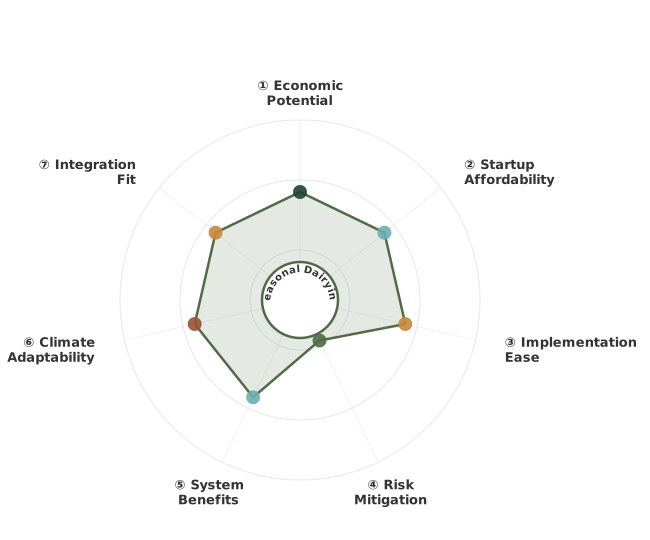
How These Traits Are Calculated
Trait dimensions are ordered clockwise starting from the top of the chart (12 o'clock position):
1. Economic Potential
Financial returns, annual value, and break-even timeline
WHAT: Evaluates financial viability by combining net annual value ($/ha from savings, income, and amortized harvests) with break-even timeline showing when practices pay for themselves.
WHY: Farmers need clear ROI understanding before committing resources. Fast payback (≤3 years) with strong returns (≥$300/ha) enables confident adoption, while long timelines (>10 years) restrict adoption to well-funded operations willing to wait for returns.
HOW: Calculated from net annual value in $/ha and break-even years. Exceptional (≥2.6): fast ROI ≤3 years + high value ≥$300/ha. Typical (1.8-2.5): moderate returns or longer timelines. Limited (<1.8): marginal economics or very long payback >10 years.
2. Startup Affordability
Initial investment costs and financial barrier to entry
WHAT: Measures financial barrier to entry through startup costs for equipment, infrastructure, consulting, and materials. Inverted scoring: lower costs = higher scores = more accessible adoption.
WHY: Affordability determines who can adopt. Low-cost practices (<$250/ha) enable widespread adoption across diverse scales, while high costs (>$2,500/ha) limit adoption to well-capitalized operations, creating barriers that slow regenerative transition.
HOW: Calculated from initial investment parsed from practice content. Inverted scoring: Exceptional (≥2.6): minimal investment <$250/ha. Typical (1.8-2.5): moderate costs $250-2,500/ha. Limited (<1.8): high barrier >$2,500/ha.
3. Implementation Ease
Learning curve and specialized knowledge required
WHAT: Measures how much learning, planning, and specialized knowledge a practice requires. Simpler practices with fewer steps score higher, while complex practices requiring extensive training or specialized resources score lower.
WHY: Complex practices create adoption barriers even when economically viable. Straightforward practices enable faster adoption and broader participation, while those requiring extensive training, timing precision, or specialized equipment limit who can succeed.
HOW: Evaluated by measuring documentation length and identifying complexity markers like location-specific requirements, seasonal timing windows, specialized skills, and dedicated equipment needs. Exceptional (≥2.6): straightforward practices with minimal prerequisites. Typical (1.8-2.5): moderate learning curve with some specialized needs. Limited (<1.8): steep learning curve requiring significant training or resources.
4. Risk Mitigation
Identified financial and ecological risk assessment
WHAT: Evaluates documented risks across financial (investment loss, market volatility) and ecological (crop failure, pest outbreaks) domains. Inverted scoring: fewer risks = higher scores.
WHY: Understanding risk exposure helps farmers make informed decisions. Low-risk practices allow confident implementation, while high-risk practices require careful planning and contingency resources. Risk transparency prevents costly failures.
HOW: Calculated from identified risks in practice content. Inverted scoring: Exceptional (≥2.6): ≤2 risks with manageable severity. Typical (1.8-2.5): 3-5 moderate risks. Limited (<1.8): 6+ risks or severe exposure.
5. System Benefits
How many ways the practice improves your land simultaneously
WHAT: Measures how many aspects of land health improve at once—carbon storage, soil quality, erosion control, water absorption, and biodiversity. Practices that improve multiple areas simultaneously create compounding benefits where each improvement reinforces the others.
WHY: The best practices solve multiple problems at once. For example, addressing erosion simultaneously builds carbon and improves water infiltration, creating a resilient system with positive feedback loops. Single-benefit approaches miss these compound transformation opportunities.
HOW: Evaluated across five key outcomes: carbon sequestration, soil organic matter increase, erosion reduction, water infiltration improvement, and biodiversity enhancement. Exceptional (≥2.6): high carbon storage (>8 t/ha/yr), improvements across 4-5 areas, transformative outcomes. Typical (1.8-2.5): moderate carbon (3-8 t/ha/yr), improvements across 2-3 areas. Limited (<1.8): modest impact (<3 t/ha/yr), single-area focus only.
6. Climate Adaptability
Geographic applicability across Köppen climate zones
WHAT: Evaluates geographic applicability by assessing how many Köppen climate zones successfully support a practice and what adaptation requirements are needed. Measures breadth of climates where farmers can implement with minimal to moderate modifications.
WHY: Universal practices working across diverse climates enable more farmers to adopt regenerative approaches. Practices limited to single climate types (only Mediterranean, only tropical) restrict adoption and slow global transition. Adaptability determines whether a practice serves niche regions or offers broad transformation.
HOW: LLM evaluation of regional success stories, Köppen zone coverage, and adaptation needs. Exceptional (≥2.6): 5+ zones or 4+ climate types, 3+ continents, minimal adaptation. Typical (1.8-2.5): 3-4 zones or 2-3 types, 2 continents, moderate adaptation. Limited (<1.8): 1-2 zones, single region, significant adaptation or highly specialized.
7. Integration Fit
How well this practice combines with others you're doing
WHAT: Measures how well a practice combines with other regenerative practices you might be doing. Some practices work as building blocks that make many other practices easier or more effective, while others work best on their own.
WHY: Practices that combine well with many others create more value on your farm. For example, cover cropping enables no-till, improves grazing, supports crop diversity, and helps water management—making all of them work better together. This helps you build a coherent system rather than juggling disconnected practices.
HOW: Evaluated by identifying which practices combine well and how strong those combinations are. 'Ideally Suited' means strong combinations where practices reinforce each other (practice A makes B easier, while B makes A more effective). 'Adequate' means complementary benefits that work well together. Exceptional (≥2.6): combines well with 6+ practices, serves as a building block. Typical (1.8-2.5): combines with 3-5 practices. Limited (<1.8): 1-2 practices or works best alone.
Going Deeper
1
WHY - The Benefits
Seasonal dairying offers a compelling pathway toward more regenerative and economically resilient dairy farming, particularly in environments with distinct growing seasons. By synchronizing herd cycles with natural forage availability, it fundamentally shifts production...
Seasonal dairying offers a compelling pathway toward more regenerative and economically resilient dairy farming, particularly in environments with distinct growing seasons. By synchronizing herd cycles with natural forage availability, it fundamentally shifts production away from constant, high-input reliance towards a more integrated, ecosystem-aligned model.
WHY - The Benefits
Seasonal dairying offers a compelling pathway toward more regenerative and economically resilient dairy farming, particularly in environments with distinct growing seasons. By synchronizing herd cycles with natural forage availability, it fundamentally shifts production...
Seasonal dairying offers a compelling pathway toward more regenerative and economically resilient dairy farming, particularly in environments with distinct growing seasons. By synchronizing herd cycles with natural forage availability, it fundamentally shifts production away from constant, high-input reliance towards a more integrated, ecosystem-aligned model.
Soil Health Benefits
When seasonal dairying is paired with well-managed grazing, it significantly enhances soil health. Concentrating grazing in defined periods allows for longer rest periods for pastures, enabling plants to fully recover and maximize root development. This extended rest (Principle 4: Maintain Living Roots) encourages deeper root penetration and increased root biomass, which improves soil structure, aeration, and water infiltration. The decomposition of a larger amount of root biomass and longer-term pasture growth contributes to a faster accumulation of soil organic matter.
The cyclical nature of seasonal dairying, particularly when incorporating diverse pasture species and managed grazing, means soil is frequently covered by living plants or substantial surface residue (Principle 3: Keep Soil Covered). This continuous cover protects soil from erosion by wind and water, reduces soil temperature fluctuations, and provides a stable habitat for soil microbes. Reduced compaction can also occur if grazing pressure is managed appropriately, avoiding herd presence on wet soils for extended periods.
Integrating livestock (Principle 5: Integrate Livestock) through a well-planned seasonal grazing system allows for strategic nutrient redistribution. Manure deposited during intense grazing periods is utilized by the growing pasture, contributing fertility directly to the land. During the dry or low-production period, when herd numbers might be reduced or cows are dry, the land receives a break from intense grazing, allowing for natural rejuvenation and nutrient cycling without overwhelming the system.
Economic Benefits
The primary economic driver for seasonal dairying is the significant reduction in feed costs. Conventional year-round dairying often relies heavily on purchased feed supplements, grains, and concentrates to maintain high milk production consistently. Seasonal dairying, by contrast, leverages the peak nutritional density of fresh pasture during its growing season, drastically reducing the need for these expensive external inputs. This reduction can range from 25% to 50% of total feed costs, translating to substantial savings for the farmer.
Furthermore, managing a herd seasonally can lead to lower operational overheads during the off-season. This might include reduced labor requirements, lower energy consumption for milking and housing, and a simplified overall management schedule. While milk production might be lower overall across the year compared to an intensive year-round system, the profit margin per liter or gallon can be higher due to lowered costs.
Seasonal dairying can also open doors to niche markets and premium pricing. Consumers are increasingly seeking dairy products perceived as more natural, sustainable, and ethically produced. Milk from cows grazing pasture for a significant portion of the year is often marketed as "pasture-raised" or "grass-fed," commanding higher prices. This can offset potentially lower total volumes and enhance brand value, especially for smaller-scale or diversified farms.
Herd health can also see improvements. Cows grazing fresh pasture often receive a more diverse range of nutrients and experience less stress than those confined to confinement facilities. This can lead to improved fertility, fewer metabolic disorders, and reduced incidence of mastitis, thereby lowering veterinary costs and improving herd longevity.
Regenerative Systems Fit
Seasonal dairying, when aligned with regenerative principles, is a powerful practice for building resilient and profitable agricultural systems.
Principle 5: Integrate Livestock: This practice fundamentally embodies integrating livestock into the landscape. By managing herd cycles to match pasture growth, dairy animals become active participants in nutrient cycling and pasture management, rather than simply consumers of purchased feed. This integration is key to closing nutrient loops on the farm.
Principle 3: Keep Soil Covered: The emphasis on pasture and forage means that land is typically covered by living plants for a much longer duration than in intensive annual cropping systems. Even during the dry or low-production season, well-managed pastures or appropriate cover crops can maintain soil protection.
Principle 4: Maintain Living Roots: Aligning production with pasture growth necessitates maintaining healthy, living perennial root systems. The rotational grazing often associated with seasonal dairying ensures that plants have adequate rest periods, allowing roots to regain vigor and depth. This continuous biological activity below ground is crucial for soil structure and function.
Principle 2: Maximize Crop Diversity: While not always inherent, seasonal dairying provides an ideal framework for incorporating diverse pasture species. Moving beyond monocultures of grass to include legumes, forbs, and a wider variety of grasses significantly enhances the nutritional profile for the cows and the ecological function of the pasture. This diversity also builds soil biology and resilience against pests and diseases.
Principle 1: Minimize Soil Disturbance: Seasonal dairying, especially when combined with pasture-based operations, inherently involves significantly less soil disturbance than annual tillage-based systems. The primary disturbance is animal impact, which, when managed adaptively, can improve soil structure and nutrient distribution.
Transition Pathway: For farms transitioning from year-round confinement dairying, seasonal production can be a stepping stone. It allows for a gradual reduction in reliance on external inputs as pasture productivity is built up. For instance, a farmer might reduce purchased feed by 20% in year 1 by extending the grazing season with cover crops, then further reducing it in subsequent years as soil health improves. The phased reduction in herd size or production intensity can make the transition financially manageable. During this period, supplemental strategies like creep grazing for calves may be necessary to ensure youngstock thrive while the pasture system matures. This allows for learning and adaptation over 3-5 years, leading to a more sustainable and regenerative model.
Sources behind this view
Videos & Podcasts
-
Achieving compact seasonal calving in dairy herds involves breeding for fertility and pasture adaptation, targeting 365-day calving intervals and high conception rates within an 8-13 week breeding sea
-
Canadian supply management enables regenerative dairy farming by providing price stability for risk-taking. Practices include multi-species forages, zero-till, adaptive grazing, and focusing on cow fa
-
Regenerative dairy farming faces challenges like year-round calving and milking. This Manitoba farm uses robotic milking, pasture access (40-60% diet in summer), and TMR (100% in winter). Intensive ro
-
Holistic management and planned grazing are foundational for 100% grass-fed dairy, improving soil health, nutrient cycling, and economic viability by reducing feed costs. This regenerative approach be
Community
-
Detailed advice on managing overgrown pastures with rotational grazing, selecting dairy cows (Devon breed recommended), and integrating other livestock for parasite control and manure management. Emph
Read more (opens in new window) permies.com -
Implements seasonal dairying with intensive pasture management: 150 acres divided into 40+ paddocks, rotating cows every 12 hours from May to Thanksgiving in New York. Focuses on diverse indigenous pl
Read more (opens in new window) smallfarms.cornell.edu -
Presents an ethical dairy model: once-a-day milking on fresh pasture, minimal supplements (kelp, salt), calves with moms for 3 weeks then daytime separation, and natural breeding for strong, comfortab
Read more (opens in new window) permies.com -
Intensive rotational grazing of dairy heifers on 25 acres in the Catskill Mountains is beneficial for environmental health and economics. Daily pasture moves, managing understocking and drought, and o
Read more (opens in new window) smallfarms.cornell.edu
Research
-
A 100-Year Review: A century of change in temperate grazing dairy systems. (opens in new window)
This study found: Dairy grazing systems evolved over 100 years from random grazing to intensive, high-output systems driven by research, technology, and breeding. Managed grazing, better genetics, and supplementary fee
-
The potential for extended lactations in Victorian dairying: a review (opens in new window)
This study found: Review suggests extended lactations can benefit Victorian dairy farms by smoothing labor, costs, and income, despite traditional seasonal calving. Success depends on cow potential, feed economics, man
-
Pasture-Based Dairy Systems in Temperate Lowlands: Challenges and Opportunities for the Future (opens in new window)
This study found: Pasture-based dairy in temperate lowlands can improve efficiency and sustainability by using more legumes for nitrogen, extending grazing, and selecting robust cows. This reduces chemical inputs, lowe
-
Reproductive management of seasonal calving dairy herds (opens in new window)
This study found: Seasonal calving dairy herds in the UK rely on excellent breeding management to maximize grass conversion to milk. This review covers the concept, impacts of poor fertility, key performance indicators
From the Web
-
Seasonal dairying aligns cow reproduction with peak forage, typically spring calving, to reduce costs and improve net income. Success requires a short calving window (6-8 weeks), effective heat detect
-
Seasonal dairying aligns calving with forage availability for profitability, requiring synchronized estrus and a short calving window. The NOP Pasture Rule mandates 30% dry-matter intake from grazing
2
WHERE - Regional Considerations
Seasonal dairying is most successful in regions with distinct growing seasons that reliably provide abundant, high-quality forage for at least 4-8 months of the year. Climate factors such as temperature, rainfall patterns, and the length of the frost-free period are...
Seasonal dairying is most successful in regions with distinct growing seasons that reliably provide abundant, high-quality forage for at least 4-8 months of the year. Climate factors such as temperature, rainfall patterns, and the length of the frost-free period are critical determinants of feasibility.
WHERE - Regional Considerations
Seasonal dairying is most successful in regions with distinct growing seasons that reliably provide abundant, high-quality forage for at least 4-8 months of the year. Climate factors such as temperature, rainfall patterns, and the length of the frost-free period are...
Seasonal dairying is most successful in regions with distinct growing seasons that reliably provide abundant, high-quality forage for at least 4-8 months of the year. Climate factors such as temperature, rainfall patterns, and the length of the frost-free period are critical determinants of feasibility.
Click Here to Look up your Region if you don't already know it
Temperate Humid Regions
Representative Locations: Northern Europe (Ireland, UK, Denmark, Netherlands), Northeastern United States (New England, Mid-Atlantic), parts of Canada, Southern Chile, Tasmania (Australia), New Zealand.
Climate Context: Mild summers, cool to cold winters, with moderate to high annual precipitation (750-1500 mm or 30-60 inches) often distributed relatively evenly throughout the year. USDA Zones 4-7, Köppen Cfb/Cfa. Growing seasons typically 6-9 months.
Suitability: Highly suitable for seasonal dairying. Reliable spring growth provides abundant high-quality forage. Challenges include managing excess moisture in autumn and winter, potentially leading to pasture degradation if animals are kept on wet fields, and managing pasture senescence in late summer drought. Successful systems often involve extensive use of diverse pasture species, potentially including cool-season and warm-season annuals managed under rotational or adaptive grazing. Over-wintering strategy may involve dry cows on less productive pastures or minimal feed, or dry-lot feeding depending on local conditions and manure management regulations.
Mediterranean Regions
Representative Locations: California (USA), Mediterranean basin (Spain, Italy, Greece), parts of South Africa, Western Australia.
Climate Context: Hot, dry summers and mild, wet winters. Annual precipitation can be variable (300-900 mm or 12-35 inches), heavily concentrated in winter. USDA Zones 8-10, Köppen Csa/Csb. Growing seasons are typically longer, but can be interrupted by summer drought.
Suitability: Moderately suitable, with significant adaptation required. The primary challenge is summer drought, which limits forage availability. Seasonal dairying often relies on strategically timed calving to align with spring growth, and then utilizing drought-tolerant forage species or supplemental feed during the dry summer months. Irrigation might be necessary for continuous pasture production, which can increase costs and resource use. Managing land to prevent erosion during heavy winter rains is also a consideration. Farms in these regions might operate on a "spring flush" calving system, maximizing production through late spring and early summer with pasture, then transitioning to high levels of supplemental feed as pastures dry off.
Subtropical Regions
Representative Locations: Southeastern United States, Southern China, Eastern Australia, Southern Brazil.
Climate Context: Hot, humid summers and mild winters. Ample rainfall often year-round or with distinct wet and dry seasons. USDA Zones 9-11, Köppen Cfa/Cwa. Long growing seasons but can be limited by heat stress in summer.
Suitability: Suitable with careful management. The long growing season offers potential for extended pasture-based periods. However, summer heat can be a major stressor for dairy cows, reducing appetite and milk production. Seasonal dairying might focus on calving to maximize production before peak summer heat, or utilize heat-tolerant forage species. Managing pasture quality through intense heat and humidity can also be challenging. Systems may involve providing significant shade and cooling for cows during summer months.
Arid/Semi-Arid Regions
Representative Locations: Western USA, North Africa, Central Asia, Interior Australia.
Climate Context: Low and unpredictable rainfall (<400 mm or 15 inches annually), high temperatures, and pronounced diurnal temperature variations. Short and variable growing seasons constrained by water availability. USDA Zones 7-9, Köppen BSh/BSk.
Suitability: Generally low or very challenging for traditional seasonal dairying focused on pasture. Relying solely on pasture for peak production during a short, water-limited growing season is difficult without significant irrigation or supplemental feeding. Dairy operations in these regions are more likely to be feedlot or confinement-based, especially for year-round production. However, adapted systems might involve very limited seasonal grazing on drought-tolerant perennial grasses or shrublands, with the majority of nutrition coming from supplemental feed. These are generally not ideal environments for a pasture-centric seasonal dairy model.
Cold Continental Regions
Representative Locations: Northern USA (Upper Midwest), Canada, Northern Europe, Northern Asia.
Climate Context: Very short growing seasons, severe winter cold, and long periods of snow cover. USDA Zones 3-5, Köppen Dfa/Dfb.
Suitability: Seasonal dairying is feasible but requires careful planning for winter. The growing season is typically 4-6 months, demanding intensive pasture management and utilization during this period. Cows calve in late winter/early spring to coincide with rapid pasture growth. The critical challenge is managing the herd through winter when pastures are unavailable. This typically means relying heavily on stored feed (hay, silage) for 4-7 months, and careful manure management from winter housing. The viability depends on the ability to produce and store sufficient feed and manage winter housing efficiently. Success hinges on maximizing pasture intake during the short summer and minimizing stored feed costs.
3
HOW - Implementation Process
Implementing seasonal dairying involves careful planning across herd management, pasture management, and financial strategy. The goal is to align the biological cycles of the cows with the land's productive capacity.
Implementing seasonal dairying involves careful planning across herd management, pasture management, and financial strategy. The goal is to align the biological cycles of the cows with the land's productive capacity.
HOW - Implementation Process
Implementing seasonal dairying involves careful planning across herd management, pasture management, and financial strategy. The goal is to align the biological cycles of the cows with the land's productive capacity.
Implementing seasonal dairying involves careful planning across herd management, pasture management, and financial strategy. The goal is to align the biological cycles of the cows with the land's productive capacity.
Prerequisites
- Climate Suitability: Verify your region has a distinct growing season of at least 4-6 months with reliable forage production.
- Pasture Base: Assess existing pasture quality and quantity. Ideally, you have a mix of perennial grasses and legumes that can support high-producing cows during peak season, or a plan to establish them.
- Herd Health: Ensure the herd is generally healthy and fertile, capable of responding to improved nutrition for peak lactation.
- Financial Planning: Develop a budget that accounts for potential income fluctuations, increased infrastructure needs (e.g., calving pens, seasonal housing), and potentially higher off-season feed costs.
- Knowledge Base: Familiarize yourself with rotational grazing, pasture management, and seasonal herd dynamics.
Phase 1: Strategic Calving & Breeding Management
Objective: Concentrate calving within a 6-8 week window, typically in late winter or early spring, to coincide with the onset of pasture growth.
Actions:
- Synchronize or Tighten Breeding Season: Utilize estrus synchronization protocols or close-herd monitoring and artificial insemination (AI) or natural service to achieve a tightly grouped calving period.
- Strategic Dry-Off: Begin drying off late-lactation cows 6-8 weeks before their planned calving date. This period of rest is crucial for udder health and preparing for the next lactation. Cows that calve earliest in the season will be among the first to be dried off.
- Year-Round vs. Seasonal Dry-Off: In a strict seasonal model, all cows are dried off simultaneously, resulting in a herd-wide dry period. In a modified system, a portion of higher producers might be milked longer, but the majority of the herd aligns to a seasonal break.
Phase 2: Pasture Management for Peak Production
Objective: Maximize forage quality and quantity during the cows' peak lactation (spring/early summer).
Actions:
- Rotational Grazing: Implement a system of paddock rotation. This typically involves 30-80+ paddocks for a herd, allowing cows to graze a fresh paddock for 1-3 days before moving on. This ensures cows eat high-quality, less mature forage and allows grazed pastures adequate rest and recovery.
- Pasture Species Selection: Incorporate a diverse mix of perennial grasses (e.g., ryegrass, fescue), legumes (e.g., clover, alfalfa), and potentially annual forages (e.g., oats, annual ryegrass) to ensure high nutritional content and extend the grazing season.
- Nutrient Management: Utilize manure from grazing cows. Supplement fertility with compost or organic fertilizers rather than synthetic nitrogen, especially in areas where intensive grazing is managed. Soil testing guides targeted applications.
- Mowing/Topping: Mow or "top" pastures after grazing to remove seed heads and encourage leafy regrowth, maintaining forage quality.
Phase 3: Off-Season or Low-Production Management
Objective: Manage the herd and land during periods of limited forage availability while minimizing costs and maintaining herd health.
Actions:
- Reduced Herd Size/Production: Dry off the majority of the herd for 6-8 weeks pre-calving. This significantly reduces feed requirements.
- Targeted Feeding: Provide supplementary feed (hay, silage, minimal grain) to dry cows or those in late lactation. Focus on meeting maintenance requirements rather than production targets.
- Winter Grazing/Stored Feed: Utilize stored forages (hay, silage) or manage grazing on less productive pastures or cover crops if weather permits. In colder climates, this involves intensive housing and feeding.
- Calving Period Management: Prepare calving pens for cows due to calve. Ensure access to clean water, dry bedding, and adequate nutrition for late pregnancy and early lactation.
Phase 4: Transitioning from Intensive Systems (If Applicable)
Objective: Gradually reduce reliance on purchased feed and synthetic inputs while building soil biology and pasture resilience. This is critical if moving from a confinement system.
Actions:
- Gradual Feed Reduction: Over 3-5 years, systematically decrease the amount of purchased feed, replacing it with higher-quality pasture and stored forages.
- Pasture Improvement: Invest in establishing diverse, robust pasture mixes and implement intensive rotational grazing to build soil organic matter and improve infiltration. This takes 2-5 years to show significant results.
- Reduced Synthetic Inputs: As soil biology strengthens, gradually reduce synthetic fertilizers and pesticides. Test for and manage nutrient deficiencies organically.
- Herd Management Adaptation: Adjust herd size or production expectations to match pasture capacity. Cull cows that do not perform well under pasture-based conditions. This might occur over 1-3 years.
- Infrastructure Adaptation: Modify existing facilities for seasonal use or create temporary housing for calving and wintering.
Sources behind this view
Videos & Podcasts
-
Achieving compact seasonal calving in dairy herds involves breeding for fertility and pasture adaptation, targeting 365-day calving intervals and high conception rates within an 8-13 week breeding sea
-
Year-round calving is favored for better environmental adaptation, with culling based on consistent breeding and performance. Calves are marketed as weaned feeders. Pasture rotation involves monitorin
-
Managing seasonal grass-fed dairy involves extending grazing with methods like balage and supplements. Key challenges are maintaining cow condition and nutrition through winter. Simple, effective past
-
The McGinn ranch transitioned to May-June calving and later weaning, allowing 'Mother Nature' to select cattle suited for year-round grazing. This strategy significantly reduced winter feed costs, imp
Community
-
Detailed advice on managing overgrown pastures with rotational grazing, selecting dairy cows (Devon breed recommended), and integrating other livestock for parasite control and manure management. Emph
Read more (opens in new window) permies.com -
Implements seasonal dairying with intensive pasture management: 150 acres divided into 40+ paddocks, rotating cows every 12 hours from May to Thanksgiving in New York. Focuses on diverse indigenous pl
Read more (opens in new window) smallfarms.cornell.edu -
For existing beef cattle farmers, implement daily pasture rotation, shift calving to post-growing season start, and extend winter grazing to reduce costs. Build infrastructure like electric fencing an
Read more (opens in new window) permies.com -
Intensive rotational grazing of dairy heifers on 25 acres in the Catskill Mountains is beneficial for environmental health and economics. Daily pasture moves, managing understocking and drought, and o
Read more (opens in new window) smallfarms.cornell.edu
Research
-
A 100-Year Review: A century of change in temperate grazing dairy systems. (opens in new window)
This study found: Dairy grazing systems evolved over 100 years from random grazing to intensive, high-output systems driven by research, technology, and breeding. Managed grazing, better genetics, and supplementary fee
-
The potential for extended lactations in Victorian dairying: a review (opens in new window)
This study found: Review suggests extended lactations can benefit Victorian dairy farms by smoothing labor, costs, and income, despite traditional seasonal calving. Success depends on cow potential, feed economics, man
-
Reproductive management of seasonal calving dairy herds (opens in new window)
This study found: Seasonal calving dairy herds in the UK rely on excellent breeding management to maximize grass conversion to milk. This review covers the concept, impacts of poor fertility, key performance indicators
-
Pasture-Based Dairy Systems in Temperate Lowlands: Challenges and Opportunities for the Future (opens in new window)
This study found: Pasture-based dairy in temperate lowlands can improve efficiency and sustainability by using more legumes for nitrogen, extending grazing, and selecting robust cows. This reduces chemical inputs, lowe
From the Web
-
Seasonal dairying aligns cow reproduction with peak forage, typically spring calving, to reduce costs and improve net income. Success requires a short calving window (6-8 weeks), effective heat detect
-
Seasonal dairying aligns calving with forage availability for profitability, requiring synchronized estrus and a short calving window. The NOP Pasture Rule mandates 30% dry-matter intake from grazing
-
Observational data from an Iowa dairy farm suggests calving timing significantly impacts profitability, with seasonal calving and grazing reducing overall farm expenses. While specific months show var
-
Explores early dry-off for cows in grass-based dairies to increase herd size and density. Advocates for seasonal calving (spring and fall) to leverage grass, avoid heat stress, and reduce costs, parti
4
Know the Debate
Seasonal dairying outcomes show significant variation by region and management approach. In humid temperate zones, reliable spring growth offers st...
Know the Debate
Seasonal dairying outcomes show significant variation by region and management approach. In humid temperate zones, reliable spring growth offers st...
Seasonal dairying outcomes show significant variation by region and management approach. In humid temperate zones, reliable spring growth offers strong pasture potential, while Mediterranean and subtropical climates present challenges with summer drought or heat that require specific forage strategies and cow cooling. Arid regions are generally unsuitable for intensive pasture-based seasonal dairy. Transitioning from confinement systems can involve temporary yield dips (1-3 years) but leads to reduced costs and improved soil health. Management intensity for rotational grazing ranges from daily moves to more flexible strip grazing, depending on goals and resources.
How much does seasonal dairying affect farm income?
Improved Profitability with Managed Income
Seasonal dairying can improve profit margins per cow by reducing purchased feed costs by 25-50% and lowering overhead during off-seasons. Potential premium pricing further enhances profitability, though total milk volume may decrease.
Sources behind this view
Sources behind this view
Videos & Podcasts
-
Dakota Finch details his grass-fed organic dairy operations in Central New York, covering grazing seasons, climate challenges, hay making difficulties, fall calving strategies, and flexible milking schedules like the '10 and 7' system. He emphasizes the need for high-quality winter feed and managing milk production for market demands.
-
Explains the New Zealand-style grass-based dairy model: cows primarily eat grazed pasture, seasonal calving, minimal housing, lower production but better economics. Louisiana's climate is suitable with fall calving to avoid heat.

-
Canadian supply management enables regenerative dairy farming by providing price stability for risk-taking. Practices include multi-species forages, zero-till, adaptive grazing, and focusing on cow families. Challenges include year-round calving and weed control, with ongoing experiments in tillage vs. herbicides.
-
Daily management of 50 dairy cows on Stony Ridge Farm, NC, including rotational grazing with electric fences, planting winter forage to cut hay costs, and a non-traditional calving schedule to optimize market prices and grazing plans.
From the Web
-
Seasonal dairying aligns calving with forage availability for profitability, requiring synchronized estrus and a short calving window. The NOP Pasture Rule mandates 30% dry-matter intake from grazing for organic ruminants.
-
Observational data from an Iowa dairy farm suggests calving timing significantly impacts profitability, with seasonal calving and grazing reducing overall farm expenses. While specific months show varied income over feed costs, personal preference may be a stronger driver than pure economics in the Upper Midwest, emphasizing grass production for increased cow numbers and farm profit.
-
Grass-based dairying markets forage through milk, requiring skilled management of high-quality pastures and rotational grazing for nutrient cycling and low-input production. It emphasizes ecological approaches, biodiversity, and stress reduction for animal health and profitability.
-
Practical steps for regenerative dairy include using lanes, water, fencing, and virtual collars. Overcoming bottlenecks like processing consolidation requires multi-year offtake agreements, blended finance, and regional processors to build resilience and a grass-fed market.
Significant Income Fluctuation and Financial Risk
The concentrated seasonality leads to major income drops during dry-off/low-production periods, creating cash flow challenges. This risk is amplified by reliance on peak season milk volume and potential volatility in stored feed costs.
Sources behind this view
Sources behind this view
Videos & Podcasts
-
Managing seasonal grass-fed dairy involves extending grazing with methods like balage and supplements. Key challenges are maintaining cow condition and nutrition through winter. Simple, effective pasture management is crucial for profitability and sustainability.
-
Seasonal dairy management, with tighter breeding windows and outwintering, improves lifestyle and soil health, reducing reliance on purchased inputs.

-
A seasonal dairy operation, like the Tandel farm's, minimizes infrastructure costs by avoiding large barns and feed storage, utilizing natural structures and a spring calving system to reduce capital investment.
-
Managing seasonal calving requires efficient labor through compact calving periods, planning, and outsourcing. Cash flow is managed by controlling costs, budgeting, and utilizing tools like milk loans, co-op feed accounts, and livestock sales, especially during the spring deficit period.
Making Sense of the Differences
The financial outcome of seasonal dairying hinges on balancing reduced yearly input costs against seasonal income dips. Farms that emphasize pasture quality, manage herd fertility tightly, and implement robust cash flow solutions tend to thrive. Those who struggle often face significant income loss without commensurate cost reduction or adequate preparation for off-peak production, especially in less climatically favorable regions.
How long does it take to see yield impacts when transitioning to seasonal dairying?
Temporary Yield Dip (1-3 years)
Transitioning from confinement dairying may cause temporary milk yield drops of 10-30% as cows adapt to pasture and soil fertility builds. This period requires careful management of herd biology and pasture quality.
Sources behind this view
Sources behind this view
Videos & Podcasts
-
Managing seasonal grass-fed dairy involves extending grazing with methods like balage and supplements. Key challenges are maintaining cow condition and nutrition through winter. Simple, effective pasture management is crucial for profitability and sustainability.
-
100% grass-fed dairy cows have high energy and mineral needs, requiring constant water and high dry matter intake. Challenges include forage quality, mineralization, and diversity, with issues appearing 18-24 months post-transition. Strategies involve supplementation, extended grazing, and tailored rations.

Research
-
Performance of Lactating Dairy Cows Managed on Pasture-Based or in Freestall Barn-Feeding Systems (opens in new window)
This study found: A study compared dairy cows managed on two different pasture systems to cows in a traditional freestall barn. The pasture systems used a mix of grasses and legumes like rye, ryegrass, crimson clover, and red clover in winter, and pearl millet or bermudagrass in summer. While cows in the barn produced about 19% more milk (around 30 kg per day compared to 25 kg), their feed costs were similar when pasture costs were included. Cows on pasture lost significantly more body weight (113 kg vs. 58 kg) and had lower blood sugar levels early after calving. Although pasture systems can be viable in the southeastern US, the substantial body weight loss in early lactation for pasture-fed cows is a notable concern.
From the Web
-
Seasonal dairying aligns calving with forage availability for profitability, requiring synchronized estrus and a short calving window. The NOP Pasture Rule mandates 30% dry-matter intake from grazing for organic ruminants.
-
Grass-based dairies face climate change impacts; adaptation includes managing summer slump with alternative forages and extending grazing via stockpiling, with species like tall fescue and bermudagrass being suitable.
Competitive Yields with Optimal Management
With optimal pasture management, diverse forages, and adaptive grazing, milk yields can be maintained competitively with conventional systems, especially when focusing on profit margin over total volume.
Sources behind this view
Sources behind this view
Videos & Podcasts
-
Describes rotational grazing for dairy and beef cattle, moving daily or every few days based on forage. Highlights success during drought, outperforming neighbors due to adaptive multi-paddock grazing, which allowed grazing through August with minimal hay.

-
Daily management of 50 dairy cows on Stony Ridge Farm, NC, including rotational grazing with electric fences, planting winter forage to cut hay costs, and a non-traditional calving schedule to optimize market prices and grazing plans.
Research
-
Pasture-Based Dairy Systems in Temperate Lowlands: Challenges and Opportunities for the Future (opens in new window)
This study found: Dairy farms in moderate climate regions can become more efficient and sustainable by focusing on pasture-based systems. These systems offer healthier food, use fewer fossil fuels and chemicals, and provide benefits for the environment, wildlife, and animal well-being. To achieve this, farms need to rely less on concentrated feeds and synthetic fertilizers, and more on longer grazing periods and high-quality forages. A key strategy is to use more legumes (like clover and vetch) in pastures, which naturally fix nitrogen from the air, reducing the need for synthetic nitrogen fertilizers. This can lead to fewer greenhouse gas emissions, less nitrogen pollution in water, more carbon stored in the soil, and less use of herbicides and pesticides. Cows best suited for these systems are efficient grazers that can maintain a consistent calving cycle and adapt to changing feed availability. Planting diverse grasslands with legumes is crucial. Future research and farmer education are vital to implement these changes, especially as consumers and policies increasingly demand sustainable food production. Farmers providing these environmental benefits should be better rewarded through market prices.
-
Milk Production, Body Weight, Body Condition Score, Activity, and Rumination of Organic Dairy Cattle Grazing Two Different Pasture Systems Incorporating Cool- and Warm-Season Forages (opens in new window)
This study found: A two-year study in Minnesota looked at how two different pasture mixes affected organic dairy cows. One pasture was made up of traditional cool-season grasses, while the other included those plus warm-season grasses and annual forages. The cows produced similar amounts of milk with comparable fat and protein levels in both systems. However, cows on the pasture with only cool-season grasses spent more time ruminating (chewing their cud), which can be an indicator of digestive health. The study suggests that adding warm-season annual grasses to grazing systems is a viable option for dairy farmers.
From the Web
-
Grass-based dairying markets forage through milk, requiring skilled management of high-quality pastures and rotational grazing for nutrient cycling and low-input production. It emphasizes ecological approaches, biodiversity, and stress reduction for animal health and profitability.
Making Sense of the Differences
Yield expectations during transition depend critically on starting farm conditions and management intensity. Abrupt transitions on limited pasture with poorly adapted herds often see significant, prolonged dips. However, a gradual, well-planned approach incorporating robust pasture improvement, diverse forage species, and adaptive grazing can minimize or overcome yield reductions within 1-3 years, especially when focusing on profitable milk production margins rather than sheer volume.
Is intensive rotational grazing required for seasonal dairying?
Intensive Rotational Grazing Crucial
Intensive rotational grazing with frequent moves (daily or every few days) and precise rest periods is essential for maximizing forage quality, driving regeneration, and achieving optimal seasonal production.
Sources behind this view
Sources behind this view
Videos & Podcasts
-
Regenerative dairy farming faces challenges like year-round calving and milking. This Manitoba farm uses robotic milking, pasture access (40-60% diet in summer), and TMR (100% in winter). Intensive rotational grazing with multi-species forages is practiced, with cows moving every second day.
-
Describes rotational grazing for dairy and beef cattle, moving daily or every few days based on forage. Highlights success during drought, outperforming neighbors due to adaptive multi-paddock grazing, which allowed grazing through August with minimal hay.
-
Discusses integrating mobile dairy into a 4-year grass/4-year crop rotation, utilizing herbal leys and legume fallows. Government schemes like SFI are used to support goals. Daily movement of mobile dairy kit takes ~30 mins; paddocks are 6ha, fenced with electric wire. Winter feeding uses bale grazing.
-
A holistic grazing plan is the most effective way to extend the grazing season for dairy cows. It involves managing paddock stay duration and recovery periods using temporary fencing to control grazing cycles and optimize forage utilization.
Research
-
Optimizing soils, pasture and grassland management for organic dairy farming (opens in new window)
This study found: This chapter focuses on how to best manage soil, pastures, and grasslands for organic dairy farms. The main goal is to feed organic dairy cows primarily with crops grown on the farm, especially pasture. This helps cows maintain good body condition when they calve and prevents them from losing too much weight during milking. Good organic pastures should be tough enough to handle different weather, grow well without synthetic fertilizers, help reduce climate change, and support a variety of wildlife. Healthy soil is essential for successful pasture-based dairy farming, and good grassland management is key. The chapter will look at practical ways to use rotational grazing and pastures with many different types of plants to meet organic farming goals, also considering the right type of cows for the system and adjusting management to changing weather.
From the Web
-
Seasonal dairying aligns cow reproduction with peak forage, typically spring calving, to reduce costs and improve net income. Success requires a short calving window (6-8 weeks), effective heat detection, high nutrition, and managing for seasonal milk supply fluctuations.
-
Grass-based dairying markets forage through milk, requiring skilled management of high-quality pastures and rotational grazing for nutrient cycling and low-input production. It emphasizes ecological approaches, biodiversity, and stress reduction for animal health and profitability.
-
Enhance dairy cow protein self-sufficiency by synchronizing daily needs with grass supply through weekly measurements and adjusting feed or grazing area. Extend grazing season with early spring/late autumn grazing and forage turnips/cover crops. Choose low-rotation or strip grazing based on workload or milk production goals.
Flexible Grazing Approaches Possible
While rotational grazing improves outcomes, simpler methods like strip grazing or strategic supplementation can be adapted for seasonal dairying, especially where labor or infrastructure is limited.
Sources behind this view
Sources behind this view
Videos & Podcasts
-
Dakota Finch details his grass-fed organic dairy operations in Central New York, covering grazing seasons, climate challenges, hay making difficulties, fall calving strategies, and flexible milking schedules like the '10 and 7' system. He emphasizes the need for high-quality winter feed and managing milk production for market demands.
-
Explains the New Zealand-style grass-based dairy model: cows primarily eat grazed pasture, seasonal calving, minimal housing, lower production but better economics. Louisiana's climate is suitable with fall calving to avoid heat.
From the Web
-
Enhance dairy cow protein self-sufficiency by synchronizing daily needs with grass supply through weekly measurements and adjusting feed or grazing area. Extend grazing season with early spring/late autumn grazing and forage turnips/cover crops. Choose low-rotation or strip grazing based on workload or milk production goals.
Making Sense of the Differences
While intensive rotational grazing maximizes regenerative benefits and production potential in seasonal dairying, its implementation varies. Many successful seasonal dairy farmers utilize rapid, frequent moves (daily or every few days) to optimize pasture health and cow nutrition. However, less intensive systems like strip grazing or carefully managed longer stay periods can also support seasonal production, particularly for farms with limited labor or infrastructure, provided overgrazing is actively avoided and forage quality is maintained.
5
HOW MUCH - Costs & Investment
Note: All costs are based on recent US economic data (2023-2025) and may vary substantially in other regions based on local labor rates, material costs, currency exchange rates, and regulatory requirements. International comparisons should use local currency equivalents...
Note: All costs are based on recent US economic data (2023-2025) and may vary substantially in other regions based on local labor rates, material costs, currency exchange rates, and regulatory requirements. International comparisons should use local currency equivalents and factor for local economic conditions.
HOW MUCH - Costs & Investment
Note: All costs are based on recent US economic data (2023-2025) and may vary substantially in other regions based on local labor rates, material costs, currency exchange rates, and regulatory requirements. International comparisons should use local currency equivalents...
Note: All costs are based on recent US economic data (2023-2025) and may vary substantially in other regions based on local labor rates, material costs, currency exchange rates, and regulatory requirements. International comparisons should use local currency equivalents and factor for local economic conditions.
Note: All costs are based on recent US economic data (2024–2026) and may vary substantially by region based on local labor rates, material costs, and regulatory requirements.
Pasture Infrastructure: Fencing and Watering
Effective seasonal dairying requires high-density grazing to maximize forage utilization through controlled animal movement. For small-scale operations under 50 acres (20 ha), initial investment for portable electric polywire and lightweight tread-in posts ranges from $1,563 to $4,689. Mid-size operations managing 50 to 500 acres (20–202 ha) typically install more robust perimeter fencing, requiring investments of $8,336 to $22,924. Large-scale operations exceeding 500 acres (202 ha) require permanent high-tensile, multi-strand fencing and extensive lane surfacing, leading to capital outlays between $46,890 and $130,250. Water systems, which are essential for livestock health, cost $1,250 to $3,647 for small operations, $5,210 to $18,756 for mid-size setups, and $26,050 to $78,150 for large-scale systems that involve deep-well drilling and substantial subterranean piping.
Transition and Calving Facilities
Converting infrastructure to support synchronized seasonal calving involves modifying existing barn structures or building cost-effective open-sided shelters. Small-scale farmers typically allocate $2,084 to $12,504 for temporary calving sheds and windbreaks. Mid-size operations scaling up their capacity often invest $15,630 to $57,310 into multi-bay calving barns or retrofitted structures to handle herd concentration. Large-scale operations face significant capital requirements of $72,940 to $260,500 to ensure adequate throughput during the intensive seasonal calving window. Furthermore, forage storage equipment, such as heavy-duty bale wrappers and forage wagons, requires an investment of $3,126 to $10,420 for small farms, $15,630 to $46,890 for mid-size operations, and $62,520 to $208,400 for highly mechanized, large-scale dairies.
Annual Operating Costs per Cow
Operating expenses in this system are centered on the goal of reducing processed feed reliance. For a standard 100-cow herd, annual purchased feed costs range from $313 to $1,459 per cow, a figure dictated primarily by the length of the effective grazing season. Veterinary and herd health expenses benefit from lower density and outdoor exposure, costing $63 to $250 per cow. Labor intensity shifts significantly during calving and breeding, with total annual labor costs estimated at $208 to $938 per cow, varying based on the reliance on hired versus family labor. Pasture maintenance, including biennial soil testing, lime application, and supplemental forage seeding, adds expenditures of $36 to $188 per acre ($89–$465/ha) annually.
Most Spend: Most operations (the middle 60%) fall within a $36,470–$88,570 startup range for mid-size operations and $208,400–$416,800 for large-scale operations. This budget reflects the necessity of balancing high-durability permanent infrastructure with the efficient, mobile equipment required for intensive grazing management.
Why the Range?: The primary drivers of cost variation are initial soil fertility and regional labor markets. Farms beginning with low organic matter or poor soil pH require higher upfront expenditures for lime and fertilizer to establish viable forage stands, while proximity to urban centers often inflates professional installation and labor costs.
Sources behind this view
Videos & Podcasts
-
A hypothetical analysis of a low overhead dairy grazing system showed net farm income per hundredweight of $3.64, four times greater than conventional dairy farm averages, with strong returns on asset
-
Details the construction and operation of a Grade A milking facility, including automatic headlocks, a grass-fed system using molasses lures, and a cost-effective carport structure. Designed for 40-50

-
Starting a cattle enterprise requires significant upfront investment. It's recommended to begin with stockers over cow-calf operations for faster returns and simpler management. Careful breed experime
-
Starting a farm incurs major costs: land purchase, water systems (seek existing sources), clearing, seeding ($7-10k over 7 yrs), and fencing ($125k on this 150-acre farm). Profitability takes 5-10 yea
Research
-
A 100-Year Review: A century of change in temperate grazing dairy systems. (opens in new window)
This study found: Dairy grazing systems evolved over 100 years from random grazing to intensive, high-output systems driven by research, technology, and breeding. Managed grazing, better genetics, and supplementary fee
-
Increasing Intensity of Pasture Use with Dairy Cattle: An Economic Analysis (opens in new window)
This study found: Intensive grazing on Pennsylvania dairy farms was more profitable than hay/corn silage, returning $129/acre. High debt and poor cash flow motivated increased grazing intensity, which lowered feed cost
-
The potential for extended lactations in Victorian dairying: a review (opens in new window)
This study found: Review suggests extended lactations can benefit Victorian dairy farms by smoothing labor, costs, and income, despite traditional seasonal calving. Success depends on cow potential, feed economics, man
-
Production Costs of Grass-Fed Organic Milk in the Northeastern United States: Empirical Results from Survey Data and Implications for Sustainable Development (opens in new window)
This study found: Grass-fed organic dairy farms in the Northeast US had average production costs of $45.91/cwt. Higher labor efficiency and milk per cow reduced costs, while more land per cow and smaller farm size incr
6
REWARDS AND RISKS - Economics & Risk Factors
Seasonal dairying presents a distinct economic profile compared to conventional year-round production, characterized by higher input efficiency during the growing season and controlled costs during the off-season, but with inherent income fluctuations.
Seasonal dairying presents a distinct economic profile compared to conventional year-round production, characterized by higher input efficiency during the growing season and controlled costs during the off-season, but with inherent income fluctuations.
REWARDS AND RISKS - Economics & Risk Factors
Seasonal dairying presents a distinct economic profile compared to conventional year-round production, characterized by higher input efficiency during the growing season and controlled costs during the off-season, but with inherent income fluctuations.
Seasonal dairying presents a distinct economic profile compared to conventional year-round production, characterized by higher input efficiency during the growing season and controlled costs during the off-season, but with inherent income fluctuations.
Economic outcomes for seasonal dairying are highly sensitive to forage availability and timing. In the best-case scenario, an operation on high-fertility soil achieves a 50% reduction in annual purchased feed costs, providing savings of $625–$1,250 per cow. By maximizing grazing days, these farms capture peak historical milk production periods without the energy-intensive costs associated with constant confinement, resulting in net profit margins 15–22% higher than conventional dairies, plus an additional 5–10% revenue lift from grass-fed product premiums. Typical operations see a 25–35% decrease in feed costs, saving $313–$625 per cow annually. While confinement-fed systems often yield higher individual cow volume, the seasonal model stabilizes output costs, effectively providing a hedge against volatile feed market price spikes. In worst-case scenarios, such as regions facing extreme drought or poor grazing management, misaligned calving windows lead to a 20% drop in milk yield. If pasture growth fails, farms may spend over $1,876–$2,292 per cow on urgent supplemental feed, leading to net annual losses ranging from $15,630 to $41,680 on a mid-sized operation.
Transitioning to a seasonal system introduces a 1–3 year "adjustment recession" where soil health and cow genetics catch up to lower-input reality. During this period, farmers often experience a 10–25% reduction in milk revenue. Infrastructure modifications during this phase cost $5,210–$41,680, which should be financed through cash reserves to avoid high-interest debt. To maintain liquidity, producers should phase out confinement year-by-year, ensuring annual transition costs do not exceed $15,630.
To mitigate operational risks, producers must hold liquid cash reserves equivalent to 3–6 months of operating expenses, roughly $41,680–$125,040 for mid-size farms. Implementing a 15–20% herd cull rate in the first two years of transition is critical to remove animals unable to thrive on forage, which improves overall herd metabolic efficiency. Finally, farmers can diversify risk by incorporating dual-purpose genetics or selling surplus bred heifers to generate an additional $521–$1,563 in revenue per cow during off-peak winter months.
Sources behind this view
Videos & Podcasts
-
Achieving compact seasonal calving in dairy herds involves breeding for fertility and pasture adaptation, targeting 365-day calving intervals and high conception rates within an 8-13 week breeding sea
-
Managing seasonal grass-fed dairy involves extending grazing with methods like balage and supplements. Key challenges are maintaining cow condition and nutrition through winter. Simple, effective past
-
The McGinn ranch transitioned to May-June calving and later weaning, allowing 'Mother Nature' to select cattle suited for year-round grazing. This strategy significantly reduced winter feed costs, imp
-
Matt McGinn transitioned to May-June calving and later weaning, reducing inputs and costs significantly. This adaptive strategy favors cattle selected by nature for forage grazing, improves drought re
Community
-
Detailed advice on managing overgrown pastures with rotational grazing, selecting dairy cows (Devon breed recommended), and integrating other livestock for parasite control and manure management. Emph
Read more (opens in new window) permies.com -
Implements seasonal dairying with intensive pasture management: 150 acres divided into 40+ paddocks, rotating cows every 12 hours from May to Thanksgiving in New York. Focuses on diverse indigenous pl
Read more (opens in new window) smallfarms.cornell.edu -
For existing beef cattle farmers, implement daily pasture rotation, shift calving to post-growing season start, and extend winter grazing to reduce costs. Build infrastructure like electric fencing an
Read more (opens in new window) permies.com -
Intensive rotational grazing of dairy heifers on 25 acres in the Catskill Mountains is beneficial for environmental health and economics. Daily pasture moves, managing understocking and drought, and o
Read more (opens in new window) smallfarms.cornell.edu
Research
-
A 100-Year Review: A century of change in temperate grazing dairy systems. (opens in new window)
This study found: Dairy grazing systems evolved over 100 years from random grazing to intensive, high-output systems driven by research, technology, and breeding. Managed grazing, better genetics, and supplementary fee
-
The potential for extended lactations in Victorian dairying: a review (opens in new window)
This study found: Review suggests extended lactations can benefit Victorian dairy farms by smoothing labor, costs, and income, despite traditional seasonal calving. Success depends on cow potential, feed economics, man
-
Reproductive management of seasonal calving dairy herds (opens in new window)
This study found: Seasonal calving dairy herds in the UK rely on excellent breeding management to maximize grass conversion to milk. This review covers the concept, impacts of poor fertility, key performance indicators
-
Pasture-Based Dairy Systems in Temperate Lowlands: Challenges and Opportunities for the Future (opens in new window)
This study found: Pasture-based dairy in temperate lowlands can improve efficiency and sustainability by using more legumes for nitrogen, extending grazing, and selecting robust cows. This reduces chemical inputs, lowe
From the Web
-
Seasonal dairying aligns cow reproduction with peak forage, typically spring calving, to reduce costs and improve net income. Success requires a short calving window (6-8 weeks), effective heat detect
-
Observational data from an Iowa dairy farm suggests calving timing significantly impacts profitability, with seasonal calving and grazing reducing overall farm expenses. While specific months show var
-
Seasonal dairying aligns calving with forage availability for profitability, requiring synchronized estrus and a short calving window. The NOP Pasture Rule mandates 30% dry-matter intake from grazing
-
Grassland farmers face challenges with dairy cattle grazing, including ration transitions, loss of body condition score and milk yield, and managing health risks like parasites and acidosis. Breeding
7
COMPATIBLE PRACTICES - Integration Opportunities
Seasonal dairying thrives when integrated with other regenerative and sound management practices, amplifying its benefits and mitigating its risks.
Seasonal dairying thrives when integrated with other regenerative and sound management practices, amplifying its benefits and mitigating its risks.
COMPATIBLE PRACTICES - Integration Opportunities
Seasonal dairying thrives when integrated with other regenerative and sound management practices, amplifying its benefits and mitigating its risks.
Seasonal dairying thrives when integrated with other regenerative and sound management practices, amplifying its benefits and mitigating its risks.
Rotational/Adaptive Grazing
- Description: Dividing pastures into smaller paddocks and moving the herd frequently, allowing adequate rest periods for plant recovery.
- Integration Benefit: Maximizes pasture utilization, ensures high forage quality for peak lactation, distributes manure evenly, allows pasture to out-yield monocultures, builds soil organic matter and root systems (Principles 3, 4, 5). This is non-negotiable for successful seasonal dairying.
Diverse Pasture Species Mix
- Description: Including a variety of grasses, legumes, and potentially forbs in pasture swards.
- Integration Benefit: Enhances nutritional value for cows (protein, minerals), improves soil fertility (legumes fix nitrogen), increases resilience to pests and climate stress, provides better ground cover, and supports greater biodiversity (Principles 2, 3, 4, 5).
Transition from Confinement (if applicable)
- Description: A gradual phase-out of intensive feeding and housing over 3-5 years, building pasture productivity and adapting herd management.
- Integration Benefit: Allows farmers to de-risk the transition, maintain partial income, learn new management skills, and build soil and herd health incrementally, leading to a successful shift to a regenerative seasonal system.
Cover Cropping
- Description: Planting non-cash crops between cash crop seasons, or in winter in dairy systems.
- Integration Benefit: Extends the grazing season into shoulder periods (fall, early spring) or into a dry period, provides additional forage, protects soil from erosion, builds soil organic matter, and can suppress weeds (Principles 3, 4, 5).
Manure Management & Composting
- Description: Strategically applying manure to pastures or composting it prior to application.
- Integration Benefit: Recycles nutrients within the farm system, reducing reliance on synthetic fertilizers. Composted manure improves soil structure and biological activity. Managed grazing helps distribute manure effectively, avoiding over-application in concentrated areas (Principle 5, supports Principle 1).
Strategic Dry-Off Periods
- Description: Planning a 6-8 week dry period for cows before calving.
- Integration Benefit: Crucial for udder health, rejuvenation, and preparing cows for peak lactation. It also reduces feed requirements during lower-forage periods, lowering costs and improving cash flow management.
Holistic Financial Planning
- Description: Developing budgets that account for seasonal income fluctuations, investment in pasture, and reduced input costs over time.
- Integration Benefit: Provides a clear financial roadmap, helps secure necessary financing, builds confidence in the transition, and allows for contingency planning. Essential for smoothing income and managing transition risks.
Water Harvesting & Management
- Description: Techniques like swales, Keyline design, or improved water trough placement to manage rainfall and water access.
- Integration Benefit: Enhances pasture resilience during dry spells, reduces reliance on irrigation, prevents stream bank erosion, and ensures reliable water access for grazing animals (Principle 3, supports Principle 5).
Seasonal dairying is not just about calving timing; it's a holistic system that integrates herd, pasture, soil, and finances. Its success is amplified when implemented as part of a broader regenerative management strategy.
Sources behind this view
Videos & Podcasts
-
Achieving compact seasonal calving in dairy herds involves breeding for fertility and pasture adaptation, targeting 365-day calving intervals and high conception rates within an 8-13 week breeding sea
-
Regenerative dairy farming faces challenges like year-round calving and milking. This Manitoba farm uses robotic milking, pasture access (40-60% diet in summer), and TMR (100% in winter). Intensive ro
-
Canadian supply management enables regenerative dairy farming by providing price stability for risk-taking. Practices include multi-species forages, zero-till, adaptive grazing, and focusing on cow fa
-
Managing seasonal grass-fed dairy involves extending grazing with methods like balage and supplements. Key challenges are maintaining cow condition and nutrition through winter. Simple, effective past
Community
-
Detailed advice on managing overgrown pastures with rotational grazing, selecting dairy cows (Devon breed recommended), and integrating other livestock for parasite control and manure management. Emph
Read more (opens in new window) permies.com -
Implements seasonal dairying with intensive pasture management: 150 acres divided into 40+ paddocks, rotating cows every 12 hours from May to Thanksgiving in New York. Focuses on diverse indigenous pl
Read more (opens in new window) smallfarms.cornell.edu -
Presents an ethical dairy model: once-a-day milking on fresh pasture, minimal supplements (kelp, salt), calves with moms for 3 weeks then daytime separation, and natural breeding for strong, comfortab
Read more (opens in new window) permies.com -
Intensive rotational grazing of dairy heifers on 25 acres in the Catskill Mountains is beneficial for environmental health and economics. Daily pasture moves, managing understocking and drought, and o
Read more (opens in new window) smallfarms.cornell.edu
Research
-
A 100-Year Review: A century of change in temperate grazing dairy systems. (opens in new window)
This study found: Dairy grazing systems evolved over 100 years from random grazing to intensive, high-output systems driven by research, technology, and breeding. Managed grazing, better genetics, and supplementary fee
-
The potential for extended lactations in Victorian dairying: a review (opens in new window)
This study found: Review suggests extended lactations can benefit Victorian dairy farms by smoothing labor, costs, and income, despite traditional seasonal calving. Success depends on cow potential, feed economics, man
-
Reproductive management of seasonal calving dairy herds (opens in new window)
This study found: Seasonal calving dairy herds in the UK rely on excellent breeding management to maximize grass conversion to milk. This review covers the concept, impacts of poor fertility, key performance indicators
-
Pasture-Based Dairy Systems in Temperate Lowlands: Challenges and Opportunities for the Future (opens in new window)
This study found: Pasture-based dairy in temperate lowlands can improve efficiency and sustainability by using more legumes for nitrogen, extending grazing, and selecting robust cows. This reduces chemical inputs, lowe
From the Web
-
Seasonal dairying aligns cow reproduction with peak forage, typically spring calving, to reduce costs and improve net income. Success requires a short calving window (6-8 weeks), effective heat detect
-
Seasonal dairying aligns calving with forage availability for profitability, requiring synchronized estrus and a short calving window. The NOP Pasture Rule mandates 30% dry-matter intake from grazing