
Strip Tillage
Strip tillage is a precision conservation practice that disturbs only narrow bands of soil for specific agronomic purposes like fertilizer placement, seedbed warming, and residue management. It is an implement-driven approach, intentionally disturbing soil in targeted bands rather than broadcast, distinguishing it from philosophies like no-till that aim for zero mechanical disturbance.
Read More: Complete Description
Strip tillage is a conservation tillage method that disturbs only a narrow band of soil where seeds are planted, leaving the areas between rows largely undisturbed. This precision approach aims to combine the benefits of reduced soil disturbance with the advantages of conventional tillage, such as warmer seedbeds and better seed-to-soil contact for germination. Unlike no-till farming, which commits to zero soil disturbance, strip tillage deliberately cultivates a narrow strip of soil, typically 15-25 cm (6-10 inches) wide, directly in the crop row. This disturbance is strategic, focused on creating an ideal environment for seed germination and early seedling growth while minimizing disruption to the soil structure in the inter-row spacing.
The core philosophy behind strip tillage is to address specific agronomic challenges that might be more difficult to overcome in a strict no-till system. For instance, in cooler climates or during early planting seasons, the undisturbed soil between rows can remain cool and wet, slowing seed germination and early growth. By tilling a narrow strip, farmers can warm the seed zone, incorporate nutrients directly where the plant will access them, and create a finer seedbed for optimal germination. This targeted approach also helps manage crop residue, which in some systems (like heavy corn residue) can be problematic for planting and can tie up nitrogen. Strip tillage in these bands can partially incorporate or move residue, facilitating planting and nutrient availability.
In the context of regenerative agriculture, strip tillage is best classified as a transition practice. While it intentionally violates the principle of minimizing soil disturbance (Principle 1), it can be a critical stepping stone for farms transitioning from conventional tillage towards full no-till systems. It offers a way to improve field conditions—like seedbed quality and nutrient management—that might be challenging to achieve immediately under zero-till on certain soil types or in specific climates. The key to its regenerative application lies in its application: it must be a deliberate, measured intervention, not an annual practice, immediately followed by supporting regenerative practices, and with a clear plan to phase it out over time as soil health improves.
The goal is to leverage strip tillage to achieve better yields and more reliable crop establishment during the transition period, thereby maintaining farm profitability while building soil health. As soil organic matter increases, biology revitalizes, and soil structure improves through practices like cover cropping and reduced compaction, the need for strip tillage diminishes. The undisturbed inter-row areas begin to function like a no-till system, resisting erosion, retaining moisture, and supporting a robust soil biology. Over several years, the farm can then fully adopt no-till methods, having used strip tillage as a strategic tool to navigate the initial challenges of transition.
Critically, strip tillage is distinct from broadcast tillage (like plowing or disking) and from no-till farming. Broadcast tillage involves disturbing the entire soil surface, leading to significant loss of organic matter, soil structure degradation, and increased erosion risk. No-till, a foundational regenerative practice, mandates zero soil disturbance, relying entirely on biology to manage residue, suppress weeds, and build structure. Strip tillage occupies a middle ground, intentionally disturbing a small fraction of the soil surface to gain specific agronomic advantages while leaving the majority of the soil undisturbed. This precision approach, if managed thoughtfully and temporarily, can be a pragmatic pathway towards more deeply regenerative systems.
International adoption of strip tillage has varied, influenced by equipment availability, climate, soil types, and local farming practices. In North America, it's often used in corn-soybean rotations. In Europe, particularly with row crops, it's also gaining traction as an alternative to moldboard plowing. In regions where early planting is crucial or where residue management is a significant challenge, strip tillage offers a practical compromise. However, careful consideration must be given to the specific context: the risk of re-compacting areas of the soil or disrupting beneficial biological activity must be carefully weighed against the perceived agronomic benefits. Successful integration into a regenerative framework hinges on its temporary use and the immediate implementation of practices that rebuild soil health.
Sources behind this view
Sources behind this view
 Videos & Podcasts
-
Farmers are adopting strip-tillage for efficiency and to address challenges in both conventional and no-till systems, including nutrient stratification and inconsistent crop emergence, aiming to impro

-
Developed strip-till technology that creates a 10-inch tilled zone for planting, injecting starter fertilizer and liquid nitrogen. This improves soil warming, drying, and germination, enabling earlier

-
A Minnesota farmer details their successful transition to strip-tilling and no-till, highlighting significant improvements in soil health (organic matter, infiltration, earthworms), yield increases, p

-
Farmers discuss no-till benefits (soil health, water retention, weed control) and challenges (labor intensity, initial cost). Strategies include tarping, mulching, cover cropping, and careful planning

 Community
-
Goranson Farm in coastal Maine reduced tillage by adopting strip tillage, using Yeomans plows to break compaction and create seedbeds, preserving soil organic matter and reducing labor by 75%.
Read more (opens in new window) smallfarms.cornell.edu -
Strip tillage is a reduced tillage method that disturbs only the planting zone, balancing no-till benefits with tillage advantages for seedbed preparation. It alleviates compaction, warms soil, and re
Read more (opens in new window) smallfarms.cornell.edu -
Conservation tillage systems, including no-till, strip-till, ridge-till, and mulch-till, aim to reduce erosion and conserve resources by maintaining at least 30% crop residue cover after planting.
Read more (pp. 2-3) (opens PDF, pp. 2-3) extension.cropsciences.illinois.edu -
Strip tillage targets soil disturbance to the planting zone, helping to retain surface residue and avoid the soil degradation caused by repeated intensive tillage.
Read more (opens in new window) smallfarms.cornell.edu
 Research
-
Технології Strip-till і Verti-till у контексті мінімізації обробітку ґрунту (opens in new window)
This study found: Strip-till and Verti-till are soil conservation technologies that save fuel, conserve moisture, reduce erosion, and boost soil life. They are effective in dry regions, increasing yields for crops like
-
Conventional, Minimum/Reduced, and Zero Tillage: Implications for Soil and Water Conservation and Residue Management in Global and Indian Contexts (opens in new window)
This study found: Zero tillage, especially with Happy Seeders, improves soil structure, water retention, and yields by up to 17% while cutting costs and emissions. Success depends on local adaptation and integrated wee
-
Regenerative farming and conservation tillage: economic benefits and ecological impacts in contemporary agriculture (opens in new window)
This study found: Regenerative farming with conservation tillage (no-till, strip-till) improves soil health, reduces emissions, and boosts farm profits by cutting costs and stabilizing yields. Requires farmer training
-
A Strip-Till One-Pass System as a Component of Conservation Agriculture (opens in new window)
This study found: A strip-till one-pass system improved soil structure, boosted soil life (earthworms, microbes) five-fold, and reduced erosion, labor, fuel, and CO2 emissions compared to traditional ploughing.
 From the Web
-
Conservation tillage principles include reducing tillage, using crop rotations with cover crops to maintain soil surface biomass (especially cereal rye), and managing equipment. These practices enhanc
-
Conservation tillage principles include reducing tillage to minimize soil compaction, using crop rotations with cover crops to maintain soil coverage, and managing equipment for site-specific needs. M
-
Strip tillage warms and dries soil by clearing planting rows of residue, often performed in fall with nutrient injection. It's a variation of no-till, allowing for earlier soil warming and improved dr
-
Strip tillage is a reduced tillage system that disturbs only the planting zone, balancing no-till benefits with tillage advantages for seedbed preparation. It alleviates compaction, warms soil, and re
Key Points
What It Is
- Disturbs only narrow bands for planting
- Combines benefits of tillage and no-till
- Faster seedbed warming and drying
- Temporary stepping stone to permanent no-till
How This Differs
- Precision disturbance of narrow soil bands only
- Solves specific production challenges (seedbed, fertilizer)
- Implement-driven conservation practice
- Not a soil philosophy — an agronomic tool
Why Do It
- Improves early season crop establishment
- Better seed-to-soil contact for germination
- Enables targeted nutrient placement
- Pragmatic transition to no-till
Know the Debate
- Soil health benefits emerge over 3-7 years of consistent management
- Strip tillage is a transition tool, not a permanent solution
- Effectiveness varies by soil type and climate
- Best in cool springs, dry climates, or heavy residue fields
Benefits - Financial
- Fertilizer savings of 10–25% via precise nutrient banding annually
- Yield increases of 5–15% during transition years with proper management
- Reduced fuel consumption lowers annual operating costs by 10–20%
Benefits - System
- Minimal soil disturbance: <25% of area tilled
- Keeps soil covered in inter-row zones
- Enables living roots year-round (with cover crops)
- Supports soil biology in undisturbed areas
Risks - Financial
- Initial capital investment ranges from $2,085 to $156,300+ based on scale
- Potential yield dips of 2–5% during initial soil-health transition phase
- Improper moisture management may create root-restricting compaction, reducing yield 5–10%
Risks - System
- Violates no-disturbance principle; one-time use only
- Potential for re-compaction in tilled bands
- Destroys some soil biology locally
- Requires precise management for success
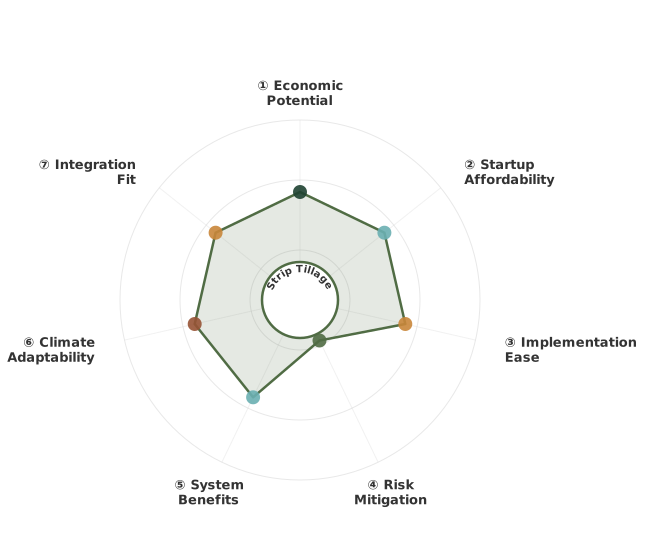
How These Traits Are Calculated
Trait dimensions are ordered clockwise starting from the top of the chart (12 o'clock position):
1. Economic Potential
Financial returns, annual value, and break-even timeline
WHAT: Evaluates financial viability by combining net annual value ($/ha from savings, income, and amortized harvests) with break-even timeline showing when practices pay for themselves.
WHY: Farmers need clear ROI understanding before committing resources. Fast payback (≤3 years) with strong returns (≥$300/ha) enables confident adoption, while long timelines (>10 years) restrict adoption to well-funded operations willing to wait for returns.
HOW: Calculated from net annual value in $/ha and break-even years. Exceptional (≥2.6): fast ROI ≤3 years + high value ≥$300/ha. Typical (1.8-2.5): moderate returns or longer timelines. Limited (<1.8): marginal economics or very long payback >10 years.
2. Startup Affordability
Initial investment costs and financial barrier to entry
WHAT: Measures financial barrier to entry through startup costs for equipment, infrastructure, consulting, and materials. Inverted scoring: lower costs = higher scores = more accessible adoption.
WHY: Affordability determines who can adopt. Low-cost practices (<$250/ha) enable widespread adoption across diverse scales, while high costs (>$2,500/ha) limit adoption to well-capitalized operations, creating barriers that slow regenerative transition.
HOW: Calculated from initial investment parsed from practice content. Inverted scoring: Exceptional (≥2.6): minimal investment <$250/ha. Typical (1.8-2.5): moderate costs $250-2,500/ha. Limited (<1.8): high barrier >$2,500/ha.
3. Implementation Ease
Learning curve and specialized knowledge required
WHAT: Measures how much learning, planning, and specialized knowledge a practice requires. Simpler practices with fewer steps score higher, while complex practices requiring extensive training or specialized resources score lower.
WHY: Complex practices create adoption barriers even when economically viable. Straightforward practices enable faster adoption and broader participation, while those requiring extensive training, timing precision, or specialized equipment limit who can succeed.
HOW: Evaluated by measuring documentation length and identifying complexity markers like location-specific requirements, seasonal timing windows, specialized skills, and dedicated equipment needs. Exceptional (≥2.6): straightforward practices with minimal prerequisites. Typical (1.8-2.5): moderate learning curve with some specialized needs. Limited (<1.8): steep learning curve requiring significant training or resources.
4. Risk Mitigation
Identified financial and ecological risk assessment
WHAT: Evaluates documented risks across financial (investment loss, market volatility) and ecological (crop failure, pest outbreaks) domains. Inverted scoring: fewer risks = higher scores.
WHY: Understanding risk exposure helps farmers make informed decisions. Low-risk practices allow confident implementation, while high-risk practices require careful planning and contingency resources. Risk transparency prevents costly failures.
HOW: Calculated from identified risks in practice content. Inverted scoring: Exceptional (≥2.6): ≤2 risks with manageable severity. Typical (1.8-2.5): 3-5 moderate risks. Limited (<1.8): 6+ risks or severe exposure.
5. System Benefits
How many ways the practice improves your land simultaneously
WHAT: Measures how many aspects of land health improve at once—carbon storage, soil quality, erosion control, water absorption, and biodiversity. Practices that improve multiple areas simultaneously create compounding benefits where each improvement reinforces the others.
WHY: The best practices solve multiple problems at once. For example, addressing erosion simultaneously builds carbon and improves water infiltration, creating a resilient system with positive feedback loops. Single-benefit approaches miss these compound transformation opportunities.
HOW: Evaluated across five key outcomes: carbon sequestration, soil organic matter increase, erosion reduction, water infiltration improvement, and biodiversity enhancement. Exceptional (≥2.6): high carbon storage (>8 t/ha/yr), improvements across 4-5 areas, transformative outcomes. Typical (1.8-2.5): moderate carbon (3-8 t/ha/yr), improvements across 2-3 areas. Limited (<1.8): modest impact (<3 t/ha/yr), single-area focus only.
6. Climate Adaptability
Geographic applicability across Köppen climate zones
WHAT: Evaluates geographic applicability by assessing how many Köppen climate zones successfully support a practice and what adaptation requirements are needed. Measures breadth of climates where farmers can implement with minimal to moderate modifications.
WHY: Universal practices working across diverse climates enable more farmers to adopt regenerative approaches. Practices limited to single climate types (only Mediterranean, only tropical) restrict adoption and slow global transition. Adaptability determines whether a practice serves niche regions or offers broad transformation.
HOW: LLM evaluation of regional success stories, Köppen zone coverage, and adaptation needs. Exceptional (≥2.6): 5+ zones or 4+ climate types, 3+ continents, minimal adaptation. Typical (1.8-2.5): 3-4 zones or 2-3 types, 2 continents, moderate adaptation. Limited (<1.8): 1-2 zones, single region, significant adaptation or highly specialized.
7. Integration Fit
How well this practice combines with others you're doing
WHAT: Measures how well a practice combines with other regenerative practices you might be doing. Some practices work as building blocks that make many other practices easier or more effective, while others work best on their own.
WHY: Practices that combine well with many others create more value on your farm. For example, cover cropping enables no-till, improves grazing, supports crop diversity, and helps water management—making all of them work better together. This helps you build a coherent system rather than juggling disconnected practices.
HOW: Evaluated by identifying which practices combine well and how strong those combinations are. 'Ideally Suited' means strong combinations where practices reinforce each other (practice A makes B easier, while B makes A more effective). 'Adequate' means complementary benefits that work well together. Exceptional (≥2.6): combines well with 6+ practices, serves as a building block. Typical (1.8-2.5): combines with 3-5 practices. Limited (<1.8): 1-2 practices or works best alone.
Going Deeper
1
WHY - The Benefits
Strip tillage offers a pragmatic approach to improving crop establishment and nutrient management, particularly during the transition to more regenerative systems. Its benefits are most pronounced when applied strategically, addressing specific agronomic challenges that...
Strip tillage offers a pragmatic approach to improving crop establishment and nutrient management, particularly during the transition to more regenerative systems. Its benefits are most pronounced when applied strategically, addressing specific agronomic challenges that can hinder early growth and overall farm profitability. Its regenerative value lies not in its inherent sustainability, but in its potential to facilitate a more comprehensive shift towards practices that genuinely build soil health.
WHY - The Benefits
Strip tillage offers a pragmatic approach to improving crop establishment and nutrient management, particularly during the transition to more regenerative systems. Its benefits are most pronounced when applied strategically, addressing specific agronomic challenges that...
Strip tillage offers a pragmatic approach to improving crop establishment and nutrient management, particularly during the transition to more regenerative systems. Its benefits are most pronounced when applied strategically, addressing specific agronomic challenges that can hinder early growth and overall farm profitability. Its regenerative value lies not in its inherent sustainability, but in its potential to facilitate a more comprehensive shift towards practices that genuinely build soil health.
Soil Health Benefits
While strip tillage intentionally disturbs soil, its impact is localized to narrow bands. In the inter-row zones, soil remains relatively undisturbed, preserving soil structure, protecting earthworm populations, and maintaining fungal networks. This means a significant portion of the soil surface continues to benefit from the principles of keeping soil covered and maintaining living roots, especially when paired with cover crops. The targeted disturbance in the row can create a more favorable microenvironment for seed germination and root development, potentially leading to improved root architecture as roots explore the less compacted zones.
However, the tilled bands can experience localized reductions in soil organic matter due to increased oxidation and disruption of microbial communities. The key to mitigating this is the precision of the operation—only disturbing what is necessary—and the immediate follow-up with practices that rebuild soil health. By creating an environment where seeds germinate and establish robustly, strip tillage indirectly supports the maintenance of living roots by ensuring a successful cash crop emerges.
Economic Benefits
The primary economic driver for adopting strip tillage is often improved crop establishment and yield, especially in challenging conditions. In cooler climates or on soils that tend to stay cool and wet, the warmer, drier seedbed created by strip tillage can accelerate germination and emergence by 3-7 days. This earlier start allows crops to reach maturity faster, potentially reducing the risk of frost damage late in the season or enabling double-cropping opportunities in some regions.
Nutrient management is another key economic benefit. Strip tillage allows for the precise placement of fertilizers (both synthetic and organic) directly into the seed zone. This targeted application reduces the total amount of fertilizer needed by 10-25% as nutrients are placed where the plant can access them most efficiently, minimizing losses to leaching or volatilization from the undisturbed zones. This precision nutrient placement can lead to direct cost savings for farmers.
The economic appeal also comes from its hybrid nature. For farmers hesitant to adopt full no-till due to concerns about early-season performance, strip tillage offers a compromise. It can maintain yields that might otherwise be compromised in a strict no-till system on their land, thereby preserving profitability during the transition phase. The investment in specialized strip-till equipment (or modifications to existing planters) needs to be weighed against these potential gains in yield and input savings.
Regenerative Systems Fit
Strip tillage is best understood as a transition practice within the regenerative agriculture framework. It consciously violates the principle of minimizing soil disturbance (Principle 1) by mechanically tilling narrow bands. However, its regenerative value emerges from how it's implemented and its intended timeline:
-
Minimizing Disturbance (Principle 1): While tillage occurs, it's limited to a small fraction of the soil area (around 20-25% of the field surface). The inter-row zones remain largely undisturbed, preserving residual soil structure and biology. The critical caveat is that this practice must be temporary. The goal is to use strip tillage to overcome initial establishment barriers, not as an ongoing management strategy. The overarching aim is to move towards full no-till where disturbance is further minimized or eliminated entirely.
-
Maximizing Crop Diversity (Principle 2): Strip tillage itself doesn't directly increase crop diversity. However, by enabling more reliable crop establishment, it can facilitate the inclusion of cover crops in the system. Cover crops, planted in the undisturbed inter-row areas or between cash crop cycles, are a primary driver of diversity. Successful cash crop establishment through strip tillage creates the confidence and economic stability to experiment with more diverse cover crop mixes, enhancing below-ground biodiversity.
-
Keeping Soil Covered (Principle 3): The significant inter-row spacing (typically 60-100 cm or 2-3 feet wide) remains covered by crop residue, cover crops, or living pasture and can be more effectively managed under strip tillage than broadcast tillage. This continuous cover in a large portion of the field is crucial for erosion control, moisture conservation, and providing habitat for soil organisms.
-
Maintaining Living Roots (Principle 4): By improving early season stand establishment, strip tillage directly supports the main cash crop's ability to maintain living roots for as long as possible. Furthermore, it opens the door for integrating cover crops, which extend the living root presence throughout the year, feeding the soil food web and improving soil structure.
-
Integrating Livestock (Principle 5): Strip tillage can be compatible with integrated livestock systems. For example, in a silvopastoral or alley-cropping system, strip tillage could be used to establish cash crops or cover crops within the alleys between trees. Managed grazing in the inter-row zones can help manage residue and incorporate nutrients, provided care is taken to avoid re-compacting previously tilled bands or damaging young trees/crops.
Transition Timeline & Phase-Out Strategy: For strip tillage to be considered regenerative, it requires a defined phase-out strategy. This typically involves: 1. Initial Adoption: Use strip tillage for 2-4 years to overcome specific establishment challenges (e.g., cool soils, residue management) and build confidence. 2. Cover Crop Integration: Simultaneously, or beginning year 1-2, implement diverse cover crops in the inter-row zones and potentially between cash crop cycles. 3. Monitoring Soil Health: Track soil organic matter, infiltration rates, earthworm populations, and aggregate stability in both the tilled bands and undisturbed inter-rows. 4. Gradual Reduction: As soil health improves and biology strengthens—evidenced by better root penetration, water infiltration, and organic matter content—begin reducing tillage intensity. This might involve narrower strips, shallower tillage, or transitioning to secondary tillage equipment that causes less disturbance if needed. 5. Full No-Till Transition: Aim to shift to full no-till within 3-7 years, depending on soil type, climate, and the rate of biological recovery. Success looks like achieving acceptable crop establishment, yield, and nutrient management without any row disturbance.
The ultimate success of strip tillage as a regenerative transition practice hinges on the farmer's commitment to phasing it out and allowing biological processes to fully take over soil management responsibilities.
Sources behind this view
Videos & Podcasts
-
Farmers are adopting strip-tillage for efficiency and to address challenges in both conventional and no-till systems, including nutrient stratification and inconsistent crop emergence, aiming to impro
-
A Minnesota farmer details their successful transition to strip-tilling and no-till, highlighting significant improvements in soil health (organic matter, infiltration, earthworms), yield increases, p
-
Farmers discuss no-till benefits (soil health, water retention, weed control) and challenges (labor intensity, initial cost). Strategies include tarping, mulching, cover cropping, and careful planning
-
Developed strip-till technology that creates a 10-inch tilled zone for planting, injecting starter fertilizer and liquid nitrogen. This improves soil warming, drying, and germination, enabling earlier
Community
-
Goranson Farm in coastal Maine reduced tillage by adopting strip tillage, using Yeomans plows to break compaction and create seedbeds, preserving soil organic matter and reducing labor by 75%.
Read more (opens in new window) smallfarms.cornell.edu -
Strip tillage is a reduced tillage method that disturbs only the planting zone, balancing no-till benefits with tillage advantages for seedbed preparation. It alleviates compaction, warms soil, and re
Read more (opens in new window) smallfarms.cornell.edu -
Explains regenerative agriculture principles: no-till gardening to support soil microbiome and sequester carbon; using compost to reduce erosion and compaction; and planting diverse cover crops (grass
Read more (opens in new window) ucanr.edu -
No-till crop production avoids damaging soil disturbance, allowing soil organisms to build a healthy ecosystem, resulting in improved soil structure, fertility, water infiltration, and reduced erosion
Read more (opens in new window) permies.com
Research
-
Технології Strip-till і Verti-till у контексті мінімізації обробітку ґрунту (opens in new window)
This study found: Strip-till and Verti-till are soil conservation technologies that save fuel, conserve moisture, reduce erosion, and boost soil life. They are effective in dry regions, increasing yields for crops like
-
Regenerative farming and conservation tillage: economic benefits and ecological impacts in contemporary agriculture (opens in new window)
This study found: Regenerative farming with conservation tillage (no-till, strip-till) improves soil health, reduces emissions, and boosts farm profits by cutting costs and stabilizing yields. Requires farmer training
-
Conventional, Minimum/Reduced, and Zero Tillage: Implications for Soil and Water Conservation and Residue Management in Global and Indian Contexts (opens in new window)
This study found: Zero tillage, especially with Happy Seeders, improves soil structure, water retention, and yields by up to 17% while cutting costs and emissions. Success depends on local adaptation and integrated wee
-
A Strip-Till One-Pass System as a Component of Conservation Agriculture (opens in new window)
This study found: A strip-till one-pass system improved soil structure, boosted soil life (earthworms, microbes) five-fold, and reduced erosion, labor, fuel, and CO2 emissions compared to traditional ploughing.
From the Web
-
Conservation tillage principles include reducing tillage, using crop rotations with cover crops to maintain soil surface biomass (especially cereal rye), and managing equipment. These practices enhanc
-
Conservation tillage principles include reducing tillage to minimize soil compaction, using crop rotations with cover crops to maintain soil coverage, and managing equipment for site-specific needs. M
-
Strip tillage is a reduced tillage system that disturbs only the planting zone, balancing no-till benefits with tillage advantages for seedbed preparation. It alleviates compaction, warms soil, and re
-
Conservation tillage principles include reducing tillage, using crop rotations with cover crops like cereal rye, and maintaining maximum residue coverage on soil to improve soil health, reduce compact
2
WHERE - Regional Considerations
Strip tillage's effectiveness and necessity vary significantly by region, influenced by climate, soil type, prevailing cropping systems, and equipment availability. Its advantages are most pronounced in areas with specific challenges that traditional no-till might not...
Strip tillage's effectiveness and necessity vary significantly by region, influenced by climate, soil type, prevailing cropping systems, and equipment availability. Its advantages are most pronounced in areas with specific challenges that traditional no-till might not initially overcome.
WHERE - Regional Considerations
Strip tillage's effectiveness and necessity vary significantly by region, influenced by climate, soil type, prevailing cropping systems, and equipment availability. Its advantages are most pronounced in areas with specific challenges that traditional no-till might not...
Strip tillage's effectiveness and necessity vary significantly by region, influenced by climate, soil type, prevailing cropping systems, and equipment availability. Its advantages are most pronounced in areas with specific challenges that traditional no-till might not initially overcome.
Click Here to Look up your Region if you don't already know it
Humid Temperate Regions
Representative Locations: Midwestern United States, much of Northern Europe (e.g., Germany, Poland, UK), Eastern China, Japan. Climate Context: Moderate temperatures, distinct seasons, ample but variable rainfall (75-150 cm or 30-60 inches annually), USDA Zones 5-7, Köppen Cfb/Cfa. Strip Tillage Application: In these regions, strip tillage is often adopted to address cool, damp soils at planting time, which can delay emergence and increase seedling disease risk. It helps create a warmer, drier seedbed conducive to early growth. Heavy crop residue from corn or small grains can also necessitate strip tillage for easier planting and to facilitate early nitrogen availability in the row. Without sufficient residue management or soil warming in a no-till system, strip tillage offers a way to improve early-season stand establishment. International examples include using it for sugar beet or corn planting in France or Germany where early season conditions can be challenging.
Continental Dryland Regions
Representative Locations: Great Plains USA, Kazakhstan, parts of Australia's wheat belt, southern Russia. Climate Context: Low to moderate rainfall (25-60 cm or 10-24 inches annually), pronounced wet/dry seasons, potential for wind erosion, USDA Zones 3-6, Köppen BSk/BSk. Strip Tillage Application: In these regions, moisture conservation is paramount. Strip tillage can create a tilled, narrow zone for planting that warms faster, promoting quicker germination and emergence, which helps the crop establish a root system before dry conditions fully set in. The undisturbed inter-rows serve as a buffer, protecting against wind and water erosion by covering the soil with stubble and potentially cover crops. It can be particularly useful for ensuring seed-to-soil contact in lighter soils or where residue levels are insufficient on their own to retain moisture and prevent wind erosion. Farmers in southern Ukraine or parts of Canada might use it for wheat or canola.
Subtropical and Mediterranean Regions
Representative Locations: Southeastern United States, Southern Europe (Spain, Italy), California, parts of South America (e.g., Argentina), Australia. Climate Context: Warm to hot summers, mild winters; humid subtropical climates have ample rain, Mediterranean climates have dry summers (40-90 cm or 15-35 inches annually), USDA Zones 8-10, Köppen Cfa/Csa/Csb. Strip Tillage Application: In regions with dry summers or where planting occurs during mild, potentially wet winters, strip tillage can aid planting. It helps create a suitable seedbed and can facilitate early nutrient uptake. In Mediterranean climates, the dry spells can be challenging for seed germination, so a warmed, finely textured seed zone can be beneficial. For crops like vegetables, fruits, or certain legumes that require specific seedbed conditions, strip tillage can offer more control than broadcasting nutrients and disturbing the entire surface. For example, it might be used in olive groves for intercropping or in vineyards for annual crop production between rows.
Tropical Regions
Representative Locations: Southeast Asia, Central and South America, sub-Saharan Africa. Climate Context: High temperatures year-round, often with distinct wet and dry seasons, high rainfall in wet periods (over 150 cm or 60 inches annually), Köppen Af/Am/Aw. Strip Tillage Application: In tropical regions with short, intense rainy seasons or long dry spells, strip tillage can be employed to ensure successful crop establishment. It can help create finer seedbeds in soils that might otherwise become cloddy or compacted during intense rains, or retain moisture in the seed zone during dry periods. For perennial cropping systems (e.g., fruit orchards, plantation crops), strip tillage might be used for planting annual cash crops or cover crops in the inter-rows. However, the high organic matter and biological activity in many tropical soils mean that strip tillage must be carefully managed to avoid excessive carbon loss and can often be bypassed entirely by effective no-till and cover cropping strategies.
3
HOW - Implementation Process
Strip tillage is an implement-driven practice. Successful implementation requires the right equipment, precise management of soil moisture, and a clear vision for how it fits into the broader regenerative transition.
Strip tillage is an implement-driven practice. Successful implementation requires the right equipment, precise management of soil moisture, and a clear vision for how it fits into the broader regenerative transition.
HOW - Implementation Process
Strip tillage is an implement-driven practice. Successful implementation requires the right equipment, precise management of soil moisture, and a clear vision for how it fits into the broader regenerative transition.
Strip tillage is an implement-driven practice. Successful implementation requires the right equipment, precise management of soil moisture, and a clear vision for how it fits into the broader regenerative transition.
Prerequisites
- Soil Assessment: Understand your soil type and existing conditions. Is compaction an issue? Is residue management challenging? Are early-season temperatures a significant limiting factor? Are your soils prone to erosion if left bare?
- Residue Levels: High residue levels (e.g., from corn) can be managed by strip tillers that cut, move, or incorporate residue in the tilled band. Low residue might not provide enough soil protection between strips.
- Climate & Planting Window: Strip tillage is most beneficial when early-season cool/wet soils or dry conditions pose a significant risk to crop establishment.
- Equipment Access: Availability of a strip-tillage implement or the ability to modify an existing planter.
- Cover Crop Plan: A strategy for planting and managing cover crops in the undisturbed areas is crucial for regenerative integration.
Phase 1: Equipment Setup and Modification
Strip-tillage machines typically consist of a row unit that includes:
- Row cleaner: To move surface residue out of the way in the tillage zone.
- Tillage component: Often coulters, rototillers, or shovels that cultivate the narrow band.
- Fertilizer tube: To place nutrients in the tilled band.
- Closing discs or rollers: To create a fine seedbed and firm the soil in the row.
Existing no-till planters can often be modified to perform strip tillage by adding specific row units. Ready-made strip-till implements are also available.
- Cost Consideration: Modifying a planter might cost $2,000-5,000 per row USD equivalent. New, dedicated strip-till units can range from $5,000-15,000+ per row depending on features and brand. This is a significant upfront investment. Seek used equipment or consider custom hire if budget is limited.
Phase 2: Field Preparation and Operation
-
Timing is Critical:
- Soil Moisture: The tilled band should be moist enough to crumble, not smear or form large clods. Too wet soil leads to compaction and poor seedbed quality. Too dry soil results in poor seedbed conditioning and potential for wind erosion in the tilled strip. Test by squeezing soil: it should form a ball that breaks apart easily.
- Season: Typically performed in spring just before planting or in fall for overwintering of the tilled strip, depending on climate and crop. Fall strip-tilling can help the soil warm and dry faster in spring and allow biological activity to begin in the loosened soil.
-
Strip Creation:
- Depth: Typically 15-25 cm (6-10 inches) deep, depending on equipment and soil type.
- Width: 15-25 cm (6-10 inches). Wider bands ensure more seed-to-soil contact but disturb more soil.
- Residue Management: Ensure row cleaners effectively move residue so the tilling component can work. Some systems incorporate residue lightly, others simply push it aside.
- Nutrient Application: Apply starter fertilizers, micronutrients, or even a portion of nitrogen fertilizer directly into the tilled band.
-
Planting:
- Immediately follow the strip-tillage operation with your planter in the freshly tilled band. This ensures optimal seed-to-soil contact and places the seed in the warmed, nutrient-enriched zone.
Phase 3: Post-Planting and Integration with Regenerative Practices
- Cover Cropping in Inter-Rows: Crucial for regenerative integration. Plant diverse cover crop mixes in the undisturbed inter-row areas. This maintains soil cover, feeds biology, improves structure, and sequesters carbon. Select species suitable for the climate and plant them at appropriate times—often after cash crop harvest in fall or strategically during the growing season if possible.
- Residue Management: Leave residue in the inter-rows to protect soil. The strip-tilled band will likely have less residue cover initially but will be protected by the developing cash crop.
- Minimize Traffic: Avoid driving on the tilled bands or the crop rows as much as possible, especially when soil is moist, to prevent re-compaction. Controlled traffic farming (CTF) principles can be adapted.
- Livestock Integration (Context-Dependent): If integrating livestock, manage grazing carefully. Ensure animals do not graze crop residue too low immediately after planting or damage young cash crops. Graze the inter-row areas during stages when crops are less vulnerable.
Transition Timeline & Phase-Out Strategy
As discussed in "Regenerative Systems Fit," the critical element for regenerative adoption is the phase-out strategy:
- Years 1-3: Use strip tillage to overcome specific establishment challenges (e.g., cool soils, residue). Focus on maximizing cover crop diversity and establishment in inter-rows. Monitor soil health indicators.
- Years 3-5: As soil organic matter increases and biological activity improves root penetration in inter-rows, experiment with reduced tillage intensity in the row (e.g., warmer, drier soil conditions mean less need for intensive tillage; improved native soil biology may enhance seed-to-soil contact).
- Years 5-7+: Transition to full no-till. Aim to establish the cash crop directly into the undisturbed residue of the previous crop (cash or cover crop) without any row tillage. Success achieved when crop establishment and yield are comparable to or better than the strip-tilled system.
The decision to phase out should be driven by soil health indicators and operational success rather than arbitrary timelines.
Sources behind this view
Videos & Podcasts
-
A Minnesota farmer details their successful transition to strip-tilling and no-till, highlighting significant improvements in soil health (organic matter, infiltration, earthworms), yield increases, p
-
Farmers discuss no-till benefits (soil health, water retention, weed control) and challenges (labor intensity, initial cost). Strategies include tarping, mulching, cover cropping, and careful planning
-
Farmers are adopting strip-tillage for efficiency and to address challenges in both conventional and no-till systems, including nutrient stratification and inconsistent crop emergence, aiming to impro
-
Developed strip-till technology that creates a 10-inch tilled zone for planting, injecting starter fertilizer and liquid nitrogen. This improves soil warming, drying, and germination, enabling earlier
Research
-
Технології Strip-till і Verti-till у контексті мінімізації обробітку ґрунту (opens in new window)
This study found: Strip-till and Verti-till are soil conservation technologies that save fuel, conserve moisture, reduce erosion, and boost soil life. They are effective in dry regions, increasing yields for crops like
-
Regenerative farming and conservation tillage: economic benefits and ecological impacts in contemporary agriculture (opens in new window)
This study found: Regenerative farming with conservation tillage (no-till, strip-till) improves soil health, reduces emissions, and boosts farm profits by cutting costs and stabilizing yields. Requires farmer training
-
Regenerative Agriculture Practices as a Green Environmental Tool for Achieving Sustainability of Agroecosystems (opens in new window)
This study found: A new TIV system combines strip-tillage and 3D spraying to improve soil health, increase yields by up to 20%, and reduce soil disturbance by 1.8x. It also cuts chemical use and pollution through targe
-
Conventional, Minimum/Reduced, and Zero Tillage: Implications for Soil and Water Conservation and Residue Management in Global and Indian Contexts (opens in new window)
This study found: Zero tillage, especially with Happy Seeders, improves soil structure, water retention, and yields by up to 17% while cutting costs and emissions. Success depends on local adaptation and integrated wee
4
Know the Debate
Strip tillage offers a flexible approach to early-season crop establishment and nutrient management, often serving as a bridge to full no-till. Its...
Know the Debate
Strip tillage offers a flexible approach to early-season crop establishment and nutrient management, often serving as a bridge to full no-till. Its...
Strip tillage offers a flexible approach to early-season crop establishment and nutrient management, often serving as a bridge to full no-till. Its success varies significantly by location and soil type: it is most advantageous in humid temperate regions needing soil warming or dryland areas requiring moisture conservation. While its initial benefits can be seen in 1-3 years, deeper soil health regeneration takes 3-7 years and relies on integrating cover crops and phasing out disturbance. Practical implementation requires investment in specialized equipment or custom hire ($20-$60/acre custom rate), and a strategic plan to eventually transition away from row disturbance.
How long until strip tillage shows soil health benefits?
Noticeable improvements (1-3 years)
Academic and institute sources suggest initial soil health improvements, like enhanced microbial activity and better seedbed conditions, can be observed within 1-3 years of adopting strip tillage, particularly when combined with good cover cropping practices.
Sources behind this view
Sources behind this view
Videos & Podcasts
-
A Minnesota farmer details their successful transition to strip-tilling and no-till, highlighting significant improvements in soil health (organic matter, infiltration, earthworms), yield increases, profitability, and reduced input costs, while acknowledging challenges and emphasizing a mindset shift and starting small.
Research
-
ANALYSIS OF FOREIGN SCIENTIFIC STUDIES OF THE INFLUENCE OF RESOURCE-SAVING TILLAGE TECHNOLOGIES ON THE PRODUCTIVITY OF AGRICULTURE CROPS AND INDICATORS OF SOIL FERTILITY (opens in new window)
This study found: A review of international studies suggests that conservation tillage methods, especially 'strip-till' (where only narrow bands of soil are tilled), can significantly improve farm productivity and soil health. These methods help plants absorb nutrients better, leading to higher crop yields, particularly when weather is challenging. By improving how soils store and release nitrogen, these practices can also reduce greenhouse gas emissions. Conservation tillage acts as a natural pest control, enhances plant growth, and improves the quality of harvested crops. Furthermore, it helps protect soil from erosion and maintains valuable soil organic matter. Strip-till is becoming more popular because it saves resources, improves how soil holds water, and allows for more efficient timing of farm tasks, ultimately boosting plant nutrition and soil structure.
From the Web
-
Strip tillage is a system requiring planning for crop rotation, cover crop management, and specialized equipment. It involves tools like coulters, row cleaners, and shanks to prepare a ~12" planting zone, alleviating compaction and managing residue. Systems can be adapted for various scales, from large tractors to walk-behind units, with horsepower requirements varying based on depth and soil conditions.
Full benefits realized (3-7+ years)
Field practitioners often report that substantial and lasting soil health improvements, such as significant organic matter increases and robust biological activity, take 3-7 years or more to fully manifest, especially in challenging soils or after intensive tillage.
Sources behind this view
Sources behind this view
Videos & Podcasts
-
Transitioned from broadcast fertilizer to strip-till in fall 2011, integrating cover crops by spring 2017 to improve fertilizer efficiency, reduce passes, and enhance crop production in Iowa.
-
A Minnesota farmer details their successful transition to strip-tilling and no-till, highlighting significant improvements in soil health (organic matter, infiltration, earthworms), yield increases, profitability, and reduced input costs, while acknowledging challenges and emphasizing a mindset shift and starting small.
-
Farmers discuss no-till benefits (soil health, water retention, weed control) and challenges (labor intensity, initial cost). Strategies include tarping, mulching, cover cropping, and careful planning. Some use minimal tillage for specific tasks, balancing efficiency with soil health and work-life balance. Nutrient management involves organic matter cycling and supplemental fertilizers.
Making Sense of the Differences
The timeline for observing strip tillage benefits depends on starting soil conditions, climate, and management intensity. Initial improvements in seedbed quality and nutrient availability can appear within 1-3 years. Deeper soil health gains, such as significant organic matter accumulation and robust soil biology, typically require 3-7 years of consistent regenerative practices like cover cropping and eventual transition to full no-till.
Is strip tillage a permanent solution or a transition tool?
Transition tool for phase-out
Regenerative farmers emphasize that strip tillage is most valuable as a temporary measure to overcome establishment challenges, with a clear strategy to phase it out as soil biology strengthens and full no-till becomes viable.
Sources behind this view
Sources behind this view
Videos & Podcasts
-
Farmers are adopting strip-tillage for efficiency and to address challenges in both conventional and no-till systems, including nutrient stratification and inconsistent crop emergence, aiming to improve soil health and yields.
-
A Minnesota farmer details their successful transition to strip-tilling and no-till, highlighting significant improvements in soil health (organic matter, infiltration, earthworms), yield increases, profitability, and reduced input costs, while acknowledging challenges and emphasizing a mindset shift and starting small.
-
Farmers discuss no-till benefits (soil health, water retention, weed control) and challenges (labor intensity, initial cost). Strategies include tarping, mulching, cover cropping, and careful planning. Some use minimal tillage for specific tasks, balancing efficiency with soil health and work-life balance. Nutrient management involves organic matter cycling and supplemental fertilizers.
-
Transitioned from broadcast fertilizer to strip-till in fall 2011, integrating cover crops by spring 2017 to improve fertilizer efficiency, reduce passes, and enhance crop production in Iowa.
Versatile conservation practice
Academic and institute sources often describe strip tillage as a standalone conservation practice that offers lasting benefits in soil health, nutrient management, and yield across various conditions, without explicitly mandating its phase-out.
Sources behind this view
Sources behind this view
Research
-
ANALYSIS OF FOREIGN SCIENTIFIC STUDIES OF THE INFLUENCE OF RESOURCE-SAVING TILLAGE TECHNOLOGIES ON THE PRODUCTIVITY OF AGRICULTURE CROPS AND INDICATORS OF SOIL FERTILITY (opens in new window)
This study found: A review of international studies suggests that conservation tillage methods, especially 'strip-till' (where only narrow bands of soil are tilled), can significantly improve farm productivity and soil health. These methods help plants absorb nutrients better, leading to higher crop yields, particularly when weather is challenging. By improving how soils store and release nitrogen, these practices can also reduce greenhouse gas emissions. Conservation tillage acts as a natural pest control, enhances plant growth, and improves the quality of harvested crops. Furthermore, it helps protect soil from erosion and maintains valuable soil organic matter. Strip-till is becoming more popular because it saves resources, improves how soil holds water, and allows for more efficient timing of farm tasks, ultimately boosting plant nutrition and soil structure.
-
Технології Strip-till і Verti-till у контексті мінімізації обробітку ґрунту (opens in new window)
This study found: This article reviews two soil-friendly farming methods, Strip-till and Verti-till, which are key to protecting soil and promoting sustainable farming, especially with challenges like soil degradation, water shortages, and climate change. Strip-till combines aspects of traditional plowing and no-till farming. It loosens soil only in narrow strips where seeds are planted and allows for targeted fertilizer application. This helps roots grow better, keeps soil moist, and can save 40-50% on fuel. Verti-till focuses on breaking up compacted soil layers, encouraging roots to grow deeper, improving water absorption, and speeding up the breakdown of crop residues, all while keeping the soil surface covered. Both methods help reduce soil erosion and greenhouse gas emissions, boost soil life, and maintain crop yields even in tough weather. In Ukraine, these methods are particularly useful in dry areas. Strip-till has shown yield increases for corn and sunflowers, while Verti-till is good for preparing fields for winter crops. The study emphasizes tailoring these techniques to individual farms and integrating them with modern farming technologies for the best results and long-term soil health.
From the Web
-
Strip tillage is a reduced tillage system that disturbs only the planting zone, balancing no-till benefits with tillage advantages for seedbed preparation. It alleviates compaction, warms soil, and retains residue, offering labor savings and improved soil health for vegetable production, especially when integrated with cover crops.
-
Strip tillage warms and dries soil by clearing planting rows of residue, often performed in fall with nutrient injection. It's a variation of no-till, allowing for earlier soil warming and improved drainage.
Making Sense of the Differences
The primary debate around strip tillage in regenerative systems centers on its role as a temporary transition tool versus a permanent practice. While many academic and institute sources highlight its benefits as a conservation tillage method, experienced regenerative farmers emphasize its value in overcoming initial barriers to no-till, with a deliberate plan to phase out row disturbance as soil health improves. Its regenerative capacity depends on this commitment to eventual transition.
Where does strip tillage perform best on different soils and climates?
Best in cool/wet springs or dryland areas
Strip tillage is most effective in climates and soils where early-season soil warming, drying, and moisture conservation are critical for germination. This includes humid temperate regions with cool, damp springs and dryland regions needing to maximize water availability.
Sources behind this view
Sources behind this view
Videos & Podcasts
-
Strip-tillage excels in high moisture, poorly drained, flat soils (e.g., Central Iowa) for seedbed warming. On slopes, contour farming is crucial to prevent erosion, as disturbed soil is susceptible to rain events.

Research
-
Технології Strip-till і Verti-till у контексті мінімізації обробітку ґрунту (opens in new window)
This study found: This article reviews two soil-friendly farming methods, Strip-till and Verti-till, which are key to protecting soil and promoting sustainable farming, especially with challenges like soil degradation, water shortages, and climate change. Strip-till combines aspects of traditional plowing and no-till farming. It loosens soil only in narrow strips where seeds are planted and allows for targeted fertilizer application. This helps roots grow better, keeps soil moist, and can save 40-50% on fuel. Verti-till focuses on breaking up compacted soil layers, encouraging roots to grow deeper, improving water absorption, and speeding up the breakdown of crop residues, all while keeping the soil surface covered. Both methods help reduce soil erosion and greenhouse gas emissions, boost soil life, and maintain crop yields even in tough weather. In Ukraine, these methods are particularly useful in dry areas. Strip-till has shown yield increases for corn and sunflowers, while Verti-till is good for preparing fields for winter crops. The study emphasizes tailoring these techniques to individual farms and integrating them with modern farming technologies for the best results and long-term soil health.
-
Rye–Vetch Spatial Arrangement and Tillage: Impacts on Soil Nitrogen and Sweet Corn Roots (opens in new window)
This study found: A four-year study in Michigan looked at how different ways of planting a cover crop mix of cereal rye and hairy vetch, along with two tillage methods (strip-tillage and full tillage), affected soil nitrogen and sweet corn. Strip-tillage generally reduced available soil nitrogen but improved soil moisture and corn plant growth compared to full tillage. Planting the rye and vetch in separate strips, rather than mixed together, increased nitrogen availability right in the corn row, though it didn't significantly boost corn yield or overall plant size. However, the corn's root system did respond to these changes. The findings suggest that combining strip-tillage with cover crops planted in strips could be a promising approach for organic farming, but more research is needed on different crops and cover crop management.
From the Web
-
Strip tillage is a reduced tillage system that disturbs only the planting zone, balancing no-till benefits with tillage advantages for seedbed preparation. It alleviates compaction, warms soil, and retains residue, offering labor savings and improved soil health for vegetable production, especially when integrated with cover crops.
Moderate benefits in other regions
While strip tillage offers general benefits like residue management and nutrient banding, its superiority over no-till may be less pronounced in regions with reliably warm, moist conditions or where soil compaction is not the primary limiting factor.
Sources behind this view
Sources behind this view
Videos & Podcasts
-
Compares strip-till, no-till, and conventional tillage, noting regional differences (Midwest vs. South) and farmer interest in these methods, particularly when combined with cover crops.
Research
-
Short-Term Effects of Strip Tillage on Soil Physicochemical Properties and Crop Yields in Northeast China (opens in new window)
This study found: A two-year study in Northeast China compared different tillage methods for growing soybeans and corn. They looked at strip tillage (tilling only the planting rows), no-till (leaving the soil undisturbed), and conventional tillage (plowing the whole field). Strip tillage made the soil in the planting rows warmer and less compacted, and the areas between rows stayed moister, especially with straw mulch. Soil structure and nutrients improved more with strip tillage and no-till compared to conventional tillage. Corn grew best with conventional tillage, but strip tillage still produced good yields. Soybeans, however, yielded the highest with no-till. The study found that tillage mainly affected crop yields by changing soil temperature and structure, with different effects on corn versus soybeans. Strip tillage is recommended for corn, while no-till is better for soybeans in this region.
From the Web
-
Strip-tilling removes residue to warm cold soils (10 hp/row), but can increase erosion on slopes and cause crusting without residue cover; natural warming is possible with good soil structure.
Making Sense of the Differences
Strip tillage's effectiveness is strongly linked to regional climate and soil conditions. It is most advantageous in areas where early-season soil warming and drying are critical (humid temperate regions with cool springs) or where moisture conservation is paramount (dryland regions). While it offers general benefits like residue management, its superiority over no-till might be less pronounced in consistently warm, moist climates or where soil compaction is not a major issue. Careful soil assessment and regional adaptation are crucial for successful implementation.
5
HOW MUCH - Costs & Investment
Note: Costs are approximate and based on recent US economic data (2023-2025). Multiply by local labor and material cost indices for your region. Labor costs vary significantly internationally.
Note: Costs are approximate and based on recent US economic data (2023-2025). Multiply by local labor and material cost indices for your region. Labor costs vary significantly internationally.
HOW MUCH - Costs & Investment
Note: Costs are approximate and based on recent US economic data (2023-2025). Multiply by local labor and material cost indices for your region. Labor costs vary significantly internationally.
Note: Costs are approximate and based on recent US economic data (2023-2025). Multiply by local labor and material cost indices for your region. Labor costs vary significantly internationally.
Note: All costs are based on recent US economic data (2024–2026) and may vary substantially by region based on local labor rates, fuel prices, equipment availability, and regulatory requirements.
Equipment Capital Costs
For producers implementing strip tillage, the primary capital expenditure involves either retrofitting an existing planter or chassis with strip-till row units or purchasing a fully integrated strip-till bar. For small-scale operations (under 50 acres (20 ha)), the most common approach is the row-unit attachment strategy. These attachments now range from $2,085 to $5,210 per unit, allowing a farmer to modernize an existing setup without a total system overhaul. Mid-size operations (50–500 acres (20–202 ha)) typically invest in standardized row unit attachments costing $5,210 to $10,420, or specialized bars ranging from $31,260 to $83,360. Large-scale operations (over 500 acres (202 ha)) frequently demand high-end, heavy-duty integrated bars featuring active downforce and GPS-guided precision. These systems reach costs of $83,360 to $156,300+. Depreciation is a significant factor here; these tools are typically amortized over an 8–10 year window, meaning the annual cost of ownership should be calculated as 10–12% of the purchase price plus maintenance.
Custom Hire and Operating Costs
Custom hire remains the preferred entry point for many producers to avoid hefty capital outlays. Custom rates for strip tillage are heavily dependent on local competition and field size. For small-scale farms, rates currently sit between $21 and $63 per acre ($52–$156/ha). Mid-size producers often negotiate rates of $17 to $42 per acre ($42–$104/ha), while large operations with consistent, high-acreage contracts can secure rates as low as $13 to $33 per acre ($32–$82/ha). If opting to own the machinery, operating costs—primarily fuel, labor, and wear-and-tear items like bearings and shanks—must be accounted for. For small-scale owners, these variable costs fluctuate between $4 and $13 per acre ($9.9–$32/ha) per pass. Mid-size operators typically see costs of $3 to $8 per acre ($7.4–$20/ha), and large-scale operations optimize this to $2 to $7 per acre ($4.9–$17/ha). These figures assume standard soil types; high-clay soils or rocky conditions may increase repair costs by 15–20%.
Input and Operational Expenditures
The recurring operational budget for a strip-till system includes the tillage pass, seed, and nutrient management. The strip-tillage operation itself ranges from $21 to $63 per acre ($52–$156/ha), encompassing labor, fuel, and equipment maintenance. Seed costs remain stable regardless of tillage method, typically trending between $42 and $167 per acre ($104–$413/ha) depending on cultivar selection. The primary economic offset is found in fertilizer management. By utilizing precision-banded applications, farmers can expect fertilizer costs of $83 to $333 per acre ($205–$823/ha), with potential total expenditure reductions of 10–25% compared to broadcast methods due to improved nutrient uptake efficiency and reduced runoff loss. Planting expenses remain relatively consistent with other conservation tillage methods, typically ranging from $13 to $33 per acre ($32–$82/ha).
Most Spend: For the majority of operations, total yearly capital and operational investment falls in the $230–$460 per acre ($568–$1,137/ha) range, excluding land and overhead. This middle 60% reflects farmers who utilize mid-scale equipment or local custom operators, balancing effective residue management with realistic equipment depreciation schedules.
Why the Range?: The primary drivers of cost variance are equipment sophistication and soil type. Operations tilling highly compacted or heavy clay soils require more robust shanks and higher horsepower, driving fuel and wear costs toward the upper end of the ranges. Conversely, operations with well-managed soil structures and existing modular attachments will consistently operate at the lower end of the cost spectrum. Geography also plays a role, as labor availability and the local density of equipment dealers dictate the spread between custom hire and ownership profitability.
Sources behind this view
Videos & Podcasts
-
A Minnesota farmer details their successful transition to strip-tilling and no-till, highlighting significant improvements in soil health (organic matter, infiltration, earthworms), yield increases, p
-
Developed strip-till technology that creates a 10-inch tilled zone for planting, injecting starter fertilizer and liquid nitrogen. This improves soil warming, drying, and germination, enabling earlier
-
Transitioned to strip-till in fall 2017 for profitability and soil health, making one pass to create tilled strips with banded fertilizer, eliminating spring tillage and saving fuel/time while maintai

-
Implementing strip-till across acres for improved fertility availability and soil health. This method involves fall strip-tilling and spring freshening, allowing for banded fertilizer application and
Community
-
Goranson Farm in coastal Maine reduced tillage by adopting strip tillage, using Yeomans plows to break compaction and create seedbeds, preserving soil organic matter and reducing labor by 75%.
Read more (opens in new window) smallfarms.cornell.edu
Research
-
Технології Strip-till і Verti-till у контексті мінімізації обробітку ґрунту (opens in new window)
This study found: Strip-till and Verti-till are soil conservation technologies that save fuel, conserve moisture, reduce erosion, and boost soil life. They are effective in dry regions, increasing yields for crops like
-
A Strip-Till One-Pass System as a Component of Conservation Agriculture (opens in new window)
This study found: A strip-till one-pass system improved soil structure, boosted soil life (earthworms, microbes) five-fold, and reduced erosion, labor, fuel, and CO2 emissions compared to traditional ploughing.
-
Strip-tillage reduces productivity in organically managed grain and forage cropping systems in the Upper Midwest, USA (opens in new window)
This study found: Eight-year organic study found strip-tillage reduced corn, soybean, and wheat yields by over 34% compared to conventional tillage, with increased weed pressure and lower nutrient availability impactin
-
Regenerative Agriculture Practices as a Green Environmental Tool for Achieving Sustainability of Agroecosystems (opens in new window)
This study found: A new TIV system combines strip-tillage and 3D spraying to improve soil health, increase yields by up to 20%, and reduce soil disturbance by 1.8x. It also cuts chemical use and pollution through targe
6
REWARDS AND RISKS - Economics & Risk Factors
Economic Scenarios
Economic Scenarios
REWARDS AND RISKS - Economics & Risk Factors
Economic Scenarios
Economic Scenarios
Strip tillage occupies a crucial middle ground between conventional tillage and no-till, offering a specialized risk-reward profile for those seeking long-term soil health dividends.
Best Case Scenario: The operation experiences optimal nutrient uptake and soil warming during the critical window between mid-April and early-May. Precise banding of inputs leads to a 20% reduction in fertilizer waste, with yield increases of 10–15% compared to previous conventional methods. By the third year, the combination of lower input costs and increased commodity yield results in a net revenue uptick of $80–$150 per acre ($198–$371/ha). The equipment investment is effectively recouped through efficiency gains within 24 months, and the farm moves toward a continuous no-till system with reduced mechanical footprint.
Typical Case Scenario: The system functions as a reliable stabilization tool. Fertilizer savings hover around 10–12%, and yields see a modest gain of 4–7% compared to historical baselines. The equipment investment is paid off through cumulative annual savings and increased soil stability over a 5–7 year period. While not producing a massive spike in profit, the system minimizes the risk of poor emergence in cold, wet springs, which on its own protects potential revenue against worst-case seasonal weather failures.
Worst Case Scenario: In less resilient soils, the tilled band is susceptible to moisture loss in dry years or compaction in wet years. If the shank depth is set incorrectly, subsoil compaction can create a plow pan that stunts root growth, potentially leading to a year-over-year yield deficit of 5–10%. If mechanical, fuel, and labor costs are not strictly controlled, the annual operational expense can balloon to $650 per acre ($1,606/ha), and without the projected yield increase, the producer faces a negative ROI for the first 4–5 years.
Transition Period Risks: The transition period often carries a "learning tax." Yields may fluctuate by 2–5% as soil organisms adjust to the change in disturbance patterns.
- Equipment Mismatch: Incorrectly calibrated closing wheels can leave air pockets in the row, causing uneven germination. This risk is mitigated by performing a "test pass" before the main planting operation, which adds $3–$5 per acre ($7.4–$12/ha) to the cost of pre-season setup but saves potential replant costs totaling $100+ per acre.
- Operational Timing: Tilling too wet is the most common transition risk. Soil structural damage can require deep-ripping or multi-year corrective tillage to resolve, effectively adding $60–$100 per acre ($148–$247/ha) in remedial tillage costs.
- Residue Management: In high-residue systems, failing to properly clear the row leads to nitrogen immobilization where microbes consume nutrients before the crop can access them. Using proper trash-whippers is essential to prevent this $30–$50 per acre ($74–$124/ha) nutrient loss.
Sources behind this view
Videos & Podcasts
-
Farmers discuss no-till benefits (soil health, water retention, weed control) and challenges (labor intensity, initial cost). Strategies include tarping, mulching, cover cropping, and careful planning
-
A Minnesota farmer details their successful transition to strip-tilling and no-till, highlighting significant improvements in soil health (organic matter, infiltration, earthworms), yield increases, p
-
Strongly advocates for no-till combined with cover crops, detailing benefits like erosion control, water conservation, improved soil structure, and increased biological activity. Emphasizes uniform re

-
Farmers are adopting strip-tillage for efficiency and to address challenges in both conventional and no-till systems, including nutrient stratification and inconsistent crop emergence, aiming to impro
Community
-
Goranson Farm in coastal Maine reduced tillage by adopting strip tillage, using Yeomans plows to break compaction and create seedbeds, preserving soil organic matter and reducing labor by 75%.
Read more (opens in new window) smallfarms.cornell.edu -
In the 1980s, USDA protocols promoted no-till, chopped-and-dropped cover crops, and compost teas over heavy tillage and chemical inputs. Farmers adopting these regenerative practices saw reduced soil
Read more (opens in new window) permies.com -
Sustainable soil management practices like reducing tillage, planting cover crops, and improving crop rotations enhance soil health and drought resilience. No-till systems drastically reduce water run
Read more (opens in new window) sustainableagriculture.net -
Explains the benefits of no-till/strip-till, cover crops, and nutrient management for reducing soil erosion, improving soil health, increasing water infiltration, and mitigating nutrient loss and gree
Read more (opens in new window) sustainableagriculture.net
Research
-
Технології Strip-till і Verti-till у контексті мінімізації обробітку ґрунту (opens in new window)
This study found: Strip-till and Verti-till are soil conservation technologies that save fuel, conserve moisture, reduce erosion, and boost soil life. They are effective in dry regions, increasing yields for crops like
-
Conventional, Minimum/Reduced, and Zero Tillage: Implications for Soil and Water Conservation and Residue Management in Global and Indian Contexts (opens in new window)
This study found: Zero tillage, especially with Happy Seeders, improves soil structure, water retention, and yields by up to 17% while cutting costs and emissions. Success depends on local adaptation and integrated wee
-
Regenerative farming and conservation tillage: economic benefits and ecological impacts in contemporary agriculture (opens in new window)
This study found: Regenerative farming with conservation tillage (no-till, strip-till) improves soil health, reduces emissions, and boosts farm profits by cutting costs and stabilizing yields. Requires farmer training
-
Soil Health, Crop Yield and Carbon Footprint Trade‐Offs Between Conservation and Conventional Farming: A Case Study (opens in new window)
This study found: Conservation farming in Central Europe improved soil health by 7% and cut GHG emissions by 43% over 8 years, maintaining crop yields. Key practices include reduced tillage, diverse rotations, and cove
From the Web
-
Conservation tillage principles include reducing tillage to minimize soil compaction, using crop rotations with cover crops to maintain soil coverage, and managing equipment for site-specific needs. M
-
Conservation tillage principles include reducing tillage, using crop rotations with cover crops to maintain soil surface biomass (especially cereal rye), and managing equipment. These practices enhanc
-
A guide for selecting row crop tillage systems, evaluating 19 criteria including erosion control, water conservation, soil fertility, weed/pest management, and costs. It presents a decision matrix for
-
Transitioning to no-till vegetable farming is crucial for soil health, as tillage causes significant damage including soil structure deterioration and loss of soil life. While tillage has temporary be
7
WHO - Labor & Expertise
Strip tillage requires a moderate level of expertise, primarily in equipment operation, soil moisture management, and strategic planning for its integration and eventual phase-out.
Strip tillage requires a moderate level of expertise, primarily in equipment operation, soil moisture management, and strategic planning for its integration and eventual phase-out.
WHO - Labor & Expertise
Strip tillage requires a moderate level of expertise, primarily in equipment operation, soil moisture management, and strategic planning for its integration and eventual phase-out.
Strip tillage requires a moderate level of expertise, primarily in equipment operation, soil moisture management, and strategic planning for its integration and eventual phase-out.
Labor Requirements:
- Equipment Operation: Operating a strip-tillage implement requires a skilled tractor operator who can manage depth control, soil conditions, and consistent row spacing.
- Cover Crop Management: Planning, seeding, and managing cover crops in the inter-rows demands attention to timing, species selection, and termination strategies.
- Soil Monitoring: Regularly checking soil moisture, infiltration rates, and residue levels requires dedicated effort.
- Transition Planning: The mental effort of planning the phase-out and monitoring soil health is significant.
Expertise Needed:
- Agronomy: Understanding soil types, compaction issues, nutrient cycling, and the role of cover crops is essential. Knowledge of early-season crop physiology and the impact of soil temperature and moisture on germination is critical.
- Equipment Operation & Maintenance: Knowing how to correctly set up, adjust, and maintain strip-tillage equipment for optimal performance in varying conditions is vital. This includes understanding how different tillage components interact with soil.
- Soil Science Basics: Understanding how tillage affects soil structure, organic matter, and biology is key to ensuring the practice is used judiciously and not as a crutch.
- Regenerative Transition Strategy: Expertise in designing a phased transition plan, identifying soil health indicators, and knowing when and how to move towards full no-till is paramount. This includes understanding the long-term benefits of biology over mechanical manipulation.
International Labor Considerations:
- Custom Hire Availability: In regions where dedicated strip-till implements are uncommon, farmers may rely on custom operators. Understanding local custom hire rates and availability is crucial for cost-effective implementation.
- DIY & Farmer Innovation: In some regions, farmers may adapt existing equipment or develop their own strip-tillage tools, requiring significant mechanical aptitude and problem-solving skills.
- Labor Costs: Labor costs vary dramatically across continents. In regions with higher labor costs, investing in efficient equipment and skillful operation is critical. In regions with lower labor costs, custom hire might be more economical, or more time can be dedicated to detailed soil monitoring and diverse cover crop management. Access to skilled operators and mechanics for specialized equipment can be a challenge in some developing agricultural economies.
Training & Resources: Farmers can gain expertise through:
- Local Extension Services: Often provide guidance on tillage practices, soil health, and cover cropping.
- Regenerative Agriculture Networks: Farmer-to-farmer learning and workshops are invaluable.
- Equipment Dealerships & Manufacturers: Offer training on their specific strip-tillage implements.
- Research Institutions: Publications and field days from agricultural research centers can provide scientific backing.
Sources behind this view
Videos & Podcasts
-
Farmers discuss no-till benefits (soil health, water retention, weed control) and challenges (labor intensity, initial cost). Strategies include tarping, mulching, cover cropping, and careful planning
-
A Minnesota farmer details their successful transition to strip-tilling and no-till, highlighting significant improvements in soil health (organic matter, infiltration, earthworms), yield increases, p
-
Farmers are adopting strip-tillage for efficiency and to address challenges in both conventional and no-till systems, including nutrient stratification and inconsistent crop emergence, aiming to impro
-
Developed strip-till technology that creates a 10-inch tilled zone for planting, injecting starter fertilizer and liquid nitrogen. This improves soil warming, drying, and germination, enabling earlier
Community
-
Goranson Farm in coastal Maine reduced tillage by adopting strip tillage, using Yeomans plows to break compaction and create seedbeds, preserving soil organic matter and reducing labor by 75%.
Read more (opens in new window) smallfarms.cornell.edu -
Strip tillage is a reduced tillage method that disturbs only the planting zone, balancing no-till benefits with tillage advantages for seedbed preparation. It alleviates compaction, warms soil, and re
Read more (opens in new window) smallfarms.cornell.edu
Research
-
Технології Strip-till і Verti-till у контексті мінімізації обробітку ґрунту (opens in new window)
This study found: Strip-till and Verti-till are soil conservation technologies that save fuel, conserve moisture, reduce erosion, and boost soil life. They are effective in dry regions, increasing yields for crops like
-
Regenerative farming and conservation tillage: economic benefits and ecological impacts in contemporary agriculture (opens in new window)
This study found: Regenerative farming with conservation tillage (no-till, strip-till) improves soil health, reduces emissions, and boosts farm profits by cutting costs and stabilizing yields. Requires farmer training
-
Conventional, Minimum/Reduced, and Zero Tillage: Implications for Soil and Water Conservation and Residue Management in Global and Indian Contexts (opens in new window)
This study found: Zero tillage, especially with Happy Seeders, improves soil structure, water retention, and yields by up to 17% while cutting costs and emissions. Success depends on local adaptation and integrated wee
-
Regenerative Agriculture Practices as a Green Environmental Tool for Achieving Sustainability of Agroecosystems (opens in new window)
This study found: A new TIV system combines strip-tillage and 3D spraying to improve soil health, increase yields by up to 20%, and reduce soil disturbance by 1.8x. It also cuts chemical use and pollution through targe
From the Web
-
Conservation tillage principles include reducing tillage to minimize soil compaction, using crop rotations with cover crops to maintain soil coverage, and managing equipment for site-specific needs. M
-
Conservation tillage principles include reducing tillage, using crop rotations with cover crops to avoid bare soil, and maximizing residue coverage on the soil surface. Traffic control and specialized
-
Strip tillage is a system requiring planning for crop rotation, cover crop management, and specialized equipment. It involves tools like coulters, row cleaners, and shanks to prepare a ~12" planting z
-
Conservation tillage principles include reducing tillage, using crop rotations with cover crops to maintain soil surface biomass (especially cereal rye), and managing equipment. These practices enhanc
8
EQUIPMENT - Tools & Infrastructure
Implementing strip tillage requires specialized equipment designed to disturb only narrow bands of soil while leaving inter-row areas intact.
Implementing strip tillage requires specialized equipment designed to disturb only narrow bands of soil while leaving inter-row areas intact.
EQUIPMENT - Tools & Infrastructure
Implementing strip tillage requires specialized equipment designed to disturb only narrow bands of soil while leaving inter-row areas intact.
Implementing strip tillage requires specialized equipment designed to disturb only narrow bands of soil while leaving inter-row areas intact.
Core Equipment
-
Strip-Tillage Implements: These are the primary tools. They can be:
- Dedicated Strip-Till Bars: Full implements designed for strip tillage, often featuring multiple row units capable of cultivating, cleaning residue, and applying fertilizer simultaneously. These come in various widths (e.g., 3-12 rows) and can be 3-point mounted or pull-type.
- No-Till Planter Modifications: Existing no-till planters can be retrofitted with strip-tillage row units that replace standard no-till units. This allows for performing strip tillage and planting in a single pass if desired, or for planting into pre-formed strips.
- Components of a Strip-Till Row Unit:
- Row Cleaner (e.g., Dawn, Yetter): Sweeps residue away from the tilling zone.
- Tillage Shank/Coulter System: A hardened shank, often with a coulter ahead, that penetrates and loosens the soil to the desired depth (15-25 cm or 6-10 inches). Some incorporate a small rototiller for finer seedbed preparation.
- Fertilizer Opener/Applicator: A tube to place liquid or granular fertilizer into the tilled band.
- Closing Discs/Wheels: To firm the soil in the tilled strip and create a seedbed.
- International Sourcing: Strip-till equipment is widely manufactured in North America and Europe. Availability may be more limited in other regions, requiring imports or adaptation of existing tillage tools. Organizations promoting conservation tillage globally are key resources for sourcing equipment information.
-
Tractor: A tractor with adequate horsepower to pull the strip-tillage implement, especially in challenging soil conditions. Horsepower requirements vary with implement width, depth of operation, and soil type, but typically range from 150-350+ HP for larger units.
-
Planter: If not using an integrated strip-till/planter bar, a standard no-till planter capable of planting into the prepared strips is necessary. The planter must be set up to accurately place seeds in the tilled furrow.
Complementary Infrastructure
-
Cover Crop Seeding Equipment:
- No-Till Drills: Essential for planting cover crops into existing residue without prior tillage.
- Broadcast Spreaders: For smaller acreages or when drills are unavailable, broadcasting seed followed by light incorporation (e.g., with a cultipacker) can work.
- Aerial Seeding: In some large-scale operations, aircraft may be used for planting cover crops into standing cash crops.
-
Residue Management Tools (Optional but helpful):
- Stalk Shredders/Choppers: To reduce the size of heavy crop residue (e.g., corn stalks) before strip tilling or planting, making residue management easier.
- Disc Harrows or Rotary Hoes: Used in some strip-tillage systems to further refine the seedbed or manage cover crops, though these add to soil disturbance.
-
Soil Testing Equipment:
- Penetrometer: To measure soil compaction levels before and after strip tillage.
- Infiltration Rings: To measure water infiltration rates.
- Soil CompactionTesters: Provide quantitative data on soil density.
-
Fertilizer Application Equipment:
- If not integrated into the strip-tiller, a separate fertilizer rig may be needed for applying nutrients to the tilled bands or for broadcasting.
International Considerations for Equipment:
- Availability & Cost: Specialized strip-tillage equipment can be expensive and may not be readily available in all global markets. Farmers may need to import equipment, incurring significant shipping and customs costs.
- Adaptation Needs: In some regions, existing tillage tools (e.g., chisel plows, cultivators) might be adapted to perform rudimentary strip tillage, though they may cause more disturbance than dedicated units.
- Maintenance & Parts: Ensuring access to spare parts and qualified mechanics for specialized equipment is crucial for timely field operations.
The infrastructure investment for strip tillage can be significant, especially for smaller or less established farms. Exploring options like custom hiring, equipment sharing with neighbors, or phased purchases can make the practice more accessible.
Sources behind this view
Videos & Podcasts
-
Developed strip-till technology that creates a 10-inch tilled zone for planting, injecting starter fertilizer and liquid nitrogen. This improves soil warming, drying, and germination, enabling earlier
-
A Minnesota farmer details their successful transition to strip-tilling and no-till, highlighting significant improvements in soil health (organic matter, infiltration, earthworms), yield increases, p
-
Transitioned to strip-till in fall 2017 for profitability and soil health, making one pass to create tilled strips with banded fertilizer, eliminating spring tillage and saving fuel/time while maintai
-
Farmers are adopting strip-tillage for efficiency and to address challenges in both conventional and no-till systems, including nutrient stratification and inconsistent crop emergence, aiming to impro
Community
-
Goranson Farm in coastal Maine reduced tillage by adopting strip tillage, using Yeomans plows to break compaction and create seedbeds, preserving soil organic matter and reducing labor by 75%.
Read more (opens in new window) smallfarms.cornell.edu -
Advanced organic mulch systems use strip tillage with alternating rye and hairy vetch cover crops. Mowed residue is moved before tillage, concentrating mulch between rows and incorporating vetch roots
Read more (opens in new window) smallfarms.cornell.edu -
Offers practical strip-tilling advice: use soil moisture, time weed control, and align GPS for planting. Enables triple-cropping for manure nitrogen management in San Joaquin Valley.
Read more (opens in new window) ucanr.edu -
Strip tillage equipment combines tools like coulters, row cleaners, shanks, and hilling discs to prepare a 12-inch planting zone in one pass, alleviating compaction and managing residue. Deep ripping
Read more (opens in new window) smallfarms.cornell.edu
Research
-
Технології Strip-till і Verti-till у контексті мінімізації обробітку ґрунту (opens in new window)
This study found: Strip-till and Verti-till are soil conservation technologies that save fuel, conserve moisture, reduce erosion, and boost soil life. They are effective in dry regions, increasing yields for crops like
-
Regenerative Agriculture Practices as a Green Environmental Tool for Achieving Sustainability of Agroecosystems (opens in new window)
This study found: A new TIV system combines strip-tillage and 3D spraying to improve soil health, increase yields by up to 20%, and reduce soil disturbance by 1.8x. It also cuts chemical use and pollution through targe
-
Conventional, Minimum/Reduced, and Zero Tillage: Implications for Soil and Water Conservation and Residue Management in Global and Indian Contexts (opens in new window)
This study found: Zero tillage, especially with Happy Seeders, improves soil structure, water retention, and yields by up to 17% while cutting costs and emissions. Success depends on local adaptation and integrated wee
-
A Strip-Till One-Pass System as a Component of Conservation Agriculture (opens in new window)
This study found: A strip-till one-pass system improved soil structure, boosted soil life (earthworms, microbes) five-fold, and reduced erosion, labor, fuel, and CO2 emissions compared to traditional ploughing.
From the Web
-
Strip tillage is a system requiring planning for crop rotation, cover crop management, and specialized equipment. It involves tools like coulters, row cleaners, and shanks to prepare a ~12" planting z
-
Strip tillage warms and dries soil by clearing planting rows of residue, often performed in fall with nutrient injection. It's a variation of no-till, allowing for earlier soil warming and improved dr
-
Strip tillage is a reduced tillage system that disturbs only the planting zone, balancing no-till benefits with tillage advantages for seedbed preparation. It alleviates compaction, warms soil, and re
9
COMPATIBLE PRACTICES - Integration Opportunities
Strip tillage, when used as a transitional practice, thrives when integrated with other regenerative techniques. Its success hinges on ensuring the tilled zones recover quickly and the undisturbed zones are actively managed for soil health.
Strip tillage, when used as a transitional practice, thrives when integrated with other regenerative techniques. Its success hinges on ensuring the tilled zones recover quickly and the undisturbed zones are actively managed for soil health.
COMPATIBLE PRACTICES - Integration Opportunities
Strip tillage, when used as a transitional practice, thrives when integrated with other regenerative techniques. Its success hinges on ensuring the tilled zones recover quickly and the undisturbed zones are actively managed for soil health.
Strip tillage, when used as a transitional practice, thrives when integrated with other regenerative techniques. Its success hinges on ensuring the tilled zones recover quickly and the undisturbed zones are actively managed for soil health.
Cover Cropping
- Integration: Plant diverse cover crop mixes in the undisturbed inter-row areas and between cash crop cycles.
- Regenerative Benefit: Cover crops maintain living roots year-round (Principle 4), keep soil covered (Principle 3), diversify plant species (Principle 2), cycle nutrients, and build soil organic matter, helping to counteract the localized disturbance of strip tillage.
No-Till Planting
- Integration: Use strip tillage to prepare planting bands, but commit to planting immediately into well-prepared strips with a no-till planter. The ultimate goal is to transition away from strip tillage entirely and plant directly into residue.
- Regenerative Benefit: This supports minimizing soil disturbance (Principle 1) as the practice is phased out. Success in strip tillage builds confidence and soil health that makes full no-till achievable.
Rotational Grazing
- Integration: If livestock are part of the system, manage them using well-planned grazing rotations. Grazing can occur in the inter-row areas, helping to manage cover crops or cash crop residue.
- Regenerative Benefit: Livestock integrate nutrients (Principle 5), stimulate plant growth. Strategic grazing prevents overgrazing, allows soil cover and living roots to be maintained, and distributes manure. Care must be taken to avoid re-compacting tilled bands or damaging young crops/trees.
Precision Nutrient Management
- Integration: Strip tillage excels at placing fertilizers directly in the seed zone. This can be combined with soil testing and variable rate application technologies to apply only what is needed, where it is needed.
- Regenerative Benefit: Reduces fertilizer overuse, minimizing environmental impact and potential harm to soil biology. More efficient nutrient cycling contributes to overall system health.
Reduced Synthetic Inputs
- Integration: As soil health improves with cover cropping and reduced disturbance, the need for synthetic fertilizers and pesticides decreases. Strip tillage can facilitate the establishment of crops that are more resilient to pests and diseases, and better able to scavenge nutrients from the soil.
- Regenerative Benefit: Supports minimizing chemical disruption (Principle 1) and promotes a healthier, more diverse soil ecosystem.
Controlled Traffic Farming (CTF)
- Integration: If possible, establish permanent traffic lanes to confine machinery to specific areas, minimizing compaction in the growing zones. This can complement strip tillage by ensuring the tilled bands are not subsequently damaged by heavy equipment traffic.
- Regenerative Benefit: Significantly reduces soil compaction, preserving soil structure and pore space, which is crucial for water infiltration and root growth.
The effectiveness of strip tillage for regenerative transition is maximized when it's seen as a problem-solving tool for overcoming specific establishment barriers, rather than an end in itself. Its integration with practices that aggressively build soil health and biology is what allows it to serve a regenerative purpose.
Sources behind this view
Videos & Podcasts
-
Farmers are adopting strip-tillage for efficiency and to address challenges in both conventional and no-till systems, including nutrient stratification and inconsistent crop emergence, aiming to impro
-
A Minnesota farmer details their successful transition to strip-tilling and no-till, highlighting significant improvements in soil health (organic matter, infiltration, earthworms), yield increases, p
-
Developed strip-till technology that creates a 10-inch tilled zone for planting, injecting starter fertilizer and liquid nitrogen. This improves soil warming, drying, and germination, enabling earlier
-
Farmers discuss no-till benefits (soil health, water retention, weed control) and challenges (labor intensity, initial cost). Strategies include tarping, mulching, cover cropping, and careful planning
Community
-
Goranson Farm in coastal Maine reduced tillage by adopting strip tillage, using Yeomans plows to break compaction and create seedbeds, preserving soil organic matter and reducing labor by 75%.
Read more (opens in new window) smallfarms.cornell.edu -
Strip tillage is a reduced tillage method that disturbs only the planting zone, balancing no-till benefits with tillage advantages for seedbed preparation. It alleviates compaction, warms soil, and re
Read more (opens in new window) smallfarms.cornell.edu -
Explains regenerative agriculture principles: no-till gardening to support soil microbiome and sequester carbon; using compost to reduce erosion and compaction; and planting diverse cover crops (grass
Read more (opens in new window) ucanr.edu -
Explains the benefits of no-till/strip-till, cover crops, and nutrient management for reducing soil erosion, improving soil health, increasing water infiltration, and mitigating nutrient loss and gree
Read more (opens in new window) sustainableagriculture.net
Research
-
Технології Strip-till і Verti-till у контексті мінімізації обробітку ґрунту (opens in new window)
This study found: Strip-till and Verti-till are soil conservation technologies that save fuel, conserve moisture, reduce erosion, and boost soil life. They are effective in dry regions, increasing yields for crops like
-
Conventional, Minimum/Reduced, and Zero Tillage: Implications for Soil and Water Conservation and Residue Management in Global and Indian Contexts (opens in new window)
This study found: Zero tillage, especially with Happy Seeders, improves soil structure, water retention, and yields by up to 17% while cutting costs and emissions. Success depends on local adaptation and integrated wee
-
Regenerative farming and conservation tillage: economic benefits and ecological impacts in contemporary agriculture (opens in new window)
This study found: Regenerative farming with conservation tillage (no-till, strip-till) improves soil health, reduces emissions, and boosts farm profits by cutting costs and stabilizing yields. Requires farmer training
-
Regenerative Agriculture Practices as a Green Environmental Tool for Achieving Sustainability of Agroecosystems (opens in new window)
This study found: A new TIV system combines strip-tillage and 3D spraying to improve soil health, increase yields by up to 20%, and reduce soil disturbance by 1.8x. It also cuts chemical use and pollution through targe
From the Web
-
Conservation tillage principles include reducing tillage, using crop rotations with cover crops to maintain soil surface biomass (especially cereal rye), and managing equipment. These practices enhanc
-
Conservation tillage principles include reducing tillage to minimize soil compaction, using crop rotations with cover crops to maintain soil coverage, and managing equipment for site-specific needs. M
-
Strip tillage is a system requiring planning for crop rotation, cover crop management, and specialized equipment. It involves tools like coulters, row cleaners, and shanks to prepare a ~12" planting z
-
Strip tillage warms and dries soil by clearing planting rows of residue, often performed in fall with nutrient injection. It's a variation of no-till, allowing for earlier soil warming and improved dr