
Virtual Fencing
Virtual fencing uses GPS-enabled collars on livestock to create adjustable, invisible boundaries. These collars use audio cues and gentle electrical stimulation to deter animals from crossing virtual lines, allowing precise management of grazing areas without physical fences. This technology offers unprecedented flexibility in grazing management, enhancing pasture utilization and enabling strategic livestock integration into regenerative systems.
Read More: Complete Description
Virtual fencing, also known as electronic fencing or smart fencing, is a technology that utilizes GPS-enabled collars worn by livestock to manage grazing areas and animal movement dynamically. These collars communicate with a base station or cloud-based system, allowing land managers to draw virtual boundaries on a map. When an animal approaches a virtual line, the collar emits a pre-determined audio cue, and if the animal continues to advance, it delivers a mild, harmless electrical stimulation, similar to a static shock from a fence. This prompts the animal to turn away from the boundary.
This technology allows for the creation of temporary grazing cells or the exclusion of livestock from specific areas such as water sources, sensitive riparian zones, vulnerable crop fields, or reforestation areas. It offers a level of fencing flexibility that traditional physical fences cannot match, enabling managers to adapt pasture allocation to forage availability, environmental conditions, and conservation goals with real-time precision. Consequently, it can significantly improve pasture utilization, reduce overland movement of livestock, and enhance their integration into complex regenerative landscapes.
Regenerative Principles Discussion:
Virtual fencing’s relationship with regenerative agriculture principles is nuanced, positioning it more as a context-dependent practice that can strongly support regeneration when used strategically, rather than a foundational practice itself.
-
Principle 1: Minimize Soil Disturbance: Virtual fencing doesn't directly involve soil disturbance. However, by enabling highly controlled grazing with reduced need for physical fencing infrastructure (which often involves soil disruption for posts and wire), it can indirectly support this principle. Precise grazing management can also prevent overgrazing in specific areas, thus protecting soil structure.
-
Principle 2: Maximize Crop Diversity: Virtual fencing can facilitate the implementation of diverse grazing plans. For instance, it can be used to create smaller, more numerous paddocks for short-duration grazing of varied pasture mixes or cover crops, promoting root and above-ground diversity across the landscape. It can also be used to protect newly sown diverse pastures or silvopasture systems from premature grazing damage.
-
Principle 3: Keep Soil Covered: By enabling managers to precisely control where livestock graze and for how long, virtual fencing can prevent overgrazing and ensure that pastures are not left bare. This allows for better maintenance of living vegetation or mulch cover, crucial for soil protection and health. It can also be used to exclude livestock from sensitive areas needing conservation, ensuring soil cover remains intact.
-
Principle 4: Maintain Living Roots: Similar to keeping soil covered, the refined control offered by virtual fencing ensures that grazing periods are short enough to allow for pasture recovery. This means plants have sufficient time to regrow and re-establish root systems, promoting continuous living roots in the soil and supporting ongoing photosynthesis.
-
Principle 5: Integrate Livestock: This is where virtual fencing shines. It significantly enhances the strategic integration of livestock. Managers can move animals around the landscape with unprecedented efficiency, mimicking natural herd movements more closely. This allows for targeted nutrient cycling, stimulating plant growth, managing weed pressure, and building soil fertility precisely where it's needed, all while minimizing soil disturbance and maximizing pasture utilization. It facilitates adaptive multi-paddock grazing, a cornerstone of regenerative livestock systems.
Context Matters for Regeneration:
Virtual fencing is context-dependent. Its regenerative value hinges entirely on the management goals and human decision-making behind its application.
-
Regenerative Application: When used to implement adaptive, multi-paddock grazing plans that promote pasture recovery, protect sensitive ecosystems, enhance landscape biodiversity, and precisely distribute animal impact for soil fertility, virtual fencing becomes a powerful regenerative tool. For example, in large-scale pastoral systems in Australia or South America, it can enable rotational grazing across vast areas that would otherwise be impractical to fence physically. It can also be vital in conservation efforts, like managing grazing within national parks or wildlife reserves to achieve specific ecosystem outcomes.
-
Extractive Application: If virtual fencing is used simply to concentrate livestock in small areas for maximum intensification without regard for pasture recovery, soil health, or ecological impacts, it can be extractive. The technology itself is neutral; its impact is determined by how it's deployed. For instance, using it to force animals into extremely high stocking density in one small area for prolonged periods could lead to overgrazing and soil degradation, violating regenerative principles.
Therefore, virtual fencing is not a foundational regenerative practice but a sophisticated management tool. Its adoption should be guided by a clear understanding of regenerative principles and a commitment to using it to achieve ecological and economic health rather than merely intensifying production. It supports the how of regenerative livestock integration, but the why must be rooted in ecological restoration and resilience.
Sources behind this view
Sources behind this view
 Videos & Podcasts
-
Adopting E-Shepard virtual fencing (Gallagher) in Eastern Montana to overcome labor challenges and enable intensive grazing. GPS collars allow remote pasture management, reducing labor and improving r

-
Virtual fencing technology (GPS collars) offers a labor-saving and potentially cost-effective method for regenerative grazing, especially on large or complex properties. It uses auditory cues and mild
-
Virtual fencing enables true adaptive grazing by allowing dynamic pasture management based on grass growth and climate, increasing farm productivity and profitability. An example in Montana shows a fa

-
Virtual fencing collars enable flexible pasture management, allowing multiple daily moves, improved forage utilization, and advanced herd sorting. Benefits include heavier weaning weights and reduced

 Community
-
Virtual fencing enables targeted grazing for invasive grass control (e.g., Medusahead reduction by 96%) and fuel break creation, significantly lowering wildfire risk in California's rangelands, with u
Read more (opens in new window) ucanr.edu -
Virtual fencing uses GPS collars for real-time animal tracking and containment, reducing roundup time and escape risks. Cattle trained for three weeks respond to audio cues 95% of the time, with colla
Read more (opens in new window) ucanr.edu -
Virtual Fencing (VF) uses GPS collars for livestock management, with NRCS EQIP offering financial assistance for adoption. Costs can be offset through EQIP practices for initial investment and ongoing
Read more (opens in new window) ucanr.edu -
Virtual fence technology uses GPS collars to manage livestock grazing on California's Sierra Nevada rangelands. It allows for precise containment, exclusion from sensitive areas, fuel reduction, and i
Read more (opens in new window) ucanr.edu
 Research
-
Virtual Fencing Technology for Cattle Management in the Pasture Feeding System—A Review (opens in new window)
This study found: Virtual fencing technology uses electronic collars on cattle to improve pasture utilization and reduce labor costs. Further development is needed to lower costs and expand its use on larger farms and
-
Review: Precision Livestock Farming technologies in pasture-based livestock systems. (opens in new window)
This study found: Smart farming tech (GPS, drones, virtual fencing) can improve livestock management on pasture for cattle, sheep, goats, pigs, and poultry, despite challenges like battery life and cost.
-
The potential of virtual fencing technology to facilitate sustainable livestock grazing management. (opens in new window)
This study found: Virtual fencing shows promise for sustainable livestock grazing, improving efficiency and environmental/animal welfare, but requires addressing reliability, animal learning, and safety concerns throug
-
Influence of Virtual Fencing Technology in Cattle Management and Animal Welfare (opens in new window)
This study found: Virtual fencing (VF) with GPS collars guides cattle using sound/mild shocks, improving pasture management and reducing labor. Cattle learn quickly with minimal long-term stress, but challenges include
 From the Web
-
Virtual fencing offers flexible pasture management via remote control, saving labor and costs, enabling new strategies like grazing fire-risk areas, though current prototypes are expensive and require
-
Virtual fencing, using GPS collars, allows flexible pasture subdivision and rotation to protect sensitive areas, manage grazing, and restore native forages, as demonstrated by a Montana rancher.
-
Virtual fencing (VF) technology enables precise cattle management on large rangelands, reducing reliance on traditional fences and improving roundup efficiency. A case study showed VF contained cattle
Source: ucanr.edu (opens in new window) -
Virtual fencing technology risks diminishing essential stockmanship and connection to land, potentially leading to animal stress and ecological degradation. The article advocates for prioritizing low-
Key Points
What It Is
- GPS collars on livestock create virtual fences
- Auditory cues and mild stimulation guide animals
- Flexible, dynamic grazing management tool
- Technology-driven livestock control system
Why Do It
- Enhances precision livestock management
- Improves pasture utilization significantly
- Reduces need for physical fencing infrastructure
- Supports adaptive multi-paddock grazing goals
Know the Debate
- Adherence varies: 80-99% success, but management matters.
- Initial costs $50-200/animal; ongoing $50-150/animal.
- Animal training takes weeks; full adaptation can take months.
- Reduces physical fencing labor and costs.
Benefits - Financial
- Increases land carrying capacity by 15–30% through precise forage management.
- Improves annual animal performance by 5–15% via superior grazing rotations.
- Reduces annual physical fencing maintenance labor by $1,042–$4,168.
- Potential revenue premiums of $0.15–$0.36 per lb through regenerative branding.
Benefits - System
- Enables precise nutrient cycling and manure distribution
- Protects sensitive habitats and riparian areas
- Facilitates year-round living roots (Principle 4, where applicable)
- Enhances biodiversity through varied grazing patterns
Risks - Financial
- Initial hardware capital requirement of $156–$365 per animal unit.
- Expected 5–10% weight gain dip during the 6-month adjustment phase.
Risks - System
- Animal avoidance or collar rejection rate
- Collar malfunction or GPS signal loss
- Over-reliance on technology, neglecting ecological observation
- Potential for escape if technology fails
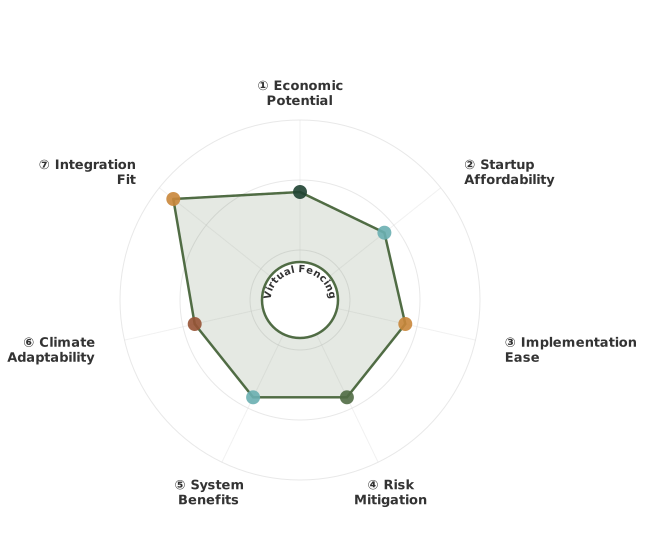
How These Traits Are Calculated
Trait dimensions are ordered clockwise starting from the top of the chart (12 o'clock position):
1. Economic Potential
Financial returns, annual value, and break-even timeline
WHAT: Evaluates financial viability by combining net annual value ($/ha from savings, income, and amortized harvests) with break-even timeline showing when practices pay for themselves.
WHY: Farmers need clear ROI understanding before committing resources. Fast payback (≤3 years) with strong returns (≥$300/ha) enables confident adoption, while long timelines (>10 years) restrict adoption to well-funded operations willing to wait for returns.
HOW: Calculated from net annual value in $/ha and break-even years. Exceptional (≥2.6): fast ROI ≤3 years + high value ≥$300/ha. Typical (1.8-2.5): moderate returns or longer timelines. Limited (<1.8): marginal economics or very long payback >10 years.
2. Startup Affordability
Initial investment costs and financial barrier to entry
WHAT: Measures financial barrier to entry through startup costs for equipment, infrastructure, consulting, and materials. Inverted scoring: lower costs = higher scores = more accessible adoption.
WHY: Affordability determines who can adopt. Low-cost practices (<$250/ha) enable widespread adoption across diverse scales, while high costs (>$2,500/ha) limit adoption to well-capitalized operations, creating barriers that slow regenerative transition.
HOW: Calculated from initial investment parsed from practice content. Inverted scoring: Exceptional (≥2.6): minimal investment <$250/ha. Typical (1.8-2.5): moderate costs $250-2,500/ha. Limited (<1.8): high barrier >$2,500/ha.
3. Implementation Ease
Learning curve and specialized knowledge required
WHAT: Measures how much learning, planning, and specialized knowledge a practice requires. Simpler practices with fewer steps score higher, while complex practices requiring extensive training or specialized resources score lower.
WHY: Complex practices create adoption barriers even when economically viable. Straightforward practices enable faster adoption and broader participation, while those requiring extensive training, timing precision, or specialized equipment limit who can succeed.
HOW: Evaluated by measuring documentation length and identifying complexity markers like location-specific requirements, seasonal timing windows, specialized skills, and dedicated equipment needs. Exceptional (≥2.6): straightforward practices with minimal prerequisites. Typical (1.8-2.5): moderate learning curve with some specialized needs. Limited (<1.8): steep learning curve requiring significant training or resources.
4. Risk Mitigation
Identified financial and ecological risk assessment
WHAT: Evaluates documented risks across financial (investment loss, market volatility) and ecological (crop failure, pest outbreaks) domains. Inverted scoring: fewer risks = higher scores.
WHY: Understanding risk exposure helps farmers make informed decisions. Low-risk practices allow confident implementation, while high-risk practices require careful planning and contingency resources. Risk transparency prevents costly failures.
HOW: Calculated from identified risks in practice content. Inverted scoring: Exceptional (≥2.6): ≤2 risks with manageable severity. Typical (1.8-2.5): 3-5 moderate risks. Limited (<1.8): 6+ risks or severe exposure.
5. System Benefits
How many ways the practice improves your land simultaneously
WHAT: Measures how many aspects of land health improve at once—carbon storage, soil quality, erosion control, water absorption, and biodiversity. Practices that improve multiple areas simultaneously create compounding benefits where each improvement reinforces the others.
WHY: The best practices solve multiple problems at once. For example, addressing erosion simultaneously builds carbon and improves water infiltration, creating a resilient system with positive feedback loops. Single-benefit approaches miss these compound transformation opportunities.
HOW: Evaluated across five key outcomes: carbon sequestration, soil organic matter increase, erosion reduction, water infiltration improvement, and biodiversity enhancement. Exceptional (≥2.6): high carbon storage (>8 t/ha/yr), improvements across 4-5 areas, transformative outcomes. Typical (1.8-2.5): moderate carbon (3-8 t/ha/yr), improvements across 2-3 areas. Limited (<1.8): modest impact (<3 t/ha/yr), single-area focus only.
6. Climate Adaptability
Geographic applicability across Köppen climate zones
WHAT: Evaluates geographic applicability by assessing how many Köppen climate zones successfully support a practice and what adaptation requirements are needed. Measures breadth of climates where farmers can implement with minimal to moderate modifications.
WHY: Universal practices working across diverse climates enable more farmers to adopt regenerative approaches. Practices limited to single climate types (only Mediterranean, only tropical) restrict adoption and slow global transition. Adaptability determines whether a practice serves niche regions or offers broad transformation.
HOW: LLM evaluation of regional success stories, Köppen zone coverage, and adaptation needs. Exceptional (≥2.6): 5+ zones or 4+ climate types, 3+ continents, minimal adaptation. Typical (1.8-2.5): 3-4 zones or 2-3 types, 2 continents, moderate adaptation. Limited (<1.8): 1-2 zones, single region, significant adaptation or highly specialized.
7. Integration Fit
How well this practice combines with others you're doing
WHAT: Measures how well a practice combines with other regenerative practices you might be doing. Some practices work as building blocks that make many other practices easier or more effective, while others work best on their own.
WHY: Practices that combine well with many others create more value on your farm. For example, cover cropping enables no-till, improves grazing, supports crop diversity, and helps water management—making all of them work better together. This helps you build a coherent system rather than juggling disconnected practices.
HOW: Evaluated by identifying which practices combine well and how strong those combinations are. 'Ideally Suited' means strong combinations where practices reinforce each other (practice A makes B easier, while B makes A more effective). 'Adequate' means complementary benefits that work well together. Exceptional (≥2.6): combines well with 6+ practices, serves as a building block. Typical (1.8-2.5): combines with 3-5 practices. Limited (<1.8): 1-2 practices or works best alone.
Going Deeper
1
WHY - The Benefits
Virtual fencing technology represents a significant advancement in livestock management, offering a blend of precision, flexibility, and efficiency that can profoundly benefit both farm economics and ecological health. While not a regenerative practice in itself, it is a...
Virtual fencing technology represents a significant advancement in livestock management, offering a blend of precision, flexibility, and efficiency that can profoundly benefit both farm economics and ecological health. While not a regenerative practice in itself, it is a...
WHY - The Benefits
Virtual fencing technology represents a significant advancement in livestock management, offering a blend of precision, flexibility, and efficiency that can profoundly benefit both farm economics and ecological health. While not a regenerative practice in itself, it is a...
Virtual fencing technology represents a significant advancement in livestock management, offering a blend of precision, flexibility, and efficiency that can profoundly benefit both farm economics and ecological health. While not a regenerative practice in itself, it is a...
Soil Health Benefits
The cornerstone of virtual fencing’s impact on soil health is its capacity to facilitate adaptive, short-duration grazing. By allowing managers to precisely cordon off small paddock sizes and move livestock frequently, it ensures that pastures receive adequate rest periods between grazing events. This rest is critical for plant recovery, allowing grasses and forbs to regrow, re-establish root systems, and build up carbohydrate reserves. Ample rest ensures plants can maintain living roots for longer periods, supporting continuous soil biological activity.
This controlled grazing also leads to more even distribution of animal impact and manure. Instead of concentrating grazing and droppings in a few preferred areas, animals can be guided to graze larger areas more uniformly. This more balanced distribution of fertility helps build soil organic matter across the landscape rather than creating nutrient hotspots and depleted zones. Over time, this can lead to a more uniform increase in soil organic carbon, improved soil structure, and enhanced water infiltration rates, all crucial components of healthy, resilient soil ecosystems.
Furthermore, virtual fencing can be used to protect sensitive areas from livestock impact. Managers can easily exclude animals from riparian zones, young tree plantations (in silvopasture systems), or areas undergoing ecological restoration. This directed exclusion prevents overgrazing, trampling damage, and soil erosion in vulnerable ecosystems, allowing them to recover and thrive. By preventing animal access to these areas, virtual fencing directly supports the principle of keeping soil covered and maintaining living roots where they are most needed for ecosystem function.
In extensively managed systems across continents like Australia, Africa, and South America, where vast distances make traditional fencing prohibitively expensive, virtual fencing offers a means to implement rotational grazing for the first time. This allows previously underutilized or overgrazed land to be managed more regeneratively, fostering plant community diversity and improving soil health over large areas.
Economic Benefits
The economic advantages of virtual fencing are substantial and multifaceted. One of the most immediate impacts is the significant reduction in the need for internal physical fencing infrastructure. While secure perimeter fences are often retained, virtual fencing can replace the miles of internal subdivision wire, posts, and gates, which are labor-intensive and costly to construct and maintain. This saves significant capital and ongoing maintenance expenses, particularly on large ranches or in challenging terrain. While the initial investment in collars and infrastructure exists, it can be considerably lower than full physical fencing across large areas.
Improved pasture utilization directly translates into increased economic efficiency. By better managing forage intake, managers can extend grazing seasons, reduce reliance on costly supplemental feed, and potentially increase livestock carrying capacity per hectare. Studies and farm trials have shown improvements in average daily gain (ADG) for livestock managed with virtual fencing, as they are guided to graze on more nutritious, actively growing forage. This means animals reach market weight faster, improving turnover and profitability.
The flexibility virtual fencing offers also creates economic resilience. Managers can quickly adapt grazing plans in response to drought, market fluctuations, or unexpected ecological events. For instance, during a drought, animals can be moved to areas with better forage availability with minimal labor, preserving precious pasture resources and animal condition. This agility helps mitigate financial risks associated with unpredictable environmental conditions.
Moreover, the ability to precisely control livestock movement and nutrient distribution offers opportunities for premium market access. Producers who can demonstrate sustainable grazing practices, enhanced animal welfare, and improved land stewardship through technologies like virtual fencing may qualify for niche markets, certifications, or government incentive programs that reward ecological performance. This can add value to their products and improve overall farm profitability.
Regenerative Systems Fit
Virtual fencing is a context-dependent practice, meaning its regenerative value is determined by how it is used. When implemented with regenerative principles as the guiding philosophy, it becomes a powerful asset for transforming livestock grazing systems.
Principle 1 (Minimize Soil Disturbance): Virtual fencing itself does not cause soil disturbance. Its regenerative contribution comes from enabling grazing management that minimizes physical disturbance. By allowing for precise paddock creation and frequent, controlled animal movements, it ensures that physical fencing, which can require soil disturbance for installation, is used less frequently or in less impactful ways. Critically, it enables adaptive grazing that prevents overgrazing and trampling, thus protecting soil structure from degradation. Moving animals frequently means less time spent in any one area, reducing prolonged pressure and compaction.
Principle 2 (Maximize Crop Diversity): Virtual fencing is instrumental in implementing diverse pasture and forage systems. Managers can create small, temporary paddocks to graze different species mixes, cover crops, or silvopasture components in a highly controlled manner. This facilitates the strategic grazing of diverse plant communities, encouraging the growth of a wider range of species and promoting a more complex underground root architecture and soil microbial community. For instance, allowing livestock to graze specific cover crop mixes for short periods can help manage weeds and improve their establishment for subsequent crop or pasture phases.
Principle 3 (Keep Soil Covered): The primary mechanism by which virtual fencing supports keeping soil covered is through enabling proactive pasture management that ensures plants are not overgrazed. By dynamically adjusting grazing areas, managers can ensure that sufficient vegetative cover or mulch is always present, protecting the soil from erosion, temperature extremes, and moisture loss. It can be used to actively exclude livestock from sensitive areas that need to recover cover, such as riparian buffers or areas recovering from drought.
Principle 4 (Maintain Living Roots): Linked directly to keeping soil covered, virtual fencing's ability to facilitate short-duration grazing with adequate rest periods is key to maintaining living roots. Plants are allowed sufficient time to regrow and re-establish their root systems after grazing. This minimizes stress on the plants and ensures continuous photosynthetic activity and root exudate production, which feeds soil biology and builds soil organic matter. This practice aligns perfectly with maintaining a living root in the soil for as long as possible throughout the year.
Principle 5 (Integrate Livestock): This is where virtual fencing offers transformative potential for regenerative agriculture. It allows for the precise implementation of intensive rotational or adaptive grazing strategies across large or complex landscapes, mimicking natural herd movements and distribution patterns. Livestock can be guided to graze specific plants, defer certain paddocks for recovery, access previously inaccessible areas, or be precisely located for manure distribution to improve fertility across different land units. This level of control allows for intentional nutrient cycling, weed management, and pasture enhancement, turning livestock into powerful ecological management tools rather than simply consumers of forage.
Virtual fencing transitions the integration of livestock from an art to a science, enabling managers to optimize grazing impacts for ecological outcomes. For example, it can be used to manage grazing in silvopasture systems, ensuring young trees are protected while livestock manage undergrowth, or to precisely control grazing on conservation land to restore grassland diversity. It is a stepping stone that enables a more sophisticated, regenerative approach to livestock integration, particularly valuable in large-scale operations or areas with challenging physical fencing limitations.
Sources behind this view
Videos & Podcasts
-
Adopting E-Shepard virtual fencing (Gallagher) in Eastern Montana to overcome labor challenges and enable intensive grazing. GPS collars allow remote pasture management, reducing labor and improving r
-
Virtual fencing in the Western US significantly boosts pasture utilization and stock density, especially on BLM land where traditional fencing is difficult. Heat maps show improved grazing patterns, l
-
Post-wildfire virtual fencing trial in Idaho demonstrated high containment (70-95%) and improved forage utilization (5-34%) for 700 cow-calf pairs. Challenges included collar retention, animal respons

-
Virtual fencing enables true adaptive grazing by allowing dynamic pasture management based on grass growth and climate, increasing farm productivity and profitability. An example in Montana shows a fa
Community
-
Virtual fencing enables targeted grazing for invasive grass control (e.g., Medusahead reduction by 96%) and fuel break creation, significantly lowering wildfire risk in California's rangelands, with u
Read more (opens in new window) ucanr.edu -
Virtual fencing uses GPS collars for real-time animal tracking and containment, reducing roundup time and escape risks. Cattle trained for three weeks respond to audio cues 95% of the time, with colla
Read more (opens in new window) ucanr.edu -
Evaluates Virtual Fence (VF) technology for sustainable range management, focusing on precise cattle distribution for vegetation management, ecosystem health, and creating fuel breaks.
Read more (opens in new window) ucanr.edu -
Virtual Fencing (VF) uses GPS collars for livestock management, with NRCS EQIP offering financial assistance for adoption. Costs can be offset through EQIP practices for initial investment and ongoing
Read more (opens in new window) ucanr.edu
Research
-
Virtual Fencing Technology for Cattle Management in the Pasture Feeding System—A Review (opens in new window)
This study found: Virtual fencing technology uses electronic collars on cattle to improve pasture utilization and reduce labor costs. Further development is needed to lower costs and expand its use on larger farms and
-
Review: Precision Livestock Farming technologies in pasture-based livestock systems. (opens in new window)
This study found: Smart farming tech (GPS, drones, virtual fencing) can improve livestock management on pasture for cattle, sheep, goats, pigs, and poultry, despite challenges like battery life and cost.
-
The potential of virtual fencing technology to facilitate sustainable livestock grazing management. (opens in new window)
This study found: Virtual fencing shows promise for sustainable livestock grazing, improving efficiency and environmental/animal welfare, but requires addressing reliability, animal learning, and safety concerns throug
-
Applying virtual fencing technology for grazing and crop management: Three case studies with cattle in Southern Australian mixed farming systems (opens in new window)
This study found: Virtual fencing technology successfully managed cattle for weed control and targeted grazing in Australian mixed farms, with animals learning audio cues. Impacts on pasture growth were inconsistent.
From the Web
-
Virtual fencing offers flexible pasture management via remote control, saving labor and costs, enabling new strategies like grazing fire-risk areas, though current prototypes are expensive and require
-
Virtual fencing, using GPS collars, allows flexible pasture subdivision and rotation to protect sensitive areas, manage grazing, and restore native forages, as demonstrated by a Montana rancher.
-
Virtual fencing (VF) technology enables precise cattle management on large rangelands, reducing reliance on traditional fences and improving roundup efficiency. A case study showed VF contained cattle
Source: ucanr.edu (opens in new window) -
Virtual fencing technology risks diminishing essential stockmanship and connection to land, potentially leading to animal stress and ecological degradation. The article advocates for prioritizing low-
2
HOW - Implementation Process
HOW - Implementation Process
Before adopting virtual fencing, consider these essential prerequisites:
- Clear Management Goals: Define what you aim to achieve. Is it improved pasture utilization, increased land carrying capacity, better ecological restoration, protection of sensitive areas, or reduced fencing costs? Regenerative goals (e.g., improving soil health, increasing biodiversity) should be paramount.
- Livestock Suitability: The technology is generally well-suited for cattle and horses. Sheep and goats may require different collar types or adjusted training due to their grazing habits and smaller head size; confirmation with technology providers is advised.
- Terrain Suitability: While flexible, areas with extreme terrain or dense canopy cover can sometimes interfere with GPS signal quality, affecting collar accuracy. Test signal strength in key areas.
- Available Forage Data: Understanding your pasture's productivity, species composition, and recovery rates will inform how you design grazing cells for optimal ecological outcomes.
- Technological Comfort: Familiarity with smartphone apps, computer interfaces, and basic GPS concepts is necessary for managing the system.
- Training & Support: Access to training resources or support from the technology provider is crucial for initial setup and ongoing management.
Phase 1: System Selection & Setup (Initial Investment)
Hardware Selection:
- Collars: Choose collars appropriate for your livestock type, size, and environment (e.g., durability, battery life, weight). Consider the number of collars needed based on your herd size and management strategy.
- Base Station/Gateways: These devices receive GPS data from collars and transmit it to the cloud. Placement is crucial for maintaining communication coverage across your grazing area. Consider the farm topography and potential signal obstructions.
- Power Source: Ensure reliable power for base stations and charging collars (solar, battery, grid).
Software & Mapping:
- Platform: Familiarize yourself with the provider's app or web platform for mapping virtual fences, monitoring livestock, and managing alerts.
- Virtual Fence Design: Begin by mapping the desired grazing areas. This involves drawing polygons on a digital map corresponding to your intended paddocks or exclusion zones. Consider topography, forage types, water access, and planned grazing duration.
- Animal Training: Livestock must be trained to recognize the system's cues. This typically involves a week or two of introduction to the collars and the audio cues in a controlled environment, gradually introducing the stimulation at a low level. Successful training is paramount for effective adoption and minimizing stress on animals.
Cost: Initial setup costs can range from $50-200 USD equivalent per animal for the collars, plus $1,000-5,000 USD equivalent for base stations and gateways, depending on farm size and complexity. Installation may involve additional labor costs.
Phase 2: Initial Grazing Management (First 1-3 Months)
Pilot Program: Start with a smaller, well-defined area or a subset of your herd (where feasible) to gain experience. This allows you to troubleshoot any setup issues and refine your management approach without affecting your entire operation.
- Paddock Design: Create simple, manageable paddock shapes initially. Focus on areas where you want to concentrate grazing or protect specific zones. For regenerative goals, design paddocks to allow for rotational grazing with generous rest periods (e.g., 30-60+ days for perennial pastures).
- Monitoring Livestock Behavior: Actively observe how your animals respond to the virtual fences. Note any instances of animals testing boundaries, collar malfunctions, or signs of stress. The system typically provides alerts when animals cross virtual fences or collars issue stimulation.
- Adjusting Boundaries & Cues: Based on animal behavior and forage situation, adjust virtual fence lines, cue intensity, and stimulation levels. The system allows for real-time adjustments, a key advantage. For example, if animals are consistently trying to cross into a protected area, you might need to re-evaluate your paddock design or training.
Regenerative Application Example: Use virtual fencing to create small, temporary paddocks for intensive grazing of a diverse cover crop mix. Move animals daily or every few days to a new area, allowing the previous area a long rest period. This encourages uniform grazing and nutrient distribution, while preventing overgrazing of any single species.
Phase 3: Adaptive Management & Optimization (Ongoing)
Daily/Weekly Monitoring: Regularly check the system interface for animal locations, fence adherence, and collar status. This includes monitoring battery life and ensuring collars are functioning correctly.
- Paddock Rotation: Plan your grazing rotations based on forage growth rates and ecological objectives. Virtual fencing allows for flexible changes to these plans as conditions evolve (e.g., adjusting paddock size based on rainfall and forage availability).
- Environmental Integrations: Utilize the system to protect sensitive areas. Draw virtual fences around riparian zones, water sources, newly planted trees, or areas needing ecological recovery.
- Data Analysis: Leverage the data collected by the system (animal location history, time spent in specific areas) to analyze grazing patterns, assess pasture utilization, and refine future grazing plans. This data can inform decisions about stocking rates, pasture health, and overall land management.
Transition Timeline & Phase-Out Strategy (if applicable to other practices): Virtual fencing itself is not a practice that is typically "phased out" to become fully regenerative. Instead, its use enables other regenerative practices. If it is used to facilitate the transition away from less regenerative practices (e.g., to implement intensive rotational grazing that replaces continuous grazing), the "phase-out" relates to those other practices. The goal is to use virtual fencing as a tool to establish and refine regenerative livestock management, and as the land and pasture health improve, the need for constant intervention or highly controlled virtual fencing might decrease, or its application might shift to more complex ecological goals. The technology remains a valuable tool for precision management, rather than being phased out.
Sources behind this view
Videos & Podcasts
-
Adopting E-Shepard virtual fencing (Gallagher) in Eastern Montana to overcome labor challenges and enable intensive grazing. GPS collars allow remote pasture management, reducing labor and improving r
-
Post-wildfire virtual fencing trial in Idaho demonstrated high containment (70-95%) and improved forage utilization (5-34%) for 700 cow-calf pairs. Challenges included collar retention, animal respons
-
Virtual fencing enables true adaptive grazing by allowing dynamic pasture management based on grass growth and climate, increasing farm productivity and profitability. An example in Montana shows a fa
-
Virtual fencing in the Western US significantly boosts pasture utilization and stock density, especially on BLM land where traditional fencing is difficult. Heat maps show improved grazing patterns, l
Community
-
Virtual fencing enables targeted grazing for invasive grass control (e.g., Medusahead reduction by 96%) and fuel break creation, significantly lowering wildfire risk in California's rangelands, with u
Read more (opens in new window) ucanr.edu -
Virtual fencing uses GPS collars for real-time animal tracking and containment, reducing roundup time and escape risks. Cattle trained for three weeks respond to audio cues 95% of the time, with colla
Read more (opens in new window) ucanr.edu -
Virtual Fencing (VF) uses GPS collars for livestock management, with NRCS EQIP offering financial assistance for adoption. Costs can be offset through EQIP practices for initial investment and ongoing
Read more (opens in new window) ucanr.edu -
Virtual fence technology uses GPS collars to manage livestock grazing on California's Sierra Nevada rangelands. It allows for precise containment, exclusion from sensitive areas, fuel reduction, and i
Read more (opens in new window) ucanr.edu
Research
-
Virtual Fencing Technology for Cattle Management in the Pasture Feeding System—A Review (opens in new window)
This study found: Virtual fencing technology uses electronic collars on cattle to improve pasture utilization and reduce labor costs. Further development is needed to lower costs and expand its use on larger farms and
-
Review: Precision Livestock Farming technologies in pasture-based livestock systems. (opens in new window)
This study found: Smart farming tech (GPS, drones, virtual fencing) can improve livestock management on pasture for cattle, sheep, goats, pigs, and poultry, despite challenges like battery life and cost.
-
The potential of virtual fencing technology to facilitate sustainable livestock grazing management. (opens in new window)
This study found: Virtual fencing shows promise for sustainable livestock grazing, improving efficiency and environmental/animal welfare, but requires addressing reliability, animal learning, and safety concerns throug
-
Applying virtual fencing technology for grazing and crop management: Three case studies with cattle in Southern Australian mixed farming systems (opens in new window)
This study found: Virtual fencing technology successfully managed cattle for weed control and targeted grazing in Australian mixed farms, with animals learning audio cues. Impacts on pasture growth were inconsistent.
From the Web
-
Virtual fencing offers flexible pasture management via remote control, saving labor and costs, enabling new strategies like grazing fire-risk areas, though current prototypes are expensive and require
-
Virtual fencing, using GPS collars, allows flexible pasture subdivision and rotation to protect sensitive areas, manage grazing, and restore native forages, as demonstrated by a Montana rancher.
-
Virtual fencing (VF) technology enables precise cattle management on large rangelands, reducing reliance on traditional fences and improving roundup efficiency. A case study showed VF contained cattle
Source: ucanr.edu (opens in new window) -
Virtual fencing technology, like NoFence, enables managed grazing for regenerative agriculture by using GPS collars that alert animals to virtual boundaries, improving profitability and animal trackin
3
Know the Debate
Virtual fencing offers unprecedented control over livestock grazing, enabling precise pasture management and integration into regenerative systems....
Know the Debate
Virtual fencing offers unprecedented control over livestock grazing, enabling precise pasture management and integration into regenerative systems....
Virtual fencing offers unprecedented control over livestock grazing, enabling precise pasture management and integration into regenerative systems. Its effectiveness and suitability, however, depend heavily on context. While humid regions with reliable cell and GPS coverage may see rapid implementation success, semi-arid or mountainous terrains can present challenges with signal integrity and require more robust technology. Initial costs range from $4,000-$17,500+ for small operations and $58,000-$190,000+ for large ones, with ongoing per-animal fees. The labor shifts from fence maintenance to tech savvy and observational skills, with training and adaptation periods varying significantly by animal species and environmental complexity.
How effectively does virtual fencing adhere to its virtual boundaries?
High adherence (80-99%) in controlled settings
Academic research indicates high effectiveness (80-99%) in containing cattle, with rapid animal learning of audio cues and minimal long-term stress. This suggests a viable alternative to physical fences under ideal conditions.
Sources behind this view
Sources behind this view
Research
-
Is Virtual Fencing an Effective Way of Enclosing Cattle? Personality, Herd Behaviour and Welfare (opens in new window)
This study found: This study tested a virtual fencing system using GPS collars on twelve Angus cows to see if it could effectively keep them within a designated area without harming their well-being. The system uses sounds and mild electric pulses from the collar to guide the animals. Over the first two weeks, the cows received more warnings and pulses as they learned to respect the virtual boundary, but after this learning period, the system worked well to keep them contained. Importantly, the cows' activity levels didn't change significantly when they received a pulse, suggesting the system didn't cause acute stress. The researchers found that individual cow personalities and how they behave as a group are important factors. Overall, virtual fencing shows promise as an alternative to traditional fences, especially for nature conservation and large grazing areas, but understanding the animals' individual traits and herd dynamics is key to successful implementation.
-
How do grazing beef and dairy cattle respond to virtual fences? A review. (opens in new window)
This study found: A review of studies on virtual fencing (VF) for cattle suggests it's a promising technology for managing pastures. Virtual fences use GPS collars that emit sounds and sometimes mild electric signals to guide animals, replacing traditional fences. The research reviewed found that while most measures of animal well-being, like weight gain and time spent lying down, were similar between virtual and physical fences, cattle using virtual fences showed lower stress hormone levels in their dung. Animals also appeared to learn to avoid the electric signals over time, with the use of electric signals decreasing as they became accustomed to the system. However, the review highlights that more research is needed, especially on long-term effects and for cows in more intensive grazing setups, to be completely sure it doesn't negatively impact animal welfare.
From the Web
-
Virtual fencing uses GPS collars to contain livestock without physical fences, employing audio cues and mild electric pulses to guide animals within user-defined boundaries on California rangelands.
Source: ucanr.edu (opens in new window)
Variable adherence in real-world settings
Field practitioners report variable success, noting that animals may test boundaries or escape due to collar issues. Challenges with GPS accuracy, battery life, and comprehensive animal training contribute to inconsistent adherence in practical farm settings.
Sources behind this view
Sources behind this view
Videos & Podcasts
-
Virtual fencing uses GPS collars and auditory/electric cues to manage livestock, reducing labor, enabling grazing in difficult terrain, and improving rotational grazing. Initial training is needed, and the system is managed via a smartphone app.
-
Virtual fencing with 'no fence collars' for cows uses GPS and sound/pulse cues to manage grazing remotely, saving time and enabling access to difficult terrains. It's a significant investment but highly effective for grazing management.

-
Virtual fencing collars are less practical for Heifer Ranch's tightly managed livestock (daily moves on 1.2-1.5 acre paddocks) due to frequent signaling, but could be useful in more brittle environments with larger grazing areas.
Making Sense of the Differences
Boundary adherence varies due to animal learning, training protocols, terrain signal reliability, and technology specifics. While research shows high efficacy under controlled conditions, farm-scale implementation requires adaptive management to address individual animal behavior, terrain challenges, and ongoing system maintenance for consistent results.
What are the true costs and infrastructure needs for virtual fencing?
Significant upfront cost & ongoing fees
Initial investment for collars and base units ranges widely ($4,000-$17,500+ for small ops), with ongoing costs of $50-150 per animal annually. Key infrastructure includes reliable GPS/cellular coverage and charging capabilities.
Sources behind this view
Sources behind this view
Videos & Podcasts
-
Meg Grisy compares virtual fencing systems 'No Fence' and 'Vence,' detailing their suitability for different operation sizes, costs, infrastructure needs, and availability. She highlights their potential for remote livestock management and notes ongoing university research.
-
Vince virtual fencing uses GPS collars and a control center for cattle management, costing ~$45/collar/year plus equipment. It's ideal for large Western rangelands where physical fencing is impractical, enabling frequent rotations with a tone-and-shock system.
From the Web
-
Virtual fencing, using GPS collars, allows flexible pasture subdivision and rotation to protect sensitive areas, manage grazing, and restore native forages, as demonstrated by a Montana rancher.
Potential savings offset by total cost of ownership
While promising reduced labor and fencing material costs (potentially 50-90%), the total cost of ownership, including hardware and recurring fees, must be carefully evaluated against the scale and specific needs of the operation.
Sources behind this view
Sources behind this view
Videos & Podcasts
-
Virtual fencing, while currently lacking precision for inter-row agroforestry, is a phenomenal technology for broader silvopasture and restoration goals, enabling precise control over livestock density and timing for optimal vegetative results.
From the Web
-
Virtual fencing technology, like NoFence, enables managed grazing for regenerative agriculture by using GPS collars that alert animals to virtual boundaries, improving profitability and animal tracking.
-
Virtual fencing reduces herding labor on large ranches, allowing for effective cattle management and tracking, though some animals can bypass it and battery life is a consideration.
Making Sense of the Differences
The economic viability of virtual fencing involves comparing the substantial upfront hardware and software costs against potential savings in labor and physical fencing. Successful implementation requires reliable telecommunications and GPS, with ongoing costs per animal for subscriptions and battery maintenance. A thorough cost-benefit analysis considering farm scale, terrain, and management goals is crucial for long-term financial success.
How long does it take for animals to learn and adapt to virtual fencing?
Rapid initial learning (days to weeks)
Research suggests livestock quickly learn audio cues and virtual boundaries, often within a few days to two weeks, showing minimal long-term stress and making it a viable alternative to physical fences.
Sources behind this view
Sources behind this view
Research
-
Is Virtual Fencing an Effective Way of Enclosing Cattle? Personality, Herd Behaviour and Welfare (opens in new window)
This study found: This study tested a virtual fencing system using GPS collars on twelve Angus cows to see if it could effectively keep them within a designated area without harming their well-being. The system uses sounds and mild electric pulses from the collar to guide the animals. Over the first two weeks, the cows received more warnings and pulses as they learned to respect the virtual boundary, but after this learning period, the system worked well to keep them contained. Importantly, the cows' activity levels didn't change significantly when they received a pulse, suggesting the system didn't cause acute stress. The researchers found that individual cow personalities and how they behave as a group are important factors. Overall, virtual fencing shows promise as an alternative to traditional fences, especially for nature conservation and large grazing areas, but understanding the animals' individual traits and herd dynamics is key to successful implementation.
-
How do grazing beef and dairy cattle respond to virtual fences? A review. (opens in new window)
This study found: A review of studies on virtual fencing (VF) for cattle suggests it's a promising technology for managing pastures. Virtual fences use GPS collars that emit sounds and sometimes mild electric signals to guide animals, replacing traditional fences. The research reviewed found that while most measures of animal well-being, like weight gain and time spent lying down, were similar between virtual and physical fences, cattle using virtual fences showed lower stress hormone levels in their dung. Animals also appeared to learn to avoid the electric signals over time, with the use of electric signals decreasing as they became accustomed to the system. However, the review highlights that more research is needed, especially on long-term effects and for cows in more intensive grazing setups, to be completely sure it doesn't negatively impact animal welfare.
From the Web
-
Virtual fencing uses GPS collars to contain livestock without physical fences, employing audio cues and mild electric pulses to guide animals within user-defined boundaries on California rangelands.
Source: ucanr.edu (opens in new window)
Extended adaptation period (6-12 months)
Field practitioners report that while initial training is crucial, a longer period of 6-12 months is often needed for consistent mastery and adaptation, especially in complex environments or with varied animal personalities.
Sources behind this view
Sources behind this view
Videos & Podcasts
-
Virtual fencing uses GPS collars and auditory/electric cues to manage livestock, reducing labor, enabling grazing in difficult terrain, and improving rotational grazing. Initial training is needed, and the system is managed via a smartphone app.
-
Virtual fencing with 'no fence collars' for cows uses GPS and sound/pulse cues to manage grazing remotely, saving time and enabling access to difficult terrains. It's a significant investment but highly effective for grazing management.
-
Adopting E-Shepard virtual fencing (Gallagher) in Eastern Montana to overcome labor challenges and enable intensive grazing. GPS collars allow remote pasture management, reducing labor and improving rotation flexibility, despite needing cell service and addressing collar fitment issues. Potential for longer pasture rest periods and better utilization.
Making Sense of the Differences
Adaptation timelines vary widely, from rapid initial learning in controlled studies to longer, ongoing adaptation periods in practical farm use. Factors like species, individual animal temperament, environmental complexity, and the quality of training significantly influence how quickly and consistently livestock adhere to virtual boundaries, suggesting that patience and ongoing management are key.
3
HOW MUCH - Costs & Investment
Note: Costs shown in USD; multiply by local labor and material cost indices for your region. Labor costs vary significantly internationally. Prices are estimates and subject to change based on technology provider, features, and farm size.
Note: Costs shown in USD; multiply by local labor and material cost indices for your region. Labor costs vary significantly internationally. Prices are estimates and subject to change based on technology provider, features, and farm size.
HOW MUCH - Costs & Investment
Note: Costs shown in USD; multiply by local labor and material cost indices for your region. Labor costs vary significantly internationally. Prices are estimates and subject to change based on technology provider, features, and farm size.
Note: Costs shown in USD; multiply by local labor and material cost indices for your region. Labor costs vary significantly internationally. Prices are estimates and subject to change based on technology provider, features, and farm size.
Note: All costs are based on recent US economic data (2024–2026) and may vary substantially by region based on local labor rates, material costs, and regulatory requirements.
Initial Hardware and Infrastructure
The primary driver of initial investment is the hardware-to-livestock ratio, which fluctuates significantly based on pasture density and topography. For small operations under 50 acres (20 ha) managing 50 head of livestock, hardware investment typically ranges from $7,815 to $18,235. This allocation covers the cost of individual GPS collars—currently priced between $188 and $313 per unit—and the purchase of at least one to two base stations, costing $1,250 to $2,605 each.
Mid-size operations ranging from 50 to 500 acres (20–202 ha) supporting 100 to 200 head face higher complexity costs. As the grazing area expands, geographical obstacles often require a more robust network of base stations and signal repeaters to maintain connectivity. At this scale, total hardware investment ranges from $26,050 to $67,730. Large operations exceeding 500 acres (202 ha) and 200 head of cattle encounter "enterprise-level" site complexity. These operations require secondary relay stations and signal boosters to cover vast, irregular terrain, pushing hardware configurations to a range of $78,150 to $200,000. These secondary relay infrastructures alone can add $5,210 to $15,630 to the hardware bill.
System Implementation and Technical Training
Unlike physical infrastructure, virtual systems demand a high commitment to initial site mapping and animal training. Small operations should anticipate $2,084 to $5,210 in professional implementation fees if utilizing a vendor-managed service package, or conversely, dedicate 40 to 80 hours of internal labor for software mapping and boundary definition. Mid-size operations typically incur $5,210 to $12,504 in implementation costs, often focusing on the technical integration of virtual zones with existing ranch management or forage monitoring platforms.
Large-scale operations, due to the complexity of managing multi-site polygon mapping and intricate herd-splitting requirements, necessitate professional technical consultation. These costs range from $15,630 to $41,680. This significant investment ensures that virtual fencing lines are optimized for water access and forage regrowth cycles, which is critical for preventing over-grazing in high-traffic sections during the intensive grazing season.
Ongoing Annual Operating Costs
After the initial capital outlay, producers must account for annual subscription fees and routine hardware maintenance. Data connectivity and software platform fees currently range from $16 to $47 per animal, annually, depending on the frequency of data polling and analytical precision. For a small operation of 50 head, this results in an annual financial requirement of $800 to $2,350. Mid-size operations with a 200-head herd face annual recurring costs of $3,200 to $9,400. Enterprise-scale operations with 500 head should budget $8,000 to $23,500 annually for full-feature data access.
Furthermore, battery maintenance represents a critical recurring cost. Averaging $21 to $52 per collar every 18 to 24 months, these costs are often overlooked during the initial budget phase. When aggregating software subscriptions and routine hardware maintenance, a standard 200-head herd manager should estimate total annual operating costs to be between $5,210 and $12,504.
Most Spend: The majority of agricultural operations fall within a total initial investment range of $26,050 to $78,150. This "middle" investment covers the standard hardware set—a mix of high-grade collars and sufficient gateway coverage—required for effective mid-scale rotational grazing without over-capitalizing on oversized infrastructure.
Why the Range?: Cost variation is largely driven by signal topography and herd density. Higher costs occur in operations with broken, mountainous, or heavily timbered terrain, which necessitates more sophisticated signal-boosting infrastructure to prevent "fence drift." Lower costs are achieved in wide-open, level prairie-style environments where a single central base station can provide high-fidelity coverage to a large number of livestock.
Sources behind this view
Videos & Podcasts
-
Adopting E-Shepard virtual fencing (Gallagher) in Eastern Montana to overcome labor challenges and enable intensive grazing. GPS collars allow remote pasture management, reducing labor and improving r
-
Virtual fencing technology (GPS collars) offers a labor-saving and potentially cost-effective method for regenerative grazing, especially on large or complex properties. It uses auditory cues and mild
-
Post-wildfire virtual fencing trial in Idaho demonstrated high containment (70-95%) and improved forage utilization (5-34%) for 700 cow-calf pairs. Challenges included collar retention, animal respons
-
Virtual fencing collars enable flexible pasture management, allowing multiple daily moves, improved forage utilization, and advanced herd sorting. Benefits include heavier weaning weights and reduced
Community
-
Virtual fencing enables targeted grazing for invasive grass control (e.g., Medusahead reduction by 96%) and fuel break creation, significantly lowering wildfire risk in California's rangelands, with u
Read more (opens in new window) ucanr.edu -
Virtual fencing uses GPS collars for real-time animal tracking and containment, reducing roundup time and escape risks. Cattle trained for three weeks respond to audio cues 95% of the time, with colla
Read more (opens in new window) ucanr.edu -
Virtual Fencing (VF) uses GPS collars for livestock management, with NRCS EQIP offering financial assistance for adoption. Costs can be offset through EQIP practices for initial investment and ongoing
Read more (opens in new window) ucanr.edu -
Virtual fencing technology, using neckbands with audible cues and mild shocks, guides livestock within virtual boundaries. Animals learn quickly with minimal stress, and the system is being refined by
Read more (opens in new window) ucanr.edu
Research
-
Virtual Fencing Technology for Cattle Management in the Pasture Feeding System—A Review (opens in new window)
This study found: Virtual fencing technology uses electronic collars on cattle to improve pasture utilization and reduce labor costs. Further development is needed to lower costs and expand its use on larger farms and
-
Influence of Virtual Fencing Technology in Cattle Management and Animal Welfare (opens in new window)
This study found: Virtual fencing (VF) with GPS collars guides cattle using sound/mild shocks, improving pasture management and reducing labor. Cattle learn quickly with minimal long-term stress, but challenges include
-
Review: Precision Livestock Farming technologies in pasture-based livestock systems. (opens in new window)
This study found: Smart farming tech (GPS, drones, virtual fencing) can improve livestock management on pasture for cattle, sheep, goats, pigs, and poultry, despite challenges like battery life and cost.
-
How do grazing beef and dairy cattle respond to virtual fences? A review. (opens in new window)
This study found: Virtual fencing for cattle shows promise, with similar welfare outcomes to physical fences and lower stress hormone levels. Animals learn to avoid electric signals, but more long-term research is need
From the Web
-
Virtual fencing offers flexible pasture management via remote control, saving labor and costs, enabling new strategies like grazing fire-risk areas, though current prototypes are expensive and require
-
Virtual fencing (VF) technology enables precise cattle management on large rangelands, reducing reliance on traditional fences and improving roundup efficiency. A case study showed VF contained cattle
Source: ucanr.edu (opens in new window) -
Virtual fencing involves significant costs ($17k-$22k for 100 cows) and requires careful implementation, including prior electric fence training, in-person moves, and using fences for recovery, not fo
-
Virtual fencing, using GPS collars, allows flexible pasture subdivision and rotation to protect sensitive areas, manage grazing, and restore native forages, as demonstrated by a Montana rancher.
5
REWARDS AND RISKS - Economics & Risk Factors
REWARDS AND RISKS - Economics & Risk Factors
In a Best Case scenario, producers achieve a full return on investment within 3 to 4 years. By reducing physical fencing maintenance labor—traditionally a major cost center—by $3,126 to $5,210 annually, and simultaneously increasing stocking rates by 20% through superior forage utilization, the system pays for itself. An annual economic uplift of 15% to 25% in gross livestock revenue is often realized when high-intensity adaptive grazing is married to precise virtual boundary management.
A Typical Case scenario involves a 5 to 7-year recoupment timeline. In this situation, the producer realizes a 5% to 10% gain in Average Daily Gain (ADG) through cleaner, more frequent pasture rotations. This results in an incremental $52 to $104 profit per animal annually, which is largely offset by the $16 to $36 per head in mandatory annual software fees.
Conversely, a Worst Case scenario occurs when hardware failure, software outages, or poor animal training leads to uncontrolled "fence breach." If 5% of a 200-head herd escapes due to grid instability, the combined cost of lost forage, livestock recovery, and emergency repair leads to a net negative impact of $20,840 to $41,680 in the first year of operation.
Market factors currently include the volatility of satellite connectivity in remote regions, which acts as a systemic risk to grazing schedules. Mitigation strategies require the installation of redundant localized gateway arrays at a cost of $2,084 to $5,210 per array. This acts as essential insurance against the risk of total cattle displacement. Furthermore, producers employing virtual management can command price premiums of $0.15 to $0.36 per lb through specialty regenerative carbon-sequestration programs or niche branding.
Transition Period Risks are most acute in the first 1–2 years. Producers often face a "learning curve yield dip," where initial mismanagement of boundary proximity causes animal stress, resulting in a 5% to 10% reduction in weight gain performance during the first 6 months. Additionally, the time investment required to train animals—2 to 4 weeks of intensive monitoring—represents a labor opportunity cost of approximately $1,563 to $3,647. To mitigate this, managers should use a "hybrid phase-in" approach, maintaining 20% of the property under physical fence while training the herd to virtual lines. This dual-containment strategy prevents catastrophic losses during the first season and keeps revenue losses within a safer 2% to 3% margin.
Sources behind this view
Videos & Podcasts
-
Adopting E-Shepard virtual fencing (Gallagher) in Eastern Montana to overcome labor challenges and enable intensive grazing. GPS collars allow remote pasture management, reducing labor and improving r
-
Post-wildfire virtual fencing trial in Idaho demonstrated high containment (70-95%) and improved forage utilization (5-34%) for 700 cow-calf pairs. Challenges included collar retention, animal respons
-
Virtual fencing enables true adaptive grazing by allowing dynamic pasture management based on grass growth and climate, increasing farm productivity and profitability. An example in Montana shows a fa
-
Virtual fencing in the Western US significantly boosts pasture utilization and stock density, especially on BLM land where traditional fencing is difficult. Heat maps show improved grazing patterns, l
Community
-
Virtual fencing enables targeted grazing for invasive grass control (e.g., Medusahead reduction by 96%) and fuel break creation, significantly lowering wildfire risk in California's rangelands, with u
Read more (opens in new window) ucanr.edu -
Virtual fencing uses GPS collars for real-time animal tracking and containment, reducing roundup time and escape risks. Cattle trained for three weeks respond to audio cues 95% of the time, with colla
Read more (opens in new window) ucanr.edu -
Virtual Fencing (VF) uses GPS collars for livestock management, with NRCS EQIP offering financial assistance for adoption. Costs can be offset through EQIP practices for initial investment and ongoing
Read more (opens in new window) ucanr.edu -
Virtual fence technology uses GPS collars to manage livestock grazing on California's Sierra Nevada rangelands. It allows for precise containment, exclusion from sensitive areas, fuel reduction, and i
Read more (opens in new window) ucanr.edu
Research
-
Virtual Fencing Technology for Cattle Management in the Pasture Feeding System—A Review (opens in new window)
This study found: Virtual fencing technology uses electronic collars on cattle to improve pasture utilization and reduce labor costs. Further development is needed to lower costs and expand its use on larger farms and
-
Review: Precision Livestock Farming technologies in pasture-based livestock systems. (opens in new window)
This study found: Smart farming tech (GPS, drones, virtual fencing) can improve livestock management on pasture for cattle, sheep, goats, pigs, and poultry, despite challenges like battery life and cost.
-
The potential of virtual fencing technology to facilitate sustainable livestock grazing management. (opens in new window)
This study found: Virtual fencing shows promise for sustainable livestock grazing, improving efficiency and environmental/animal welfare, but requires addressing reliability, animal learning, and safety concerns throug
-
Influence of Virtual Fencing Technology in Cattle Management and Animal Welfare (opens in new window)
This study found: Virtual fencing (VF) with GPS collars guides cattle using sound/mild shocks, improving pasture management and reducing labor. Cattle learn quickly with minimal long-term stress, but challenges include
From the Web
-
Virtual fencing offers flexible pasture management via remote control, saving labor and costs, enabling new strategies like grazing fire-risk areas, though current prototypes are expensive and require
-
Virtual fencing, using GPS collars, allows flexible pasture subdivision and rotation to protect sensitive areas, manage grazing, and restore native forages, as demonstrated by a Montana rancher.
-
Virtual fencing (VF) technology enables precise cattle management on large rangelands, reducing reliance on traditional fences and improving roundup efficiency. A case study showed VF contained cattle
Source: ucanr.edu (opens in new window) -
Virtual fencing technology risks diminishing essential stockmanship and connection to land, potentially leading to animal stress and ecological degradation. The article advocates for prioritizing low-
6
WHO - Labor & Expertise
WHO - Labor & Expertise
Virtual fencing systems significantly alter labor demands, shifting them from physical fencing maintenance to technological management and observation.
- Collar Application & Removal: For initial training and during system setup, labor is required to fit collars to animals. This can be a one-time or periodic task depending on collar design and herd movement.
- System Monitoring: Daily or frequent checks of the software interface are needed to monitor animal locations, fence adherence, battery life, and system alerts. This can take 15-30 minutes per day for a medium-sized operation.
- Boundary Adjustment: Modifying virtual fences based on forage availability, pasture recovery, or environmental conditions is done through the software. This is typically quick but requires informed decision-making.
- Battery Management: Regular charging or replacement of collar batteries is crucial. This might involve gathering animals periodically, which requires handling labor.
- Training & Troubleshooting: Time investment is needed for initial animal training and learning to operate the system. Troubleshooting technical issues may also require dedicated time.
International Labor Cost Variations: In regions with high labor costs (e.g., Northern Europe, North America, Australia), virtual fencing's ability to reduce the need for physical fencing labor (which can be extensive and hazardous) presents a significant economic advantage. The shift to less physically demanding, tech-focused management can be highly beneficial.
In regions where labor is considerably cheaper (e.g., parts of Asia, Africa, Latin America), the economic justification might lean more towards improved grazing management and pasture productivity rather than direct labor savings from fencing. The upfront technology cost needs careful evaluation against local labor rates and the potential for increased output or land value. Farms might also leverage local IT support or community knowledge for system maintenance.
Expertise Requirements
-
Technological Aptitude: Users need to be comfortable with smartphone applications and computer interfaces. Understanding basic GPS concepts and data interpretation is beneficial. Most modern systems are designed for user-friendliness, but a degree of comfort with technology is essential for effective management.
-
Animal Behavior Understanding: For successful training and system implementation, a good understanding of livestock behavior is crucial. Knowing how animals learn, respond to stimuli, and interact with their environment helps in designing effective virtual fences and training protocols.
-
Regenerative Grazing Management Knowledge: This is paramount for deriving ecological and economic benefits. Virtual fencing is a tool; its effective use depends on a manager's understanding of:
- Pasture Ecology: Knowing forage species, growth curves, and recovery needs.
- Nutrient Cycling: Strategically distributing manure through controlled grazing.
- Soil Health Principles: Understanding how grazing impacts soil structure, organic matter, and water infiltration.
- Adaptive Planning: Ability to adjust grazing plans based on real-time environmental data and ecological observations.
-
Problem-Solving Skills: As with any technology, issues may arise. The ability to troubleshoot technical problems, adapt management strategies on the fly, and consult support resources is important.
International Nuances:
- Digital Literacy: Access to and comfort with digital devices can vary significantly. Training programs may need to be adapted for different levels of digital literacy.
- Extension Services: The availability of localized extension services or peer networks that can offer guidance on both technology use and regenerative grazing principles is vital. Governments and NGOs can play a role in providing this support.
- Language Barriers: Software interfaces and support materials need to be available in multiple languages relevant to the target international audience.
Sources behind this view
Videos & Podcasts
-
Adopting E-Shepard virtual fencing (Gallagher) in Eastern Montana to overcome labor challenges and enable intensive grazing. GPS collars allow remote pasture management, reducing labor and improving r
-
Post-wildfire virtual fencing trial in Idaho demonstrated high containment (70-95%) and improved forage utilization (5-34%) for 700 cow-calf pairs. Challenges included collar retention, animal respons
-
Virtual fencing enables true adaptive grazing by allowing dynamic pasture management based on grass growth and climate, increasing farm productivity and profitability. An example in Montana shows a fa
-
Virtual fencing in the Western US significantly boosts pasture utilization and stock density, especially on BLM land where traditional fencing is difficult. Heat maps show improved grazing patterns, l
Community
-
Virtual fencing enables targeted grazing for invasive grass control (e.g., Medusahead reduction by 96%) and fuel break creation, significantly lowering wildfire risk in California's rangelands, with u
Read more (opens in new window) ucanr.edu -
Virtual fencing uses GPS collars for real-time animal tracking and containment, reducing roundup time and escape risks. Cattle trained for three weeks respond to audio cues 95% of the time, with colla
Read more (opens in new window) ucanr.edu -
Virtual Fencing (VF) uses GPS collars for livestock management, with NRCS EQIP offering financial assistance for adoption. Costs can be offset through EQIP practices for initial investment and ongoing
Read more (opens in new window) ucanr.edu -
Virtual fence technology uses GPS collars to manage livestock grazing on California's Sierra Nevada rangelands. It allows for precise containment, exclusion from sensitive areas, fuel reduction, and i
Read more (opens in new window) ucanr.edu
Research
-
Review: Precision Livestock Farming technologies in pasture-based livestock systems. (opens in new window)
This study found: Smart farming tech (GPS, drones, virtual fencing) can improve livestock management on pasture for cattle, sheep, goats, pigs, and poultry, despite challenges like battery life and cost.
-
Virtual Fencing Technology for Cattle Management in the Pasture Feeding System—A Review (opens in new window)
This study found: Virtual fencing technology uses electronic collars on cattle to improve pasture utilization and reduce labor costs. Further development is needed to lower costs and expand its use on larger farms and
-
The potential of virtual fencing technology to facilitate sustainable livestock grazing management. (opens in new window)
This study found: Virtual fencing shows promise for sustainable livestock grazing, improving efficiency and environmental/animal welfare, but requires addressing reliability, animal learning, and safety concerns throug
-
Animal Welfare Implications of Digital Tools for Monitoring and Management of Cattle and Sheep on Pasture (opens in new window)
This study found: Digital tools like sensors, GPS, and drones can improve cattle and sheep welfare monitoring on pastures by detecting health issues and managing movement. Virtual fences may pose welfare risks due to e
From the Web
-
Virtual fencing offers flexible pasture management via remote control, saving labor and costs, enabling new strategies like grazing fire-risk areas, though current prototypes are expensive and require
-
Virtual fencing, using GPS collars, allows flexible pasture subdivision and rotation to protect sensitive areas, manage grazing, and restore native forages, as demonstrated by a Montana rancher.
-
Virtual fencing technology risks diminishing essential stockmanship and connection to land, potentially leading to animal stress and ecological degradation. The article advocates for prioritizing low-
-
Cattle adapted quickly to virtual fencing in South Australian mixed farms, showing learning responses to audio cues. Limitations include social drivers and water management needs. Research provides ev
7
COMPATIBLE PRACTICES - Integration Opportunities
Virtual fencing is exceptional at integrating with other regenerative practices, primarily by enabling or enhancing their implementation.
Virtual fencing is exceptional at integrating with other regenerative practices, primarily by enabling or enhancing their implementation.
COMPATIBLE PRACTICES - Integration Opportunities
Virtual fencing is exceptional at integrating with other regenerative practices, primarily by enabling or enhancing their implementation.
Virtual fencing is exceptional at integrating with other regenerative practices, primarily by enabling or enhancing their implementation.
Adaptive/Rotational Grazing
- Synergy: Virtual fencing allows for the creation of dynamic, small paddocks and rapid herd movements without physical infrastructure. This is the core application for implementing complex rotational or adaptive grazing, mimicking natural herd behavior and maximizing pasture recovery.
- Benefit: Enables consistent, effective rest periods for pastures, leading to improved forage diversity, soil health, and carrying capacity.
Silvopasture Systems
- Synergy: Virtual fencing can protect young trees from grazing damage by creating exclusion zones. It can also guide livestock to graze specific understory areas when needed, aiding in weed control and nutrient cycling around trees.
- Benefit: Facilitates the establishment and management of integrated tree-livestock systems, combining timber/nut production with livestock income while enhancing ecosystem services.
Cover Cropping in Pasture Systems
- Synergy: Virtual fencing can be used to graze cover crops strategically, integrating them into the livestock rotation. This allows for precise control over when and for how long animals graze specific cover crop mixes, ensuring optimal nutrient cycling and forage utilization.
- Benefit: Enhances the benefits of cover cropping by allowing livestock to actively participate in the system, improving soil fertility and breaking pest cycles.
Conservation Area Management
- Synergy: Easily create temporary or permanent virtual exclusion zones around sensitive ecosystems like wetlands, riparian buffers, native grass restorations, or areas designated for wildlife habitat.
- Benefit: Protects fragile environments from overgrazing or trampling, allowing for ecological regeneration and compliance with conservation objectives.
Water Infrastructure Optimization
- Synergy: While virtual fencing doesn't provide water, it can be used to manage livestock proximity to existing water sources, preventing overgrazing around water points which is a common cause of degradation.
- Benefit: Helps distribute grazing pressure more evenly and prevents the creation of "sacrifice zones" around water troughs or ponds, promoting better overall pasture condition and soil health.
Precision Livestock Farming (PLF) Data Integration
- Synergy: Virtual fencing data (animal location, movement patterns) can be integrated with other PLF data (e.g., weight, health monitoring, rumination) for a more holistic view of herd performance and welfare.
- Benefit: Provides more comprehensive insights into herd dynamics, allowing for better management decisions that link animal health and productivity to land management.
Sources behind this view
Videos & Podcasts
-
Adopting E-Shepard virtual fencing (Gallagher) in Eastern Montana to overcome labor challenges and enable intensive grazing. GPS collars allow remote pasture management, reducing labor and improving r
-
Post-wildfire virtual fencing trial in Idaho demonstrated high containment (70-95%) and improved forage utilization (5-34%) for 700 cow-calf pairs. Challenges included collar retention, animal respons
-
Virtual fencing in the Western US significantly boosts pasture utilization and stock density, especially on BLM land where traditional fencing is difficult. Heat maps show improved grazing patterns, l
-
Virtual fencing enables true adaptive grazing by allowing dynamic pasture management based on grass growth and climate, increasing farm productivity and profitability. An example in Montana shows a fa
Community
-
Virtual fencing enables targeted grazing for invasive grass control (e.g., Medusahead reduction by 96%) and fuel break creation, significantly lowering wildfire risk in California's rangelands, with u
Read more (opens in new window) ucanr.edu -
Virtual fencing uses GPS collars for real-time animal tracking and containment, reducing roundup time and escape risks. Cattle trained for three weeks respond to audio cues 95% of the time, with colla
Read more (opens in new window) ucanr.edu -
Evaluates Virtual Fence (VF) technology for sustainable range management, focusing on precise cattle distribution for vegetation management, ecosystem health, and creating fuel breaks.
Read more (opens in new window) ucanr.edu -
Virtual fence technology uses GPS collars to manage livestock grazing on California's Sierra Nevada rangelands. It allows for precise containment, exclusion from sensitive areas, fuel reduction, and i
Read more (opens in new window) ucanr.edu
Research
-
Review: Precision Livestock Farming technologies in pasture-based livestock systems. (opens in new window)
This study found: Smart farming tech (GPS, drones, virtual fencing) can improve livestock management on pasture for cattle, sheep, goats, pigs, and poultry, despite challenges like battery life and cost.
-
Virtual Fencing Technology for Cattle Management in the Pasture Feeding System—A Review (opens in new window)
This study found: Virtual fencing technology uses electronic collars on cattle to improve pasture utilization and reduce labor costs. Further development is needed to lower costs and expand its use on larger farms and
-
The potential of virtual fencing technology to facilitate sustainable livestock grazing management. (opens in new window)
This study found: Virtual fencing shows promise for sustainable livestock grazing, improving efficiency and environmental/animal welfare, but requires addressing reliability, animal learning, and safety concerns throug
-
Applying virtual fencing technology for grazing and crop management: Three case studies with cattle in Southern Australian mixed farming systems (opens in new window)
This study found: Virtual fencing technology successfully managed cattle for weed control and targeted grazing in Australian mixed farms, with animals learning audio cues. Impacts on pasture growth were inconsistent.
From the Web
-
Virtual fencing offers flexible pasture management via remote control, saving labor and costs, enabling new strategies like grazing fire-risk areas, though current prototypes are expensive and require
-
Virtual fencing, using GPS collars, allows flexible pasture subdivision and rotation to protect sensitive areas, manage grazing, and restore native forages, as demonstrated by a Montana rancher.
-
Virtual fencing (VF) technology enables precise cattle management on large rangelands, reducing reliance on traditional fences and improving roundup efficiency. A case study showed VF contained cattle
Source: ucanr.edu (opens in new window) -
Virtual fencing uses GPS collars to contain livestock without physical fences, employing audio cues and mild electric pulses to guide animals within user-defined boundaries on California rangelands.
Source: ucanr.edu (opens in new window)