
Annual Ryegrass
Annual ryegrass (Lolium multiflorum) is primarily utilized in regenerative systems as a versatile cover crop and forage source. It excels in mixes, often seeded with legumes like berseem and crimson clover, contributing to organic matter addition and potentially weed suppression. Its tolerance for wet conditions makes it a preferred choice over cereal rye in certain scenarios. Regenerative benefits include its role in building soil structure and enhancing water infiltration, especially in no-till systems. While not a nitrogen fixer itself, its inclusion in diverse cover crop mixes supports overall soil health and nutrient cycling. Annual ryegrass integrates well with practices like no-till seeding, where it can be applied efficiently with drills. It is also managed for grazing, showing high tolerance for frequent defoliation, though allowing for recovery is crucial. In some contexts, it can overwinter and requires careful termination in spring. Farmer experiences highlight its rapid emergence when drilled and its potential to yield significant dry matter as forage, though it may be outcompeted by brassicas in terms of protein and energy. Proper management, including grazing height and recovery periods, is key to its success.
For a full botanical description see: Plants For A Future(opens in new window) (external link)
Regenerative Quick Profile
All recommendations assume integrated, regenerative practices—not conventional inputs.
Climate & Soil Fit
Climate: Tropical Savanna, Hot Semi-Arid (Steppe), Cold Semi-Arid (Steppe), Humid Subtropical, Oceanic (Maritime Temperate), Hot-Summer Mediterranean, Warm-Summer Mediterranean, Monsoon-Influenced Humid Subtropical, Subtropical Highland, Hot-Summer Continental, Warm-Summer Continental, Subarctic, Monsoon-Influenced Hot-Summer Continental
Zones: USDA 5-10, Australian Zones 3-9
Optimal Soil: Loam Soil
System Role & Functions
Primary: Cover Crop System
Secondary: Forage Integration, Cash Crop With Services
Key Benefits: Climate adaptable, Easy establishment
Management Level
Experience: Beginner-Friendly
Maintenance: Moderate maintenance - Annual ryegrass's system integration is supported by focusing on building soil fertility through compost and cover cropping, and employing water management techniques to optimize its performance.
Value Streams
- Forage production
- Soil building and erosion control
- Livestock forage value
Know the Debate
- Nitrogen contribution varies with termination, legumes, and system.
- Seeding rate ranges from low to high based on goal.
- Termination timing depends on intended use and risks.
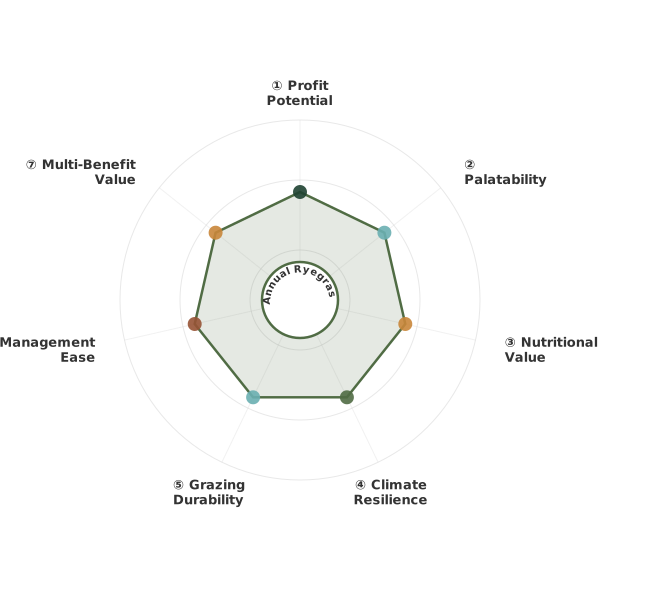
How These Traits Are Calculated
Trait dimensions are ordered clockwise starting from the top of the chart (12 o'clock position):
1. Profit Potential
Economic returns from hay sales, grazing value, and system contributions
WHAT: Synthesizes direct revenue potential (hay sales or grazing service value) with system contributions (nitrogen fixation, reduced supplement needs) into net economic value. Captures both cash income and cost savings.
WHY: Forage profitability comes from two sources—direct sales (hay, haylage) or indirect value (grazing services supporting livestock production). High-value forages provide $300-600/acre in combined revenue and savings versus $100-200/acre for lower-value options. This determines whether forage enterprises are viable versus purchasing feed.
HOW: Scored via LLM synthesis of economics data (hay yields, prices, grazing value), timeline considerations (establishment costs, productive lifespan), and system value (nitrogen contributions, supplement replacement). Exceptional (3.0): High yields with premium pricing or exceptional grazing value plus nitrogen fixation. Typical (2.0): Moderate returns. Limited (1.0): Low yields, commodity pricing, or minimal system contributions.
2. Palatability
Livestock preference and voluntary consumption rates
WHAT: Measures how eagerly livestock consume the forage—preference ranking when choices are available. Highly palatable forages are grazed first and completely; limited palatability means animals avoid unless no alternatives exist.
WHY: Palatability directly determines voluntary intake, which drives animal performance. High-palatability forages support faster weight gain and higher milk production because animals eat more. Low-palatability forages reduce performance and waste productive potential—animals selectively graze preferred species and leave unpalatable plants ungrazed.
HOW: Ratings based on the palatability trait documenting livestock selection preference. Exceptional (3.0): Preferentially selected, high sugar content, tender growth eagerly consumed (orchardgrass, white clover, ryegrass). Typical (2.0): Readily consumed when available. Limited (1.0): Avoided unless no other options (coarse stems, bitter compounds, low digestibility).
3. Nutritional Value
Protein content and forage quality for livestock growth and production
WHAT: Measures protein content as the primary indicator of forage nutritional quality. High-protein forages (>18%) support rapid growth and high milk production; low-protein forages (<12%) require supplementation for production animals.
WHY: Protein is the most expensive supplement in livestock diets ($0.40-0.60/lb). Forages with exceptional protein content eliminate or reduce supplement costs while supporting maximum animal performance. High-quality forage can save $200-400/cow/year in purchased feed versus low-protein options.
HOW: Ratings based on the protein_content trait. Exceptional (3.0): High protein (>18%) supporting rapid weight gain or high milk production (alfalfa, clovers, young grasses). Typical (2.0): Moderate protein (12-18%) for maintenance and moderate production (mature grasses). Limited (1.0): Low protein (<12%) requiring supplementation for production animals (mature warm-season grasses, low-fertility forages).
4. Climate Resilience
Weighted: drought tolerance (60%) + climate adaptability (40%)
WHAT: Combines drought tolerance (primary climate stressor for forages) with overall climate adaptability (temperature range, geographic flexibility). Resilient forages survive extended dry periods and diverse weather patterns.
WHY: Drought is the most common forage crisis—dry years can cut production 50-80% and force costly hay purchases or herd reductions. Drought-tolerant forages maintain productivity through dry spells, reducing feed costs and providing grazing when less-resilient options fail. Geographic adaptability allows forage systems to work across farm regions.
HOW: Weighted formula prioritizes drought tolerance (60% weight) as primary stressor, with climate adaptability (40% weight) for temperature and general flexibility. Exceptional (3.0): Survives extended drought (6+ weeks) with minimal production loss and works across diverse climates. Typical (2.0): Moderate drought and climate tolerance. Limited (1.0): Drought-sensitive or narrow climate requirements.
5. Grazing Durability
Weighted: trampling tolerance (70%) + seasonal availability (30%)
WHAT: Combines grazing tolerance (resistance to trampling and frequent defoliation) with seasonal availability (timing and duration of productive growth). Durable forages handle intensive rotational grazing and provide consistent seasonal production.
WHY: Grazing tolerance determines management system viability. Tolerant forages allow intensive rotational grazing or mob grazing for maximum animal performance and pasture health. Intolerant forages are hay-only or require long rest periods. Seasonal availability indicates production timing—year-round, seasonal gaps, or narrow windows.
HOW: Weighted formula prioritizes grazing tolerance (70% weight) for management system determination, with seasonal availability (30% weight) for production timing. Exceptional (3.0): Handles intensive rotational grazing with consistent seasonal production. Typical (2.0): Moderate tolerance and availability. Limited (1.0): Hay-only species or narrow seasonal production windows.
6. Management Ease
Weighted: establishment ease (50%) + low maintenance needs (50%)
WHAT: Combines establishment difficulty (germination, stand establishment) with ongoing maintenance requirements (fertility, weed control, renovation needs). Easy forages establish reliably and persist without intensive management.
WHY: Pasture establishment is expensive ($150-400/acre) and risky. Easy-to-establish forages reduce stand failure risk and provide quicker returns. Low-maintenance forages reduce annual input costs and labor, improving long-term profitability of grazing systems.
HOW: Weighted formula balances establishment ease (50% weight) for startup success and inverted maintenance intensity (50% weight) for ongoing care. Exceptional (3.0): Fast germination, reliable stand establishment, minimal fertility/weed management needs (white clover, orchardgrass). Typical (2.0): Moderate establishment and care requirements. Limited (1.0): Difficult establishment or intensive maintenance (heavy fertility, frequent renovation, weed competition).
7. Multi-Benefit Value
Ecosystem services beyond forage—nitrogen fixation, pollinator support, wildlife habitat
WHAT: Measures ecosystem services provided beyond livestock nutrition. Multi-benefit forages contribute nitrogen fixation (legumes), pollinator support (flowering species), wildlife habitat, soil building, erosion control, and biodiversity support.
WHY: Forage systems can either extract from farm ecosystems or contribute to them. Nitrogen-fixing legumes (clovers, alfalfa) provide $80-150/acre/year worth of fertility for companion grasses and following crops. Flowering forages support pollinators critical for fruit/vegetable crops. These service-stacking forages deliver total system value beyond livestock production.
HOW: Ratings based on the multi_benefit_value trait documenting service diversity. Exceptional (3.0): Multiple significant benefits (legumes fixing 80-150 lbs N/acre/year + pollinator support + wildlife forage). Typical (2.0): Some ecosystem contributions. Limited (1.0): Single-purpose forage with minimal ecosystem services beyond grazing value.
Ratings are based on documented performance in regenerative systems, not conventional high-input scenarios. All traits assume integrated management practices focused on soil health and ecosystem services.
4
System Role & Multi-Benefit Value
Functional roles, integration strategies, and stacked benefits
System Role & Multi-Benefit Value
Functional roles, integration strategies, and stacked benefits
Functional Role
Total System Value
Annual ryegrass offers significant whole-farm resilience by enhancing soil health and providing forage. As a cover crop, it directly contributes to soil organic carbon sequestration and improved water infiltration, especially when used in rotation with cash crops like rice (Excerpt 10). It can provide valuable grazing forage, extending the grazing season for cattle, although it requires careful termination management to prevent overwintering issues (Excerpt 6, 7). While not a nitrogen fixer, its rapid growth and biomass production contribute substantially to organic matter, improving soil structure and fertility for subsequent crops. This diversification in soil management and potential forage production reduces reliance on external inputs and mitigates risks associated with crop failure or market volatility.
Integration Characteristics
Multi-Benefit Value: Adequate - Exceptional biomass accumulation and weed suppression are key benefits, alongside excellent erosion control; it also offers moderate pollinator support and integrates well as animal forage, contributing to a dynamic system.
Sources behind this view
 Videos & Podcasts
-
Grass in arable rotations breaks pest cycles, builds soil fertility and structure through continuous roots and carbon exudates, enhances biodiversity, and spreads risk. Proper management is crucial; d

 Research
-
Functional traits in cover crop mixtures: Biological nitrogen fixation and multifunctionality (opens in new window)
This study found: Mixed cover crops with diverse plant types (legumes, brassicas, grasses) offer multiple farm benefits (ecosystem services) better than single-species stands. Complementary traits enhance sustainabilit
-
Potential of Forages to Diversify Cropping Systems in the Northern Great Plains (opens in new window)
This study found: Forage crops in the Northern Great Plains can boost grain yields, improve soil health, and add nitrogen. They also offer environmental benefits like carbon storage but can impact soil moisture. Innova
5
Management & Care Requirements
Integration guidance, maintenance needs, and care practices
Management & Care Requirements
Integration guidance, maintenance needs, and care practices
How to Integrate This Plant
Annual ryegrass excels as a cover crop, primarily for soil health and organic matter addition. Its rapid establishment makes it ideal for erosion control and weed suppression, especially in the year of planting. It tolerates wet conditions, making it a good choice for challenging sites. Ryegrass can be interseeded into existing crops like corn and soybeans, requiring careful herbicide management for successful establishment. It can also be part of a mix for grazing or to improve soil structure. Its main system roles are erosion control, organic matter addition, and weed suppression. Compatible practices include interceding and cover cropping. It starts providing value in Year 1 through rapid ground cover and soil protection.
Integration Practices & Management
Regenerative farmers integrate annual ryegrass (Lolium multiflorum) primarily as a cover crop, often utilizing no-till or minimal tillage establishment methods for efficiency and soil health. It can be seeded using specialized equipment like Gandy or Valmar seeders, sometimes directly into crop residue. Seeding rates are adjusted based on seed size and desired outcomes, with specific mixes including legumes like berseem or crimson clover for added benefits. Annual ryegrass is chosen for its tolerance to wet conditions and ability to establish quickly. While the knowledge base doesn't detail specific grazing integration, cover crops in general are used in rotational and mob grazing systems to provide forage and enhance soil biology, with careful timing and rest periods being crucial for pasture health. Termination strategies vary; annual ryegrass can be managed through natural winterkill, grazing down, crimping, or mowing. Some sources suggest careful spring termination is required. In terms of crop integration, it can be intercropped or used in rotation sequences, with its management influenced by factors like soil type, purpose (e.g., organic matter addition, weed suppression), and competition with other species. While not extensively detailed in these sources, farmers may select it for its rapid establishment and potential to overwinter, contributing to soil carbon storage and overall farm resilience.
Management Profile
Maintenance Intensity: Adequate - Annual ryegrass's system integration is supported by focusing on building soil fertility through compost and cover cropping, and employing water management techniques to optimize its performance.
Sources behind this view
Videos & Podcasts
-
Integrating livestock (especially ruminants) with cover crops in cash grain systems significantly enhances soil health, nutrient cycling, and weed control. It creates economic opportunities, improves

-
Livestock integration enhances soil health by recycling nutrients and managing crop residue. Animals convert high-carbon residue to lower-carbon forms and excrete over 90% of ingested nutrients, preve
-
Integrating livestock (especially ruminants) with cover crops accelerates nutrient cycling, boosts soil biology, and breaks weed cycles. It creates economic opportunities by making diverse rotations p
-
Farmers detail diverse cover cropping mixes (rye, vetch, oats, flax, sunflowers, peas, canola) and polyculture systems to boost soil health and reduce inputs. They emphasize continuous living roots, l
Research
-
Farming with forages can reconnect crop and livestock operations to enhance circularity and foster ecosystem services (opens in new window)
This study found: Integrating crops and livestock with forages can boost sustainability by improving nutrient cycling, soil health, and biodiversity, reducing pollution and emissions. Practices like using cover crops f
-
Root and Shoot Biomass Contributions to Soil Carbon and Nitrogen Under Grazing Intensity and Crop Rotation in an Integrated Crop–Livestock System (opens in new window)
This study found: Combining crops and livestock with lower grazing intensity and crop rotation (especially with high-residue crops like corn) boosts soil carbon and nitrogen inputs, improving sustainability. Maize and
-
Will current rotational grazing management recommendations suit future intensive pastoral systems? (opens in new window)
This study found: Current rotational grazing advice may need updating for future intensive systems due to climate, breeding, and intensification. Recommendations include higher pasture mass, adjusted residuals, and lon
-
Demonstrating Short-Term Impacts of Grazing and Cover Crops on Soil Health and Economic Benefits in an Integrated Crop-Livestock System in South Dakota (opens in new window)
This study found: South Dakota study: Integrated crop-livestock systems increased farm profit by $17-$43/acre/year. Grazing increased soil compaction and reduced soil carbon/water retention, while cover crops had mixed
 From the Web
-
Annual ryegrass management includes specific establishment (20-30 lb/A broadcast, 10-20 lb/A drilled) and killing methods (mechanical or herbicide). It can become a weed, especially in mild climates,
-
Detailed management of annual ryegrass cover crops includes establishment (20-30 lb/A broadcast, 10-20 lb/A drilled), killing (mechanical or herbicide), and pest control. It can become a weed and is a
6
Economics & Value Streams
Direct harvest, system benefits, ecosystem services, and risk diversification
Economics & Value Streams
Direct harvest, system benefits, ecosystem services, and risk diversification
Comprehensive economic analysis including direct harvest value, system enhancement contributions, ecosystem services, value timeline, and risk diversification strategies.
Economics in Regenerative Systems
| Metric | Value |
|---|---|
| Seed Cost | $20-40/acre $49-98/ha |
| Establishment Cost | $100-200/acre $247-494/ha |
| Forage Yield | 4-8 tons/acre/year 4-8 tons/ha/year |
| Annual Management Cost | $50-100/acre $123-247/ha |
| Value/Sale Price | $90-160/ton $90-160/tonne |
| Net Annual Return* | $60-$1130/acre/year |
Values represent typical ranges for regenerative agriculture contexts. Actual results vary by region, management, and market conditions. Costs exclude land and labor.
* Net Annual Return = (Yield × Market Price) − (Amortized Establishment Cost + Annual Maintenance). This return is realized only at/after first harvest; early years have costs but no revenue. Range shows worst case to best case scenarios.
System Enhancement Value
Beyond cost recovery: soil building, nitrogen, biomass, and weed suppression
Nitrogen Fixation & Cycling
Variable, dependent on soil conditions and ryegrass biomass. Can contribute to reduced N leaching and improved N availability to subsequent crops, potentially saving $20-50/acre in fertilizer replacement.
Annual ryegrass, while not a legume, contributes indirectly to nitrogen cycling within an integrated system. When used as a cover crop, its decomposition after termination releases nutrients back into the soil, including nitrogen that was scavenged from the soil during its growth. This scavenging effect can be beneficial in preventing nitrogen leaching, particularly in sandy soils or during periods of heavy rainfall, as noted in excerpt where its tolerance for wet conditions is highlighted. While it doesn't fix atmospheric nitrogen, its ability to scavenge and store soil nitrogen, and subsequently release it upon decomposition, acts as a form of nutrient management. This stored nitrogen becomes available to subsequent cash crops, potentially reducing the need for synthetic nitrogen inputs. The diversity of cover crop mixes, as discussed in excerpt and, often includes legumes which directly contribute nitrogen, and annual ryegrass complements these by scavenging existing soil nitrogen. The overall impact is a more efficient use of available nitrogen within the agroecosystem.
Soil Building & Weed Suppression
Annual ryegrass offers a suite of benefits in integrated farm systems beyond direct harvest. As a cover crop, it significantly improves soil health by increasing soil organic matter through biomass incorporation and root activity. Its fibrous root system enhances soil structure, improving water infiltration and aeration, which is crucial for subsequent crops, especially in challenging soil conditions as alluded to in excerpt. Excerpt highlights its use in mixes for diversity and wildlife attraction, and excerpt notes its shade tolerance, making it suitable for interceding. It can also help suppress winter annual weeds, reducing competition for the following cash crop. The rapid emergence and growth, as mentioned in excerpt, allow it to scavenge excess nutrients, preventing their loss. This nutrient scavenging, coupled with organic matter addition, contributes to a more resilient and fertile soil base, reducing reliance on external inputs and enhancing overall system efficiency. Its inclusion in mixes, as seen in excerpts and, promotes biodiversity within the agricultural landscape.
Erosion Control
Variable, contributes to reduced soil erosion. Direct yield improvement from windbreak effect is minimal for annual ryegrass alone, but contributes to overall soil health.
Annual ryegrass, as a fast-growing, relatively dense cover crop, can offer some degree of erosion control and minor windbreak effects, particularly when planted in a well-established stand. Its fibrous root system helps to bind soil particles, reducing wind and water erosion. While not as substantial as a perennial windbreak or a dense cereal grain crop, a terminated cover crop residue layer provides surface cover that buffers wind speed at the soil surface. Excerpt mentions seeding into corn stubble, implying a desire for ground cover. The benefits are most pronounced in the period immediately following its termination and before the establishment of the subsequent cash crop. This surface protection is crucial in preventing topsoil loss, which is a fundamental aspect of soil health and long-term productivity. The effectiveness is enhanced when combined with reduced tillage practices, as the residue remains on the surface.
Ecosystem Service Contributions
Environmental contributions: carbon, pollinators, wildlife, and water
- Carbon Sequestration: Annual ryegrass, with its rapid growth and substantial biomass production, contributes to carbon sequestration by incorporating organic matter into the soil. Its root system also plays a role in soil carbon storage.
- Pollinator Support: Low. While some flowering may occur, it is not a primary pollinator attractant compared to dedicated flowering cover crops.
- Wildlife Habitat: Medium. Provides ground cover and potential forage for some wildlife. Excerpt specifically mentions its inclusion in mixes for wildlife attraction.
- Water Quality: Not applicable
Value Timeline: Soil Building Process
When you'll see results: immediate soil benefits, compounding over seasons
Years 1-2
Erosion control, soil structure improvement, nutrient scavenging, weed suppression, and wildlife habitat establishment.
Years 3-5
Continued soil health improvements, increased water infiltration, and gradual release of stored nutrients from decomposing biomass. Potential for forage integration as noted in excerpt.
Years 10-20
Significantly enhanced soil fertility and structure, leading to more resilient cash crops and potentially reduced input requirements. Established benefits for soil biology.
20+ Years
Long-term improvements in soil organic matter, water holding capacity, and overall farm resilience, contributing to a more sustainable and productive agricultural system.
Farm Risk Reduction
How this reduces farm risk: lower input costs and better soil resilience
- Multiple Revenue Streams: Forage integration (excerpt), potential for niche cash crop markets (excerpt), and reduced input costs for primary cash crops through improved soil health.
- Temporal Income Spread: Provides immediate benefits in soil health and erosion control within the first year, with ongoing services like nutrient cycling and organic matter addition over subsequent years. Can be integrated into multi-year cover cropping strategies.
- Market Risk Hedge: Reduces reliance on synthetic fertilizers by improving nutrient cycling. Enhances soil resilience to drought and heavy rainfall, mitigating yield losses. Diversifies farm operations through multi-functional cover cropping, reducing exposure to single commodity market volatility.
Sources behind this view
Videos & Podcasts
-
Full-season cover cropping and grazing are presented as key strategies for soil health, significantly reducing fertilizer and feed costs. Practices like using hairy vetch for nitrogen fixation and imp
![Thumbnail for [S2E2] Farmer Panel: Fertilizer Reduction Strategies](/static/thumbnails/B1Q32-kEq_c.jpg)
-
Cover crops attract beneficial insects and pollinators, suppress pests, and improve soil biology. Mimicking nature's integration of animals and plants, alongside practices like no-till and diversity,

-
Planting green establishes cash crops (soybeans, sunflowers) into live cover crops (cereal rye) to improve soil health, control erosion, suppress weeds, and enhance trafficability, driven by economic
-
Integrating livestock (especially ruminants) with cover crops in cash grain systems significantly enhances soil health, nutrient cycling, and weed control. It creates economic opportunities, improves
Research
-
Economics of Cover Crops (opens in new window)
This study found: Cover crops can be profitable if they produce enough biomass, offering economic benefits through grazing, reduced inputs, carbon credits, and monetization of soil services.
-
Enhancing Sustainable Farming and Climate Resilience: The Role of Cover Crops (opens in new window)
This study found: Cover crops boost soil health, fix nitrogen, suppress weeds, and sequester carbon, enhancing farm profitability and climate resilience. Addressing adoption challenges is key.
-
Regenerative Agriculture: Restoring Ecosystems¢ Resilience and Productivity: A Review (opens in new window)
This study found: Regenerative agriculture builds soil health and ecosystem services through practices like no-till, cover crops, and diverse rotations. It increases soil organic matter, improves water infiltration, bo
-
Evaluating Cover Crops for Benefits, Costs and Performance within Cropping System Niches (opens in new window)
This study found: Review of cover crops highlights benefits (pest control, soil health, yield) and costs. Best species identified for different seasons/regions. Rye excels in winter, C4 grasses in summer. Legumes fix N
8
Know the Debate
Annual ryegrass is a flexible cover crop and forage, but its benefits and management have nuances. Its nitrogen contribution depends heavily on ter...
Know the Debate
Annual ryegrass is a flexible cover crop and forage, but its benefits and management have nuances. Its nitrogen contribution depends heavily on ter...
Annual ryegrass is a flexible cover crop and forage, but its benefits and management have nuances. Its nitrogen contribution depends heavily on termination timing and whether it's grown with legumes. While standard seeding rates are often cited, practical farm experience shows wider ranges can be successful depending on goals. Furthermore, optimal termination strategies vary, from ensuring clean fields for cash crops to leveraging its growth for 'planting green' systems or extended grazing. Understanding these variations is key to maximizing its value on your operation.
How much nitrogen does annual ryegrass provide?
Scavenges/Reduces Loss (Primary N benefit)
Academic and Institute sources highlight annual ryegrass's ability to scavenge existing soil nitrogen, preventing leaching and making it available to subsequent crops. Significant N contribution primarily comes from companion legumes in diverse mixes.
Sources behind this view
Sources behind this view
Research
-
INCREASING PRODUCTIVITY OF PERMANENT GRASS GRASSES IN THE SYSTEM OF BIOLOGIZATION OF AGRICULTURE IN THE NON-BLACK SOIL ZONE OF RUSSIA (opens in new window)
This study found: A five-year study in Russia found that planting annual legumes before perennial grasses, like timothy, significantly boosted grass productivity. The legumes acted as a 'cover crop,' adding nitrogen and other nutrients to the soil. This improved the growth and quality of the grasses, leading to better root development and nutrient storage in the plants. The benefits lasted for four years, resulting in over 120 hundredweight (cwt) more hay per hectare and an economic gain of about 17,000 rubles.
From the Web
-
Annual ryegrass is a versatile cool-season cover crop that prevents erosion, improves soil structure, scavenges nitrogen, and suppresses weeds. It can be used as a living mulch, nurse crop, or emergency forage, with potential N uptake of up to 60 lb/A.
Variable availability linked to termination
Field experience suggests that while ryegrass scavenges nitrogen, its actual availability to cash crops is highly dependent on termination timing and decomposition. High seeding rates can also maximize its biomass contribution.
Sources behind this view
Sources behind this view
Videos & Podcasts
-
Full-season cover cropping and grazing are presented as key strategies for soil health, significantly reducing fertilizer and feed costs. Practices like using hairy vetch for nitrogen fixation and improving water infiltration through stable soil aggregates enable a transition away from synthetic inputs, with economic benefits seen in both crop yields and livestock production.
Making Sense of the Differences
The actual nitrogen benefit from annual ryegrass varies based on management, especially termination timing and the presence of legumes. While it effectively scavenges existing soil nitrogen, preventing losses, its direct N contribution to the subsequent crop is influenced by how and when it's managed. Legume companions are critical for significant new nitrogen inputs. High seeding rates can maximize biomass and nutrient cycling potential, but precise availability for cash crops hinges on decomposition and release rates.
What is the optimal seeding rate for annual ryegrass?
Standard ranges for efficient cover cropping
Institute guidance suggests a seeding rate of 10-30 lb/A drilled or 20-30 lb/A broadcast for effective cover cropping, balancing stand density with cost and regional suitability.
Sources behind this view
Sources behind this view
From the Web
-
Annual ryegrass is a versatile cover crop for erosion control, soil structure, weed suppression, and nutrient scavenging. Recommended seeding rates are 20-30 lb/A broadcast or 10-20 lb/A drilled. Optimal seeding times vary by hardiness zone, with fall seeding in Zone 6+ and midsummer-to-early fall in Zone 5 and colder. It can be mixed with legumes and small grains.
-
Detailed management of annual ryegrass cover crops includes establishment (20-30 lb/A broadcast, 10-20 lb/A drilled), killing (mechanical or herbicide), and pest control. It can become a weed and is a heavy user of moisture/N. Tetraploid varieties offer larger plants.
Higher rates used for maximum biomass/forage
Farmer experience shows higher rates, like 75 lbs/acre in Iowa, are used to maximize biomass and forage quality, particularly for early spring grazing or in colder climates, demonstrating successful application beyond standard recommendations.
Sources behind this view
Sources behind this view
Videos & Podcasts
-
Uses full-season cover crops (200 acres annually) in a low-rainfall (5 inches) environment to build soil organic matter and retain moisture. Integrating livestock via swath grazing on diverse 16-species mixes stimulates root growth and accelerates organic matter gains, moving beyond traditional methods.

Making Sense of the Differences
Seeding rates for annual ryegrass show variation based on operational goals and context. While standard recommendations from extension services focus on efficient cover cropping (10-30 lb/acre), farmers aiming to maximize biomass for forage or in challenging climates may utilize significantly higher rates (up to 75 lb/acre). The choice depends on balancing desired stand density, cost, and the specific role ryegrass plays in the farming system.
When should annual ryegrass be terminated?
Terminate before seed set to prevent weediness
Institute and academic sources emphasize terminating annual ryegrass before it sets seed to avoid it becoming a persistent weed, recommending mechanical or chemical methods for clean fields.
Sources behind this view
Sources behind this view
From the Web
-
Manage annual ryegrass by avoiding overgrazing and mowing too low. Terminate mechanically (disking/plowing) or chemically (contact herbicides) before seed set. It can become a weed and develop resistance. Ryegrass is good for forage and grazing, with tetraploid cultivars offering larger plants.
-
Annual ryegrass is a versatile cool-season cover crop that prevents erosion, improves soil structure, suppresses weeds, and scavenges nutrients. It establishes quickly, even in poor soils, and can be used as a living mulch or emergency forage. Seeding rates range from 10-30 lb./A with specific timing based on hardiness zones.
Plant into living cover ('planting green') or manage for extended grazing
Farmer experience demonstrates planting cash crops into living ryegrass for its soil benefits, terminating shortly after, or managing it for extended grazing seasons, highlighting flexibility beyond pre-determined termination dates.
Sources behind this view
Sources behind this view
Videos & Podcasts
-
Planting green establishes cash crops (soybeans, sunflowers) into live cover crops (cereal rye) to improve soil health, control erosion, suppress weeds, and enhance trafficability, driven by economic returns. Recommended for regions with challenging spring conditions.
Making Sense of the Differences
Termination timing for annual ryegrass involves a trade-off between preventing weediness and leveraging its soil-building or grazing benefits. Standard practice favors termination before seed set via mechanical or chemical means for conventional cropping. However, 'planting green' systems allow cash crops to be established into living ryegrass, with termination occurring post-planting, to maximize weed suppression and soil cover. For grazing, management aims to maintain forage quality and extend the season, with termination dictated by subsequent crop needs.
9
Learn More
Why farmers use this plant and additional resources
Learn More
Why farmers use this plant and additional resources
Why Regenerative Farmers Use This Plant
Annual ryegrass (Lolium multiflorum) is a highly adaptable and vigorous cool-season annual grass that offers substantial benefits within regenerative agriculture systems, particularly for livestock integration and soil health improvement. Its rapid establishment and prolific growth make it an excellent candidate for extending grazing seasons and increasing carrying capacity. Under optimal rotational grazing management, annual ryegrass can support an impressive carrying capacity, typically ranging from 2-4 Animal Units per acre (AU/acre), or approximately 5-10 AU per hectare (AU/ha), especially during its peak growth phases in spring and fall. This translates to significant potential for livestock weight gain or milk production, with well-managed stands often contributing to daily gains of 2.0-3.0 lbs (0.9-1.4 kg) per head during the vegetative stage.
Beyond its direct contribution to forage availability, annual ryegrass plays a crucial role in building soil health and resilience. Its extensive fibrous root system, reaching depths of 12-36 inches (30-90 cm), effectively scavenges nutrients from deeper soil profiles, preventing leaching and making them available to subsequent crops or pasture phases. This nutrient cycling, coupled with the significant biomass it produces (often exceeding 4,000-8,000 lbs of dry matter per acre or 4,500-9,000 kg/ha in favorable conditions), contributes to soil organic matter accumulation, enhancing soil structure, water infiltration, and overall soil biological activity. Furthermore, its dense growth habit provides excellent ground cover, suppressing weeds and protecting the soil surface from erosion by wind and water, a critical function in maintaining soil integrity throughout the year.
The palatability and nutritional profile of annual ryegrass are key to its success as a forage. When grazed in its vegetative stage, it typically boasts a crude protein content of 14-18% and a high Total Digestible Nutrients (TDN) value, often exceeding 65-75%. This makes it a highly digestible and energy-rich feed for grazing livestock, including cattle, sheep, and horses. Its ability to provide high-quality forage during the shoulder seasons—late fall and early spring—when perennial forages are dormant or less productive, is invaluable for extending the grazing season. This reduces reliance on stored feeds like hay, leading to significant cost savings and improved animal health through consistent access to fresh, nutritious pasture.
Annual ryegrass has demonstrated success across diverse agricultural landscapes and regenerative farming practices globally. In the UK, it is often used in temporary leys to boost pasture productivity for dairy and beef systems, providing high yields in the spring and autumn. Australian farmers in temperate regions utilize it for winter grazing in wheat-sheep systems, capitalizing on its cool-season growth to fill feed gaps. In the United States, it is a popular choice for cover cropping and forage in the Midwest and South, integrated into corn-soybean rotations or used as a standalone pasture renovation tool to improve soil health and livestock feed. Brazilian coffee growers are exploring its use as a winter cover crop and potential forage source in silvopasture systems, enhancing soil health and providing supplementary feed. In parts of South America, it's used as a winter cover crop in sugarcane or coffee plantations, providing biomass and nutrient scavenging before being terminated by grazing or mowing.
Sources behind this view
From the Web
-
Annual ryegrass (*Lolium multiflorum*) is a versatile cover crop used for pasture, hay, green manure, and weed suppression. It improves soil by increasing water infiltration and accumulating nitrogen,
-
Annual ryegrass is a versatile cool-season cover crop that prevents erosion, improves soil structure, suppresses weeds, scavenges nutrients, and provides forage. It establishes quickly, holds soil wel
-
Annual ryegrass is a versatile cool-season cover crop that prevents erosion, improves soil structure, suppresses weeds, scavenges nutrients, and provides forage. It establishes quickly, even in poor s