
Bulrush Millet
Bulrush millet (Pennisetum glaucum) is primarily utilized in regenerative agriculture as a warm-season annual forage and a component in diverse cover crop mixes. It plays a significant role in extending grazing seasons, particularly during summer months, and can be incorporated into strategies for drought management. Farmers are including it in multi-species cover crop blends, often aiming for 6-15 species to enhance soil health and resilience. While not a nitrogen fixer itself, its inclusion in mixes alongside legumes like cowpeas and sunn hemp contributes to overall system benefits. Regenerative benefits stem from its role in building soil organic matter through biomass production and its integration into no-till systems, which helps maintain soil structure and reduce erosion. Its rapid growth can help suppress weeds, potentially reducing the need for herbicides. Bulrush millet is integrated into practices like rotational grazing and no-till drilling of summer mixes. Experiments in India have explored its integration into crop rotations with farmyard manure to improve soil organic carbon and yield sustainability, highlighting its potential in agroecological systems. Farmers report success in using it as a key summer forage to address feed shortages and improve flexibility.
For a full botanical description see: Wikipedia(opens in new window) (external link)
Regenerative Quick Profile
All recommendations assume integrated, regenerative practices—not conventional inputs.
Climate & Soil Fit
Climate: Tropical Rainforest, Tropical Monsoon, Tropical Savanna, Hot Semi-Arid (Steppe), Cold Semi-Arid (Steppe), Hot Desert, Cold Desert, Humid Subtropical, Oceanic (Maritime Temperate), Hot-Summer Mediterranean, Warm-Summer Mediterranean, Monsoon-Influenced Humid Subtropical, Subtropical Highland, Hot-Summer Continental, Warm-Summer Continental, Subarctic, Monsoon-Influenced Hot-Summer Continental, Tundra
Zones: USDA 8-11, Australian Zones 3-15, EU Mediterranean, Subtropical
System Role & Functions
Primary: Forage Integration
Secondary: Cover Crop System, Cash Crop With Services
Key Benefits: Easy establishment
Management Level
Experience: Beginner-Friendly
Maintenance: Moderate maintenance - This fast-growing annual thrives with good soil fertility, which can be nurtured through compost, mulch, and cover cropping, and benefits from strategic water management.
Value Streams
- Forage production
- Diversifies farm income
- Enhances biodiversity
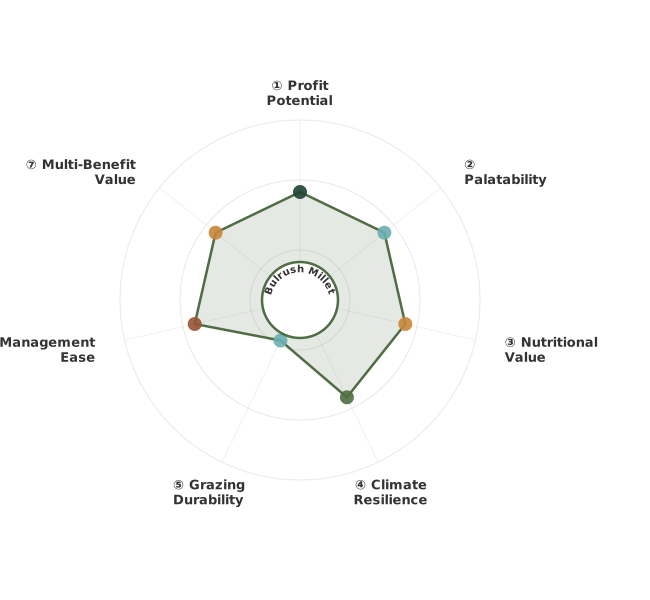
How These Traits Are Calculated
Trait dimensions are ordered clockwise starting from the top of the chart (12 o'clock position):
1. Profit Potential
Economic returns from hay sales, grazing value, and system contributions
WHAT: Synthesizes direct revenue potential (hay sales or grazing service value) with system contributions (nitrogen fixation, reduced supplement needs) into net economic value. Captures both cash income and cost savings.
WHY: Forage profitability comes from two sources—direct sales (hay, haylage) or indirect value (grazing services supporting livestock production). High-value forages provide $300-600/acre in combined revenue and savings versus $100-200/acre for lower-value options. This determines whether forage enterprises are viable versus purchasing feed.
HOW: Scored via LLM synthesis of economics data (hay yields, prices, grazing value), timeline considerations (establishment costs, productive lifespan), and system value (nitrogen contributions, supplement replacement). Exceptional (3.0): High yields with premium pricing or exceptional grazing value plus nitrogen fixation. Typical (2.0): Moderate returns. Limited (1.0): Low yields, commodity pricing, or minimal system contributions.
2. Palatability
Livestock preference and voluntary consumption rates
WHAT: Measures how eagerly livestock consume the forage—preference ranking when choices are available. Highly palatable forages are grazed first and completely; limited palatability means animals avoid unless no alternatives exist.
WHY: Palatability directly determines voluntary intake, which drives animal performance. High-palatability forages support faster weight gain and higher milk production because animals eat more. Low-palatability forages reduce performance and waste productive potential—animals selectively graze preferred species and leave unpalatable plants ungrazed.
HOW: Ratings based on the palatability trait documenting livestock selection preference. Exceptional (3.0): Preferentially selected, high sugar content, tender growth eagerly consumed (orchardgrass, white clover, ryegrass). Typical (2.0): Readily consumed when available. Limited (1.0): Avoided unless no other options (coarse stems, bitter compounds, low digestibility).
3. Nutritional Value
Protein content and forage quality for livestock growth and production
WHAT: Measures protein content as the primary indicator of forage nutritional quality. High-protein forages (>18%) support rapid growth and high milk production; low-protein forages (<12%) require supplementation for production animals.
WHY: Protein is the most expensive supplement in livestock diets ($0.40-0.60/lb). Forages with exceptional protein content eliminate or reduce supplement costs while supporting maximum animal performance. High-quality forage can save $200-400/cow/year in purchased feed versus low-protein options.
HOW: Ratings based on the protein_content trait. Exceptional (3.0): High protein (>18%) supporting rapid weight gain or high milk production (alfalfa, clovers, young grasses). Typical (2.0): Moderate protein (12-18%) for maintenance and moderate production (mature grasses). Limited (1.0): Low protein (<12%) requiring supplementation for production animals (mature warm-season grasses, low-fertility forages).
4. Climate Resilience
Weighted: drought tolerance (60%) + climate adaptability (40%)
WHAT: Combines drought tolerance (primary climate stressor for forages) with overall climate adaptability (temperature range, geographic flexibility). Resilient forages survive extended dry periods and diverse weather patterns.
WHY: Drought is the most common forage crisis—dry years can cut production 50-80% and force costly hay purchases or herd reductions. Drought-tolerant forages maintain productivity through dry spells, reducing feed costs and providing grazing when less-resilient options fail. Geographic adaptability allows forage systems to work across farm regions.
HOW: Weighted formula prioritizes drought tolerance (60% weight) as primary stressor, with climate adaptability (40% weight) for temperature and general flexibility. Exceptional (3.0): Survives extended drought (6+ weeks) with minimal production loss and works across diverse climates. Typical (2.0): Moderate drought and climate tolerance. Limited (1.0): Drought-sensitive or narrow climate requirements.
5. Grazing Durability
Weighted: trampling tolerance (70%) + seasonal availability (30%)
WHAT: Combines grazing tolerance (resistance to trampling and frequent defoliation) with seasonal availability (timing and duration of productive growth). Durable forages handle intensive rotational grazing and provide consistent seasonal production.
WHY: Grazing tolerance determines management system viability. Tolerant forages allow intensive rotational grazing or mob grazing for maximum animal performance and pasture health. Intolerant forages are hay-only or require long rest periods. Seasonal availability indicates production timing—year-round, seasonal gaps, or narrow windows.
HOW: Weighted formula prioritizes grazing tolerance (70% weight) for management system determination, with seasonal availability (30% weight) for production timing. Exceptional (3.0): Handles intensive rotational grazing with consistent seasonal production. Typical (2.0): Moderate tolerance and availability. Limited (1.0): Hay-only species or narrow seasonal production windows.
6. Management Ease
Weighted: establishment ease (50%) + low maintenance needs (50%)
WHAT: Combines establishment difficulty (germination, stand establishment) with ongoing maintenance requirements (fertility, weed control, renovation needs). Easy forages establish reliably and persist without intensive management.
WHY: Pasture establishment is expensive ($150-400/acre) and risky. Easy-to-establish forages reduce stand failure risk and provide quicker returns. Low-maintenance forages reduce annual input costs and labor, improving long-term profitability of grazing systems.
HOW: Weighted formula balances establishment ease (50% weight) for startup success and inverted maintenance intensity (50% weight) for ongoing care. Exceptional (3.0): Fast germination, reliable stand establishment, minimal fertility/weed management needs (white clover, orchardgrass). Typical (2.0): Moderate establishment and care requirements. Limited (1.0): Difficult establishment or intensive maintenance (heavy fertility, frequent renovation, weed competition).
7. Multi-Benefit Value
Ecosystem services beyond forage—nitrogen fixation, pollinator support, wildlife habitat
WHAT: Measures ecosystem services provided beyond livestock nutrition. Multi-benefit forages contribute nitrogen fixation (legumes), pollinator support (flowering species), wildlife habitat, soil building, erosion control, and biodiversity support.
WHY: Forage systems can either extract from farm ecosystems or contribute to them. Nitrogen-fixing legumes (clovers, alfalfa) provide $80-150/acre/year worth of fertility for companion grasses and following crops. Flowering forages support pollinators critical for fruit/vegetable crops. These service-stacking forages deliver total system value beyond livestock production.
HOW: Ratings based on the multi_benefit_value trait documenting service diversity. Exceptional (3.0): Multiple significant benefits (legumes fixing 80-150 lbs N/acre/year + pollinator support + wildlife forage). Typical (2.0): Some ecosystem contributions. Limited (1.0): Single-purpose forage with minimal ecosystem services beyond grazing value.
Ratings are based on documented performance in regenerative systems, not conventional high-input scenarios. All traits assume integrated management practices focused on soil health and ecosystem services.
4
System Role & Multi-Benefit Value
Functional roles, integration strategies, and stacked benefits
System Role & Multi-Benefit Value
Functional roles, integration strategies, and stacked benefits
Functional Role
Total System Value
Bulrush millet offers substantial system value beyond direct forage harvest. As a component of multi-species cover crops, it significantly enhances soil health by increasing biomass, improving soil structure, and scavenging nutrients, thereby reducing the need for synthetic inputs. Its rapid growth in summer makes it ideal for extending the grazing season, providing critical feed when cool-season forages may be dormant, thus diversifying the farm's feed resources and reducing reliance on stored feed. This contributes to whole-farm resilience by mitigating drought impacts and providing consistent forage availability. The plant's role in soil organic carbon sequestration, particularly when integrated into no-till systems and diverse cropping modules as seen in research, offers long-term ecological benefits. Furthermore, its inclusion in diverse mixes supports beneficial insect populations and can contribute to a more robust farm ecosystem, enhancing overall biodiversity and ecosystem services.
Integration Characteristics
Multi-Benefit Value: Adequate - This fast-growing annual provides valuable forage and biomass, excels at weed suppression, and enhances soil structure through its extensive root system.
Sources behind this view
 Research
-
Functional traits in cover crop mixtures: Biological nitrogen fixation and multifunctionality (opens in new window)
Mixed cover crops with diverse plant types (legumes, brassicas, grasses) offer multiple farm benefits (ecosystem services) better than single-species stands. Complementary traits enhance sustainabilit
6
Economics & Value Streams
Direct harvest, system benefits, ecosystem services, and risk diversification
Economics & Value Streams
Direct harvest, system benefits, ecosystem services, and risk diversification
Comprehensive economic analysis including direct harvest value, system enhancement contributions, ecosystem services, value timeline, and risk diversification strategies.
Economics in Regenerative Systems
| Metric | Value |
|---|---|
| Seed Cost | $15-30/acre $37-74/ha |
| Establishment Cost | $100-200/acre $247-494/ha |
| Forage Yield | 4-8 tons/acre/year 4-8 tons/ha/year |
| Annual Management Cost | $50-100/acre $123-247/ha |
| Value/Sale Price | $70-130/ton $70-130/tonne |
| Net Annual Return* | $-20 to $890/acre/year |
Values represent typical ranges for regenerative agriculture contexts. Actual results vary by region, management, and market conditions. Costs exclude land and labor.
* Net Annual Return = (Yield × Market Price) − (Amortized Establishment Cost + Annual Maintenance). This return is realized only at/after first harvest; early years have costs but no revenue. Range shows worst case to best case scenarios.
System Enhancement Value
Beyond harvest: livestock nutrition, soil building, and pasture improvement
Nitrogen Fixation (if legume)
Bulrush millet (Pennisetum glaucum) is a warm-season grass and does not fix atmospheric nitrogen. Therefore, it does not contribute to nitrogen fixation value as a legume would. Its role in nutrient cycling is primarily through the decomposition of its biomass, which returns organic matter and nutrients to the soil. While it doesn't add nitrogen, its prolific growth can scavenge available nutrients, preventing their leaching, and its residue can contribute to soil organic matter over time. When used as a cover crop, its value lies in its ability to build soil structure and feed soil biology, rather than direct nitrogen input. Other species in a diverse mix, such as legumes, would be responsible for nitrogen fixation.
Livestock Nutrition & Soil Building
Variable, depends on integration context and species diversity in mix. Forage value can range from $0.10-$0.30/lb dry matter. Soil organic matter contribution is long-term and variable.
Bulrush millet offers significant value as a component in diverse cover crop mixes, particularly for its ability to scavenge nutrients and provide biomass for soil organic matter enhancement. Excerpts,,,, and consistently highlight its inclusion in multi-species mixes for various benefits. Its rapid growth and drought tolerance (mentioned in) make it a resilient option for filling nutritional gaps and providing forage during dry periods. Furthermore, its fibrous root system contributes to improved soil structure and water infiltration. When integrated as a cash crop with services, it can act as a buffer against market volatility for other crops and provide valuable forage for livestock, reducing feed costs. Its inclusion in a diverse mix also supports beneficial insects and pollinators, as indicated by the emphasis on flowering species in and, although millet itself is primarily wind-pollinated. The decomposition of its residue contributes to the soil food web, enhancing soil biological activity.
Erosion Control
As a relatively short-statured annual grass, bulrush millet does not provide significant windbreak or erosion control value in the same way that perennial trees or dense shrubbery would. While its above-ground biomass can offer some surface cover, helping to reduce wind erosion and protect soil from raindrop impact, this effect is temporary and seasonal. Its fibrous root system does contribute to soil aggregation and stability, which indirectly aids in erosion resistance, particularly when used in a cover cropping system. However, it is not typically selected or managed for the primary purpose of acting as a windbreak or for substantial, long-term erosion control. The primary benefits derived from bulrush millet in integrated systems are related to forage production, soil health improvement through biomass, and drought tolerance.
Ecosystem Service Contributions
Environmental contributions: carbon, pollinators, wildlife, and water
- Carbon Sequestration: Bulrush millet, as a fast-growing annual grass, has good potential for carbon sequestration during its growth cycle due to high biomass production. Its extensive root system also contributes to soil carbon storage. The amount sequestered is dependent on management practices, soil type, and environmental conditions.
- Pollinator Support: Low to Medium. While not a primary attractant for many pollinators compared to flowering broadleaves or legumes, its presence in diverse mixes can contribute to a more robust insect ecosystem. Its flowers are wind-pollinated, but the plant structure can offer habitat.
- Wildlife Habitat: Provides habitat and forage for ground-dwelling birds and small mammals during its growth phase. Its residue can offer overwintering sites for beneficial insects.
- Water Quality: Not applicable
Value Timeline: Forage Establishment & Production
When you'll see results: annuals year 1, perennial establishment 1-2, peak 3-10
Years 1-2
Forage production, soil organic matter contribution through residue decomposition, improved soil structure and water infiltration, nutrient scavenging.
Years 3-5
Established soil health benefits, continued forage provision, potential reduction in synthetic inputs for subsequent cash crops, increased resilience to drought.
Years 10-20
Significant long-term soil organic matter accumulation, enhanced soil biological activity, potential for increased water-holding capacity and nutrient cycling efficiency, contributing to overall farm resilience.
20+ Years
Sustained improvements in soil health, leading to reduced input needs and increased productivity of the entire farming system. Potential for a more stable and biologically rich ecosystem.
Farm Risk Reduction
How this reduces farm risk: feed cost reduction and livestock performance
- Multiple Revenue Streams: Direct forage sales (if applicable), reduced livestock feed costs (grazing), improved cash crop yields due to enhanced soil health, potential for niche markets as a cover crop seed.
- Temporal Income Spread: Provides forage during warm-season growth periods and can extend grazing into the fall when mixed with cool-season species, as noted in. Its rapid growth offers a relatively quick return of biomass and soil benefits within a single growing season.
- Market Risk Hedge: Drought tolerance offers resilience against water scarcity. Integration into cover crop mixes diversifies farm functions, reducing reliance on single-commodity markets. Enhanced soil health can buffer against extreme weather events, leading to more stable yields.
Sources behind this view
Research
-
Evaluating Cover Crops for Benefits, Costs and Performance within Cropping System Niches (opens in new window)
Review of cover crops highlights benefits (pest control, soil health, yield) and costs. Best species identified for different seasons/regions. Rye excels in winter, C4 grasses in summer. Legumes fix N
-
Potential of Forages to Diversify Cropping Systems in the Northern Great Plains (opens in new window)
Forage crops in the Northern Great Plains can boost grain yields, improve soil health, and add nitrogen. They also offer environmental benefits like carbon storage but can impact soil moisture. Innova