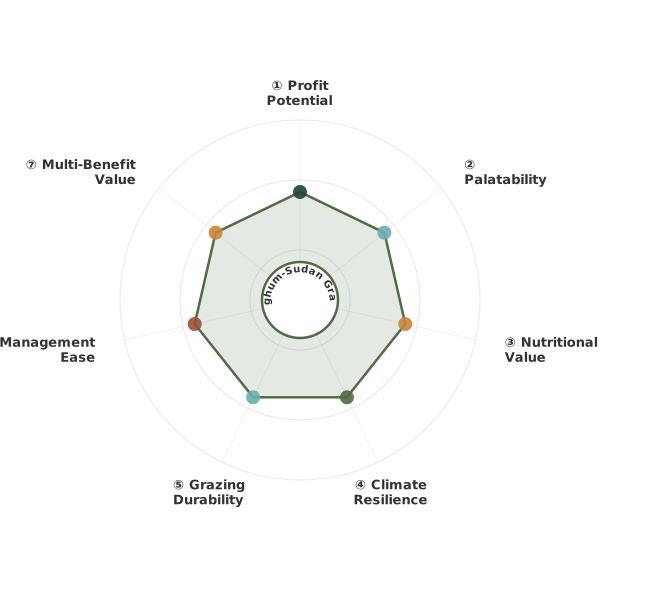
Regenerative Quick Profile

All recommendations assume integrated, regenerative practices—not conventional inputs.

Climate & Soil Fit

Climate: Tropical Rainforest, Tropical Monsoon, Tropical Savanna, Hot Semi-Arid (Steppe), Cold Semi-Arid (Steppe), Hot Desert, Cold Desert, Humid Subtropical, Oceanic (Maritime Temperate), Hot-Summer Mediterranean, Warm-Summer Mediterranean, Monsoon-Influenced Humid Subtropical, Subtropical Highland, Hot-Summer Continental, Warm-Summer Continental, Subarctic, Monsoon-Influenced Hot-Summer Continental, Tundra

Zones: USDA 6-11, Australian Zones 1-14

System Role & Functions

Primary: Cover Crop System

Secondary: Forage Integration, Cash Crop With Services

Key Benefits: Climate adaptable, Easy establishment, Weed Suppression

Management Level

Experience: Beginner-Friendly

Maintenance: Moderate maintenance - While drought-tolerant, grain sorghum benefits from thoughtful fertility management and water conservation strategies to optimize its performance and yield within the farming system.

Value Streams

  • Cover crop (soil investment)
  • Soil building and erosion control
  • Livestock forage value
1

Climate Suitability Assessment

Will this plant thrive in your climate?

IDEALLY SUITED

Köppen Zone: Aw (Tropical Savanna), Cfa (Humid Subtropical), Cwa (Monsoon-Influenced Humid Subtropical)
USDA Zone: 6a, 7a, 8a, 9a
Australian Zone: subtropical
EU Climate Region: atlantic, continental

Sorghum-Sudan grass excels in climates characterized by long, warm to hot growing seasons and adequate moisture. This includes humid subtropical (Köppen Cfa, Cwa), oceanic (Cfb), hot continental (Dfa), and subtropical Australian zones. USDA zones 5b through 10b, and EU Atlantic and Continental regions also provide ideal conditions. These environments offer sufficient frost-free days (120-180+) and temperatures (70-90°F/21-32°C) that promote vigorous vegetative growth, high biomass production, and effective weed suppression. Establishment is reliable with soil temperatures above 60°F (15°C), and the plant tolerates summer heat and humidity well. Rainfall of 30-50 inches (75-125 cm) annually is generally sufficient, though supplemental irrigation can further enhance performance in drier periods. Its rapid growth makes it an excellent choice for cover cropping, forage integration, and cash crop with services, providing significant soil health benefits and high-quality forage yields.

ADEQUATE

Köppen Zone: Af (Tropical Rainforest), Am (Tropical Monsoon), BSh (Hot Semi-Arid (Steppe)), Cfb (Oceanic (Maritime Temperate)), Csa (Hot-Summer Mediterranean), Csb (Warm-Summer Mediterranean), Cwb (Subtropical Highland), Dfa (Hot-Summer Continental), Dfb (Warm-Summer Continental)
USDA Zone: 5a, 5b, 10a, 11a, 12a
Australian Zone: grassland, temperate
EU Climate Region: mediterranean

Sorghum-Sudan grass performs adequately in climates with moderate growing seasons and temperatures, or where water management is a key consideration. This includes semi-arid cool steppe (Köppen BSk), Mediterranean (Csa, Csb), warm continental (Dfb), dry hot continental (Dwa), and temperate Australian zones. USDA zones 3b-4b and 5a, and grassland Australian zones also fall into this category. These regions typically have 90-140 frost-free days and summer temperatures that are warm but may not be consistently hot for extended periods. While the plant can establish and grow, yields and biomass production may be moderate compared to ideal zones. Water availability is often a limiting factor, especially in Mediterranean and semi-arid regions, necessitating irrigation for optimal performance. The growing season length can also impact total biomass accumulation. Careful timing of planting and adequate moisture management are crucial for success, making it a viable but not optimal choice.

NOT RECOMMENDED

Köppen Zone: ET (Tundra), BSk (Cold Semi-Arid (Steppe)), BWh (Hot Desert), BWk (Cold Desert), Dfc (Subarctic), Dwa (Monsoon-Influenced Hot-Summer Continental)
USDA Zone: 2a, 3a, 3b, 4a

Sorghum-Sudan grass is not recommended in climates with extremely short, cool growing seasons and severe winter cold, or where extreme heat and drought are unmanageable. This includes subarctic (Köppen Dwb) and USDA zones 3a, 3b, and 4a. These zones experience winter temperatures far too low for survival and growing seasons too short for reliable establishment and maturation, even as an annual. In these regions, alternative cold-hardy cover crops like Winter Rye or Hairy Vetch are far more suitable for biomass production and soil protection. While Sorghum-Sudan grass can technically survive in some hot, semi-arid climates (Köppen BSh) with intensive irrigation, the high water demand and potential for heat stress make it a less practical and economically questionable choice compared to more drought-tolerant legumes like Cowpea or Sunn Hemp, which are better adapted to such challenging conditions.

Better alternatives for these "not recommended" zones: Winter Rye (Extremely cold-hardy annual cover crop for biomass and soil protection.), Hairy Vetch (Cold-tolerant annual legume for nitrogen fixation, can overwinter in milder parts of this zone.), Annual Ryegrass (Fast-growing, relatively cold-tolerant annual grass for biomass.), Cowpea (Heat-tolerant nitrogen fixer for hot, dry zones.), Sunn Hemp (Tropical nitrogen fixer adapted to hot, dry conditions.)

Note: Zones listed above represent climates where this plant can produce reliably with reasonable management. Climate zones not mentioned would require intensive climate modification (greenhouses, extensive infrastructure) and are not economically viable for regenerative agriculture purposes.

2

Soil Suitability Assessment

Which soil types work best for this plant?

ADEQUATE

Acidic Soil, Alkaline Soil, Clay Soil, Desert Soil, Loam Soil, Rich Soil, Rocky Soil, Sandy Soil, Wet Soil

This plant performs acceptably in these soil types with moderate, manageable remediation such as pH adjustment, compost addition, or drainage improvement. The required amendments are practical and cost-effective for regenerative agriculture.

NOT RECOMMENDED

Saline Soil

Growing this plant in these soil types would require impractical remediation such as complete soil replacement, extensive amendments, or cost-prohibitive infrastructure. These conditions are not economically viable for regenerative agriculture.

Note: Soil suitability assessments focus on remediation requirements. "Ideally Suited" means the plant generally thrives without the need for substantial amendments, "Adequate" means manageable remediation (lime, compost, mulch), and "Not Recommended" means impractical soil changes would be required. Climate factors like rainfall and temperature also influence success.

3

Seasonal Considerations

Planting timing, growth duration, and harvest windows

For grain sorghum as a cover crop, timing is key to maximizing its benefits within your rotation. Spring planting should occur after the soil has warmed sufficiently and all danger of frost has passed, aiming for soil temperatures consistently above 50°F (10°C). This allows for rapid establishment, typically within one to two weeks, setting the stage for significant biomass production through the warm summer months.

If incorporating sorghum as a summer cover, plant it after the harvest of an early-season cash crop, ensuring adequate time for growth before cooler temperatures arrive. For fall planting, sow sorghum in late summer or early autumn, well before the first expected frost. It will likely not survive significant frosts in colder climates (D zones) and will enter dormancy or die back in cooler regions (C zones) as temperatures drop. Termination should ideally occur in late fall or early winter, or in early spring before planting your next cash crop, allowing sufficient time for decomposition. This warm-season grass excels at scavenging nutrients and building organic matter when given a full growing season.

4

System Role & Multi-Benefit Value

Functional roles, integration strategies, and stacked benefits

Functional Role

Integration Characteristics

Multi-Benefit Value: Adequate - Grain sorghum offers grain and forage production, significant biomass for soil organic matter, improved soil structure via its roots, and effective weed suppression, though it does not fix nitrogen.

5

Economics & Value Streams

Direct harvest, system benefits, ecosystem services, and risk diversification

Comprehensive economic analysis including direct harvest value, system enhancement contributions, ecosystem services, value timeline, and risk diversification strategies.

Economics in Regenerative Systems

Metric Value
Seed Cost $15-30/acre $37-74/ha
Establishment Cost
Forage Yield
Annual Management Cost
Value/Sale Price

Values represent typical ranges for regenerative agriculture contexts. Actual results vary by region, management, and market conditions. Costs exclude land and labor.

System Enhancement Value

Beyond cost recovery: soil building, nitrogen, biomass, and weed suppression

Nitrogen Fixation & Cycling

Grain sorghum, as a non-leguminous grass, does not contribute to nitrogen fixation through symbiotic relationships with bacteria. Therefore, it does not provide a direct nitrogen contribution to the soil in the way that legumes do. Its role in nutrient cycling is primarily through the decomposition of its biomass, which returns organic matter and the nutrients it has scavenged from the soil back into the system. In integrated systems, its contribution lies more in scavenging existing nutrients and improving soil structure, which can enhance the availability and uptake of nutrients by subsequent crops or in mixed swards. While it doesn't add nitrogen, its efficient nutrient scavenging can reduce the need for external nitrogen inputs by making existing soil nutrients more accessible.

Soil Building & Weed Suppression

Grain sorghum offers significant system benefits beyond direct harvest, particularly in integrated farming systems. As a warm-season cover crop (Excerpt), it can scavenge nutrients and add substantial biomass to the soil, contributing to increased soil organic matter over time. Its deep root system, as noted for sorghum-Sudan grass in Excerpt, can improve soil structure, enhance water infiltration, and break up compaction, making nutrients more accessible. In dryland conditions, sorghum's drought tolerance, mentioned in Excerpt for sorghum-Sudan, is a critical asset for resilience, as highlighted by its performance during dry spells in Excerpt. When used in a cover cropping strategy, it can provide 'cash crop with services' value, offering forage integration possibilities (Excerpt) for livestock, providing nutritional gaps or late-season grazing. Its role in diverse mixes, as emphasized in Excerpts and, enhances overall system resilience and soil health, contributing to a more robust agricultural ecosystem.

Erosion Control

Variable, depending on planting density and configuration. Can contribute to residue cover, reducing wind erosion by an estimated 10-20% on exposed fields.

While not typically planted as a dedicated windbreak, grain sorghum's dense growth habit and height can offer some degree of windbreak effect, particularly when grown in rows or as part of a mixed stand. In dryland farming systems, maintaining residue cover is paramount for moisture conservation and erosion control, and sorghum's stalks and leaves contribute significantly to this residue. Excerpt highlights Jim Cavin's use of mulch tillage for dryland sorghum and wheat, emphasizing year-round residue cover to conserve moisture and manage weeds. While not a formal windbreak, this residue management, facilitated by sorghum's biomass, helps protect the soil surface from wind erosion and reduces evaporation. The 40-inch row spacing mentioned for sorghum in dryland conditions also aids in residue dispersion and can contribute to surface roughness, further mitigating wind's erosive power. The 'diking' technique mentioned in excerpt also aims to capture rainfall, which is indirectly related to managing the impact of weather events, including wind-driven erosion.

Ecosystem Service Contributions

Environmental contributions: carbon, pollinators, wildlife, and water

  • Carbon Sequestration: Grain sorghum has a moderate to high carbon sequestration potential due to its rapid growth and substantial biomass production, especially when managed for residue retention. Its root system also contributes to soil carbon. The decomposition of its organic matter adds carbon to the soil profile.
  • Pollinator Support: Low. While some sorghum varieties may produce small flowers, they are not typically considered a primary pollinator attractant compared to dedicated flowering cover crops or other broadleaf species. Its main value is in biomass and nutrient cycling.
  • Wildlife Habitat: Moderate. Sorghum can provide some habitat and food sources (grain) for certain wildlife, particularly birds, during its growth cycle and after harvest. Its stalks can offer roosting or nesting sites.
  • Water Quality: Not applicable

Value Timeline: Soil Building Process

When you'll see results: immediate soil benefits, compounding over seasons

Years 1-2

Erosion control through residue cover, soil moisture conservation, potential for forage integration/grazing, nutrient scavenging, and initial improvements in soil structure from root activity.

Years 3-5

Continued soil health improvements, increased organic matter, enhanced water infiltration, potential for reduced weed pressure in subsequent cash crops due to cover crop benefits, and established drought resilience in the system.

Years 10-20

Significant improvements in soil organic matter and overall soil health, leading to more stable yields and reduced input needs. The plant's resilience contributes to long-term farm viability, particularly in variable climates.

20+ Years

Long-term soil health benefits, including enhanced water-holding capacity and nutrient cycling, making the system more resilient to climate change and market fluctuations. The plant's contribution to a diverse and healthy soil microbiome supports ongoing ecosystem services.

Farm Risk Reduction

How this reduces farm risk: lower input costs and better soil resilience

  • Multiple Revenue Streams: Primary cash crop revenue, forage for livestock integration, potential for cover crop seed production, and the indirect value of improved soil health leading to reduced input costs for other crops.
  • Temporal Income Spread: Annual harvest revenue from the grain, with ongoing soil health benefits and potential forage availability that can be utilized at different times of the year, contributing to a more consistent farm output.
  • Market Risk Hedge: Drought tolerance provides a significant hedge against water scarcity. Its role as a cover crop in a diverse rotation reduces reliance on a single cash crop, and its integration with livestock offers alternative income and nutrient cycling opportunities, buffering against market volatility for grain prices.
6

Regenerative Suitability Details

Comprehensive trait ratings for system integration assessment

Comparative ratings for this plant across key regenerative agriculture traits.

Trait Suitability Explanation
Cold Hardiness Not Recommended Grain sorghum is a warm-season annual, sensitive to frost, and will winterkill reliably in Zone 8 and colder, leaving the soil exposed over winter.
Weed Suppression Ideally Suited The rapid growth and dense canopy characteristic of this hybrid strongly suppress weeds, making it an exceptional tool for weed management, especially within multi-species summer mixes.
Nitrogen Fixation Not Recommended As a grass, grain sorghum does not fix nitrogen but efficiently scavenges existing nutrients and builds significant biomass.
Root System Depth Adequate Grain sorghum possesses a robust, fibrous root system reaching 2-4 feet, which effectively scavenges nutrients and enhances topsoil structure through its soil-building action.
Biomass Production Ideally Suited As indicated by its fast growth and high biomass advantages, this hybrid produces substantial organic matter, exceeding typical yields and providing excellent cover crop benefits.
Establishment Ease Ideally Suited Sorghum-Sudan grass hybrids are known for their rapid growth and vigorous establishment, quickly outcompeting weeds and thriving in warm conditions, contributing to excellent early stand establishment.
Multi Benefit Value Adequate Grain sorghum offers grain and forage production, significant biomass for soil organic matter, improved soil structure via its roots, and effective weed suppression, though it does not fix nitrogen.
Climate Adaptability Ideally Suited Grain sorghum excels in heat and drought, performing across zones 5-11 by thriving in arid conditions and producing under stress.
Maintenance Intensity Adequate While drought-tolerant, grain sorghum benefits from thoughtful fertility management and water conservation strategies to optimize its performance and yield within the farming system.

Comparative System: Ratings compare plants within their economic category (e.g., cover crop nitrogen fixation compared to other cover crops, not to all plants). Individual farm conditions and management practices significantly influence actual performance.

7

Learn More

Why farmers use this plant and additional resources

Why Regenerative Farmers Use This Plant

As an exceptionally fast-growing, high-biomass warm-season annual grass, this species is a cornerstone in many regenerative agricultural systems, offering rapid production of palatable and nutritious feed. Its vigorous growth allows it to produce substantial amounts of vegetative matter, often reaching heights of 1.5-2.5 meters (5-8 feet) within 6-8 weeks of planting under optimal conditions. This high biomass production is critical for building soil organic matter, providing excellent ground cover to suppress weeds and prevent erosion, and serving as a valuable feed source for livestock. BMR (brown midrib) varieties are particularly prized for their improved digestibility, leading to better nutrient utilization by grazing animals, with crude protein levels often remaining above 10-12% through early winter and Total Digestible Nutrients (TDN) often exceeding 70%.

Integrating this species into a forage system can significantly boost carrying capacity. Under well-managed rotational grazing, it can support an estimated 2-4 Animal Units (AU) per acre (5-10 AU/hectare) during its peak growth period, contributing to higher livestock weight gains or milk production. Gains of 2.0-3.0 lbs/day (0.9-1.4 kg/day) are achievable on well-managed stands during peak growth. Its palatability is generally high for cattle and sheep, making it an efficient feed. The rapid regrowth potential means it can be grazed multiple times within a single growing season, effectively extending the available grazing period and reducing reliance on stored feeds. In regions with long growing seasons, multiple grazing cycles can yield over 10-15 tons of dry matter per acre (22-34 tonnes/hectare) annually. Fall growth can be stockpiled, providing excellent quality forage with crude protein levels often remaining above 10-12% through early winter, potentially extending the grazing season by 60-90 days and significantly reducing hay feeding costs.

Beyond direct forage production, this grass offers significant ecological benefits. Its extensive root system, which can reach depths of 1.2-1.8 meters (4-6 feet), effectively scavenges nutrients from deeper soil profiles, preventing leaching, and contributes significantly to soil structure improvement and water infiltration. This aggressive root system is instrumental in breaking up soil compaction and improving the overall health of degraded soils, with potential to increase water holding capacity in the topsoil by 20-50% over time. The dense canopy it forms protects the soil surface from intense rainfall and wind, mitigating erosion. While not a nitrogen fixer, its residue readily decomposes, contributing carbon and nutrients back to the soil. As a highly efficient scavenger of residual soil nitrogen, it prevents its leaching and makes it available for subsequent crops, often reducing the need for synthetic nitrogen inputs by 40-60%. Its massive biomass production contributes significantly to building soil organic matter when residues are incorporated or left to decompose. Its dense growth also provides excellent weed suppression, outcompeting many annual weeds. Estimates suggest potential carbon sequestration of 1,000 to 3,000 lbs of carbon per acre (1,120 to 3,360 kg per hectare) annually.

This versatile grass has demonstrated success across diverse agricultural landscapes. In the humid subtropical regions of the southeastern United States, it's a staple for summer grazing, filling the gap when cool-season pastures decline. Farmers in Brazil utilize it in silvopasture systems, intercropping it with trees to provide shade and forage for cattle, or in pasture renovation programs to boost carrying capacity. In Australia, it's often incorporated into dryland farming rotations to improve soil health and provide supplemental feed during dry periods, utilizing its drought tolerance and ability to produce significant biomass under limited rainfall. In the US Midwest, it's integrated into corn-soybean rotations, planting it after soybean harvest for fall grazing and soil building, or as a summer cover crop between cash crops. In South Africa, farmers utilize it in rotation with maize or interseeded with legumes to improve soil structure and provide high-quality summer forage. In European systems, particularly in warmer regions, it serves as a productive summer cover crop or a component of multi-species forage mixes. Indian farmers utilize it in intercropping systems or as a dedicated fodder crop to supplement livestock diets.

8

How to Integrate This Plant

Practical guidance for regenerative systems

Establishment is typically achieved through direct seeding. For broadcast seeding, aim for 50-100 lbs/acre (56-112 kg/ha), ensuring good seed-to-soil contact through cultipacking or light harrowing. Drilled seedings can be slightly lower, around 30-50 lbs/acre (34-56 kg/ha). The optimal planting depth is shallow, between 0.25-0.5 inches (0.6-1.3 cm), as the seeds require good soil contact and moisture for rapid germination and light/warmth to germinate. Planting typically occurs at the beginning of the warm season, from April to July in the Northern Hemisphere and October to January in the Southern Hemisphere, when soil temperatures are consistently above 15°C (60°F) or 15.5°C (60°F). Adequate moisture is crucial for germination and early establishment, with approximately 1 inch (2.5 cm) of rain or irrigation needed within the first two weeks. Row spacing, if drilled, typically ranges from 6-12 inches (15-30 cm).

Management practices should focus on maximizing its growth potential while maintaining forage quality and promoting soil health. Water requirements are moderate; while relatively drought-tolerant once established, it performs best with adequate moisture, ideally around 1 to 1.5 inches (2.5 to 3.8 cm) of water per week during active growth. Fertility can be significantly enhanced through biological means; incorporating compost, utilizing well-composted manure from rotational grazing, or planting as a follow crop to legumes will provide essential nutrients. Its efficient scavenging of soil nitrogen means it can thrive on residual fertility, often reducing the need for significant synthetic fertilizer applications. Growth is rapid; it typically establishes within 14-21 days and reaches grazing height of 24-36 inches (60-90 cm) in 30-45 days, with total height at maturity reaching 3 to 7 feet (0.9 to 2.1 m) depending on variety and growing conditions. Pest and disease management is best handled through maintaining plant vigor and diversity, promoting beneficial insect habitat, employing crop rotation, and using resistant varieties. Avoid monocultures to reduce susceptibility.

Forage and grazing integration is a primary role for this species. Under adaptive multi-paddock grazing, it can support 2.5 to 3.5 AU/acre (6 to 9 AU/ha) with 3-5 day grazing periods and 45-60 day rest intervals during the active growing season. Cattle moved onto the stand when it reaches 8-12 inches (20-30 cm) tall and removed at a 3-4 inch (8-10 cm) residual height can gain 2.0-2.8 lbs/day (0.9-1.3 kg/day) during peak growth. The species is highly palatable to cattle and sheep, though goats may browse it more selectively. Fall growth can be stockpiled, providing excellent quality forage with crude protein levels often remaining above 10-12% through early winter in moderate climates, potentially providing 60-90 grazing days and significantly reducing hay feeding costs. Its rapid regrowth rate means it can provide multiple grazing cycles within a single growing season, creating a consistent forage supply. It is important to manage for prussic acid potential, especially during drought or frost events, by allowing plants to regrow to at least 24 inches (60 cm) after stress.

View Full Document (Printable single-page version)