Regenerative Quick Profile

All recommendations assume integrated, regenerative practices—not conventional inputs.

Climate & Soil Fit

Climate: Tropical Rainforest, Tropical Monsoon, Tropical Savanna, Hot Semi-Arid (Steppe), Cold Semi-Arid (Steppe), Hot Desert, Cold Desert, Humid Subtropical, Oceanic (Maritime Temperate), Hot-Summer Mediterranean, Warm-Summer Mediterranean, Monsoon-Influenced Humid Subtropical, Subtropical Highland, Hot-Summer Continental, Warm-Summer Continental, Subarctic, Monsoon-Influenced Hot-Summer Continental, Tundra

Zones: USDA 5-9, Australian Zones 3-11

Optimal Soil: Loam Soil

System Role & Functions

Primary: Cash Crop With Services

Secondary: Cover Crop System, Forage Integration

Key Benefits: Rotation Value, Market Accessibility, Harvest Processing Ease

Management Level

Experience: Intermediate

Maintenance: High maintenance - While eliminating tillage, establishing and managing a perennial grain requires different long-term strategies and potentially more patience than annual cropping systems.

Value Streams

  • Grain harvest
  • Livestock forage value

Know the Debate

  • Kernza yields vary: 200-1500 lbs/acre (560-1680 kg/ha) by management
  • Carbon sequestration benefits depend on establishment and time
  • Requires 3-5 years establishment for optimal soil health
  • Differentiates from annual grains: no tillage, deep roots
1

Climate Suitability Assessment

Will this plant thrive in your climate?

IDEALLY SUITED

Köppen Zone: Cfa (Humid Subtropical), Cfb (Oceanic (Maritime Temperate)), Dfa (Hot-Summer Continental), Dfb (Warm-Summer Continental)
USDA Zone: 5a, 5b, 6a, 6b, 7a, 7b
Australian Zone: temperate
EU Climate Region: atlantic, continental

Kernza Perennial Wheatgrass thrives in regions with a consistent growing season of 150-200+ frost-free days and moderate temperatures, ideally between 60-75°F (15-24°C) during its active growth phases. Köppen zones Cfb and Dfb, USDA zones 5b-8b, Australian temperate zones, and EU Atlantic and Continental regions offer these optimal conditions. These climates provide sufficient rainfall (30-50 inches/75-125 cm annually) or manageable irrigation potential, supporting robust establishment and perennial stand longevity. Winter temperatures are cold enough to signal dormancy but not so extreme as to cause widespread winter kill, especially with snow cover. Summer temperatures are warm enough for good grain development and biomass production without causing significant heat stress or disease issues. This combination allows for reliable multi-year productivity, high yields, and efficient nutrient cycling, making it a highly valuable cash crop with ecosystem services in these zones.

ADEQUATE

Köppen Zone: BSk (Cold Semi-Arid (Steppe)), Csa (Hot-Summer Mediterranean), Csb (Warm-Summer Mediterranean), Cwa (Monsoon-Influenced Humid Subtropical), Cwb (Subtropical Highland), Dfc (Subarctic), Dwa (Monsoon-Influenced Hot-Summer Continental)
USDA Zone: 4a, 4b, 8a, 8b
Australian Zone: subtropical

Kernza can perform adequately in climates with a growing season of 120-180 days and temperatures that can fluctuate, including Köppen zones Cfa, Csa, Csb, Dfa, and Dwa, USDA zones 4b-5a and 9a-10b, and Australian subtropical regions. These zones may experience more extreme summer heat or drier periods, necessitating supplemental irrigation to maintain productivity and stand health. Winter temperatures can be borderline in some of these areas, requiring careful site selection and potentially leading to some winter kill, reducing perennial stand longevity. While yields may be reduced by 10-20% compared to ideal zones due to these environmental stresses, Kernza can still provide valuable forage and grain production, along with its cover cropping and soil health benefits, making it a viable, though not optimal, choice with appropriate management strategies.

NOT RECOMMENDED

Köppen Zone: Af (Tropical Rainforest), Am (Tropical Monsoon), Aw (Tropical Savanna), ET (Tundra), BSh (Hot Semi-Arid (Steppe)), BWh (Hot Desert), BWk (Cold Desert)
USDA Zone: 2a, 3a, 3b, 9a, 9b, 10a, 10b, 11a, 11b, 12a, 12b, 13a, 13b

Kernza Perennial Wheatgrass is not recommended for climates with extreme winter cold or prolonged, intense summer heat and drought, specifically Köppen zone Dwb, USDA zones 3a-4a, and Australian subtropical regions with severe dry spells. In very cold zones (USDA 3a-4a, Dwb), winter temperatures below -20°F (-29°C) lead to high winter kill rates, making perennial stand establishment unreliable and economically unviable. The short growing seasons in these regions also limit biomass production. In hot, dry climates (parts of USDA 9a-10b, some subtropical Australian areas), summer heat above 85°F (29°C) for extended periods causes significant stress, reducing nitrogen fixation, increasing water demand to 40-50 inches (100-125 cm) annually, and potentially leading to stand failure. Establishment success can be below 70% in these challenging conditions, requiring intensive management and irrigation, making it a poor economic choice compared to more adapted species.

Better alternatives for these "not recommended" zones: Winter Rye (Extremely cold-hardy annual for biomass and soil protection, but not a perennial grain.), Hairy Vetch (Cold-hardy annual legume for nitrogen fixation, but not a perennial grain.), Annual Ryegrass (Fast-growing annual for cover cropping, but lacks perenniality and grain production.), Sorghum-Sudangrass (Heat-tolerant annual for biomass and forage, but not a perennial grain.)

Note: Zones listed above represent climates where this plant can produce reliably with reasonable management. Climate zones not mentioned would require intensive climate modification (greenhouses, extensive infrastructure) and are not economically viable for regenerative agriculture purposes.

2

Soil Suitability Assessment

Which soil types work best for this plant?

IDEALLY SUITED

Loam Soil

This plant thrives in these soil types without requiring amendments or remediation. Natural soil conditions support optimal growth and productivity.

ADEQUATE

Acidic Soil, Alkaline Soil, Clay Soil, Desert Soil, Rich Soil, Rocky Soil, Sandy Soil

This plant performs acceptably in these soil types with moderate, manageable remediation such as pH adjustment, compost addition, or drainage improvement. The required amendments are practical and cost-effective for regenerative agriculture.

NOT RECOMMENDED

Saline Soil, Wet Soil

Growing this plant in these soil types would require impractical remediation such as complete soil replacement, extensive amendments, or cost-prohibitive infrastructure. These conditions are not economically viable for regenerative agriculture.

Note: Soil suitability assessments focus on remediation requirements. "Ideally Suited" means the plant generally thrives without the need for substantial amendments, "Adequate" means manageable remediation (lime, compost, mulch), and "Not Recommended" means impractical soil changes would be required. Climate factors like rainfall and temperature also influence success.

3

Seasonal Considerations

Planting timing, growth duration, and harvest windows

For optimal yield and quality, consider planting wheat during early spring, once soil temperatures consistently reach around 50°F (10°C) and the risk of hard frost has passed. This allows for robust vegetative growth before the heat of summer. Spring-sown wheat typically matures in 90 to 120 days from seeding, progressing through establishment, flowering, and crucial grain fill stages.

Alternatively, if your region permits, planting winter wheat varieties in late fall, before the ground freezes and after soil temperatures have cooled significantly below 60°F (15°C), allows the crop to enter dormancy and resume growth early in spring. This often leads to earlier maturity and can provide a wider harvest window.

Harvest approaches as the grain reaches optimal moisture content, typically between 13% and 15%. While wheat can remain standing for a period after maturity, delaying harvest too long, especially through periods of rain or high humidity, can compromise grain quality and increase the risk of lodging. Monitor crop maturity closely in the weeks following grain fill completion to secure a timely harvest.

4

System Role & Multi-Benefit Value

Functional roles, integration strategies, and stacked benefits

Functional Role

Integration Characteristics

Multi-Benefit Value: Not Recommended - Primarily cultivated for food, common wheat offers limited direct ecosystem services. Its integration can indirectly support soil health through residue, but it provides negligible direct pollinator or wildlife habitat, functioning as a focused annual component.

5

Economics & Value Streams

Direct harvest, system benefits, ecosystem services, and risk diversification

Comprehensive economic analysis including direct harvest value, system enhancement contributions, ecosystem services, value timeline, and risk diversification strategies.

Grain Production Economics

Metric Value
Seed Cost $20-35/acre $49-86/ha
Expected Yield 30-50 30-50
Market Price 0.40-0.60 0.40-0.60
Harvest/Processing Cost 100-150 247-370
Insurance Cost 15-25 37-61
Net Annual Return* $-400 to $240/acre/year

Values represent regenerative practices (diverse rotations, cover crops, reduced inputs). Conventional systems may see different yields and costs.

* Net Annual Return = (Yield × Market Price) − (Amortized Establishment Cost + Annual Maintenance). This return is realized only at/after first harvest; early years have costs but no revenue. Range shows worst case to best case scenarios.

System Enhancement Value

Beyond harvest: ecosystem services from regenerative cash crop practices

Ecological Service Contributions

Common wheat, within integrated farm systems, offers several system benefits beyond direct harvest revenue. As a component of cover crop mixes, as explored by tools like the 'Smart Mix Calculator', it contributes to soil organic matter increase and can improve soil structure. Its root system, enhanced by treatments, can penetrate compacted layers, improving water infiltration and aeration. When used as a post-wheat cover crop, it can provide valuable residue for subsequent crops, contributing to a 'cash crop with services' model. Furthermore, wheat's inclusion in a diverse planting schedule, as seen in historical contexts and modern cover cropping strategies, promotes biodiversity within the agroecosystem. Its residue decomposition rate, influenced by its carbon-to-nitrogen ratio, impacts nutrient cycling. In systems where it's part of a rotation, it can help break disease cycles and manage weed pressure, contributing to overall farm resilience and reduced reliance on external inputs.

Erosion Control (if applicable)

Variable, dependent on planting density and integration within a cover crop mix. Indirect benefit through soil stabilization, potentially contributing to yield protection of adjacent crops by reducing erosion.

While common wheat (Triticum aestivum) is not typically planted as a dedicated windbreak, its role within a diverse cover cropping system or as an intercrop can contribute to soil stabilization and erosion control, indirectly mitigating wind damage to adjacent crops. The dense root structure of wheat, as highlighted by the potential for '2x root structure' with seed treatments, helps bind soil particles, reducing susceptibility to wind erosion, particularly during fallow periods or before the establishment of more robust perennial windbreaks. When integrated into a cover crop mix, as suggested by the 'Smart Mix Calculator', wheat can be part of a multi-species strategy that collectively builds soil resilience. The residue left after termination also contributes to surface cover, further reducing wind action on the soil. The presence of wheat in a system can therefore be seen as a component that enhances the overall resilience of the farm landscape against wind-driven soil loss, even if its primary function isn't wind interception.

Ecosystem Service Contributions

Environmental contributions: carbon, pollinators, wildlife, and water

  • Carbon Sequestration: As a C3 annual grass, common wheat sequesters carbon primarily in its biomass (above and below ground) and contributes to soil organic carbon through residue decomposition. The extent of sequestration is influenced by yield, management practices, and the duration of residue cover, with potential for significant contribution when managed within regenerative systems that promote soil health.
  • Pollinator Support: Low. While wheat flowers, it is wind-pollinated and does not produce nectar or pollen in quantities that significantly benefit most managed or wild pollinators. Its primary role is not as a direct pollinator attractant.
  • Wildlife Habitat: Provides some habitat and food sources, particularly as stubble or cover crop residue, offering shelter and foraging opportunities for small birds and ground-dwelling insects. Seed heads can be a food source for granivorous birds. Its role is more as a temporary habitat within a larger landscape mosaic.
  • Water Quality: Not applicable

Value Timeline: Production & Services

When you'll see results: varies by crop (annual harvest vs. perennial establishment)

Years 1-2

Initial soil stabilization and erosion control through root development and residue cover. Contribution to breaking pest/disease cycles in rotations. Potential for enhanced seedling vigor and root structure with seed treatments.

Years 3-5

Continued contribution to soil organic matter buildup. Improved soil structure and water infiltration. Established residue management benefits for subsequent cash crops. Wheat can be part of a diverse cover crop mix providing benefits like nitrogen fixation (if legumes are paired) and improved grazing potential.

Years 10-20

Long-term improvements in soil health, leading to increased resilience and potentially reduced input needs. Wheat's role in diverse rotations contributes to sustained soil fertility and structure.

20+ Years

Sustained benefits of improved soil health, leading to consistent yields and reduced farm risk. Contribution to a more robust and resilient agroecosystem.

Farm Risk Reduction

How this reduces farm risk: backup income, weather protection, market hedges

  • Multiple Revenue Streams: Direct cash crop revenue, potential for revenue from cover crop services (e.g., grazing integration), and indirect value through improved soil health leading to reduced input costs and enhanced yields in subsequent crops.
  • Temporal Income Spread: Value is primarily annual through harvest, but ongoing benefits accrue over time through soil health improvements. Its inclusion in cover cropping sequences spreads ecological benefits across seasons.
  • Market Risk Hedge: Diversifies farm revenue streams, reducing reliance on a single commodity. Its role in soil health can provide drought tolerance and resilience against extreme weather events, buffering against yield losses and market volatility.
6

Regenerative Suitability Details

Comprehensive trait ratings for system integration assessment

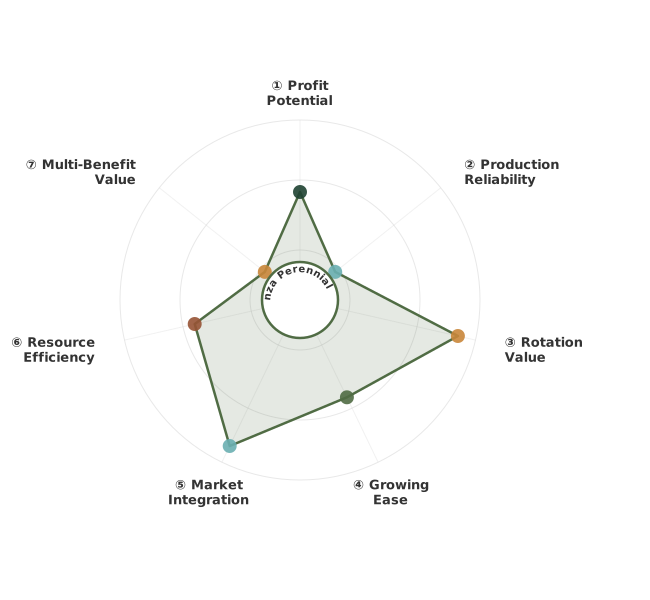
Comparative ratings for this plant across key regenerative agriculture traits.

Trait Suitability Explanation
Rotation Value Ideally Suited As a perennial, Kernza eliminates tillage, drastically improving soil health and biodiversity. Its extensive root system makes it the ultimate cover crop and continuous living root expression.
Yield Potential Not Recommended Kernza Perennial Wheatgrass currently yields approximately 25% of annual wheat, representing a significant trade-off for its perennial benefits and improving potential.
Establishment Ease Adequate Common wheat reliably establishes from seed within 7-14 days with appropriate seedbed preparation. It demonstrates adequate early vigor, performing well in diverse farm settings with moderate competition from other plant life.
Input Requirements Adequate Common wheat benefits from mindful fertility management and integrated pest solutions for optimal growth. It thrives in well-managed soils, making it a suitable component for many diverse farming landscapes.
Multi Benefit Value Not Recommended Primarily cultivated for food, common wheat offers limited direct ecosystem services. Its integration can indirectly support soil health through residue, but it provides negligible direct pollinator or wildlife habitat, functioning as a focused annual component.
Climate Adaptability Adequate Common wheat flourishes in many temperate zones (3-9), though extreme temperatures and specific moisture management needs temper its 'exceptional' status compared to more resilient perennial options.
Market Accessibility Ideally Suited Common wheat benefits from well-established global commodity networks, numerous purchasers, and transparent pricing, facilitating its integration into diverse market scales.
Maintenance Intensity Not Recommended While eliminating tillage, establishing and managing a perennial grain requires different long-term strategies and potentially more patience than annual cropping systems.
Harvest Processing Ease Ideally Suited Standard combine harvesting, minimal specialized machinery, straightforward threshing and cleaning, and readily available local infrastructure make common wheat exceptionally manageable for cash grain production.

Comparative System: Ratings compare plants within their economic category (e.g., cover crop nitrogen fixation compared to other cover crops, not to all plants). Individual farm conditions and management practices significantly influence actual performance.

7

Know the Debate

Kernza® perennial wheatgrass offers significant regenerative advantages, particularly its deep root system for soil health and carbon sequestration...

Kernza® perennial wheatgrass offers significant regenerative advantages, particularly its deep root system for soil health and carbon sequestration, eliminating annual tillage. However, its implementation and outcomes vary significantly based on context. Yields and the rate of ecological benefits depend heavily on climate, soil type, and the specific management approach. Farmers in temperate regions with adequate rainfall often see more rapid improvements in soil health and consistent yields, while those in drier climates or who are new to perennial systems may experience longer establishment periods and potentially lower initial yields.

Kernza yields and carbon sequestration vs. annual grains?

High potential (academic/idealized)

Academic and institute research highlight Kernza's strong potential for soil carbon sequestration and yields ranging from 500-1500 lbs/acre (0.56-1.68 metric tons/ha) when managed under ideal conditions, emphasizing its perennial benefits.

Variable reality (field reports)

Field reports suggest Kernza yields can be lower, between 200-800 lbs/acre (224-896 kg/ha), especially during early establishment or in drier climates. Carbon sequestration benefits are acknowledged but may take longer to materialize significantly compared to annual cropping systems.

Making Sense of the Differences

Comparing Kernza to annual grains reveals a trade-off between immediate yield and long-term soil health benefits. Academic estimates often reflect optimal conditions and potential, while field reports highlight the variability encountered in real-world farming, influenced by climate, soil type, management intensity, and the crop's perennial establishment phase. Farmers should expect lower initial grain yields and plan for a 2-3 year establishment period to realize maximum soil-building and carbon sequestration benefits, integrating it where its perennial advantages outweigh the immediate yield gap.

8

Learn More

Why farmers use this plant and additional resources

Why Regenerative Farmers Use This Plant

Kernza® (intermediate wheatgrass) is a groundbreaking perennial grain developed by The Land Institute, representing a paradigm shift in grain production and offering a unique regenerative solution. Its most significant attribute is its exceptionally deep perennial root system, which can extend over 10 feet (3 meters) into the soil. This extensive root network actively sequesters carbon, improves soil structure by creating stable aggregates, and enhances water infiltration and retention. Unlike annual grains, Kernza® eliminates the need for annual tillage, drastically reducing soil disturbance, preventing erosion, and preserving soil organic matter and structure.

In terms of yield, Kernza® currently offers competitive output for a perennial grain. Research indicates potential yields of 500-1500 lbs/acre (0.56-1.68 metric tons/ha) after establishment, with ongoing breeding efforts focused on increasing this further. Some estimates suggest potential yields of 200-800 lbs/acre (224-896 kg/ha) of grain, with ongoing breeding efforts focused on increasing this further. The grain itself possesses desirable characteristics, including a rich, nutty flavor, good test weight (typically 45-55 lbs/bushel or 58-70 kg/hl), a higher oil content than many annual grains, and a good protein profile comparable to wheat, often ranging from 12-16%. This makes it a versatile ingredient for baked goods, food products, and a valuable ingredient for bakers and food processors seeking unique textures and nutritional profiles.

Integrating Kernza® into farming systems offers substantial ecological and economic benefits. As a perennial, it provides continuous ground cover, acting as an effective erosion control measure and a habitat for beneficial insects and soil microbes throughout the year. Its deep roots are adept at scavenging nutrients from lower soil profiles, drawing down nitrates and other leached nutrients from deeper soil profiles that annual crops cannot access, reducing the reliance on external fertilizer inputs over time. The dense canopy it forms can help suppress weeds, lessening the need for herbicides. Kernza® can be grown in diverse rotations, serving as a valuable break crop in annual systems or as a foundational element in perennial polycultures. Its residue contribution is significant, adding substantial organic matter to the soil surface after harvest, further fueling soil biological activity and building long-term soil fertility.

The ecosystem services provided by Kernza® are profound. The extensive root system contributes to significant soil organic matter accumulation, estimated to be higher than annual grains due to continuous root growth and turnover. This enhanced soil health leads to improved water holding capacity, making farms more resilient to drought conditions and buffering against both drought and heavy rainfall. Research is ongoing to quantify its precise impact on carbon sequestration rates, but its perennial nature and deep rooting are strong indicators of substantial atmospheric carbon drawdown. The continuous living cover also provides crucial habitat and forage for a variety of beneficial insects, including pollinators, throughout the growing season, supporting biodiversity within agricultural landscapes. Furthermore, its resilient growth and ability to scavenge nutrients from deeper soil profiles can contribute to reduced nutrient runoff into waterways, improving water quality.

Kernza® has already seen promising adoption and is finding its niche in a variety of regenerative systems globally. In the Midwestern United States, farmers are integrating it into corn-soybean rotations to build soil health and reduce erosion, often using it as a cover crop or for grain production. In parts of Europe, particularly in France, Germany, and Scandinavia, its potential as a sustainable grain option is being explored in organic farming systems and mixed farming systems, and for its potential to enhance landscape resilience. Australian farmers and researchers are investigating its drought resilience and suitability for dryland farming regions, where its perennial nature offers a significant advantage, and in dryland cropping systems for its drought tolerance and soil-building capabilities. In South America, its use as a cover crop and soil builder in diverse agricultural landscapes, including those supporting livestock and in Brazilian coffee plantations as a perennial understory crop, is also gaining traction.

9

How to Integrate This Plant

Practical guidance for regenerative systems

Establishing Kernza® typically involves direct seeding into a well-prepared seedbed, ideally after a period of weed control. For drilled seed, rates of 30-50 lbs/acre (34-56 kg/ha) are common, planted at a depth of 0.25-0.5 inches (0.6-1.3 cm). If broadcasting, seeding rates may increase to 50-70 lbs/acre (56-78 kg/ha) to account for less precise seed-to-soil contact. Row spacing for drilled seed is typically 6-10 inches (15-25 cm), creating a dense sward.

Planting is best timed for early spring (March-April in the Northern Hemisphere, September-October in the Southern Hemisphere) or late summer/early fall (August-September in the Northern Hemisphere, February-March in the Southern Hemisphere). This timing allows for establishment before extreme temperatures and for the plant to develop a robust root system before the onset of warmer growing seasons. Adequate moisture is crucial during establishment, with approximately 1 inch (2.5 cm) of water per week recommended until the plants are well-rooted.

Management of Kernza® focuses on building its perennial vigor and maximizing its ecosystem services. While it is drought-tolerant once established due to its deep roots, supplemental irrigation may be beneficial during prolonged dry spells, especially during grain fill. Fertility should be managed through biological means first, such as incorporating compost, utilizing the residue from previous cover crops, or integrating rotational grazing. Synthetic fertilizer inputs are generally not recommended or needed after the initial establishment phase, as the plant is adapted to scavenge nutrients effectively. Kernza® typically establishes within 30-45 days.

Kernza® typically reaches maturity for grain harvest in its second year, with harvest occurring in mid-summer (July-August in the Northern Hemisphere, January-February in the Southern Hemisphere). Plant height at maturity can range from 3-5 feet (0.9-1.5 meters). Pest and disease management is best achieved through crop rotation, maintaining plant health, and encouraging beneficial insect populations through habitat creation and diverse planting.

Harvest and rotation management are key to maximizing Kernza®'s benefits. While establishment occurs in the first year, significant grain yield is typically realized from the second year onward. The planting-to-harvest calendar for Kernza® as a perennial grain involves planting in early spring or late summer and then typically harvesting the grain in the second summer after planting, around July or August in the Northern Hemisphere. Days to maturity for the grain harvest are long, as it's a perennial crop that requires time to develop its root system before dedicating energy to seed production. Harvest indicators include the heads turning golden brown and the grain reaching a moisture content of 13-14% for safe storage, or when the kernels are hard and difficult to dent with a fingernail.

Post-harvest residue management is critical; leaving standing stubble at 8-12 inches (20-30 cm) is highly recommended. This stubble protects the soil surface from erosion, insulates the roots, and provides habitat for beneficial organisms over winter. Relay cropping is a promising integration strategy; for example, a cover crop like red clover or hairy vetch can be interseeded into the standing Kernza® at the boot stage, allowing it to establish before the grain harvest. Immediately after combine harvest, establishing a subsequent cover crop, such as winter rye or oats, can ensure continuous soil cover. Grain drying and storage require standard equipment, similar to other small grains, with attention to moisture levels to prevent spoilage.

Kernza®'s rotation position is highly flexible. It can follow annual crops like corn or soybeans, providing a significant soil-building phase before returning to annuals. In the US Midwest, farmers are integrating it into corn-soybean rotations, planting it in late summer after soybean harvest and harvesting the Kernza® grain the following summer, before planting a fall cover crop or returning to corn. In the UK, it can be sown in early autumn, providing ground cover through winter and spring, with harvest in mid-summer, after which a quick-growing cover crop can be established. In Australian dryland farming systems, its drought resilience and perennial nature make it a valuable option for stabilizing soils and providing a consistent, albeit potentially lower, grain yield in challenging environments, often established with autumn rains. In Brazil, it's being considered as a component in agroforestry systems, potentially providing grain and ground cover beneath tree canopies. Its perennial nature also makes it ideal for integration into silvopasture systems or as a component of diverse forage mixes.