
Siberian Peashrub
Caragana arborescens, commonly known as Siberian peashrub, demonstrates significant potential within regenerative agriculture systems, primarily as a component in shelterbelts and agroforestry designs. Studies, such as one in Saskatchewan, Canada, highlight its role in enhancing soil organic carbon (SOC) sequestration. Shelterbelts incorporating Caragana arborescens showed markedly higher SOC concentrations compared to adjacent agricultural fields, indicating its contribution to soil building and long-term carbon storage. While not explicitly detailed as a cover crop or forage in the provided excerpts, its inclusion in shelterbelt systems suggests benefits for soil health and potentially for providing habitat or supplemental resources in integrated farm landscapes. The knowledge base indicates its use in established agricultural settings, suggesting resilience and compatibility with existing farm structures. Further research within the knowledge base would be beneficial to fully delineate its specific functions as a nitrogen fixer or in direct support of rotational grazing or no-till practices, though its role in soil carbon enhancement is clearly supported.
For a full botanical description see: Wikipedia(opens in new window) (external link)
Regenerative Quick Profile
All recommendations assume integrated, regenerative practices—not conventional inputs.
Climate & Soil Fit
Climate: Tropical Rainforest, Tropical Monsoon, Tropical Savanna, Hot Semi-Arid (Steppe), Cold Semi-Arid (Steppe), Hot Desert, Cold Desert, Humid Subtropical, Oceanic (Maritime Temperate), Hot-Summer Mediterranean, Warm-Summer Mediterranean, Monsoon-Influenced Humid Subtropical, Subtropical Highland, Hot-Summer Continental, Warm-Summer Continental, Subarctic, Extreme Subarctic, Monsoon-Influenced Hot-Summer Continental, Monsoon-Influenced Warm-Summer Continental, Monsoon-Influenced Subarctic, Monsoon-Influenced Extreme Subarctic, Tundra
Zones: USDA 2-7, Australian Zones 3-6
Optimal Soil: Loam Soil
System Role & Functions
Primary: Nitrogen Fixer
Secondary: Windbreak, Cover Crop System
Key Benefits: Multi-benefit value, Climate adaptable, Drought tolerant
Management Level
Experience: Beginner-Friendly
Maintenance: Very low maintenance - Its inherent hardiness, drought tolerance, and nitrogen-fixing capabilities mean Siberian peashrub thrives with minimal external inputs, integrating seamlessly into low-input systems.
Time to Production: Moderate (2-5 years) - As a nitrogen-fixing legume, Siberian peashrub provides edible peas and forage, achieving useful production within 3-5 years as it integrates into the soil ecosystem.
Value Streams
- Fruit/nut harvest
- Nitrogen fixation
Know the Debate
- Soil carbon impact varies: enhancement in old stands, potential reduction in others.
- Natural restoration may be better for arid, low-rainfall areas.
- Age and context significantly influence carbon sequestration.
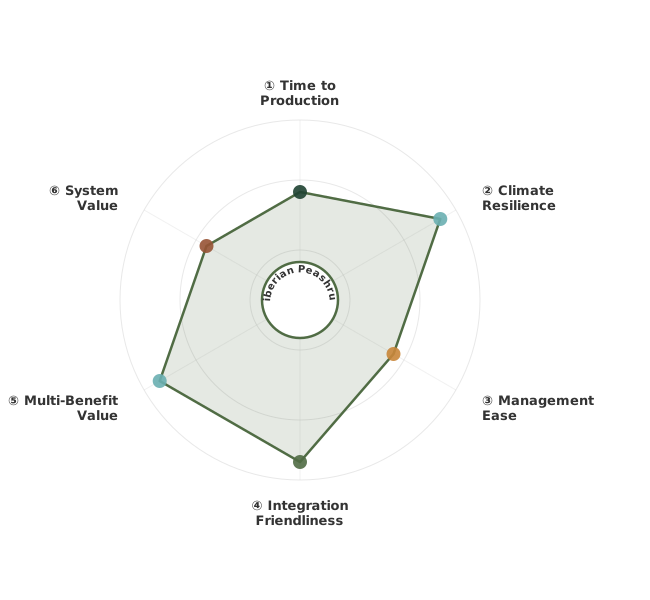
How These Traits Are Calculated
Trait dimensions are ordered clockwise starting from the top of the chart (12 o'clock position):
1. Time to Production
Years from planting to first harvestable yields
WHAT: Measures the waiting period from tree establishment to first meaningful production. Fast-producing trees yield within 2-5 years; slow producers require 8-15+ years before significant harvests.
WHY: Time to production determines cash flow timing and financial feasibility for farm businesses. Long wait times create significant opportunity costs—land and labor tied up for years without income. Fast producers allow quicker experimentation and cash flow recovery, reducing risk for new tree crop farmers.
HOW: Ratings based on years to first harvest documented in economics data. Exceptional (3.0): Production within 2-4 years (elderberry, mulberry, some nut bushes). Typical (2.0): 5-8 years (many fruit trees). Limited (1.0): 10-15+ years (hardwood timber, some nut trees like pecan, walnut).
2. Climate Resilience
Weighted: hardiness zones (50%) + drought tolerance (30%) + adaptability (20%)
WHAT: Combines temperature tolerance (hardiness zone range), water stress resilience (drought tolerance), and overall climate flexibility. Multi-decade tree investments require reliable climate matching to prevent total loss.
WHY: Wrong climate choices mean complete failure for permanent plantings. A tree that dies in year 5 from unexpected cold or prolonged drought represents catastrophic loss of 5 years' investment. Climate resilience determines geographic range and weather variability tolerance—critical as climate patterns become less predictable.
HOW: Weighted formula prioritizes hardiness zone range (50% weight) for core temperature tolerance, drought tolerance (30% weight) for water stress, and overall adaptability (20% weight) for general climate flexibility. Exceptional (3.0): Wide hardiness range (8+ zones) with strong drought tolerance. Typical (2.0): Moderate range and tolerance. Limited (1.0): Narrow climate requirements.
3. Management Ease
Weighted: establishment (40%) + low maintenance (30%) + pest resistance (30%)
WHAT: Combines establishment difficulty, ongoing maintenance requirements, and disease/pest pressure into overall management workload. Low-maintenance trees fit easily into busy farm operations without specialized expertise or intensive inputs.
WHY: Labor is the limiting factor for most diversified farms. High-maintenance trees requiring pruning expertise, disease management, and intensive pest control compete for limited time with other farm enterprises. Easy-care trees deliver production with minimal intervention, making them viable for time-constrained farmers.
HOW: Weighted formula balances establishment ease (40% weight) for startup success, inverted maintenance intensity (30% weight) for ongoing care, and inverted pest/disease pressure (30% weight) for health management. Exceptional (3.0): Easy to establish, self-sufficient growth, naturally pest-resistant. Typical (2.0): Moderate care needs. Limited (1.0): Difficult establishment, intensive maintenance, or heavy pest pressure.
4. Integration Friendliness
Compatibility with silvopasture, alley cropping, and multi-species systems
WHAT: Measures how well the tree integrates with other farm enterprises—grazing livestock, annual crops, or other perennials. Integration-friendly trees tolerate livestock browsing, don't heavily shade out crops, and coexist with diverse plantings.
WHY: Integrated tree systems (silvopasture, alley cropping, food forests) provide higher total returns per acre than monoculture plantings. Trees that work well with livestock provide shade + forage + production simultaneously. Integration flexibility allows farmers to stack enterprises and adapt to market opportunities.
HOW: Ratings based on the integration_friendliness trait documenting compatibility with grazing, cropping, and multi-species systems. Exceptional (3.0): Tolerates livestock browsing, provides livestock benefits (shade, browse), compatible with understory crops. Typical (2.0): Some integration possible with management. Limited (1.0): Requires isolation, incompatible with livestock or cropping.
5. Multi-Benefit Value
Stacked benefits beyond primary product—shade, wildlife, nitrogen, erosion control
WHAT: Measures the diversity of ecosystem services provided beyond the main harvest product. Multi-benefit trees deliver shade, windbreak, wildlife habitat, nitrogen fixation, erosion control, pollinator support, and aesthetic value simultaneously.
WHY: Single-purpose trees are economically fragile—market price swings or production failures eliminate all value. Multi-benefit trees provide resilience through diverse value streams. A nitrogen-fixing tree that produces nuts, provides shade for livestock, supports wildlife, and controls erosion delivers 4-5x the system value of a production-only tree.
HOW: Ratings based on the multi_benefit_value trait documenting service diversity. Exceptional (3.0): 4+ significant services stacked (nitrogen-fixing legume trees providing nuts + shade + wildlife + windbreak). Typical (2.0): 2-3 moderate services. Limited (1.0): Single-purpose production trees with minimal additional benefits.
6. System Value
Total ecosystem and economic value across short, medium, and long timeframes
WHAT: Synthesizes the total regenerative value delivered across multiple decades, including immediate ecosystem services (years 1-5), medium-term production value (years 5-15), and long-term system transformation (years 15-50). Captures the compounding benefits of permanent plantings.
WHY: Trees are multi-decade investments requiring patient capital. System value measures whether the total package—early ecosystem services, eventual production, and long-term legacy benefits—justifies the wait time and land commitment. High system value trees pay back investment through diverse, stacking, compounding benefits.
HOW: Scored via LLM synthesis of economics timelines, ecosystem service diversity, and long-term soil/water/carbon impacts. Exceptional (3.0): Strong early services + valuable production + transformative long-term impacts. Typical (2.0): Moderate benefits across timeframes. Limited (1.0): Long wait with limited service stacking or weak economic returns.
Ratings are based on documented performance in regenerative systems, not conventional high-input scenarios. All traits assume integrated management practices focused on soil health and ecosystem services.
5
Management & Care Requirements
Integration guidance, maintenance needs, and care practices
Management & Care Requirements
Integration guidance, maintenance needs, and care practices
How to Integrate This Plant
Siberian peashrub (Caragana arborescens) is a highly valuable nitrogen-fixing shrub for regenerative systems. Its primary roles include soil organic carbon sequestration, nitrogen fixation to enrich soil fertility, and providing a windbreak. It can be integrated into silvopasture systems, alley cropping, and food forests, acting as a nurse crop or a component of a multi-layered planting. In silvopasture, it can provide browse for goats or sheep and improve soil under grazing pressure. In alley cropping, it can be planted in hedgerows between crop rows to fix nitrogen and reduce wind erosion. Its contribution begins early; in Year 1-2, it establishes and starts fixing nitrogen. By Year 5, it provides significant soil improvement and windbreak benefits. By Year 20, its mature structure offers substantial ecosystem services, including enhanced soil organic carbon as noted in shelterbelt studies. The total system value extends beyond nitrogen fixation to include soil health improvement, carbon sequestration, and habitat creation.
Integration Practices & Management
Caragana arborescens is integrated into regenerative agriculture systems primarily as a component of shelterbelts, contributing to soil organic carbon sequestration. While the provided source focuses on its presence in established shelterbelts and observed soil organic carbon increases, it does not detail specific integration methods such as seeding rates, timing, or companion planting for establishment. Similarly, information regarding its use in grazing systems, including mob grazing or rotational strategies, timing, and rest periods, is absent. Termination strategies like natural winterkill, grazing, crimping, mowing, or herbicide use are also not specified in the given text. Management considerations such as fertility needs, competition management, or succession planning are not discussed. Furthermore, its integration with cash crops through relay cropping, intercropping, or rotation sequences is not elaborated upon. The knowledge base, based on the single provided excerpt, highlights Caragana arborescens' role in enhancing soil organic carbon in established shelterbelts, but lacks practical insights into its establishment, management, or termination within active regenerative farming practices.
Management Profile
Maintenance Intensity: Ideally Suited - Its inherent hardiness, drought tolerance, and nitrogen-fixing capabilities mean Siberian peashrub thrives with minimal external inputs, integrating seamlessly into low-input systems.
Pest Disease Pressure: Ideally Suited - Siberian peashrub's robust nature and resistance to common pests and diseases allow it to flourish in challenging conditions with virtually no need for external management.
Time To Production: Adequate - As a nitrogen-fixing legume, Siberian peashrub provides edible peas and forage, achieving useful production within 3-5 years as it integrates into the soil ecosystem.
Sources behind this view
 Videos & Podcasts
-
Integrates nitrogen-fixing woody plants (Siberian pea shrub, sea berry, Autumn Olive) as nurse crops in agroforestry systems using chop-and-drop mulch techniques. Plants are managed via coppicing or p
 Community
-
Integrate Siberian Pea Shrubs into food forests outside tree drip lines for nitrogen fixation. Use 'chop and drop' mulch from pollarded/coppiced shrubs to improve soil health. Manage landscapers to av
Read more (opens in new window) permies.com -
Siberian peashrub (Caragana arborescens) is a valuable, though contested, perennial crop for agroforestry, offering nitrogen fixation, protein, and biomass. It's highlighted as a beneficial alternativ
Read more (opens in new window) permies.com
8
Know the Debate
Caragana arborescens, or Siberian peashrub, offers benefits for soil health but its impact on soil carbon is debated and highly context-dependent. ...
Know the Debate
Caragana arborescens, or Siberian peashrub, offers benefits for soil health but its impact on soil carbon is debated and highly context-dependent. ...
Caragana arborescens, or Siberian peashrub, offers benefits for soil health but its impact on soil carbon is debated and highly context-dependent. While established plantations can sequester significant carbon, particularly in older stands and suitable climates, some research indicates potential negative impacts compared to natural grasslands. In arid, low-rainfall regions, the effectiveness of human-induced regeneration versus natural restoration needs careful consideration for optimal soil improvement and market access.
Soil Carbon Gains: Natural Restoration vs. Shrub Plantations
Carbon Sequestration (Established Plantations)
Established stands of Siberian peashrub, especially older ones, can significantly increase soil organic carbon storage and contribute to soil health. These woody legumes enhance soil structure and sequester carbon over the long term, especially in reclaimed or degraded lands.
Sources behind this view
Sources behind this view
 Research
-
Changes in Soil Microbial Community and Its Effect on Carbon Sequestration Following Afforestation on the Loess Plateau, China (opens in new window)
This study found: A study on China's Loess Plateau found that planting a specific shrub (Caragana korshinskii) for 18-28 years significantly improved soil health compared to cropland. The shrublands had 1.7 times more of a soluble soil organic matter component (fulvic acid-C) in the topsoil. The diversity and abundance of beneficial soil microbes, including bacteria and fungi, were much higher in the older shrublands. These changes in soil life were strongly linked to the soil's ability to store carbon and form stable organic matter. This indicates that establishing these shrublands is effective for carbon sequestration and restoring soil health.
-
Fine root dynamics and its contribution to soil organic carbon stocks with Caragana intermedia plantation development in alpine sandy land (opens in new window)
This study found: A three-year study on the Tibetan Plateau looked at how the roots of a shrub called Caragana intermedia affect soil carbon. They found that root growth and decay changed as the shrub plantations got older, with younger plantations (4-6 years old) having faster root turnover. Root growth was also slower in areas with more soil nutrients. The amount of carbon added to the soil each year from dying roots varied, contributing between 2.4% and 7.5% of the total soil carbon. The study suggests that these shrubs have good potential to store carbon over the long term, especially in younger stands and poorer soils. It's important to consider the age of the planting and soil depth when estimating how much carbon roots add to the soil in desert environments.
Carbon Reduction Potential (vs. Natural Grasslands)
In some dry grassland environments, intense Caragana shrub plantations may negatively impact soil structure and reduce overall soil carbon compared to native, undisturbed grasslands. This suggests that active planting may not always be superior to natural ecological processes.
Sources behind this view
Sources behind this view
Research
-
<i>Caragana korshinskii</i> Kom. plantation reduced soil aggregate stability and aggregate-associated organic carbon on desert steppe (opens in new window)
This study found: A 2022 study in China's dry grasslands found that planting pea shrub (<jats:italic>Caragana korshinskii</jats:italic>) significantly reduced soil health compared to letting native grasslands grow naturally. The pea shrub plantations, even at lower densities, resulted in weaker soil structure and substantially less soil carbon (over 40% less) in the top 40 cm of soil compared to natural grasslands. The research suggests that natural grassland restoration is a better approach for improving soil structure and increasing carbon storage in these arid environments.
Arid Region Suitability (Human-Induced Regeneration)
In very arid, low-rainfall areas, human-induced regeneration, potentially involving shrubs like Caragana, may be more viable than relying solely on natural processes or plantings with low yields. Careful ground truthing is recommended for market access.
Sources behind this view
Sources behind this view
Videos & Podcasts
-
In arid, low-rainfall regions, environmental planting carbon projects have low yields; human-induced regeneration may be more suitable. Groia can analyze these areas, but ground truthing is recommended for market access.

Making Sense of the Differences
The impact of Caragana arborescens on soil carbon varies significantly based on environmental context and stand age. While established plantations can sequester carbon, their long-term effect compared to natural grasslands needs careful assessment, especially in arid conditions where natural regeneration might be a more effective strategy. Farmers should consider local rainfall, existing soil conditions, and planting age when evaluating carbon sequestration potential.
9
Learn More
Why farmers use this plant and additional resources
Learn More
Why farmers use this plant and additional resources
Why Regenerative Farmers Use This Plant
Caragana arborescens, commonly known as Siberian Peashrub, is a remarkably resilient and versatile perennial legume shrub that offers substantial benefits within regenerative agricultural systems. It is a cornerstone for long-term soil health and ecosystem services, capable of fixing atmospheric nitrogen, thereby enriching soil fertility and reducing the reliance on synthetic nitrogen fertilizers by an estimated 40-60% for adjacent crops. Once established, it typically fixes 50-150 lbs of nitrogen per acre (56-168 kg/ha) annually, a crucial contribution to building soil health organically.
Its deep root system, often reaching 6-15 feet (1.8-4.5 m) or more, excels at breaking up compacted soils, improving water infiltration, enhancing soil structure, and scavenging nutrients from lower soil profiles. This extensive root biomass significantly improves soil organic matter content over time, leading to enhanced water-holding capacity and better soil aggregation. Mature stands are estimated to sequester 2-5 tons of CO2e per acre per year, contributing significantly to climate change mitigation.
Beyond its soil-building capabilities, Siberian Peashrub provides essential habitat and forage for pollinators and beneficial insects, with its abundant yellow flowers offering a crucial early nectar and pollen source during its bloom period in late spring. Its dense growth habit makes it an exceptional windbreak, effectively reducing wind erosion, protecting vulnerable crops and livestock from harsh winds, and creating microclimates that can extend growing seasons for understory plants. As a long-lived asset, it represents a stable component of farm infrastructure, accumulating value over decades through its ecosystem services and potential for biomass production.
Sources behind this view
Community
-
Siberian peashrub (Caragana arborescens) is a valuable, though contested, perennial crop for agroforestry, offering nitrogen fixation, protein, and biomass. It's highlighted as a beneficial alternativ
Read more (opens in new window) permies.com -
Integrate Siberian Pea Shrubs into food forests outside tree drip lines for nitrogen fixation. Use 'chop and drop' mulch from pollarded/coppiced shrubs to improve soil health. Manage landscapers to av
Read more (opens in new window) permies.com