Available data suggests its potential utility in regenerative agriculture. Studies indicate *Casuarina equisetifolia* possesses significant carbon sequestration capacities, contributing to soil building and climate resilience. Research on nutrient-poor sand dunes shows that nitrogen and phosphorus fertilization can enhance soil nutrient availability in *Casuarina equisetifolia* plantations, though its direct impact on tree growth rates in this context requires further investigation. Furthermore, its rhizosphere hosts salt-tolerant Plant Growth Promoting Fungi (PGPF), which could play a role in enhancing plant health and nutrient cycling in saline agroforestry systems. Bacterial communities in its soil also vary with parent material, highlighting the importance of soil context. Although not explicitly detailed as a nitrogen fixer in these excerpts, its inclusion in agroforestry systems points to its role as a component within polyculture layers, contributing to ecological stability and potentially other regenerative benefits not fully elucidated here. While coverage in our knowledge base is limited, the above represents documented uses in regenerative systems.

Regenerative Quick Profile

All recommendations assume integrated, regenerative practices—not conventional inputs.

Climate & Soil Fit

Climate: Tropical Rainforest, Tropical Monsoon, Tropical Savanna, Hot Semi-Arid (Steppe), Cold Semi-Arid (Steppe), Hot Desert, Cold Desert, Humid Subtropical, Oceanic (Maritime Temperate), Hot-Summer Mediterranean, Warm-Summer Mediterranean, Monsoon-Influenced Humid Subtropical, Subtropical Highland, Hot-Summer Continental, Warm-Summer Continental, Subarctic, Monsoon-Influenced Hot-Summer Continental

Zones: USDA 9-11, Australian Zones 11-14, EU Mediterranean, Subtropical

Optimal Soil: Sandy Soil

System Role & Functions

Primary: Windbreak

Secondary: Food Forest, Specialty

Key Benefits: Multi-benefit value, Drought tolerant, Integration-friendly

Management Level

Experience: Beginner-Friendly

Maintenance: Very low maintenance - Highly self-sufficient, Australian pine thrives with minimal external inputs due to its drought tolerance, wind resistance, and ability to grow vigorously in sandy coastal soils.

Time to Production: Slow (5+ years) - As a long-term provider of timber and windbreak services, its primary value is realized over many years, making it a species for establishing enduring ecological and resource systems.

Value Streams

  • Fruit/nut harvest
1

Climate Suitability Assessment

Will this plant thrive in your climate?

IDEALLY SUITED

Köppen Zone: Af (Tropical Rainforest), Am (Tropical Monsoon), Aw (Tropical Savanna), Cfa (Humid Subtropical), Csa (Hot-Summer Mediterranean), Csb (Warm-Summer Mediterranean), Cwa (Monsoon-Influenced Humid Subtropical)
USDA Zone: 6a, 7a, 8a, 9a, 10a, 11a, 12a
Australian Zone: tropical, subtropical

Casuarina species perform exceptionally well in climates offering consistently warm temperatures and adequate moisture, as found in USDA Zones 8a-13a, Australian subtropical and tropical zones, and Köppen Cfa, Aw, and Am. These regions provide long growing seasons with minimal frost risk, allowing for rapid establishment and vigorous growth. Optimal temperatures support dense foliage development, making Casuarina highly effective as windbreaks. Rainfall patterns in these zones are generally sufficient, though good drainage is often beneficial, especially in tropical monsoon climates. The plant's inherent drought tolerance is also advantageous in subtropical savanna climates with distinct dry periods. These conditions minimize the need for intensive management or supplemental inputs, ensuring reliable and robust windbreak function for extended periods, contributing significantly to soil protection and microclimate moderation in agricultural landscapes.

ADEQUATE

Köppen Zone: BSh (Hot Semi-Arid (Steppe)), BWh (Hot Desert), Cfb (Oceanic (Maritime Temperate)), Cwb (Subtropical Highland), Dfa (Hot-Summer Continental), Dfb (Warm-Summer Continental)
USDA Zone: 5a, 5b
Australian Zone: grassland, temperate
EU Climate Region: atlantic, mediterranean

Casuarina can be adequately suited in climates with moderate temperatures and seasonal rainfall, including USDA Zones 7a-7b, Australian grassland zones, Köppen Cfb, Csa, Csb, and As, and EU Atlantic and Mediterranean regions. These zones typically offer sufficient growing days and manageable temperature ranges, allowing for establishment and reasonable growth. However, performance may be limited by occasional frost in cooler temperate or Atlantic regions, or by dry spells in Mediterranean and tropical steppe climates, potentially requiring supplemental irrigation during establishment or dry periods. While not reaching the peak vigor seen in ideal zones, Casuarina can still provide effective windbreak functions, though growth rates may be slower, and stand density might be less pronounced. Species selection becomes more critical to ensure frost tolerance and drought resilience in these transitional climates.

NOT RECOMMENDED

Köppen Zone: ET (Tundra), BSk (Cold Semi-Arid (Steppe)), BWk (Cold Desert), Dfc (Subarctic), Dwa (Monsoon-Influenced Hot-Summer Continental)
USDA Zone: 2a, 3a, 3b, 4a
Australian Zone: arid

Casuarina is not recommended for climates characterized by extreme cold or extreme aridity, specifically USDA Zones 6a-6b, Australian arid zones, Köppen BWh and BSh, and potentially some very cold EU regions not explicitly listed but implied by extreme temperature ranges. In hot desert and semi-arid zones (BWh, BSh), the combination of intense heat and severe lack of consistent moisture makes establishment and survival highly improbable without extensive, impractical irrigation and protection. Growth will be stunted, and windbreak effectiveness minimal. In cold zones (USDA 6a-6b), winter temperatures are too low for reliable perennial survival, leading to frequent winter kill and unreliable windbreak development. Alternative plants with superior cold hardiness or extreme drought tolerance are far better suited for these challenging environments, offering more reliable and cost-effective solutions for regenerative agriculture functions.

Better alternatives for these "not recommended" zones: Acacia aneura (Mulga) (highly drought-tolerant native Australian tree adapted to arid conditions), Atriplex spp. (Saltbush) (highly salt and drought tolerant shrubs/small trees, excellent for arid/semi-arid zones), Juniperus virginiana (Eastern Redcedar) (very cold-hardy native evergreen, excellent windbreak), Populus tremuloides (Quaking Aspen) (fast-growing deciduous tree, tolerates cold and can form dense stands)

Note: Zones listed above represent climates where this plant can produce reliably with reasonable management. Climate zones not mentioned would require intensive climate modification (greenhouses, extensive infrastructure) and are not economically viable for regenerative agriculture purposes.

2

Soil Suitability Assessment

Which soil types work best for this plant?

IDEALLY SUITED

Sandy Soil

This plant thrives in these soil types without requiring amendments or remediation. Natural soil conditions support optimal growth and productivity.

ADEQUATE

Acidic Soil, Alkaline Soil, Clay Soil, Desert Soil, Loam Soil, Rich Soil, Rocky Soil

This plant performs acceptably in these soil types with moderate, manageable remediation such as pH adjustment, compost addition, or drainage improvement. The required amendments are practical and cost-effective for regenerative agriculture.

NOT RECOMMENDED

Saline Soil, Wet Soil

Growing this plant in these soil types would require impractical remediation such as complete soil replacement, extensive amendments, or cost-prohibitive infrastructure. These conditions are not economically viable for regenerative agriculture.

Note: Soil suitability assessments focus on remediation requirements. "Ideally Suited" means the plant generally thrives without the need for substantial amendments, "Adequate" means manageable remediation (lime, compost, mulch), and "Not Recommended" means impractical soil changes would be required. Climate factors like rainfall and temperature also influence success.

3

Seasonal Considerations

Planting timing, growth duration, and harvest windows

Establishing your Casuarina equisetifolia is best achieved in early spring, after the last expected frost, when the soil begins to warm and active growth is imminent. This timing is crucial for both bare-root and containerized seedlings, allowing them to establish a robust root system before the heat of summer. Expect your casuarina to reach a good level of establishment within the first two to three years. While some biomass may be utilized earlier, true first harvest of significant yield typically occurs around year five. Full production, where the trees reach their mature potential and yield consistently, can take up to seven to ten years. These resilient trees will continue to be productive for decades, often exceeding 30 years.

For ongoing management, pruning is best carried out during the dormant season, typically in late fall or winter, before new growth emerges. This encourages vigorous development and maintains tree structure. Casuarina is generally evergreen, so while it doesn't experience a stark winter dormancy like deciduous trees, its growth will slow considerably in cooler periods. Harvest cycles will depend on your specific production goals, but generally align with periods of active growth following pruning or natural flushes. Bloom timing is less critical for harvest but occurs during the warmer, active growing seasons.

4

System Role & Multi-Benefit Value

Functional roles, integration strategies, and stacked benefits

Functional Role

Total System Value

Casuarina equisetifolia offers significant multi-benefit stacking in regenerative agriculture. Its primary function as a windbreak enhances the productivity and resilience of adjacent agricultural areas by reducing wind damage and soil erosion, particularly in coastal or exposed regions. Excerpts highlight its capacity for carbon sequestration (Excerpt 3), contributing to climate change mitigation and soil health improvement. The plant's halotolerance (Excerpt 2) allows for its use in saline environments where other species struggle, adding a layer of risk diversification to farm systems. While direct harvest value isn't detailed, its biomass can be used for fuel, mulch, or timber. Furthermore, its root systems can help stabilize dunes and prevent coastal erosion. In silvopasture or agroforestry setups, it can create sheltered microclimates, improving animal comfort and forage quality. The presence of beneficial microbes in its rhizosphere (Excerpt 2) also hints at potential soil health enhancement.

Integration Characteristics

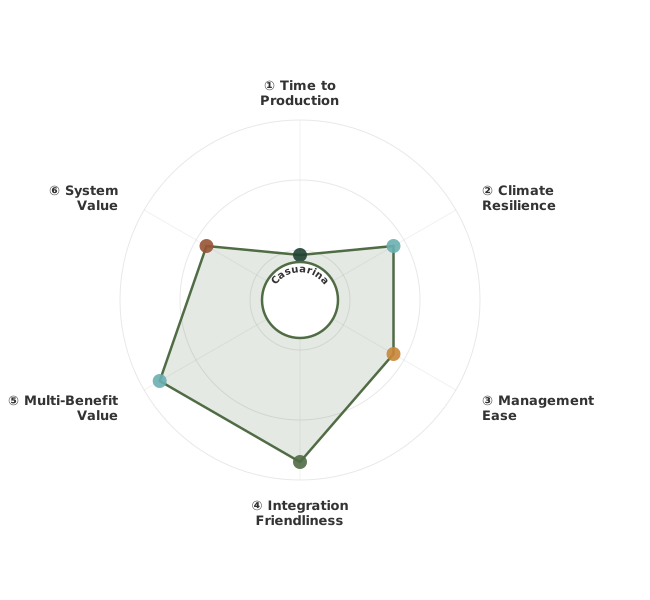
Multi-Benefit Value: Ideally Suited - It actively builds soil fertility through nitrogen fixation, provides robust windbreaks, and effectively controls erosion with its deep root system, while also offering valuable habitat.

Integration Friendliness: Ideally Suited - Casuarina readily integrates into diverse systems by fixing nitrogen, stabilizing soil, and providing biomass for timber or windbreaks, particularly beneficial for coastal or degraded land restoration.

5

Management & Care Requirements

Integration guidance, maintenance needs, and care practices

How to Integrate This Plant

Casuarina equisetifolia, a fast-growing tree, can be integrated into regenerative systems primarily as a windbreak due to its dense foliage and tolerance to coastal conditions. Its ability to establish on nutrient-poor sands (Excerpt 1) makes it suitable for marginal lands, helping to stabilize soil and prevent erosion. While not explicitly mentioned in the excerpts for nitrogen fixation, its woody nature and potential for biomass production suggest carbon sequestration benefits (Excerpt 3). In agroforestry settings, it can provide habitat and reduce wind speed, indirectly benefiting livestock and crops. When considering integration, focus on its role in buffering less hardy species from wind and salt spray, creating microclimates conducive to other plants and potentially animals. Its early establishment means it can begin providing wind protection relatively quickly, with significant biomass accumulation and carbon sequestration occurring within 3-5 years.

Integration Practices & Management

Source discusses fertilization experiments in young *Casuarina equisetifolia* plantations on nutrient-poor sand dunes, indicating its use in improving soil nutrient availability and carbon sequestration, though it notes limited impact on growth rates with added nitrogen and phosphorus. Source highlights the isolation of salt-tolerant Plant Growth Promoting Fungi from *Casuarina equisetifolia* in salt-affected agroforestry systems, suggesting its resilience in challenging environments. Source identifies *Casuarina equisetifolia* as having high carbon sequestration capacity within agroforestry systems. While these studies demonstrate its potential for soil improvement and carbon storage, they do not detail establishment methods, integration with grazing or cash crops, termination strategies, or specific management considerations from a farmer's perspective. Therefore, practical farmer experiences and specific integration techniques for *Casuarina equisetifolia* within regenerative systems are not covered by this knowledge base. While coverage in our knowledge base is limited, the above represents documented uses in regenerative systems. While coverage in our knowledge base is limited, the above represents documented uses in regenerative systems.

Management Profile

Maintenance Intensity: Ideally Suited - Highly self-sufficient, Australian pine thrives with minimal external inputs due to its drought tolerance, wind resistance, and ability to grow vigorously in sandy coastal soils.

Pest Disease Pressure: Ideally Suited - Remarkably tolerant of challenging coastal conditions like salt spray and wind, this species exhibits inherent resilience to pests and diseases, requiring little to no intervention.

Time To Production: Not Recommended - As a long-term provider of timber and windbreak services, its primary value is realized over many years, making it a species for establishing enduring ecological and resource systems.

6

Economics & Value Streams

Direct harvest, system benefits, ecosystem services, and risk diversification

Comprehensive economic analysis including direct harvest value, system enhancement contributions, ecosystem services, value timeline, and risk diversification strategies.

Per-Tree Production Economics

Metric Value
Establishment Cost $5-10
Years to First Harvest 5-7 years
Annual Maintenance $2-4
Yield 30-60 lbs/year 13-27 kg/year
Market Price $0-0/lb $0-0/kg
Productive Lifespan 30-50 years
Net Annual Return* $-4 to $-2/year (negative)

Values shown per mature tree, not per acre. In regenerative systems, trees are integrated at low densities across diverse landscapes. Establishment costs spread over the lifespan of the tree. Early years have costs but no revenue.

* Net Annual Return = (Yield × Market Price) − (Amortized Establishment Cost + Annual Maintenance). This return is realized only at/after first harvest; early years have costs but no revenue. Range shows worst case to best case scenarios.

System Enhancement Value

Beyond harvest: wind protection and erosion control from grasses/shrubs

Windbreak & Erosion Control Value

Protects 2-14 acres per 100ft row (based on 200-600 ft downwind protection); 5-15% crop yield improvement potential.

Casuarina equisetifolia is recognized for its primary function as a windbreak, offering significant protection to agricultural lands. Its dense foliage and rapid growth create an effective barrier against prevailing winds, which is crucial for reducing soil erosion and protecting vulnerable crops. The quantitative reference data suggests windbreaks can protect downwind areas ranging from 200 to 600 feet, potentially benefiting 2 to 14 acres per 100ft row. This protection can lead to substantial yield improvements for sensitive crops, estimated between 5-15%, by mitigating wind damage and reducing desiccation. Furthermore, windbreaks can create microclimates that are more favorable for crop growth, increasing overall farm resilience and productivity, especially in exposed or arid regions.

Nitrogen Fixation (if legume)

Variable, dependent on specific microbial communities and environmental conditions. Potential reduction in synthetic N fertilizer needs.

While Casuarina equisetifolia is not a legume and does not fix atmospheric nitrogen, research indicates its rhizosphere can host nitrogen-fixing microorganisms. Studies have identified Plant Growth Promoting Fungi (PGPF) in the rhizosphere of Casuarina equisetifolia that exhibit nitrogen fixation properties. This symbiotic relationship, though not direct N-fixation by the tree itself, can contribute to soil nutrient availability. The presence of these PGPF, particularly saline-tolerant strains, suggests a potential for enhanced nutrient cycling, which indirectly benefits surrounding crops or other plants in an integrated system. This microbial contribution can reduce the reliance on synthetic nitrogen fertilizers, leading to cost savings and a more sustainable nutrient management strategy within the farm system.

Additional System Contributions

Beyond its windbreak function, Casuarina equisetifolia contributes to the agroforestry system through significant carbon sequestration. Studies highlight its high potential for carbon storage, with one mention indicating a potential of 577.95 tCO₂/ha in specific regions. This role in climate change mitigation adds an ecosystem service value. Additionally, research on its rhizosphere has identified Plant Growth Promoting Fungi (PGPF) with capabilities beyond nitrogen fixation, including phosphate, potassium, and zinc solubilization, as well as ACC deaminase production. These PGPF can enhance nutrient uptake and stress tolerance in the trees and potentially in intercropped species, contributing to overall soil health and plant vigor. The tree itself can also provide habitat and food sources for local wildlife, further enhancing biodiversity within the farm landscape.

Ecosystem Service Contributions

Environmental contributions: carbon, pollinators, wildlife, and water

  • Carbon Sequestration: Casuarina equisetifolia demonstrates substantial carbon sequestration potential, with recorded capacities of up to 577.95 tCO₂/ha. Its rapid growth on various soil types, including nutrient-poor sands, contributes to significant biomass accumulation and subsequent carbon storage.
  • Pollinator Support: Low, primarily due to its wind-pollinated nature. While it may offer some incidental shelter, it is not a significant nectar or pollen source for most pollinators.
  • Wildlife Habitat: Provides moderate habitat value through its dense foliage, offering shelter and nesting sites for birds. Its biomass contributes to overall landscape structure, indirectly supporting various wildlife.
  • Water Quality: Not applicable, as typically planted in drier, exposed areas rather than riparian zones for water filtration.

Value Timeline: Protection Development

When you'll see results: faster than trees, protection begins 1-3 years

Years 1-2

Initial windbreak establishment providing modest wind reduction and erosion control. Early stages of soil carbon sequestration. Potential for some PGPF activity benefiting soil health.

Years 3-5

Established windbreak offering significant protection, leading to measurable yield improvements for adjacent crops. Increased soil organic carbon due to biomass decomposition. Enhanced PGPF activity contributing to nutrient availability.

Years 10-20

Mature windbreak providing maximum protective benefits. Significant ongoing carbon sequestration in biomass and soil. Potential for early timber harvest or biomass utilization if managed for such purposes.

20+ Years

Long-term, stable windbreak function. Continued substantial carbon sequestration. Potential for significant timber harvest value if grown for that purpose, alongside sustained ecosystem services.

Farm Risk Reduction

How this reduces farm risk: crop protection and erosion reduction

  • Multiple Revenue Streams: Windbreak protection (indirect yield enhancement), carbon sequestration credits, potential biomass/timber sales, improved soil health reducing input costs.
  • Temporal Income Spread: Ongoing ecosystem services (windbreak, carbon sequestration) provide continuous value, supplemented by periodic income from potential timber or biomass harvests. Indirect income through yield protection is also continuous.
  • Market Risk Hedge: Reduces reliance on single crop markets by enhancing yields of adjacent crops. Drought tolerance and ability to grow on poor soils offer resilience against adverse environmental conditions. Carbon sequestration provides a potential revenue stream independent of traditional agricultural markets.
7

Regenerative Suitability Details

Comprehensive trait ratings for system integration assessment

Comparative ratings for this plant across key regenerative agriculture traits.

Trait Suitability Explanation
Drought Tolerance Ideally Suited Australian pine showcases exceptional drought tolerance, thriving in arid conditions by utilizing deep, nitrogen-fixing roots to access soil moisture and enhance local fertility.
Establishment Ease Ideally Suited This species germinates rapidly and establishes quickly in poor, sandy soils, demonstrating aggressive early vigor that naturally suppresses weeds through dense growth.
Time To Production Not Recommended As a long-term provider of timber and windbreak services, its primary value is realized over many years, making it a species for establishing enduring ecological and resource systems.
Multi Benefit Value Ideally Suited It actively builds soil fertility through nitrogen fixation, provides robust windbreaks, and effectively controls erosion with its deep root system, while also offering valuable habitat.
Climate Adaptability Adequate Australian pine thrives in warm, coastal environments (zones 9-11), tolerating heat and dry conditions, though it is sensitive to frost.
Hardiness Zone Range Not Recommended This tropical to subtropical species flourishes in zones 10-11, indicating a preference for warmer climates with limited tolerance for cold.
Maintenance Intensity Ideally Suited Highly self-sufficient, Australian pine thrives with minimal external inputs due to its drought tolerance, wind resistance, and ability to grow vigorously in sandy coastal soils.
Pest Disease Pressure Ideally Suited Remarkably tolerant of challenging coastal conditions like salt spray and wind, this species exhibits inherent resilience to pests and diseases, requiring little to no intervention.
Integration Friendliness Ideally Suited Casuarina readily integrates into diverse systems by fixing nitrogen, stabilizing soil, and providing biomass for timber or windbreaks, particularly beneficial for coastal or degraded land restoration.

Comparative System: Ratings compare plants within their economic category (e.g., cover crop nitrogen fixation compared to other cover crops, not to all plants). Individual farm conditions and management practices significantly influence actual performance.

8

Learn More

Why farmers use this plant and additional resources

Why Regenerative Farmers Use This Plant

Casuarina equisetifolia, commonly known as Coastal She-oak or Horsetail Tree, is a highly valuable perennial tree for regenerative agriculture systems due to its remarkable resilience, multi-functional ecological services, and long-term economic potential. This species is exceptionally well-suited for coastal and degraded land rehabilitation, where its deep root system (extending 15-30+ feet or 4.5-9+ meters) stabilizes soil and prevents erosion, particularly in sandy or saline environments. At maturity, Casuarina equisetifolia is estimated to sequester 2-5 tons of CO2e per acre per year, contributing significantly to climate change mitigation. Its dense canopy provides crucial shade regulation, moderating microclimates for understory crops or livestock, and acts as an effective windbreak, protecting fields from damaging winds and reducing soil desiccation. Over its multi-decade lifespan, this tree represents a substantial asset, providing a consistent source of timber, biomass, and ecological stability, with economic returns accumulating over many years.

Beyond its direct carbon sequestration and erosion control benefits, Casuarina equisetifolia plays a vital role in enhancing agroecosystem health. While not a nitrogen fixer itself, its association with actinomycetes in its root nodules allows it to thrive in nutrient-poor soils and can contribute to nutrient cycling in mixed plantings. It acts as an excellent nurse tree, providing initial shade and wind protection for more sensitive species during establishment. In silvopasture systems, its hardy nature means it can withstand grazing pressure once established, offering shade and shelter for livestock, while its fallen foliage contributes organic matter to the soil. Its ability to tolerate saline conditions makes it ideal for integrating into coastal farming systems, often improving soil structure and fertility over time through the decomposition of its biomass.

The quantitative ecosystem benefits of Casuarina equisetifolia are substantial, particularly in its role as a landscape stabilizer and microclimate modifier. Its deep root systems improve water infiltration into the soil, reducing runoff and recharging groundwater. The physical presence of the tree canopy and its windbreak effect can reduce evaporation rates from surrounding soils by up to 30-40%. While specific data on pollinator visits per flower is limited, its biomass production and potential for flowering can support local insect populations, contributing to biodiversity. The decomposition of its leaf litter, which is rich in organic compounds, gradually builds soil organic matter over decades, enhancing soil structure, water-holding capacity, and nutrient availability for associated plants.

Casuarina equisetifolia has demonstrated remarkable success across diverse regenerative farming contexts. In coastal regions of Southeast Asia, it is widely used for dune stabilization and as a windbreak in coconut and fruit plantations, protecting crops from salt spray and typhoons. In Australia, it is employed in arid and semi-arid zones for land rehabilitation and as a source of biomass for bioenergy, often integrated into agroforestry blocks on marginal lands. Farmers in parts of India utilize it for fuelwood and timber production on degraded soils, with its hardy nature requiring minimal inputs. In coastal Queensland, Australia, farmers integrate it into silvopasture systems with cattle, utilizing its shade and shelter benefits while managing grazing pressure. In the Philippines, it is extensively used for shoreline protection and as a windbreak in rice paddies and fruit orchards, with trees harvested for lumber and fuelwood. In arid regions of India, it is planted on degraded lands to combat desertification and provide a sustainable source of biomass for local communities. In Brazil, it can be found in coastal agroforestry projects, helping to stabilize sandy soils and provide habitat for wildlife. In Australian coastal agriculture, it's used for windbreaks and sand stabilization, protecting horticultural crops from salt-laden winds. Farmers in Southeast Asia utilize it in agroforestry systems, integrating it with fruit trees and intercropping with nitrogen-fixing ground covers like Centrosema or Pueraria species. In parts of South America, it's employed in silvopasture designs to provide shade and browse for livestock in tropical climates, while also improving soil fertility in areas with sandy or degraded soils. In the Caribbean, it serves as a vital component in restoring degraded or eroded farmlands, providing shade and improving soil structure for subsequent crop rotations.

9

How to Integrate This Plant

Practical guidance for regenerative systems

Establishing Casuarina equisetifolia is typically achieved through seed propagation or cuttings. Seeds are sown in well-draining media, often in nurseries, at a depth of approximately 0.25-0.5 inches (0.6-1.3 cm). For direct seeding in the field, rates can range from 1-2 lbs of seed per acre (1.1-2.2 kg/ha) for establishing windbreaks or rows, planted at a depth of 0.5-1 inch (1.3-2.5 cm). For optimal establishment, seedlings are often started in nurseries and transplanted after 6-12 months, planted at a depth of 6-8 inches (15-20 cm), ensuring the root ball is fully covered. Spacing recommendations vary based on the intended use; for windbreaks or erosion control, rows can be planted 10-15 ft (3-4.5 m) apart with trees spaced 5-10 ft (1.5-3 m) within the row. For alley cropping or silvopasture, wider row spacing of 30-40 ft (9-12 m) is recommended to accommodate equipment and grazing animals. Planting is best timed with the onset of the rainy season, typically March-May in the Northern Hemisphere and September-November in the Southern Hemisphere, to ensure adequate moisture for establishment.

Once established, Casuarina equisetifolia requires minimal water, though supplemental irrigation of approximately 1 inch (2.5 cm) per week may be beneficial during the first 1-2 years, especially in drier climates. Mature trees are highly drought-tolerant. Fertility management should prioritize biological approaches. Incorporating compost or well-rotted manure at planting can provide initial nutrients. As the trees mature, their leaf litter contributes significantly to soil organic matter. While they can tolerate nutrient-poor soils, a light application of organic mulch around the base can enhance growth. Pruning is generally minimal, focused on removing dead or crossing branches and shaping the tree for its intended function, such as maintaining light penetration for understory crops. Pest and disease management is generally not a significant concern due to the tree's hardiness, but monitoring for any signs of stress and ensuring good air circulation can prevent issues.

In agroforestry and silvopasture systems, Casuarina equisetifolia is integrated for its long-term benefits. Establishment typically takes 1-3 years to establish a robust root system and begin significant above-ground growth. Trees reach significant size and canopy cover within 3-7 years, and full production for timber or biomass can be expected within 5-15 years, depending on management and environmental conditions. For alley cropping or silvopasture, rows are typically spaced 30-40 feet (9-12 m) apart to allow for equipment access and the cultivation of understory crops or grazing of livestock. Understory planting can begin in year 2-3, with nitrogen-fixing ground covers like Centrosema or drought-tolerant legumes being ideal companions. Measurable soil carbon increases can be observed by year 5-7 as the trees mature and their root systems expand. Long-term infrastructure considerations include initial irrigation for establishment, protection from browsing animals, especially in the early years, and potentially support structures for timber harvesting.