
Blue Gum
Eucalyptus globulus, or Blue Gum, finds specific applications within regenerative agriculture systems, primarily as a component in agroforestry projects and for land management. Excerpts indicate its use in demarcating land class boundaries on farms and for commercial saw log production, suggesting a role in farm infrastructure and economic diversification. In Sub-Saharan Africa, it has been integrated into agroforestry systems alongside rainwater harvesting and organic soil amendments like poultry litter biochar, which demonstrably increased soil organic matter and soil pH. Studies in India highlight its significant carbon sequestration potential, contributing substantially to carbon stock outside of forests. Research in Ethiopia and Ecuador has examined its impact on soil fungal communities and soil organic carbon stocks, with plantations showing variations in soil attributes compared to natural forests and grasslands. While not explicitly detailed as a cover crop or nitrogen fixer in these excerpts, its integration into diverse agroforestry models points to its utility in building soil organic matter and sequestering carbon within managed landscapes.
For a full botanical description see: Plants For A Future(opens in new window) (external link)
Regenerative Quick Profile
All recommendations assume integrated, regenerative practices—not conventional inputs.
Climate & Soil Fit
Climate: Tropical Rainforest, Tropical Monsoon, Tropical Savanna, Hot Semi-Arid (Steppe), Cold Semi-Arid (Steppe), Cold Desert, Humid Subtropical, Oceanic (Maritime Temperate), Hot-Summer Mediterranean, Warm-Summer Mediterranean, Monsoon-Influenced Humid Subtropical, Subtropical Highland, Hot-Summer Continental, Warm-Summer Continental, Subarctic, Monsoon-Influenced Hot-Summer Continental
Zones: USDA 8-11, Australian Zones 3-14
Optimal Soil: Loam Soil
System Role & Functions
Primary: Timber With Food
Secondary: Windbreak, Specialty
Key Benefits: Fast production, Climate adaptable, Drought tolerant
Management Level
Experience: Beginner-Friendly
Maintenance: Very low maintenance - Its rapid establishment and inherent resilience minimize the need for external interventions, fitting seamlessly into a low-input regenerative system.
Time to Production: Fast (1-2 years) - Achieves rapid biomass production and early timber yields within 7-12 years, contributing to the cyclical nature of regenerative forestry.
Value Streams
- Fruit/nut harvest
Know the Debate
- Carbon sequestration varies widely by system and age.
- Ecological impact depends on management and local context.
- Water use varies with tree age and climate conditions.
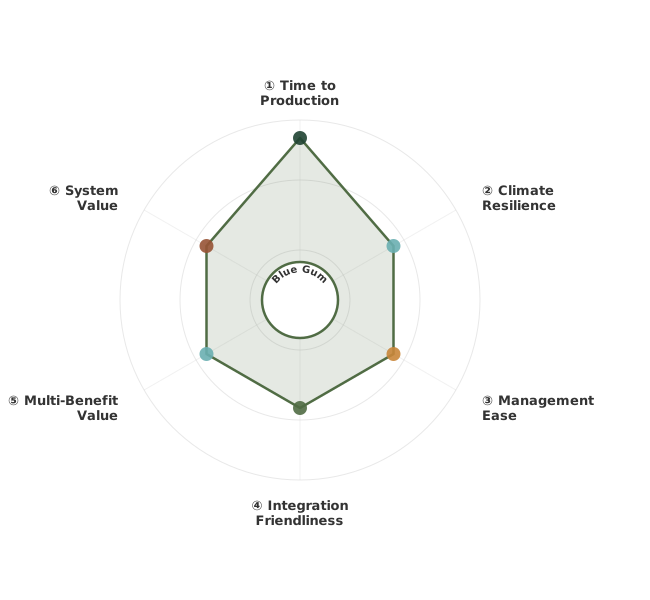
How These Traits Are Calculated
Trait dimensions are ordered clockwise starting from the top of the chart (12 o'clock position):
1. Time to Production
Years from planting to first harvestable yields
WHAT: Measures the waiting period from tree establishment to first meaningful production. Fast-producing trees yield within 2-5 years; slow producers require 8-15+ years before significant harvests.
WHY: Time to production determines cash flow timing and financial feasibility for farm businesses. Long wait times create significant opportunity costs—land and labor tied up for years without income. Fast producers allow quicker experimentation and cash flow recovery, reducing risk for new tree crop farmers.
HOW: Ratings based on years to first harvest documented in economics data. Exceptional (3.0): Production within 2-4 years (elderberry, mulberry, some nut bushes). Typical (2.0): 5-8 years (many fruit trees). Limited (1.0): 10-15+ years (hardwood timber, some nut trees like pecan, walnut).
2. Climate Resilience
Weighted: hardiness zones (50%) + drought tolerance (30%) + adaptability (20%)
WHAT: Combines temperature tolerance (hardiness zone range), water stress resilience (drought tolerance), and overall climate flexibility. Multi-decade tree investments require reliable climate matching to prevent total loss.
WHY: Wrong climate choices mean complete failure for permanent plantings. A tree that dies in year 5 from unexpected cold or prolonged drought represents catastrophic loss of 5 years' investment. Climate resilience determines geographic range and weather variability tolerance—critical as climate patterns become less predictable.
HOW: Weighted formula prioritizes hardiness zone range (50% weight) for core temperature tolerance, drought tolerance (30% weight) for water stress, and overall adaptability (20% weight) for general climate flexibility. Exceptional (3.0): Wide hardiness range (8+ zones) with strong drought tolerance. Typical (2.0): Moderate range and tolerance. Limited (1.0): Narrow climate requirements.
3. Management Ease
Weighted: establishment (40%) + low maintenance (30%) + pest resistance (30%)
WHAT: Combines establishment difficulty, ongoing maintenance requirements, and disease/pest pressure into overall management workload. Low-maintenance trees fit easily into busy farm operations without specialized expertise or intensive inputs.
WHY: Labor is the limiting factor for most diversified farms. High-maintenance trees requiring pruning expertise, disease management, and intensive pest control compete for limited time with other farm enterprises. Easy-care trees deliver production with minimal intervention, making them viable for time-constrained farmers.
HOW: Weighted formula balances establishment ease (40% weight) for startup success, inverted maintenance intensity (30% weight) for ongoing care, and inverted pest/disease pressure (30% weight) for health management. Exceptional (3.0): Easy to establish, self-sufficient growth, naturally pest-resistant. Typical (2.0): Moderate care needs. Limited (1.0): Difficult establishment, intensive maintenance, or heavy pest pressure.
4. Integration Friendliness
Compatibility with silvopasture, alley cropping, and multi-species systems
WHAT: Measures how well the tree integrates with other farm enterprises—grazing livestock, annual crops, or other perennials. Integration-friendly trees tolerate livestock browsing, don't heavily shade out crops, and coexist with diverse plantings.
WHY: Integrated tree systems (silvopasture, alley cropping, food forests) provide higher total returns per acre than monoculture plantings. Trees that work well with livestock provide shade + forage + production simultaneously. Integration flexibility allows farmers to stack enterprises and adapt to market opportunities.
HOW: Ratings based on the integration_friendliness trait documenting compatibility with grazing, cropping, and multi-species systems. Exceptional (3.0): Tolerates livestock browsing, provides livestock benefits (shade, browse), compatible with understory crops. Typical (2.0): Some integration possible with management. Limited (1.0): Requires isolation, incompatible with livestock or cropping.
5. Multi-Benefit Value
Stacked benefits beyond primary product—shade, wildlife, nitrogen, erosion control
WHAT: Measures the diversity of ecosystem services provided beyond the main harvest product. Multi-benefit trees deliver shade, windbreak, wildlife habitat, nitrogen fixation, erosion control, pollinator support, and aesthetic value simultaneously.
WHY: Single-purpose trees are economically fragile—market price swings or production failures eliminate all value. Multi-benefit trees provide resilience through diverse value streams. A nitrogen-fixing tree that produces nuts, provides shade for livestock, supports wildlife, and controls erosion delivers 4-5x the system value of a production-only tree.
HOW: Ratings based on the multi_benefit_value trait documenting service diversity. Exceptional (3.0): 4+ significant services stacked (nitrogen-fixing legume trees providing nuts + shade + wildlife + windbreak). Typical (2.0): 2-3 moderate services. Limited (1.0): Single-purpose production trees with minimal additional benefits.
6. System Value
Total ecosystem and economic value across short, medium, and long timeframes
WHAT: Synthesizes the total regenerative value delivered across multiple decades, including immediate ecosystem services (years 1-5), medium-term production value (years 5-15), and long-term system transformation (years 15-50). Captures the compounding benefits of permanent plantings.
WHY: Trees are multi-decade investments requiring patient capital. System value measures whether the total package—early ecosystem services, eventual production, and long-term legacy benefits—justifies the wait time and land commitment. High system value trees pay back investment through diverse, stacking, compounding benefits.
HOW: Scored via LLM synthesis of economics timelines, ecosystem service diversity, and long-term soil/water/carbon impacts. Exceptional (3.0): Strong early services + valuable production + transformative long-term impacts. Typical (2.0): Moderate benefits across timeframes. Limited (1.0): Long wait with limited service stacking or weak economic returns.
Ratings are based on documented performance in regenerative systems, not conventional high-input scenarios. All traits assume integrated management practices focused on soil health and ecosystem services.
5
Management & Care Requirements
Integration guidance, maintenance needs, and care practices
Management & Care Requirements
Integration guidance, maintenance needs, and care practices
How to Integrate This Plant
Blue gum (Eucalyptus globulus) can be integrated into regenerative systems primarily for timber production and as a boundary marker, as seen in excerpt. Its robust growth makes it suitable for windbreaks and erosion control, particularly on steeper or undulating terrain. In agroforestry systems, it can be integrated with crops and soil amendments like poultry litter or biochar to improve soil health, as demonstrated by increased soil pH and organic matter in excerpt. While not explicitly mentioned for direct grazing, its woody biomass contributes to carbon sequestration and can be a source of mulch or biochar. Compatible practices include alley cropping and general agroforestry systems. Early contributions (Year 1-2) are minimal, focusing on establishment. By Year 5-10, it provides some shade and windbreak benefits. By Year 20 and beyond, it becomes a significant source of timber and contributes substantially to carbon sequestration and soil stabilization.
Integration Practices & Management
While the provided sources do not detail specific regenerative agriculture practices like seeding rates, companion planting, or termination strategies for Eucalyptus globulus, they offer insights into its integration within broader land management. One farmer uses Blue Gums (Eucalyptus globulus) to demarcate land class boundaries and for commercial timber production, suggesting strategic placement informed by land subdivision. Another study evaluated Eucalyptus globulus in an agroforestry system in Sub-Saharan Africa, integrating it with rainwater harvesting and organic soil amendments like poultry litter biochar to improve soil organic matter and pH. Research also indicates that Eucalyptus globulus plantations support high fungal diversity. In India, Eucalyptus globulus was identified as a dominant species in trees outside forests, contributing significantly to carbon stock and sequestration. These examples highlight its use in boundary planting, agroforestry systems for soil improvement, and as a contributor to carbon sequestration, indicating a role in diversified farm landscapes rather than direct integration with annual cash crops or grazing within the scope of these specific examples.
Management Profile
Maintenance Intensity: Ideally Suited - Its rapid establishment and inherent resilience minimize the need for external interventions, fitting seamlessly into a low-input regenerative system.
Pest Disease Pressure: Adequate - While generally robust, monitoring and fostering a diverse ecosystem can support its natural resilience against potential pest and disease challenges.
Time To Production: Ideally Suited - Achieves rapid biomass production and early timber yields within 7-12 years, contributing to the cyclical nature of regenerative forestry.
Sources behind this view
 Research
-
Bund Based Agroforestry Using Eucalyptus Species: A Review (opens in new window)
This study found: Review on Eucalyptus trees planted on field borders (bunds) in agroforestry systems. Discusses crop interactions, resource competition, shading effects, and carbon sequestration benefits.
-
Eucalyptus Succession on Croplands in the Highlands of Northwestern Ethiopia: Economic Impact Analysis Using Farm Household Model (opens in new window)
This study found: The northwestern highlands of Ethiopia are characterized by severe land degradation and apparently low agricultural productivity. This situation is continuously threatening the livelihoods of smallhol
-
Carbon sequestration potential of eucalyptus-based agroforestry and cropping systems (opens in new window)
This study found: Eucalyptus-based agroforestry systems in India effectively capture carbon (up to 10 Mg C ha⁻¹ yr⁻¹), improving soil health and farmer livelihoods, but require careful water management.
8
Know the Debate
Eucalyptus globulus offers significant carbon sequestration, timber production, and ecosystem services like windbreaks and habitat. However, its ef...
Know the Debate
Eucalyptus globulus offers significant carbon sequestration, timber production, and ecosystem services like windbreaks and habitat. However, its ef...
Eucalyptus globulus offers significant carbon sequestration, timber production, and ecosystem services like windbreaks and habitat. However, its effectiveness and ecological impact vary greatly depending on the environment and how it's managed. In humid, temperate agroforestry systems, it can enhance biodiversity and soil health, while monocultures in drier regions may deplete water resources and impact native flora and fire regimes. Entry costs for timber production are substantial, requiring long-term investment, while windbreak or biomass applications are more accessible. Labor demands are moderate, primarily for establishment and optional thinning, with mature trees requiring little direct intervention.
What are the annual carbon sequestration rates of Eucalyptus globulus?
Significant sequestration (2-5 tons CO2e/acre/yr)
Mature Eucalyptus globulus trees in optimal conditions are estimated to sequester 2-5 tons of CO2e per acre annually. Diverse agroforestry systems and longer rotations, like those in Australia and Brazil, can further enhance this potential, with some studies suggesting higher rates and net carbon negativity when integrated with other forest components.
Sources behind this view
Sources behind this view
 Videos & Podcasts
-
Integrated eucalyptus and teak agroforestry systems in Brazil's cerrado sequester up to 7 tons/ha/year of carbon, increase beef production 2.5x, reduce slaughter age, and lower methane emissions, offering significant environmental and economic advantages.

Research
-
Carbon Storage and Environmental Adaptation of <i>Eucalyptus camaldulensis </i>Dehnn, in Bangladesh (opens in new window)
This study found: A study in Bangladesh tracked *Eucalyptus camaldulensis* (River Red Gum) trees for 20 years to understand their carbon storage and environmental impact. The trees grew significantly in size, with trunk diameter reaching nearly 30 cm and height over 17 meters by year 20. Over the years, these trees stored substantial amounts of carbon, with the amount per tree increasing from about 46 kg at 5 years to over 430 kg at 20 years. Annually, the trees captured between 5 and 17 kg of carbon per year. While these trees are fast-growing and help meet timber demand, they can also harm soil fertility. This is due to their chemical effects on other plants, high need for nutrients, and significant water use. The study suggests that while eucalyptus can be beneficial for carbon capture, its widespread planting in new areas should be approached with caution. Practices like adding soil amendments or planting other soil-improving plants alongside eucalyptus could help reduce negative impacts on soil health.
-
Carbon sequestration potential of eucalyptus-based agroforestry and cropping systems (opens in new window)
This study found: Eucalyptus trees, especially when integrated into farming systems with crops or livestock (agroforestry), are effective at capturing carbon and helping to reduce greenhouse gases. In India, eucalyptus plantations can store significant amounts of carbon, with some studies showing rates of over 10 Mg per hectare per year. Older trees and healthy soil contribute to higher carbon storage. Agroforestry systems with eucalyptus not only store carbon in trees and soil but also improve soil health, biodiversity, and farmer livelihoods. However, eucalyptus trees use a lot of water, which has led to restrictions in some areas. Careful planning, choosing the right species, and sustainable management are key to maximizing carbon benefits while avoiding negative impacts like water depletion.
Variable yields (up to 10 Mg C ha⁻¹ yr⁻¹)
Academic research shows Eucalyptus plantations can sequester significant carbon, with India studies reporting up to 10 Mg C ha⁻¹ yr⁻¹ (approx. 3.7 tons CO2e/acre/yr). However, sequestration rates are influenced by rotation length, species mix, and soil conditions; some studies indicate variations or potential harm to soil fertility in certain monocultural contexts.
Sources behind this view
Sources behind this view
Research
-
Carbon sequestration potential of eucalyptus-based agroforestry and cropping systems (opens in new window)
This study found: Eucalyptus trees, especially when integrated into farming systems with crops or livestock (agroforestry), are effective at capturing carbon and helping to reduce greenhouse gases. In India, eucalyptus plantations can store significant amounts of carbon, with some studies showing rates of over 10 Mg per hectare per year. Older trees and healthy soil contribute to higher carbon storage. Agroforestry systems with eucalyptus not only store carbon in trees and soil but also improve soil health, biodiversity, and farmer livelihoods. However, eucalyptus trees use a lot of water, which has led to restrictions in some areas. Careful planning, choosing the right species, and sustainable management are key to maximizing carbon benefits while avoiding negative impacts like water depletion.
-
Carbon Storage and Environmental Adaptation of <i>Eucalyptus camaldulensis </i>Dehnn, in Bangladesh (opens in new window)
This study found: A study in Bangladesh tracked *Eucalyptus camaldulensis* (River Red Gum) trees for 20 years to understand their carbon storage and environmental impact. The trees grew significantly in size, with trunk diameter reaching nearly 30 cm and height over 17 meters by year 20. Over the years, these trees stored substantial amounts of carbon, with the amount per tree increasing from about 46 kg at 5 years to over 430 kg at 20 years. Annually, the trees captured between 5 and 17 kg of carbon per year. While these trees are fast-growing and help meet timber demand, they can also harm soil fertility. This is due to their chemical effects on other plants, high need for nutrients, and significant water use. The study suggests that while eucalyptus can be beneficial for carbon capture, its widespread planting in new areas should be approached with caution. Practices like adding soil amendments or planting other soil-improving plants alongside eucalyptus could help reduce negative impacts on soil health.
-
Soil physicochemical properties under eucalyptus tree species planted in alley maize cropping agroforestry practice in Decha Woreda, Kaffa zone, southwest Ethiopia (opens in new window)
This study found: In a farming system in southwest Ethiopia that combines eucalyptus trees with corn (maize) in rows, a study looked at how the trees affected the soil. Researchers compared soil under four types of eucalyptus trees planted in rows with soil in nearby open fields. After analyzing soil samples, they found that the eucalyptus trees did not significantly change key soil health indicators like total nitrogen, phosphorus, pH, organic matter, soil moisture, or organic carbon, even with short-term tree growth. The only notable difference was in the amount of sand in the soil. This suggests that in this specific high-rainfall clay soil environment, eucalyptus trees grown for a short time in this agroforestry setup don't negatively impact the soil's basic physical and chemical properties.
Making Sense of the Differences
Annual carbon sequestration rates for Eucalyptus globulus vary significantly based on system design and age. While mature trees and diverse agroforestry systems show promising accumulation, monocultures or shorter rotations may yield less. Factors like soil type, rainfall, and management practices play a crucial role. Farmers should plan for long-term accumulation, recognizing that integrated systems typically offer higher and more stable carbon storage potential.
What are the ecological impacts of Eucalyptus globulus in non-native regions?
Enhances biodiversity and soil in diverse systems
In integrated agroforestry or diverse plantings, Eucalyptus can improve soil carbon, organic matter, and support biodiversity. Australian farmers use it for habitat, shelter, and fire mitigation when managed with a wet understory, demonstrating its positive role when not in monoculture.
Sources behind this view
Sources behind this view
Videos & Podcasts
-
Actively manage woodland to prevent eucalyptus domination, encouraging biodiversity and habitat for native species by controlling eucalyptus growth and promoting diverse native plants.

-
Eucalyptus flammability in Australia is due to lack of wet undergrowth; maintaining a lush understory is key to fire mitigation and soil regeneration, with eucalyptus being a powerful tool for this.

Research
-
Carbon sequestration potential of eucalyptus-based agroforestry and cropping systems (opens in new window)
This study found: Eucalyptus trees, especially when integrated into farming systems with crops or livestock (agroforestry), are effective at capturing carbon and helping to reduce greenhouse gases. In India, eucalyptus plantations can store significant amounts of carbon, with some studies showing rates of over 10 Mg per hectare per year. Older trees and healthy soil contribute to higher carbon storage. Agroforestry systems with eucalyptus not only store carbon in trees and soil but also improve soil health, biodiversity, and farmer livelihoods. However, eucalyptus trees use a lot of water, which has led to restrictions in some areas. Careful planning, choosing the right species, and sustainable management are key to maximizing carbon benefits while avoiding negative impacts like water depletion.
Can negatively impact soil, water, and natives in monoculture
Monocultures of Eucalyptus plantations can deplete soil fertility due to allelopathic effects and high resource demands. In some regions, they may also displace native flora, alter fire regimes, and significantly reduce water availability, particularly in dry or sensitive ecosystems.
Sources behind this view
Sources behind this view
Videos & Podcasts
-
Actively manage woodland to prevent eucalyptus domination, encouraging biodiversity and habitat for native species by controlling eucalyptus growth and promoting diverse native plants.
Research
-
Carbon Storage and Environmental Adaptation of <i>Eucalyptus camaldulensis </i>Dehnn, in Bangladesh (opens in new window)
This study found: A study in Bangladesh tracked *Eucalyptus camaldulensis* (River Red Gum) trees for 20 years to understand their carbon storage and environmental impact. The trees grew significantly in size, with trunk diameter reaching nearly 30 cm and height over 17 meters by year 20. Over the years, these trees stored substantial amounts of carbon, with the amount per tree increasing from about 46 kg at 5 years to over 430 kg at 20 years. Annually, the trees captured between 5 and 17 kg of carbon per year. While these trees are fast-growing and help meet timber demand, they can also harm soil fertility. This is due to their chemical effects on other plants, high need for nutrients, and significant water use. The study suggests that while eucalyptus can be beneficial for carbon capture, its widespread planting in new areas should be approached with caution. Practices like adding soil amendments or planting other soil-improving plants alongside eucalyptus could help reduce negative impacts on soil health.
-
Surface and Subsurface Water Impacts of Forestry and Grassland Land Use in Paired Watersheds: Electrical Resistivity Tomography and Water Balance Analysis (opens in new window)
This study found: A three-year study in southern Brazil compared how eucalyptus plantations and grasslands affect water resources in nearby watersheds. Researchers found that during wetter periods, eucalyptus trees used significantly more water through evaporation and plant transpiration than grasslands did, resulting in less runoff from the grassland. However, during dry spells, the eucalyptus plantations drew down more underground water, lowering the water table compared to the grassland. By combining water measurements with a special imaging technique to see underground, the study provides valuable information for managing water resources sustainably, especially when considering forestry or grassland production.
Making Sense of the Differences
The ecological impact of Eucalyptus globulus in non-native regions hinges on management and context. While monocultures can deplete soil nutrients and water, and potentially displace native species or alter fire behavior, integration into diverse agroforestry systems can enhance soil properties and biodiversity. Maintaining a wet understory and avoiding monoculture planting are key strategies for mitigating negative impacts and fostering regenerative outcomes.
How does water use vary for Eucalyptus globulus?
Drought-tolerant once established
Mature Eucalyptus globulus, with its deep root systems, demonstrates significant drought tolerance. Its substantial water uptake in establishment phases can be managed with early site selection and supplemental irrigation, but once established, it requires less water and can even aid in managing waterlogged soils, especially in temperate maritime climates.
Sources behind this view
Sources behind this view
Videos & Podcasts
-
Harvest and utilize eucalyptus logs for constructing retaining walls for terraces and swales to capture rainwater. This method saves significant costs, provides long-lasting structures, creates wildlife habitat, and offers recreational space, transforming a problematic plant into a valuable resource in Northern California.

 From the Web
-
Eucalyptus largiflorens exhibits drought tolerance through vacuolar salt disposal, accumulating high foliar Na and Cl (2000-6000 ppm) in mesophyll and dermal cells, as observed in a study of the Murray Darling Basin.
High water use impacting local hydrology
Plantations, especially young ones, can significantly impact local water resources. Studies in Brazil show Eucalyptus used more water than grasslands, potentially lowering groundwater tables and increasing runoff cycles. This suggests careful planning is needed to avoid water depletion in arid or semi-arid environments.
Sources behind this view
Sources behind this view
Research
-
Surface and Subsurface Water Impacts of Forestry and Grassland Land Use in Paired Watersheds: Electrical Resistivity Tomography and Water Balance Analysis (opens in new window)
This study found: A three-year study in southern Brazil compared how eucalyptus plantations and grasslands affect water resources in nearby watersheds. Researchers found that during wetter periods, eucalyptus trees used significantly more water through evaporation and plant transpiration than grasslands did, resulting in less runoff from the grassland. However, during dry spells, the eucalyptus plantations drew down more underground water, lowering the water table compared to the grassland. By combining water measurements with a special imaging technique to see underground, the study provides valuable information for managing water resources sustainably, especially when considering forestry or grassland production.
-
Site Classification of Eucalyptus urophylla × Eucalyptus grandis Plantations in China (opens in new window)
This study found: Background and Objectives: It is important to match species needs with site conditions for sustainable forestry. In Eucalyptus urophylla × Eucalyptus grandis plantations in southern Yunnan, China, species-site mismatches have led to inappropriate expansion and management, which has degraded forests and decreased efficiency in plantation production. Further research is needed to understand the relationship between tree growth and site productivity. We empirically explored site features and classified site types within these plantations in southern Yunnan. Our objective was to develop a theoretical basis for improving site selection for afforestation, and to establish intensive management in that region. Materials and Methods: 130 standard plots were set up in 1−15-year-old eucalyptus plantations in Pu’er and Lincang. We used quantification theory to examine the relationship between dominant tree growth traits and site factors. Hierarchical cluster analysis and canonical correlation analysis were applied to classify sites and evaluate the growth potential of E. urophylla × E. grandis plantations, respectively. Results: The multiple correlation coefficient between eight site factors (altitude, slope, slope position, aspect, soil depth, texture, bulk density, and litter thickness) and the quantitative growth of the dominant tree was 0.834 (p < 0.05). Slope position, altitude, and soil depth were the main factors contributing to the variation in stand growth. Plantation growth was best on lower slopes at relatively low altitude, where thick and weathered red soil layers existed. Conversely, the poorest plantations were located on upper slopes at higher altitude, with a thin semi-weathered purple soil layer. The soil factors total nitrogen (N) and potassium (K), trace boron (B), copper (Cu), and zinc (Zn) content, available phosphorous (P), and organic matter content in the soil influenced plantation growth. Conclusions. The addition of N, P, and K fertilizer as well as trace elements such as B, Cu, and Zn can promote the productivity of these plantations.
Making Sense of the Differences
Water management for Eucalyptus globulus is context-dependent. Young trees require adequate moisture for establishment, and plantations can impact local water tables. However, mature trees exhibit significant drought tolerance due to deep root systems. Farmers should consider regional rainfall patterns, soil drainage, and their specific goals (biomass production vs. drought resilience) when integrating Eucalyptus, ensuring water availability during establishment and monitoring its impact on surrounding ecosystems.