
Madake Bamboo
Phyllostachys bambusoides, while not extensively covered in our knowledge base regarding its regenerative agriculture applications, shows potential as a multi-functional component in sustainable farming systems. Its primary uses appear to revolve around its role as a structural element in agroforestry and polyculture systems, providing biomass and habitat. While direct mentions of nitrogen fixation or cover cropping are limited, its vigorous growth suggests significant potential for biomass production, contributing to soil building and carbon sequestration. Integration with practices like rotational grazing could be explored, where its dense growth might offer shelter or fencing, though specific farmer experiences with this are not detailed in the current excerpts. The limited knowledge base data necessitates further investigation into its specific benefits and optimal integration within diverse regenerative landscapes. Its woody nature and rapid spread suggest it could be a valuable, albeit demanding, addition to systems aiming for long-term ecological enhancement.
For a full botanical description see: Plants For A Future(opens in new window) (external link)
Regenerative Quick Profile
All recommendations assume integrated, regenerative practices—not conventional inputs.
Climate & Soil Fit
Climate: Tropical Rainforest, Tropical Monsoon, Tropical Savanna, Hot Semi-Arid (Steppe), Cold Semi-Arid (Steppe), Hot Desert, Cold Desert, Humid Subtropical, Oceanic (Maritime Temperate), Hot-Summer Mediterranean, Warm-Summer Mediterranean, Monsoon-Influenced Humid Subtropical, Subtropical Highland, Hot-Summer Continental, Warm-Summer Continental, Subarctic, Monsoon-Influenced Hot-Summer Continental, Tundra
Zones: USDA 6-10, Australian Zones 3-9
Optimal Soil: Loam Soil
System Role & Functions
Primary: Cover Crop System
Secondary: Cash Crop With Services, Specialty
Key Benefits: Fast production, Integration-friendly, Easy establishment
Management Level
Experience: Beginner-Friendly
Maintenance: Moderate maintenance - Its vigorous growth necessitates integration into the landscape as a managed element, with its spread guided through strategic planting and the incorporation of organic matter.
Time to Production: Fast (1-2 years) - This bamboo variety offers rapid returns, with harvestable shoots and culms available within 1-3 years, contributing to a dynamic and productive system.
Value Streams
- Fruit/nut harvest
- Soil building and erosion control
Know the Debate
- Aggressive bamboo spread requires significant containment efforts.
- Carbon sequestration varies by species, climate, and management.
- Bamboo yields differ from theoretical maximums based on context.
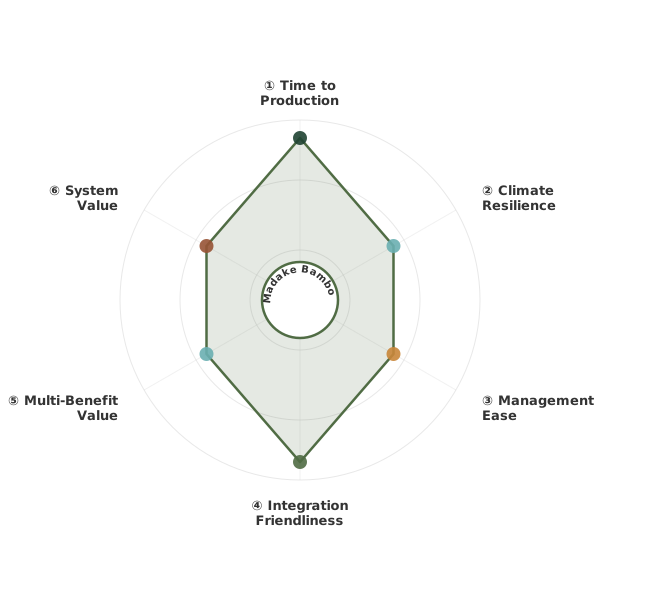
How These Traits Are Calculated
Trait dimensions are ordered clockwise starting from the top of the chart (12 o'clock position):
1. Time to Production
Years from planting to first harvestable yields
WHAT: Measures the waiting period from tree establishment to first meaningful production. Fast-producing trees yield within 2-5 years; slow producers require 8-15+ years before significant harvests.
WHY: Time to production determines cash flow timing and financial feasibility for farm businesses. Long wait times create significant opportunity costs—land and labor tied up for years without income. Fast producers allow quicker experimentation and cash flow recovery, reducing risk for new tree crop farmers.
HOW: Ratings based on years to first harvest documented in economics data. Exceptional (3.0): Production within 2-4 years (elderberry, mulberry, some nut bushes). Typical (2.0): 5-8 years (many fruit trees). Limited (1.0): 10-15+ years (hardwood timber, some nut trees like pecan, walnut).
2. Climate Resilience
Weighted: hardiness zones (50%) + drought tolerance (30%) + adaptability (20%)
WHAT: Combines temperature tolerance (hardiness zone range), water stress resilience (drought tolerance), and overall climate flexibility. Multi-decade tree investments require reliable climate matching to prevent total loss.
WHY: Wrong climate choices mean complete failure for permanent plantings. A tree that dies in year 5 from unexpected cold or prolonged drought represents catastrophic loss of 5 years' investment. Climate resilience determines geographic range and weather variability tolerance—critical as climate patterns become less predictable.
HOW: Weighted formula prioritizes hardiness zone range (50% weight) for core temperature tolerance, drought tolerance (30% weight) for water stress, and overall adaptability (20% weight) for general climate flexibility. Exceptional (3.0): Wide hardiness range (8+ zones) with strong drought tolerance. Typical (2.0): Moderate range and tolerance. Limited (1.0): Narrow climate requirements.
3. Management Ease
Weighted: establishment (40%) + low maintenance (30%) + pest resistance (30%)
WHAT: Combines establishment difficulty, ongoing maintenance requirements, and disease/pest pressure into overall management workload. Low-maintenance trees fit easily into busy farm operations without specialized expertise or intensive inputs.
WHY: Labor is the limiting factor for most diversified farms. High-maintenance trees requiring pruning expertise, disease management, and intensive pest control compete for limited time with other farm enterprises. Easy-care trees deliver production with minimal intervention, making them viable for time-constrained farmers.
HOW: Weighted formula balances establishment ease (40% weight) for startup success, inverted maintenance intensity (30% weight) for ongoing care, and inverted pest/disease pressure (30% weight) for health management. Exceptional (3.0): Easy to establish, self-sufficient growth, naturally pest-resistant. Typical (2.0): Moderate care needs. Limited (1.0): Difficult establishment, intensive maintenance, or heavy pest pressure.
4. Integration Friendliness
Compatibility with silvopasture, alley cropping, and multi-species systems
WHAT: Measures how well the tree integrates with other farm enterprises—grazing livestock, annual crops, or other perennials. Integration-friendly trees tolerate livestock browsing, don't heavily shade out crops, and coexist with diverse plantings.
WHY: Integrated tree systems (silvopasture, alley cropping, food forests) provide higher total returns per acre than monoculture plantings. Trees that work well with livestock provide shade + forage + production simultaneously. Integration flexibility allows farmers to stack enterprises and adapt to market opportunities.
HOW: Ratings based on the integration_friendliness trait documenting compatibility with grazing, cropping, and multi-species systems. Exceptional (3.0): Tolerates livestock browsing, provides livestock benefits (shade, browse), compatible with understory crops. Typical (2.0): Some integration possible with management. Limited (1.0): Requires isolation, incompatible with livestock or cropping.
5. Multi-Benefit Value
Stacked benefits beyond primary product—shade, wildlife, nitrogen, erosion control
WHAT: Measures the diversity of ecosystem services provided beyond the main harvest product. Multi-benefit trees deliver shade, windbreak, wildlife habitat, nitrogen fixation, erosion control, pollinator support, and aesthetic value simultaneously.
WHY: Single-purpose trees are economically fragile—market price swings or production failures eliminate all value. Multi-benefit trees provide resilience through diverse value streams. A nitrogen-fixing tree that produces nuts, provides shade for livestock, supports wildlife, and controls erosion delivers 4-5x the system value of a production-only tree.
HOW: Ratings based on the multi_benefit_value trait documenting service diversity. Exceptional (3.0): 4+ significant services stacked (nitrogen-fixing legume trees providing nuts + shade + wildlife + windbreak). Typical (2.0): 2-3 moderate services. Limited (1.0): Single-purpose production trees with minimal additional benefits.
6. System Value
Total ecosystem and economic value across short, medium, and long timeframes
WHAT: Synthesizes the total regenerative value delivered across multiple decades, including immediate ecosystem services (years 1-5), medium-term production value (years 5-15), and long-term system transformation (years 15-50). Captures the compounding benefits of permanent plantings.
WHY: Trees are multi-decade investments requiring patient capital. System value measures whether the total package—early ecosystem services, eventual production, and long-term legacy benefits—justifies the wait time and land commitment. High system value trees pay back investment through diverse, stacking, compounding benefits.
HOW: Scored via LLM synthesis of economics timelines, ecosystem service diversity, and long-term soil/water/carbon impacts. Exceptional (3.0): Strong early services + valuable production + transformative long-term impacts. Typical (2.0): Moderate benefits across timeframes. Limited (1.0): Long wait with limited service stacking or weak economic returns.
Ratings are based on documented performance in regenerative systems, not conventional high-input scenarios. All traits assume integrated management practices focused on soil health and ecosystem services.
6
Economics & Value Streams
Direct harvest, system benefits, ecosystem services, and risk diversification
Economics & Value Streams
Direct harvest, system benefits, ecosystem services, and risk diversification
Comprehensive economic analysis including direct harvest value, system enhancement contributions, ecosystem services, value timeline, and risk diversification strategies.
Per-Tree Production Economics
| Metric | Value |
|---|---|
| Establishment Cost | $5-10 |
| Years to First Harvest | 3-5 years |
| Annual Maintenance | $2-4 |
| Yield | 50-100 lbs/year 22-45 kg/year |
| Market Price | $0-0/lb $0-1/kg |
| Productive Lifespan | 20-30 years |
| Net Annual Return* | $-4 to $-2/year (negative) |
Values shown per mature tree, not per acre. In regenerative systems, trees are integrated at low densities across diverse landscapes. Establishment costs spread over the lifespan of the tree. Early years have costs but no revenue.
* Net Annual Return = (Yield × Market Price) − (Amortized Establishment Cost + Annual Maintenance). This return is realized only at/after first harvest; early years have costs but no revenue. Range shows worst case to best case scenarios.
System Enhancement Value
Beyond cost recovery: soil building, nitrogen, biomass, and weed suppression
Nitrogen Fixation & Cycling
Soil Building & Weed Suppression
Beyond its primary role as a cover crop and potential windbreak, Madake bamboo offers a suite of secondary functions that significantly enhance system value. Its rapid biomass production makes it a prime candidate for hugelkultur beds, particularly in areas with scarce traditional wood, contributing to soil building and moisture retention. The silica content in bamboo may support specific mushroom species, opening avenues for mycoculture integration. Furthermore, bamboo can serve as a nurse species, facilitating the establishment of other food forest plants by providing shade and wind protection. Its perennial nature means it can be harvested annually for mulch, construction materials, and edible shoots, providing a renewable resource that reduces reliance on external inputs and allows for forest regeneration. The dense growth can also offer vital habitat and nesting sites for various wildlife species.
Erosion Control
e.g., protects 3-5 acres per tree row, 5-15% crop yield improvement (variable based on windbreak density and width)
Madake bamboo (Phyllostachys bambusoides) is highly regarded for its potential as a fast-growing windbreak, as indicated in the knowledge base. Its dense growth habit and rapid establishment make it an effective barrier against prevailing winds, which can significantly benefit agricultural systems. Windbreaks protect crops from physical damage, reduce soil erosion by minimizing wind velocity at ground level, and can create a more favorable microclimate for plant growth. This protection can lead to improved crop yields and quality, especially for sensitive crops. Furthermore, windbreaks can shield livestock from harsh winds, reducing stress and energy expenditure, which can translate to better health and productivity. The establishment of a bamboo windbreak also provides a perpetual source of biomass for other farm uses, contributing to a circular economy within the farm system. The perennial nature of bamboo means that once established, it offers ongoing protection without the need for annual replanting.
Ecosystem Service Contributions
Environmental contributions: carbon, pollinators, wildlife, and water
- Carbon Sequestration: Madake bamboo exhibits high carbon sequestration potential due to its rapid growth rate and dense biomass production. As a perennial, it stores carbon in its culms, rhizomes, and root systems, and contributes to soil organic matter over time. Its quick establishment compared to traditional timber species means it can begin sequestering carbon relatively early in its lifecycle.
- Pollinator Support: Low with brief justification: While bamboo flowers, it is not typically recognized as a primary nectar or pollen source for most commercially important pollinators. Its primary value lies in structural and biomass contributions rather than direct floral resources.
- Wildlife Habitat: Provides structural habitat and nesting opportunities due to its dense, tall growth. The shoots can be a food source for some wildlife, and the rhizome systems can support soil fauna.
- Water Quality: Not applicable
Value Timeline: Soil Building Process
When you'll see results: immediate soil benefits, compounding over seasons
Years 1-2
Initial erosion control and windbreak establishment begins. Emergence of edible shoots for early harvest. Biomass for mulch and compost starts to become available.
Years 3-5
Established windbreak offers significant protection. Consistent harvest of edible shoots. First harvests of culms for lighter construction and hugelkultur material. Developing shade canopy.
Years 10-20
Mature grove provides substantial shade and robust windbreak. High-volume harvest of culms for construction, furniture, and other value-added products. Significant contribution to soil organic matter and microclimate regulation.
20+ Years
Long-term, stable source of timber and biomass. Continued ecosystem services including soil health improvement, carbon sequestration, and habitat provision. Potential for continued harvest of mature culms.
Farm Risk Reduction
How this reduces farm risk: lower input costs and better soil resilience
- Multiple Revenue Streams: Edible bamboo shoots, construction materials (poles, lumber), furniture components, biomass for mulch/compost, potential for value-added products (e.g., crafts, charcoal), ecosystem services (windbreak, erosion control, shade).
- Temporal Income Spread: Provides an annual harvest of shoots with a renewable supply of culms for longer-term material needs. Ecosystem services like windbreaks and shade are ongoing and perennial, offering continuous value.
- Market Risk Hedge: Diversifies revenue beyond traditional crops or livestock. Reduces reliance on external inputs by providing on-farm construction materials and organic matter. Its resilience to certain environmental stresses and its rapid growth can offer stability in fluctuating markets or challenging climatic conditions.
Sources behind this view
 Community
-
Bamboo is a highly valuable permaculture plant, serving as a pioneer and nurse species for forest gardens, providing construction material, food, and medicine. Phyllostachys bambusoides ('madake') is
Read more (opens in new window) permies.com
8
Know the Debate
Phyllostachys bambusoides offers significant regenerative potential, particularly in humid subtropical and temperate regions, but its establishment...
Know the Debate
Phyllostachys bambusoides offers significant regenerative potential, particularly in humid subtropical and temperate regions, but its establishment...
Phyllostachys bambusoides offers significant regenerative potential, particularly in humid subtropical and temperate regions, but its establishment and benefits are highly context-dependent. While it thrives in USDA Zones 7-9, cooler climates require careful species selection and site prep, and its deep root system (6-15+ ft) maximizes water infiltration and soil stability across various soil types. Establishing dense stands for full benefits can take 5-10 years, with initial growth aiming for 15-25 ft in 3-5 years. Successful integration requires managing its invasive potential, either through species choice or containment, given its aggressive rhizome spread.
How to manage aggressive bamboo spread?
Intensive Containment Recommended
Academic research and field experience highlight the necessity of deep rhizome barriers and regular pruning to manage the aggressive, invasive spread of running bamboo species like Phyllostachys bambusoides. This approach aims to prevent ecological damage and protect property lines.
Sources behind this view
Sources behind this view
 Videos & Podcasts
-
Use only clumping bamboo species for regenerative systems; they provide winter fodder, stabilize slopes, and act as windbreaks. Running bamboo requires deep rhizome barriers and regular pruning, and should be kept away from water and property lines.
-
Running bamboo's rapid growth offers a resilient fodder reserve, but its aggressive rhizome spread causes severe ecological damage, including invasion, understory suppression, and hydrological changes, creating long-term liabilities.
 Research
-
Bamboo farming as Green timber for Net Zero carbon emission – Nature Based Solution (NBS) for India (opens in new window)
This study found: Planting bamboo across India's degraded forests and unused farmland could be a key strategy for achieving Net Zero carbon emissions. Bamboo grows very quickly, capturing a lot of carbon (about 10 tons per acre each year), which can be turned into carbon credits. It's also a cheaper and strong alternative to timber and steel for building. Farmers could earn over $1,100 per acre annually, and it could create jobs for millions of rural workers in planting and processing. The study suggests avoiding a specific type of bamboo, 'Balcooa', in southern and central India because it tends to fail in those climates.
Opt for Clumping Species
Field practitioners strongly advise using only clumping bamboo varieties, which offer many regenerative benefits like winter fodder and slope stabilization without the extensive, ongoing management demanded by running types.
Sources behind this view
Sources behind this view
Videos & Podcasts
-
Use only clumping bamboo species for regenerative systems; they provide winter fodder, stabilize slopes, and act as windbreaks. Running bamboo requires deep rhizome barriers and regular pruning, and should be kept away from water and property lines.
Making Sense of the Differences
The choice between running and clumping bamboo hinges on a farmer's tolerance for intensive management and risk. Running bamboos like Phyllostachys bambusoides offer robust biomass and soil benefits but require substantial investment in containment (deep barriers, constant monitoring) to prevent invasive spread and ecological disruption. Clumping bamboos, while potentially less vigorous, maintain desirable traits without the same invasive pressure, offering a lower-maintenance alternative.
How much carbon do different bamboo species sequester?
High Sequestration Potential (2-5 tons CO2e/acre/year)
Carbon sequestration estimates for Phyllostachys bambusoides suggest significant potential, with figures ranging from 2-5 tons CO2e/acre/year, drawing on its rapid growth and extensive root systems. Academic studies on specific species and stands support these higher estimates.
Sources behind this view
Sources behind this view
Videos & Podcasts
-
Bamboo leaves and young shoots provide 12-25% crude protein, comparable to tree fodder and alfalfa, offering a valuable, low-bloat risk feed option, especially in winter.
Research
-
Effects of Moso Bamboo (Phyllostachys edulis) Forest Stand Density on Root Growth and Soil Quality for Shoot Production Under a Long-Term Bamboo-Stocking Retention Model (opens in new window)
This study found: Researchers in China studied how the number of Moso bamboo plants per area affects bamboo shoot harvest and soil health. They tested densities ranging from 1200 to 3000 plants per hectare, comparing them to a standard selective logging approach. The best results for both shoot yield and the number of shoots harvested were found at a density of 2400 plants per hectare. This density also led to better soil conditions, including higher levels of organic matter and key nutrients like nitrogen, phosphorus, and potassium. The study found that the amount of nitrogen in the bamboo's fine roots was particularly important, explaining over 75% of the variation in shoot yield. This suggests that managing bamboo density can be a key strategy for increasing harvests while improving soil quality.
-
Quantifying the impact of different agroforestry systems on soil carbon fractions lability and long‐term carbon sequestration in Central Himalayas (opens in new window)
This study found: A 16-year study in the Central Himalayas looked at how different farming systems that include trees (agroforestry) affect soil carbon. The research found that these systems significantly increased the amount of soil carbon, storing between 0.111 and 0.697 Mg C per hectare per year. One system using bamboo (*Bambusa vulgaris*) was particularly effective at storing carbon. The study also showed that the agroforestry systems made the soil carbon more 'active' or 'labile', meaning it's more readily available for plants and soil microbes, especially in deeper soil layers. This active carbon was strongly linked to the overall soil carbon levels, suggesting that improving the quality of soil carbon is key to increasing total soil carbon storage. Overall, agroforestry systems show great potential for boosting carbon storage and improving soil health.
Variable Sequestration Claims (Up to 10 tons C/ha/year or more)
Some reports, particularly from India and the Himalayas, suggest significantly higher carbon sequestration rates (up to 10 tons C/ha/year) or substantial soil organic matter increases (23% in topsoil), though these results may be context-specific and less consistently replicated in global studies.
Sources behind this view
Sources behind this view
Videos & Podcasts
-
Demonstrates rolling out hay bales (approx. 100 tons of biomass) for regenerative farming, using them as soil input to build health and sequester carbon, rather than solely for animal feed, supplementing with broom straw.
Research
-
Bamboo farming as Green timber for Net Zero carbon emission – Nature Based Solution (NBS) for India (opens in new window)
This study found: Planting bamboo across India's degraded forests and unused farmland could be a key strategy for achieving Net Zero carbon emissions. Bamboo grows very quickly, capturing a lot of carbon (about 10 tons per acre each year), which can be turned into carbon credits. It's also a cheaper and strong alternative to timber and steel for building. Farmers could earn over $1,100 per acre annually, and it could create jobs for millions of rural workers in planting and processing. The study suggests avoiding a specific type of bamboo, 'Balcooa', in southern and central India because it tends to fail in those climates.
-
Effect of using Agrogeotextiles on soil carbon sequestration in the Indian Himalayas (opens in new window)
This study found: In the Indian Himalayas, a three-year study found that using mats made from Arundo donax (a type of reed grass) significantly improved soil health in corn fields. When these mats were used on a 4% slope, they helped increase soil organic matter by about 23% in the top 6 inches of soil compared to fields without the mats. The mats also improved soil structure, making it more stable, and boosted the amount of living microbes in the soil by 86%. This practice, combined with a corn-vegetable pea-wheat rotation, led to a healthier soil carbon management score, suggesting it's a promising method for conserving soil and storing carbon in this hilly region. The study also noted that using these conservation mats along with crop rotation was more profitable than using crop rotation alone.
-
Impact of agro-geotextiles on soil aggregation and organic carbon sequestration under a conservation-tilled maize-based cropping system in the Indian Himalayas (opens in new window)
This study found: A five-year study in the Indian Himalayas looked at how using natural fiber mats made from giant reed (<jats:italic>Arundo donax</jats:italic>) could improve soil health in corn and wheat fields. When these mats were used on a 4% slope, along with planting peas (a nitrogen-fixing crop) and managing crop residues, soil organic matter increased by about 23% in the top 30 cm of soil compared to fields without the mats. Soil structure also improved, with more organic matter found in soil clumps. Crucially, soil erosion was reduced by a remarkable 92%. The combination of these practices, including the natural fiber mats, improved the soil's ability to manage carbon and significantly reduced soil loss, offering a way for farmers to adapt to climate change and increase income.
Making Sense of the Differences
Reported carbon sequestration rates for bamboo vary, with some studies estimating 2-5 tons CO2e/acre/year due to rapid growth and root development, while others, particularly in specific Asian contexts, claim significantly higher figures up to 10 tons C/ha/year. This discrepancy likely stems from variations in bamboo species, stand density, management practices, measurement methods (C vs. CO2e, soil depth), and environmental conditions such as climate and soil type. Farmers should consider the lower, more broadly applicable figures for initial planning, but recognize that optimizing species, density (e.g., Moso bamboo studies), and site conditions are key to maximizing carbon capture.
9
Learn More
Why farmers use this plant and additional resources
Learn More
Why farmers use this plant and additional resources
Why Regenerative Farmers Use This Plant
Phyllostachys bambusoides, commonly known as Giant Timber Bamboo or Madake, is a vigorous perennial species offering substantial regenerative benefits for long-term agricultural systems. At maturity, it is a highly effective carbon sequesterer, with established stands capable of capturing an estimated 2-5 tons of CO2e per acre per year through rapid biomass accumulation and extensive root systems. This contributes significantly to climate change mitigation efforts.
Beyond its direct carbon sequestration, Phyllostachys bambusoides provides crucial ecosystem services. Its dense culms and foliage offer excellent biomass for bioenergy, construction materials, or artisanal products, representing a valuable, long-term asset with multi-decade economic returns. The dense growth habit provides excellent windbreak protection, reducing soil erosion and protecting crops and livestock from harsh winds. The multi-layered canopy offers valuable shade regulation, creating cooler microclimates that can reduce irrigation needs and enhance the comfort of grazing animals.
The extensive rhizomatous root system is highly effective at stabilizing soil, preventing erosion on slopes and along waterways, and can improve soil structure over time. The deep root system, extending 6-15+ feet (1.8-4.5+ m), enhances soil structure and water-holding capacity, leading to improved drought resilience. Over years of establishment and growth, this perennial system contributes to measurable soil organic matter increases, typically by 5-10% in the top 6 inches (15 cm) within 7-10 years, further enhancing the soil's ability to support diverse plant and microbial communities. The decomposition of its leaf litter contributes organic matter to the soil, fostering a healthy soil food web and increasing soil organic carbon levels over time. While not a nitrogen fixer, its dense foliage can capture atmospheric nitrogen through dry deposition, which becomes available to the soil upon decomposition. The physical presence of bamboo can also alter local hydrology, slowing down surface runoff and allowing for greater groundwater recharge.
In diverse agroforestry systems, it can serve as a living fence, a buffer strip along riparian zones, or a component of multi-story cropping systems, enhancing biodiversity and ecological resilience. The dense stands can also serve as habitat for beneficial insects and birds, enhancing biodiversity within the farm landscape. The plant's vigorous growth can also contribute to nutrient cycling, with fallen leaves and culm sheaths decomposing to enrich the soil.
Regional success stories highlight the versatility and adaptability of Phyllostachys bambusoides. In the humid subtropical regions of the southeastern United States (USDA Zones 7-9), it establishes quickly and is used for biomass production, riparian buffer restoration, and as a windbreak for pecan orchards. In Japan, its traditional use in rural landscapes provides building materials and contributes to the ecological balance of farming communities. In parts of South America, its rapid growth and adaptability make it a candidate for sustainable biomass production and land restoration projects. In the UK (RHS Zones H4-H7) and other temperate oceanic climates like parts of New Zealand or Western Europe, establishment may be slower, and winter hardiness is a greater consideration, requiring careful site selection; it is often used in hedgerows or as a structural element in garden designs. In Australia's temperate and subtropical zones (Zones 2-5), its drought tolerance and rapid growth make it suitable for erosion control on degraded lands and as a source of biomass in dryland farming systems. In regions with colder continental climates (USDA Zones 5-6, Canadian Zones 3a-5b), selection of hardier Phyllostachys species or varieties may be necessary, and protection from extreme cold during establishment is vital. In Brazilian coffee plantations, it can be integrated as a shade provider and windbreak along farm boundaries or within agroforestry plots.
Sources behind this view
Community
-
Bamboo is a highly valuable permaculture plant, serving as a pioneer and nurse species for forest gardens, providing construction material, food, and medicine. Phyllostachys bambusoides ('madake') is
Read more (opens in new window) permies.com