
Ponderosa Pine
While direct mentions of Ponderosa Pine (*Pinus ponderosa*) as a primary regenerative agriculture input like a cover crop or forage are limited in this knowledge base, its role in ecosystem function and restoration provides key insights. Studies indicate Ponderosa Pine's significant capacity for carbon sequestration, with live trees storing substantial amounts of carbon, nitrogen, and phosphorus over time. Its integration into forest systems, particularly in savanna and mixed conifer stands, is being explored through practices like targeted grazing and mechanical thinning to enhance resilience to wildfire. These restoration efforts, sometimes combined with prescribed fire, show subtle long-term effects on soil carbon and nitrogen cycling. Ponderosa Pine's natural fire resistance, characterized by thick bark, historically contributed to park-like forest structures, suggesting its potential role in agroforestry systems designed to mimic resilient natural landscapes. Further research is needed to fully understand its direct applications within regenerative farming systems, but its ecological benefits in carbon storage and soil health are evident in restoration contexts.
For a full botanical description see: Plants For A Future(opens in new window) (external link)
Regenerative Quick Profile
All recommendations assume integrated, regenerative practices—not conventional inputs.
Climate & Soil Fit
Climate: Tropical Rainforest, Tropical Monsoon, Tropical Savanna, Hot Semi-Arid (Steppe), Cold Semi-Arid (Steppe), Hot Desert, Cold Desert, Humid Subtropical, Oceanic (Maritime Temperate), Hot-Summer Mediterranean, Warm-Summer Mediterranean, Monsoon-Influenced Humid Subtropical, Subtropical Highland, Hot-Summer Continental, Warm-Summer Continental, Subarctic, Monsoon-Influenced Hot-Summer Continental, Tundra
Zones: USDA 4-7, Australian Zones 3-5
Optimal Soil: Sandy Soil
System Role & Functions
Primary: Silvopasture
Secondary: Food Forest, Specialty
Key Benefits: Drought tolerant, Wide zone range, Low maintenance
Management Level
Experience: Beginner-Friendly
Maintenance: Very low maintenance - Ponderosa pine thrives with minimal intervention due to its inherent drought tolerance and adaptation to challenging environments, relying on natural soil fertility and moisture retention.
Time to Production: Slow (5+ years) - As a long-term timber species, Ponderosa pine contributes to landscape stability and ecosystem services over many years, with its cones offering secondary ecological value.
Value Streams
- Fruit/nut harvest
Know the Debate
- Survival varies by region and provenance under climate change
- Future range predicted to shift due to heat and drought
- Tree selection and management crucial for resilience
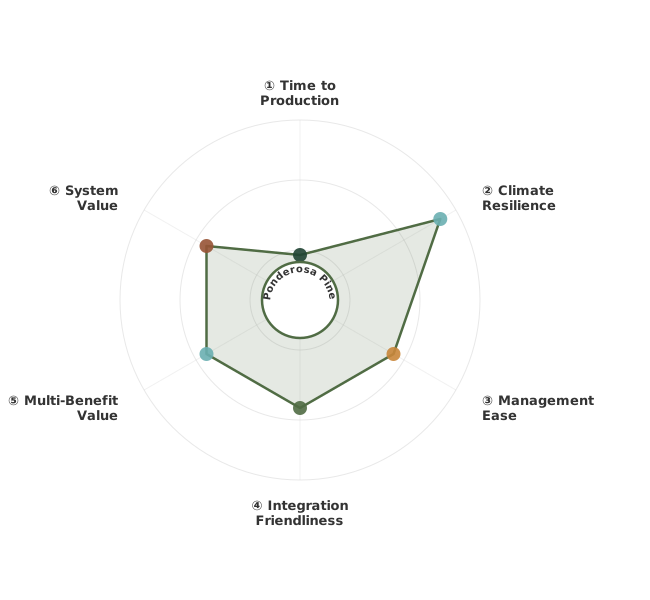
How These Traits Are Calculated
Trait dimensions are ordered clockwise starting from the top of the chart (12 o'clock position):
1. Time to Production
Years from planting to first harvestable yields
WHAT: Measures the waiting period from tree establishment to first meaningful production. Fast-producing trees yield within 2-5 years; slow producers require 8-15+ years before significant harvests.
WHY: Time to production determines cash flow timing and financial feasibility for farm businesses. Long wait times create significant opportunity costs—land and labor tied up for years without income. Fast producers allow quicker experimentation and cash flow recovery, reducing risk for new tree crop farmers.
HOW: Ratings based on years to first harvest documented in economics data. Exceptional (3.0): Production within 2-4 years (elderberry, mulberry, some nut bushes). Typical (2.0): 5-8 years (many fruit trees). Limited (1.0): 10-15+ years (hardwood timber, some nut trees like pecan, walnut).
2. Climate Resilience
Weighted: hardiness zones (50%) + drought tolerance (30%) + adaptability (20%)
WHAT: Combines temperature tolerance (hardiness zone range), water stress resilience (drought tolerance), and overall climate flexibility. Multi-decade tree investments require reliable climate matching to prevent total loss.
WHY: Wrong climate choices mean complete failure for permanent plantings. A tree that dies in year 5 from unexpected cold or prolonged drought represents catastrophic loss of 5 years' investment. Climate resilience determines geographic range and weather variability tolerance—critical as climate patterns become less predictable.
HOW: Weighted formula prioritizes hardiness zone range (50% weight) for core temperature tolerance, drought tolerance (30% weight) for water stress, and overall adaptability (20% weight) for general climate flexibility. Exceptional (3.0): Wide hardiness range (8+ zones) with strong drought tolerance. Typical (2.0): Moderate range and tolerance. Limited (1.0): Narrow climate requirements.
3. Management Ease
Weighted: establishment (40%) + low maintenance (30%) + pest resistance (30%)
WHAT: Combines establishment difficulty, ongoing maintenance requirements, and disease/pest pressure into overall management workload. Low-maintenance trees fit easily into busy farm operations without specialized expertise or intensive inputs.
WHY: Labor is the limiting factor for most diversified farms. High-maintenance trees requiring pruning expertise, disease management, and intensive pest control compete for limited time with other farm enterprises. Easy-care trees deliver production with minimal intervention, making them viable for time-constrained farmers.
HOW: Weighted formula balances establishment ease (40% weight) for startup success, inverted maintenance intensity (30% weight) for ongoing care, and inverted pest/disease pressure (30% weight) for health management. Exceptional (3.0): Easy to establish, self-sufficient growth, naturally pest-resistant. Typical (2.0): Moderate care needs. Limited (1.0): Difficult establishment, intensive maintenance, or heavy pest pressure.
4. Integration Friendliness
Compatibility with silvopasture, alley cropping, and multi-species systems
WHAT: Measures how well the tree integrates with other farm enterprises—grazing livestock, annual crops, or other perennials. Integration-friendly trees tolerate livestock browsing, don't heavily shade out crops, and coexist with diverse plantings.
WHY: Integrated tree systems (silvopasture, alley cropping, food forests) provide higher total returns per acre than monoculture plantings. Trees that work well with livestock provide shade + forage + production simultaneously. Integration flexibility allows farmers to stack enterprises and adapt to market opportunities.
HOW: Ratings based on the integration_friendliness trait documenting compatibility with grazing, cropping, and multi-species systems. Exceptional (3.0): Tolerates livestock browsing, provides livestock benefits (shade, browse), compatible with understory crops. Typical (2.0): Some integration possible with management. Limited (1.0): Requires isolation, incompatible with livestock or cropping.
5. Multi-Benefit Value
Stacked benefits beyond primary product—shade, wildlife, nitrogen, erosion control
WHAT: Measures the diversity of ecosystem services provided beyond the main harvest product. Multi-benefit trees deliver shade, windbreak, wildlife habitat, nitrogen fixation, erosion control, pollinator support, and aesthetic value simultaneously.
WHY: Single-purpose trees are economically fragile—market price swings or production failures eliminate all value. Multi-benefit trees provide resilience through diverse value streams. A nitrogen-fixing tree that produces nuts, provides shade for livestock, supports wildlife, and controls erosion delivers 4-5x the system value of a production-only tree.
HOW: Ratings based on the multi_benefit_value trait documenting service diversity. Exceptional (3.0): 4+ significant services stacked (nitrogen-fixing legume trees providing nuts + shade + wildlife + windbreak). Typical (2.0): 2-3 moderate services. Limited (1.0): Single-purpose production trees with minimal additional benefits.
6. System Value
Total ecosystem and economic value across short, medium, and long timeframes
WHAT: Synthesizes the total regenerative value delivered across multiple decades, including immediate ecosystem services (years 1-5), medium-term production value (years 5-15), and long-term system transformation (years 15-50). Captures the compounding benefits of permanent plantings.
WHY: Trees are multi-decade investments requiring patient capital. System value measures whether the total package—early ecosystem services, eventual production, and long-term legacy benefits—justifies the wait time and land commitment. High system value trees pay back investment through diverse, stacking, compounding benefits.
HOW: Scored via LLM synthesis of economics timelines, ecosystem service diversity, and long-term soil/water/carbon impacts. Exceptional (3.0): Strong early services + valuable production + transformative long-term impacts. Typical (2.0): Moderate benefits across timeframes. Limited (1.0): Long wait with limited service stacking or weak economic returns.
Ratings are based on documented performance in regenerative systems, not conventional high-input scenarios. All traits assume integrated management practices focused on soil health and ecosystem services.
5
Management & Care Requirements
Integration guidance, maintenance needs, and care practices
Management & Care Requirements
Integration guidance, maintenance needs, and care practices
How to Integrate This Plant
Ponderosa pine (Pinus ponderosa) can be integrated into regenerative farm systems primarily through silvopasture, leveraging its resilience and fire adaptation. Its primary function in this context is providing shade and shelter for livestock, which is crucial for animal welfare and productivity, especially in hotter climates. Compatible practices include silvopasture, where it can be managed with targeted grazing to enhance forest stand resilience to wildfire, as indicated by studies simulating crown fire. The timeline to contribution sees minimal direct value in Year 1-2 beyond initial establishment. By Year 5, it begins offering moderate shade, and by Year 20, it provides substantial shade and contributes to landscape structure. Multi-benefit stacking includes carbon sequestration in biomass and soil (as noted in excerpt and), erosion control on slopes, and habitat for wildlife. Its thick bark and fire resistance (excerpt) also contribute to landscape resilience against fire, making it a valuable component in fire-prone agricultural landscapes.
Integration Practices & Management
The provided knowledge base offers limited direct information on how regenerative farmers integrate *Pinus ponderosa* (Ponderosa pine). The sources primarily focus on its ecological characteristics, particularly its relationship with fire adaptation and carbon storage. Studies mention Ponderosa pine in the context of wildfire risk assessment and forest stand resilience, evaluating treatments like targeted grazing and mechanical thinning in Ponderosa pine savannas. One study examined carbon and nitrogen storage in Ponderosa pine-dominated sites over time. Another references Ponderosa pine as a conifer species found in California, relevant for tree identification. While the sources touch upon grazing and thinning as management practices that can influence Ponderosa pine ecosystems, they do not detail specific regenerative agriculture establishment methods, integration with grazing systems (e.g., mob grazing, rest periods), termination strategies, fertility needs, competition management, succession planning, or integration with cash crops within a regenerative farming context. Therefore, practical farmer experiences and insights on these specific regenerative integration strategies for Ponderosa pine are not present in this knowledge base.
Management Profile
Maintenance Intensity: Ideally Suited - Ponderosa pine thrives with minimal intervention due to its inherent drought tolerance and adaptation to challenging environments, relying on natural soil fertility and moisture retention.
Pest Disease Pressure: Adequate - While generally hardy, maintaining ecosystem health through balanced fertility management and promoting biodiversity can enhance its resilience to natural stressors.
Time To Production: Not Recommended - As a long-term timber species, Ponderosa pine contributes to landscape stability and ecosystem services over many years, with its cones offering secondary ecological value.
Sources behind this view
 Research
-
Modeling the Financial Potential of Silvopasture Agroforestry in Eastern North Carolina and Northeastern Oregon (opens in new window)
This study found: Abstract Silvopasture is the planned and managed agroecosystem in which forage, livestock, and woody perennials are integrated “either simultaneously or sequentially on the same parc
8
Know the Debate
Ponderosa Pine's role in regenerative systems depends on its ability to thrive under changing environmental conditions. While known for drought tol...
Know the Debate
Ponderosa Pine's role in regenerative systems depends on its ability to thrive under changing environmental conditions. While known for drought tol...
Ponderosa Pine's role in regenerative systems depends on its ability to thrive under changing environmental conditions. While known for drought tolerance and fire resistance, academic research and field observations highlight significant regional variations in its climate adaptability and survival rates. Understanding these differences is crucial for selecting appropriate provenances and managing stands for long-term resilience, especially in increasingly warmer and drier climates where competition and water stress are major factors. Management strategies, from fire suppression to wildfire preparedness, also profoundly impact forest composition and health.
How will Ponderosa Pine survive changing climate?
Variable survival based on provenance and local climate
Seedlings from lower elevations and drier origins exhibit higher drought tolerance, suggesting a need to select provenances adapted to future warmer and drier conditions. Climate change is predicted to shift the viable growing range poleward and to higher elevations, potentially decreasing survival rates in traditional lower elevation areas.
Sources behind this view
Sources behind this view
Research
-
Provenance Variation in Early Survival, Growth, and Carbon Isotope Discrimination of Southwestern Ponderosa Pine Growing in Three Common Gardens across an Elevational Gradient (opens in new window)
This study found: A three-year study planted ponderosa pine seedlings from different origins (provenances) in three locations across an elevation range in Arizona and New Mexico to see how they survive and grow. The study found that seedlings had the best survival in the middle elevation forest, with very low survival at the highest and lowest elevations. At the hot, dry lowest elevation site, seedlings from lower elevations survived longer, indicating they are more tolerant to drought. The main cause of seedling death changed from drought at lower elevations to animal damage (like from rodents) at higher elevations, which could make it hard to replant pine trees in some areas. Seedlings grew better and showed signs of using water more efficiently at the middle elevation site. The study also found differences between seedling origins in their growth and water use, suggesting that choosing the right seed source is important for successful tree planting and reforestation efforts.
-
Ability of seedlings to survive heat and drought portends future demographic challenges for five southwestern US conifers (opens in new window)
This study found: This study looked at how well young trees of five conifer species in the southwestern US can survive extreme heat and drought. Researchers tested seedlings of pinyon pine, ponderosa pine, Douglas fir, white fir, and Engelmann spruce under hot, dry conditions. They found that the species that normally grow in cooler, wetter areas (Douglas fir, white fir, Engelmann spruce) were more easily harmed by heat and dryness. However, the species that prefer warmer, drier spots (pinyon pine, ponderosa pine) are predicted to face the most severe seedling-killing conditions sooner. By the end of this century, large parts of the ranges for all these species could become too harsh for young trees to survive, suggesting significant changes in forest composition are likely.
-
Identifying potential provenances for climate-change adaptation using spatially variable coefficient models. (opens in new window)
This study found: Scientists have developed a sophisticated computer model to help identify which local varieties (ecotypes) of Douglas-fir trees are best suited to survive in a changing climate across North America. By analyzing over 70,000 data points on where Douglas-fir trees are found and how they respond to different climate conditions, the model can pinpoint areas where specific tree populations are likely to thrive. This method is more effective than older approaches and can identify distinct groups of trees with unique climate needs. While it requires a lot of data and computing power, this approach could significantly speed up the process of finding climate-resilient tree varieties for future planting, potentially saving time and resources compared to traditional, long-term growth trials.
Resilient in native range, but vulnerable to extreme drought and competition
Ponderosa Pine's natural fire resistance and deep root system are advantageous, but extreme heat and drought, coupled with competition from other species and potential overstocking, pose significant threats. Management practices like thinning and controlled burns are crucial for maintaining health and resilience in its native habitat.
Sources behind this view
Sources behind this view
 Videos & Podcasts
-
Explains healthy lodgepole pine forests are resilient, often growing densely after fire due to serotinous cones, but older stands can be widely spaced like ponderosa pine. Reducing density through thinning and controlled burns helps manage wildfire risk by reducing ladder fuels and promoting larger, more fire-resistant trees.

Research
-
Forest restoration treatments in a ponderosa pine forest enhance physiological activity and growth under climatic stress (opens in new window)
This study found: AbstractAs the climate warms, drought will increasingly occur under elevated temperatures, placing forest ecosystems at growing risk of extensive dieback and mortality. In some cases, increases in tree density following early 20th‐century fire suppression may exacerbate this risk. Treatments designed to restore historical stand structure and enhance resistance to high‐severity fire might also alleviate drought stress by reducing competition, but the duration of these effects and the underlying mechanisms remain poorly understood. To elucidate these mechanisms, we evaluate tree growth, mortality, and tree‐ring stable‐carbon isotope responses to stand‐density reduction treatments with and without prescribed fire in a ponderosa pine forest of western Montana. Moderate and heavier cutting experiments (basal area reductions of 35% and 56%, respectively) were initiated in 1992, followed by prescribed burning in a subset of the thinned units. All treatments led to a growth release that persisted to the time of resampling. The treatments had little effect on climate–growth relationships, but they markedly altered seasonal carbon isotope signals and their relationship to climate. In burned and unburned treatments, carbon isotope discrimination (Δ13C) increased in the earlywood (EW) and decreased in the latewood (LW) relative to the control. The sensitivity of LW Δ13C to late‐summer climate also increased in all treatments, but not in the control. Such increased sensitivity indicates that the reduction in competition enabled trees to continue to fix carbon for new stem growth, even when the climate became sufficiently stressful to stop new assimilation in slower‐growing trees in untreated units. These findings would have been masked had we not separated EW and LW. The importance of faster growth and enhanced carbon assimilation under late‐summer climatic stress became evident in the second decade post‐treatment, when mountain pine beetle activity increased locally, and tree mortality rates in the controls of both experiments increased to more than twice those in their respective treatments. These findings highlight that, when thinning is used to restore historical forest structure or increase resistance to high‐severity fire, there will likely be additional benefits of enhanced growth and physiological activity under climatic stress, and the effects may persist for more than two decades.
 From the Web
-
Ponderosa pine growth is influenced by fire resistance (thick bark) and shade intolerance, often leading to pure or even-aged stands. Fire suppression has altered forest composition, and prescribed burning is used for restoration. Competition and thinning significantly impact growth rates.
Source: ucanr.edu (opens in new window)
Adaptable with careful selection and experimental planting
Some practitioners successfully grow trees outside their traditional ranges by experimenting with 'play plants' and selecting for hardiness. While direct planting of Ponderosa Pine in extreme cold zones may be challenging, its inherent adaptability suggests potential for hybridization or careful provenance selection for more marginal future climates.
Sources behind this view
Sources behind this view
Videos & Podcasts
-
Experiment with 'play plants' outside their normal range by trying them at least three times in different locations and conditions. Limit these to 5% of production. Successes include pawpaws and Taylor Asian pears; peaches failed due to extreme cold (-38°F) in this region.

-
When planting trees for climate resilience, consider future climate zones and use available tools for plant selection. Overcoming challenges of long-term investment on leased land can involve appealing to legacy or using faster-growing species.
-
Bristlecone pines (Pinus aristata), though native to warmer, high-altitude regions, can grow in Anchorage, Alaska, due to their exceptional tolerance for cold, snow, and short growing seasons. They are typically planted and have a distinctive 'fuzzy' appearance from long-retained needles.

Making Sense of the Differences
Ponderosa Pine's adaptation to a changing climate is influenced by its genetic origin, local environmental conditions, and management practices. While its deep roots and fire resistance offer advantages, increased drought and heat stress pose risks, particularly in lower elevations. Successful integration into future landscapes will likely depend on selecting drought-tolerant provenances and implementing adaptive management that accounts for local climate projections and potential competition from other species. Experimentation with 'play plants' in marginal areas highlights the potential for resilience through careful species selection and context-specific planting.