
Radiata Pine
Pinus radiata, or Monterey Pine, is discussed in the context of integrated forest management and agroforestry, rather than as a primary regenerative crop like a cover crop or nitrogen fixer. While not a nitrogen fixer, its afforestation has been linked to increased soil methane uptake, suggesting a role in carbon sequestration. However, studies also highlight that monoculture plantations of P. radiata can lead to a significant loss of soil carbon and a reduction in soil invertebrate diversity compared to native forests. Transitional forestry models propose evolving industrial plantations towards more integrated systems, merging production with conservation goals. While P. radiata can offer timber and potentially reduce pressure on native forests, its integration into regenerative systems requires careful consideration of ecological impacts, particularly regarding soil health and biodiversity. The importance of soil microbiomes for tree growth, even for non-native species like P. radiata, is also noted.
For a full botanical description see: Plants For A Future(opens in new window) (external link)
Regenerative Quick Profile
All recommendations assume integrated, regenerative practices—not conventional inputs.
Climate & Soil Fit
Climate: Tropical Rainforest, Tropical Monsoon, Tropical Savanna, Hot Semi-Arid (Steppe), Cold Semi-Arid (Steppe), Cold Desert, Humid Subtropical, Oceanic (Maritime Temperate), Hot-Summer Mediterranean, Warm-Summer Mediterranean, Monsoon-Influenced Humid Subtropical, Subtropical Highland, Hot-Summer Continental, Warm-Summer Continental, Subarctic, Monsoon-Influenced Hot-Summer Continental
Zones: USDA 8-10, Australian Zones 4-11, EU Atlantic, Mediterranean, Oceanic
Optimal Soil: Loam Soil
System Role & Functions
Primary: Specialty
Secondary: Windbreak, Timber With Food
Key Benefits: Easy establishment
Management Level
Experience: Intermediate
Maintenance: High maintenance - System integration focuses on fostering a resilient ecosystem through healthy soil, beneficial insect populations, and diverse plantings to naturally mitigate potential pest and disease challenges.
Time to Production: Slow (5+ years) - Monterey pine is a rapid biomass accumulator, primarily valued for timber production rather than edible yields, and is not a primary candidate for agroforestry systems focused on swift edible crop cycles.
Value Streams
- Fruit/nut harvest
Know the Debate
- Pine plantations can degrade soil carbon when poorly managed.
- Integrated forestry offers ecological and carbon benefits.
- Tree protection needs vary by browse pressure and goals.
- Establishment success depends on species and local factors.
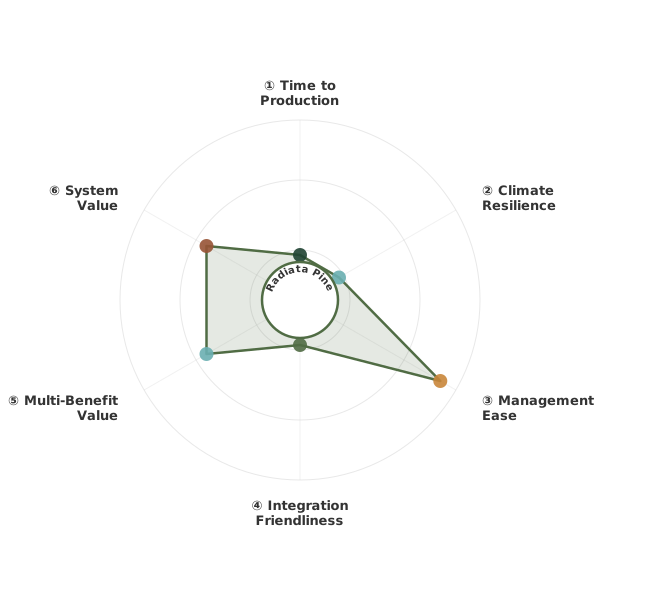
How These Traits Are Calculated
Trait dimensions are ordered clockwise starting from the top of the chart (12 o'clock position):
1. Time to Production
Years from planting to first harvestable yields
WHAT: Measures the waiting period from tree establishment to first meaningful production. Fast-producing trees yield within 2-5 years; slow producers require 8-15+ years before significant harvests.
WHY: Time to production determines cash flow timing and financial feasibility for farm businesses. Long wait times create significant opportunity costs—land and labor tied up for years without income. Fast producers allow quicker experimentation and cash flow recovery, reducing risk for new tree crop farmers.
HOW: Ratings based on years to first harvest documented in economics data. Exceptional (3.0): Production within 2-4 years (elderberry, mulberry, some nut bushes). Typical (2.0): 5-8 years (many fruit trees). Limited (1.0): 10-15+ years (hardwood timber, some nut trees like pecan, walnut).
2. Climate Resilience
Weighted: hardiness zones (50%) + drought tolerance (30%) + adaptability (20%)
WHAT: Combines temperature tolerance (hardiness zone range), water stress resilience (drought tolerance), and overall climate flexibility. Multi-decade tree investments require reliable climate matching to prevent total loss.
WHY: Wrong climate choices mean complete failure for permanent plantings. A tree that dies in year 5 from unexpected cold or prolonged drought represents catastrophic loss of 5 years' investment. Climate resilience determines geographic range and weather variability tolerance—critical as climate patterns become less predictable.
HOW: Weighted formula prioritizes hardiness zone range (50% weight) for core temperature tolerance, drought tolerance (30% weight) for water stress, and overall adaptability (20% weight) for general climate flexibility. Exceptional (3.0): Wide hardiness range (8+ zones) with strong drought tolerance. Typical (2.0): Moderate range and tolerance. Limited (1.0): Narrow climate requirements.
3. Management Ease
Weighted: establishment (40%) + low maintenance (30%) + pest resistance (30%)
WHAT: Combines establishment difficulty, ongoing maintenance requirements, and disease/pest pressure into overall management workload. Low-maintenance trees fit easily into busy farm operations without specialized expertise or intensive inputs.
WHY: Labor is the limiting factor for most diversified farms. High-maintenance trees requiring pruning expertise, disease management, and intensive pest control compete for limited time with other farm enterprises. Easy-care trees deliver production with minimal intervention, making them viable for time-constrained farmers.
HOW: Weighted formula balances establishment ease (40% weight) for startup success, inverted maintenance intensity (30% weight) for ongoing care, and inverted pest/disease pressure (30% weight) for health management. Exceptional (3.0): Easy to establish, self-sufficient growth, naturally pest-resistant. Typical (2.0): Moderate care needs. Limited (1.0): Difficult establishment, intensive maintenance, or heavy pest pressure.
4. Integration Friendliness
Compatibility with silvopasture, alley cropping, and multi-species systems
WHAT: Measures how well the tree integrates with other farm enterprises—grazing livestock, annual crops, or other perennials. Integration-friendly trees tolerate livestock browsing, don't heavily shade out crops, and coexist with diverse plantings.
WHY: Integrated tree systems (silvopasture, alley cropping, food forests) provide higher total returns per acre than monoculture plantings. Trees that work well with livestock provide shade + forage + production simultaneously. Integration flexibility allows farmers to stack enterprises and adapt to market opportunities.
HOW: Ratings based on the integration_friendliness trait documenting compatibility with grazing, cropping, and multi-species systems. Exceptional (3.0): Tolerates livestock browsing, provides livestock benefits (shade, browse), compatible with understory crops. Typical (2.0): Some integration possible with management. Limited (1.0): Requires isolation, incompatible with livestock or cropping.
5. Multi-Benefit Value
Stacked benefits beyond primary product—shade, wildlife, nitrogen, erosion control
WHAT: Measures the diversity of ecosystem services provided beyond the main harvest product. Multi-benefit trees deliver shade, windbreak, wildlife habitat, nitrogen fixation, erosion control, pollinator support, and aesthetic value simultaneously.
WHY: Single-purpose trees are economically fragile—market price swings or production failures eliminate all value. Multi-benefit trees provide resilience through diverse value streams. A nitrogen-fixing tree that produces nuts, provides shade for livestock, supports wildlife, and controls erosion delivers 4-5x the system value of a production-only tree.
HOW: Ratings based on the multi_benefit_value trait documenting service diversity. Exceptional (3.0): 4+ significant services stacked (nitrogen-fixing legume trees providing nuts + shade + wildlife + windbreak). Typical (2.0): 2-3 moderate services. Limited (1.0): Single-purpose production trees with minimal additional benefits.
6. System Value
Total ecosystem and economic value across short, medium, and long timeframes
WHAT: Synthesizes the total regenerative value delivered across multiple decades, including immediate ecosystem services (years 1-5), medium-term production value (years 5-15), and long-term system transformation (years 15-50). Captures the compounding benefits of permanent plantings.
WHY: Trees are multi-decade investments requiring patient capital. System value measures whether the total package—early ecosystem services, eventual production, and long-term legacy benefits—justifies the wait time and land commitment. High system value trees pay back investment through diverse, stacking, compounding benefits.
HOW: Scored via LLM synthesis of economics timelines, ecosystem service diversity, and long-term soil/water/carbon impacts. Exceptional (3.0): Strong early services + valuable production + transformative long-term impacts. Typical (2.0): Moderate benefits across timeframes. Limited (1.0): Long wait with limited service stacking or weak economic returns.
Ratings are based on documented performance in regenerative systems, not conventional high-input scenarios. All traits assume integrated management practices focused on soil health and ecosystem services.
5
Management & Care Requirements
Integration guidance, maintenance needs, and care practices
Management & Care Requirements
Integration guidance, maintenance needs, and care practices
How to Integrate This Plant
Radiata pine can be integrated into regenerative systems primarily for its rapid biomass production and potential for carbon sequestration. While not a nitrogen fixer, its primary roles include timber production, windbreaks, and potentially as a nurse crop for slower-growing species in specific contexts. It is compatible with silvopasture systems where its early growth can provide shade and reduce wind stress for livestock, though careful management is needed to prevent overgrazing. Its rapid growth means it begins providing some shade and windbreak benefits from Year 3-5, with significant timber volume achievable by Year 10-20. The multi-benefit stacking includes timber revenue, soil carbon enhancement (as evidenced by increased methane uptake in afforested areas), and potential reduction of pressure on native forests by providing an alternative timber source. Its value extends beyond timber to landscape modification and climate mitigation.
Integration Practices & Management
Source advocates for a middle ground between monocultures like *Pinus radiata* and solely native plantings, suggesting a merged approach for production and conservation benefits. Source contrasts highly productive *Pinus radiata* plantations with native forests in New Zealand, framing them within a 'transitional forestry' model. Source notes that afforestation with *Pinus radiata* increased soil methane uptake in Argentina, suggesting a potential soil health benefit, though this study focused on conversion from grassland rather than integration into existing agricultural rotations. The sources do not detail specific establishment methods, integration with grazing, termination strategies, management considerations for fertility or competition, or integration with cash crops as typically practiced in regenerative agriculture. Therefore, based on the knowledge base, specific regenerative farming integration methods for *Pinus radiata* cannot be detailed. While coverage in our knowledge base is limited, the above represents documented uses in regenerative systems. While coverage in our knowledge base is limited, the above represents documented uses in regenerative systems.
Management Profile
Maintenance Intensity: Not Recommended - System integration focuses on fostering a resilient ecosystem through healthy soil, beneficial insect populations, and diverse plantings to naturally mitigate potential pest and disease challenges.
Pest Disease Pressure: Not Recommended - Susceptibility to certain biotic stressors necessitates a proactive, ecological approach to plant health, emphasizing a biodiverse landscape and robust soil biology to support natural defenses.
Time To Production: Not Recommended - Monterey pine is a rapid biomass accumulator, primarily valued for timber production rather than edible yields, and is not a primary candidate for agroforestry systems focused on swift edible crop cycles.
Sources behind this view
 Research
-
Long-term effects of afforestation with Pinus radiata on soil carbon, nitrogen, and pH: a case study (opens in new window)
This study found: Planting of Pinus radiata D. Don in previously grazed pastures is a common land-use change in New Zealand. Although carbon (C) accumulates relatively rapidly in the trees, there have been no studies o
-
Afforestation of pastures with
<i>Pinus</i>
<i>radiata</i>
influences soil carbon and nitrogen pools and mineralisation and microbial properties (opens in new window)
This study found: In New Zealand, Pinus radiata D. Don is frequently planted on land under pasture primarily for production forestry, but with the added advantage of potentially offsetting carbon dioxide (CO2) emission
-
Transitional forestry in New Zealand: re-evaluating the design and management of forest systems through the lens of forest purpose. (opens in new window)
This study found: Transitional forestry is proposed as a purpose-led management model for New Zealand forests, balancing timber production, resilience, biodiversity, and climate goals across various forest types.
8
Know the Debate
Pinus radiata's success as a regenerative forestry tool is context-dependent, varying significantly with climate, management intensity, and scale. ...
Know the Debate
Pinus radiata's success as a regenerative forestry tool is context-dependent, varying significantly with climate, management intensity, and scale. ...
Pinus radiata's success as a regenerative forestry tool is context-dependent, varying significantly with climate, management intensity, and scale. In humid temperate regions with adequate rainfall, its rapid growth and carbon sequestration potential are more readily realized, especially when integrated into multi-purpose systems. However, even in these regions, the ecological impacts of monocultures require careful management to avoid soil degradation. Conversely, in semi-arid or severely degraded landscapes, its establishment and long-term viability depend heavily on initial site conditions, careful species selection, and potentially supplemental irrigation during early years. High upfront costs for seedlings and potentially protection measures are common, with significant returns realized over decades.
Ecological impact of Pinus radiata plantations vs. native forests
Soil degradation in monocultures
Studies indicate that monoculture plantations, especially those involving clear-cutting, can lead to a significant reduction in soil organic carbon, nutrient cycling, and soil invertebrate diversity when compared to native forest ecosystems.
Sources behind this view
Sources behind this view
Research
-
Karışık baltalık ormanların sahil çamına dönüştürülmesinin toprak ve ölü örtüdeki organik karbon ve besin maddesi stoklarına etkisi (opens in new window)
This study found: This study in Turkey looked at how changing forest types affects soil health. They compared natural deciduous woodlands to pine forests planted after clear-cutting older forests. They found that planting pine forests, especially a second time after clear-cutting, significantly reduced the amount of carbon and nutrients in the forest floor litter. While soil organic carbon was higher in the newer pine and young deciduous forests compared to older ones, these differences weren't statistically significant. However, phosphorus levels were significantly lower in the newer pine and young deciduous forests. This suggests that converting natural woodlands to monoculture pine plantations, particularly through repeated clear-cutting and replanting, can negatively impact soil nutrient levels.
Carbon sequestration in managed systems
When managed within integrated or transitional forestry models, Pinus radiata plantations can contribute to carbon sequestration and offer ecological benefits, potentially providing an alternative to native forest exploitation.
Sources behind this view
Sources behind this view
Research
-
Afforestation of pastures with
<i>Pinus</i>
<i>radiata</i>
influences soil carbon and nitrogen pools and mineralisation and microbial properties (opens in new window)
This study found: In New Zealand, Pinus radiata D. Don is frequently planted on land under pasture primarily for production forestry, but with the added advantage of potentially offsetting carbon dioxide (CO2) emissions from energy and industrial sources. Conversion of pasture to P. radiata plantations can, however, result in lowered contents of soil carbon (C) at some sites. We here examine the effects of this land-use change on soil C and nitrogen (N) pools, and on microbial properties involved in the cycling of these nutrients, at 5 paired sites, each with an established pasture and P. radiata plantation. Four sites had first-rotation trees aged 12–30 years and the other site second-rotation trees aged 20 years. In mineral soil at 0–10 cm depth, total and microbial C and N, extractable C, CO2-C production, and, generally, net mineral-N production were lower under P. radiata than under pasture; differences were significant ( P &lt; 0.05), except for total and extractable C at 2 sites. Differences between these land uses were less distinct in soil at 10–30 cm depth. On an area basis, total C in 0–30 cm depth soil was lower under P. radiata than under pasture at most sites, but significantly lower at only one site. Total N, microbial C and N, and CO2-C and net mineral-N production were, however, again generally significantly lower under P. radiata . These ecosystem differences were less marked, although still present, except for CO2-C production, when forest litter (LFH material) was included in the area calculations. Overall, our study suggests that afforestation with P. radiata leads to a reduction in total N, microbial biomass, and microbial activity, but a less consistent effect on soil C storage after one rotation.
-
Long-term effects of afforestation with Pinus radiata on soil carbon, nitrogen, and pH: a case study (opens in new window)
This study found: Planting of Pinus radiata D. Don in previously grazed pastures is a common land-use change in New Zealand. Although carbon (C) accumulates relatively rapidly in the trees, there have been no studies of the annual effect on soil C content during the early years of establishment. Here, we study soil properties under P. radiata and pasture each year over 11 years after P. radiata was planted into pasture that had been grazed by sheep. Under the growing trees, grass was gradually shaded out by the unpruned trees, and completely disappeared after 6 years; needle litterfall had then increased appreciably. By year 9, soil microbial C and nitrogen (N), and net N mineralisation, were significantly lower under pine than under pasture. Soil pH, sampled at 0–100 mm in early spring each year, decreased by ~0.3 units under pine and increased by ~0.3 units under pasture. Close to the pine stems, total C and N decreased significantly for 3 years, while ~100 kg N/ha accumulated in the trees. Soil C and N increased in subsequent years, when litterfall increased. Overall, the mineral soil under pine lost ~500 kg N/ha over 11 years, consistent with uptake by the trees. Leaching losses (estimated using lysimeters) in year 9 were 4.5 kg N/ha.year. These data indicate that ~6 Mg C/ha may have been lost from the mineral soil at this site. The difficulties associated with measuring losses of C are discussed.
-
Processes influencing soil carbon storage following afforestation of pasture with Pinus radiata at different stocking densities in New Zealand (opens in new window)
This study found: Since 1992, afforestation with Pinus radiata D. Don in New Zealand has led to the establishment of over 600 000 ha of new plantation forests, about 85% of which are on fertile pastures used previously for grazing sheep and cattle. While this leads to rapid accumulation of carbon (C) in vegetation, the effects of afforestation on soil C are poorly understood. We examined key soil C cycling processes at the (former) Tikitere agroforestry experimental site near Rotorua, New Zealand. In 1973, replicated stands of P. radiata (100 and 400 stems/ha) were established on pastures, while replicated pasture plots were maintained throughout the first 26-year rotation. In 1996, soil C and microbial biomass C in 0–0.10 m depth soil, in situ soil respiration and net N mineralisation, and soil temperature were lower in the forest than in the pasture, and tended to decline with increasing tree-stocking density. In the 400 stems/ha stands, mineral soil C (0–0.50 m depth) was lower than in the pasture (104 and 126 Mg C/ha, respectively; P &lt; 0.01). Carbon accumulation in the forest floor during the first rotation of these forest stands was 12 Mg C/ha. Using the Rothamsted soil C model (Roth-C), we examined how changes in plant C inputs following afforestation might lead to changes in soil C content to 0.30 m depth. Steady-state pasture inputs of 9.0 Mg C/ha.year were estimated using Roth-C; these C inputs were assumed to decrease linearly during the first 12 years following tree establishment (until canopy closure). Below-ground C inputs in the forest were estimated using steady-state relationships between litterfall and soil respiration; these inputs were assumed to increase linearly between years 1 and 12, after which they remained constant at 1.53 Mg C/ha.year until harvest. Measured changes in soil C (0−0.30 m) during the first rotation, in conjunction with the below-ground inputs, were used to estimate above-ground inputs (as a proportion of total litterfall [3.81 Mg C/ha.year]) to the soil. Our results suggest 10% of litterfall C over one rotation actually entered the mineral soil. Using these results and estimates of additional C inputs to the soil from harvest slash and weeds following harvest, we found mineral-soil C stocks would continue to decline during second and third rotations of P. radiata; the magnitude of this decline depended in part on how much slash enters the mineral soil matrix. We confirmed our modelling approach by simulating soil C changes to within 8% over 19 years following afforestation of pasture at another previously studied site, Purukohukohu. Whether afforestation leads to an increase or decrease in mineral-soil C may depend on previous pasture management; in highly productive pastures, high C inputs to the soil may maintain soil C at levels that cannot be sustained when trees are planted onto these grasslands.
Making Sense of the Differences
The ecological impact of Pinus radiata varies significantly with management. While monocultures, especially those with clear-cutting, can degrade soil health and biodiversity, integrated approaches and transitional forestry models offer the potential for carbon sequestration and ecological benefits. Farmers should consider the long-term management strategy and compare it to native forest dynamics to gauge its true impact.
Tree protection needs for Pinus radiata establishment
Protection required for best timber quality
Mechanical protection, such as tree tubes or animal exclusion fencing, is often necessary for Pinus radiata establishment to ensure survival, tree form, and timber quality, especially where browse pressure is high.
Sources behind this view
Sources behind this view
Research
-
Provenance Variation in Early Survival, Growth, and Carbon Isotope Discrimination of Southwestern Ponderosa Pine Growing in Three Common Gardens across an Elevational Gradient (opens in new window)
This study found: A three-year study planted ponderosa pine seedlings from different origins (provenances) in three locations across an elevation range in Arizona and New Mexico to see how they survive and grow. The study found that seedlings had the best survival in the middle elevation forest, with very low survival at the highest and lowest elevations. At the hot, dry lowest elevation site, seedlings from lower elevations survived longer, indicating they are more tolerant to drought. The main cause of seedling death changed from drought at lower elevations to animal damage (like from rodents) at higher elevations, which could make it hard to replant pine trees in some areas. Seedlings grew better and showed signs of using water more efficiently at the middle elevation site. The study also found differences between seedling origins in their growth and water use, suggesting that choosing the right seed source is important for successful tree planting and reforestation efforts.
Early integration without protection possible
With careful species selection, robust transplant stock, and adaptive grazing management, Pinus radiata can be integrated early into silvopasture systems without extensive protection, potentially reducing costs and leveraging animal impact for fertility.
Sources behind this view
Sources behind this view
 Videos & Podcasts
-
A rancher in North Dakota seeks hardy, zone three-hearty trees for silvopasture and savannah development, aiming for animal nutrition, wind protection, shade, and snow catchment in an extreme climate.

-
Discusses four key tree fodder species: Willow (high biomass, tannins, easy propagation), Black Locust (tree alfalfa, nitrogen-fixing, rot-resistant wood), Poplar (high biomass, balanced nutrition, adaptable), and Mulberry (high digestibility for non-ruminants). Focuses on nutritional benefits, propagation, and suitability for temperate climates.
Making Sense of the Differences
The need for tree protection for Pinus radiata establishment depends on local conditions, animal species present, and management goals. In areas with high browse pressure or strict timber quality requirements, protective measures are often essential. However, in silvopasture systems, strategic early integration with robust seedlings and adaptive grazing can reduce costs and labor, although it may lead to slower growth or less ideal timber form.