
Pistachio
The provided excerpts highlight its integration within established perennial cropping systems. Studies in California and Arizona focus on managing soil health and water use in almond and pistachio orchards, suggesting Pistacia vera is primarily cultivated as a fruit-bearing tree within these systems. Research into root zone salinity and water uptake in drip-irrigated orchards, alongside monitoring fungal populations like Aspergillus flavus, indicates a focus on optimizing resource management and mitigating plant diseases in established monocultures or silvopasture-like settings. The limited data does not detail its use as a cover crop, nitrogen fixer, or primary forage source. However, its inclusion in land suitability analyses for future agricultural scenarios suggests its potential as a resilient component in diversified perennial systems, contributing to long-term land productivity and adaptation to changing environmental conditions. While coverage in our knowledge base is limited, the above represents documented uses in regenerative systems.
For a full botanical description see: Plants For A Future(opens in new window) (external link)
Regenerative Quick Profile
All recommendations assume integrated, regenerative practices—not conventional inputs.
Climate & Soil Fit
Climate: Tropical Rainforest, Tropical Monsoon, Tropical Savanna, Hot Semi-Arid (Steppe), Cold Semi-Arid (Steppe), Hot Desert, Cold Desert, Humid Subtropical, Oceanic (Maritime Temperate), Hot-Summer Mediterranean, Warm-Summer Mediterranean, Monsoon-Influenced Humid Subtropical, Subtropical Highland, Hot-Summer Continental, Warm-Summer Continental, Subarctic, Monsoon-Influenced Hot-Summer Continental, Tundra
Zones: USDA 7-9, Australian Zones 4-6, EU Mediterranean, Semi-arid
Optimal Soil: Loam Soil
System Role & Functions
Primary: Cash Crop With Services
Secondary: Food Forest, Silvopasture
Key Benefits: Drought tolerant
Management Level
Experience: Advanced
Maintenance: High maintenance - Maintaining a healthy pistachio orchard involves supporting soil fertility through compost and mulch, and managing water naturally.
Time to Production: Slow (5+ years) - Pistachios offer long-term value, with the system maturing over 7-15 years to reach full nut production potential.
Value Streams
- Fruit/nut harvest
Know the Debate
- Pistachio yields vary with irrigation, rootstock, and soil salinity.
- Water management balances yield with conservation goals.
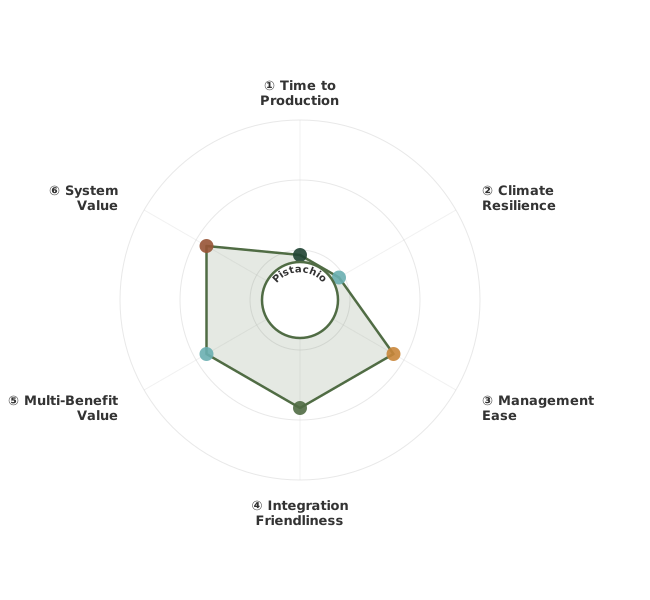
How These Traits Are Calculated
Trait dimensions are ordered clockwise starting from the top of the chart (12 o'clock position):
1. Time to Production
Years from planting to first harvestable yields
WHAT: Measures the waiting period from tree establishment to first meaningful production. Fast-producing trees yield within 2-5 years; slow producers require 8-15+ years before significant harvests.
WHY: Time to production determines cash flow timing and financial feasibility for farm businesses. Long wait times create significant opportunity costs—land and labor tied up for years without income. Fast producers allow quicker experimentation and cash flow recovery, reducing risk for new tree crop farmers.
HOW: Ratings based on years to first harvest documented in economics data. Exceptional (3.0): Production within 2-4 years (elderberry, mulberry, some nut bushes). Typical (2.0): 5-8 years (many fruit trees). Limited (1.0): 10-15+ years (hardwood timber, some nut trees like pecan, walnut).
2. Climate Resilience
Weighted: hardiness zones (50%) + drought tolerance (30%) + adaptability (20%)
WHAT: Combines temperature tolerance (hardiness zone range), water stress resilience (drought tolerance), and overall climate flexibility. Multi-decade tree investments require reliable climate matching to prevent total loss.
WHY: Wrong climate choices mean complete failure for permanent plantings. A tree that dies in year 5 from unexpected cold or prolonged drought represents catastrophic loss of 5 years' investment. Climate resilience determines geographic range and weather variability tolerance—critical as climate patterns become less predictable.
HOW: Weighted formula prioritizes hardiness zone range (50% weight) for core temperature tolerance, drought tolerance (30% weight) for water stress, and overall adaptability (20% weight) for general climate flexibility. Exceptional (3.0): Wide hardiness range (8+ zones) with strong drought tolerance. Typical (2.0): Moderate range and tolerance. Limited (1.0): Narrow climate requirements.
3. Management Ease
Weighted: establishment (40%) + low maintenance (30%) + pest resistance (30%)
WHAT: Combines establishment difficulty, ongoing maintenance requirements, and disease/pest pressure into overall management workload. Low-maintenance trees fit easily into busy farm operations without specialized expertise or intensive inputs.
WHY: Labor is the limiting factor for most diversified farms. High-maintenance trees requiring pruning expertise, disease management, and intensive pest control compete for limited time with other farm enterprises. Easy-care trees deliver production with minimal intervention, making them viable for time-constrained farmers.
HOW: Weighted formula balances establishment ease (40% weight) for startup success, inverted maintenance intensity (30% weight) for ongoing care, and inverted pest/disease pressure (30% weight) for health management. Exceptional (3.0): Easy to establish, self-sufficient growth, naturally pest-resistant. Typical (2.0): Moderate care needs. Limited (1.0): Difficult establishment, intensive maintenance, or heavy pest pressure.
4. Integration Friendliness
Compatibility with silvopasture, alley cropping, and multi-species systems
WHAT: Measures how well the tree integrates with other farm enterprises—grazing livestock, annual crops, or other perennials. Integration-friendly trees tolerate livestock browsing, don't heavily shade out crops, and coexist with diverse plantings.
WHY: Integrated tree systems (silvopasture, alley cropping, food forests) provide higher total returns per acre than monoculture plantings. Trees that work well with livestock provide shade + forage + production simultaneously. Integration flexibility allows farmers to stack enterprises and adapt to market opportunities.
HOW: Ratings based on the integration_friendliness trait documenting compatibility with grazing, cropping, and multi-species systems. Exceptional (3.0): Tolerates livestock browsing, provides livestock benefits (shade, browse), compatible with understory crops. Typical (2.0): Some integration possible with management. Limited (1.0): Requires isolation, incompatible with livestock or cropping.
5. Multi-Benefit Value
Stacked benefits beyond primary product—shade, wildlife, nitrogen, erosion control
WHAT: Measures the diversity of ecosystem services provided beyond the main harvest product. Multi-benefit trees deliver shade, windbreak, wildlife habitat, nitrogen fixation, erosion control, pollinator support, and aesthetic value simultaneously.
WHY: Single-purpose trees are economically fragile—market price swings or production failures eliminate all value. Multi-benefit trees provide resilience through diverse value streams. A nitrogen-fixing tree that produces nuts, provides shade for livestock, supports wildlife, and controls erosion delivers 4-5x the system value of a production-only tree.
HOW: Ratings based on the multi_benefit_value trait documenting service diversity. Exceptional (3.0): 4+ significant services stacked (nitrogen-fixing legume trees providing nuts + shade + wildlife + windbreak). Typical (2.0): 2-3 moderate services. Limited (1.0): Single-purpose production trees with minimal additional benefits.
6. System Value
Total ecosystem and economic value across short, medium, and long timeframes
WHAT: Synthesizes the total regenerative value delivered across multiple decades, including immediate ecosystem services (years 1-5), medium-term production value (years 5-15), and long-term system transformation (years 15-50). Captures the compounding benefits of permanent plantings.
WHY: Trees are multi-decade investments requiring patient capital. System value measures whether the total package—early ecosystem services, eventual production, and long-term legacy benefits—justifies the wait time and land commitment. High system value trees pay back investment through diverse, stacking, compounding benefits.
HOW: Scored via LLM synthesis of economics timelines, ecosystem service diversity, and long-term soil/water/carbon impacts. Exceptional (3.0): Strong early services + valuable production + transformative long-term impacts. Typical (2.0): Moderate benefits across timeframes. Limited (1.0): Long wait with limited service stacking or weak economic returns.
Ratings are based on documented performance in regenerative systems, not conventional high-input scenarios. All traits assume integrated management practices focused on soil health and ecosystem services.
5
Management & Care Requirements
Integration guidance, maintenance needs, and care practices
Management & Care Requirements
Integration guidance, maintenance needs, and care practices
How to Integrate This Plant
Pistachio trees (Pistacia vera) can be integrated into regenerative systems primarily as a long-term cash crop that also provides ecological services. Their role as a cash crop with services means they can be part of alley cropping systems, where annual crops are grown between rows of trees, or potentially in silvopasture if managed carefully to avoid overgrazing of young trees or damage to nuts. As a tree, pistachios offer potential for shade, windbreak effects, and soil stabilization. They are not nitrogen fixers and do not directly support pollinators in the way flowering annuals do, but their perennial nature contributes to soil health and carbon sequestration over time. Their value increases significantly as they mature and begin producing nuts, with early contributions focused on soil health and structure. Beyond direct harvest, they enhance the farm landscape by providing habitat and improving soil structure.
Integration Practices & Management
The provided knowledge base offers limited insight into the specific regenerative agriculture integration methods for Pistacia vera. The sources primarily focus on pest dynamics in commercial pistachio orchards and the impact of irrigation and salinity on pistachio and almond crops within the San Joaquin Valley. These studies detail observations on Aspergillus flavus populations and soil water content under varying conditions. However, there is no information within this knowledge base regarding establishment techniques such as seeding rates, timing, companion planting, or tillage practices. Similarly, the knowledge base does not address integration with grazing systems, including mob or rotational grazing, or specific termination strategies for Pistacia vera. Management considerations like fertility needs, competition, and succession planning are also absent. Furthermore, the sources do not describe Pistacia vera's integration with cash crops through methods like relay cropping, intercropping, or inclusion in rotation sequences. Consequently, practical farmer experiences and specific insights into how regenerative farmers actively manage Pistacia vera within their systems are not available in this dataset.
Management Profile
Maintenance Intensity: Not Recommended - Maintaining a healthy pistachio orchard involves supporting soil fertility through compost and mulch, and managing water naturally.
Pest Disease Pressure: Adequate - Orchard health is supported by fostering beneficial insect populations and promoting plant resilience through a balanced ecosystem.
Time To Production: Not Recommended - Pistachios offer long-term value, with the system maturing over 7-15 years to reach full nut production potential.
Sources behind this view
 Community
-
Provides pistachio orchard design recommendations (20-22 ft row width, 17-21 ft tree spacing) and discusses weed control methods like cultivation, herbicides, and ground cover, considering harvest and
Read more (opens in new window) ucanr.edu
 From the Web
-
Pistachio orchard management in California's San Joaquin Valley recommends 20-22 ft row spacing and 17-21 ft in-row spacing, balancing early production with mature tree needs and mechanical harvest. W
Source: ucanr.edu (opens in new window)
8
Know the Debate
Pistachio cultivation offers long-term value as a perennial nut crop, with its establishment and management influenced by several factors. Grafted ...
Know the Debate
Pistachio cultivation offers long-term value as a perennial nut crop, with its establishment and management influenced by several factors. Grafted ...
Pistachio cultivation offers long-term value as a perennial nut crop, with its establishment and management influenced by several factors. Grafted trees are typically planted in late winter or early spring, requiring reliable water for the first 3-5 years to establish deep root systems. While mature trees are drought-tolerant, optimal yields and resilience depend on careful water management throughout their long lifespan. Successful integration into agroforestry systems also hinges on appropriate spacing (25-40 ft rows) to balance tree health with understory potential, such as hay harvest or livestock integration starting around year 2-3. Entry costs and labor vary significantly with scale, initial infrastructure needs, and management intensity, but the asset value and ecosystem services provided by long-lived trees like pistachios are substantial.
How do water use strategies impact pistachio yield and quality?
Optimized irrigation and rootstocks enhance yield
Academic research highlights that careful water management and selection of appropriate rootstocks are key to maximizing pistachio yield and quality, particularly in arid regions. Strategies that promote deep root growth and manage salinity can lead to better early yields and overall orchard health.
Sources behind this view
Sources behind this view
 Research
-
Impact of Drought and Changing Water Sources on Water Use and Soil Salinity of Almond and Pistachio Orchards: 1. Observations (opens in new window)
This study found: A study in California's San Joaquin Valley looked at how drought and using different water sources affected soil salt levels in almond and pistachio orchards. Researchers measured soil moisture, salt buildup, and water loss from plants and soil. They found that orchards in the western part of the valley, which used lower quality irrigation water and had finer soils, had higher salt levels. The amount of water used by the trees was slightly less than expected in these western orchards, and the water's ability to flush salts through the soil (leaching fraction) was between 11% and 28%. In contrast, orchards in the eastern valley used water of better quality, had soil that better matched expected water use, and had about 20% leaching.
-
Root vacuolar sequestration and suberization are prominent responses of <i>Pistacia</i> spp. rootstocks during salinity stress (opens in new window)
This study found: Researchers studied how two types of pistachio root systems (the base of the tree that is grafted onto) handle salty soil conditions. Using microscopy, they looked at how the roots stored salt and built up protective layers. They found that the roots store salt in their cell compartments (vacuoles) and create thicker, waterproof barriers (suberin) in their outer tissues. These responses help protect the rest of the plant. One rootstock, UCB1, was better at storing salt and building these barriers, showing less damage to its leaves compared to the other type, P. integerrima. These findings suggest that looking at how roots store salt and form barriers can help select better rootstock varieties for areas with salty soils.
-
The Effect of Plant Water Status on the Chemical Composition of Pistachio Nuts (Pistacia vera L. Cultivar Bianca) (opens in new window)
This study found: Pistachio nuts are worldwide appreciated for their chemical and organoleptic profiles. There are several studies on the influence of irrigation on pistachio productivity, whereas there are little available data on the influence on nut quality. In this study we characterized some qualitative traits of pistachio nuts cultivar Bianca in Mediterranean environment and how plant water status affected them. Water status had a positive and significant influence on the chlorophylls content, nuts from less stressed trees showed higher values of chlorophyll a (14.7 mg/100 g) and b (21.1 mg/100 g) compared than more stressed trees (9.3 and 11.5 mg/100 g for a and b, respectively). Solid phase microextraction technique in headspace followed by gas chromatography/mass spectrometry (HS-SPME GC/MS) identified seventeen different compounds with terpenes being the major class of volatiles; the most abundant were α-Pinene (range 26.2–35 μg/g), D-Limonene (2.8–3.3 μg/g), 2-Carene (1.8–3 μg/g) and β-Myrcene (0.6–1.4 μg/g). Overall, we found higher level of terpenes in less stressed trees and for α-Pinene and β-Myrcene differences were significant. The fatty acid composition analysis revealed oleic acid (70.1–71.1%), linoleic acid (13.5–14.4%) and palmitic acid (9.6–9.8%) as the most abundant compounds, but tree water status did not influence their concentration. Overall, the data reported proved that supplemental irrigation contributes to increase pistachio nut quality.
Drought tolerance with strategic water management for resilience
Field and academic insights suggest that mature pistachio trees are inherently drought-tolerant, but strategic water management, like combining water-saving irrigation with cover crops, can enhance resilience and soil health. This approach aims to optimize resource use and improve long-term sustainability, especially in areas with water scarcity.
Sources behind this view
Sources behind this view
Research
-
Integrating Deficit Irrigation Strategies and Soil-Management Systems in Almond Orchards for Resilient Agriculture (opens in new window)
This study found: A three-year study in southern Spain looked at how different watering and ground cover methods affect almond trees. Researchers tested two irrigation levels (full watering vs. water-saving) and two ground covers (bare soil vs. a mix of vetch and oat cover crops) on three almond varieties. For two varieties (Guara and Lauranne), water-saving irrigation with cover crops slightly reduced yields compared to full watering with cover crops, but one variety (Marta) was unaffected. The water-saving approach still provided good yields, showing promise for growing almonds in dry areas. The cover crop mix significantly boosted soil health by increasing beneficial microbes and enzymes, especially in the top few inches of soil and when combined with full watering. The cover crops also captured atmospheric carbon. Combining water-saving irrigation with cover crops appears to be a good strategy for improving soil function and saving water in almond orchards, especially in dry climates.
-
Present and Future Land Suitability Analysis for Almond and Pistachio Crops in the Beira Baixa Region Using Spatial Multicriteria Decision Systems (opens in new window)
This study found: Researchers used a special mapping tool (AHP) to figure out which land in Portugal's Beira Baixa region is best for growing almonds and pistachios, both now and in the future, considering different climate change predictions. Currently, about 16% of the land is highly suitable for each crop. The study suggests that in the future, more land will become highly suitable for both almonds and pistachios, even with changing climate conditions.
-
Introducing a stratified vertical gravel tube subsurface drip system under different irrigation regimes for pistachio: Growth, yield and water productivity (opens in new window)
This study found: AbstractHigh evapotranspiration and low precipitation are known as the main challenging factors for pistachio (Pistacia vera L.) orchards situated in arid and semi‐arid regions. Therefore, it is necessary to take some measures to mitigate surface evaporation. This study was carried out to assess water productivity (WP) as well as yield and annual shoot growth of pistachios using a new method of irrigation known as the stratified vertical gravel tube subsurface drip irrigation (SVGTSD) system in a 15‐year‐old pistachio orchard in an arid region in Iran. In this system, each tree contained four vertical gravel columns with different lengths. A randomized complete block design with a split‐plot arrangement with three replicates (five trees in each plot) for 3 years was used. Three irrigation regimes included 100% crop evapotranspiration (100% ETc), 85% ETc and 70% ETc (as the main plots), and seven vertical gravel column with a depth arrangement of 40–40–40–40 cm (using a gravel column from the lateral pipe level and without a gravel tube as the control) and gravel‐filled tubes with depths of 10–10–10–10 cm, 10–10–20–20 cm, 10–10–30–30 cm, 10–10–20–30 cm, 10–10–20–40 cm and 10–10–20–50 cm (all 30 cm below ground level) (as subplots) were used. The results showed that the different depths of gravel tube placement significantly affected the annual shoot growth and yield. The deeper the tube was placed, the greater the yield and annual shoot growth, resulting in 10–10–20–50 cm being the most productive. Regarding tree growth, yield and WP, the best performance was observed at full irrigation (100% ETc) with a 10–10–20–50‐cm vertical gravel tube arrangement. Furthermore, in this subsurface irrigation method, there was no concern regarding emitter clogging by roots, root accumulation around the emitters or root intrusion into the emitters. In addition, having a low additional cost (only 13.9%) in comparison with conventional subsurface drip irrigation together with a higher yield (3475 kg ha−1), WP (0.9 kg m−3) and shoot growth (35 cm), SVGTSD is more economical and feasible compared to other irrigation methods and can be extensively applied in pistachio orchards.
Making Sense of the Differences
Pistachio production in arid and semi-arid regions is fundamentally tied to water management. While mature trees exhibit significant drought tolerance, optimal yields and nut quality are achieved through careful irrigation, especially during establishment and in the presence of saline soils. The choice of rootstock plays a role in salt tolerance and early productivity. Integrating practices like cover cropping with water-saving irrigation strategies offers a path to enhanced resilience, as demonstrated in studies from Spain and California, suggesting that balancing water use with soil health building is key to sustainable pistachio cultivation.