Available excerpts suggest its potential as a green manure. In one instance, it's mentioned alongside *Alnus acuminata* in an agro-ecosystem experiment with dairy cows and rotational grazing, indicating its integration into livestock systems for potential soil fertilization. The concept of trees acting as green manure, fertilizing the landscape, is highlighted, with *Acacia melanoxylon* cited as an example that might even 'die off' once its fertilizing job is complete, implying a role in nutrient cycling. Though not explicitly detailed as a nitrogen fixer in these snippets, its classification as a legume suggests this capability, contributing to soil building. The knowledge base does not provide farmer experiences or details on its use as a cover crop, forage, polyculture layer, or for pollinator support, nor does it detail carbon sequestration benefits or integration with practices like no-till or agroforestry beyond its mention in a tree-growing system context. While coverage in our knowledge base is limited, the above represents documented uses in regenerative systems.

Regenerative Quick Profile

All recommendations assume integrated, regenerative practices—not conventional inputs.

Climate & Soil Fit

Climate: Tropical Rainforest, Tropical Monsoon, Tropical Savanna, Hot Semi-Arid (Steppe), Cold Semi-Arid (Steppe), Hot Desert, Cold Desert, Humid Subtropical, Oceanic (Maritime Temperate), Hot-Summer Mediterranean, Warm-Summer Mediterranean, Monsoon-Influenced Humid Subtropical, Subtropical Highland, Hot-Summer Continental

Zones: USDA 8-11, Australian Zones 3-14

Optimal Soil: Loam Soil

System Role & Functions

Primary: Nitrogen Fixer

Secondary: Silvopasture, Specialty

Key Benefits: Multi-benefit value, Nitrogen Fixation, Root System Depth

Management Level

Experience: Beginner-Friendly

Maintenance: Moderate maintenance - Australian blackwood integrates seamlessly into regenerative systems, with its robust nature requiring minimal external inputs beyond natural fertility management and observation for pest balance.

Value Streams

  • Nitrogen fixation
1

Climate Suitability Assessment

Will this plant thrive in your climate?

IDEALLY SUITED

Köppen Zone: Af (Tropical Rainforest), Am (Tropical Monsoon), Aw (Tropical Savanna), Cfa (Humid Subtropical), Cwa (Monsoon-Influenced Humid Subtropical)
USDA Zone: 9a, 10a, 11a, 12a
Australian Zone: temperate
EU Climate Region: atlantic

Blackwood thrives in regions with mild winters and moderate summers, characterized by consistent rainfall and a long growing season. These conditions are met in Köppen Cfb zones, USDA zones 7a-8b, Australian temperate zones, and EU Atlantic regions. In these areas, Blackwood exhibits excellent perenniality, establishing robust root systems and reliably fixing nitrogen throughout the year. Its growth is vigorous, leading to high biomass production suitable for silvopasture and specialty uses. Minimal management is required, as natural precipitation patterns align with its needs, and it is resilient to common pests and diseases. Establishment success rates are very high, typically exceeding 85%, and multi-year productivity is assured. The plant's lifecycle is perfectly synchronized with the climate, allowing for optimal nitrogen input into the soil and high-quality forage or biomass yields, making it a cornerstone species for regenerative agriculture in these favorable climates.

ADEQUATE

Köppen Zone: BSh (Hot Semi-Arid (Steppe)), Cfb (Oceanic (Maritime Temperate)), Csa (Hot-Summer Mediterranean), Csb (Warm-Summer Mediterranean), Cwb (Subtropical Highland)
USDA Zone: 8a
Australian Zone: tropical, subtropical
EU Climate Region: mediterranean

Blackwood can perform adequately in climates with some seasonal extremes, including humid subtropical (Cfa), tropical savanna (Aw), cooler Mediterranean (Csb), and parts of USDA zones 6a-10b, Australian subtropical and tropical zones, and EU Mediterranean regions. These zones typically have sufficient growing degree days but may experience periods of heat stress, drought, or less consistent rainfall. While Blackwood can establish and provide nitrogen fixation, its perennial success and yield may be reduced by 10-20% compared to ideal zones. Supplemental irrigation might be necessary during dry spells, and careful timing of planting is crucial to avoid extreme temperatures during establishment. Management inputs may increase slightly to mitigate these challenges, but the plant's inherent resilience and nitrogen-fixing capabilities still offer significant benefits for regenerative agriculture. Stand persistence might be reduced to 2-3 years in less optimal conditions, requiring periodic reseeding or management adjustments.

NOT RECOMMENDED

Köppen Zone: ET (Tundra), BSk (Cold Semi-Arid (Steppe)), BWh (Hot Desert), BWk (Cold Desert), Dfa (Hot-Summer Continental), Dfb (Warm-Summer Continental), Dfc (Subarctic), Dwa (Monsoon-Influenced Hot-Summer Continental)
USDA Zone: 2a, 3a, 3b, 4a, 5a, 5b, 6a, 7a

Blackwood is not recommended for climates characterized by extreme heat, prolonged drought, or consistently high temperatures that fall outside its optimal range, specifically Köppen Csa and BSh, USDA zones 9a-13a, and potentially drier Australian regions. In these zones, Blackwood faces severe limitations that make its cultivation economically and practically questionable. High summer temperatures (often exceeding 90°F/32°C) cause significant heat stress, drastically reducing nitrogen fixation by 50-70% and hindering overall growth. Extended dry periods, common in Mediterranean and arid/semi-arid climates, require intensive irrigation infrastructure, increasing operational costs substantially. Establishment success rates can drop below 70% due to rapid soil drying and heat damage. While it might survive as a short-lived annual with significant intervention, its perennial nature and primary function as a nitrogen-fixer are compromised. Alternative plants better adapted to heat and drought, such as certain Acacia species, Leucaena, or drought-tolerant legumes, are far more suitable for these challenging environments.

Better alternatives for these "not recommended" zones: Acacia spp. (Wattle) (Many Australian native Acacias are nitrogen-fixers well-adapted to arid and semi-arid conditions.), Leucaena leucocephala (Drought-tolerant nitrogen-fixing tree well-suited to tropical and subtropical climates.), Atriplex spp. (Saltbush) (Highly drought-tolerant and adapted to saline soils, providing biomass and browse.), Prosopis spp. (Mesquite) (Drought-tolerant nitrogen-fixer that can thrive in arid conditions, though can be invasive.)

Note: Zones listed above represent climates where this plant can produce reliably with reasonable management. Climate zones not mentioned would require intensive climate modification (greenhouses, extensive infrastructure) and are not economically viable for regenerative agriculture purposes.

2

Soil Suitability Assessment

Which soil types work best for this plant?

IDEALLY SUITED

Loam Soil

This plant thrives in these soil types without requiring amendments or remediation. Natural soil conditions support optimal growth and productivity.

ADEQUATE

Acidic Soil, Alkaline Soil, Clay Soil, Rich Soil, Rocky Soil, Sandy Soil

This plant performs acceptably in these soil types with moderate, manageable remediation such as pH adjustment, compost addition, or drainage improvement. The required amendments are practical and cost-effective for regenerative agriculture.

NOT RECOMMENDED

Desert Soil, Saline Soil, Wet Soil

Growing this plant in these soil types would require impractical remediation such as complete soil replacement, extensive amendments, or cost-prohibitive infrastructure. These conditions are not economically viable for regenerative agriculture.

Note: Soil suitability assessments focus on remediation requirements. "Ideally Suited" means the plant generally thrives without the need for substantial amendments, "Adequate" means manageable remediation (lime, compost, mulch), and "Not Recommended" means impractical soil changes would be required. Climate factors like rainfall and temperature also influence success.

3

Seasonal Considerations

Planting timing, growth duration, and harvest windows

When establishing Acacia melanoxylon, aim for planting nursery stock during the dormant season, ideally in early spring after the last expected frost, allowing roots to establish before summer heat. Containerized seedlings can be planted throughout the active growing season, but will benefit from consistent moisture. Expect your blackwood to take roughly 2-3 years for initial establishment, with the first meaningful harvest of timber or pods occurring around 5-7 years. Full production, where the trees reach their prime for yield, will be achieved within 10-15 years, and these trees are known for their longevity, offering productive yields for many decades.

Seasonal management focuses on nurturing growth and preparing for harvest. Pruning is best undertaken during the dormant season, typically in late fall or winter, to minimize stress and sap loss. Bloom occurs in late winter to early spring, signaling the start of renewed growth and preceding the development of seed pods. Harvest timing will depend on your specific production goals – for timber, it's a long-term endeavor, while pods or other products may be harvested in late summer or fall as they mature. Winter dormancy is a crucial period for the trees to rest and consolidate resources before the next active growth cycle.

4

System Role & Multi-Benefit Value

Functional roles, integration strategies, and stacked benefits

Functional Role

Total System Value

Blackwood (Acacia melanoxylon) offers significant multi-benefit stacking potential within regenerative agriculture. Its primary function as a nitrogen fixer directly enhances soil fertility, reducing reliance on external nutrient inputs and improving the productivity of associated crops or pastures. As indicated by its inclusion in agro-ecosystems with cattle grazing (excerpt), it can be part of a silvopasture system, providing forage and improving soil health under animal impact. The 'green manure' aspect (excerpt) highlights its contribution to on-farm nutrient cycling and soil organic matter. Beyond nutrient provision, Blackwood can serve as a windbreak or provide shade, further enhancing the farm microclimate. Its establishment contributes to carbon sequestration and supports local biodiversity, creating a more resilient and self-sustaining farming system. Risk diversification is achieved through its multiple functions, providing ecological services that buffer against environmental and economic volatilities.

Integration Characteristics

Multi-Benefit Value: Ideally Suited - As a nitrogen fixer with deep roots that enhance soil structure, Blackwood acacia provides valuable timber, habitat, and improves the overall health and resilience of the agroecosystem.

5

Management & Care Requirements

Integration guidance, maintenance needs, and care practices

How to Integrate This Plant

Blackwood (Acacia melanoxylon) can be integrated into regenerative systems primarily as a nitrogen-fixing tree, contributing significantly to soil fertility. Its role as green manure, as noted in excerpt, means it can be used to fertilize landscapes, particularly in swale systems designed for tree growth or moisture retention. It can also be part of agro-ecosystems evaluated for soil quality, as seen in excerpt, where it was interplanted with grasses and grazed by cattle. Blackwood's nitrogen-fixing capability enhances soil health, reducing the need for synthetic inputs and supporting pasture or crop productivity. Its presence can also contribute to shade and windbreak functions in larger systems. The timeline for contribution begins early with nitrogen fixation, with more substantial biomass and soil improvement evident from year 3-5 onwards. Its value extends beyond direct harvest, enhancing overall farm resilience through improved soil structure, nutrient cycling, and by supporting biodiversity.

Integration Practices & Management

The provided knowledge base offers limited direct insights into the specific regenerative agriculture integration practices for *Acacia melanoxylon*. Source indicates its role as a green manure, suggesting it contributes to landscape fertilization, and notes that excessive fertility might lead to its natural die-off, implying a role in nutrient cycling. Source details an experiment where *Acacia melanoxylon* was part of an agro-ecosystem with grasses and dairy cows, suggesting its tolerance to grazing pressure within a rotational system, though specific management details like timing or rest periods are not provided. Source identifies *Acacia melanoxylon* as a weed species. The knowledge base does not elaborate on establishment methods, precise integration with cash crops, termination strategies beyond natural processes or potential grazing effects, or specific management considerations like fertility needs or competition control as practiced by regenerative farmers. Therefore, while its potential as a nitrogen-fixing plant contributing to fertility is hinted at, detailed practical integration methods remain outside the scope of these sources.

Management Profile

Maintenance Intensity: Adequate - Australian blackwood integrates seamlessly into regenerative systems, with its robust nature requiring minimal external inputs beyond natural fertility management and observation for pest balance.

6

Economics & Value Streams

Direct harvest, system benefits, ecosystem services, and risk diversification

Comprehensive economic analysis including direct harvest value, system enhancement contributions, ecosystem services, value timeline, and risk diversification strategies.

Cover Crop Investment

Metric Value
Seed Cost $15-30/acre $37-74/ha
Termination Cost 20-50 49-124
Biomass Production 2-5 4-11
N Fixation Value 50-100 56-112
Weed Control Savings 15-40 37-99

Cover crops are soil investments, not cash crops. Economics measured in soil health gains, input reduction, and subsequent crop performance. Values show direct costs and estimated benefits.

System Enhancement Value

Beyond harvest: nitrogen fixation replacing fertilizer costs

Nitrogen Fixation Value

50-150 lbs N/acre/year = $48-135/acre fertilizer replacement (variable based on environmental conditions and tree age)

As a legume, Acacia melanoxylon is a primary nitrogen fixer, playing a critical role in enhancing soil fertility within integrated farm systems. This biological process significantly reduces the need for synthetic nitrogen fertilizers, leading to substantial cost savings and environmental benefits. The nitrogen fixed by blackwood enriches the soil, promoting the growth of companion crops and pastures, as indicated by its use in improving pastures and its classification as a green manure that fertilizes the landscape. The quantitative impact of this nitrogen fixation can be substantial, contributing to the overall nutrient cycling and soil health of the farm. This not only boosts plant productivity but also creates a more resilient and self-sustaining agricultural ecosystem. The nitrogen contribution is a cornerstone of its value in agroforestry and food forest designs.

Additional Soil Building Benefits

Produces abundant mulch, valuable timber and firewood, potential for waste material utilization in composting.

Acacia melanoxylon offers a suite of benefits beyond direct shade and nitrogen fixation. It produces abundant mulch, contributing to soil moisture retention and organic matter accumulation, as noted in its role in food forests. Its timber and firewood are also valuable products. In silvopasture systems, it contributes to a diversified landscape that can support a wider range of biodiversity. The mention of its use in compost with cow manure highlights its potential in waste utilization and soil amendment creation, closing nutrient loops within the farm. Furthermore, as a woody perennial, it contributes to long-term soil structure improvement and can act as a nurse crop or support species in agroforestry systems, fostering the growth of other desirable plants.

Erosion Control

Variable, but can protect 3-5 acres per tree row, potentially leading to 5-15% crop yield improvement in protected areas.

While not explicitly detailed in the provided excerpts for Acacia melanoxylon, trees in general, particularly those with dense canopies and robust root systems like blackwood, can serve as effective windbreaks. Windbreaks mitigate wind damage to crops and soil, reduce erosion, and can create microclimates that are more conducive to plant growth. They can also offer protection to livestock from harsh winds, reducing stress and energy expenditure. The effectiveness of a windbreak is influenced by its height, density, length, and orientation relative to prevailing winds. Establishing rows of blackwood can create zones of reduced wind speed, thereby protecting adjacent areas and potentially increasing crop yields through improved growing conditions and reduced desiccation. The silvopasture application suggests potential for landscape modification that could include windbreak functions.

Ecosystem Service Contributions

Environmental contributions: carbon, pollinators, wildlife, and water

  • Carbon Sequestration: Acacia melanoxylon is a nitrogen-fixing tree with a growth rate of approximately 1 meter per year and produces valuable timber, indicating a significant potential for carbon sequestration in its biomass (wood, leaves, roots) and in the soil through organic matter accumulation.
  • Pollinator Support: Medium. While not specifically highlighted for pollinator attraction in the provided excerpts, many Acacia species are known to produce flowers that can support local pollinator populations, especially when integrated into diverse farm landscapes.
  • Wildlife Habitat: Blackwood provides habitat through its canopy structure, offering shade and shelter. Its mulch contributes to soil invertebrate populations, and its woody biomass can support nesting and foraging for various arboreal and ground-dwelling species. Its value as timber also implies a robust woody structure.
  • Water Quality: Not applicable

Value Timeline: N Fixation & Production

When you'll see results: nitrogen fixation begins immediately, harvest at maturity

Years 1-2

Initial nitrogen fixation begins, contributing to soil fertility. Mulch production starts, aiding soil moisture and organic matter. Erosion control benefits may begin as root systems establish. Some initial shade provision for understory plants or early-stage livestock.

Years 3-5

Established nitrogen fixation significantly improves soil nutrient levels. Substantial mulch production. Developing shade canopy provides meaningful benefits to livestock. First harvests of firewood may be possible. Timber development is underway.

Years 10-20

Mature nitrogen fixation provides substantial soil fertility. Significant shade value for livestock. Valuable timber production for specialty uses or construction. Mature canopy provides robust habitat and microclimate regulation.

20+ Years

Long-term timber harvest potential for high-value specialty timber. Continued provision of mature shade and significant contributions to soil organic matter and ecosystem stability. Ongoing habitat provision and microclimate regulation.

Farm Risk Reduction

How this reduces farm risk: fertilizer cost hedge and rotation benefits

  • Multiple Revenue Streams: Specialty timber, firewood, soil fertility enhancement (reduced fertilizer costs), livestock shade (improved productivity), mulch production (soil amendment), potential for compost inputs.
  • Temporal Income Spread: Ongoing ecosystem services (nitrogen fixation, shade, habitat) are provided continuously. Harvestable products (firewood, timber) are available on different time scales, from relatively short-term (firewood) to long-term (specialty timber).
  • Market Risk Hedge: Drought tolerance provides resilience against water scarcity. Nitrogen fixation reduces reliance on volatile fertilizer markets. Specialty timber offers a premium market alternative to commodity crops. Diverse ecosystem services contribute to overall farm resilience and reduced vulnerability to single-point failures.
7

Regenerative Suitability Details

Comprehensive trait ratings for system integration assessment

Comparative ratings for this plant across key regenerative agriculture traits.

Trait Suitability Explanation
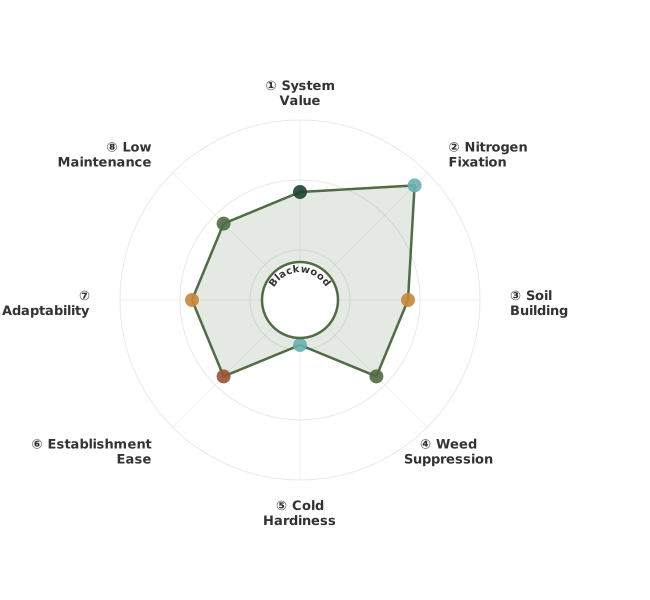
Cold Hardiness Not Recommended Blackwood acacia thrives in zones 9-10, contributing to year-round soil cover and resilience in warmer climates; its frost sensitivity necessitates placement in temperate zones where winter ground cover is naturally maintained.
Weed Suppression Adequate Once established, Blackwood acacia offers effective weed suppression through its moderate shade and competitive root system, integrated into the landscape's natural competition dynamics.
Nitrogen Fixation Ideally Suited This Acacia species actively enriches soil nitrogen through symbiotic relationships, enhancing the fertility management of surrounding plants and contributing to the soil food web.
Root System Depth Ideally Suited The deep taproot and extensive lateral roots of Australian blackwood actively improve soil structure by breaking hardpans and accessing deep resources, enhancing nutrient cycling and water infiltration.
Biomass Production Adequate Blackwood acacia contributes moderate biomass and nitrogen, enhancing soil organic matter and supporting ongoing fertility management through its reliable growth in suitable climates.
Establishment Ease Adequate Establishes readily in moist, well-drained soils within zones 9-11, benefiting from careful seedbed preparation for optimal early vigor and integration into the soil ecosystem.
Multi Benefit Value Ideally Suited As a nitrogen fixer with deep roots that enhance soil structure, Blackwood acacia provides valuable timber, habitat, and improves the overall health and resilience of the agroecosystem.
Climate Adaptability Adequate Adaptable to zones 9-11, Blackwood acacia performs best with consistent moisture management and tolerates some drought once established, contributing to landscape resilience within its preferred climate range.
Maintenance Intensity Adequate Australian blackwood integrates seamlessly into regenerative systems, with its robust nature requiring minimal external inputs beyond natural fertility management and observation for pest balance.

Comparative System: Ratings compare plants within their economic category (e.g., cover crop nitrogen fixation compared to other cover crops, not to all plants). Individual farm conditions and management practices significantly influence actual performance.

8

Learn More

Why farmers use this plant and additional resources

Why Regenerative Farmers Use This Plant

Acacia melanoxylon, commonly known as Blackwood, offers significant regenerative benefits when integrated into agricultural systems, particularly for its role in soil improvement, ecosystem support, and as a long-term soil builder. While not typically used as a short-term cover crop in the same vein as annual legumes, its perennial nature and nitrogen-fixing capabilities make it a valuable component of agroforestry, silvopasture, and land restoration efforts.

Soil Improvement and Fertility: As a legume, it can fix atmospheric nitrogen, contributing directly to soil fertility and reducing the reliance on synthetic nitrogen fertilizers. Mature trees are estimated to fix 30-60 lbs of nitrogen per acre (34-67 kg/ha) annually, potentially lowering input costs for subsequent crops. Its deep root system, often reaching depths of 6-30 feet (1.8-9 meters), not only accesses nutrients from lower soil profiles but also improves soil structure, enhances water infiltration, and sequesters carbon effectively over its lifespan. This extensive root network aids in scavenging nutrients from deeper soil profiles, bringing them to the surface where they can be accessed by shallower-rooted cash crops. The woody biomass produced by Blackwood, when incorporated into the soil through leaf litter decomposition, root turnover, or pruned material, contributes substantial organic matter, enhancing soil structure, water-holding capacity, and fostering a more robust soil microbiome. Over a 5-10 year rotation, the decomposition of its biomass and root exudates significantly contributes to soil organic matter levels. Its deep roots also help to break up compacted soils, improving aeration and drainage, which are critical for healthy soil ecosystems.

Biodiversity and Ecosystem Services: Beyond its direct soil-building contributions, Acacia melanoxylon offers multifaceted system integration benefits. Its dense foliage provides habitat and shelter for beneficial insects and birds, contributing to a more balanced farm ecosystem. As a component of agroforestry systems, it provides shade and habitat for beneficial insects and pollinators, creating a more biodiverse farm ecosystem. The flowers of Blackwood are a valuable nectar and pollen source for a variety of native and managed pollinators. In silvopasture systems, managed grazing of its foliage or pruned branches can provide supplemental nutrition for livestock, while the trees themselves benefit from the nutrient cycling facilitated by animal manure. Its presence can also create microclimates that are more favorable for other desirable species, fostering a more complex and resilient farm ecosystem.

Erosion Control and Resilience: As a windbreak or shelterbelt, it effectively reduces soil erosion caused by wind and can protect vulnerable cash crops from harsh weather. Its deep roots help to stabilize soil, significantly reducing erosion on slopes. The plant's ability to establish and thrive in a variety of soil conditions, including those that may be marginal for other species, makes it a resilient choice for land restoration and stabilization efforts. Its presence can also help to break disease cycles by introducing a non-host species into a monoculture or simplified rotation. The improved soil structure leads to enhanced water infiltration and retention, making farms more resilient to drought conditions.

Economic Benefits: The integration of Acacia melanoxylon can lead to tangible economic benefits through reduced reliance on external inputs. While it does not fix atmospheric nitrogen, its contribution to soil organic matter and nutrient cycling can indirectly reduce the need for synthetic fertilizers over the long term. Improved soil structure and water retention can lead to more consistent crop yields, estimated to increase by 5-15% in well-integrated systems. Furthermore, its potential use as a timber source or for other woody products offers an additional income stream, diversifying farm revenue.

Regional Success Stories: Regional adaptations highlight Acacia melanoxylon's versatility. In Australian wheat-sheep systems, it is often integrated into farm boundaries or as part of shelterbelts, providing wind protection and nitrogen input to adjacent fields. In Brazilian coffee and cocoa plantations, it is utilized as an understory nitrogen-fixing tree, improving soil fertility and providing shade to sensitive crops. In New Zealand's pastoral farming, it is increasingly used in riparian plantings and on marginal land to prevent erosion and improve soil health, while also offering timber potential. In the Mediterranean climate of Southern California, its drought tolerance makes it suitable for erosion control on slopes and as an ornamental or functional planting in orchards. In the temperate regions of Western Europe, such as the UK, Acacia melanoxylon can be planted in hedgerows or as part of silvopasture systems, providing shelter for livestock and improving soil structure. In the humid subtropics of southeastern Brazil, it is integrated into coffee and cocoa plantations as a shade tree and nitrogen contributor. In Australia, it is widely used in land rehabilitation projects and as a component of diverse agroforestry systems.

9

How to Integrate This Plant

Practical guidance for regenerative systems

Establishing Acacia melanoxylon typically involves direct seeding or planting seedlings.

Seeding and Planting: For direct seeding, rates range from 0.5-2 lbs/acre (0.56-2.2 kg/ha), depending on seed viability and desired stand density. For broadcast applications, rates can be higher, up to 3-5 lbs/acre (3.4-5.6 kg/ha). Seeds require scarification or soaking in hot water to break dormancy. The optimal planting depth is shallow, around 0.25-0.5 inches (0.6-1.3 cm), as the seeds require light for germination. For nursery beds, a seeding rate of 1-2 grams per square meter is common. Seedlings, if used, can be planted at a spacing of 10-20 feet (3-6 meters) apart, allowing ample room for growth and development into mature trees. For more densely managed agroforestry systems, spacing might be closer, around 8-15 feet (2.4-4.5 meters).

Timing: In the Northern Hemisphere, the ideal sowing window is typically late spring to early summer, from March to June, allowing seedlings to establish before the onset of winter. In the Southern Hemisphere, this translates to sowing from September to December. Planting is best done in late spring or early summer in temperate regions, or during the wet season in subtropical areas, to ensure adequate moisture for establishment.

Management: Once established, Acacia melanoxylon is relatively low-maintenance, aligning with regenerative principles. Water requirements are moderate, with approximately 1 inch (2.5 cm) of rainfall or irrigation per week being beneficial during the establishment phase (first 1-2 years). Once established, its deep root system makes it relatively drought-tolerant, though supplemental irrigation may be beneficial during prolonged dry spells. Fertility management should prioritize biological approaches; incorporating compost or well-rotted manure can support young plants. As a nitrogen-fixing legume, it generally requires minimal synthetic nitrogen fertilization. Initial soil preparation may involve ensuring good drainage.

Growth and Maturity: Its growth timeline is moderate; it can reach a height of 10-15 feet (3-4.5 meters) within 3-5 years and mature to 30-60 feet (9-18 meters) or more over 10-20 years, with timber potential reached in 10-20 years. Mature plants can reach heights of 30-60 feet (9-18 m) or more, with a spread of 20-30 feet (6-9 m).

Pest and Disease Management: Pest and disease management should focus on maintaining plant health through good cultural practices, proper site selection, and watering, and by encouraging biodiversity within the farm system to support natural predators and beneficial insect populations. Avoiding monocultures is also key.

Termination and Biomass Management: As a woody perennial, termination is generally not a primary concern in the context of annual cover cropping. Instead, its integration focuses on its role as a long-term component of the farming system. If removal is necessary, mechanical methods such as felling or chipping are employed. For systems where it is used as a shade tree or windbreak, pruning is the primary management technique, with the pruned material contributing valuable organic matter to the soil surface. If biomass is harvested for mulch or compost, it can be done annually or biennially. The resulting organic material will decompose over 30-120 days, releasing nutrients, including fixed nitrogen, into the soil. In silvopasture systems, managed grazing can occur around the trees.

Seed Management: Seed management is crucial to prevent unwanted spread in sensitive ecosystems. If volunteer establishment is not desired, seed heads should be removed before maturity, or controlled grazing can prevent seed set. Managing the area around mature trees can also prevent germination. Relay or intercropping is not typical for this tree species.