Available research highlights its potential for soil health. One study indicates that incorporating Acorus calamus into plant configurations, specifically the Metasequoia glyptostroboides-Acorus calamus (M-Ac) mode, significantly benefits soil organic carbon (SOC) accumulation and carbon fraction stability in lakeshore zones. This configuration showed the highest SOC, total carbon, and mineral-associated organic carbon in the topsoil layer, suggesting a role in carbon sequestration and soil building. Furthermore, Acorus calamus influences rhizosphere microbial communities, a crucial aspect of soil vitality. Its use in constructed wetlands also demonstrates a tolerance to varying conditions, potentially indicating resilience in diverse agricultural settings. While specific applications like cover cropping or nitrogen fixation are not detailed, its contribution to soil carbon and microbial health warrants further investigation within regenerative systems. While coverage in our knowledge base is limited, the above represents documented uses in regenerative systems.

Regenerative Quick Profile

All recommendations assume integrated, regenerative practices—not conventional inputs.

Climate & Soil Fit

Climate: Tropical Rainforest, Tropical Monsoon, Tropical Savanna, Hot Semi-Arid (Steppe), Cold Semi-Arid (Steppe), Humid Subtropical, Oceanic (Maritime Temperate), Hot-Summer Mediterranean, Warm-Summer Mediterranean, Monsoon-Influenced Humid Subtropical, Subtropical Highland, Hot-Summer Continental, Warm-Summer Continental, Subarctic, Monsoon-Influenced Hot-Summer Continental

Zones: USDA 3-9, Australian Zones 1-6

Optimal Soil: Rich Soil, Wet Soil

System Role & Functions

Primary: Cover Crop System

Secondary: Soil Remediation, Specialty

Key Benefits: Low maintenance, Cold Hardiness

Management Level

Experience: Advanced

Maintenance: Very low maintenance - Sweet flag flourishes in its preferred wet conditions with minimal intervention, as this self-spreading perennial rarely requires external fertility management or pest control once integrated into the system.

Value Streams

  • Cover crop (soil investment)
  • Soil building and erosion control
1

Climate Suitability Assessment

Will this plant thrive in your climate?

IDEALLY SUITED

Köppen Zone: Af (Tropical Rainforest), Am (Tropical Monsoon), Cfa (Humid Subtropical)
USDA Zone: 6a, 7a, 8a, 9a, 10a, 11a, 12a
Australian Zone: Zone 3, temperate
EU Climate Region: Atlantic, Continental

Sweet Flag excels in regions with mild winters and warm, moist summers, typically found in temperate oceanic (Köppen Cfb, EU Atlantic) and temperate continental climates (Köppen Dfb, EU Continental). These zones offer a long growing season with consistent precipitation (30-50 inches/75-125 cm annually) and temperatures that support vigorous vegetative growth without extreme heat stress. USDA Zones 7a-8b and Australian temperate zones also fall into this category, providing reliable perennial survival and excellent establishment rates. Its preference for moist or wet soils is consistently met, allowing it to spread effectively and perform its primary function as a cover crop, contributing to soil health and structure. Minimal management is required beyond ensuring adequate moisture, making it a highly reliable and low-input option for regenerative agriculture in these climates.

ADEQUATE

Köppen Zone: Aw (Tropical Savanna), Cfb (Oceanic (Maritime Temperate)), Cwa (Monsoon-Influenced Humid Subtropical), Cwb (Subtropical Highland), Dfa (Hot-Summer Continental), Dfb (Warm-Summer Continental)
USDA Zone: 5a, 5b
Australian Zone: Zone 2, subtropical

Sweet Flag can perform adequately in a range of climates that offer sufficient growing season length and moisture, though with some limitations. Humid subtropical (Köppen Cfa, Australian subtropical) and some continental climates with hot summers (Köppen Dfa, Dwa, Dwb, USDA 5b-6b, 9a-10b) provide enough warmth and a reasonable growing period. However, these zones may experience periods of heat stress or drought during summer, requiring supplemental irrigation to maintain optimal growth and cover crop performance. Its ability to spread and provide soil benefits is good, but stand persistence might be slightly reduced compared to ideal zones without careful water management. Establishment is generally successful (70-85%) with proper timing and moisture availability, and it can contribute positively to soil remediation and cover cropping goals with standard management practices.

NOT RECOMMENDED

Köppen Zone: ET (Tundra), BSh (Hot Semi-Arid (Steppe)), BSk (Cold Semi-Arid (Steppe)), BWh (Hot Desert), BWk (Cold Desert), Csa (Hot-Summer Mediterranean), Csb (Warm-Summer Mediterranean), Dfc (Subarctic), Dwa (Monsoon-Influenced Hot-Summer Continental)
USDA Zone: 2a, 3a, 3b, 4a
Australian Zone: Zone 1

Sweet Flag is not recommended for climates with extreme cold or extreme heat coupled with prolonged drought. This includes very cold continental and subarctic regions (Köppen Dfd, Dwd; USDA Zones 1-4a; Australian Zone 1) where winter temperatures are far too low for survival, and growing seasons are too short for establishment or function. Similarly, hot, arid, or semi-arid regions (Köppen BSh, some USDA 8b-10b fringes with extreme drought) are unsuitable due to insufficient moisture and heat stress that severely limits nitrogen fixation, growth, and survival. In these zones, establishment success drops below 70%, and the plant would require intensive management, such as extensive irrigation infrastructure or protection, making it economically and practically unviable for its intended functions as a cover crop or for soil remediation. Alternative plants better adapted to these specific harsh conditions are necessary.

Better alternatives for these "not recommended" zones: Hairy Vetch (cold-hardy annual legume for nitrogen fixation in cold zones), Winter Rye (extremely cold-hardy cover crop for biomass and soil protection in cold zones), Sunn Hemp (tropical nitrogen fixer adapted to hot, dry conditions in warm zones), Cowpea (drought-tolerant legume for cover cropping in hot climates)

Note: Zones listed above represent climates where this plant can produce reliably with reasonable management. Climate zones not mentioned would require intensive climate modification (greenhouses, extensive infrastructure) and are not economically viable for regenerative agriculture purposes.

2

Soil Suitability Assessment

Which soil types work best for this plant?

IDEALLY SUITED

Rich Soil, Wet Soil

This plant thrives in these soil types without requiring amendments or remediation. Natural soil conditions support optimal growth and productivity.

ADEQUATE

Clay Soil, Loam Soil, Sandy Soil

This plant performs acceptably in these soil types with moderate, manageable remediation such as pH adjustment, compost addition, or drainage improvement. The required amendments are practical and cost-effective for regenerative agriculture.

NOT RECOMMENDED

Acidic Soil, Alkaline Soil, Desert Soil, Rocky Soil, Saline Soil

Growing this plant in these soil types would require impractical remediation such as complete soil replacement, extensive amendments, or cost-prohibitive infrastructure. These conditions are not economically viable for regenerative agriculture.

Note: Soil suitability assessments focus on remediation requirements. "Ideally Suited" means the plant generally thrives without the need for substantial amendments, "Adequate" means manageable remediation (lime, compost, mulch), and "Not Recommended" means impractical soil changes would be required. Climate factors like rainfall and temperature also influence success.

3

Seasonal Considerations

Planting timing, growth duration, and harvest windows

Acorus calamus offers versatile cover cropping opportunities across a wide range of climates. For spring planting, sow seeds or rhizomes after the last expected frost when soil temperatures consistently reach 50°F (10°C). Establishment can take several weeks, and it thrives in moist conditions throughout the summer, providing excellent weed suppression and biomass.

Fall planting is highly effective, ideally accomplished 4-6 weeks before the first expected frost, allowing for good establishment before winter dormancy. Its cold hardiness means Acorus calamus will likely overwinter successfully in zones Dfa and warmer, acting as a robust winter cover. Termination is best performed in early spring, several weeks before planting your main cash crop, to allow sufficient decomposition.

While not typically a summer cover crop that is intentionally planted for that sole purpose, its vigorous growth in warm, wet conditions means it can fill that niche if allowed. Frost-seeding is less common for Acorus calamus due to its specific propagation needs, but early spring sowing after soil thaw is a reliable method. Its peak biomass is usually achieved in late summer to early fall, depending on planting time and moisture availability.

4

System Role & Multi-Benefit Value

Functional roles, integration strategies, and stacked benefits

Functional Role

Total System Value

Sweet flag offers substantial system value by enhancing soil health and water quality. Its primary contribution to regenerative systems lies in its role as a cover crop, specifically for erosion control in wetland and riparian areas and for its proven ability to increase soil organic carbon (SOC) and improve carbon fraction stability. Studies highlight its role in mixed plantings (e.g., M-Ac) leading to higher SOC and mineral-associated organic carbon. Beyond direct harvest (which is not a primary focus in these excerpts), sweet flag acts as a powerful ecosystem service provider. It contributes to water purification in constructed wetlands, showing tolerance to leachate and potentially aiding in phytoremediation. Its presence fosters beneficial microbial communities in the rhizosphere, further enhancing soil function. By stabilizing soil and improving water quality, it supports biodiversity and aquatic ecosystems. Risk diversification is achieved through its resilience in wet environments and its contribution to a more robust, multi-functional farm landscape.

Integration Characteristics

Multi-Benefit Value: Adequate - Valuable for wetland restoration and water purification, it offers some wildlife habitat but limited direct soil improvement or broader ecosystem services.

5

Management & Care Requirements

Integration guidance, maintenance needs, and care practices

How to Integrate This Plant

Sweet flag (Acorus calamus), a non-tree perennial, primarily functions as a cover crop system component, particularly beneficial in wetland or riparian zones. Its root system offers excellent erosion control, stabilizing soil along water edges. While not directly providing shade, windbreaks, or nitrogen fixation, it significantly enhances soil organic carbon (SOC) accumulation and stability, as indicated by studies showing its contribution to higher SOC, total carbon, and mineral-associated organic carbon in mixed plantings (M-Ac configuration). This makes it valuable for improving soil health and structure. Compatible practices include its use in riparian buffer strips, constructed wetlands for water treatment, and as a component in mixed perennial plantings for ecological restoration. Its primary contribution begins in Year 1 with ground cover and erosion control, with significant soil health benefits developing by Year 3-5 as the root system matures and contributes to SOC. The multi-benefit stacking includes improved water quality through phytoremediation potential, enhanced soil microbial communities, and valuable habitat for wildlife.

Integration Practices & Management

For instance, studies mention Acorus calamus in plant configurations for soil organic carbon accumulation and its role in shaping rhizosphere microbial communities in wetland environments. One source notes its presence alongside other wetland plants like cattail and iris, suggesting aesthetic or ecological roles in certain plantings. However, details regarding establishment methods such as seeding rates, timing, or tillage practices are absent. Similarly, information on integrating Acorus calamus with grazing systems, termination strategies, fertility needs, competition management, succession planning, or its use in cash crop rotations (intercropping, relay cropping) is not present in the provided text. The knowledge base does not contain practical farmer experiences or specific insights into how Acorus calamus is actively managed in regenerative agriculture beyond its observed presence in certain ecological contexts. While coverage in our knowledge base is limited, the above represents documented uses in regenerative systems. While coverage in our knowledge base is limited, the above represents documented uses in regenerative systems.

Management Profile

Maintenance Intensity: Ideally Suited - Sweet flag flourishes in its preferred wet conditions with minimal intervention, as this self-spreading perennial rarely requires external fertility management or pest control once integrated into the system.

6

Economics & Value Streams

Direct harvest, system benefits, ecosystem services, and risk diversification

Comprehensive economic analysis including direct harvest value, system enhancement contributions, ecosystem services, value timeline, and risk diversification strategies.

Cover Crop Investment

Metric Value
Seed Cost N/A N/A
Termination Cost 30-75 74-185
Biomass Production 5-15 11-34
N Fixation Value N/A N/A
Weed Control Savings 20-50 49-124

Cover crops are soil investments, not cash crops. Economics measured in soil health gains, input reduction, and subsequent crop performance. Values show direct costs and estimated benefits.

System Enhancement Value

Beyond cost recovery: soil building, nitrogen, biomass, and weed suppression

Soil Building & Weed Suppression

Sweet flag (Acorus calamus) offers significant system value beyond direct harvest, particularly in soil remediation and enhancing soil health. Studies, such as one in Hongze Lake, indicate that Acorus calamus configurations, particularly Metasequoia glyptostroboides-Acorus calamus (M-Ac), show substantial benefits for soil organic carbon (SOC) accumulation and carbon fraction stability. In the 0-20 cm soil layer, M-Ac exhibited the highest SOC, total carbon, and mineral-associated organic carbon, outperforming other configurations. This suggests a direct role in improving soil structure, water retention, and nutrient cycling, acting as a natural soil conditioner. Furthermore, research on wetland plants, including Acorus calamus, identifies bacterial phyla crucial for contaminant bioremediation, positioning it as a potential candidate for phytoremediation in affected areas. Its presence also influences rhizosphere microbial communities, contributing to a healthier soil ecosystem by supporting beneficial microorganisms essential for nutrient availability and plant growth. This integrated approach to soil management reduces reliance on synthetic inputs and enhances overall farm resilience.

Ecosystem Service Contributions

Environmental contributions: carbon, pollinators, wildlife, and water

  • Carbon Sequestration: Sweet flag contributes to carbon sequestration through the accumulation of soil organic carbon, as evidenced by its strong performance in SOC fractions in certain configurations. Its root system and biomass contribute to soil carbon storage.
  • Pollinator Support: Low. No direct mention of pollinator support in the provided knowledge base excerpts.
  • Wildlife Habitat: Sweet flag can contribute to wetland habitats, providing some cover and potential food sources for small aquatic invertebrates and birds. Its use in aquatic container designs suggests a role in creating microhabitats within managed landscapes.
  • Water Quality: Sweet flag, as a wetland plant, is likely to contribute to water filtration by absorbing excess nutrients and potentially trapping sediment, particularly in riparian buffer zones or constructed wetlands, as suggested by its inclusion in wetland studies.

Value Timeline: Soil Building Process

When you'll see results: immediate soil benefits, compounding over seasons

Years 1-2

Initial soil health improvements, such as enhanced microbial activity and early stages of SOC accumulation, begin. If planted in a remediation context, early signs of contaminant uptake may be observed.

Years 3-5

Established soil remediation benefits become more pronounced, with significant SOC gains and improved soil structure. Potential for early harvest of specialty products like dried root for medicinal or culinary use.

Years 10-20

Mature sweet flag stands will provide robust soil remediation and carbon sequestration benefits. The plant's aesthetic qualities may be fully realized in landscape designs.

20+ Years

Long-term contributions to soil health and ecosystem services, including sustained water filtration and habitat provision, continue. The full potential for specialty product harvesting can be realized.

Farm Risk Reduction

How this reduces farm risk: lower input costs and better soil resilience

  • Multiple Revenue Streams: ['Specialty crop (dried root for medicinal/culinary use)', 'Soil remediation services', 'Ecosystem services (carbon sequestration, water filtration)']
  • Temporal Income Spread: Value is spread through ongoing ecosystem services (soil health, water filtration) and periodic harvests of specialty products. The plant's role in soil improvement is a continuous, long-term benefit.
  • Market Risk Hedge: Diversifies farm income beyond traditional crops by offering niche market products. Its role in soil remediation reduces reliance on costly inputs and mitigates environmental risks associated with contaminated land. Its presence in integrated systems enhances overall farm resilience.
7

Regenerative Suitability Details

Comprehensive trait ratings for system integration assessment

Comparative ratings for this plant across key regenerative agriculture traits.

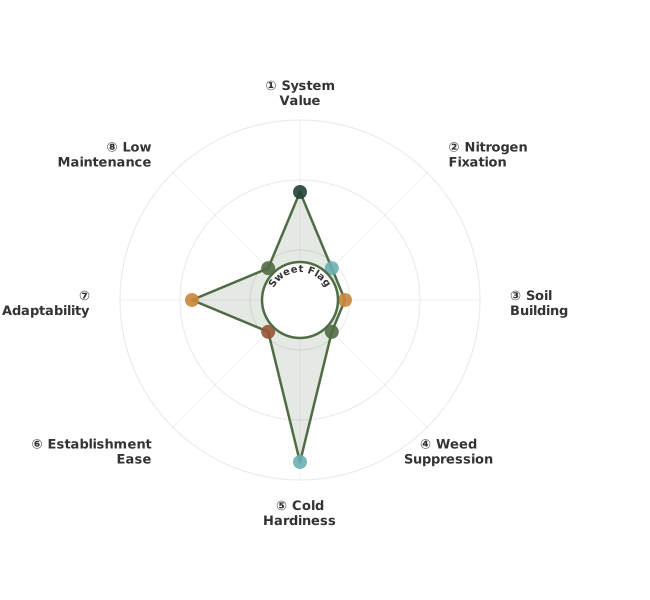
Trait Suitability Explanation
Cold Hardiness Ideally Suited Sweet flag is a resilient wetland perennial (Zone 3) that actively grows in cool, moist conditions, providing consistent ground cover and contributing to winter soil protection.
Weed Suppression Not Recommended While slow to establish and spread rhizomatously, its initial canopy closure is too gradual for robust weed suppression compared to more dynamic ground covers.
Nitrogen Fixation Not Recommended As a non-legume, this plant does not contribute to nitrogen fixation; its role is not in direct soil nitrogen enrichment.
Root System Depth Adequate Sweet flag possesses a moderately deep rhizomatous root system that enhances topsoil structure and promotes water infiltration, supporting overall soil health.
Biomass Production Not Recommended This wetland plant exhibits slow growth and limited above-ground biomass, contributing minimally to soil organic matter compared to other regenerative options.
Establishment Ease Not Recommended Slow to establish from seed, sweet flag thrives in moist to wet environments and can be outcompeted by faster-growing aquatic plants in less specific settings.
Multi Benefit Value Adequate Valuable for wetland restoration and water purification, it offers some wildlife habitat but limited direct soil improvement or broader ecosystem services.
Climate Adaptability Adequate This plant prefers wet to moist soils and zones 3-9, tolerating cold well but requiring specific wetland or riparian habitats to thrive, especially in extreme heat and dry conditions.
Maintenance Intensity Ideally Suited Sweet flag flourishes in its preferred wet conditions with minimal intervention, as this self-spreading perennial rarely requires external fertility management or pest control once integrated into the system.

Comparative System: Ratings compare plants within their economic category (e.g., cover crop nitrogen fixation compared to other cover crops, not to all plants). Individual farm conditions and management practices significantly influence actual performance.

8

Learn More

Why farmers use this plant and additional resources

Why Regenerative Farmers Use This Plant

Acorus calamus, commonly known as Sweet Flag, offers significant regenerative benefits when integrated into agricultural systems, primarily through its exceptional biomass production, soil-improving capabilities, and ecosystem services. While not a nitrogen-fixing legume, its dense root system and vigorous above-ground growth contribute substantially to soil organic matter and structure.

Soil Stabilization and Erosion Control: Its robust rhizomatous growth habit makes it an exceptional tool for erosion control and soil stabilization, particularly in damp or wet areas. The dense root system, often reaching 2-4 feet (0.6-1.2 meters) and capable of penetrating up to 24 inches (60 cm) into saturated soils, binds soil particles effectively, preventing costly erosion and sedimentation in waterways. This natural stabilization can significantly reduce the need for engineered solutions and protect valuable topsoil from being washed away, especially in areas prone to flooding or heavy rainfall. Its improved soil aggregation enhances water infiltration and retention, mitigating both drought stress and waterlogging.

Nutrient Management and Water Quality: Acorus calamus excels in ecosystem services that support a resilient farm. Its presence in riparian buffers and constructed wetlands helps filter pollutants, such as excess nutrients (nitrates and phosphates) and sediment, from agricultural runoff before they reach surface waters. This phytoremediation capacity is crucial for maintaining healthy aquatic ecosystems and can lead to improved water availability for downstream agricultural and municipal uses. Its ability to scavenge nutrients from lower soil profiles also prevents leaching and makes them available to subsequent cash crops.

Biomass Production and Soil Organic Matter: In a typical growing season, Acorus calamus can produce upwards of 10-20 tons of dry biomass per acre (22-45 metric tons/ha). This substantial biomass, upon decomposition, enriches the soil with carbon and essential nutrients, feeding soil microbial communities and supporting nutrient cycling over time. The continuous addition of organic matter from its roots and residue fosters a thriving soil microbial community, enhancing nutrient cycling and disease suppression. Over a 3-5 year rotation, consistent incorporation of its biomass can lead to measurable improvements in soil structure, water-holding capacity, and biological activity.

Weed Suppression and Habitat Enhancement: Its dense foliage provides excellent ground cover, significantly suppressing weed germination and growth compared to bare fallow periods, thereby reducing competition for resources for cash crops. This weed suppression can save farmers an estimated $50-$150 per acre annually in weed control costs, depending on the intensity of weed pressure. Furthermore, its dense stands offer excellent habitat and food sources for beneficial insects, pollinators, and small wildlife, enhancing on-farm biodiversity and supporting natural pest control mechanisms.

Overall Farm Resilience: The improved soil health and water management facilitated by Acorus calamus create a more resilient and productive farming system overall, indirectly supporting higher yields and reduced input needs for subsequent crops. Its perennial nature means it builds soil structure and organic matter year after year without the need for annual reseeding. While direct yield increases for cash crops are not its primary function, the improved conditions it creates are a cornerstone of regenerative agriculture.

9

How to Integrate This Plant

Practical guidance for regenerative systems

Establishing Acorus calamus can be achieved through various methods, depending on the specific agricultural context and desired outcome, with vegetative propagation being the most common and reliable.

Planting Methods and Timing:

  • Vegetative Propagation: Rhizome divisions, root cuttings, or plugs are the most common methods, as seed propagation can be unreliable and slow to establish.
  • Planting Depth and Spacing: For rhizomes, plant 2-4 inches (5-10 cm) deep, ensuring at least one growth bud is present. For divisions or plugs, spacing can vary from 6-12 inches (15-30 cm) to 12-24 inches (30-60 cm) apart, depending on the desired density and rate of ground cover.
  • Planting Timing:
  • Northern Hemisphere: Late spring to early summer (April to June), or early spring as soon as the ground can be worked (March to June).
  • Southern Hemisphere: Early spring to early summer (September to November), or September to December.
  • Planting is best done in moist to wet soil conditions. Spring planting is generally preferred for optimal establishment.

Growth and Management:

  • Moisture Requirements: Thrives in moist to wet conditions and can tolerate waterlogged areas and standing water. Consistent moisture of at least 1 inch (2.5 cm) per week during its active growth phase will maximize biomass.
  • Fertility Needs: Generally low. Its ability to scavenge nutrients means it often requires minimal external inputs. If supplemental fertility is needed during establishment, compost or well-rotted manure integrated into the soil before planting is preferred over synthetic fertilizers.
  • Establishment and Maturity: Typically establishes within 30-60 days. Mature plants can reach heights of 2-5 feet (0.6-1.5 meters), depending on growing conditions and variety. Dense stands can form within one to two growing seasons.
  • Pest and Disease Management: Rarely an issue for Acorus calamus in its preferred wet environments; its resilience is a key advantage.

Integration into Regenerative Systems:

  • Cover Crop Integration: Managed primarily for its biomass and soil-conditioning properties. Termination is rarely necessary for its role in riparian zones and areas prone to waterlogging. If management requires reduction, mowing or cutting can be employed.
  • Termination (if needed): Natural winterkill can occur in colder climates (USDA Zones 4-5) where temperatures consistently drop below 0°F (-18°C). In milder regions, grazing can be an effective method to reduce biomass and incorporate residue, followed by mowing or crimping. If mechanical termination is chosen, it is best performed at or near full bloom to maximize biomass and nutrient content, typically 2-3 weeks before planting the subsequent cash crop.
  • Residue Decomposition: Varies but generally takes 30-60 days, releasing nutrients slowly.
  • Containment: If containment or removal is required, mechanical methods like digging or repeated mowing can be employed. Its biomass can be incorporated into compost piles or left to decompose in situ.
  • Seed Management: Generally not a concern as it primarily reproduces vegetatively. However, its ability to establish volunteer plants can be beneficial in perennial systems or buffer strips if managed appropriately.

Regional Adaptations:

  • USA (Midwest/Pacific Northwest): Planted along drainage ditches, field edges, and in low-lying areas to prevent erosion, filter runoff from corn and soybean fields, and improve water quality.
  • United Kingdom: Valuable in pasture renovation, establishing vegetation along farm ponds and streams to prevent bank erosion, creating robust buffer zones along rivers and streams, and in wetland restoration projects.
  • Australia: Utilized in rice paddies, flood-prone areas, ephemeral wetlands, or along drainage lines to manage water flow, reduce sediment loss, improve soil structure, and condition soil.
  • Brazil: Integrated into agroforestry systems, particularly in areas with higher rainfall or near water bodies, used in contour planting to stabilize slopes, and in the understory in wetter microclimates to enhance soil stability and biodiversity around water sources.
  • Europe: Incorporated into pasture mixes, used in riparian buffer zones to manage water and soil health, and for phytoremediation capabilities in agricultural catchments.