Its primary regenerative use appears to be as a **pollinator support** species, particularly in coastal or exposed conditions where other plants may struggle. While not explicitly mentioned as a cover crop or nitrogen fixer, its dense growth habit could contribute to **soil building** and erosion control in appropriate systems. The plant's ability to thrive in challenging environments suggests potential for integration into **agroforestry** or **permaculture** designs, offering resilience. No specific farmer experiences or insights regarding its integration with practices like rotational grazing or no-till were detailed in the knowledge base. Further research is needed to fully understand its potential benefits, such as carbon sequestration or its utility as a forage crop, and to gather practical farmer feedback on its application within regenerative systems. While coverage in our knowledge base is limited, the above represents documented uses in regenerative systems.

Regenerative Quick Profile

All recommendations assume integrated, regenerative practices—not conventional inputs.

Climate & Soil Fit

Climate: Tropical Rainforest, Tropical Monsoon, Tropical Savanna, Hot Semi-Arid (Steppe), Cold Semi-Arid (Steppe), Hot Desert, Cold Desert, Humid Subtropical, Oceanic (Maritime Temperate), Hot-Summer Mediterranean, Warm-Summer Mediterranean, Monsoon-Influenced Humid Subtropical, Subtropical Highland, Hot-Summer Continental, Warm-Summer Continental, Subarctic, Monsoon-Influenced Hot-Summer Continental, Tundra

Zones: USDA 4-8, Australian Zones 3-6

Optimal Soil: Sandy Soil

System Role & Functions

Primary: Pollinator Support

Secondary: Cover Crop System, Soil Remediation

Key Benefits: Low maintenance

Management Level

Experience: Advanced

Maintenance: Very low maintenance - This hardy perennial requires minimal intervention, contributing to system resilience by tolerating coastal conditions and poor soils with natural moisture retention and soil integration.

Value Streams
1

Climate Suitability Assessment

Will this plant thrive in your climate?

IDEALLY SUITED

Köppen Zone: Af (Tropical Rainforest), Am (Tropical Monsoon), Cfa (Humid Subtropical), Cfb (Oceanic (Maritime Temperate))
USDA Zone: 7a, 8a, 9a, 10a, 11a, 12a
Australian Zone: temperate
EU Climate Region: atlantic

Thrift (Armeria maritima) performs optimally in climates with mild winters and moderate summers, characterized by consistent rainfall and well-drained soils. These conditions are met in Köppen zones Cfb, and regional zones like USDA 7a-8b, Australian temperate, and EU Atlantic regions. In these areas, Thrift establishes readily, exhibits excellent perenniality, and reliably supports pollinators. Its tolerance for coastal conditions further enhances its suitability. Minimal management is required, as natural precipitation often suffices, and its low-growing habit provides effective ground cover. The plant thrives in temperatures ranging from 50-75°F (10-24°C) during the growing season, with winter lows not dropping below 20°F (-7°C). Its ability to persist for many years without significant intervention makes it an excellent, low-input choice for regenerative agriculture in these favored climates, contributing effectively to biodiversity and ecosystem services.

ADEQUATE

Köppen Zone: Aw (Tropical Savanna), Csa (Hot-Summer Mediterranean), Csb (Warm-Summer Mediterranean), Cwa (Monsoon-Influenced Humid Subtropical), Cwb (Subtropical Highland)
USDA Zone: 6a
Australian Zone: subtropical

Thrift can perform adequately in a range of climates that offer a balance of moderate temperatures and sufficient moisture, though with some limitations. This includes Köppen zones Cfa and Csb, and regional zones such as USDA 5b-6b, 9a-10b, Australian subtropical, and EU Mediterranean-influenced areas. In these zones, Thrift can establish and provide pollinator support, but its perennial reliability may be reduced compared to ideal climates. Challenges can include susceptibility to root rot in persistently wet Cfa zones, or requiring supplemental watering and careful site selection in warmer USDA 9b-10b and subtropical regions to mitigate heat and dry spells. While it can persist, its vigor and the consistency of its functions might be slightly diminished, necessitating more attentive management regarding soil drainage and water availability. Establishment success is generally good (70-85%) with appropriate timing and site preparation.

NOT RECOMMENDED

Köppen Zone: ET (Tundra), BSh (Hot Semi-Arid (Steppe)), BSk (Cold Semi-Arid (Steppe)), BWh (Hot Desert), BWk (Cold Desert), Dfa (Hot-Summer Continental), Dfb (Warm-Summer Continental), Dfc (Subarctic), Dwa (Monsoon-Influenced Hot-Summer Continental)
USDA Zone: 2a, 3a, 3b, 4a, 5a, 5b

Thrift is not recommended for climates with extreme winter cold or prolonged hot, dry summers, making cultivation economically and practically questionable. This includes Köppen zones Dfb and Csa, and regional zones like USDA 3a-5a, Australian Mediterranean, and EU Boreal regions. In cold zones (Dfb, USDA 3a-5a), extreme winter temperatures (-10 to -30°F) lead to unreliable perennial survival and significant winter kill, limiting its use to a risky annual at best. Establishment success drops below 70%, and its primary functions are severely compromised. In hot, dry zones (Csa), prolonged summer heat and drought stress Thrift, reducing its vigor and pollinator support capabilities, requiring intensive irrigation and making it less suitable for cover cropping or soil remediation. Alternative plants like Lavender, Rosemary, or Hairy Vetch are better suited due to their superior tolerance to these specific challenging conditions, offering more reliable performance for similar ecological functions.

Better alternatives for these "not recommended" zones: Lavender (Lavandula spp.) (Drought-tolerant, pollinator-friendly, thrives in hot, dry conditions), Rosemary (Salvia rosmarinus) (Drought-tolerant, pollinator-friendly, adapted to Mediterranean climates), Hairy Vetch (Cold-hardy annual legume for nitrogen fixation and pollinator support), Winter Rye (Extremely cold-hardy cover crop for biomass and soil protection)

Note: Zones listed above represent climates where this plant can produce reliably with reasonable management. Climate zones not mentioned would require intensive climate modification (greenhouses, extensive infrastructure) and are not economically viable for regenerative agriculture purposes.

2

Soil Suitability Assessment

Which soil types work best for this plant?

IDEALLY SUITED

Sandy Soil

This plant thrives in these soil types without requiring amendments or remediation. Natural soil conditions support optimal growth and productivity.

ADEQUATE

Clay Soil, Desert Soil, Loam Soil, Rich Soil, Rocky Soil

This plant performs acceptably in these soil types with moderate, manageable remediation such as pH adjustment, compost addition, or drainage improvement. The required amendments are practical and cost-effective for regenerative agriculture.

NOT RECOMMENDED

Acidic Soil, Alkaline Soil, Saline Soil, Wet Soil

Growing this plant in these soil types would require impractical remediation such as complete soil replacement, extensive amendments, or cost-prohibitive infrastructure. These conditions are not economically viable for regenerative agriculture.

Note: Soil suitability assessments focus on remediation requirements. "Ideally Suited" means the plant generally thrives without the need for substantial amendments, "Adequate" means manageable remediation (lime, compost, mulch), and "Not Recommended" means impractical soil changes would be required. Climate factors like rainfall and temperature also influence success.

3

Seasonal Considerations

Planting timing, growth duration, and harvest windows

Armeria maritima offers resilient cover cropping across a range of climates. For spring planting, sow after the last expected frost, allowing its establishment for several weeks before warm-season cash crops. This cool-season native thrives in moderate temperatures, offering excellent weed suppression and soil health benefits.

Fall planting is most effective when timed several weeks before the first expected frost. This allows for good root development before winter dormancy. In colder zones (Dfb, Dfc), Armeria maritima will likely overwinter as a low-growing mat, providing winter cover and resuming growth in early spring. In milder climates (Cfa, Cfb, Csa, Csb), it can maintain green cover throughout the winter.

Termination should occur when the cover crop shows signs of active growth in spring, ideally a few weeks before planting your primary cash crop. While summer planting is less common for Armeria maritima due to its preference for cooler conditions, it can be considered in very hot regions as a nurse crop for later plantings or in shaded areas. Its peak biomass is typically achieved in late spring or early summer, depending on planting time and climate. Frost-seeding in late winter can also be a strategy in suitable regions.

4

System Role & Multi-Benefit Value

Functional roles, integration strategies, and stacked benefits

Functional Role

Total System Value

Thrift offers a compelling multi-benefit profile for regenerative agriculture. Its primary contribution is robust pollinator support, attracting a wide array of bees, butterflies, and other beneficial insects crucial for crop pollination and ecosystem health. This direct ecosystem service significantly enhances farm resilience by ensuring better yields for insect-pollinated crops. As a low-growing perennial, thrift also provides excellent groundcover, contributing to erosion control on slopes and disturbed areas, thus protecting soil resources. While it doesn't offer direct harvest value in the traditional sense, its role in supporting the broader farm ecosystem is substantial. By attracting pollinators, it indirectly boosts the productivity of other crops. Its presence enhances overall biodiversity and can contribute to soil carbon sequestration through its root system. This plant diversifies the farm's ecological functions, reducing reliance on single-point solutions and building resilience against pests, diseases, and environmental fluctuations.

Integration Characteristics

Multi-Benefit Value: Not Recommended - Primarily ornamental, it offers modest ecosystem services by providing groundcover and supporting soil health in specific niches within a biodiverse planting.

5

Management & Care Requirements

Integration guidance, maintenance needs, and care practices

How to Integrate This Plant

Thrift (Armeria maritima) is a valuable perennial for regenerative systems, primarily serving as excellent pollinator support. Its low-growing, mounding habit makes it suitable for edges, borders, and interplanting within various practices. It can be integrated into food forests, alley cropping systems, and potentially as a living mulch or groundcover in silvopasture or mob grazing setups where its low stature is not a hindrance. Thrift begins providing significant pollinator support from Year 1, with its flowering display becoming more robust in subsequent years. Beyond direct pollinator attraction, thrift contributes to soil health by stabilizing soil and preventing erosion on slopes or disturbed areas. Its ability to thrive in coastal or exposed conditions also offers resilience. The multi-benefit stacking comes from its role in supporting beneficial insects, enhancing biodiversity, and adding aesthetic value, all contributing to a more resilient and ecologically functional farm.

Integration Practices & Management

Information regarding the specific integration methods of *Armeria maritima* by regenerative farmers is limited within the provided knowledge base. The available sources do not detail establishment techniques such as seeding rates, optimal timing, companion planting strategies, or tillage practices (no-till vs. minimal tillage) for this species. Similarly, there is no information presented on how *Armeria maritima* is integrated into grazing systems, including mob grazing, rotational grazing, specific timing of animal access, or the duration of rest periods. Termination strategies, whether through natural winterkill, grazing, crimping, mowing, or herbicide application, are also not discussed. Furthermore, the knowledge base does not offer insights into management considerations like fertility requirements, methods for managing competition with other plants, or succession planning involving *Armeria maritima*. Finally, its integration with cash crops through relay cropping, intercropping, or rotation sequences, along with practical farmer experiences, is absent from the available text. Consequently, a detailed explanation of *how* regenerative farmers utilize *Armeria maritima* cannot be constructed from this knowledge base.

Management Profile

Maintenance Intensity: Ideally Suited - This hardy perennial requires minimal intervention, contributing to system resilience by tolerating coastal conditions and poor soils with natural moisture retention and soil integration.

6

Economics & Value Streams

Direct harvest, system benefits, ecosystem services, and risk diversification

Comprehensive economic analysis including direct harvest value, system enhancement contributions, ecosystem services, value timeline, and risk diversification strategies.

Cover Crop Investment

Metric Value
Seed Cost $20-50/acre $49-124/ha
Termination Cost 25-75 62-185
Biomass Production 1-3 2-7
N Fixation Value N/A N/A
Weed Control Savings 10-30 25-74

Cover crops are soil investments, not cash crops. Economics measured in soil health gains, input reduction, and subsequent crop performance. Values show direct costs and estimated benefits.

System Enhancement Value

Beyond harvest: pollination services for your crops and ecosystem

Pollination Service Provision

Armeria maritima (thrift) serves a critical role in pollinator support, producing 'purplish pink blossoms on short stems in spring and sporadically throughout the year'. This extended blooming period provides a valuable and consistent nectar and pollen source for a variety of pollinators, enhancing biodiversity within the farm ecosystem. As a pioneer plant on 'newly formed or disturbed land, such as volcanic ash deserts, lava rocks, gravel plains, and exhausted soils', thrift contributes to ecological succession. Its ability to colonize harsh environments suggests a role in soil remediation by improving soil structure and potentially nutrient availability. Furthermore, its dense mound formation can offer habitat and nesting sites for small insects and ground-dwelling invertebrates, contributing to a more robust farm ecosystem. The plant's resilience in challenging conditions also adds a layer of ecological stability and functional redundancy to the system.

Nitrogen Fixation (if legume)

Variable, dependent on specific soil conditions and potential (unconfirmed) nitrogen fixation rates. Potential fertilizer replacement value is currently unquantifiable without further research.

While Armeria maritima (thrift) is not explicitly identified as a nitrogen-fixing legume in the provided knowledge base excerpts, it is mentioned as a pioneer species capable of colonizing harsh environments and potentially mining nutrients. Pioneer plants often play a role in improving soil fertility by introducing or cycling nutrients. In systems where thrift is established, particularly on depleted or newly formed soils, its presence can contribute to soil health. If it exhibits any degree of nitrogen fixation or enhances nutrient availability through other biological processes, it would reduce the reliance on synthetic nitrogen inputs. Further research would be needed to quantify any direct nitrogen fixation capabilities of Armeria maritima, but its role as a soil improver in challenging conditions suggests an indirect contribution to nutrient cycling and availability within an integrated farm system.

Erosion Control (if applicable)

Localized erosion control; impact on crop yield or livestock protection over large areas is minimal.

Armeria maritima (thrift) forms 'foot-wide grassy mounds'. While these mounds are dense and can provide ground cover, they are relatively low-growing and not of a scale to function as a significant windbreak in the traditional sense of protecting large agricultural areas or livestock from strong winds. Their primary benefit in this regard would be localized erosion control on slopes or exposed coastal areas where they are native. The dense root system of established mounds can help stabilize soil, preventing wind and water erosion. This localized stabilization can contribute to overall farm resilience, especially in coastal or sandy environments. However, the impact on crop yields or protection of livestock over larger acreages is negligible compared to more substantial windbreak species.

Ecosystem Service Contributions

Environmental contributions: carbon, pollinators, wildlife, and water

  • Carbon Sequestration: Low to moderate. As a perennial low-growing plant forming dense mounds, it contributes to soil organic matter accumulation over time, particularly in its native coastal environments. The perennial nature allows for continuous carbon storage in biomass and soil.
  • Pollinator Support: High. Produces abundant purplish-pink blossoms in spring and sporadically throughout the year, providing a consistent food source for pollinators.
  • Wildlife Habitat: Provides ground cover and potential nesting sites for small invertebrates and insects within its dense mounds. Limited value for larger wildlife browse or mast production.
  • Water Quality: Not applicable

Value Timeline: Bloom & Establishment

When you'll see results: annuals bloom year 1, perennials mature 2-3 years

Years 1-2

Initial establishment of ground cover, localized erosion control, early pollinator support from flowering.

Years 3-5

Established mounds provide more robust soil stabilization, consistent pollinator support, potential for early soil improvement as a pioneer species.

Years 10-20

Mature, dense mounds contribute significantly to localized soil health and erosion control. Ongoing, high-level pollinator support. Potential for increased soil organic matter accumulation.

20+ Years

Long-term contribution to soil structure and stability. Sustained provision of pollinator habitat and resources. Continued role in ecological succession and resilience of the farm system.

Farm Risk Reduction

How pollinator support reduces crop failure risk

  • Multiple Revenue Streams: Pollinator support (indirectly through enhanced crop yields), soil health improvement (reducing input costs), erosion control (mitigating land degradation losses), potential for aesthetic value/niche markets.
  • Temporal Income Spread: Ongoing ecosystem services (pollinator support, soil stabilization) provide continuous value, complementing annual crop cycles. Extended blooming period offers value across seasons.
  • Market Risk Hedge: Reduces reliance on synthetic inputs through soil health contributions. Enhances crop resilience and yield stability via pollinator support. Provides functional redundancy in harsh environments, mitigating risks associated with soil degradation.
7

Regenerative Suitability Details

Comprehensive trait ratings for system integration assessment

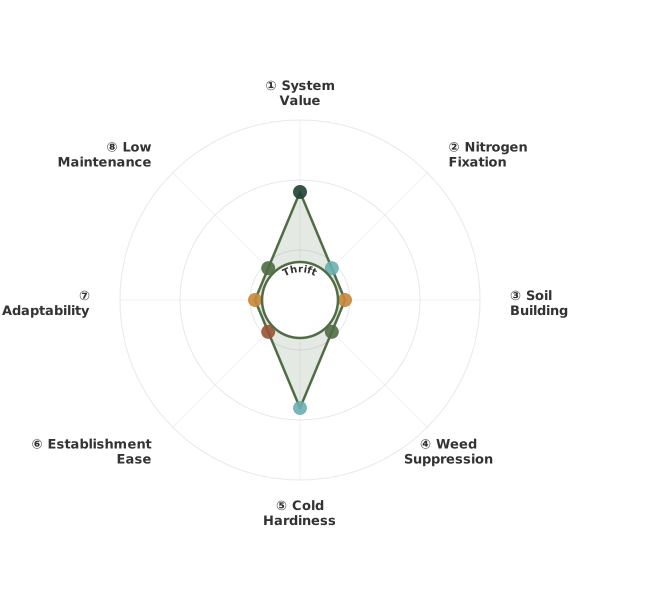
Comparative ratings for this plant across key regenerative agriculture traits.

Trait Suitability Explanation
Cold Hardiness Adequate Sea thrift forms dense, year-round groundcover, contributing to soil structure and resilience in cooler climates (Zone 4-5) as part of an integrated system.
Weed Suppression Not Recommended As a low-growing, clumping plant, its contribution to weed suppression is primarily through occupying space rather than dense canopy formation, supporting a diverse understory.
Nitrogen Fixation Not Recommended This plant does not fix atmospheric nitrogen; its role in soil fertility is through nutrient cycling and scavenging, enhancing the efficiency of existing soil resources.
Root System Depth Not Recommended Its shallow, fibrous root system stabilizes coastal soils and aids in moisture retention, contributing to the soil's structural integrity without deep compaction breaking.
Biomass Production Not Recommended Sea pink contributes minimally to aboveground biomass, focusing its energy on maintaining groundcover and supporting a healthy soil microbiome beneath the surface.
Establishment Ease Not Recommended Optimal establishment is achieved through transplanting or by providing well-drained, nutrient-balanced soils, allowing it to integrate effectively into the existing landscape.
Multi Benefit Value Not Recommended Primarily ornamental, it offers modest ecosystem services by providing groundcover and supporting soil health in specific niches within a biodiverse planting.
Climate Adaptability Adequate Hardy and tolerant of coastal conditions and periods of low moisture, it thrives in well-drained soils, requiring minimal intervention to maintain its role in the ecosystem.
Maintenance Intensity Ideally Suited This hardy perennial requires minimal intervention, contributing to system resilience by tolerating coastal conditions and poor soils with natural moisture retention and soil integration.

Comparative System: Ratings compare plants within their economic category (e.g., cover crop nitrogen fixation compared to other cover crops, not to all plants). Individual farm conditions and management practices significantly influence actual performance.

8

Learn More

Why farmers use this plant and additional resources

Why Regenerative Farmers Use This Plant

Armeria maritima, commonly known as Thrift or Sea Pink, is a low-growing, perennial evergreen subshrub that offers unique regenerative benefits when integrated into agricultural systems, particularly in its role as a groundcover, erosion control agent, and pollinator attractant. While not a nitrogen-fixing legume, its dense, low-growing habit and extensive fibrous root system are exceptionally effective at binding soil particles, preventing erosion on slopes, exposed areas, and coastal regions. Its fibrous root system typically extends 6-12 inches (15-30 cm) deep, and can penetrate compacted soils, improving aeration and water infiltration.

Beyond its soil-binding capabilities, Armeria maritima serves as an excellent living mulch and habitat provider. Its dense growth habit effectively suppresses weed germination by outcompeting them for light and nutrients, reducing the need for mechanical or chemical weed control. This weed suppression is particularly beneficial in perennial cropping systems or along field edges. Furthermore, its small, abundant pink flowers, typically blooming from spring through summer, are a valuable nectar and pollen source for a wide array of beneficial insects, including native bees, butterflies, and hoverflies. This increased insect activity can lead to improved pollination of nearby cash crops and enhanced natural pest control within the agroecosystem, attracting predatory insects that help manage common agricultural pests.

The long-term ecosystem services provided by Armeria maritima are substantial. As a perennial, it establishes a permanent root structure that continuously improves soil health year after year, contributing to a steady increase in soil organic matter through the decomposition of its foliage and root exudates. While specific biomass production figures for Armeria maritima as a standalone cover crop are not as widely documented as for larger cover crops, its dense ground cover can effectively reduce wind and water erosion. Its ability to thrive in challenging conditions, including coastal spray and wind, means it can establish and persist where many other plants would struggle, ensuring continuous ground cover and protection. In systems designed for biodiversity, it creates microhabitats for small invertebrates and can act as a buffer zone, protecting more sensitive crops from harsh environmental conditions. While it doesn't directly fix atmospheric nitrogen, its ability to scavenge available nutrients from the soil and prevent their loss through leaching contributes to overall nutrient cycling efficiency within the farm ecosystem.

Armeria maritima has found success in various regional agricultural settings. In the UK, it is often used in wildflower meadows, along field margins in mixed farming systems, and to stabilize sea walls and coastal paths, providing habitat for pollinators and reducing erosion on chalky and coastal soils. In New Zealand's pastoral systems, it can be incorporated into silvopasture designs or used on steeper slopes to prevent soil loss. In coastal regions of the Pacific Northwest, USA, its salt tolerance makes it suitable for use in vineyards and berry farms as a groundcover that also attracts beneficial insects, and it's planted on vineyard terraces to prevent soil erosion. Australian farmers in coastal areas utilize it for its salt tolerance and ability to bind sandy soils, reducing wind erosion in pasture and horticultural settings, and it is explored for its drought tolerance and ability to stabilize sandy soils in low-input agricultural landscapes. In California's vineyards, it is used as a drought-tolerant groundcover between rows, suppressing weeds and supporting beneficial insects. In European cottage gardens and farm borders, it is a common sight, valued for its resilience to coastal winds and its long flowering period. In Brazilian coffee plantations, it can be used as a low-lying ground cover in shaded areas, contributing to soil health without competing significantly with the coffee plants. Its resilience and low maintenance requirements make it a practical choice for farmers seeking to enhance biodiversity and soil stability without significant ongoing management.

9

How to Integrate This Plant

Practical guidance for regenerative systems

Establishing Armeria maritima is typically done through seed or division. For seeding, rates of approximately 0.25-2 lbs per acre (0.3-2.2 kg/ha) are common, depending on seed purity and desired stand density. For broadcast sowing, rates of 1-2 lbs per acre (1.1-2.2 kg/ha) are recommended, while drilled rates can be slightly lower, around 0.5-1 lb per acre (0.56-1.1 kg/ha). Seeds should be sown at a shallow depth of 0.125-0.25 inches (0.3-0.6 cm) to ensure good contact with the soil and benefit from light for germination. It can be broadcast or drilled, with drilled seeds often spaced 6-12 inches (15-30 cm) apart to allow for plant establishment and spread. For faster establishment or in areas with intense weed pressure, starting seeds in a nursery bed or using container-grown plants is an effective strategy.

The ideal planting time varies by region: in the Northern Hemisphere, late spring (March-May) or early autumn (August-October) are generally best to take advantage of cooler, moist conditions. In the Southern Hemisphere, this translates to sowing in March-April or August-September, or late spring (October-November). Germination can take 14-21 days, with plants typically establishing a good ground cover within 30-90 days of sowing and reaching a mature, dense form over the first growing season.

Once established, Armeria maritima is a low-maintenance perennial. It requires moderate moisture, particularly during establishment, with approximately 0.5-1 inch (1.3-2.5 cm) of rainfall or irrigation per week. While it is drought-tolerant once mature, consistent moisture will promote denser growth and flowering. Fertility needs are minimal; it thrives in average to poor soils and does not require significant synthetic fertilizer inputs. Excessive fertilization can lead to leggy growth and reduced flowering. Its growth timeline is perennial, meaning it will establish and provide groundcover and flowering for many years. Mature plants typically reach a height of 4-12 inches (10-30 cm) with a spread of 12-18 inches (30-45 cm), forming dense cushions or mats. Pest and disease issues are rare, with biological control and good air circulation being the primary methods of prevention. Its primary challenges during establishment can be competition from aggressive weeds and potential overwatering in poorly draining soils.

For category-specific integration as a cover crop or living mulch, Armeria maritima is best managed through minimal intervention. Termination is rarely necessary due to its perennial nature and low growth habit. If it needs to be removed or managed to prevent excessive spread, mechanical methods like mowing, grazing, or digging can be employed. Mowing to a height of 2 inches (5 cm) in late autumn can help manage its density. Natural winterkill can occur in colder climates (below -5°C / 23°F), eliminating the need for active termination. Where winterkill is not reliable, mowing or grazing can be effective for biomass reduction, ideally done before flowering to prevent unwanted reseeding. If a farmer wishes to replace it with an annual crop, it can be dug out or tilled, though this is a more intensive process. Its slow decomposition means it does not contribute significant nitrogen credits; its value is in its persistent ground cover and biodiversity support. Seed management is generally not a concern as it does not readily produce viable seed in most agricultural settings, and reseeding is usually not desired. If volunteer establishment is not desired, deadheading flowers before seed set can prevent unwanted spread. Relay or inter-seeding into established crops is not a typical practice for Armeria maritima due to its slow initial growth and perennial habit.