Existing studies highlight its significant role in coastal ecosystem restoration and carbon sequestration. Research in China and Tanzania indicates *Avicennia marina* forests contribute substantially to soil organic carbon (SOC) storage, with variations based on climate and vegetation type. In the Sundarbans, it was included in mixed plantations for assessing blue carbon sequestration potential, demonstrating its capacity to contribute to soil ecological functions and carbon pools. A study in Southern China compared *Avicennia marina* forests with other vegetation, noting its influence on sediment C/N ratios and microphytobenthic chlorophyll-a. Although not explicitly detailed as a cover crop, forage, or nitrogen fixer in these excerpts, its presence in mangrove systems underscores its value in building soil health and sequestering carbon, key tenets of regenerative practices. Further research is needed to explore its specific applications within diversified farming systems. While coverage in our knowledge base is limited, the above represents documented uses in regenerative systems.

Regenerative Quick Profile

All recommendations assume integrated, regenerative practices—not conventional inputs.

Climate & Soil Fit

Climate: Tropical Rainforest, Tropical Monsoon, Tropical Savanna, Hot Semi-Arid (Steppe), Cold Semi-Arid (Steppe), Hot Desert, Cold Desert, Humid Subtropical, Oceanic (Maritime Temperate), Hot-Summer Mediterranean, Warm-Summer Mediterranean, Monsoon-Influenced Humid Subtropical, Subtropical Highland, Hot-Summer Continental, Warm-Summer Continental, Subarctic, Monsoon-Influenced Hot-Summer Continental, Tundra

Zones: USDA 9-11, Australian Zones 11-13, EU Mediterranean, Subtropical

Optimal Soil: Saline Soil

System Role & Functions

Primary: Riparian

Secondary: Soil Remediation, Specialty

Key Benefits: Multi-benefit value, Low maintenance, Root System Depth

Management Level

Experience: Advanced

Maintenance: Very low maintenance - Thriving in saline environments, this mangrove naturally filters water and stabilizes shorelines, requiring minimal system integration rather than external water management or fertility management.

Value Streams
1

Climate Suitability Assessment

Will this plant thrive in your climate?

IDEALLY SUITED

Köppen Zone: Af (Tropical Rainforest), Am (Tropical Monsoon), Aw (Tropical Savanna), Cfa (Humid Subtropical)
USDA Zone: 9a, 10a, 11a, 12a
Australian Zone: Zone 5, tropical, subtropical

Grey Mangrove performs optimally in consistently warm, frost-free environments with abundant rainfall, conditions met across Köppen zones Am, Aw, and regional zones like USDA 9a-13a, Australian Zone 5, subtropical, and tropical. These climates provide average temperatures above 18°C year-round and rainfall exceeding 1500-2000mm annually, supporting rapid growth and dense establishment along coastal and estuarine areas. Its primary functions of riparian buffering and soil remediation are highly effective due to vigorous development and resilience. Minimal management is required beyond protection from extreme weather events. The high salinity tolerance of Grey Mangrove is fully utilized in these zones, allowing it to colonize and stabilize shorelines effectively, contributing significantly to coastal ecosystem health and resilience. Establishment success is very high (>90%), and multi-year productivity is reliable, making it an ideal choice for these warm, humid regions.

ADEQUATE

Köppen Zone: Cwa (Monsoon-Influenced Humid Subtropical)
USDA Zone: 8a
Australian Zone: Zone 3, Zone 4, temperate
EU Climate Region: atlantic, mediterranean

Grey Mangrove can be adequately suited in climates with distinct seasons, including Köppen zones As, Cfa, Cwa, and regional zones like USDA 8a-8b, Australian Zone 3, Zone 4, temperate, EU Atlantic, and Mediterranean. These zones offer warm summers but may experience cooler winters with occasional frost, or have pronounced dry seasons. While Grey Mangrove can survive and perform its riparian and soil remediation functions, its growth rate and overall vigor will be reduced compared to ideal tropical conditions. Establishment success is good (70-85%) but may require careful site selection near reliable freshwater sources or sheltered coastal areas to mitigate frost and drought stress. Performance in these zones is economically viable with standard management practices, but yields and effectiveness may be 10-20% lower than in truly tropical climates. Long-term stand persistence is generally good but may be slightly reduced by winter dieback or summer drought.

NOT RECOMMENDED

Köppen Zone: ET (Tundra), BSh (Hot Semi-Arid (Steppe)), BSk (Cold Semi-Arid (Steppe)), BWh (Hot Desert), BWk (Cold Desert), Cfb (Oceanic (Maritime Temperate)), Csa (Hot-Summer Mediterranean), Csb (Warm-Summer Mediterranean), Cwb (Subtropical Highland), Dfa (Hot-Summer Continental), Dfb (Warm-Summer Continental), Dfc (Subarctic), Dwa (Monsoon-Influenced Hot-Summer Continental)
USDA Zone: 2a, 3a, 3b, 4a, 5a, 5b, 6a, 7a

Grey Mangrove is not recommended in climates with significant frost risk or consistently cool temperatures, as seen in Köppen zone Cwb and regional zones USDA 7a-7b. These zones experience winter lows that are too cold for Grey Mangrove's survival, with temperatures frequently dropping below freezing for extended periods. This leads to severe winter kill, making it impossible to establish or maintain a viable population for its intended functions of riparian buffering and soil remediation. While summers might offer some warmth, the annual cycle of freezing temperatures prevents consistent growth and resilience. The establishment success rate drops significantly below 70%, and the plant would require intensive, economically unfeasible protection measures like greenhouses or constant replanting to survive. Alternative plants better suited to these colder, frost-prone environments are necessary for successful regenerative agriculture practices in these regions.

Better alternatives for these "not recommended" zones: Bald Cypress (Taxodium distichum) (Highly cold-hardy wetland tree with excellent riparian and soil stabilization benefits.), River Birch (Betula nigra) (Adaptable to various soil types and moisture levels, with better cold tolerance.), Willow species (Salix spp.) (Fast-growing riparian species with good soil stabilization properties and broader climate tolerance.), Common Alder (Alnus glutinosa) (Excellent riparian tree for wet soils, tolerates cooler climates.)

Note: Zones listed above represent climates where this plant can produce reliably with reasonable management. Climate zones not mentioned would require intensive climate modification (greenhouses, extensive infrastructure) and are not economically viable for regenerative agriculture purposes.

2

Soil Suitability Assessment

Which soil types work best for this plant?

IDEALLY SUITED

Saline Soil

This plant thrives in these soil types without requiring amendments or remediation. Natural soil conditions support optimal growth and productivity.

ADEQUATE

Alkaline Soil, Clay Soil, Loam Soil, Rich Soil, Sandy Soil, Wet Soil

This plant performs acceptably in these soil types with moderate, manageable remediation such as pH adjustment, compost addition, or drainage improvement. The required amendments are practical and cost-effective for regenerative agriculture.

NOT RECOMMENDED

Acidic Soil, Desert Soil, Rocky Soil

Growing this plant in these soil types would require impractical remediation such as complete soil replacement, extensive amendments, or cost-prohibitive infrastructure. These conditions are not economically viable for regenerative agriculture.

Note: Soil suitability assessments focus on remediation requirements. "Ideally Suited" means the plant generally thrives without the need for substantial amendments, "Adequate" means manageable remediation (lime, compost, mulch), and "Not Recommended" means impractical soil changes would be required. Climate factors like rainfall and temperature also influence success.

3

Seasonal Considerations

Planting timing, growth duration, and harvest windows

Establishing Avicennia Marina, or grey mangrove, requires careful timing to leverage its vigorous growth. For nursery planting, aim for the onset of the active growing season, typically in early spring, after the risk of frost has passed. This allows seedlings to establish a strong root system before cooler temperatures arrive. Both bare-root and containerized stock thrive when planted during this period of warming soil and increasing daylight.

Expect your young mangroves to take several years to become truly established, usually by the third or fourth year. Initial harvests, if the species is being managed for a product, might be possible by year five, with full production typically reached by year eight to ten. Avicennia Marina is a long-lived species, capable of productive lifespans spanning decades.

Seasonal management focuses on supporting this long-term growth. While pruning is generally best avoided during active growth, any necessary structural pruning can be done in late fall or winter, once the tree has entered a state of dormancy. Harvests will be dictated by the specific product being cultivated, but are usually timed to coincide with periods of optimal growth or maturity. Bloom timing varies by regional climate but generally occurs during the warmer, wetter periods. Winter offers a period of reduced growth, allowing the plant to conserve energy.

4

System Role & Multi-Benefit Value

Functional roles, integration strategies, and stacked benefits

Functional Role

Total System Value

The grey mangrove offers significant whole-farm resilience, particularly for coastal agricultural operations. Its primary direct value lies in its ecosystem services: exceptional erosion control along shorelines and riverbanks, preventing land loss and protecting infrastructure. It acts as a natural windbreak, buffering crops and livestock from harsh coastal winds. Significant blue carbon sequestration occurs in its biomass and the associated soil, contributing to climate change mitigation. The mangrove ecosystem provides crucial habitat for a diverse range of wildlife, including birds and marine life, potentially supporting fisheries. While direct harvest is not a primary focus in regenerative systems, its role in stabilizing coastal environments and enhancing biodiversity diversifies farm resilience against climate change impacts like sea-level rise and storm surges.

Integration Characteristics

Multi-Benefit Value: Ideally Suited - As a crucial coastal ecosystem engineer, Avicennia marina unparalleledly stabilizes shorelines, sequesters carbon, provides habitat, and filters water, offering significant ecological value.

5

Management & Care Requirements

Integration guidance, maintenance needs, and care practices

How to Integrate This Plant

Grey mangrove (Avicennia marina) can be integrated into coastal and riparian regenerative systems primarily for erosion control and habitat creation. Its dense root systems stabilize shorelines, preventing soil loss in areas prone to inundation and wave action. While not directly mentioned for nitrogen fixation, mangroves in general contribute to nutrient cycling in estuarine environments. Compatible practices would include establishing buffer zones along coastlines or tidal rivers, functioning as natural windbreaks and providing habitat. Timeline to contribution: Year 1-2: Initial establishment and stabilization of soil. Year 5: Significant shoreline stabilization and development of microhabitats. Year 10-20: Mature trees provide substantial erosion control, windbreak effects, and contribute to blue carbon sequestration. Multi-benefit stacking includes shoreline protection, carbon sequestration in biomass and soil, habitat for coastal wildlife and potentially fish nurseries, and water quality improvement through sediment trapping.

Integration Practices & Management

The provided knowledge base offers limited direct insights into how regenerative farmers specifically integrate Avicennia marina (black mangrove) into their practices, particularly concerning establishment, grazing, termination, and cash crop integration. The sources primarily focus on Avicennia marina's ecological role in coastal wetland ecosystems, its contribution to soil organic carbon sequestration, and its interaction with other plant and animal communities. For instance, studies mention its presence in mixed mangrove plantations and natural forests, highlighting its significance in blue carbon pools and its influence on sediment properties in coastal environments. One study notes its occurrence alongside other dominant wetland vegetation like Phragmites australis and Spartina alterniflora. However, the knowledge base does not detail specific regenerative agriculture techniques such as seeding rates, tillage practices, companion planting, mob grazing, rotational systems, specific termination strategies, fertility management, or its use in rotation sequences with cash crops. Therefore, practical farmer experiences and specific integration methods for regenerative agriculture are not discernible from these sources.

Management Profile

Maintenance Intensity: Ideally Suited - Thriving in saline environments, this mangrove naturally filters water and stabilizes shorelines, requiring minimal system integration rather than external water management or fertility management.

6

Economics & Value Streams

Direct harvest, system benefits, ecosystem services, and risk diversification

Comprehensive economic analysis including direct harvest value, system enhancement contributions, ecosystem services, value timeline, and risk diversification strategies.

Cover Crop Investment

Metric Value
Seed Cost N/A N/A
Termination Cost N/A N/A
Biomass Production N/A N/A
N Fixation Value N/A N/A
Weed Control Savings N/A N/A

Cover crops are soil investments, not cash crops. Economics measured in soil health gains, input reduction, and subsequent crop performance. Values show direct costs and estimated benefits.

System Enhancement Value

Beyond harvest: shade for livestock, soil building, and system benefits

Windbreak & Erosion Control

Variable, dependent on buffer width and fetch. Primarily protects against erosion and inundation, with indirect benefits to adjacent land productivity.

While grey mangroves (Avicennia marina) are primarily associated with coastal and riparian zones, their dense root systems and upright growth habit provide significant physical barriers. In integrated farm systems located within their natural range, this translates to effective erosion control along waterways and coastlines, protecting valuable agricultural land from tidal inundation and wave action. The pneumatophores, which emerge from the soil, further contribute to soil stabilization by trapping sediment. This stabilization prevents the loss of fertile topsoil, a critical asset for any farm. Furthermore, by reducing the impact of wind and water on adjacent agricultural areas, mangroves can indirectly improve the microclimate, potentially leading to more stable crop growth and reduced stress on livestock housed nearby. Their presence as a natural buffer is a key component of riparian management.

Other System Contributions

Grey mangroves (Avicennia marina) offer substantial soil remediation and specialty product potential within integrated farm systems. Excerpt indicates that while *S. alterniflora* invasion can decrease SOC in mangrove communities, the presence of mangroves themselves plays a role in soil organic carbon storage. Excerpt highlights that *Avicennia marina*-dominated sites and mixed plantations containing *A. marina* exhibited higher soil organic carbon and available nitrogen, suggesting a role in nutrient cycling and soil health improvement. Furthermore, mangroves are known to improve water quality by filtering pollutants and excess nutrients from runoff before they reach open water bodies, a critical function in riparian systems. Their specialized habitat also supports a unique array of biodiversity, acting as nurseries for fish and crustaceans, which can be a direct or indirect economic benefit through aquaculture or ecotourism. The specialty aspect could involve sustainable harvesting of mangrove products, though this requires careful management.

Ecosystem Service Contributions

Environmental contributions: carbon, pollinators, wildlife, and water

  • Carbon Sequestration: Grey mangroves contribute significantly to carbon sequestration, particularly through the accumulation of soil organic carbon (SOC). Studies show SOC densities in mangrove soils can be substantial, with potential for long-term storage in anoxic conditions. Excerpt notes higher soil organic carbon in *Avicennia marina*-dominated sites and mixed plantations.
  • Pollinator Support: Low. While mangroves support various invertebrates, they are not typically considered primary pollinator support species for agricultural crops.
  • Wildlife Habitat: High. Mangrove ecosystems provide crucial habitat, acting as nurseries for fish and invertebrates, and supporting birdlife. Their complex root structures offer shelter and breeding grounds.
  • Water Quality: High. Mangroves are highly effective at filtering sediments, nutrients, and pollutants from water as it flows through their root systems, significantly improving water quality in coastal and estuarine environments.

Value Timeline: When Benefits Begin

When you'll see results: which benefits come early vs. long-term

Years 1-2

Erosion control and initial sediment trapping commence. Basic riparian buffer function begins. Early contributions to soil stabilization and water quality improvement.

Years 3-5

Established soil remediation and stabilization. Increased sediment accretion and organic matter accumulation. Beginning to establish more robust wildlife habitat. Potential for early signs of blue carbon accrual.

Years 10-20

Mature riparian buffer providing significant coastal protection. Substantial soil organic carbon sequestration and ongoing soil remediation. Robust and diverse wildlife habitat established. Optimized water filtration capacity. Potential for development of specialty product streams.

20+ Years

Long-term, stable ecosystem services. Significant blue carbon storage. Continued role in coastal protection and water quality. Mature, resilient habitat supporting complex food webs. Potential for sustainable, long-term specialty product harvesting if managed.

Farm Risk Reduction

How this reduces farm risk: backup income, weather protection, market hedges

  • Multiple Revenue Streams: Coastal protection (reduced damage costs), water quality improvement (reduced treatment costs downstream), soil remediation (improved land productivity), blue carbon sequestration (potential future markets), biodiversity support (aquaculture/ecotourism potential), specialty products (sustainable harvesting).
  • Temporal Income Spread: Ongoing, continuous provision of ecosystem services (erosion control, water filtration, habitat). Potential for periodic income from specialty product harvesting. Long-term value through carbon sequestration and land resilience.
  • Market Risk Hedge: Reduces reliance on single-commodity markets by providing essential ecological services that protect agricultural assets and improve land value. Offers resilience against coastal erosion and extreme weather events. Diversifies farm functions beyond traditional crop/livestock production.
7

Regenerative Suitability Details

Comprehensive trait ratings for system integration assessment

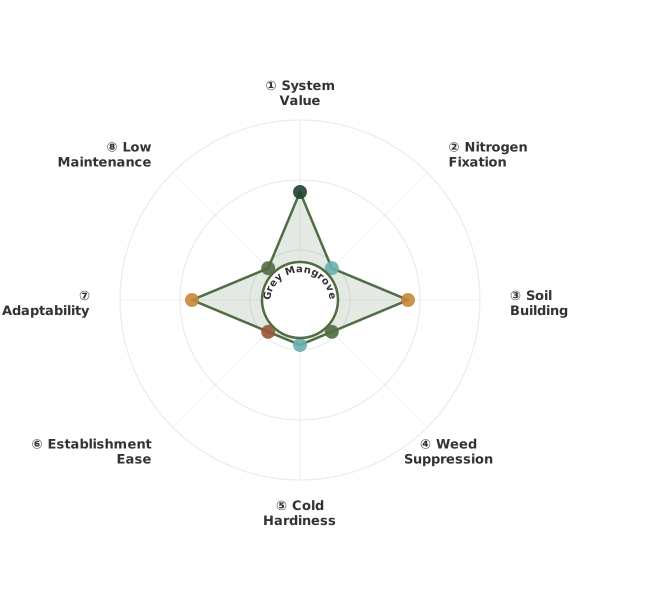
Comparative ratings for this plant across key regenerative agriculture traits.

Trait Suitability Explanation
Cold Hardiness Not Recommended Avicennia marina is a tropical mangrove, thriving in warm climates and highly sensitive to frost, limiting its use as a summer annual in suitable regions.
Weed Suppression Not Recommended Adapted to saline, waterlogged coastal environments, Avicennia marina does not function effectively in typical terrestrial soil-building cover crop roles and offers poor weed suppression.
Nitrogen Fixation Not Recommended While Avicennia marina may have symbiotic relationships, its nitrogen fixation is not relevant nor documented for enhancing soil fertility in agricultural systems.
Root System Depth Ideally Suited This mangrove species possesses extensive, deep root systems and pneumatophores, making it excellent for soil stabilization and nutrient cycling within saline coastal environments.
Biomass Production Not Recommended In terrestrial agricultural systems, Avicennia marina's biomass production and organic matter contribution are negligible, as it is not suited for typical soil-building roles.
Establishment Ease Not Recommended Avicennia marina requires specific saline, intertidal conditions for establishment, with slow germination and sensitivity to non-coastal environments limiting its farm applicability.
Multi Benefit Value Ideally Suited As a crucial coastal ecosystem engineer, Avicennia marina unparalleledly stabilizes shorelines, sequesters carbon, provides habitat, and filters water, offering significant ecological value.
Climate Adaptability Not Recommended Primarily a coastal mangrove, Avicennia marina is adapted to saline, tropical/subtropical zones and exhibits high sensitivity to frost and freshwater, restricting its climate adaptability.
Maintenance Intensity Ideally Suited Thriving in saline environments, this mangrove naturally filters water and stabilizes shorelines, requiring minimal system integration rather than external water management or fertility management.

Comparative System: Ratings compare plants within their economic category (e.g., cover crop nitrogen fixation compared to other cover crops, not to all plants). Individual farm conditions and management practices significantly influence actual performance.

8

Learn More

Why farmers use this plant and additional resources

Why Regenerative Farmers Use This Plant

Avicennia marina, commonly known as grey mangrove, is a foundational species in coastal regenerative agriculture and ecosystem restoration. Its primary regenerative value lies in its exceptional ability to stabilize shorelines, prevent erosion, and create valuable intertidal habitat. While not a nitrogen fixer in the traditional sense like legumes, its dense, intricate root systems trap sediment and organic matter, effectively building soil and increasing land elevation over time. This process is crucial for reclaiming degraded coastal areas and protecting agricultural lands from inundation and saltwater intrusion. The decomposition of mangrove leaf litter contributes significantly to nutrient cycling within the estuarine ecosystem, supporting a rich food web and gradually improving soil structure and fertility in nutrient-poor saline soils.

Integrating Avicennia marina into coastal farming systems offers multifaceted benefits. As a living shoreline, it acts as a natural buffer against storm surges and wave action, reducing the need for costly artificial defenses and protecting valuable crops from damage. Established Avicennia marina stands can trap an estimated 10-50 tons of sediment per acre per year (25-125 metric tons/ha), significantly increasing soil organic matter and land elevation. The complex root structures provide nursery grounds and habitat for commercially important fish and shellfish species, offering potential for integrated aquaculture or enhancing local fisheries. Studies indicate that healthy mangrove forests can improve water quality by removing excess nutrients and sediments, benefiting both adjacent marine ecosystems and any freshwater sources used for irrigation. The fallen leaves and organic matter decompose, enriching the soil with organic carbon and essential nutrients, which can reduce reliance on synthetic fertilizers for nearby crops over time.

Furthermore, the mangrove ecosystem sequesters significant amounts of carbon, not only in its biomass but also within the waterlogged sediments, contributing to climate change mitigation efforts. Estimates suggest mangrove forests can sequester 3 to 15 tons of CO2 per acre per year (7.5 to 37 metric tons/ha) depending on age and location, potentially 3-4 times that of terrestrial forests. Its presence can also help filter pollutants from land-based runoff before they reach open waters. The biodiversity supported by mangrove forests is immense, with studies showing a tenfold increase in fish biomass in areas adjacent to healthy mangrove stands compared to barren coastlines. The dense canopy offers shade and habitat for beneficial insects and birds, contributing to a more balanced farm ecosystem.

Regional success examples highlight the adaptability of Avicennia marina. In the Sundarbans region of India and Bangladesh, it forms the backbone of the world's largest mangrove forest, protecting vast agricultural deltas from cyclones and supporting a thriving fishing industry. In Florida, USA, it is a key component of living shoreline projects designed to protect coastal properties and restore estuarine health, and is planted in intertidal zones to restore degraded coastlines and protect against storm damage. In Australia, particularly in Western Australia and Queensland, it is integral to coastal management plans, safeguarding beaches and supporting unique marine life, and is a key species in estuarine restoration projects aimed at improving water quality and fish nursery grounds. In parts of Southeast Asia, it is used in integrated mangrove-shrimp farming systems, where the mangroves provide habitat and water filtration for shrimp ponds, demonstrating a successful model of aquaculture integrated with natural ecosystem services. In the Mekong Delta, Vietnam, it is integrated with rice paddies, where the mangrove fringe protects the fields from saltwater intrusion and erosion while providing habitat for beneficial species. In the Persian Gulf, it is planted in arid coastal zones to combat desertification and stabilize shorelines. In East Africa, communities are re-establishing mangrove forests to protect fishing grounds and provide sustainable firewood resources.

9

How to Integrate This Plant

Practical guidance for regenerative systems

Establishing Avicennia marina typically involves planting propagules (viviparous seedlings that have already germinated while still attached to the parent tree) or seedlings. Propagules are preferred for their higher success rate.

Planting:

  • Density: Propagules can be planted directly into the substrate at a density of 500-1000 propagules per acre (1235-2470 propagules/ha). For shoreline stabilization, planting densities can range from 1 to 5 propagules per meter, while for creating dense mangrove stands, densities might be higher, around 1,000 to 4,000 propagules per hectare (2,500 to 10,000 trees/ha). Seedlings, often grown in nurseries, are planted at similar densities.
  • Depth: The planting depth for propagules is typically 4-8 inches (10-20 cm), ensuring the base is firmly in the substrate. For seedlings, the root ball should be planted level with the surrounding soil surface, with the top of the root ball approximately 2-4 inches (5-10 cm) below the sediment surface, ensuring stability against tidal action.
  • Timing: The ideal planting time is during the warmer months, generally from April to September in the Northern Hemisphere and October to March in the Southern Hemisphere, coinciding with periods of stable water levels and temperatures above 20°C (68°F). Planting is also recommended during the onset of the rainy season or periods of consistent rainfall to aid establishment.

Management:

  • Watering: Avicennia marina is adapted to brackish or saltwater conditions and generally does not require supplemental watering beyond natural tidal inundation. During establishment, supplemental watering may be beneficial in extremely dry periods, aiming for at least 1 inch (2.5 cm) of water equivalent per week if rainfall is insufficient.
  • Fertility: Fertility is primarily derived from nutrient cycling within the estuarine environment, from decomposing leaf litter and sediment deposition. Avoidance of artificial fertilizers is paramount, as they can disrupt the delicate estuarine ecosystem.
  • Growth: Growth is slow but steady. Seedlings typically establish within 60-90 days. Mature trees can reach heights of 15-30 feet (4.5-9 meters) over several years, depending on site conditions and species vigor, typically within 5-10 years.
  • Pest and Disease: Pest and disease management is typically handled by the natural ecosystem; healthy mangrove stands are resilient and generally resistant to significant outbreaks.

Integration & Long-Term Management:

  • Role: Avicennia marina is integrated as a foundational species for creating or restoring mangrove forests, which in turn support associated agricultural or aquaculture activities. Its role is to provide permanent habitat, erosion control, and carbon sequestration.
  • Termination: Termination is not applicable as it is a perennial tree intended for long-term establishment. The focus is on facilitating its growth and expansion. If a stand needs to be thinned for specific reasons, selective harvesting can be employed, with the woody biomass potentially contributing to biochar production or being used as a slow-release organic amendment in other agricultural contexts, though its high salt content requires careful consideration.
  • Seed Management: Seed management involves allowing natural dispersal of propagules by tides and currents, or collecting and planting them in suitable areas.
  • Protection: The primary "management" is ensuring that planted areas are protected from direct human disturbance, excessive boat traffic, pollution, and excessive nutrient loading during the establishment phase. In areas where mangroves are being restored, planting is often done in conjunction with sediment management or wave attenuation structures to improve initial survival rates. Relay or intercropping is not applicable to this species.