
Glossy Privet
Existing research highlights its potential within regenerative agriculture systems. Studies indicate its use in creating urban forests where organic mulching, particularly around L. lucidum, significantly enhances soil enzymatic activities vital for carbon and nitrogen cycling, up to a 75% increase in dehydrogenase activity. This mulching also promotes the movement of soil organic carbon to deeper soil layers, contributing to carbon sequestration. Furthermore, L. lucidum has demonstrated utility in phytoremediation of heavy metal-contaminated soils, fostering significantly higher microbial diversity in its rhizosphere compared to bulk soil. This suggests a role in soil health improvement and ecosystem restoration. Although specific primary uses like cover cropping or forage are not detailed in these excerpts, its impact on soil biology and carbon dynamics points to benefits in soil building and potentially as a component in agroforestry or other diverse planting systems aimed at ecological enhancement. While coverage in our knowledge base is limited, the above represents documented uses in regenerative systems.
For a full botanical description see: Wikipedia(opens in new window) (external link)
Regenerative Quick Profile
All recommendations assume integrated, regenerative practices—not conventional inputs.
Climate & Soil Fit
Climate: Tropical Rainforest, Tropical Monsoon, Tropical Savanna, Hot Semi-Arid (Steppe), Cold Semi-Arid (Steppe), Hot Desert, Cold Desert, Humid Subtropical, Oceanic (Maritime Temperate), Hot-Summer Mediterranean, Warm-Summer Mediterranean, Monsoon-Influenced Humid Subtropical, Subtropical Highland, Hot-Summer Continental, Warm-Summer Continental, Subarctic, Monsoon-Influenced Hot-Summer Continental, Tundra
Zones: USDA 7-10, Australian Zones 3-12
Optimal Soil: Loam Soil
System Role & Functions
Primary: Soil Remediation
Secondary: Food Forest, Specialty
Key Benefits: Cold Hardiness
Management Level
Experience: Advanced
Maintenance: High maintenance - Managing Ligustrum lucidum involves integrating its growth into the overall system through strategic pruning. This approach focuses on shaping its form and utilizing pruned material as mulch, minimizing external inputs and maximizing resource cycling.
Value Streams
Know the Debate
- Establishment benefits take 1-10 years depending on outcome
- Adapts to various soil types, including saline and clay
- Requires specific planting density and initial care
- Benefits include windbreak, erosion control, and biodiversity
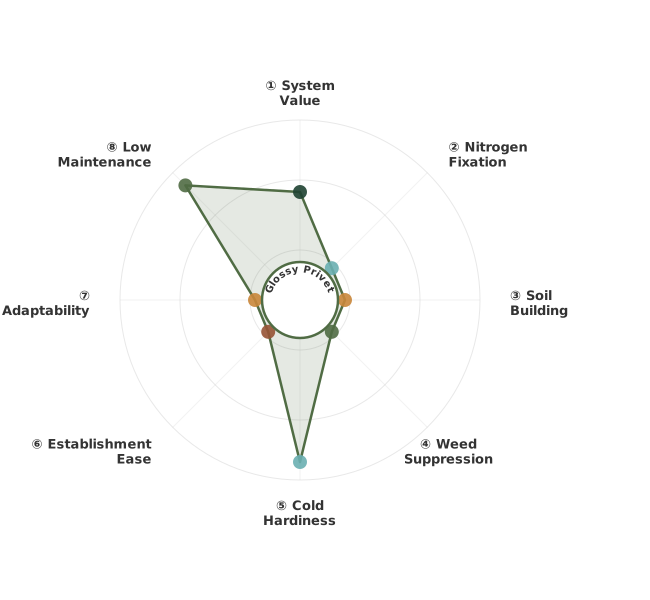
How These Traits Are Calculated
Trait dimensions are ordered clockwise starting from the top of the chart (12 o'clock position):
1. System Value
Ecosystem service stacking across nitrogen, carbon, water, biodiversity
WHAT: Synthesizes the compounding value of multiple ecosystem services delivered simultaneously—nitrogen fixation, soil organic matter building, pollinator support, erosion control, and water infiltration improvement. This is the total regenerative impact beyond single-function metrics.
WHY: The highest-value cover crops deliver 3-5 significant ecosystem services at once. A legume that fixes nitrogen, builds biomass, supports pollinators, and improves water infiltration provides $150-300/acre in combined benefits versus $30-60 for single-function covers. This service stacking is the core principle of regenerative agriculture.
HOW: Scored via LLM synthesis of economics data, timeline benefits, and trait combinations. Exceptional (3.0): 4-5 major services stacked with strong economic value ratios. Typical (2.0): 2-3 moderate services. Limited (1.0): Single-function covers with minimal service stacking. Considers seed cost relative to benefit value.
2. Nitrogen Fixation
Biological nitrogen production via legume root nodule bacteria
WHAT: Measures the ability to convert atmospheric nitrogen (N₂) into plant-available ammonia through symbiotic bacteria in root nodules. Legumes form partnerships with rhizobium bacteria that fix 60-150 lbs N/acre/year, reducing or eliminating synthetic fertilizer needs for following crops.
WHY: Nitrogen is the most expensive fertilizer input in crop production ($0.50-1.00/lb). Cover crops with exceptional nitrogen fixation can provide $60-150/acre worth of fertility while building soil organic matter. This biological process also reduces groundwater contamination from nitrogen runoff and lowers farm carbon footprint.
HOW: Ratings based on annual nitrogen fixation capacity and reliability across soil conditions. Exceptional (3.0): Legumes like hairy vetch, crimson clover, and field peas fixing >100 lbs N/acre/year. Typical (2.0): Moderate fixers like red clover at 60-100 lbs N/acre/year. Limited (1.0): Non-legumes (grasses, brassicas) with zero fixation capacity.
3. Soil Building
Weighted: biomass production (60%) + root system depth (40%)
WHAT: Combines above-ground biomass production with root depth to measure total soil organic matter contribution. Biomass provides surface organic matter, while deep roots deposit carbon at depth and break up compaction layers.
WHY: Soil organic matter is the foundation of regenerative agriculture, improving water retention, nutrient cycling, and biological activity. Each 1% increase in soil organic matter holds an additional 20,000 gallons of water per acre and represents $500-1,000 in fertility value. Deep roots access subsoil nutrients and create channels for water infiltration.
HOW: Weighted formula prioritizes biomass production (60% weight) for immediate organic matter contribution, with root depth (40% weight) for long-term soil structure. Exceptional (3.0): High-biomass crops with deep roots like cereal rye (8+ tons biomass, 5+ ft roots). Typical (2.0): Moderate on both factors. Limited (1.0): Low biomass or shallow roots.
4. Weed Suppression
Physical competition through rapid establishment and dense growth
WHAT: Measures the ability to outcompete weeds through rapid germination, aggressive early growth, and dense canopy formation. Physical smothering and light competition reduce weed pressure without herbicides.
WHY: Weed management is a major labor and cost burden for farmers. Cover crops that effectively suppress weeds reduce herbicide costs ($20-60/acre), decrease cultivation passes (fuel + labor), and provide clean seedbeds for cash crops. This is especially valuable in organic systems where herbicide options are limited.
HOW: Ratings based on germination speed, tillering density, and canopy closure timing. Exceptional (3.0): Fast-establishing, dense-tillering crops like cereal rye, oilseed radish that close canopy within 3-4 weeks. Typical (2.0): Moderate establishment and coverage. Limited (1.0): Slow-establishing or sparse crops that allow weed competition.
5. Cold Hardiness
Winter survival for fall planting and spring green manure value
WHAT: Measures tolerance to freezing temperatures and ability to survive winter conditions. Winter-hardy cover crops can be fall-planted, overwinter as living mulch, and provide early spring growth before cash crop planting.
WHY: Fall-planted winter-hardy covers extend the growing season into unused months, capturing solar energy and preventing erosion during wet periods. Spring green manure from overwintered covers provides early nitrogen and biomass. This timing flexibility is critical in cold climates with short growing seasons.
HOW: Ratings based on minimum survival temperature and winter active growth. Exceptional (3.0): Winter-hardy crops like cereal rye, hairy vetch, crimson clover surviving to -20°F with active growth in spring. Typical (2.0): Moderate cold tolerance. Limited (1.0): Warm-season crops like buckwheat, cowpea killed by first frost.
6. Establishment Ease
Germination speed, soil requirement flexibility, planting window breadth
WHAT: Measures how easily the cover crop establishes from seed, including germination speed, tolerance for variable soil conditions, and flexibility in planting timing. Easy establishment means reliable stands without intensive management.
WHY: Difficult-to-establish covers increase risk of stand failure, wasted seed costs, and reduced benefits. Easy establishment crops tolerate late planting, poor seedbed preparation, and variable moisture—critical when cover cropping windows are narrow between cash crops. Reliable establishment ensures consistent soil building and weed suppression benefits.
HOW: Ratings based on days to emergence, soil condition sensitivity, and planting window breadth. Exceptional (3.0): Fast germinators like buckwheat (3-5 days) and cereal rye (5-7 days) with wide planting windows. Typical (2.0): Moderate establishment requirements. Limited (1.0): Slow or finicky establishers requiring precise conditions.
7. Adaptability
Weighted: climate tolerance (60%) + multi-benefit versatility (40%)
WHAT: Combines climate adaptability (temperature and rainfall range) with multi-benefit versatility (diverse ecosystem services) to measure overall system flexibility. High adaptability means the cover works across farm regions and provides multiple functions.
WHY: Farmers need cover crops that work reliably across diverse fields and provide stacked benefits. Climate-adaptable covers reduce risk in variable weather, while multi-benefit crops deliver nitrogen fixation + pollinator support + forage value simultaneously. This versatility maximizes return on cover crop investment.
HOW: Weighted formula prioritizes climate tolerance (60% weight) for geographic reliability, with multi-benefit value (40% weight) for functional stacking. Exceptional (3.0): Wide climate range + multiple significant benefits. Typical (2.0): Moderate on both factors. Limited (1.0): Narrow climate range or single-function crops.
8. Low Maintenance
Inverted from maintenance intensity—low inputs mean high scores
WHAT: Measures minimal input requirements for successful cover cropping. Low-maintenance covers require no irrigation, minimal fertility, easy termination, and tolerate variable management timing.
WHY: Cover crops compete for resources with cash crops in tight rotations. Low-maintenance covers fit easily into existing systems without adding labor, equipment, or input costs. Easy termination is especially critical—covers that are difficult to kill can become weeds and delay cash crop planting.
HOW: Inverted score from maintenance intensity trait (4.0 minus raw score). Exceptional (3.0): Self-sufficient crops like cereal rye, field peas requiring no irrigation or fertility, easily terminated by mowing or winter-kill. Typical (2.0): Moderate input needs. Limited (1.0): High-maintenance crops needing irrigation, heavy fertility, or difficult termination (herbicides, multiple tillage passes).
Ratings are based on documented performance in regenerative systems, not conventional high-input scenarios. All traits assume integrated management practices focused on soil health and ecosystem services.
8
Know the Debate
Ligustrum lucidum, or Glossy Privet, demonstrates versatility in regenerative systems, with its benefits and establishment timeline varying conside...
Know the Debate
Ligustrum lucidum, or Glossy Privet, demonstrates versatility in regenerative systems, with its benefits and establishment timeline varying conside...
Ligustrum lucidum, or Glossy Privet, demonstrates versatility in regenerative systems, with its benefits and establishment timeline varying considerably by context. In humid regions with ample rainfall, soil biology can respond rapidly, showing improvements within a few years. However, in drier climates or when aiming for substantial structural benefits like windbreaks and significant biomass accumulation, patience is key, with noticeable impacts taking roughly five to ten years to materialize. Its management is generally low-input once established, but initial planting density and timely pruning are crucial for optimal performance.
How fast does Ligustrum lucidum establish and provide benefits?
Early soil improvements (1-3 years)
Research shows early improvements in soil enzymatic activity and microbial diversity within 1-3 years, particularly with methods like organic mulching. These benefits contribute to faster carbon and nutrient cycling.
Sources behind this view
Sources behind this view
 Research
-
The composition and depth of green roof substrates affect the growth of Silene vulgaris and Lagurus ovatus species and the C and N sequestration under two irrigation conditions. (opens in new window)
This study found: This study looked at how different soil mixes and depths on green roofs affect two native plant species (Silene vulgaris and Lagurus ovatus) in dry Mediterranean climates. They tested a mix of compost, soil, and bricks (CSB) versus a mix of compost and bricks (CB), at depths of 5 cm and 10 cm. They also compared watering at 40% of normal versus drought conditions over nine months. The best results came from the CSB mix at 10 cm depth, which led to much better plant cover (80-90% for Lagurus ovatus) and healthier plants, especially when watered. Plants couldn't survive without water. This deeper, soil-rich mix also captured more carbon and nitrogen, and had higher activity from beneficial soil microbes, which is crucial for plant growth. The study suggests that even with reduced watering (40% of normal), these native plants can thrive on deeper, soil-based green roof substrates.
-
Changes of Plant Growth and Soil Physicochemical Properties by Cultivating Different Economic Plant Species in Saline-Alkali Soil of Hetao Oasis, Inner Mongolia (opens in new window)
This study found: In the Hetao Oasis, where soils are salty and alkaline, a two-year study tested four types of plants to see which would grow best and help improve the soil. Chinese date (Ziziphus jujuba var. spinose) didn't survive well. Russian olive (Elaeagnus angustifolia) did very well, with a high survival rate and fast growth, making it a good choice for these challenging soils. Chinese wolfberry (Lycium chinense) and sea buckthorn (Hippophae rhamnoides) also survived and grew, though slower. All three successful plants helped lower soil pH. Russian olive was particularly good at increasing soil carbon and nutrients. The study suggests planting Russian olive widely, sea buckthorn in slightly better areas, and Chinese wolfberry after some soil improvements.
Structural benefits emerge over 5-10+ years
Field experience indicates significant structural benefits like wind reduction and substantial biomass occur after 5-10 years of establishment. Deep root development for erosion control and soil binding also mature over this longer timeframe.
Sources behind this view
Sources behind this view
 Videos & Podcasts
-
Managing invasives requires combined livestock impact (grazing, trampling) and potentially sod establishment; protecting hardwoods necessitates intensive rotational grazing (short duration, long rest). Electric netting is key for sheep/goats. Black locust may serve as a trainer tree for oaks and walnuts.
-
Discusses planting site requirements for Siberian Elm hybrids, Siberian Larch (needs initial moisture, tolerates dry/sandy soils, dislikes wet feet), Bur Oak (tolerates high pH), and Northern Red Oak (prefers lower pH, needs more moisture).
Making Sense of the Differences
The timeline for Ligustrum lucidum's benefits varies depending on the specific goal. Early soil biological improvements can be observed within 1-3 years, especially with practices like mulching. However, significant structural advantages such as effective wind reduction or substantial biomass accumulation typically require 5-10 years of establishment. This variance underscores the importance of matching expectations to the plant's growth cycle and the specific management chosen.
What benefit does Ligustrum lucidum offer in different soil conditions?
Adaptable to challenging soils (saline, alkaline, clay)
Studies confirm L. lucidum thrives in salty-alkaline soils, improving soil carbon and nutrients. Field experience also notes its suitability for heavy clay soils, where it helps break compaction with its deep roots.
Sources behind this view
Sources behind this view
Videos & Podcasts
-
Discusses planting site requirements for Siberian Elm hybrids, Siberian Larch (needs initial moisture, tolerates dry/sandy soils, dislikes wet feet), Bur Oak (tolerates high pH), and Northern Red Oak (prefers lower pH, needs more moisture).
-
For wet/clay soils, consider silvopasture and specific plants like clover, birdsfoot trefoil, ryegrass, giant radish, alfalfa, and trees. These help manage water, break compaction, and improve soil health, especially when combined with rotational grazing.
Research
-
Changes of Plant Growth and Soil Physicochemical Properties by Cultivating Different Economic Plant Species in Saline-Alkali Soil of Hetao Oasis, Inner Mongolia (opens in new window)
This study found: In the Hetao Oasis, where soils are salty and alkaline, a two-year study tested four types of plants to see which would grow best and help improve the soil. Chinese date (Ziziphus jujuba var. spinose) didn't survive well. Russian olive (Elaeagnus angustifolia) did very well, with a high survival rate and fast growth, making it a good choice for these challenging soils. Chinese wolfberry (Lycium chinense) and sea buckthorn (Hippophae rhamnoides) also survived and grew, though slower. All three successful plants helped lower soil pH. Russian olive was particularly good at increasing soil carbon and nutrients. The study suggests planting Russian olive widely, sea buckthorn in slightly better areas, and Chinese wolfberry after some soil improvements.
-
Reclamation of Saline Soil under Association between Atriplex nummularia L. and Glycophytes Plants (opens in new window)
This study found: A field study in a dry region of Brazil tested how well plants could clean up salty soils. They found that planting a salt-tolerant shrub called saltbush (Atriplex nummularia) by itself was the most effective. Over 18 months, this plant significantly reduced the saltiness and sodium levels in the soil, by up to 84%. While planting saltbush with other local trees and shrubs didn't improve salt removal as much as saltbush alone, the combination still helped improve overall soil quality.
-
Soil aluminium toxicity in New Zealand pastoral farming – a review (opens in new window)
This study found: In New Zealand's often acidic pasture soils, high levels of aluminum can stunt plant roots and reduce yields. This is particularly true when soil pH drops below 5.5-5.7. Different plants have varying tolerance: lucerne (alfalfa) is most sensitive, followed by white clover and ryegrass, while some lotus species and other clovers are more tolerant. Aluminum toxicity tends to worsen with soil depth. The good news is that applying lime is the most effective way to combat this issue by raising soil pH. For every tonne of lime applied per hectare, soil pH can increase by about 0.1 units, bringing aluminum levels down. While ground application of lime is best, it moves slowly through the soil unless there's high rainfall. For hilly terrain, targeting lime application from the air to areas with the lowest pH and most clover can provide the best economic benefit.
Broad adaptation with focus on moisture management
While generally adaptable, optimal performance relies on matching species to the local moisture regime. Deep-rooted varieties are favored for arid conditions to enhance water infiltration and storage.
Sources behind this view
Sources behind this view
Videos & Podcasts
-
Enhance drought resilience with low-density planting of deep-rooted species like lucerne, Sanfoin, chory, sweet clover, and safflower. These plants store moisture deep in the soil and provide nitrogen fixation.
Research
-
Changing water use and adaptive strategies along rainfall gradients in Mediterranean lupins. (opens in new window)
This study found: Researchers studied lupin plants from areas with different rainfall patterns in the Mediterranean to understand how they cope with drought. They found that lupin varieties from drier regions tend to flower earlier, produce less biomass and leaf area, and have larger root systems relative to their shoots compared to those from wetter areas. These drier-region varieties also use less water and show signs of stress later. When compared to yellow lupins, narrow-leafed lupins from dry areas used even less water and had slower stress responses. The study highlights that for narrow-leafed lupins, the timing of their growth stages (phenology) is the most important adaptation to varying rainfall. This timing affects how much they grow, how well they survive, how much water they use, and when they start to show drought stress. Therefore, matching the lupin variety's growth timing to the specific rainfall patterns of a farm is key to getting the best yields and reducing drought-related risks.
-
Identify a sustainable afforestation pattern for soil carbon sequestration: Considering both soil water‐carbon conversion efficiency and their coupling relationship on the Loess Plateau (opens in new window)
This study found: Planting trees can help the environment and fight climate change, but the wrong kind of planting can dry out soil, especially in dry areas like the Loess Plateau. This study compared different tree and shrub planting methods. It found that planting a mix of different tree species was better than planting just one type. While some single-species plantings (like Caragana shrub) stored a lot of carbon, they used up too much soil water. Mixed plantings used less water and still stored carbon effectively. The best approach for storing soil carbon while minimizing water loss was a mixed-species planting. This suggests that planting a variety of trees is a more sustainable way to restore degraded land and capture carbon in dry regions.
Making Sense of the Differences
Ligustrum lucidum demonstrates remarkable adaptability to a range of soil conditions, including challenging salty, alkaline, and clay soils. Its deep root system is a significant asset for improving water infiltration and binding soil, particularly on slopes and in areas prone to erosion. While generally robust, optimal performance is achieved when its water needs are considered; in arid regions, deep-rooted varieties are preferred for moisture storage, whereas in wetter climates, its tolerance for heavier soils is advantageous.
What are the primary establishment and management needs for Ligustrum lucidum?
Specific planting density and initial care crucial
Research suggests dense planting, whether through direct seeding (1-2 lbs/acre) or cuttings/saplings spaced 1-3 feet apart, is effective. Proper depth, good soil contact, and initial watering are key for establishment.
Sources behind this view
Sources behind this view
Videos & Podcasts
-
Cover crops are categorized as cool-season/warm-season, grasses/broadleaves (legumes/brassicas). Selection factors include growth cycle, water use, and plant architecture for optimal sunlight capture. Specific species examples are given, with legumes providing significant nitrogen. Proper legume inoculation is crucial, requiring careful storage and handling of inoculants.

-
Introduces four promising Midwest agroforestry crops: Elderberry (adaptable, dual harvest, 2-3 years to production), Black Currant (disease-resistant varieties, shade tolerant, 3-5 years to production), Hazelnut (drought-tolerant hybrid, 3-8 years to production), and Chinese Chestnut (climate-adapted, specific soil needs, 12-15 years to full production).
Research
-
The composition and depth of green roof substrates affect the growth of Silene vulgaris and Lagurus ovatus species and the C and N sequestration under two irrigation conditions. (opens in new window)
This study found: This study looked at how different soil mixes and depths on green roofs affect two native plant species (Silene vulgaris and Lagurus ovatus) in dry Mediterranean climates. They tested a mix of compost, soil, and bricks (CSB) versus a mix of compost and bricks (CB), at depths of 5 cm and 10 cm. They also compared watering at 40% of normal versus drought conditions over nine months. The best results came from the CSB mix at 10 cm depth, which led to much better plant cover (80-90% for Lagurus ovatus) and healthier plants, especially when watered. Plants couldn't survive without water. This deeper, soil-rich mix also captured more carbon and nitrogen, and had higher activity from beneficial soil microbes, which is crucial for plant growth. The study suggests that even with reduced watering (40% of normal), these native plants can thrive on deeper, soil-based green roof substrates.
Low-maintenance once established; pruning key
Once established, L. lucidum is drought-tolerant and requires minimal fertilization. Pruning, typically post-flowering or in late winter/early spring, is essential for managing size, shape, and biomass production.
Sources behind this view
Sources behind this view
Videos & Podcasts
-
Discusses four key tree fodder species: Willow (high biomass, tannins, easy propagation), Black Locust (tree alfalfa, nitrogen-fixing, rot-resistant wood), Poplar (high biomass, balanced nutrition, adaptable), and Mulberry (high digestibility for non-ruminants). Focuses on nutritional benefits, propagation, and suitability for temperate climates.
-
Enhance drought resilience with low-density planting of deep-rooted species like lucerne, Sanfoin, chory, sweet clover, and safflower. These plants store moisture deep in the soil and provide nitrogen fixation.
-
Managing invasives requires combined livestock impact (grazing, trampling) and potentially sod establishment; protecting hardwoods necessitates intensive rotational grazing (short duration, long rest). Electric netting is key for sheep/goats. Black locust may serve as a trainer tree for oaks and walnuts.
Making Sense of the Differences
Establishing Ligustrum lucidum requires attention to planting density and initial care, whether through seeding or cuttings, with a focus on ensuring good soil contact and moisture. Once established, it becomes relatively low-maintenance, drought-tolerant, and requires minimal external fertility. The primary ongoing management involves strategic pruning, ideally timed to avoid interfering with pollinator activity or harvest, to maintain its structure and encourage biomass production.