Shore Grass
Insights suggest its potential roles in regenerative agriculture. Research indicates its use in revegetation efforts, even on challenging sites like rare earth tailings, alongside other species. However, it can also act as an invasive species, significantly reducing soil carbon storage in mangrove ecosystems, highlighting the importance of managing its spread. Studies have explored its performance under deficit irrigation with saline water, suggesting resilience that might be leveraged in water-scarce regenerative systems. Although not explicitly detailed as a cover crop or nitrogen fixer in these excerpts, its participation in revegetation trials and its interaction with soil properties indicate a capacity for soil improvement and potential use in integrated systems. Further research is needed to fully understand its benefits and integration into diverse regenerative practices. While coverage in our knowledge base is limited, the above represents documented uses in regenerative systems.
For a full botanical description see: Wikipedia↗(opens in new window) (external link)
Regenerative Quick Profile
All recommendations assume integrated, regenerative practices—not conventional inputs.
Climate & Soil Fit
Climate: Tropical Rainforest, Tropical Monsoon, Tropical Savanna, Hot Semi-Arid (Steppe), Cold Semi-Arid (Steppe), Humid Subtropical, Oceanic (Maritime Temperate), Hot-Summer Mediterranean, Warm-Summer Mediterranean, Monsoon-Influenced Humid Subtropical, Subtropical Highland, Hot-Summer Continental, Warm-Summer Continental, Subarctic, Monsoon-Influenced Hot-Summer Continental
Zones: USDA 7-11, Australian Zones 3-14
Optimal Soil: Sandy Soil
System Role & Functions
Primary: Soil Remediation
Secondary: Cover Crop System, Forage Integration
Key Benefits: Climate adaptable, Low maintenance
Management Level
Experience: Beginner-Friendly
Maintenance: Very low maintenance - Once established, this salt-tolerant grass requires minimal intervention for fertility management and moisture retention, thriving naturally in coastal and saline settings.
Value Streams
- Livestock forage value
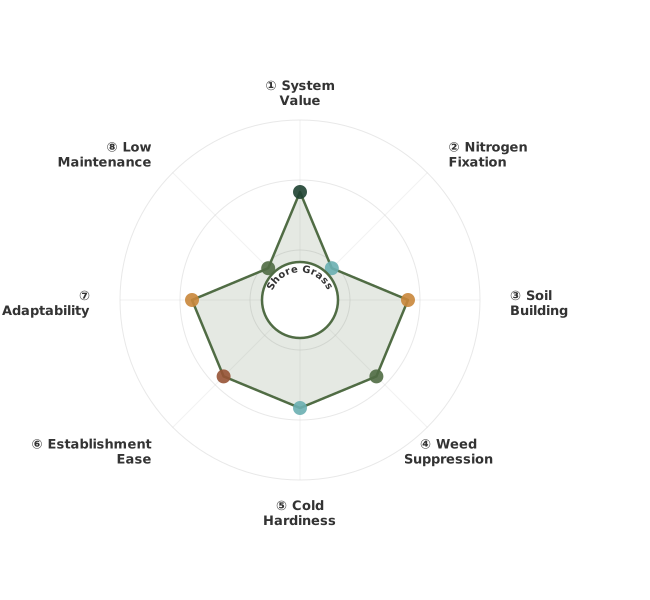
Regenerative Trait Ratings
How These Traits Are Calculated
Trait dimensions are ordered clockwise starting from the top of the chart (12 o'clock position):
1. System Value
Ecosystem service stacking across nitrogen, carbon, water, biodiversity
WHAT: Synthesizes the compounding value of multiple ecosystem services delivered simultaneously—nitrogen fixation, soil organic matter building, pollinator support, erosion control, and water infiltration improvement. This is the total regenerative impact beyond single-function metrics.
WHY: The highest-value cover crops deliver 3-5 significant ecosystem services at once. A legume that fixes nitrogen, builds biomass, supports pollinators, and improves water infiltration provides $150-300/acre in combined benefits versus $30-60 for single-function covers. This service stacking is the core principle of regenerative agriculture.
HOW: Scored via LLM synthesis of economics data, timeline benefits, and trait combinations. Exceptional (3.0): 4-5 major services stacked with strong economic value ratios. Typical (2.0): 2-3 moderate services. Limited (1.0): Single-function covers with minimal service stacking. Considers seed cost relative to benefit value.
2. Nitrogen Fixation
Biological nitrogen production via legume root nodule bacteria
WHAT: Measures the ability to convert atmospheric nitrogen (N₂) into plant-available ammonia through symbiotic bacteria in root nodules. Legumes form partnerships with rhizobium bacteria that fix 60-150 lbs N/acre/year, reducing or eliminating synthetic fertilizer needs for following crops.
WHY: Nitrogen is the most expensive fertilizer input in crop production ($0.50-1.00/lb). Cover crops with exceptional nitrogen fixation can provide $60-150/acre worth of fertility while building soil organic matter. This biological process also reduces groundwater contamination from nitrogen runoff and lowers farm carbon footprint.
HOW: Ratings based on annual nitrogen fixation capacity and reliability across soil conditions. Exceptional (3.0): Legumes like hairy vetch, crimson clover, and field peas fixing >100 lbs N/acre/year. Typical (2.0): Moderate fixers like red clover at 60-100 lbs N/acre/year. Limited (1.0): Non-legumes (grasses, brassicas) with zero fixation capacity.
3. Soil Building
Weighted: biomass production (60%) + root system depth (40%)
WHAT: Combines above-ground biomass production with root depth to measure total soil organic matter contribution. Biomass provides surface organic matter, while deep roots deposit carbon at depth and break up compaction layers.
WHY: Soil organic matter is the foundation of regenerative agriculture, improving water retention, nutrient cycling, and biological activity. Each 1% increase in soil organic matter holds an additional 20,000 gallons of water per acre and represents $500-1,000 in fertility value. Deep roots access subsoil nutrients and create channels for water infiltration.
HOW: Weighted formula prioritizes biomass production (60% weight) for immediate organic matter contribution, with root depth (40% weight) for long-term soil structure. Exceptional (3.0): High-biomass crops with deep roots like cereal rye (8+ tons biomass, 5+ ft roots). Typical (2.0): Moderate on both factors. Limited (1.0): Low biomass or shallow roots.
4. Weed Suppression
Physical competition through rapid establishment and dense growth
WHAT: Measures the ability to outcompete weeds through rapid germination, aggressive early growth, and dense canopy formation. Physical smothering and light competition reduce weed pressure without herbicides.
WHY: Weed management is a major labor and cost burden for farmers. Cover crops that effectively suppress weeds reduce herbicide costs ($20-60/acre), decrease cultivation passes (fuel + labor), and provide clean seedbeds for cash crops. This is especially valuable in organic systems where herbicide options are limited.
HOW: Ratings based on germination speed, tillering density, and canopy closure timing. Exceptional (3.0): Fast-establishing, dense-tillering crops like cereal rye, oilseed radish that close canopy within 3-4 weeks. Typical (2.0): Moderate establishment and coverage. Limited (1.0): Slow-establishing or sparse crops that allow weed competition.
5. Cold Hardiness
Winter survival for fall planting and spring green manure value
WHAT: Measures tolerance to freezing temperatures and ability to survive winter conditions. Winter-hardy cover crops can be fall-planted, overwinter as living mulch, and provide early spring growth before cash crop planting.
WHY: Fall-planted winter-hardy covers extend the growing season into unused months, capturing solar energy and preventing erosion during wet periods. Spring green manure from overwintered covers provides early nitrogen and biomass. This timing flexibility is critical in cold climates with short growing seasons.
HOW: Ratings based on minimum survival temperature and winter active growth. Exceptional (3.0): Winter-hardy crops like cereal rye, hairy vetch, crimson clover surviving to -20°F with active growth in spring. Typical (2.0): Moderate cold tolerance. Limited (1.0): Warm-season crops like buckwheat, cowpea killed by first frost.
6. Establishment Ease
Germination speed, soil requirement flexibility, planting window breadth
WHAT: Measures how easily the cover crop establishes from seed, including germination speed, tolerance for variable soil conditions, and flexibility in planting timing. Easy establishment means reliable stands without intensive management.
WHY: Difficult-to-establish covers increase risk of stand failure, wasted seed costs, and reduced benefits. Easy establishment crops tolerate late planting, poor seedbed preparation, and variable moisture—critical when cover cropping windows are narrow between cash crops. Reliable establishment ensures consistent soil building and weed suppression benefits.
HOW: Ratings based on days to emergence, soil condition sensitivity, and planting window breadth. Exceptional (3.0): Fast germinators like buckwheat (3-5 days) and cereal rye (5-7 days) with wide planting windows. Typical (2.0): Moderate establishment requirements. Limited (1.0): Slow or finicky establishers requiring precise conditions.
7. Adaptability
Weighted: climate tolerance (60%) + multi-benefit versatility (40%)
WHAT: Combines climate adaptability (temperature and rainfall range) with multi-benefit versatility (diverse ecosystem services) to measure overall system flexibility. High adaptability means the cover works across farm regions and provides multiple functions.
WHY: Farmers need cover crops that work reliably across diverse fields and provide stacked benefits. Climate-adaptable covers reduce risk in variable weather, while multi-benefit crops deliver nitrogen fixation + pollinator support + forage value simultaneously. This versatility maximizes return on cover crop investment.
HOW: Weighted formula prioritizes climate tolerance (60% weight) for geographic reliability, with multi-benefit value (40% weight) for functional stacking. Exceptional (3.0): Wide climate range + multiple significant benefits. Typical (2.0): Moderate on both factors. Limited (1.0): Narrow climate range or single-function crops.
8. Low Maintenance
Inverted from maintenance intensity—low inputs mean high scores
WHAT: Measures minimal input requirements for successful cover cropping. Low-maintenance covers require no irrigation, minimal fertility, easy termination, and tolerate variable management timing.
WHY: Cover crops compete for resources with cash crops in tight rotations. Low-maintenance covers fit easily into existing systems without adding labor, equipment, or input costs. Easy termination is especially critical—covers that are difficult to kill can become weeds and delay cash crop planting.
HOW: Inverted score from maintenance intensity trait (4.0 minus raw score). Exceptional (3.0): Self-sufficient crops like cereal rye, field peas requiring no irrigation or fertility, easily terminated by mowing or winter-kill. Typical (2.0): Moderate input needs. Limited (1.0): High-maintenance crops needing irrigation, heavy fertility, or difficult termination (herbicides, multiple tillage passes).
Ratings are based on documented performance in regenerative systems, not conventional high-input scenarios. All traits assume integrated management practices focused on soil health and ecosystem services.
1
Climate Suitability Assessment
Will this plant thrive in your climate?
Climate Suitability Assessment
Will this plant thrive in your climate?
Köppen Zone: Cfa (Humid Subtropical), Cfb (Oceanic (Maritime Temperate))
USDA Zone: 6a, 7a, 8a, 9a, 10a, 11a
Australian Zone: tropical, subtropical
Shore Grass thrives in consistently warm and moist environments, performing optimally in tropical rainforest (Af), tropical monsoon (Am), and subtropical (Australian) climates, as well as USDA zones 8b through 13. These regions provide the necessary high temperatures (consistently above 70°F/21°C) and abundant rainfall (over 60 inches/1500 mm annually) for continuous growth and vigorous establishment. Its primary function of soil remediation is highly effective, stabilizing soils and improving structure. Furthermore, its dense growth habit makes it an excellent cover crop, suppressing weeds and preventing erosion. In these ideal zones, it also serves as a valuable forage source, providing consistent biomass. Minimal management is required, as natural conditions align perfectly with its lifecycle, ensuring high productivity and reliability for regenerative agriculture practices. The plant exhibits strong perennial persistence in these warm, humid settings.
Köppen Zone: Af (Tropical Rainforest), Am (Tropical Monsoon), Aw (Tropical Savanna), Csa (Hot-Summer Mediterranean), Csb (Warm-Summer Mediterranean), Cwa (Monsoon-Influenced Humid Subtropical), Cwb (Subtropical Highland), Dfa (Hot-Summer Continental), Dfb (Warm-Summer Continental)
USDA Zone: 5a, 5b, 12a
Australian Zone: grassland, temperate
EU Climate Region: atlantic
Shore Grass can perform adequately in climates with moderate temperatures and sufficient moisture, including humid subtropical (Cfa), temperate oceanic (Cfb), tropical savanna (Aw), and Mediterranean climates with cooler summers (Csb). USDA zones 6a-8a and Australian temperate and grassland zones also fall into this category. These regions offer a growing season of 150-250 frost-free days and rainfall generally between 30-60 inches (750-1500 mm) annually. While it can provide soil remediation and function as a cover crop, its effectiveness for forage integration and perennial persistence may be reduced due to seasonal temperature fluctuations or dry spells. Supplemental irrigation or careful timing of planting might be necessary to maximize its benefits and ensure reliable establishment and productivity. Management inputs are generally moderate.
Köppen Zone: ET (Tundra), BSh (Hot Semi-Arid (Steppe)), BSk (Cold Semi-Arid (Steppe)), BWh (Hot Desert), BWk (Cold Desert), Dfc (Subarctic), Dwa (Monsoon-Influenced Hot-Summer Continental)
USDA Zone: 2a, 3a, 3b, 4a
Australian Zone: arid
EU Climate Region: mediterranean
Shore Grass is not recommended for arid (BWh, BSh, Australian arid) and Mediterranean (Csa, EU Mediterranean) climates due to extreme temperature and moisture limitations. Hot desert climates experience prolonged drought and temperatures exceeding 100°F (38°C), preventing establishment and survival. Semi-arid regions face intense heat and erratic, insufficient rainfall, severely limiting growth and making it impractical for cover cropping or forage. Mediterranean climates, while having mild winters, suffer from hot, dry summers that Shore Grass cannot tolerate, requiring impractical levels of irrigation. In these zones, its soil remediation potential is minimal and short-lived, and it is entirely unsuitable for cover cropping or forage integration. Alternative, more drought and heat-tolerant species are essential for these challenging environments.
Note: Zones listed above represent climates where this plant can produce reliably with reasonable management. Climate zones not mentioned would require intensive climate modification (greenhouses, extensive infrastructure) and are not economically viable for regenerative agriculture purposes.
2
Soil Suitability Assessment
Which soil types work best for this plant?
Soil Suitability Assessment
Which soil types work best for this plant?
Sandy Soil
This plant thrives in these soil types without requiring amendments or remediation. Natural soil conditions support optimal growth and productivity.
Acidic Soil, Alkaline Soil, Clay Soil, Desert Soil, Loam Soil, Rich Soil, Rocky Soil, Saline Soil, Wet Soil
This plant performs acceptably in these soil types with moderate, manageable remediation such as pH adjustment, compost addition, or drainage improvement. The required amendments are practical and cost-effective for regenerative agriculture.
Note: Soil suitability assessments focus on remediation requirements. "Ideally Suited" means the plant generally thrives without the need for substantial amendments, "Adequate" means manageable remediation (lime, compost, mulch), and "Not Recommended" means impractical soil changes would be required. Climate factors like rainfall and temperature also influence success.
3
Seasonal Considerations
Planting timing, growth duration, and harvest windows
Seasonal Considerations
Planting timing, growth duration, and harvest windows
Paspalum vaginatum excels as a versatile cover crop, particularly in warmer climates. For spring planting, aim for after the last expected frost when soil temperatures consistently reach above 60°F (15°C). This allows for good establishment before summer heat. In late summer, following a cash crop harvest, Paspalum can be sown to provide a fall and early winter cover, especially in zones where it demonstrates good overwinter survival. While it isn't typically a primary choice for early spring frost-seeding due to its warm-season nature, it can be established through direct seeding in late spring or early summer.
Expect establishment within 3-6 weeks under favorable conditions. Peak biomass is usually achieved during the warmest summer months. Termination is best accomplished with tillage or mowing shortly before planting your next cash crop, ideally when it's actively growing, to ensure efficient breakdown. As a winter cover in milder climates, it can remain green, offering soil protection and nutrient retention. In cooler regions, it will likely enter dormancy and can be managed similarly to other perennial grasses before spring planting.
4
System Role & Multi-Benefit Value
Functional roles, integration strategies, and stacked benefits
System Role & Multi-Benefit Value
Functional roles, integration strategies, and stacked benefits
Functional Role
Total System Value
Paspalum vaginatum offers significant system value through its primary role in soil remediation and erosion control. While direct harvest value is minimal in a regenerative context, its contribution to ecosystem services is substantial. Its aggressive root system stabilizes soil, preventing erosion and potentially improving water infiltration, especially in challenging soil conditions like salinity, as suggested by studies investigating its response to saline irrigation. In degraded or tailing sites, it can be part of a revegetation strategy to build soil organic matter and improve soil structure. The plant's ability to tolerate saline conditions enhances its utility in coastal or irrigation-stressed environments, contributing to risk diversification for farms in such locations. Though not a nitrogen fixer, its biomass contributes to soil organic matter over time. Its presence can support soil microbial communities, further enhancing nutrient cycling and soil health, which underpins the entire regenerative system.
Integration Characteristics
Multi-Benefit Value: Adequate - Excellent for stabilizing bare ground and preventing erosion in wet or saline zones, it also offers habitat and contributes to the overall ecological function of the landscape.
5
Management & Care Requirements
Integration guidance, maintenance needs, and care practices
Management & Care Requirements
Integration guidance, maintenance needs, and care practices
How to Integrate This Plant
Shore grass (Paspalum vaginatum) can be integrated into regenerative systems primarily for its soil remediation and erosion control capabilities. While not a primary nitrogen fixer or shade provider, its dense root system is effective in stabilizing soils, particularly in wetter or saline conditions. It can be utilized in areas prone to erosion, such as slopes or waterways, and in pasture renovation where soil health needs improvement. Its tolerance to saline conditions also makes it suitable for coastal or irrigated areas facing salinity challenges. Compatible practices include its use in buffer strips along water bodies or in degraded pasture areas that are being rehabilitated. Timeline to contribution: Year 1: Initial establishment and erosion control. Year 3-5: Established ground cover providing significant soil stabilization and potential for improved soil structure. Multi-benefit stacking includes soil health improvement, erosion reduction, and potential for phytoremediation of saline soils, contributing to overall farm resilience.
Integration Practices & Management
Source mentions Paspalum vaginatum as one of several plants used in a revegetation strategy for rare earth tailings, alongside Medicago sativa and Lolium perenne. However, it does not detail establishment methods, grazing integration, or termination strategies. Source investigates Paspalum vaginatum's response to deficit irrigation and saline water in a controlled study, comparing it with bermudagrass, but this context is not directly about regenerative farming integration. Source focuses on the negative impact of invasive Paspalum vaginatum on carbon dynamics in mangrove ecosystems, noting its potential to reduce carbon storage. Consequently, this knowledge base does not provide direct information on how regenerative farmers establish, graze, terminate, or manage Paspalum vaginatum for crop integration or fertility enhancement. Further research or case studies would be needed to understand its practical application in regenerative farming systems. While coverage in our knowledge base is limited, the above represents documented uses in regenerative systems. While coverage in our knowledge base is limited, the above represents documented uses in regenerative systems.
Management Profile
Maintenance Intensity: Ideally Suited - Once established, this salt-tolerant grass requires minimal intervention for fertility management and moisture retention, thriving naturally in coastal and saline settings.
6
Economics & Value Streams
Direct harvest, system benefits, ecosystem services, and risk diversification
Economics & Value Streams
Direct harvest, system benefits, ecosystem services, and risk diversification
Comprehensive economic analysis including direct harvest value, system enhancement contributions, ecosystem services, value timeline, and risk diversification strategies.
Cover Crop Investment
| Metric | Value |
|---|---|
| Seed Cost | $25-60/acre $62-148/ha |
| Termination Cost | 15-50 37-124 |
| Biomass Production | 3-8 7-18 |
| N Fixation Value | N/A N/A |
| Weed Control Savings | 20-75 49-185 |
Cover crops are soil investments, not cash crops. Economics measured in soil health gains, input reduction, and subsequent crop performance. Values show direct costs and estimated benefits.
System Enhancement Value
Beyond harvest: soil healing, contamination removal, and land restoration
Soil Remediation & Building
Paspalum vaginatum demonstrates significant value in soil remediation and improving soil health. Excerpt highlights its role in carbon dynamics, noting that while invasion can reduce carbon storage, restoration efforts involving other species alongside hydrological rehabilitation can lead to improved soil organic matter recalcitrance and reduced CO2 emissions. Excerpt indicates P. vaginatum, when used in revegetation efforts on rare earth tailings, contributed to slowing organic matter loss in control plots, though composite materials were more effective. Its ability to grow in challenging conditions, including saline soils (Excerpt), suggests it can be instrumental in reclaiming degraded lands, improving soil structure, and potentially supporting microbial communities involved in nutrient cycling, thereby enhancing the overall resilience of the farming system.
Erosion Control
Variable, depending on planting density and width. Potential for 5-15% crop yield improvement in protected zones.
While not explicitly detailed in the provided excerpts, Paspalum vaginatum's dense, rhizomatous growth habit suggests potential for soil stabilization and erosion control, particularly in riparian or coastal areas. This can act as a natural windbreak, slowing down wind speeds at the soil surface. By reducing wind velocity, it can mitigate wind erosion, protect young seedlings from desiccation and physical damage, and potentially improve microclimates for adjacent crops or pastures. The effect of windbreaks can vary significantly based on density, height, and width, but studies on other dense grasses and windbreaks often show yield improvements in protected areas ranging from 5-15% due to reduced stress and improved moisture retention.
Ecosystem Service Contributions
Environmental contributions: carbon, pollinators, wildlife, and water
- Carbon Sequestration: Paspalum vaginatum's carbon sequestration potential is variable. While invasion can lead to reduced carbon storage, particularly in soil due to compaction and low C/N ratio residues (Excerpt), its dense root system can contribute to soil organic matter buildup over time. Its effectiveness is likely dependent on management practices and the specific ecosystem it inhabits.
- Pollinator Support: Low. The provided excerpts do not mention Paspalum vaginatum's contribution to pollinator support. It is generally considered a grass with limited floral resources for pollinators.
- Wildlife Habitat: Variable. As a dense grass, it can provide ground cover and some nesting habitat for small ground-dwelling animals and ground-nesting birds. Its forage value is generally considered moderate to low for many livestock species, but can be utilized, especially when integrated into a mixed forage system.
- Water Quality: Applicable in riparian and coastal systems. Its dense root structure and ability to tolerate saline conditions (Excerpt) make it suitable for stabilizing shorelines and potentially filtering runoff in such environments, preventing erosion and improving water quality.
Value Timeline: Soil Healing Process
When you'll see results: remediation timeline varies by contamination type
Years 1-2
Initial soil stabilization and erosion control, particularly on degraded or disturbed sites. Early stages of soil organic matter contribution and potential for early remediation of compacted soils. Limited forage value.
Years 3-5
Established soil remediation benefits become more pronounced. Improved soil structure and potential for increased recalcitrance of organic matter. Forage integration becomes more viable as the stand matures. Windbreak and erosion control functions become more robust.
Years 10-20
Significant contributions to long-term soil health and remediation. Mature soil carbon sequestration potential. Established presence as a cover crop system, offering ongoing soil protection and organic matter input. Forage integration provides a consistent, albeit potentially moderate, feed source.
20+ Years
Long-term maintenance of soil remediation benefits. Sustained soil organic matter, improved soil structure, and continued erosion control. May act as a resilient component of the farm system, requiring minimal inputs and providing consistent ecological services.
Farm Risk Reduction
How this reduces farm risk: future land value and production potential
- Multiple Revenue Streams: Soil remediation services, cover cropping, forage integration, potential for land reclamation value.
- Temporal Income Spread: Ongoing ecosystem services (soil health, erosion control) spread over the long term, with forage integration providing a periodic, albeit potentially lower-value, income stream. Value is primarily in its ecological function rather than direct, high-value harvest.
- Market Risk Hedge: Reduces risk by improving soil resilience against erosion and degradation, thereby protecting long-term productivity. Its tolerance to saline conditions (Excerpt) offers an advantage in areas with water quality issues, providing a more stable plant component than less tolerant species. Its role in soil remediation can reduce reliance on costly external inputs for land restoration.
7
Regenerative Suitability Details
Comprehensive trait ratings for system integration assessment
Regenerative Suitability Details
Comprehensive trait ratings for system integration assessment
Comparative ratings for this plant across key regenerative agriculture traits.
| Trait | Suitability | Explanation |
|---|---|---|
| Cold Hardiness | Adequate | Seashore paspalum offers moderate resilience in cooler climates (Zone 7-8), providing ground cover in coastal or mild regions where soil health is supported by integrated practices. |
| Weed Suppression | Adequate | Its dense, low-growing habit forms a living mulch, outcompeting opportunistic plants and contributing to a healthy soil surface ecosystem. |
| Nitrogen Fixation | Not Recommended | As a non-legume, Seashore Paspalum does not contribute to atmospheric nitrogen fixation but thrives in environments where soil fertility is managed through natural processes. |
| Root System Depth | Adequate | Developing a dense, fibrous root system extending 2-4 feet, it actively builds soil structure, enhances water infiltration, and stabilizes landscapes. |
| Biomass Production | Adequate | Seashore paspalum generates moderate biomass, especially in moist or coastal settings, directly contributing to the accumulation of soil organic matter and improving soil structure. |
| Establishment Ease | Adequate | It reliably establishes in saline and waterlogged conditions, thriving in marginal areas and reducing the need for extensive site preparation. |
| Multi Benefit Value | Adequate | Excellent for stabilizing bare ground and preventing erosion in wet or saline zones, it also offers habitat and contributes to the overall ecological function of the landscape. |
| Climate Adaptability | Ideally Suited | Highly tolerant of heat, salt, and drought (zones 7-11), and adaptable to wet conditions, Seashore Paspalum excels in diverse coastal environments by efficiently utilizing available resources. |
| Maintenance Intensity | Ideally Suited | Once established, this salt-tolerant grass requires minimal intervention for fertility management and moisture retention, thriving naturally in coastal and saline settings. |
Comparative System: Ratings compare plants within their economic category (e.g., cover crop nitrogen fixation compared to other cover crops, not to all plants). Individual farm conditions and management practices significantly influence actual performance.
8
Learn More
Why farmers use this plant and additional resources
Learn More
Why farmers use this plant and additional resources
Why Regenerative Farmers Use This Plant
Paspalum vaginatum, commonly known as seashore paspalum, offers significant regenerative benefits when integrated into agricultural systems, primarily as a highly adaptable forage, turf, and cover crop. While not a nitrogen-fixing legume, it excels at scavenging available nutrients from the soil, preventing their leaching, and efficiently converting them into biomass. Its dense, fibrous root system, capable of reaching depths of 12-36 inches (30-90 cm), is particularly effective at improving soil structure, enhancing water infiltration, and reducing erosion on slopes and in areas prone to runoff. This robust root development also contributes to soil organic matter accumulation over time, with consistent stands potentially adding 0.5-1.5% to soil organic matter levels within 3-5 years, depending on management and climate. In susceptible landscapes, its dense root system can reduce soil erosion by up to 70%.
Beyond its direct soil-building capabilities, seashore paspalum provides valuable forage for livestock, offering good nutritional content, especially when managed appropriately. Carrying capacities typically range from 1.5 to 3 Animal Units per acre (0.6 to 1.2 AU/ha) depending on fertility and rainfall. Its tolerance to saline and waterlogged conditions makes it a resilient option in challenging environments where other grasses struggle, making it a valuable tool for reclaiming or improving degraded land. Furthermore, its dense growth habit provides excellent weed suppression, outcompeting many common annual and perennial weeds and reducing the need for costly and environmentally impactful weed control measures. This makes it an effective component in rotational grazing systems, fallow periods, or as a living mulch in perennial cropping systems like orchards, vineyards, or sugarcane plantations, where it can reduce bare ground exposure by over 80% during its growing season and offer erosion control and moisture retention benefits.
The ecosystem services provided by Paspalum vaginatum extend to supporting beneficial insect populations and pollinators. Its dense foliage offers habitat and protection for various invertebrates, while its flowering heads can attract pollinators, contributing to local biodiversity. In systems where it is allowed to flower, it can support a range of native bee species and other beneficial insects that aid in pest control for nearby cash crops. Its ability to thrive with minimal synthetic input once established also reduces the overall environmental footprint of the farming operation, aligning with regenerative principles of minimizing off-farm inputs and enhancing on-farm ecosystem health. The significant biomass produced, often exceeding 4-6 tons of dry matter per acre (9-13 tonnes/ha) under optimal conditions, contributes directly to soil organic matter. As this biomass decomposes, it releases scavenged nutrients back into the soil profile, making them available for subsequent cash crops and reducing the reliance on synthetic fertilizers.
Regional success stories highlight Paspalum vaginatum's versatility. In coastal areas of the southeastern United States and Australia, it is valued for its salt tolerance and ability to stabilize sandy soils, often used in turf management and as a resilient pasture. In South America, particularly in Brazil and Argentina, it is utilized in silvopasture systems and for erosion control on cattle ranches. In the rice paddies of Southeast Asia, it can be used as a cover crop during fallow periods to improve soil structure and prevent erosion. In the Mediterranean basin, its drought and salinity tolerance make it suitable for coastal agricultural areas and as a component in dryland pasture systems. In the sugarcane fields of Queensland, Australia, it can be planted as a ground cover to prevent soil loss and improve soil health between crop cycles. Its adaptability to various soil types and its resilience to moderate drought and salinity make it a valuable tool for farmers seeking to improve soil health and livestock productivity in diverse climatic conditions.
9
How to Integrate This Plant
Practical guidance for regenerative systems
How to Integrate This Plant
Practical guidance for regenerative systems
Establishing Paspalum vaginatum can be achieved through seeding or vegetative propagation. For seeding, rates typically range from 5-15 lbs/acre (5.6-16.8 kg/ha) for broadcast seeding and 3-8 lbs/acre (3.4-9 kg/ha) when drilled. For drilled seed, rates typically range from 5-10 lbs/acre (5.6-11.2 kg/ha) and 10-20 lbs/acre (11.2-22.4 kg/ha) for broadcast applications, depending on seed quality and desired stand density. The optimal planting depth is shallow, around 0.25-0.5 inches (0.6-1.3 cm), to ensure good seed-to-soil contact and rapid germination. For best results, planting should occur during warmer periods, typically from late spring through early summer in the Northern Hemisphere (April-July) and during the warmer months in the Southern Hemisphere (October-January), or when soil temperatures consistently exceed 18°C (65°F). For faster establishment or in areas where seed viability is a concern, sprigs or sod can be used, providing near-instant ground cover. Vegetative establishment using sod or plugs is also highly effective, especially for quicker coverage in turf or erosion control applications. Seashore paspalum typically establishes within 30-45 days and can reach a mature height of 6-12 inches (15-30 cm), though this can vary with mowing or grazing.
Management of seashore paspalum focuses on maintaining its dense ground cover and managing its growth. It requires approximately 1 inch (2.5 cm) of water per week, either from rainfall or irrigation, particularly during establishment and periods of active growth, though established stands exhibit good drought tolerance. Fertility management should prioritize biological approaches; compost application, incorporation of manure, or utilizing the residue from preceding cover crops are excellent starting points. Its nutrient requirements are generally moderate, and its nutrient scavenging ability means it can thrive on residual fertility. If synthetic inputs are used transitionally, they should be applied judiciously to supplement biological fertility building. Pest and disease management should focus on cultural practices such as proper mowing height, adequate drainage, ensuring good air circulation, avoiding over-fertilization, and maintaining a healthy soil microbiome to reduce susceptibility. Healthy stands are generally resistant to major issues, with biological controls being the preferred method for any emerging issues.
Termination and residue management for seashore paspalum depend on its role in the rotation. As a cover crop, it can be terminated by natural winterkill in colder climates where temperatures consistently drop below -5°C (23°F). In milder regions, grazing with livestock is an excellent method to reduce biomass and incorporate residue, followed by mowing or crimping. Mowing or crimping at the end of the growing season or ideally 2-3 weeks before planting the subsequent cash crop is also effective in creating a mulch layer and preventing volunteer establishment if reseeding is undesirable. If herbicides are used, they should be considered a last resort during a transitional phase, applied carefully to avoid harming soil biology, and always after exploring biological and mechanical termination methods. The residue decomposes relatively quickly, typically within 30-75 days, with a significant portion of its scavenged nutrients becoming available to the following crop. For a truly regenerative approach, allowing its natural senescence or integrating it with livestock grazing before planting is preferred.